International Journal of Innovative Technology and Exploring Engineering (IJITEE) ISSN: 2278-3075,Volume-8, Issue-11, September 2019
A CDIO Framework on Instructor Teaching
Effectiveness using Digitized Technology Concepts
K.S.Kamatchi, T.Gnana Sambandan
Abstract— In Engineering education it is mandatory to provide a set of digitized, technology related skill development activities to enhance the faculties teaching ability to strengthen vital innovations in academic and digital skill expertise throughout their career and to improve the continuous learning outcome of their students. This study examines the teaching and learning with digital competence will motivate and improve the performance of student learning and effectiveness in teaching (Angelo, 1991). The CDIO approach (Standard 9) guiding the educators to advance their skills in the teaching includes personal, interpersonal, process, product, system building skills and their competence are integral to implement a CDIO-based education. It is essential to recognize that faculties at distinct points of their teaching path will have divergent skillful advancement in cooperation, utility, collaboration, knowledge exchange and require explicit technologically qualified to react productively to learner, institution and various national academic regulatory bodies. In the paper, we try to compare the faculties with digital learning skills in the integrated curriculum of engineering programmes in the state of Tamil Nadu, in India with the technology integrated framework of CDIO followed by various developing countries. The proposed method shows that the teachers from various disciplines are exposed to frequent ICT (Information & Communication Technology) based training had definitely gained higher levels in using instructional technology, creativity, knowledge skill, effectiveness in delivering their instructions to improve the student cdio based learning outcome to enhance overall digital competence
Keywords: Digital competence, Continuous learning outcome, Engineering education, ICT, CDIO Standards, e.g., Standards: 9, 8 and 7.
I. INTRODUCTION
A CDIO is an educational framework that allows engineers to conceive, design, implement and operates complex systems and products in a current team based engineering background. Fai (2011) and Taajamaa et al. (2011) have recommended to accumulate “digital thinking” methods (Rowe, 1991) to the front end of the CDIO process, thereby exposing and providing students with tools for dealing with complex, multidisciplinary problems. The CDIO approach integrates extensive and widely suitable progress for improving curriculum, learning, workspaces and teaching is supported by various e-assessment and shift in its mechanism. To implement changes in educational system with CDIO is neither so difficult but demands that both the institution and educator should react strongly and accurately.
Revised Manuscript Received on September 03, 2019
K.S.Kamatchi *, CSE, NITTTR, University of Madras, Chennai, India Email: [email protected]
T.Gnana Sambandan #, CSE, NITTTR, University of Madras, Chennai, India Email: [email protected]
1 “Hearty thanks to Mrs.Gomathy & Saroja Anantha Subramanian for their valuable guidance and financial support”
The changes not alone affect the administration, but also educators, because their roles are decisive and their strength and attitudes are important (Maskit, 2011). The direction of the study is to strengthen the effectiveness of teachers and their instructional technology by using various digital tools to improve student creativity, technological skill and the overall performance of students. According to McAfee and Brynjolfsson an outstanding re-creation of our economy, society and human lives will take place mainly driven by digital technology. ICT as an educational resource is a positively essential part of a teacher education and training programme adapt to the digitalization of college and society. The faculty must be inclined to teach a curriculum emphasizing how to use various digital tools, resources, personal and interpersonal skills, active learning with solution based activities, group work, self-evaluation and discussions. The objective of this paper is to ensure digital competencies is very essential part in teacher training and it requires a model for systematic curricula development. To define and integrate ICT as an influential part, then CDIO is used as an exemplary and guideline in multidisciplinary programs and courses throughout the engineering education. Faculty-students have a digital tool box and a wide collection of pedagogic ideas that includes planning, designing, executing and evaluating learning processes with available instructional technology ideas and how to utilize ICT in their integrated work. The cdio approach is to reinforce the digital competency level of faculties by
Conceive:-The teachers identified the concepts is that visual models of using any digital tools help to overcome the difficulties and explain the concept effectively, with confidence, apply the knowledge and skills acquired for the course.
Design:-The teachers can design with available or new digital models and technology that is easier to understand by the students.
Implement:-Teachers will prepare a lesson plan and a PowerPoint presentation (any smart digital tool) for guiding students individually or in small groups and get the feedback from the students
Operate:-The teachers will come to college/university and gave a lecture among students with the new instructional technology.
This paper contains the data collected from 34 members who take part in training at the Teacher Training Institute to develop Technical and Research skills of the educators, (NITTTR) Chennai by conducted a survey that includes 17 divergent growing countries around the globe (Table 2) who had visited Chennai, India for an ICT training programme during December-February 2019. Sampling was constructed for the trainee members on the consequence of ICT based training which follows the framework of CDIO in India. The evaluation were compared
activity partner from the growing countries and for the instructors of engineering programmes (multidisciplinary) in TamilNadu (confined to the district of Chennai), also applied to undergo related training in the field of ICT following the CDIO framework. The interactions were started with the training members who were undergoing an ICT training programme sponsored purely by the government of India based on Outcome Based Education (OBE) that are monitored and conducted by the authors mentioned above in the paper because the training programme’s coordinator is who nothing but the mentor of an author. The study disclosed in the paper is only a chunk of a whole research project and the proposal of other recommendations is beyond the scope of the paper. Meaningful development has been drawn from the comparative study.
II. TRAINING IN DIGITAL TECHNOLOGY
Peterson (2002) suggest that, “The various tools and techniques in the Instructional technology includes non-electronic and various computerized instruments, that are used in the distribution of course materials, delivery of instructions etc. From an outcomes assessment perspective, the routine factor of the educational processes and classroom is now become using the digital technology (Nulden, 1999). Many learners prefer to work with different types of interactive digital media include blogs, mobile devices (e.g., cell phones, PDAs), social networking sites (e.g., Face book, MySpace, Twitter), user-generated content (e.g., YouTube), and virtual worlds (e.g., Second Life) for gaining knowledge. Malhotra (2002) stated that, “Instructional technology that are used directly or indirectly in facilitating, enhancing, and improving the effectiveness of teachers instructions which includes hardwar, software, tools and techniques in the efficiency of teaching, learning, and practicing knowledge in education”. Diaz Romero and Moncada Linares (2016) and Mattila (2015) suggest that digital savvy is seen as a eye opener, which helps in acquiring other important competencies such as language, business, statistics, cultural awareness, learn to teach and broadly be defined as the confident, critical use of ICT ,creative to achieve knowledge e.g. effort associated with goals.
Digital tools. Now-a-days there is a mixture of digital tools that are ready to use in marketplace. For intension of the study, the digital tools were divided into three groups: traditional digital tools (e.g., websites, e-mail, Microsoft Office suite, instant messaging, PDFs), social and interactive digital tools (e.g., Face book, Skype, Twitter, Wikis, Blogs, podcasting, simulations, games, virtual worlds), and course/learning digital tools (e.g., online quizzes and tests, survey, video conference, virtual classes, learning management systems). The variations between digital literacy and digital competency level of instructors in engineering programme (multi-disciplinary) are displayed in Figure 1. Digital competence is a prerequisite skill for today’s instructors, since they have to control many facit from the subject being taught to pedagogical tools. Ueltschy (2001) analysed the adoption of technology inside the classroom had certain outcomes respect to increases in the student learning, involvement, enjoyment. Learning in future could be in online for the students who live across the
country or anywhere in the world. Teaching and learning is going to be public and user friendly. Efficient learning is started with various online courses that offer high-quality college education to all who realize their desire and fulfill their ability with massive open online courses (MOOCs) like iversity, Coursera, edX. It is essential to improve the blended learning among students by providing efficient technology oriented training to the faculties to handle various digital and collaborative tools available now-a-days to improve the cdio based learning outcome among students.
III. TECHNOLOGY AND INSTRUCTOR
It is mandatory to promote digital skills in the curriculum of training given to the teachers in all forms of professional development, incorporating and in-service training of teachers. Their role includes incorporating the goals on digital technologies in university policies, strategies and overall vision and drive students based on ICT in higher education. For educators it is crucial to learn, be updated about the best apps, web platforms and digital tools which is easier, more effective and engaging them to provide digital solutions to empower and support students learning activity. Hands-on method and learning-by-doing approach, allow trainers to develop factual ICT and digital skills to improve cdio based skills among learners. The technology and computer always get advancements and modifications hand in hand. Educators must continue to try for excellence in their work by training themselves in a variety of tools including e-mail, social network, instant message, and online programs such as Skype, WebCT, as well as video conferencing-to teach. Thus, educators to be technology illiterate are not acceptable. To facilitate teachers’ professional development and further integration of ICT in education, EMAInd (Erasmus Mundus Association) aims to enhance the clarity and enchantment of European higher education in India. Erasmus plus KA1 offers innovative and practice driven training, workshops, seminars, faculty development program for teachers based on ICT in higher education. It provides training based on innovative education to meet advancement of soft skills, definitive professional requirement, diagonal competencies, dispute for teachers and education staff about ICT and new technology, involvement, intercultural learning, innovative teaching methods and soft skills. It offers tools for teachers to exchange best practices, peer learning and professional development of teachers at EU level like (Socrative, Quizlet, Edpuzzle Kahoot, ePortfolios , Padlet, Trello, Sway, One Note, Stream Team, One Drive and Share Point) allow teachers to grow insight into the fusion of ICT tools in everyday teaching that will promote students` enthusiastic engagement and motivation in learning process in a more creative and collaborative way will be needed to further scale-up and promote them among educators, stakeholders and policy-makers. In short, ICT based teacher training is not often compulsory, so most of the faculties end up dedicate their spare time to develop these digital skills. Currently there is a lack of interest among the teachers in the innovative activities, gaining knowledge and ideas with the use of ICT and therefore it is more important to contrary with the authorities have to
International Journal of Innovative Technology and Exploring Engineering (IJITEE) ISSN: 2278-3075,Volume-8, Issue-11, September 2019
reform this fact of existence.
IV. BACKGROUND
This article explains that engineering education targets mostly on the learner with high technical expertise, which is basics component for engineering, and education also require to transfer them with the perspective to work in multidisciplinary teams and to be more creative (Crawley, Kamp, Malmqvist 2014). Enforcing CDIO into an already entrenched teaching program provide a various changes in the education process, e.g. Instructor endorsement of the CDIO context (standard 1), a preliminary course that brings the framework for engineering practice and recommend vital personal and interpersonal skills (standard 4), active exploratory learning methods (standard 8), and boost the teacher ability in providing unified learning experiences (standard 10). Effectiveness in teacher instruction blends with technology equip students with primitive technical skill and critical reasoning competence to be successful (Zahorik 2003). A digital instructional competence is to judge when, what, why and how ICT should be used as a methodological and pedagogic support for learning. “A student can learn faster, with the availability of any new instructional technology leads them to learn more, and/or learn easier” revealed by Peterson, Albaum, Munuera, and Cunningham (2002),. Teachers can find their own instructional methods and digital tools suitable to the content, environment and the context. CDIO promises to provide new changes to education and training activities, transform traditional training objectives and models by transferring and training afford new knowledge includes information technology development, digital tools, connected network systems and super data to change ways of teaching institutions and methodology. Technology has a greater inflict on encouraging critical and innovative thinking in students to improve higher order learning, thinking skills and overall performance (Cradler, McNabb, Freeman, & Burchett, 2002). In the context of fast shift for tech knowledge, instead of acquiring the knowledge of academic curriculum, it is better to have a collection of self-study and continuing study skills is of greater importance. The finding of Eagle, Hunt and Kitchen (2004), is persistent that a definite approach of learner predilection for technology oriented learning methods toward instructional technologies is relatively high. Teachers effectively check for learners perception throughout the class digitally and modify their instruction based on the getting feedback from them (Guskey 1996). The authors evaluate certain training domains conducted for faculties in the field of ICT such as faculty development programme, hands on workshop, short term courses, respectively. Wong (2006) recommended that the college campus is not the classroom of the future rather it would be in the virtual globe of Second life.
Table: 1 Percentage of Instructor Preferences for Technology and Learning outcome by Field
Engineering Field Instructor Learning Outcomes
Civil 25% 30%
Agriculture 13% 15%
Mechanical 30% 34%
Electrical-Electronics 21% 28%
Communication 45% 51%
Computer-Science 73% 95%
Aerospace 22% 25%
The authors have argued that outcome based assessment which can be used as indicator to measure the learning outcomes of training activity partner and it is used for measuring the protracted term of Programme Educational Objectives. Assessment were carried out at the ending point of the training programme to identify the faculty digital competence level and results obtained by conducting experiments on ICT courses that illustrate the online tests were used as tools for measuring psychometric and self-diagnosing were used for checking the pragmatic category. Added to these investigations, the research task considered four methods namely online test, mini-project development, self-assessment and e-portfolio have undergone a survey oversee by both authors in TamilNadu state in India, while considered performance based task and others separate from these four for the growing countries. In confer with OBE, the paper has treated only the imperative components of appraisal to know the effectiveness of digital competency among the training activity member. Results gained are from review handled on the samples.
V. METHODOLOGY
The interview obstruction is used for survey procedure was studied. The Purposive sampling approach(Sharma, BVS, 1988) has been adopted for the proposed comparative study. Demographic data are presented below.
A. Demography of the samples:
In this paper the axiom is that there is a meaningful change in viewing portfolios of assessments in Outcome Based Education between India (demarcate to the State of TamilNadu) and growing countries in the area of Information and Communication technology that reveals effectiveness of teachers gaining digital knowledge and using various digital tools. In the demography of growing countries: Number of Cases (respondents): 34, representing 17 distinctive countries as shown in Table 2.The training activity member those who are willing to attend the ICT training programme conducted by government of India in collaboration with TCP (Technical Cooperation proposal of Colombo Plan), SCAP(Special Commonwealth Assistance for Africa Project) and ITEC (Indian Technical and Economic Cooperation Scheme) had stay at chennai to go through training programme for two months financed by Government of India. (January & February 2019) on the topic of “ICT Applications in Education and Training”. The demography of TamilNadu (confined to Chennai district): 19 Institutions providing various Engineering programmes (5 from Central domain; 4 from Northern domain and 10 from Southern domain)
.
Number of cases (respondents): 350 educators from various engineering disciplines follows curriculum (110 from Central part of institutions; 90 from Northern part of institutions and 150 from Southern part of institutions) with a well merger of gender, knowledge, maturity and experience.Purpose sampling is selected to represent the total required data for well-matched groups based on the intention of viewpoint for feedback scrutiny. Convenient or purposive sampling (Sharma BAV 1988) is administered and the selection of the respondents
are also keen, but fascinate the intension of the research. Standard (excluding lower region of institutes): Online Test = 2.035; Mini-Project = 2.094; Self-Evaluation=1.598; E-portfolio = 3.093. Standard exploratory survey of TamilNadu (confined to Chennai district): Online Test = 2.015; Mini-Project= 1.032; Self-Evaluation=1.095; E-portfolio = 2.097
VI. RESULTS AND DISCUSSIONS
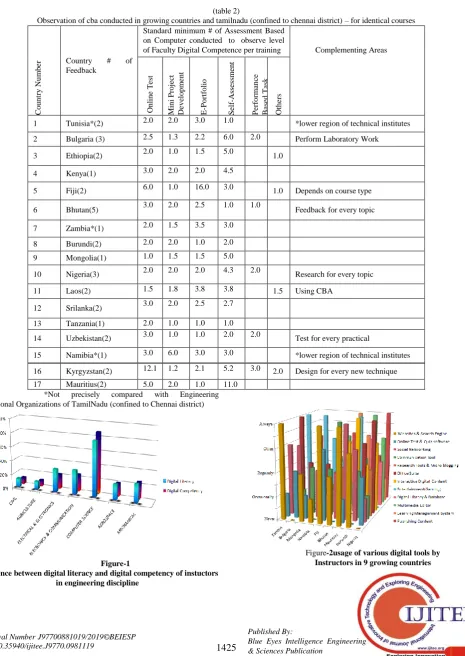
Figure 2 and Figure 3 shows the handling of various digital tools by the training activity member during ICT training. Figure 4 shows dispersion of normal least number of online test is conducted for the training activity partner of the growing countries to find the median level of digital competence. The standard of average coincides with that of TamilNadu (confined to Chennai district), namely 2.15 Kyrgyzstan, only shows comparatively high, and show up that the evaluation structure would fix well with OBE practices.
(table 2)
Observation of cba conducted in growing countries and tamilnadu (confined to chennai district) – for identical courses
C
o
u
n
tr
y
N
u
m
b
er Country # of Feedback
Standard minimum # of Assessment Based on Computer conducted to observe level
of Faculty Digital Competence per training Complementing Areas
O
n
li
n
e
T
est
M
in
i
P
ro
je
ct
D
ev
el
o
p
m
en
t
E
-P
o
rt
fo
li
o
S
el
f-A
ssessme
n
t
P
er
fo
rma
n
ce
B
ase
d
Ta
sk
O
th
er
s
1 Tunisia*(2) 2.0 2.0 3.0 1.0 *lower region of technical institutes
2 Bulgaria (3) 2.5 1.3 2.2 6.0 2.0 Perform Laboratory Work
3 Ethiopia(2) 2.0 1.0 1.5 5.0 1.0
4 Kenya(1) 3.0 2.0 2.0 4.5
5 Fiji(2) 6.0 1.0 16.0 3.0 1.0 Depends on course type
6 Bhutan(5) 3.0 2.0 2.5 1.0 1.0 Feedback for every topic
7 Zambia*(1) 2.0 1.5 3.5 3.0
8 Burundi(2) 2.0 2.0 1.0 2.0
9 Mongolia(1) 1.0 1.5 1.5 5.0
10 Nigeria(3) 2.0 2.0 2.0 4.3 2.0 Research for every topic
11 Laos(2) 1.5 1.8 3.8 3.8 1.5 Using CBA
12 Srilanka(2) 3.0 2.0 2.5 2.7
13 Tanzania(1) 2.0 1.0 1.0 1.0
14 Uzbekistan(2) 3.0 1.0 1.0 2.0 2.0 Test for every practical
15 Namibia*(1) 3.0 6.0 3.0 3.0 *lower region of technical institutes
16 Kyrgyzstan(2) 12.1 1.2 2.1 5.2 3.0 2.0 Design for every new technique
17 Mauritius(2) 5.0 2.0 1.0 11.0 *Not precisely compared with Engineering Educational Organizations of TamilNadu (confined to Chennai district)
Figure-1
Difference between digital literacy and digital competency of instuctors in engineering discipline
[image:4.595.71.537.177.834.2]International Journal of Innovative Technology and Exploring Engineering (IJITEE) ISSN: 2278-3075,Volume-8, Issue-11, September 2019
Figure-3
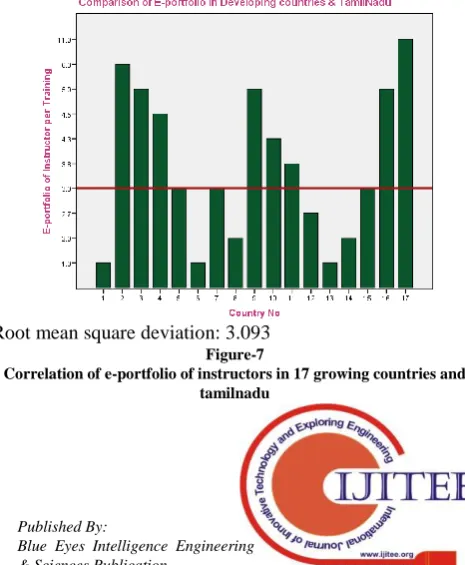
Usage of various digital tools by instructors in 8 growing countries Provided with the training is entrenched on project development is concerned. A figure 5 show a standard value is 2.094 compared with a part of growing countries, while TamilNadu projects a mear 1.032. In the instance of training is involved with self-evaluation Figure 6 shows a standard value is 1.598 discussed with that of growing countries, although TamilNadu display a tenuous value 1.095. Regarding e-portfolio is concerned for the trainee participant Figure 7 shows an equate value is 3.093 in the matter of growing countries, though TamilNadu shows a miserable 2.097.
Root-Mean Square deviation: 2.035 Figure-4
Correlation of online test conducted in 17 growing countries and tamilnadu
[image:5.595.316.538.214.397.2]Root-Mean Square deviation: 2.094
Figure-5
Correlation of mini- project development conducted in 17 growing countries and tamilnadu
Hence, the balanced # of project-development, E-portfolio, self-assessment followed in TamilNadu is initiate to be lustrous insufficient when relate with the average of growing countries with digital tools for teaching courses, growing skills relevant to digitized technology. However, these disciplinary differences were not obvious among students. Thus, it shows that the college students, regardless of discipline, they were always interested in using the technology for efficient learning in cdio based education.
Root-Mean Square deviation: 1.598
Figure-6
Correlation of self-assessment observed in 17 growing countries and tamilnadu
VII. DISCIPLINE VARIANCES
An instructor following various regulations exhibit similar utility based values that is used for various course materials includes disciplinary differences in option for using the tools in digitized technology. Colleagues in other Engineering curriculum, like agriculture and civil department do not exhibit strong preferences to use
Root mean square deviation: 3.093 Figure-7
[image:5.595.51.280.431.778.2] [image:5.595.309.542.548.831.2]VIII. CONCLUSION
OBE based components such as online test, continuous mini project-development and e-portfolio, self-evaluation would considerably aid in augmenting the digital competency of a teacher by getting frequent training in ICT irrelevant to any discipline, an instructor can improve their digital learning ability, skill as well as to understand the knowledge of students in technology, their requirement in terms of instructional technology, feedbacks to improve the long-term growth, by following the Outcome Based Education principles and practices with CDIO. While the average number of project-development, self-assessment, e-portfolio works being followed in TamilNadu is even though less compared with the growing countries is essential to analyze by themselves and for promoting technology based training among teachers using updated digital tools. The research is stated in the paper gives startling results that are shown as outcome conferred below. In the case of regularly conducting online tests, the average standard number followed in TamilNadu matched well with that of other promoting countries. However, in the case of e-portfolio, an important component of OBE; the average standard number adept in TamilNadu is grossly insufficient while correlated with some countries such as Bulgaria and Mauritius but slightly proportionate with some African countries.
REFERENCES
1. I.Ingemarsson, Berggren, D. Brodeur, E.F Crawley, and S. Östlund, CDIO: A reforming engineering education for international initiative. Global Transactions on Engineering and Technology Education, (2003).
2. E.F Crawley (2001). The CDIO Syllabus in the declaration of objective for undergraduate engineering education (CDIO Report). Cambridge, Massachusetts Institute of Technology.
3. L.Victoria, Christopher Buzzard, Crittenden, (2011), “The benefit of Digital Technologies in Classroom: A Teaching , Learning Perspective”, Volume: 33 issue: 2, page(s): 131-139
4. C.Wyatt-Smitt, V. Klenowski, P. Colbert, Quality in Learning by Designing the assessment Springer, 2014.
5. P.Black, & D.Wiliam (1998). Class room learning and Assessment followed in Education: Policy, Principles, Practice , 7-74.
6. E. Crawley and J. Malmqvist (2007), “Rethinking of Engineering Education”, Business Media and Springer Science.
7. H.Hu (2009). A virtual team based project at the undergraduate level in international design and assessment. Marketing Education Review,19(1), 17-22.
8. S.H Kim & J.Bagaka (2005). The digital divide of the students’ usage in the field of technology tools: An analysis in the multi-level for the role of teacher practices and classroom characteristics. Contemporary Issues in Technology and Teacher Education, Vol.5
9. Mohan, A, Nair, S.S, Jackson C ,Merle D and Lannin J “The Professional attributes in the curriculum of engineering. IEEE Transactions on Education (2010).
10. Digital teaching competences: proposal of a profile A Rangel Baca - Pixel-Bit. Media and Education Magazine, 46, 235-248., 2015 - idus.us.es
11. Joanna Bull on “Impact on Higher Education Institutions in Computer-Assisted Assessment”: The CAA Centre, Teaching & Learning Directorate University of Luton, United Kingdom. 12. Bloom Taxonomy for the educational aspiration (1956): The
Handbook on Cognitive domain, classification of educational goals in Longman, New York.
13. Adell, J. 1997. Technologies in education in the society of information technologies. Electronic magazine of educational technology.
14. UNESCO. 2008. ICT skills standards for teachers in London 15. Escudero, J. 2006. The teacher and his training: Competencies and
teacher training at the service of a school model in our time. In Program and thematic development of Training and Updating of the Pedagogical Function. Murcia: University of Murcia.
16. Vera, Torres and Martínez. 2014. Evaluation of Basic abilities of ICT in higher education teachers in country México. Pixel-Bit. Media and Education Magazine. 44, (January, 2014).
AUTHORS PROFILE
K.S.Kamatchi is a full-time research scholar from National Institute of Technical Teacher Training and research at the department of Computer Science, affiliated to University of Madras. She has completed her Master degree in Engineering from Anna University. Published 10 peer review research articles and presented more than 12 papers in both International and National Conferences. She worked as a Professor and Head in Sri Ranganathar College of Engineering & Technology and had vast experience in publishing papers includes Outcome Based Education and in the field of CDIO. She present a paper under “E-Assessment to improve Students Learning Outcome “ and won a best paper presentation award from the department of Education, university
of Madras