Journal of Chemical and Pharmaceutical Research, 2014, 6(2):432-436
Research Article
CODEN(USA) : JCPRC5
ISSN : 0975-7384
Kinematics study on vertical jump between different ability groups
Song Yuquan
1, Li Jianshe
2,
Gu
Yaodong
1and James Ren
31
Faculty of Sports Science, Ningbo University, Ningbo Zhejiang
2
Zhejiang University of Water Resources and Electric Power, Hangzhou
3
Liverpool John Moores University, Liverpool UK L3 3AF
_____________________________________________________________________________________________
ABSTRACT
The aim of this study was to investigate the contribution made by the lower limb joints to vertical jump performance by good and poor performers of the vertical jump. Two groups of players were selected who were found to be good and poor jumpers, respectively. The jump performance was recorded simultaneously by means of a force platform and a Vicon motion analysis system. Generally, better jumpers demonstrated greater joint moments, power at the ankle, knee, and as a result jumped higher under both conditions. It appears that the superior performance of the better jumpers was due to greater muscle capability in all lower limb joints rather than to technique.
Keywords: Vertical jump; Joint kinetics; Muscle strength
_____________________________________________________________________________________________
INTRODUCTION
As a crucial indicator of explosiveness, the ability of vertical jump can also reflect muscle strength, running speed, body coordination, flexibility and dexterity synthetically [1, 2]. The research on vertical jump is always used to provide feedback to the effect of strength trainings, as well, it has been proved that there is a link between the lower limb strength and jumping performance. Furthermore, several studies have shown that the ankle moment and keen moment are highly correlated to jumping height. Hubley and Wells have noted that 49% effective work during vertical jump is exerted by knee, and 23% by ankle [3]. While another group of researchers (Fukashiro and Komi) have been conducted that 33% effective work is by knee, and 16% by ankle [4]. However, these inconsistencies have not been further discussed in subsequent researches. In addition, there is quite few study on the relationship between the joint strength of lower limb and jumping height in superior and inferior groups, which is vital to profoundly understand the characteristics of muscle strength. As arm-swing has been commonly considered as an important factor to influence jumping height, the effect of ability of vertical jump is worth to be tracked. In order to have a better understanding of the internal factor of differences of jumping height in different groups, the purpose of the current study was therefore to investigate the biomechanics characteristics in superior and inferior groups with arm-swing and no-arm-swing to warrant the influence of muscle strength and technique on jumping performance.
EXPERIMENTAL SECTION
Sixty male college students participated in the preliminary experiment of vertical jump to obtain the difference in jumping ability. The former 8 ones (age 21.6±1.8; height 1.75±0.06m; weight 70.8±4.2kg) were as the superior group and the latter 8 ones (age 221.6±1.98; height 1.72±0.08m; weight 72.2±9.3kg) were as the inferior group. All subjects had no lower back and lower extremity injuries and surgeries and the joint range of movement was normal.
a sampling rate of 100fps were used to collect kinematics data. The trajectories of the reflective markers were synchronized in time with the collected force data by a force plate (Kistler, Switzerland). Eight retro-reflective markers were bilaterally attached to the second metatarsophalangeal joint, lateral malleolus, lateral keen and lateral thigh. The collected time was limited to six seconds, including two seconds of preparation before jump. Inverse dynamics was adopted to calculate each joint moment, and instantaneous power was obtained by multiplying moment and angular multiply. The moment was defined to be positive as extension and negative as flexion. Finally all data were normalized to the body weight.
All statistical tests were performed using SPSS13.0 statistical software to collect averages, standard deviation and difference test and significance test were applied to each index. The alpha level for determining statistical significance was set at 0.05.
[image:2.595.191.411.270.532.2]RESULTS
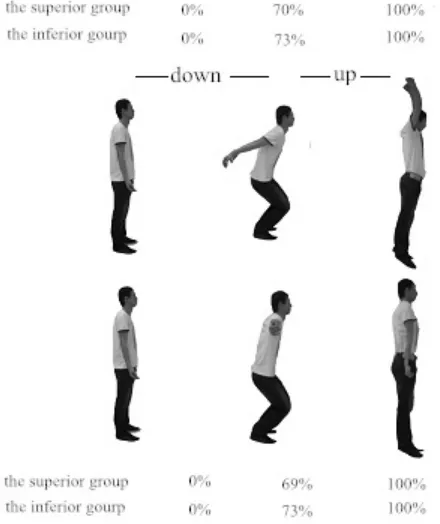
Fig 1 showed the percentage of time in each phase during vertical jump with and without arm-swing. The superior group demonstrated earlier decrease to the lowest point of the center of gravity compared with the inferior group. However, arm-swing had no significant effect on the moving speed of the center of gravity.
Figure 1 Change of the center of gravity with arm-swing(above)and no-arm-swing(below)in groups with different level during vertical jump
[image:2.595.168.443.647.728.2]For arm-swing, the mean height of the superior group is 13cm higher than the inferior group (Table 1), which is 11cm for no-arm-swing (Table 2).The peak moment were greater in both conditions for the superior group, but there is no significant differences exist. The value of peak power is higher for the superior group than the inferior. In addition, the value of peak power at ankle in both conditions and keen with arm-swing has significant differences.
Table 1 performance of vertical jump with arm-swing(mean±SD)
The superior group The inferior group P Height(m)
Peak moment(N.m/Kg) Ankle
Knee
Peak power(W/kg) Ankle
knee
0.519±0.020 3.02±0.48 3.30±0.52 20.79±2.68 17.96±2.15
0.389±0.023 2.65±0.38 2.65±0.47 16.01±3.18 14.23±3.02
<0.001* 0.28 0.16 0.005* 0.037*
Table 2 performance of vertical jump without arm-swing(mean±SD)
The superior group The inferior group P Height(m)
Peak moment(N.m/Kg) Ankle
Knee
Peak power(W/kg) Ankle
knee
0.411±0.025 2.85±0.43 3.11±0.63 19.96±2.55 17.46±2.37
0.298±0.031 2.46±0.25 2.52±0.52 15.21±3.20 13.82±3.11
<0.001* 0.32 0.58 0.003*
0.061
*significance P<0.05
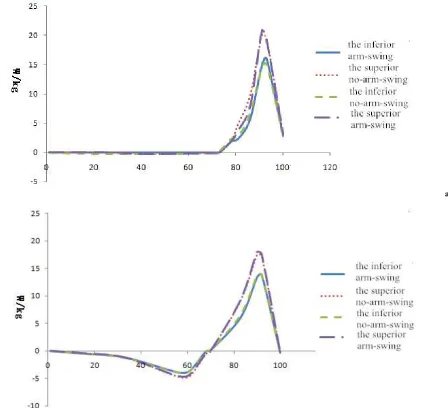
Fig 2,3 showed the change of moment and power with time. There was a significant difference in the two groups, and the value of power shifted to be positive at about 70% of the jumping phase. Whereas the difference between the effects of arm-swing and no-arm-swing, there was not shown significant. Only the earlier appearance of peak moment at keen with no-arm-swing in the superior group presented significance.
a
[image:3.595.107.500.251.718.2]b
a
[image:4.595.91.539.72.480.2]b Figure 3 Mean power of lower limb:a. ankle; b. knee
DISCUSSION
The muscle strength and the power appears to be different in the two groups. Fig 3 indicates the difference between the two groups according to the value of power. As each index is normalized to weight and the height of all the subjects in each group is almost the same, this study demonstrated that it is muscle ability that determines the result of the research. Bosco and Komi [5] found that the ratio of fast twitch fibers is highly associated with the performance of vertical jump. Although the present study did no further research on the muscle component of subjects in different groups, we infer that the ratio of fast twitch fibers is higher in superior group than the inferior group. Moreover this study focused on the influence of technique on the jump performance though limiting the movement of arms. Without arm-swing the height of vertical jump decreased about 10cm in both group, whereas the value of joint moment and instantaneous power showed no significant differences (Fig 2,3), and the ability of subjects themselves plays an important part in vertical jump.
CONCLUSION
Due to ascendant characteristics of the elastic reserve and release of muscle group around the keen joint which has low synchronism with the antagonistic muscle group that stabilize the joint, the jumping efficiency shows to be superior. Furthermore, the performance of vertical jump is also related to the coordination of muscle and nerve, which can be a direction of researches on the superior athletes.
Acknowledgement
This work was financially supported by Postgraduate Key Course Development of Ningbo University (Grant NO. zdkc2012008).
REFERENCES
[1] CH Zhang, HJ Liu, China Sport Science and Technology, 2008, 44(6), 107-109.
[2] M Paasuke, J Ereline, H Gapeyeva, Journal of Sports Medicine and Physical Fitness, 2001, 41, 354-361. [3] CL Hubley, RP Wells, European Journal of Applied Physiology, 1983, 50, 247-254.
[4] S Fukashiro, PV Komi, International Journal of Sport Medicine, 1987, 8, 15-21. [5] C Bosco, PV Komi, European Journal of Applied Physiology, 1979, 41, 275-284. [6] ZQ JIN, ZH Li, JR Guo, Tianjin Institute of Physical Education, 2001, 16(1),47-50. [7] JH Yoon, WY So, Iran J Public Health. 2013, 42(7), 673-680.
[8] JT Blackburn, MF Norcross, LN Cannon, SM Zinder, J Athl Train. 2013, 48(6), 764-772. [9] A Lees, J Van Renterghem, D De Clercq, Journal of Biomechanics, 2004, 37, 1929-1940.