Abstract: Considering the water utilization and conservation needs in agriculture it would be essential to have very accurate water irrigation schedule to save water. Appropriate bonding of water to the paddy field would be essential to meet the moisture demand unto 75% to reduce the risk of plant stress and yield loss. Data features such as Evapotranspiration; Permeability of the soil, Drainage, The length of the growing season, the levelness of the soil surface has to be considered to recommend the irrigation scheduling. In this paper we are developing a model which would base on Seasonal data and other data determine the water scheduling requirements for the day or week ahead. This would also help in planning the water needs well ahead. The research identifies delta and non-delta regions of TamilNadu to determine the evapotranspiration based on the climatic data available and discusses the architecture components required for the real time data acquisition and ingestion mechanism. It determines the ET0 and maps it with the FAO based reference model for the implementation.
Keyword: Paddy Cultivation, Big Data, Recommendation System, AWS, Irrigation scheduling factors
I. INTRODUCTION
Across the world 150 million hectares of rice land provides around 550–600 million tons of rough rice annually (Maclean, et al. 2002). Irrigation of paddy in the traditional days has been always manual. Typically, farmers measure the water level in the fields by physical inspection and accordingly adjust the in-flow and drainage water from the paddy fields to ensure correct or appropriate water levels. The expertise comes to maintain appropriate levels would be based on expert judgement and passing of experiential knowledge from the ancestors.
The primary purpose of irrigation is to match the supply and demand of water to the paddy fields. Based on the timing, duration, watering and maintenance of water level directly contributes to the effectiveness of the irrigation and yield of the paddy crop.(Salem, et al. 2013) Techniques like pudding has been used traditionally to effectively reduce water loss from lowland paddy fields. Various factors such as evapotranspiration, Effective rainfall, Seepage, Drainage and percolation affect the water balance components in paddy fields.
Revised Manuscript Received on July 22, 2019.
* Correspondence Author
N. Revathi*, Department of Computer Science, Periyar University PG
Extension centre, Dharmapuri. Tamil Nadu, India. Email:
P. Sengottuvelan, Department of Computer Science, Periyar University PG Extension centre, Dharmapuri. Tamil Nadu, India. Email: [email protected]
a. Irrigation Systems
In country like India, irrigation system varies widely. There is individual pump in the paddy fields which either could be run on diesel, electricity running as Submersible and goes up to 15-m dept to 300-m dept depending on the scale. Another approach reservoir-based irrigation based on nearby ponds or water reservoirs.
Having 18% of world population in India with 4% world’s fresh water 80% of its used in agriculture. Only 48% of it is used in India’s surface and groundwater bodies. Problems such as water storage, poor infrastructure and inappropriate water management leads to only usage of 18-20% of the water.(Dhawan 2017) Climate changes is also severely affecting(N H RAO 2018) the overall situation of paddy cultivation, which is essential to be managed better.
Community-based surface irrigation is based on the pre-existing water bodies diverted from river through cannels. In the case of the pumps the water pumps would be under the ownership of the landowners in the case of utilization of canals or pond or reservoirs or river bodies it would be through governance models.
Subsequently electronics controls and tools came into use where the water levels are consistently maintained by monitoring the water levels using Programmable Integrated Circuits (Raihana 2011). Different factors affecting the water requirements in the field needs to be balanced in an optimized way in the land areas cultivated through effective scheduling and irrigation of water.
b. Water and Irrigation requirements
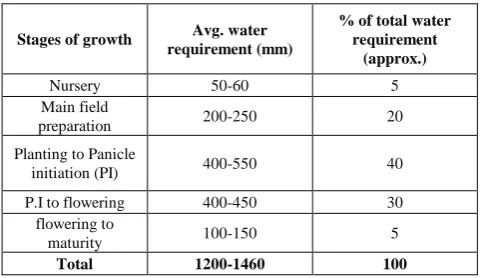
For effective scheduling of irrigation, it’s important to understand the irrigation schedule of paddy crop. This is essential to calculate the overall requirements of water in terms of different stages for appropriate planning (Irrigation water management in paddy 2009). The following Table 1 would outline the various stages of growth in paddy cultivation and its average water requirement and its percentage.
The typical irrigation requirements are outlined in the Table-1 provided below and it would vary based on the typical type of the crop (Irrigation water management in paddy 2009):
Real-Time Irrigation Scheduling Through
IoT in Paddy Fields
Table 1. Water requirements in each stages of paddy cultivation
Stages of growth Avg. water requirement (mm)
% of total water requirement
(approx.)
Nursery 50-60 5
Main field
preparation 200-250 20
Planting to Panicle
initiation (PI) 400-550 40
P.I to flowering 400-450 30
flowering to
maturity 100-150 5
Total 1200-1460 100
c. Cropping System Model
Cropping System Model(Figure 1) can be leveraged to have a holistic perspective in terms of the agricultural approach towards data and its functions on the field. The model components involved was developed by DSSAT (Decision Support System for Agro technology) can be leveraged so that we can corroborate on the Soil, Weather, Crop management to simulate growth models and yield functions. DSSAT has been used by more than 14,000 people in over 150 countries worldwide.
Existing Literature:
In the year 1996, Li Y.H and Cui Yunalai has discussed forecasting of the daily evapotranspiration in the paddy fields and there by developing the model to appropriately manage the drainage and flow of water using Lotus-1-2-3. (Li and Cui 1996)
Typically, imbalance exists with in the farmers cultivating in the low-lying areas as they suffer due to scarcity of water. Alternate wetting and Drying were discussed to optimize the irrigation which has been successful in countries like China. Implementation of AWD is done by monitoring the water depth in the field using “field water tube. (B.A.M. Bouman 2007)
Artificial Neural Network Controller based approach was recommended (Manoj Singh 2018) in the research on Irrigation control by leveraging Distributed Time delay neural network topology. Bayesian regulation function was used for training. The control was focused on soil moisture using the evapotranspiration model.
By identifying the Evapotranspiration to be at 3.6mm/day and 3.5mm/day for off-season using the model built effective management of irrigation was achieved to maximize utilization of water for crop. This would also control unnecessary seepage from the conveyance system. (Lee Teang Shui 2006)
Kirtan has reviewed intelligent irrigation methods which adopts AI and Machine learning in 2018. This paper proposes a fully automated early accessible method of irrigation for efficient use of water resources by leveraging IoT. (Kirtan Jha 2018)
Using CROPWAT model in Bangladesh a study was conducted to estimate irrigation requirements for wet season and dry season. Historic climate data from three weather
stations in the region were used as an Input for Penman-Monteith method for estimating reference evapotranspiration. The CROPWAT model estimated seasonal irrigation water requirement of 1212 mm for Rice of type Oryza sativa L.This was done for large scale and would focus on urban planning of irrigation projects. (M.B. Hossain 2017)
Considering the lack of real-time information available for irrigation managers pilot implementation of real-time control, influence on the water delivery and utilization was done. This would also have integration with sensors such as Soil Moisture, temperature and relative humidity implemented with the help of open source electronics with 30 prototypes in Telangana, Andhra Pradesh, India. (K. Yella Reddy 2016) Various parameters such as index vegetation (estimated using aerial images), irrigation events, water flow level, pressure, and wind speed are periodically sampled and implemented with Drools rule engine along with a web based application as Digital Farming(PLATEM) in 2019 which calls for the need of adopting Big data as this was applied to small database and dealt through MySQL kind of database. The intent is fostering open communication between farmers, government and different agencies. There is a need for improving irrigation planning based on business context and rules as well. (Carlos Cambra Baseca 2019)
Soil water flow for oil palm was done in Malaysia by the Department of land management where in many soil model exists for reference. The model was built to determine the daily trend for the measured soil water content. Darcy’s law was applied to estimate water soil fluxes to estimate root water uptake and water stress response. (C.B.S. 2018) Smart phone App was built using estimate potential evapotrapuration (PET) in real time based on gridded data from NASA-POWER. The app was built with an intent to be more efficient in irrigation and related water conservation. This model also uses meteorological data for calculation of PET using the Penman-Monteith method. The accuracy, tendency and precision were measured and compared with PET Estimates. The results obtained were more satisfactory for the studied locations which can be accessed over Play Store. (WalterMaldonado 2019).
This paper would focus on the irrigation side of the problem and necessary technology framework to be leveraged for the getting the necessary inputs for processing and help in scheduling the irrigation accordingly.
d. Cropping System Model
Cropping System Model(Figure 1) can be leveraged to have a holistic perspective in terms of the agricultural approach towards data and its functions on the field. The model components involved was developed by DSSAT (Decision Support System for Agro technology) can be leveraged so that we can corroborate on the Soil, Weather, Crop management to simulate growth models and yield functions. DSSAT has been used by more than 14,000 people in over 150 countries worldwide.
[image:2.595.46.288.94.233.2]the paddy fields and there by developing the model to appropriately manage the drainage and flow of water using Lotus-1-2-3. (Li and Cui 1996).
Typically, imbalance exists with in the farmers cultivating in the low-lying areas as they suffer due to scarcity of water. Alternate wetting and Drying were discussed to optimize the irrigation which has been successful in countries like China. Implementation of AWD is done by monitoring the water depth in the field using “field water tube. (B.A.M. Bouman 2007)
Artificial Neural Network Controller based approach was recommended (Manoj Singh 2018) in the research on Irrigation control by leveraging Distributed Time delay neural network topology. Bayesian regulation function was used for training. The control was focused on soil moisture using the evapotranspiration model.
By identifying the Evapotranspiration to be at 3.6mm/day and 3.5mm/day for off-season using the model built effective management of irrigation was achieved to maximize utilization of water for crop. This would also control unnecessary seepage from the conveyance system. (Lee Teang Shui 2006)
Kirtan has reviewed intelligent irrigation methods which adopts AI and Machine learning in 2018. This paper proposes a fully automated early accessible method of irrigation for efficient use of water resources by leveraging IoT. (Kirtan Jha 2018)
Using CROPWAT model in Bangladesh a study was conducted to estimate irrigation requirements for wet season and dry season. Historic climate data from three weather stations in the region were used as an Input for Penman-Monteith method for estimating reference evapotranspiration. The CROPWAT model estimated seasonal irrigation water requirement of 1212 mm for Rice of type Oryza sativa L.This was done for large scale and would focus on urban planning of irrigation projects. (M.B. Hossain 2017)
Considering the lack of real-time information available for irrigation managers pilot implementation of real-time control, influence on the water delivery and utilization was done. This would also have integration with sensors such as Soil Moisture, temperature and relative humidity implemented
with the help of open source electronics with 30 prototypes in Telangana, Andhra Pradesh, India. (K. Yella Reddy 2016) Various parameters such as index vegetation (estimated using aerial images), irrigation events, water flow level, pressure, and wind speed are periodically sampled and implemented with Drools rule engine along with a web based application as Digital Farming(PLATEM) in 2019 which calls for the need of adopting Big data as this was applied to small database and dealt through MySQL kind of database. The intent is fostering open communication between farmers, government and different agencies. There is a need for improving irrigation planning based on business context and rules as well. (Carlos Cambra Baseca 2019)
Soil water flow for oil palm was done in Malaysia by the Department of land management where in many soil model exists for reference. The model was built to determine the daily trend for the measured soil water content. Darcy’s law was applied to estimate water soil fluxes to estimate root water uptake and water stress response. (C.B.S. 2018) Smart phone App was built using estimate potential evapotrapuration (PET) in real time based on gridded data from NASA-POWER. The app was built with an intent to be more efficient in irrigation and related water conservation. This model also uses meteorological data for calculation of PET using the Penman-Monteith method. The accuracy, tendency and precision were measured and compared with PET Estimates. The results obtained were more satisfactory for the studied locations which can be accessed over Play Store. (WalterMaldonado 2019).
[image:3.595.46.552.587.822.2]This paper would focus on the irrigation side of the problem and necessary technology framework to be leveraged for the getting the necessary inputs for processing and help in scheduling the irrigation accordingly.
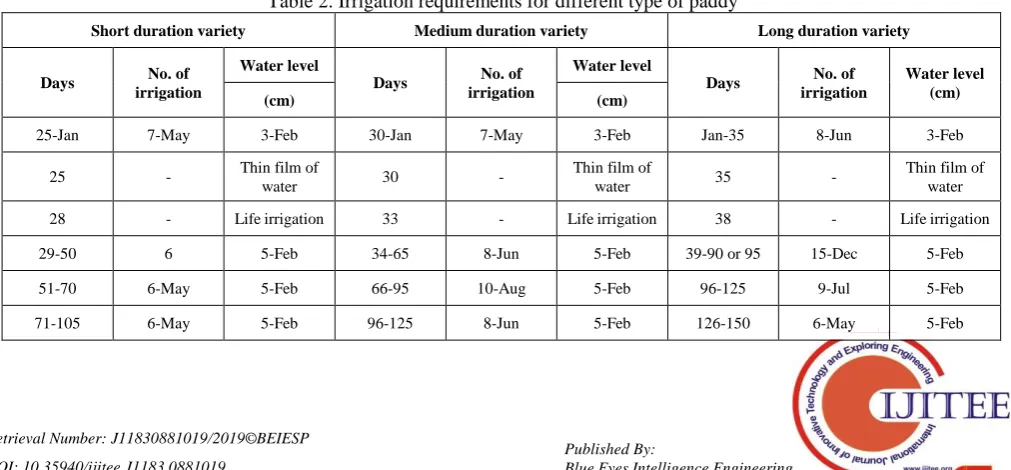
Table 2. Irrigation requirements for different type of paddy
Short duration variety Medium duration variety Long duration variety
Days No. of irrigation
Water level
Days No. of irrigation
Water level
Days No. of irrigation
Water level (cm)
(cm) (cm)
25-Jan 7-May 3-Feb 30-Jan 7-May 3-Feb Jan-35 8-Jun 3-Feb
25 - Thin film of
water 30 -
Thin film of
water 35 -
Thin film of water
28 - Life irrigation 33 - Life irrigation 38 - Life irrigation
29-50 6 5-Feb 34-65 8-Jun 5-Feb 39-90 or 95 15-Dec 5-Feb
51-70 6-May 5-Feb 66-95 10-Aug 5-Feb 96-125 9-Jul 5-Feb
Figure 1.Cropping System Model (CSM) Source: https://dssat.net/models-and-applications/components
II. PROBLEM STATEMENT
The external data has to be corroborated with the on field data and equipment’s for effective irrigation to the paddy field which consumes critical sustainable resources such as water. Also effective usage of government subsidized electricity to irrigate the field when the perennial rivers are dearth of water hugely depends on political will for water. The effective irrigation of water to the field will result in better yield which needs to be done by collecting the data more accurately. This research outlines the approach with AWS (Amazon Web Services) based Cloud Architecture to collect the data fields from IoT Devices and also discusses the data attributes which influences the irrigations scheduling. The research would directly or indirectly contribute to solve the problems such as : Prevent excessive use of water for irrigation of paddy, Reduce monitoring overhead related labour, minimize pumping cost, improve quality of ground water and downstream surface water and yield.
III. METHODOLOGY
a. Data Source
NASA based POWER(Prediction of Worldwide Energy
Resource) data source which is planned to be obtained for
the paddy cultivation region specific to Thanjavur and regions
closer to that. The POWER project provides data for (1) Renewable Energy, (2) Sustainable Buildings, and (3) Agroclimatology related community. This data is collected based on satellite observations. We have considered the data for Thanjavur and related regions.
b. Data Acquisition: Big Data and Cloud
Figure- 2: M/C Learning Model
c. Architecture components:
The cloud infrastructure would be used for alerting, notification and controlling the irrigation aspect of the paddy field with the given components ( Figure 3. AWS Components). The data would be ingested to the IoT Gateway with the help of Field Gateway through Internet enabled through Wi-Fi/2G/3G/4G means. Then the data would be received at the Kinesis as data streams and lambda would be enacted upon any deviation or anomaly found in the given inputs. Example the data would have significant signature in terms if the field is well watered field, optimally watered field or the field is stressed for water. RDS would be having meta data which would information about the farmer, farming field related additional inputs.
Figure 3. AWS Components
The DynamoDB would be able to store the input stream data and RDS would hold the Meta Data and every day would be scheduled for conversion to flat files and stored back in S3. SQS, SES and SNS would be used for notification different clients.
IV. RESULT AND DISCUSSION
a. Determination of water needed for irrigation
The following diagram depicts the irrigation water needs for the rice, this includes various aspects such as Evapotranspiration of the reference crop, water needed for the crop, amount of water needed for land preparation, losses due to percolation and seepage, effective rainfall etc,
Figure- 4: irrigation water Model
1) Equations
Effective irrigation water needed (IN) is calculated using the formula given below:
IN = ETcrop + SAT + PERC + WL – Pe
b. Scheduling of Irrigation
Typically, in the paddy field it is important to decide if the water must be let to the fields continuously or it must be released on Rotation basis. In the farmlands whoever is monitoring the field would channelize the water flow by adjusting the land parcels accordingly (Brouwer 1989). The volume or quantity of water to be irrigated would vary time to time based on the current utilization in the fields which are typically done by experience and visual inspection (Feel and Appearance Method) by “rule of thumb”.
The simplest and basic irrigation water management tool is the Error! Reference source not found.:
QT = DA Equation-1
where Q is the flow rate (ft3 /s) and T is time (hr) and D would depict the depth (in) the farm area represented as A measured in acres.
c. Scheduling of irrigation
D
el
ta
R
eg
io
n
Lo
ca
ti
o
n
LAT LON PARAMETER JAN FEB MAR APR MAY JUN JUL AUG SEP OCT NOV DEC
10.75 79.25 PRECTOT 0.62 0.54 0.54 1.28 1.81 1.47 1.85 2.34 3.98 5.44 6.7 3.2
10.75 79.25 RH2M 75.39 66.19 58.97 59.32 60.53 60.5 61.08 63.36 69.33 77.68 83.53 81.57
10.75 79.25 T2M_RANGE 9.18 11.4 12.36 10.52 9.37 9.06 8.96 9.17 8.34 7.02 6.31 7.35
10.75 79.75 PRECTOT 0.83 0.58 0.65 1.44 1.92 1.54 1.75 2.19 3.52 5.73 7.32 3.77
10.75 79.75 RH2M 76.62 71.81 67.82 67.9 68.67 67.02 66.92 68.9 73.32 78.7 82.46 80.62
10.75 79.75 T2M_RANGE 5.12 6.51 7.23 6.24 5.91 6.08 6.09 6.15 5.45 4.37 3.64 4.11
10.75 80.25 PRECTOT 1.1 0.63 0.73 1.64 2.18 1.82 1.91 2.18 3.21 5.92 7.57 4.24
10.75 80.25 RH2M 76.76 75.83 75.07 75.5 76.65 74.6 74 75.46 77.74 79.81 80.84 78.81
10.75 80.25 T2M_RANGE 1.86 2.36 2.66 2.36 2.6 3.01 3.08 3.03 2.56 1.89 1.41 1.53
10.75 80.75 PRECTOT 1.38 0.69 0.74 1.81 2.56 2.4 2.5 2.54 3.37 6.09 7.71 4.67
10.75 80.75 RH2M 76.66 77.66 78.64 79.46 81.19 79.77 79.16 80.18 80.91 80.83 79.9 77.65
10.75 80.75 T2M_RANGE 0.51 0.52 0.58 0.69 0.92 1.19 1.27 1.21 1.02 0.85 0.62 0.52
c. Experiments and data
When to water the field or when to irrigate would depend on the growth stage of the crop, monitoring of moisture stress levels, monitoring soil water depletion and external agroclimatic conditions. External watering of the field is always considered to be supplemental to the rainfall events and status of the soil profile. This is should also take care of the rainfall probability in the context of paddy growth to manage the risk accordingly.
[image:6.595.51.549.84.292.2]The model was built and developed for the 3 locations namely Salem, Thanjavur and Nagaipattinam to bring on variation between normal and delta regions based city. These Latitude and longitude are outlined as given in the below table:
Location Latitude Longitude
Salem 11.65 78.15
Nagapattina
m 10.76 79.84
Thanjavur 10.78 79.13
[image:6.595.92.247.499.571.2]The climatology related data for the above given 3 locations has been given in the
Figure 5: Salem, Figure 7: Nagai, and
Figure 6: Thanjavur respectively. They indicate the factors such as Temperature, Relative Humidity, Means Sea Level Pressure, Radiation and Windspeed which are essential to calculate the Evapotranspiration.
These would be calculated based the Hargreaves equation given below:
Ra = water equivalent of extra-terrestrial radiation (mm day−1),Tmean = mean air temperature, Tmax = daily maximum air temperature (◦C), Tmin = daily minimum air
temperature (◦C).This approach has been taken become there was not much data available from the weather department specific to TamilNadu region. To estimate the dew point which is essential to calculate the actual air pressure the following formula is used based on Mark G Lawrence in 2005(Lawrence 2005).
Td = T - ((100 - RH)/5.)
Then subsequently actual vapour pressure is calculated using the formula given below:
[image:6.595.307.547.543.837.2]In this case Td is the dewpoint temperature calculated earlier. The data both hourly and daily are to be obtained for the three locations which needs to be arrived for Max, Min for the temperature.
Figure 6: Thanjavur
Figure 7: Nagai
The final data which is after calculation would be as given below in the table:
Equation 1: Extraterrestrial Daily Solar Radiation
Subsequently the Extra terrestrial radiation can be calculated using the following fomula for Salem for the month of July:
Monthly average Declination of Sun(°)=21.290140856854 in July
Monthly average Sunset Hour Angle(°)=94.60841963854 in July
Coefficent : R
R=1+0.033*cos(2*π*n/365)=0.96816773220219
Extraterrestrial Daily Solar Radiation in July
=33108.358263274(kJ/m^2/day) =9.1967661842429(kWh/m^2/day)
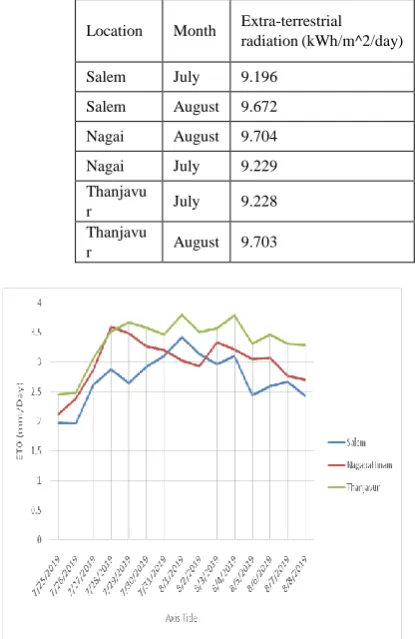
Table 2: Extra-terrestrial radiation across 3 locations
Location Month
Extra-terrestrial radiation (kWh/m^2/day )
Salem July 9.196
Salem August 9.672
Nagai August 9.704
Nagai July 9.229
Thanjavur July 9.228
[image:8.595.97.243.66.192.2] [image:8.595.46.254.218.538.2]Thanjavur August 9.703
Table 2: Extra-terrestrial radiation across 3 locations
Location Month Extra-terrestrial
radiation (kWh/m^2/day)
Salem July 9.196
Salem August 9.672
Nagai August 9.704
Nagai July 9.229
Thanjavu
r July 9.228
Thanjavu
r August 9.703
Figure 8: ET0 for 3 locations (mm/day)
[image:8.595.66.273.700.790.2]The ET0 (Evapotranspiration) data has been obtained and determined and plotted as per the chart given above. This data would be further fed into the data collected into the cloud infrastructure for generation of the necessary alerts and this would be used to integrated with the Control systems for motors for appropriate irrigation of water. The field level data obtained such as soil moisture to be corroborated with the climatic data and to work based on the GIS level satellite data for building the prediction models for irrigating the fields.
Table: Reference table for ET0 for different climatic Zones Climatic
zone
low (less than 15°C)
medium (15-25°C)
high (more than 25°C)
Desert/arid 6-Apr 8-Jul 10-Sep
Semi arid 5-Apr 7-Jun 9-Aug
(Moist)
Sub-humid 4-Mar 6-May 8-Jul
Humid 2-Jan 4-Mar 6-May
Data ranges of ET0 modelled and arrived at stands at the following values:
Table 3: ET0 ranges for the 3 locations
Sno# Location ET0
1 Salem 1.96-3.43
2 Thanjavur 2.11-3.6
3 Nagapattina
m 2.46-3.8
Based on the above said values in reference(Table 3: ET0 ranges for the 3 locations) and mapping them to the climatic zones which as per the reference table seems to be more in the Moist, Sub-Humid range which falls in the Agro climate areas.
V. CONCLUSION
Considering the water scarcity situation and depleting water table in delta regions the research has built the scheduling model for irrigation. The model would be executed along with aws cloud infrastructure through iot means for seamless integration. The model was built using python and was leveraging the existing reference evotransportation for paddy and measured against it. The essential ingredients of these solutions would be real-time integration of field data and weather data from external sources for determining schedule and quantity.
The IoT infrastructure which would send the data over MQTT protocol to the kinesis streams which helps to generate alerts and notifications to farmers. The irrigation schedule model would help scheduling of water to improve the water needs and conserve when not needed. In the future data can be revalidated using deep neural networks and drone based visualization to minimize the problems of sensor disruptions because of rats and other animals.
REFERENCES
[1].B.A.M. Bouman, R.M. Lampayan, and T.P. Tuong. 2007. Water
Management in Irrigated Rice: Coping with Water Scarcity. Los Baños, Philippines: International Rice Research Institute.
[2].Brouwer, C. 1989. Irrigation Scheduling. English. Food and
Agricultural Organization- Land and Water Development Division.
[3].C.B.S., Teh. 2018. "Development and Validation of an unsaturated
soil water flow model for oil palm." Tropical Agriculture Science
787-800.
[4].Carlos Cambra Baseca, Sandra Sendra,Jaime Lloret, Jesus Tomas.
2019. "A Smart Decision System for Digital Farming." MDPI,
Agronomy 9 (216): 1-19. doi:10.3390/agronomy9050216.
[5].Dhawan, Dr. Vibha. 2017. Water and Agriculture in India. Federal
ministry of Food & Agriculture.
[6].2009. Irrigation water management in paddy. ICAR, NAIP. 03 24.
Accessed 05 11, 2019.
http://agropedia.iitk.ac.in/content/irrigation-water-management-paddy.
[7].k. yella reddy, l. narayan reddy , sekhar nagothu and sai bhaskar
reddy nakka. 2016. "sensors for water monitoring for improved on farm water management." (2nd world irrigation forum) 1-8.
[8].kirtan jha, aalap doshi and poojan patel. 2018. "intelligent
irrigation system using artificial intelligence and machine learning: a comprehensive review." (international journal of advanced research) 6 (10): 1493-1502.
[9].Lawrence, Mark G. 2005. "The
temperature in moist air: A simple conversion and applications." Bulletin of the American Meteorological Society, 225-233. http;//dx.doi.org/10.1175/BAMS-86-2-225.
[10].Lee Teang Shui, M. Aminul Haque and Huang Yuk Feng. 2006.
"Modeling water balance components in Rice field irrigation." (Journal - The Institution of Engineers,) 67 (4).
[11].Li, Y.H., and Yuanlai Cui. 1996. "Real-time forecasting of
irrigation water requirements of paddy fields." Agricultural
Water Management 31 (3): 185-193. Accessed 5 15, 2019. https://sciencedirect.com/science/article/pii/0378377496012528 .
[12].M.B. Hossain, S. Yesmin, M. Maniruzzaman and J.C. Biswas.
2017. "Irrigation Scheduling of Rice (Oryza sativa L.) Using CROPWAT Model in the Western Region of Bangladesh." (The Agriculturists, A Scientific Journal of Krishi Foundation) 15 (1): 19-27.
[13].Maclean, J. L., D. C. Dawe, B. Hardy, and G. P. Hettel. 2002.
Rice almanac Source book for the most important economic activity on earth Third edition. Accessed 5 16, 2019. https://eurekamag.com/research/035/670/035670717.php.
[14].Manoj Singh, Swati Vitkar. 2018. "Automation of Irrigation
Monitoring Using Artificial Neural Network." (IOSR Journal of Business and Management (IOSR-JBM)) 43-48.
[15].N H RAO, K L Rao. 2018. "Big Data and Climate Smart
Agriculture - Status and Implications for Agricultural Research and Innovation in India." (Proc Indian Natn Sci Acad) 84 (3): 625-640. doi:10.16943/ptinsa/2018/49342.
[16].Raihana, Samsudin Nur. 2011. Canal Irrigation Control System
In Paddy Field. Accessed 5 15, 2019. http://eprints.utem.edu.my/6217.
[17].Saleem, Syed Khusro, Dilini Delgoda, S K Ooi, Kithsiri B.
Dassanayake, L Liu, Malka N. Halgamuge, and Hector Malano. 2013. "Model Predictive Control for Real-Time Irrigation
Scheduling." IFAC Proceedings Volumes 46 (18): 299-304.
Accessed 5 15, 2019.
https://sciencedirect.com/science/article/pii/s147466701535001 1.
[18].WalterMaldonado, Júnior Taynara, Tuany Borges,
ValerianoGlaucode ,Souza Rolim. 2019. "EVAPO: A smartphone application to estimate potential evapotranspiration using cloud gridded meteorological data from NASA-POWER
system." Computers and Electronics in Agriculture 187-192.
AUTHORSPROFILE
N.Revathi is received the Msc degree in Information Technology Chennai 2013 and the M.Phil degree completed in Computer Science from Periyar University, Salem 2015. She is currently working towards the Ph.D in Department of Computer Science, Periyar University, India.and she is interested in Data Mining, Big data analytics.
Dr.P.Sengottuvelan received his M.Sc degree in Computer Technology from Periyar University in 2001 & M.E. degree in Computer Science & Engineering from Anna University in 2004 and the Ph.D degree in Computer Science & Engineering from Vinayaka Missions University in 2010. From 2004 to 2015, he was the Faculty in the Department of IT, Bannari Amman Institute of Technology, Sathyamangalam. Since 2015, he has been with the Department of Computer Science at Periyar University PG Extension centre, Dharmapuri, where he is currently a Associate Professor. His Professional activities include guided 10 PhDs in the field of CSE & IT and guiding seven PhD’s in the field of CS. Also he has Published and presented more than 100