
Controlled Bose-Condensed Sources for
Atom Interferometry
Stuart Stephen Szigeti
A thesis submitted in partial fulfilment of the requirements for the degree of Doctor of Philosophy in Theoretical Physics at the Australian National University
July, 2013
lll
To my mother) Bronwyn.
Controlled Bose-Condensed Sources for
Atom Interferometry
Stuart S. Szigeti
Department of Quantum Science,
The Australian National University, Canberra, Australia.
Supervisory committee: Assoc. Prof. Joseph J. Hope Dr Andre R. R. Carvalho Prof. Craig M. Savage
Abstract
This thesis contributes to the debate over the viability of using Bose-condensed sources to improve the sensitivity of atom interferometers. Specifically, we present theoretical investigations into (1) the effect of source momentum width on large momentum transfer (LMT) atom interferometry with Bragg pulses, and (2) the prospect of stabilising a high flux, narrow linewidth, continuously pumped atom laser via measurement-based feedback control of the BEC that forms the lasing mode of the atom laser.
To begin, this thesis considers the effect of the atomic source's momentum width on the efficiency of Bragg mirrors and beamsplitters and, more generally, on the phase sensitivity of Bragg pulse atom interferometers in the Mach-Zehnder configuration. We show that an atomic cloud's ·momentum width places a fundamental upper bound on the maximum transfer efficiency of a Bragg mirror pulse, and furthermore limits the phase sensitivity of a Bragg pulse atom interferometer. We quantify these momentum width effects and precisely compute how mirror efficiencies and interferometer phase sensitivities vary as functions of Bragg order and source type. In particular, ·we show that narrow momentum width Bose-condensed sources give comparable sensitivities to broad momentum width thermal sources, even after incorporating the lower atom number flux of Bose-condensed sources. Coupled with other favourable properties of Bose-condensed sources, such as their high tolerance to classical noise due to wavefront distortions of the optical Bragg pulse and the Coriolis effect, this suggests that LMT Bragg atom interferometry with Bose-condensed sources should yield improved sensitivities over current inertial sensors. Furthermore, our results and methodology allow for the efficient optimisation of Bragg pulses, which will help in the design of LMT Bragg mirrors and beamsplitters for atom-interferometer-based
Vl Abstract
inertial sensors, irrespective of source type.
In the second part of this thesis, we investigate the prospect of measurement-based feedback control of a BEC, with the aim of reducing density fluctuations by cooling the condensate to a stable spatial mode close to the ground state. Firstly, we consider the effects of experimental imperfections on the problem of estimation-based feedback control of a trapped weakly-interacting BEC undergoing continuous position measurement. These limitations violate the assumption that the estimator (i.e., filter) accurately models the underlying system, thus requiring a separate analysis of the system and filter dynamics. We quantify the parameter regimes for stable cooling and show that the control scheme is robust to detector inefficiency, time delay, technical noise and miscalibrated parameters. These results show that reasonable experimental imperfections do not limit the feasibil-ity of cooling a BEC by continuous measurement and feedback. Secondly, we designed a feedback-control scheme for a trapped condensate, with interatomic interactions of any strength, based on a phase-contrast imaging setup. We derive the quantum filtering equa-tion for the system, and show that it gives a resolution-limited, continuous measurement of the condensate's density. A semiclassical analysis of this control scheme shows that feedback-cooling of an interacting BEC is also possible, and that the interatomic inter-actions actually increase the effectiveness of the control. Therefore, measurement-based feedback control can stabilise the spatial mode of a BEC, which is a requirement for the high flux, narrow linewidth, continuously pumped atom laser sources that could potentially give inertial measurement sensitivities orders of magnitude beyond current state-of-the-art devices.
Declaration
To the best of my knowledge and except where acknowledged in the customary manner, the material presented in this thesis is original and has not been submitted in whole or part for a degree in any university. Where work has been performed in collaboration with others, I have acknowledged the contributions of all authors.
Stuart Szigeti
Acknowledgements
According to folklore, a Ph.D. student labours in isolation and poverty, only surfacing from beneath a sea ofjournal articles to scrounge for ramen noodles or to placate a tyrannical supervisor. Fortunately, my Ph.D. experience was nothing like this. This was largely due to the many excellent people that embody the rich research culture within the Department of Quantum Science, and the ANU more generally. It has been a privilege working with people of such remarkable intellect, wisdom, kindness, integrity and humour, and it is most humbling and gratifying that many of you count me as a friend. I truly could not have written this thesis without you.
First and foremost, I need to thank my closest theory collaborators, Joe Hope, Andre Carvalho and Michael Hush. I am indebted to Joe, my supervisor, who is allegedly great. Thank you for your guidance, intellectual courage in the face of uncertainty and friendship. You have taught me much about physics, but also about life. To Andre, my co-supervisor, thank you for your considered wisdom, attention to detail, encouragement and profession-alism. You have been a bedrock of support, and a good friend. You are the physicist and athlete I want to be 'when I grow up'. To Michael, my dear friend, I don't even know where to begin. You have occupied so many roles during my time in the group, including fellow Ph.D. student, postdoctoral fellow, gym companion, gossiper, provocateur, amateur philosopher, visionary and General Nice Person. Every moment has been a pleasure.
To my lesser (in time, not importance) theory collaborators, Mattias Johnsson and Graham Dennis, you have my deep thanks. You have both provided excellent comp u-tational support, been very tolerant of my distracting questions and conversation during work hours and been consistent wine-drinking companions. Mattias, I treasure your open mind, keen insights, sardonic wit, passionate temperament and very large muscles. Gra-ham, everyone always calls you a genius, so I won't do so here. \i\That I will acknowledge is your humble character, your kindness and your very fine taste in wine.
I have also had the pleasure of working with many fine experimentalists from the Quantum Sensors and Atom Laser group. A large thank you to John Close for teaching me his particular approach to physics and human interactions ( they are only slightly related), and for his insightful and entertaining discussions. John, I apologise for any grammatical or stylistic errors in this thesis, and promise to one day read Strunk and White. To Nick Robins, I offer my thanks for his advice on the particulars of experimental physics, his indefatigable enthusiasm and optimism and for his generosity and kindness. I feel that moving a few optics tables is not ample repayment for the fun and inclusivity that Nick fosters around the office. To John Debs, I offer a great deal of thanks for sparking my initial interest in atom interferometry, and for tolerating the somewhat irritating questions (and also the occasionally inadequate answers) of this theoretician. JD, I have enjoyed every minute of your fine company, easy humour and excellent friendship. I thank Paul Altin for the numerous little kindnesses, such as providing the numbers for those trapping frequencies, providing the 15\TE;X template for this thesis and the gift of delicious cherries. I
Vlll Acknowledgements
am so very glad that we got the opportunity to work together, and to also perform together at the 'Rachmaninoff-off' piano recital.
My time within the Department of Quantum Science has been greatly enriched by a large number of past and present Ph.D. students. In particular, I must thank Sarah Ad-long, Seiji Armstrong, Richard Barry, Shayne Bennetts, Chris Bentley, Geoff Campbell, Helen Chrzanowski, Daniel Doring, Kyle Hardman, Kim Heenan, Daniel Higginbottom, Brianna Hillman, Mahdi Hosseini, David Johnston, Hannah Keal, Tim Lam, Gordon Mc-Donald, Rachel Poldy, Ben Sparkes, Michael Stefszky, Robin Stevenson, Phil Threlfall, Kate Wagner and Paul Wigley. I feel that simply listing your names is wholly inadequate, as you have all had a profound influence on me during my candidature. However, properly thanking you all would take another thesis, which I am currently not that keen on writing! Nevertheless, I will single out Robin Stevenson for a special thank you. Although we have never formally collaborated, Robin has provided much support by virtue of his proximity to me in the office. You have been a great office-mate and friend during our time together. Teaching physics has been both a refreshing break from my Ph.D. and a valuable learning experience. It is therefore fitting to thank Anna Wilson, who first gave me the opportunity to teach all those years ago, and my employers Ben Buchler, John Close, Joe Hope, Paul Francis, Frank Mills and Craig Savage. I feel you have all taught me much, however, as is typical in education, this is difficult to precisely quantify.
I must also acknowledge the generous financial support provided by an Australian Post-graduate Scholarship and miscellaneous scholarships from The ANU College of Science and the Research School of Physics and Engineering, of which I am very grateful. Furthermore, I thank Gaye Carney and-Laura Walmsley for deftly handling the administrative issues encountered as a Ph.D. student.
Of course, there are people to thank outside of the Department of Quantum Science. Many thanks to my father, Chris, and Kim for their unerring love, and for the many educational opportunities they have provided. I know at times doctoral studies and a career in academia seem peculiar, if not entirely foreign, so I appreciate your confidence and support. Thanks also to my grandparents, Joyce and Trevor, and my Aunt Merryn. Your emotional support and generosity has been invaluable. I must also acknowledge my 'adopted' family in Canberra: Betty, Ralph, Colby, Cam and Andy, for their interest and support during my candidature.
Finally, I need to thank my long-suffering partner Tegan, who has been my closest friend and strongest supporter. You have shared in all the highs and lows of doing ~ Ph.D. in theoretical physics, and I feel that you must take considerable responsibility for the successful completion of this thesis. Thank you for sharing this endeavour with me, and for not getting too cross when I fail to do the vacuuming.
Publications
Publications Featured in this Thesis
• 'Continuous measurement feedback control of a Bose-Einstein condensate using phase-contrast imaging', S.S. Szigeti, M. R. Hush, A. R.R. Carvalho and J. J. Hope, Phys. Rev. A. 80, 013614 (2009).
• 'Feedback control of an interacting Bose-Einstein condensate using phase-contrast imaging', S. S. Szigeti, M. R. Hush, A. R.R. Carvalho and J. J. Hope, Phys. Rev. A. 82, 043632 (2010).
• 'Why momentum width matters for atom interferometry with Bragg pv.lses', S. S. Szigeti, J.E. Debs, J. J. Hope, N. P. Robins and J. D. Close, New Journal of Physics 14, 023009 (2012).
• 'Robustness of system-filter separation for the feedback control of a quantum harmonic oscillator undergoing continuous position measurement', S. S. Szigeti, S. J. Adlong, M. R. Hush, A. R. R. Carvalho and J. J. Hope, Phys. Rev. A. 87, 013626 (2013).
Other Publications
• 'Intensity profiles of superdeformed bands in Pb isotopes in a two-level mixing model', A. N. \~ilson, S.S. Szigeti, P. M. Davidson, J. I. Rogers and D. Iv!. Cardamone, Phys. Rev. C 79, 014312 (2009).
• 'Precision atomic gravimeter based on Bragg diffraction', P.A. Altin, M. T. Johnsson, V. Negnevitsky, G. R. Dennis, R. P. Anderson, J. E. Debs, S. S. Szigeti, K. S. Hardman, S. Bennetts, G. D. McDonald, L. D. Turner, J. D. Close and N. P. Robins, New Journal of Physics 15(2), 023009 (2013).
• 'Controlling spontaneous-emission noise in measurement-based feedback cooling of a Bose-Einstein condensate', NI. R. Hush, S. S. Szigeti, A. R. R. Carvalho and J. J. Hope, arXiv:1301.1963v2 (submitted to New Journal of Physics) (2013).
X
a
A
witty
saying proves
nothing.
iiContents
Abstract v
Declaration v1
Acknowledgements VII
Publications 1x
1 Introduction 1
1.1 Inertial Sensing With an Atom Interferometer . . . . . . . . . . . 2 1.1.1 Motivation for Improved Inertial Sensing . . . . . . . . 2 1.1.2 Sensitivity of an Atom Interferometer to Linear Acceleration. 3 1.2 Bose-Einstein Condensation . . . . . . . . . . . . . . . . . . . . 6 1.3 Research Questions Addressed in this Thesis . . . . . . . . . . 6
1.3.1 Near-Term Improvement: Large Momentum Transfer Mirrors and Beamsplitters and a Bose-Condensed Source . . . . . . . . . . . . . . 7 1.3.2 Medium-Term Improvement: A Feedback-Cooled BEC For Stable
Atom Laser Operation 8
1.4 Outline of Thesis . . . . . . . . . . . . . . 9
2 Atom-Light Interactions and Bose-Einstein Condensation
2.1 Two-Level Atom Interacting With a Classical Radiation Field 2.1.1 Special Case: Constant D, 6 and¢. . . . .. .. . 2.1.2 Special Case: On Resonance (6
=
0) and Constant ¢. 2.2 Introduction to Bose-Einstein Condensation . . . . 2.2.1 Brief Review of Second Quantisation . . . . 2.2.2 Atom-Light Interactions for Bose-Einstein Condensates . 2.2.3 Mean-Field Approximation . . . .. . . .2.2.4 Ground State of the Condensate Wavefunction
3 Introduction to Atom Interferometry With Bragg Atom-Optical ments
3.1 Preliminaries: the Optical Mach-Zehnder Interferometer 3.1.1 Classical Treatment . . .
3.1.2 Quantum Noise Considerations . 3.2 The Mach-Zehnder Atom Interferometer 3.2.1 Many-Particle Considerations . .
3.3 The Mach-Zehnder Atom Interferometer as an Inertial Sensor 3.3.1 Derivation of Phase Shift From Classical Trajectories
Xlll
Ele-11
11 15 16 16 17 18 20 23
25
25
XIV
3.4
Contents
3.3.2 Validity of the Classical Trajectory Approach for the Derivation of Interferometer Phase Shifts . . . . . . . . . . . . . . . . . . . . . . . 39 3.3.3 Sensitivity of Gravitational Measurement with MZ Atom
Interfer-ometer . . . . Theory of Bragg Scattering With Light Pulses . . . . . . . . 3.4.1 Hamiltonian for Semiclassical Model of Bragg Scattering 3.4.2 Adiabatic Elimination of Excited State . . . . . . . . 3.4.3 Bloch's Theorem and Quasi-Momentum Representation 3.4.4 Raman-Nath Regime . . . . 3.4.5 Bragg Regime (i.e. Effective Two-Level System) . 3.4.6 Intermediate Quasi-Bragg Regime . .. .. .. .
40 41 43 44 45 47 47 50
4 The Role of Momentum Width in Atom Interferometry With Bragg
Pulses 53
4.1 Review: Motivation for Large Momentum Transfer Beamsplitters and Mirrors 55 4.2 Review: Semiclassical Model of Bragg Scattering . . .. . . . 56 4.3 Green's Function Description of MZ Interferometer . . . . . . . . 57 4.3.1 Input State and Output Number for Bose-Condensed Source 58 4.3.2 Input State and Output Number for Thermal Source 59 4.4 Utility Function for Optimisation of Bragg Pulses . . 60 4.5 Simplifications to the Optimisation Problem . . . . . . . 61 4.5.1 Assumption 1: Identical Beamsplitting Pulses . . . . 61 4.5.2 Assumption 2: Independent Optimisation of Mirror Pulse 62 4.6 Analysis of Bragg Mirror . . . . . . . . . . . . . . . . 65
4.6.1 Numerical Optimisation of Bragg Mirrors With Unconstrained Laser Power . . . . . . . . . . . . . . . . . . . . . . . 65 4.6.2 Two-level Model For 'Bragg-Like' Regime of Mirror . . . 68 4.6.3 Simple Model For 'Raman-Nath-Like' Regime of Mirror 70 4.6.4 Mirror Optimisation With Limitations On Laser Power.
4. 7 Analysis of Mach-Zehnder Atom Interferometer . . . . 4.7.1 Numerical Optimisation of Bragg MZ Atom Interferometer 4.7.2 Two-Level Model for the Mach-Zehnder Interferometer 4.7.3 Comparison of Thermal and Bose-Condensed Sources . 4.8 Conclusions . . . . . . . . . . . . . . . . . . . . . .
5 Continuous Estimation and Control of a Bose-Einstein Condensate Via 71 74 74 75 76 79
a Continuous Position Measurement 81
5.1 Motivation: a Feedback-Controlled Atom Laser for Atom Interferometry. . . 81 5.2 Collective Coupling of Atomic Ensemble to Cavity Mode . . . . . . . . . . . 82 5.3 Estimation: The Quantum Filter Equation for a EEC Undergoing
Contin-uous Cavity-Mediated Position Measurement 85
5.3.1 Coupling of System to Reservoir 85
5.3.2 System Evolution . . . 87
5.3.3 Measurement Scheme 88
5.3.4 Quantum Filter . . . . ~ 91
Contents xv
6 Robustness of Feedback-Cooled BEC to Unmodelled Experimental Im-perfections
6.1 Model of System-Filter Separation . . . . 6.2 Analytic Results For System-Filter Separation .
6.3
6.2.1 Average Steady-State Energy . . . . 6.2.2 System Stability . . . . 6.2.3 Rate of Convergence to Steady State Effects of experimental imperfections . . . . 6.3.1 Effect of Classical Gaussian Noise . . 6.3.2
6.3.3
Effect of Imperfect Filter Parameters Effect of Time Delay . . . . . . . . .
6.4 Example Scenario: A Feedback-Cooled Bose-Einstein Condensate 6.5 Conclusions . . . . . . . . . . . . . . . . . . . . . . . .
95 96 98 101 101 102 103 103 104 106 107 108
7 Continuous Estimation of a Bose-Einstein Condensate via Phase-Contrast
Imaging 111
7.1 Theoretical Model of Atom-Light Coupling . . . . . . . . . . . . . . . 112 7.2 Evolution of System Unitary for Quasi-2D ('Pancake-Shaped') Condensate . 113 7.2.1 Mode Reduction of Atomic Field . . . . . . . . . . 113 7.2.2 Reservoir Approximations For System-Bath Coupling. . . . . 115 7.2.3 Unitary Evolution for Position-Space Operators . . . . . . . . . . 116 7.3 Evolution of System Unitary for Quasi-lD ('Cigar-Shaped') Condensate 117 7.4 Measurement and Conditional Master Equation . . . . . . . . . . . . . 119 7.5 Adiabatic Elimination of Excited Atomic State . . . . . . . . . . . . . 120 7.6 Approximation of Measurement Operator in Forward-Scattering Limit 122 7.7 Summary . . . . . . . . . . . . . . . . . . . . . 123
8 Feedback Control of an Interacting Bose-Einstein Condensate under
Con-tinuous Phase-Contrast Imaging 125
8.1 Review of Model of Phase-Contrast Measurement Filter 126 8.1.1 Control . . . . . . . . . . . . . . . . . . . . 128 8.2 Single-Atom Limit . . . .
8.3 Semiclassical Model: The Hartree-Fock Approximation 8.3.1 Simulation of Equation (8.32)
8.3.2 The Gaussian Assumption 8.3.3 Numerical Results . . . .
129 132 134 135 137 8.3.4 Remarks on the Validity of Gaussian and Semiclassical Approximations139 8.4 Conclusions . . . 140
9 Conclusions and Outlook
9.1 Atom Interferometry With LMT Bragg Atom-Optical Elements and a Bose-Condensed Source . . . 9.2 Reducing Density Fluctuations in a BEC \Vith Measurement-Based
Feed-back Control
9.3 Future Work . . . .
A Derivation of Equation of Motion for Scattering in Bragg Regime
143
143
144 145
XVI Contents
B Introduction to Stochastic Calculus 151
151 151 153 155 156 157 157 159 B.1 Classical Stochastic Calculus . . . . . . . . . . . .
B.1.1 White Noise and the Wiener Process . . . . B.1.2 Stochastic Integration and the Ito Integral . B.1.3 Ito Stochastic Differential Equations (SDEs) . B.1.4 Stratonovich Calculus . . . . B.1.5 Converting Between Ito and Stratonovich Calculi B.2 Quantum Stochastic Calculus . . . . . . . . .
B.2.1 Quantum Stochastic Differential Equations
C Appendices for Chapter 6 161
C.1 Derivation of Equation (6.18) . . . . . . . . . . . 161 C.2 Derivation of Bound on Convergence Rate for Variances 161 C.3 Derivation of Convergence Rate r0 . . . 162 C.4 Proof of System Stability When Measurement Signal is Corrupted by
Clas-sical Gaussian Noise . . . . . . . . . . . . . . . . . . . . . . . 163
D Appendices for Chapter 8 167
D.1 Efficient Simulation of Stochastic Schrodinger Equations (8.22) and (8.32) 167 D.2 Derivation of Equations (8.37) . . . .. . . 169
Chapter 1
Introduction
The wave-particle nature of light and matter is a remarkable tenet of the quantum theory. This concept had its beginnings in the early 20th century with the work of Planck [1] and Einstein [2], who postulated that light of frequency v could only be emitted and absorbed in discrete packets of energy E = hv and momentum p = hv / c, where h is Planck's constant and c is the speed of light. In contrast to the wave theory of light, this theory of 'light quanta' or photons successfully explained the blackbody radiation spectrum and the photoelectric effect. Further evidence of photons was provided by the electron scattering experiments of Compton [3]. This dual nature was extended to matter by de Broglie [4], who hypothesised that all particles of mass m and momentum p could be treated as waves with wavelength AdB
=
h/p. Although controversial at first, de Broglie's hypothesis gained support after the electron diffraction experiments of Davisson, Germer [5] and George Thomson [6]. Shortly thereafter, Stern and Knauer demonstrated the diffraction and reflection of atoms from crystalline and metallic surfaces [7,8]. These experiments marked the beginning of the discipline of atom optics.Broadly speaking, atom optics concerns itself with the study of neutral atoms in the regime where their de Broglie wavelength becomes important. In the years following Stern and Knauer's first experiments, progress in atomic-wave physics was limited. In part this was due to the difficulty associated with measuring the small wavelengths of atoms at room temperature [9]. It was not until the development of the optical laser [10], followed by the techniques of laser cooling and trapping [11-15], that samples of atoms could be cooled such that their wavelengths reached an appreciable size. Moreover, access to laser light allowed for the confinement and movement of atoms. This facilitated the development of many atom-optical elements, including lenses [16, 17], mirrors [18, 19] and diffraction gratings [20, 21]. Thus, samples of atoms could be collimated into beams [22] and then focussed, reflected and diffracted in a similar manner to light. The analogy between atomic-waves and light further deepened with the construction of more complicated devices such as atomic resonators [23-25], waveguides [26, 27] and interferometers [28-31].
Atom interferometry is one of the leading applications of atom optics. Interferometry can be broadly defined as the science of measuring phase shifts via the interference of two or more waves. The foundational principles of interferometry were pioneered by the field of classical optics, with the development of a number of light interferometers in the late 19th century [32-35]. Today, optical interferometers of varying geometries, sophistication and cost are ubiquitous in modern metrology. Some common applications are rotation sensing with Sagnac interferometers [36], measuring the refractive index of a material with a Mach-Zehnder interferometer [37] and the measurement of gravity with a falling corner cube in a Michelson interferometer [38]. Nevertheless, for certain applications atom interferometers offer a number of advantages over optical interferometers. Firstly, the difference between the dispersion relation for atoms and photons make some atom interferometry meas
2 Introduction
ments significantly more sensitive. As an example, the Sagnac rotation sensor has a sensi-tivity 6.¢ ex A/v.X, where A is the area enclosed by the interferometer and v and A are the speed and wavelength of the wave, respectively [39]. For atoms of mass M and momentum p, v = p/M and,\= h/p, whereas for photons of angular frequency w, v = c and.\= w/c. Assuming atom- and optical-interferometers with identical enclosed areas and particle flux, the ratio of phase sensitivities is llcfaatom/ 6.¢photon = M c2
/tM
,
which for alkali atoms and optical wavelengths is on the order of 1010. Admittedly, optical lasers have photon fluxesconsiderably higher than the fluxes of current atomic sources, and multiple coils of fibre optic cable allow for a Sagnac light interferometer of much larger effective area than a similarly sized Sagnac atom interferometer. Nevertheless, even after accounting for these differences in flux and effective area, the Sagnac atom interferometer is 104 times more sensitive to rotations than its optical counterpart [40]. Secondly, atom interferometers are capable of probing physics not practically accessible to light interferometers. For instance, photons are massless particles with zero magnetic moment. This makes optical inte rfer-ometers poorly suited to direct laboratory-based measurements of both gravitational and magnetic fields. In addition, the varied physical properties of atoms, such as their mass, magnetic moment, polarisability, well-characterised interactions (with light, other atoms and the environment) and rich internal structure, give atom interferometers a controllabil-ity and versatility unsurpassed by other matter-wave interferometers [28], including those based upon electron [41, 42] and neutron [43, 44] sources.
It is, therefore, unsurprising that atom interferometers are numbered amongst the most precise measuring devices available to the modern physicist. The precision and accuracy of atomic fountain clocks are renowned, with a caesium atomic clock providing the definition of the International System of Units (SI) second to one part in 1016 [45-4 7]. Atom inter-ferometric measurements of the fine structure constant [48,49] and Newton's gravitational constant [50, 51] have recently reached the precision of the CODATA recommended val-ues. Furtherinore, atom interferometers can operate as extremely precise accelerometers and gyroscopes ( i.e. inertial sensors), allowing for the measurement of linear accelera-tions [52], rotations [53, 54], local gravity [55, 56] and gravity gradients [57, 58]. Improving the sensitivity of inertial sensors based on atom interferometry is the primary motivation for the work in this thesis.
1.1
Inertial Sensing With an Atom Interferometer
1.1.1 Motivation for Improved Inertial Sensing
Introduction 3
In addition, Muller et al. have argued that an atom interferometer in the Mach-Zehnder configuration, which is a known inertial sensor, would allow for tests of the gravitational redshift [63-65]. This claim has proven to be controversial, and has led to a robust discu s-sion within the community over the past few years [66-68]. As of the beginning of 2013, Schleich et al. claim to have resolved the controversy by showing that a Mach-Zehdner atom interferometer functions purely as an inertial sensor [69, 70]. Less controversially, there have been ambitious proposals for using space-based atom interferometers for grav i-tational wave detection in frequency bands not available to optical interferometers [62, 71]. Although possible in principle, the practical realisation of such schemes require enormous improvements to the sensitivity of current atom-interferometer-based gravimeters.
At the foundational end of metrology, improved gravimeter precision may be required in order to redefine the kilogram, which is currently the only SI unit based on a material artefact. One proposal aims to define the kilogram in terms of electrical units by using a \Vatt balance, which balances the gravitational weight of a test mass with the force generated by two current-carrying coils of wire [72]. This requires a precision inertial measurement at the "' 10-9 level, which is achievable with an atom interferometer [73].
There also exist numerous practical applications of inertial sensors. Gravimeters are an important tool in geophysics, and more specifically geodesy. Accurate models of geoid dynamics require accurate measurements of the density below the Earth's crust, which can change due to tectonic plate movements, magma flows, volcanic activity and tidal forces [74]. Anomalous density variations below the Earth's surface can also be indicative of high density ore deposits, which are obviously of interest to resource companies. Improvements in the sensitivity of gravimeters and gravity gradiometers will always be welcomed in mineral exploration; however, the stability and portability of the measurement apparatus is also crucial, as typical commercial resource operations require fast, wide-ranging, yet still accurate, initial surveys. Atom interferometers can satisfy these criteria, and indeed an aeroplane-based gravity gradient measurement with an atom interferometer has recently been demonstrated [75]. Gravimetry also allows for a detailed study of the Earth's oceans and climate, allowing for water table monitoring and measurements of ice sheet thickness. Large-scale monitoring has been achieved from space, using the Gravity Recovery and Climate Experiment (GRACE) satellite mission [76, 77]. Atom interferometers would be better suited for the local monitoring of water tables and ice sheets. Finally, precision inertial sensors have applications in navigation. The use of gravity gradiometry for the dead-reckoning navigation of hypersonic scramjet cruise missiles has been proposed [78]. Similar navigation systems could also be important for future space travel and exploration.
1.1.2 Sensitivity of an Atom Interferometer to Linear Acceleration
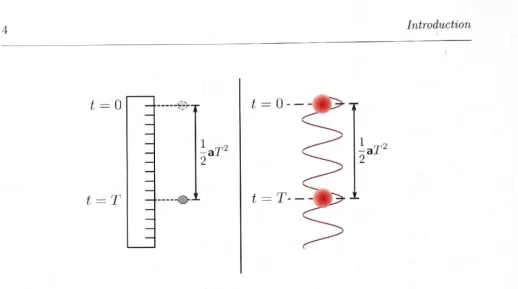
Fundamentally, a measurement of acceleration only requires a freely-falling test mass and a ruler capable of measuring the position of the test mass. If the frame of the ruler accelerates with respect to the inertial frame defined by the freely-falling test mass, then the position of the test mass as measured by the ruler will differ to that expected if the ruler was also freely falling ( see Figure 1.1). The precision of the inertial measurement is therefore determined by the graduations marked on the ruler.
4 Introduction
t=O
---~="r
[image:20.618.70.589.22.311.2]t
=T
---0Figure 1.1: Illustration of a measurement of acceleration, a, with a freely-falling test mass and a ruler (left). "\Vi thin the specific context of atom interferometry, the test mass is an atom and the
ruler is an optical lattice (right). If from time t
=
0 to time t=
T the test mass is stationary, as measured by the ruler, then there is no acceleration. However, if the test mass is displaced relative to the ruler, then the frame of the ruler is accelerating with respect to the inertial frame definedby the freely-falling test mass. The size and direction of the acceleration is determined from the change in the test mass position and the elapsed time T.
masses, while the optical lattices (which are fixed in the lab frame) function as a ruler (see Figure 1.1). The graduations of this 'optical ruler' are determined by the light wavelength,
which is on the order of rv 500 nm. The position of the atoms relative to the optical ruler
is encoded in the phases written onto the atoms by the light. The overall phase difference between the two wave packets is due entirely to the phase shifts imparted by the laser, and this is sensitive to the linear acceleration, a, of the lab frame (see Section 3.3.1):
(1.1)
where <Pi is the phase of the ith laser pulse, nkerr is the momentum that is effectively transferred to the atoms by the optical beamsplitters and mirror, and Tis the time between pulses, during which the atoms freely evolve. The phase shift <I> is proportional· to A
=
kerrT2, the space-time area enclosed by the arms of the interferometer. For an atom interferometer with a flux of N atoms/s at the shot-noise limit, the sensitivity of ( or the uncertainty in) the measurement is(1.2)
where kerr
=
lkerrl. This shows that there are three possible means of improving the sensi-tivity of an atom-interferometer-based inertial sensor: increase the flµx, increase the time between pulses and/or increase the momentum imparted to the atoms via the beamsplitters and mirrors1. This would suggest that the best atom-interferometer-based inertial sensors would be high flux with a large enclosed space-time area. However, this is not true for the current generation of inertial sensors. To date, the best state-of-the-art measurement of gravity, g, with an atom interferometer has a sensitivity of~6.g/g= 1.1
x 10-8/
../Hz
[79].1
Strictly, there is a fourth route: squeezing the quantum state of the atomic source below the shot-noise
Introduction 5
Time
~ I
---
~
I
'
I
' '
'
.
'
' '
~
'
'
'
----
!
~
--.
!
',,
-~
C:
' '
0 ~
+-'
l/l I•
.,
..
•I0
[image:21.608.136.475.103.363.2]0..
T
T
Figure 1.2: Space-time diagram of an atom interferometer in the Mach-Zehnder configuration, which functions as an inertial sensor. An initial atomic cloud is coherently split, reflected and recombined by three optical pulses, separated by time T. The phase imprinted onto each atomic wave packet by the light is proportional to the position of the wave packet.
This interferometer used an atomic fountain of laser-cooled (but still thermal) caesium atoms with a flux of N
=
107 atoms/s, stimulated Raman transitions for the beamsp lit-ters and mirrors (keff=
2nk, where k is the wave-vector of the light pulse) and a free propagation time T=
400 ms between pulses. Although practical constraints on the size of interferometers put limitations on the size of T ( 400 ms is the longest reported for gravimetry), atom fluxes for thermal beams are around 1011 atoms/s [80], and there ex -ist multiple Bragg-pulse mirrors capable of transferring 101 units of momentum [81]. Of course, atom interferometers with high flux and large space-time area are not yet amongst state-of-the-art inertial sensors precisely because current sensitivities are not limited by flux and space-time area. Current devices are limited by classical noise sources, such as vibrations [82], wavefront aberrations in the laser pulses and the Coriolis effect [49, 83, 84]. All these noise sources affect the spatial properties of the atomic source and impinge on the ability to mode match the atoms to the laser pulses that form the optical ruler so crucial to inertial measurement.6 Introduction
1.
2
Bose-Einstein Condensation
Perhaps the most stunning example of matter behaving as waves occurs in Bose-Einstein
condensation (BEC). The history of BEC began before the complete development of quan-tum mechanics with the statistical work of Bose and Einstein. In 1924, Bose attempted to explain Planck's blackbody spectrum by developing a statistical theory of indistinguish-able massless bosons [85]. The following year, Einstein extended Bose's statistics to include massive indistinguishable bosons [86]. Einstein also predicted that below a finite critical temperature, a sample of indistinguishable massive bosons would cease to obey Bose-Einstein statistics and instead undergo a phase transition, where all the bosons condense into the lowest single-particle quantum state. In this regime, the bosons can no longer be individually identified, and thus the sample behaves as a single, coherent matter wave. Einstein's prediction of BEC remained untested for many years, and it took significant de-velopments in laser and evaporative cooling and atomic traps before it was experimentally realised. This occurred in 1995, when condensates of rubidium [87] and sodium [88] atoms were created. Due to the coherent quantum mechanical properties of BEC, its isolation from the environment and its high controllability using a combination of optical, rf and magnetic fields [89], BEC has the potential to address a broad range of research questions in fundamental and applied science. These include studies in quantum nonequilibrium thermodynamics [90], entanglement of massive particles [91] and the quantum simulation of both cosmological phenomena, such as Hawking radiation emitted from a black hole's event horizon [92], and phase transitions in condensed matter, including superconductivity and quantum magnetism [93].
Of particular interest to precision measurement is the atom laser, which is the atomic analog of the optical laser (see Figure 1.3). A complete discussion of the atom laser is beyond the scope of this thesis; for a precise definition of an atom laser, a review of experimental progress in the development of the atom laser and a discussion of its potential for precision measurement, the interested reader is directed to [94]. We merely note that the atom laser's narrow linewidth [95], high brightness [96], negligible nonlinear mean-field effects [97] and control over the quantum state ( allowing for the possibility
of squeezing [98, 99]) makes it a highly suitable source for an atom-interferometry-based inertial sensor. However, atom laser technology is still in its infancy, and a number of theoretical and technical challenges must be overcome in order to realise its full potential.
1.3
Research Questions Addressed
in
this
Thesis
Thus far, we have hypothesised that the properties of BEC ( and, mo.re s.pecifically, atom lasers) make them ideal candidate sources for the next generation of improved inertial sensors based on atom interferometry. Whether this is true will depend, in part, on the answers to the following questions:
1. Is there any advantage in using Bose-condensed sources over laser-cooled thermal sources in inertial sensing with large space-time area atom interferometry?
2. Can a high flux, low momentum width, continuously pumped atom laser be built and stably operated?
Providing definitive answers to these two questions is well~ beyond the scope of a single thesis, and is more properly the topic of an entire research programme. Nevertheless, this thesis makes a contribution towards answering these questions by addressing two related
Introduction
(b) Pumping mechanism
Trap (resonator)
•
BEC
(lasing mode) Outcoupling (
~ mlaser
7
Figure 1.3: Schematic diagrams of ( a) a photon laser and (b) a continuously pumped atom laser (Source: p. 4 of [1001). In (b), the parabola and diagonal line represent the trapping and grav
i-tational potentials, respectively, and the blue Gaussian is the ground state wavefunction for the
harmonic trapping potential. Both atom and photon lasers are composed of a lasing mode confined within a resonator. This lasing mode is macroscopically populated with bosons from a ( cont
inu-ously replenished) reservoir via Bose-enhanced scattering. The beam of both lasers is formed by outcoupling bosons from the lasing mode. In an optical laser, the lasing electromagnetic mode is supported by a resonator formed from mirrors and/or gratings. In contrast, an atom laser has an
electromagnetic resonator that confines the macroscopic matter wave of atoms.
1.3.1 Near-Term Improvement: Large Momentum Transfer Mirrors and
Beamsplitters and a Bose-Condensed Source
As shown by equation (1.2), the sensitivity of a shot-noise-limited measurement scales
linearly with the momentum imparted by the atom-optical elements to the atoms. The development of large momentum transfer (LMT) beamsplitting has been crucial for the precise atom-interferometric measurements of the fine structure constant [49], and it will almost certainly be required for the sensitivities desired in future atom-interferometer -based inertial sensors. Indeed, the proposed gravitational wave detector based on atom interferometry requires LMT beamsplitters and mirrors capable of transferring 1000 photon recoils [71]. This is a couple of orders of magnitude above the 24 photon recoil LMT atom -optical elements of Muller et al. [101], which were used in the largest momentum transfer atom interferometer capable of phase measurement to date. Certainly, part of the difficulty
in capitalising on LMT relates to the optical wavefront distortions and Coriolis effects that plague the thermal sources used in these interferometers. Indeed, this is suggested by the result of Debs et al., who constructed a BEC gravimeter, utilising LMT mirrors and beamsplitters, that had superior fringe contrast to a similar thermal source gravimeter
[102]. Nonetheless, it does not immediately follow that Bose-condensed sources will provide better sensitivities. For these difficulties are technical in nature, and therefore a technical solution may present itself. A recent example is a tip-tilt mirror, capable of ameliorating noise due to the Coriolis effect [103].
In the first part of this thesis, we ignore these technical effects due to the transverse
momentum width of the atomic source, and ask the question: What is the fundamental effect of the longitudinal momentum width of the source on the efficiency of Bragg LMT
mirrors and beamsplitters? We restrict our considerations to Bragg diffraction, as the other LMT contender, Bloch oscillations [104, 105], is an adiabatic process that requires
8 Introduction
the fine structure constant
[
49
])
.
The full analysis and conclusions are outlined in Chapter 4, and they reveal that source momentum width does matter for LMT with Bragg pulses. More precisely, narrow mo
men-tum width sources (such as an expanded BEC or an atom laser) allow for high efficiency
Bragg atom-optical elements, whereas broader momentum width thermal sources are fun-damentally limited to poorer efficiencies. Our work suggests that there is an advantage to using Bose-condensed sources over thermal sources for inertial sensing based on atom interferometry, even after taking into account the lower flux of Bose-condensed sources
compared to laser-cooled thermal sources. Coupled with the other advantages of a
nar-row momentum width, such as a higher tolerance to optical wavefront distortions and the Coriolis effect, this suggests that an improvement to atom-interferometer-based inertial measurements could be driven, in the near term, by moving to Bose-condensed sources
and utilising Bragg LMT mirrors and beamsplitters.
1.3.2
Medium-Term Improvement: A Feedback-Cooled BEC For Stable
Atom Laser Operation
In the medium to long term, further improvements to the sensitivity of atom-interferomete r-based inertial sensors will require the development of a higher flux, narrower momentum
width source. This is a continuously pumped atom laser. However, there are still a number
of theoretical and technical issues that need to be addressed before atom lasers are s
uit-able for high precision atom interferometry. One particular issue relates to the stability of
an atom laser under strong outcoupling (from the source BEC) and continuous pumping.
The strong outcoupling needed for a high flux source can cause atom laser shutdown
[106],
whereas continuous pumping only leads to stable operation in the high interatomicinter-action regime, where the pumping also causes a broadening of the atom laser linewidth (i.e. momentum width) [107,
108].
Both these issues are due to the presence of density fluctuations in the BEC from which the atom laser beam is outcoupled. In the latter partof this thesis, we ask the question: Can measurement-based feedback control be used to
reduce density fluctuations in a trapped BEG?
Measurement-based feedback control has shown promise for improving the control of quantum systems. Early experiments
[109-
113]
and much theoretical work[114
-
11
8
]
onthe feedback control of quantum systems has been applied to relatively low-dim_ensional
systems. The first study of feedback control on ultracold gases showed that it could be
used to reduce the effect of phase diffusion in a continuously pumped single-mode atom laser
[119
,
120]. Using feedback to control the spatial degrees of freedom of a trapped atom was examined by Doherty and Jacobs[117],
who considered a continuous positionmeasurement of an atom with harmonic confinement. By assuming an initial Gaussian state
for the system, and applying Linear-Quadratic-Gaussian (LQG) control
[11
8
].
(Sec. 6.4);they were able to calculate the optimal cooling scheme even in the presence of measurement
backaction. As shown in Chapter 5, this work also applies to the feedback cooling of a
non-interacting BEC undergoing a continuous position measurement. In Chapter 6, we
investigate the robustness of this control scheme, and show that feedback-cooling is still possible when particular experimental imperfections are included. In Chapters 7 and 8· we present and analyse a feedback-control scheme for an interacting condensate based on
phase-contrast imaging. This gives a continuous measurement of the density profile rather
t
Introduction 9
is a viable option for reducing density fluctuations in a condensate, which is a necessary step towards the high flux, narrow momentum width atom laser sources required in order to achieve increases in sensitivity orders of magnitude beyond the current generation of atom-interferometer-based inertial sensors.
1.4 Outline of Thesis
To begin, Chapter 2 provides a brief introduction to the semiclassical model of atom-light interactions and Bose-Einstein condensation. The theory from this chapter is used extensively throughout the entire thesis. Chapters 3 and 4 address the question of source choice for LMT atom interferometry with Bragg pulses (see Section 1.3.1). Chapter 3 introduces atom interferometry, with a particular focus on inertial sensing, and the semi-classical theory of Bragg scattering with light. This provides the necessary background for
Chapter 4, which investigates the effect of source momentum width on the sensitivity of a Bragg LMT atom interferometer in the Mach-Zehnder configuration. Incidentally, the tools developed in this chapter allow for the numerical optimisation of Bragg beamsplit-ters and mirrors. Chapters 5 - 8 address the prospect of stabilising an atom laser with measurement-based feedback control (see Section 1.3.2). Motivation for the development of a feedback-cooled BEC is given in Chapter 5. This chapter also introduces quantum filtering theory via a derivation of the quantum filtering equation (which provides the best-estimate of the quantum state) for a non-interacting BEC via a cavity-mediated continuous position measurement. Chapter 6 considers the effects of experimental imperfections on the viability of this control scheme. In particular, the filter is shown to be robust under the corruption of the measurement signal by classical noise, the mismatch of system and filter parameters and a time delay of the control signal. Chapter 7 presents a feedback-control scheme for a BEC (with interatomic interactions) imaged with off-resonant laser light. The quantum filtering equation for this apparatus is derived, and shown to give a measurement of the condensate's density. A semiclassical analysis of this control-scheme is presented in
Chapter 2
Atom-Light Interactions and
Bose-Einstein Condensation
This chapter introduces results and techniques from two areas of quantum-atom optics that are ubiquitous throughout this thesis: the interaction of light with atoms, and the theory of
Bose-Einstein Condensation (BEC). We begin with the former, focussing in particular on
the dynamics of a two-level atom interacting with a classical monochromatic radiation field. This simple semiclassical model will be used to describe the mirror and beamsplitting light pulses needed for atom interferometry. Furthermore, it introduces concepts, such as dipole coupling, the rotating wave approximation and interaction picture, that are important for understanding the more complicated feedback-control models developed and analysed in
this thesis. The second part of this chapter introduces the theory of BEC from a field-theoretic perspective. In particular, the second quantisation approach used throughout this thesis is briefly introduced, along with the full-field and semiclassical (mean-field) dynamics of the BEC. Finally, some brief results on the ground state of the condensate are
presented.
2.1
Two-Level Atom Interacting With a Classical Radiation
Field
\!\Te begin by considering the coupling of an atom ( of mass M) with a classical electromag -netic field. vVe assume an idealised atom consisting of only two electronic levels, ground (g) and excited (e), with energies
nw
9 andnw
e
,
respectively. Furthermore, the modes of theradiation field are assumed to have wavelengths much greater than the Bohr radius of the atom. In this limit, the atom-light coupling is predominately determined by the coupling between the classical radiation field and the atomic dipole moment1, which is assumed to arise from a single electron moving within the atom .. This treatment is most satisfactory for the optical transitions of hydrogen and hydrogen-like atoms ( e.g. alkali atoms and alkali-earth ions) used in many atom-optics experiments. The Hamiltonian describing this semiclassical atom-light interaction is
A2
A p A A
H
=
2M
+
nw
9lg)(gl+
nwele)(el - d · E(r, t), (2.1)where
d
qr e is the dipole momentum operator ( q<
0 is the electron charge and f eis the operator for the electron position relative to the atom's centre-of-mass position),
1
This can be rigorously shown from the minimal-coupling Hamiltonian, which is derived by imposing local gauge invariance on the Schrodinger equation for a free electron. See, for example, [121] (pp. 146 -149).
12 Chapter 2: Atom-Light Interactions and Bose-Einstein Conde7:sation
E(r
,
t) is the classical electric field operator andr
andp
are the centre-of-mass positionand momentum operators of the atom, respectively, satisfying the usual commutation relation [xi,Pj]
=
inbij· Importantly, the centre-of-mass atomic operators commute with the electronic operators.In the electronic state basis, the dipole operator can be written as the following matrix:
(2.2)
Since the Coulomb potential felt by the electrons is even with respect to x, y and z, the
electronic position wavefunctions for the ground and excited states must be even or odd.
This implies that the diagonal elements of the dipole operator are zero. We denote the
off-diagonal terms by dge
=
q(glrele) and deg= q(elrelg)=
d=g·We consider a plane wave radiation field
E(r
,
t)=
E0 cos (wt - kL ·r
+¢),where E0 is the electric field amplitude (and polarisation), w the frequency, kL the wave vector and¢the phase. Also,
(2.3a)
(2.3b)
For simplicity, we set
e =
1r such that dge · E0=
deg · E0=
-ldge · Eol- This can beachieved with a real E0 and an appropriate choice of the phase of lg). We can therefore write the dipole coupling term as
-d ·
E(r, t)=
(lg) (gl + le) (el)[-d ·
E(r,t)]
(lg) (gl + le) (el)=
nfl (lg)(el + le)(gl) cos (wt - kL ·r
+ ¢),where
fl=
ldge · E01/n
is called the Rabi frequency. Note also thatCOS (wt - kL. f
+
<p)=
1
(
i(wt-kL·f+¢,)+
e-i(wt-kL·f+¢,))=
t (
ei(wt-kL·f+¢)+
e-i(wt-kL'f+<P))j
d3p IP) (Pl(2.4)
=
1
J
d3p ( ei(wt+¢) IP - nkL) (Pl+ e-i(wt+¢) IP+ nkL) (Pl)' (2.5)where we have used exp (±ikL · r) IP)
=
IP± nkL). Denoting the tensor products of theelectronic states with the atomic centre-of-mass momentum state as lg, p) and le, p), we
obtain
A A
J
3nfl
[
'(
t dJ) ' •-d · E(r, t)
=
d p2
e2
w + · (lg, p - nkL) (e, Pl+ le, p - nkL)
(g,
Pl)+ e-i(wt+<,t,) (lg, p + nkL) (e, Pl+ le, p + nkL)
(g,
Pl)]J
3nrl [
i(wt+¢) ',=
d P2
e (lg, p) (e, P + nkLI + le, p)(g,
p + nkLI)-i(wt+<t>)
(I
) (
I
]
+ e g, p + nkL e, p + le, p +,nkL) (g, Pl) .
(2.6)
This shows that the radiation field both couples the two electronic levels of the atom and
2.1 Two-Level Atom Interacting With a Classical Radiation Field 13
We can simplify the Hamiltonian further by transforming to a frame rotating at the
laser frequency w. Formally, this is done by separating fI
=
H
0+
V,
with'vVe now move into the interaction picture using the unitary transformation
A ( i A ) U
=
exp ...,..YiH0t
,
in which case
V
---+VI',
whereA At A A
VI'= U VU
(2.7)
(2.8)
(2.9)
=
t~
+n~
J
d3p ( e-i[(weg-w)t-¢] lg, p)(e,
p + fikLI + ei[(weg+w )t+.P] le, p) (g, p + fikLI+ e-i[(we9+w )t+¢] lg, p + fikL) (e, Pl+ ei[(weg-w)t-¢] le, P + fikL) (g, Pl) , (2.10)
where weg
=
we - w9 is the energy difference between the two levels. This Hamiltoniancontains terms that co-rotate at frequencies ±(weg - w), and those that counter-rotate at frequencies ±(w+we9). Provided lwe9-wl
«
lw
e
9+w
l
,
these counter-rotating terms average to zero on the timescale of interest. This is the rotating wave approximation (RV/A). It is an excellent approximation for optical frequency radiation, where w is on the order of 1015 Hz. It also has validity for longer wavelength radiation (such as radio frequency)provided the radiation is sufficiently close to the atomic resonance. After making the RWA, the interaction Hamiltonian is
where .6.0
=
weg - w is the detuning of the laser from the atomic resonance.Finally, we remove the atomic kinetic energy operator by moving to the centre-of-mass atomic frame, and remove the time-dependent exponentials by shifting the zero of energy.
This is formally done by writing
VI'
=
iib
+
v
'
'
with(2.12)
(2.13)
where wD(P)
=
kL ·p
/
Mis the Doppler frequency shift and wr=
nlkLl2 /21\II is the atomic14 Chapter 2: Atom-Light Interactions and Bose-Einstein Condensation
in (2.11) remain unchanged. However, the time-dependent exponentials in the off-diagonal terms are rotated away. For example,
l
g
,
p)(e,
p+ nkLI
-tu'tlg,
p)(e,
p+
nkLI
U
'
=
exp { i [ :~+
~
(L,0 +wD(P)+
w,)
]
t}
1
9
,
p)(e, P+rikLI
x exp
{-i
[
(p~:d -
~
(L,o+
wn(P +hkL) -w,)]t}
'!":,. t ( )
=
/
0le,
p+ nkL
) (
g,
Pl,
2.14where we have used [(p
+ nkL
)
2-p
2]/2M]=
wD(P) +wr and wD(P+ nkL)=
wD(P)+
2wr· We therefore obtainA A
,t
A ' A 'Vr = U VU
=
J
d3p
nllip
)
(l
e,
p+ nkL
)(e,
P+
nkLI -
l
g
,
p)(
g
,
P
l
)
+
n~
Jd
3p(
ei
1lg
,
p
)(e,
p+nkLI
+e
-
i
11
e,
p+nkL
)(
g
,
pl)
'
(2.15) wherefl (p)
=
Llo+ w
p (p)+ wr.
(2.16) The Hamiltonian (2.15) factorises into a product of 2-dimensional Hilbert subspaces, each with Hamiltonian(2.17)
where the two basis vectors are
lg
,
p
)
= (~)
'
(2.18)The shift in the detuning from Ll0 -t Ll(p) is an artefact of moving to the atom's rest frame ( which shifts the resonance w0 -t w0
+
w D (p) with respect to the radiation field in the lab frame) and an additional energy shift due to the kinetic (recoil) energynwr
absorbed by the atom due to the photon. Overall, the atom's resonant frequency is w0=
Weg+
wD(P)+
Wr· Typically Weg»
wD, wr, and so Wo::::::; Weg· This is the conclusion drawn in many textbook treatments of this semiclassical atom-light interaction; where the effect of the light's momentum on the atom is neglected by the approximation E(r, t)::::::; E(t). We have included the atom's centre-of-mass momentum in this treatment, as this i~ relevant to the discussion of atom interferometry in Chapter 3.Physically, the Hamiltonian (2.17) shows that the radiation field couples
l
g
,
p) andl
e,
p+
nkL).
Ultimately, we are interested in how the system coherently evolves under this coupling. An arbitrary state can be written asl1P(
t
))
=
J
dpl1P
p
(t)),
(2.19),,
where
2.1 Two-Level Atom Interacting With a Classical Radiation Field 15
for ground and excited state amplitudes c9 and ce, respectively. Substituting the state [1Pp(t)) and the Hamiltonian (2.17) into the Schrodinger equation
8
Ain
0tf'l/Jp(t))
=
Hp[1Pp(t)), (2.21)gives the following set of coupled first order differential equations:
(2.22)
Analytically solving these equations for general time-dependent 0,
.6.
and¢ can be difficult, if not impossible, and continues to be a source of research interest2. Nevertheless, we canobtain physical insight into the atom's response by examining the following special cases.
2.1.1
Special Case: Constant D,
~and
¢.
This is the typical two-state problem considered in most introductory atomic and optical
physics textbooks. The solution to equation (2.22) is3
(2.23)
where a± and b± are constants and>..± are the eigenvalues of the matrix in equation (2.22). These are determined by solving the secular equation
Hence
O _ i.6./2 - >..± - iOeic/> /2
- -iOe-ic/> /2 -i.6./2 - >..±
=
(i.6./2 - >..±) (-i.6./2 - >..±)+
02=
>..i+ (02
+
.6.2)/4. (2.24)(2.25)
where we have defined the effective Rabi frequency Oeff
=
J
02+
.6. 2. The constants a± and b±, which define the eigenvectors of the matrix in equation (2.22), are determined fromthe initial conditions c9(0) and ce(O):
Substituting equations (2.25) and (2.26) into (2.22) gives the solutions
c9(t)
=
c9(0) cos (Oefft/2)+
i ( O~ff c9(0)+
O~ff eic/> ce(O)) sin (Oefft/2),ce(t)
=
ce(O) cos (Oefft/2) - i(n.6.
ce(O) -no
e-ic/>c9(o))
sin (Oefft/2),~ teff ~ 'eff
(2.26a)
(2.26b)
(2.27a)
(2.27b)
2
In contrast, numerical solution is trivial in all but the most pathological of cases.
3
16 Chapter 2: Atom-Light Interactions and Bose-Einstein Conde7:sation
or
(cce( 9
(t))
t)Now suppose the atom is initially in the ground state: c9(0)
=
1, ce(O)=
0. Then the probability that the atom is in the excited state, as a function of time, is2
~i .
2 (nefft)
Pe(t)=
lce(t)I
= -
2- sm-2- ·
neff
(2.29)
The name Rabi frequency now become clear, as this is the frequency at which Pe(t) os-cillates when Li
=
0. More generally, the effective Rabi frequencyOeff
is the frequency of probability oscillations. Increasing O increases the strength of the coupling, and the rate at which the atom 'flops' between the ground and excited state. Detuning further from the resonance also increases this rate of flopping, but decreases the amplitude of Pe(t). In the limitllil
»
0, the radiation field is sufficiently off-resonant that Pe(t) ~ 0, and so the excited state ceases to take part in the system dynamics.It is interesting to note that these solutions are formally identical to those of an un-damped classical oscillator (with resonant frequency w0 ) driven by a monochromatic plane wave of frequency w.
2.1.2 Special Case: On Resonance (~ =
0)
and Constant¢
Assume initial condition c9
(0)
=
1, ce(O)=
0.
In this case the solution is [122,123]c9
(t)
=
cos(tit
dsO(s)),ce(t) · - ieic,i>sin
(tit
dsO(s)).(2.30a)
(2.30b)
These solutions are also approximately valid for time varying phase¢, provided
1
¢1
«
0/2.2.2 Introduction to Bose-Einstein Condensation
In this thesis, the atom-light interactions described thus far are used t0 manipulate the atomic state of a Bose-Einstein condensate (BEC). It is therefore appropriate to give a brief overview of some of the basic theory underpinning our understanding of BEC. Broadly speaking, BEC occurs when there is a macroscopic population in the ground state of the system. Perhaps surprisingly, BEC is a simple consequence of the statistics obeyed by identical massive bosons (integer spin particles). For a gas of
N
nqn-interacting bosons, the mean occupancy of each energy state is given by the distribution [124]1
(ni)
=
e(Ei-µ)/kBT _ 1' (2.31)'
2. 2 Introduction to Bose-Einstein Condensation 17
classical distinguishable particles, indicating that virtually all the bosons are in excited states. However, for low temperatures it is possible for the ground state to be occupied
by a significant fraction of the atomic population. In particular, if the temperature T for a three-dimensional gas of free bosons in the thermodynamic limit N ---+ oo drops below a critical temperature Tc, the gas undergoes a sharp phase transition, whereupon all atoms
in the gas occupy the ground state. Heuristically, the value of the critical temperature
cor-responds to the temperature where the thermal de Broglie wavelength is on the order of the
interparticle spacing. In practice, most experimental work on BEC use alkali atoms that are magnetically or optically trapped. In contrast to the continuum case, once the temper-ature of a gas of trapped bosons falls below the transition temperature, the occupation of the ground state increases smoothly as a function of decreasing T. Nonetheless, the
scal-ing of this ground-state occupation with temperature is still dramatic. For example, when
the bosons are confined within the harmonic potential
V(r)
=
M(w;x2+
wiy2+
w;z2)/2,where M is the mass of each boson and wi is the trap frequency for the ith direction, the
number of bosons in the ground state is [124] (pp. 21 - 24)
(2.32)
Here N is the total number of bosons and the critical temperature is
(2.33)
where w
=
(wxwywz)l/3 is the geometric mean of the trapping frequencies. More generally, the values for (n0 ) and Tc are dependent on the density of states, and therefore the choice of potential.For a condensate of N
=
104 rubidium-87 atoms, in a symmetric trap with frequencieswi
=
21r x 50 Hz, the critical temperature is Tc rv 2 µK. At T=
0.5 µK, more than 94 % of the atoms have condensed. Intriguingly, when finite-size effects and interatomic interactionsare accounted for, this only modifies the critical temperature by a few percent [125].
2.2.1 Brief Review of Second Quantisation
The argument for the existence of BEC from statistical mechanics, as sketched above, is
essentially that proposed by Einstein in his 1925 paper [86]. Although elegant, similar statistical techniques are limited in their applicability to theory and experiment in modern atom optics. A more powerful approach is to treat the atoms in a BEC as a bosonic field.
This requires the theoretical tools of quantum field theory4. Briefly, quantum field theory
is the fundamental description of a multiple particle quantum system. The general state
I\JI) for a many-body system is most conveniently expressed as a linear combination of
Fock (or number) states
ln
1,n
2 , n3 , .. . ), where ni denotes the number of particles in the ith single-particle state. Specifically, if there are k single-particle states thenCX) CX) CX)
I\JI)
=
L L
...
L
cn1,n2,·-·,nk(t)ln1,n2, '· · ,nk).n1 =0 n2=0 nk=O
4
A complete treatment of quantum field theory is beyond the scope of this thesis. For an excellent







![Figure 4.3: equation ( 4.62)]. Note Plot of the mirror fidelity F( w) as a function of the dimensionless width, w [see that the function monotonically decreases with increasing w](https://thumb-us.123doks.com/thumbv2/123dok_us/8209158.262791/85.605.176.418.90.281/equation-fidelity-function-dimensionless-function-monotonically-decreases-increasing.webp)
![Figure 4.4: Plot of the maximum mirror fidelity, maxiF(t), as a function of momentum width, O", under the assumption of Raman-Nath scattering [see equation (4.65)]](https://thumb-us.123doks.com/thumbv2/123dok_us/8209158.262791/87.605.126.460.90.331/figure-maximum-fidelity-function-momentum-assumption-scattering-equation.webp)
