Individual
based
simulation
for
online
marketplace diffusion among trading small
medium enterprises:
A
conceptual framework
Singgih Saptadi1,2,*, Arlita Rahma Widyasrini1, Bonita Melinda Pangaribuan1, Sriyanto1 and Ary Arvianto1,2
1Industrial Engineering Department, Diponegoro University, Semarang, Central Java, Indonesia 2
Logistics and E-Business Research Center, Diponegoro University, Semarang, Central Java, Indonesia
Abstract.The number of Indonesian SMEs and Indonesian Internet users are increasing. This situation is of concern to the Indonesian government. The government then launched a SME go online program with a target of 8 million SMEs using the online platform in 2019. One of the online platforms that SMEs may use in Indonesia is the online marketplace such as Tokopedia, Bukalapak and others. Previous research studied the factors that support or hinder the adoption of e-commerce in SMEs environment but had not explored how the interaction of those factors in the adoption of online marketplace. In a social system, the diffusion and adoption of online marketplaces in SMEs is influenced by socio-economic characteristics, personality variables and communication behaviours that exist and are acquired by individuals. This paper describes a conceptual framework for the development of an individual-based simulation commonly referred to as an agent-based simulation to understand the adoption by SMEs and the diffusion of online marketplace in SME environments.
1 Introduction
Small and medium enterprise (SME) is a labor-intensive company with requirements such as education, worker skills, capital or technology tend to be simple [1]. Indonesian Ministry of Cooperatives and Small Medium Enteprises stated that the number of SMEs in Indonesia in 2013 amounted to 57,800,000 units (99.9% of business enterprises in Indonesia). With that amount, SMEs have huge contributions to Indonesian economy within last five years that are 60.34% of Product Domestic Brutto and 97.22% of national employment (http://www.kemenperin.go.id/artikel/14200/Kontribusi-UMKM-Naik).
Internet has a very rapid user growth. Currently, internet penetration in Indonesia reached 53.7% of population [2] and this means more than 140 million internet users in Indonesia. With a huge and growing market potential, internet use by SMEs is a concern of Indonesian government. Considering the contribution of SMEs to Indonesian economy and the economic potential of the internet, the government launched a SMEs go online program
*
with a target of 8 million SMEs utilizing online platforms in 2019 [3]. An online platform that is feasible to be utilized by SMEs freely and easily is marketplce online in Indonesia. Some of the known online marketplace are Tokopedia, Bukalapak and others. Unfortunately, until 2017 only 3.79 million SMEs that utilize the online platform.
The online marketplace is a form of e-commerce that is often referred to as multichannel ecommerce. The development of internet technology enables the emergence of new varieties of e-commerce. As an innovation, the online marketplace is perceived as something new [4] in marketing SME products. The diffusion of online marketplace in the SMEs environment is influenced by various factors, both the supporting factors and the inhibiting factor of online marketplace adoption by SMEs..
Some researches studied the factors that support or hinder the adoption of e-commerce, especially in the SMEs. MacGregor & Vrazalic studied factors that drive e-commerce adoption by SMEs in Wollongong (Australia) and Karlstad (Sweden) [5]. These factors are: consumer demand, increased sales, and increased control of goods. Govindaraju & Chandra studied the inhibiting factor of e-commerce adoption by SMEs in Indonesia and showed that human resource and sources of information as two inhibiting factors [6]. Saptadi et al examined the influence of SME owners' support and SMEs IT sophistication on IT adoption by SMEs [7].
These studies have not explored how the interaction of various factors in the adoption of online marketplace. The diffusion of the online marketplace, as well as the diffusion of other innovations, occurs in a social system. In social systems, the diffusion of the online marketplace in SME environments and the adoption of online marketplace by an SME is influenced by social factors and individual characteristics of the adopters. Based on this, the study sees the need for an understanding of the adoption of online marketplaces by SMEs and the diffusion of online marketplaces among SMEs through a model that illustrates the individual characteristics of the adopter and of the social system. We therefore examine the development of an individual-based model commonly referred to as an agent-based model to understand the adoption by SMEs and the diffusion of online markeplace in SME environments.
This paper explains our initial idea of individual-based modeling for online marketplace diffusion. In the next section, we describe some concepts related to the diffusion of innovation in the social systems that mostly we adapt from Rogers [4]. Then, we explain the conceptual framework that we use as the basis for the next activity in this study. This paper concludes with an explanation of our next research agenda.
2 Difusion of Innovation and Individual Based Modeling
Diffusion is a process of an idea or innovation communicated or dispersed through certain channels at a time period among members of its social system. Innovation is an idea or practice that is perceived new by individuals who will adopt it or apply it [4]. Messages or information disseminated in the process of interaction or communication containing ideas, ideas or practices that are considered new. According to Rogers, the diffusion of innovation is influenced by four elements: the innovation itself, communication channels, time, and social systems [4].
socio-economic structure. an online marketplace is also exposed to individuals who have diverse personalities and communicating behaviors [4]. Considering the online marketplace will be adopted by SMEs that have various characters and diffused in the social environment of SMEs, then understanding the diffusion of the online marketplace in SMEs requires methods that consider the characteristics of individuals that live within a social system.
Individual-based simulation is a form of computational modeling in which a phenomenon of the agent and its interactions is modeled. The modeled phenomena include the characteristics of agents, environments, and descriptions of interactions between agents and agents with their environment [8]. The answer is that in ecology, the individuals are not atoms but living organisms. Individual organisms have properties an atom does not have. Individuals grow and develop, changing in many ways over their life cycle. Individuals reproduce and die, typically persisting for much less time than the systems they belong to. Individuals need resources, so they modify their environment. Individuals differ from each other, even within the same species and age, so each interacts with its environment in unique ways [9].
3 The Conceptual Framework
In this section, we discuss the conceptual framework underlying this research. The first part of the conceptual framework is the definition of an agent. The agent or entity in this study is the decision maker in SMEs (we shortly name as SMEs), and the government. An SME interacts with other SMEs through conversations with other SMEs, news from mass media or facilitated training by the government.
As an agent, each SME has individual attributes, namely (1) adoption status as adopter or non-adopter, (2) the initial value of any inhibiting factors and drivers. In this study, we involve some of the following factors derived from previous studies: (a) Have educated human resources; (b) Knowledge of the benefits of online marketplaces; (c) Knowledge of implementation of online marketplaces; (d) Experience using electronic marketing media; (e) Have time to learn an online marketplace; (f) Have time to operate an online marketplace; (g) Online marketplace compliance with business processes; (h) Have support from management to use online marketplace; (i) the threat from competitors who are using online marketplace; (j) Get information about online marketplace from media; (k) Consumer order through online marketplace; (l) Sales increase; (m) Improved control and follow-up.
The value of these variables will change with the interaction of SMEs with other agents as well as news from the mass media. Based on the values of these attributes, SMEs may accept or reject the adoption of an online marketplace.
Start
Initiate state variables
Interaction ?
Add the value of each attribute after conversation
Each value > = mean of attribute values of
adopters
Satisfied with conversation
Advertisem ent?
Add the value of each attribute after ads
Satisfied with ads
Training? Add the value of each attribute after training
Satisfied with training Adopter?
As a partner in conversation with
non-adopter
Each value > = mean of attribute values of adopters
Each value > = mean of attribute values of adopters
All
adopter? End
Satisified with one of the
channels? Become an adopter
Y
N
Y
N
Y
N
Y
N
Y
N
Y N
Y
N
Y
N
Y
[image:4.595.134.497.76.625.2]N
Fig. 1.Process overview.
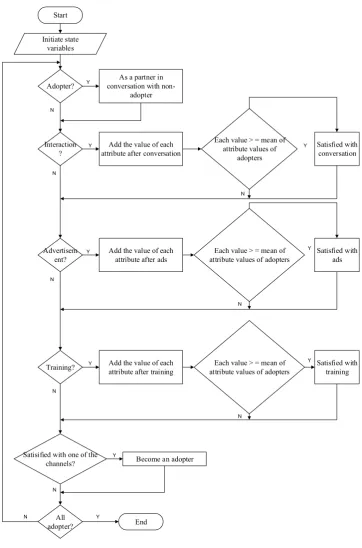
Second channel in diffusing online marketplace is news from mass media. If an agent with a potential status receives information about an online marketplace from mass media or advertising, it will receive an additional value of the online marketplace and if this value is greater than the marketplace's online information adopter value of the ad, then the agent is satisfied with the advertisement and they may become new adopter or stay as non-adopter.
than the value of the online marketplace information adopter of the training, then the agent is satisfied with the training and they may become new adopter or stay as non-adopter.
4 Next Agenda
This paper presents a conceptual framework for the development of individual-based simulations (agent-based models) from the diffusion of the online marketplace. The conceptual framework includes defining agents / entities and developing process overviews. This paper describes UKM as an agent that has several attributes. The agent attributes include the current status of adoption and the factors that influence the adoption of an online marketplace by SMEs. The process overview explains how SME attributes shift the status of SMEs from non-adopters to adopters.
The conceptual framework will be used in this research. A questionnaire will be developed and distributed to trading SMEs. The results of data collection will be processed and elaborated to obtain any patterns of characteristics of SMEs in adopting the online marketplace.
The definitions of agents and their attributes and characteristic patterns of SMEs in adopting will be translated into agent-based simulation languages. To date, we have not determined the software for agent-based simulation programming. based on popularity, Netlogo is the strongest candidate to be chosen. Our simulation results will be analysed to gain a deeper understanding of the diffusion of online marketplace in the SME trading environment.
References
1. D. D. Utama, Darwanto, Pengembangan Usaha Mikro Kecil Dan Menengah (UMKM) Berbasis Ekonomi Kreatif Di Kota Semarang. http://eprints.undip.ac.id/40407/ (Diponegoro University Institutional Repository, 2013)
2. Internet World Stats, Internet Usage in Asia.
https://www.internetworldstats.com/stats3.htm. (2017)
3. K. Ayuwuragil,. Kemenkop UKM: 3,79 Juta UMKM Sudah Go Online
.https://www.cnnindonesia.com/ekonomi/20171115161037-78-255819/kemenkop-ukm-379-juta-umkm-sudah-go-online. (CNN Indonesia, 2017) 4. E. M. Rogers, Diffusion of Innovations (5thed.). (The Free Press, NewYork, 2003) 5. R. MacGregor, L. Vrazalic, Electronic Commerce Adoption in Small to Medium
Enterprises (SMEs) A Comparative Study of SMEs in Wollongong (Australia) and
Karlstad (Sweden).
https://www.uow.edu.au/content/groups/public/@web/@commerce/@econ/documents/ doc/uow012275.pdf. (2004)
6. R. Govindaraju, D. Chandra, IEEE 3rd ICCSN, E-commerce adoption by Indonesian small, medium, and micro enterprises (SMMEs): Analysis of goals and barriers, 113-117 (2011)
7. S. Saptadi, I. Sudirman, T.M.A A. Samadhi, R. Govindaraju, Owner’s Support, IT Sophistication and IT Adoption in Indonesian Manufacturing SMEs, (2015)
8. U. Wilensky, W. Rand, An Introduction to Agent-Based Modeling, (The MIT Press, London, 1955)
9. S.F. Railsback, V. Grimm, Individual-Based Modeling and Ecology,Princeton University Press, Princeton, 2005)