Abstract: Different factors determine a company's success. The quality of the company's performance management system (PMS) is one factor that supports this success. Performance management is essentially the systematic process by which the company involves its employees in the achievement of organizational missions and objectives. Facing tighter business competition, performance management can be the best approach to increase employee motivation, boost productivity, and produce tangible impacts on improving the performance and development of the company's business. This paper presents an alternative framework of performance management system for corporate level for construction companies in Indonesia. In the development of the proposed alternative PMS, one of the performance management system approaches, namely the Knowledge - Based Performance Management System (KBPMS). The proposed framework is expected to be more suitable for construction companies in Indonesia, especially in facing global challenges and to be more competitive in this industry business competition.
Keywords: Conceptual framework, construction industry, construction companies, knowledge-based performance management system (KBPMS), performance management system (PMS)
I. INTRODUCTION
The construction industry in Indonesia has played an important role in national economic growth for decades. Driven by the increasing investment in infrastructure projects, this industry is predicted to continue to thrive over the next decade. However, the industry will face major challenges, such as the opening of global markets, project funding needs, mastery of technology, competence of the workforce, readiness of the national bureaucracy and political policies. On the other hand, business competition in the industry has become very tight both among national construction companies and with foreign companies. Meanwhile, the performance of national construction companies is considered relatively low. For this reason, national construction companies must be able to develop strategies to improve their performance so that they can improve their competitiveness.
Revised Manuscript Received on March 08, 2019.
Ima Fatima, Student - Doctor in Science and Management, School of
Business and Management, Insitut Teknologi Bandung, Indonesia.
Dermawan Wibisono, School of Business and Management, Institut
Teknologi Bandung, Indonesia; Pertamina University, Indonesia.
Akbar Adhiutama, School of Business and Management, Institut
Teknologi Bandung, Indonesia.
In order to develop the feature of the company's performance, which can compete nationally and internationally present and in the future, strategic steps must be prepared to create a wide range of improvements to the construction company's services. Efforts to improve the construction company's services can be made by controlling the factors affecting the company's performance, which ultimately determine the profit of the company in achieving its goals.
Construction industry is a complex industry, which is reflected in a system of supply-demand, which is composed of various entities actors and stakeholders. It is having different characteristics with services business in other industries, such as in the production processes and management practices applied. The complexity of internal and external factors in the construction industry has made performance management an important way to facilitate continuous business improvement (Robinson et al., 2005). Comprehensive measurement of a company's performance is essential for business transformation and enables companies to be compared on the basis of standardized instruction in order to identify and apply best practices more widely.
Performance management is an important element of business management. It gives the required data for process control and enables challenging and achievable objectives to be achieved. The implementation of business strategies must also be supported. Performance management sets performance expectations for organizations and motivates stakeholders to perform hard in the way the organization expects. In addition, the performance management system (PMS) provides organizations with a complete and professional management process to evaluate organizations ' performance results. PMS has not been widely enforced within the construction industry, however, despite its importance. Studies associated to the development and application of PMS during this industry are also still very rare, particularly in Indonesia. Construction companies often find it difficult to identify and select appropriate performance measures associated with their strategies and important processes. The decision-making process is largely supported on managers ' intuition and common sense and a number of broad financial measures that are insufficient within the competitive surroundings of these days.
This paper presents study result which is undertaken to understand factors that conclude the persistence of construction companies’ performance issues in Indonesia.
Conceptual Framework of Performance
Management System for Construction Companies in
Indonesia
Taking into consideration aspects ranging from the industry environment, existing performance management system (PMS) approaches adopted by construction companies, obstacles in implementation of PMS, to the growth of a conceptual framework of PMS that is more suitable for construction companies. In the development of the proposed alternative PMS, one of the performance management system approaches, namely the Knowledge - Based Performance Management System (KBPMS).
The result is expected to provide insight of construction business environment as well as an alternative proposed framework of PMS that is appropriate for construction companies to confront the challenges.
II. LITERATURE REVIEW
Now a day’s competitive business situations, the competitive advantage has become one of the organizations ' main objectives. Therefore, companies have made various attempts to gain and maintain competitive benefit throughout the world in the suitable industry (Kaplan and Norton, 1996; Kagioglou et al., 2001). This has often led to the adoption of recent philosophies in the manufacturing and service sectors, like synchronous engineering, lean production and plenty of others, like just-in-time(JIT), total quality management (TQM), benchmarking, reengineering of business processes (BPR). The main driver of these philosophies was to optimize the performance of an organization in its market and to rethink performance management systems through efficient performance measurement and gain competitive advantage (Kagioglou et al., 2001).
The Concept of Performance Management
Many definitions stated by previous researchers could all be referred to as performance management is an attempt to achieve a better result for organizations, teams and individuals in order to understand and manage performance in terms of objectives, standards and skills as planned and agreed upon.
The performance management method is literally regarded as a closed - loop control system that deploys policy and strategy and receives feedback from completely different levels to manage the business performance. While Hendry, Bradley and Perkins (1997) pointed out that performance Management may be a systematic approach to rising individuals or teams ' performance in order to attain organizational goals/targets.
The last 30 years, performance performance management and measuring have wide interest. Business have traditionally measured financial performance, profit, turnover, etc. These performance financial measures were the only measure of a company's success. However, the measure of performance based on financial measures can’t deal with recent modification within the trade, in particular due to the emergence of latest technologies and increased competition (Kaplan and Norton, 1992). There is criticism that ancient performance measure systems only rely on financial measures like come on investment, sales per worker, profit, efficiency, etc. (Sommerville and Robertson, 2000 ; Love and Holt, 2000 ; Amaratunga et al., 2000).
confirm their past performance, but not what contributed to it (Kagioglu et al., 2001). It was also observed that only short-term behavior was promoted by exclusive reliance on these money indicators or measures in management systems. This short - term focus led to long - term viability issues being ignored by organizations (Kaplan and Norton, 2000).
A company's performance ought to be managed in line with its business and working methods and objectives (Bititci et al., 1997). This can be the most stream of the process for performance management.
The performance measurement method determines how successful companies or individuals have achieved their goals and techniques. The results of organizational strategies and operational strategies are measured in a quantifiable form in order to watch an organization's qualitative signs (Kagioglou et al., 2001).
There are many PMS frameworks have been developed by previous researchers. Several most important approaches, are:
• Knowledge-Based Performance Management Systems (KBPMS) (Wibisono, 2006),
• Performance Prism (Neely et al., 2002),
• Kanji Business Excellence Model (KBEMS) (Kanji, 2002),
• Organizational Health Index(OHI) (McKinsey),
• The Balanced Scorecard (BSC) (Kaplan and Norton, 1996),
• Vital Signs / Quantum Performance Measurement Model (QPMM) (Hronec, 1993),
• Performance for World Class Manufacturing (PWCM) (Maskell, 1991),
• Key Performance Indicators model (KPI) (CBPP, 1990), • Performance Measurement Questionnaire (PMQ) (Dixon
et al., 1990),
• Theory of Constraints (TOC) (Goldratt, 1990),
• SMART Performance Pyramid (Cross and Lynch, 1989), • Performance Measurement Matrix (Matrix) (Keagan,
1989),
• The EFQM (European Foundation for Quality Management) excellence model (1988),
• Malcolm Baldrige National Quality Award
(MBNQA)/Malcolm Baldrige Criteria for Performance Excellence (MBCfPE) Quality (USA Trade Department, 1987).
The Balanced Scorecard (BSC), Performance Prism and the Malcolm Baldridge National Quality Award (MBNQA) / Malcolm Baldrige Criteria for Performance Excellence (MBCfPE) were among the most widely used by organizations around world.
Other general perspectives, like a competition (Neely et al., 1995) and employees (Neely et al., 2000), as well as specific applications and construction suppliers have been identified (Kagioglou et al., 2001 ; Wang et al., 2010).
MBNQA / MBCfPE is one of the most widely used models of quality management. Rather than just a quality model, it was recognized as descriptive holistic business models and transformed into a framework for business excellence (Oackland and Marosszeky, 2006).
The MBNQA / MBCfPE promotes excellence in performance and improvement in fight through seven classes used to assess the organization, i.e. leadership, strategic planning, customer focus, measurement, analysis and knowledge management, concentrate on the workforce, focus on operations and results (NIST, 2011).
Andy Neely and Chris Adams have promoted their "Performance Prism" to replace previous generation models such as a balanced scorecard and a performance pyramid. The Performance Prism aims to manage an organization's performance from five interconnected dimensions, i.e. satisfaction of stakeholders, contribution of stakeholders,
strategies, processes and capabilities. All previous
frameworks highlighted the need to translate performance measurement from strategy. However, Neely and Adams (2001) claimed that the needs and contributions of stakeholders have priority over strategies, processes and capabilities while measuring performance.
Performance Management in Construction
The core business of the construction trade is the production of new buildings or the renovation of existing ones for a variety of customers. It is therefore not surprising that performance measure in construction is traditionally approached in two ways: (a) in relation to the product as an installation, and (b) in relation to the production of the product (Kagioglou, 2001).
Performance management within the industry has not been wide implemented (Alarcón et al, 2001; Kagioglou, 2001). Although measurements of method performance have received considerable attention from educational researchers within the last two decades, the construction industry still prefers to measure performance in terms of time and cost (Bowen et al., 2002; Forbes et al., 2002These traditional (result-based) performance preferences measured in projects, in particular costs and schedules, are not suitable for continuous improvement because they are not effective in characteristic the root causes of losses in quality and productivity (Alarcon and Serpell, 1996).
Several models, such as Pyramid (Lynch and Cross, 1995) and BSC (Kaplan and Norton, 1992), were proposed to support the development of performance measurement systems, focusing mainly on balancing measures. These models are usually multi-dimensional in that they focus on a wide range of financial and non-financial measures and deal with various levels of management. They give mechanisms to facilitate the alignment of performance indicators with the strategic goals of the company and to link them to key management processes. On the effectiveness of such models, however, very little has been published. In addition,
none of them consider the requirements of projects like construction trade.
In the industry, some studies are to identify factors that affect the model and implementation of performance measurement systems (Lantelme and Formoso, 2000). Frequently, Companies often select indicators that are not difficult to collect or that deliver short - term results, resulting in a large number of performance measurement systems that do not support company strategies and critical process decision - making.
Some initiatives aimed at developing a benchmarking performance measurement system and enabling performance comparison between companies have shown that the difficulty in establishing and explicitly developing their competitive strategies, as well as strategic objectives and actions, is a major barrier to the model of a performance measurement system in construction companies (KPI Working Group in the UK, 2000 and Corporacíon de Desarrollo Tecnológico, 2002 in Chile).
The top managers of these companies often lack of organizational adaptability and culture that are essential for strategic planning (Barros Neto, 2002). When these companies formulate their strategies, top managers are responsible, while this process is generally highly intuitive, non - analytical, informal and seldom made clear to other members of the company (Barros Neto, 2002).
According to the Brazilian study (Lantelme and Formoso, 2000), performance measurement in the construction industry is increasingly concerned, for several reasons: (a) many companies have been involved in the growth of quality management systems based on quality award criteria or the ISO 9001: 2000 standard, due to the demands of public and private customers ; (b) traditional measures used in the management of production, such as productivity rates, do not provide the necessary support for decision - making in the current business environment ; and (c) companies required measures that can be used by the sector as a whole in order to carry out benchmarking.
Today, PMS are becoming standard for most companies in various industrial sector, including construction companies. However, the problems encountered by most practitioners are how can they analyze the existing implemented PMS rather than designing from scratch. It is therefore, important that the existing PMS procedures are analyzed and use as feed back to the design of the new PMS.
III. DESIGN METHODOLOGY OF PERFORMANCE MANAGEMENT SYSTEM
KBPMS can be considered as a refinement of the famous concept of the BSC(Kaplan and Norton, 1992), Performance PRISM(Neely, 2001, and MBNQA/MBCfPE, because it combines the simplicity design of BSC with Performance Prism attention on the stakeholders, and clear direction of performance indicators from the MBNQA/MBCfPE. These three are new generation PMSs that evolved from traditional PMS, which initially only concerned to financial aspects as a measure of success. The new framework pays particular attention to non-financial aspects in addition to financial aspects that are proven to be no longer a reference in measuring a company's performance.
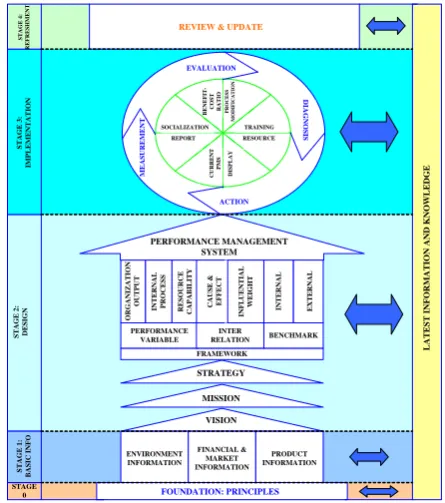
From strategic and operational structures, the KBPMS can be seen. There are two modules in the strategic part, namely the Environment and the Perspective of Business Results. The Environment Module of the Company determines the company's certain environment. The Perspective Module for Business Results analyzes financial and non-financial performance. Two modules are developed in the operational part, i.e. Internal Process Perspective and Resource Capability Perspective, and sub - modules and performance variables are available in each module.
There are four main stages in KBPMS design, namely basic information, design, implementation, and refreshment. (1) Basic Information - This stage provides company’s basic information input for the design, usually consists of environment information, financial and market information and product information. The SWOT analysis (strength, weakness, opportunity, threat) can be used at this stage, because it can not only identify unique skills, but also show the opportunities of the company (Wheelen and Hunger, 2006 in Wibisono, 2012).
(2) Design - The design stage starts with the company's vision and mission. The vision and mission statements express the organization's broad orientation and direction (Ferreira and Otley, 2009). Then, organization’s strategies can be examined by using TOWS (threat-opportunity-weakness-strength) matrix based on the SWOT analysis. This strategy is the direction of the organization chooses to pursue long-term organizational goals (Johnson et al., 2005). The process continued by variables selection which should appropriate to the company condition. The variables should be realistic and challenging. Performance variables are classified into 3 perspectives, i.e.: organization output, internal process and resource capability. Afterward, the process is followed by indicators interrelation analysis. Finally, KPIs are benchmarked internally or externally. (3) Implementation - Implementation of a PMS is based on PDCA (plan, do, check, action) Cycle popularized by W. Edward Deming (Stoop, 1996 in Wibisono, 2006). There are four main pillars in the PMS implementation i.e.: performance measurement, evaluation to the measurement result, diagnosis to identify improvement process and action to be done. To support the four functions, PMS should be designed by considering some aspects which are currently
implemented PMS, reporting system, new PMS
socialization to the whole organization levels, analysis of benefit to cost of new PMS implementation ratio, training
program to the PMS implementation, resource allocation and communication display for every employee.
(4) Refreshment - The designed PMS should be dynamic and updated to the current changes, either business competition environment, public demand, customer needs,
technological development or new performance
management system method. Changes can be happened in every stage. Beside keeping PMS up-to-date, it is also important to consider the leadership, commitment and stakeholders participation to hold the spirit that today must be better than yesterday and tomorrow must be better than today (Wibisono, 2006).
The full description of KBPMS framework design is listed in a chart shown in Figure 1.
FOUNDATION: PRINCIPLES VISION MISSION STRATEGY FRAMEWORK PERFORMANCE MANAGEMENT SYSTEM ENVIRONMENT INFORMATION FINANCIAL & MARKET INFORMATION PRODUCT INFORMATION PERFORMANCE VARIABLE INTER RELATION BENCHMARK O R G A N IZ A T IO N O U T P U T R E S O U R C E C A P A B IL IT Y IN T E R N A L P R O C E S S C A U S E & E F F E C T IN F L U E N T IA L W E IG H T IN T E R N A L E X T E R N A L
REVIEW & UPDATE
[image:4.595.314.537.224.476.2]STAGE 0 L A T E S T I N F O R M A T IO N A N D K N O W L E D G E S T A G E 2 : D E S IG N S T A G E 3 : IM P L E M E N T A T IO N S T A G E 4 : R E F R E S H M E N T S T A G E 1 : B A S IC I N F O SOCIALIZATION TRAINING REPORT RESOURCE C U R R E N T P M S D IS P L A Y B E N E F IT -C O S T R A T IO P R O C E S S M O D IF IC A T IO N EVALUATION ACTION M E A S U R E M E N T D IA G N O S IS
Fig. 1 Method to Design PMS (Wibisono, 2006) Related to the framework, no study was conducted to propose KPIs based on KBPMS for construction industry. Some previous studies used KBPMS framework in designing PMS for organizations in Indonesia (Wibisono and Kosasih 2010; Rahayu and Wibisono 2010; Wibisono 2011) have shown the effectiveness of implementation of this framework in some industries. This shows that KBPMS is appropriate to be used in various industry with no exception for construction sector.
IV. PROPOSED FRAMEWORK
As stated in the previous part, very few empirical studies were conducted to analyze and/or propose KPIs for construction company from a holistic view, particularly in Indonesia. KBPMS proposed an improved methodology for the design of a realistic PMS and its effective implementation in a production environment for Indonesia. Effectively implemented in those sectors show that KBPMS is appropriate to be used in various industry with no exception of construction
The foundations of KBPMS-based PMS development are the following principles. PMS should: 1) relate performance of the lowest level of the company to the corporate strategy, 2) a pair of measurable and well defined criteria, 3) The performance metrics standard for each criterion is very important ; procedures should be added to compare the actual performance achieved with the standards provided, 4) foster continuous improvement rather than just monitor performance, 5) provide information on a timely basis; timeliness is essential in the implementation for providing feedback as close to the event as possible.
The current PMS utilized by construction companies in Indonesia are primarily based on the Balanced Scorecard and Malcolm Baldrige Criteria for Performance Excellence (MBCfPE). However, the implementation of these PMS
frameworks considered not quite successful from top management down to the lowest level of hierarchy, particularly to foster continuous improvement and company’s sustainability.
[image:5.595.139.462.248.474.2]This study proposed an alternative conceptual PMS structure that ensures the arrangement of effective strategies for the performance management system that can be adopted by construction companies. The framework is contextually developed on the conditions and environment for Indonesian building companies that have never been done before. The conceptual framework for process performance adopts the KBPMS with perspective / aspect adjustment and rationalizes the relationship between performance measures and strategic objectives (Figure 2.).
Fig. 2 Rationalization of Performance Measures Performance indicators at corporate level have been
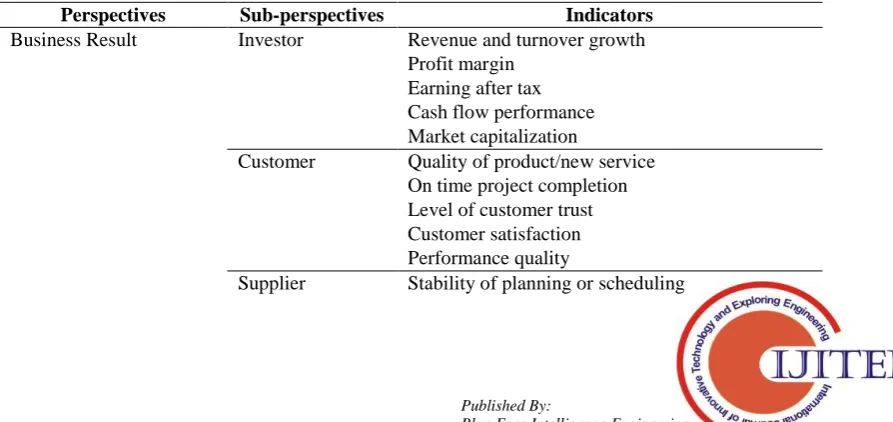
selected from several literatures, the proposal of the construction company and the author, while taking into account the vision, mission and strategy of the company. These indicators have been classified into three main perspectives and eleven sub - perspectives within the framework of KBPMS, which are relevant to the
construction industry, namely the business outcome perspective, which consists of sub - perspectives of investors, customers, suppliers, government and society and Sub-perspectives of marketing and resource capacity perspective with sub-perspectives of human resources, technology and organization.
Table. 1 Main Performance Indicators
Perspectives Sub-perspectives Indicators
Business Result Investor Revenue and turnover growth
Profit margin Earning after tax Cash flow performance Market capitalization
Customer Quality of product/new service
On time project completion Level of customer trust Customer satisfaction Performance quality
[image:5.595.92.539.606.817.2]Stability of relationship between suppliers and company
Number of suppliers
On time payment to suppliers Supplier satisfaction
Government Amount of Government support
Vision alignment with Government
Alignment with the direction and goals of Government programs
Relationship/work closely with Government Occupational health & safety assessment Community Corporate Social Responsibility
Success of the Community Development Program Image (positive-negative perception)
Company approach to community
Public relations & assessment results achievement Internal Business Process Innovation Creative innovation
Developing products/services effective & safely Anticipation of future customer needs
Recent Innovations used for running a business Number of patent
Operation Process Acquisition of new contract Health operating cash flow Decrease in operating costs
Appropriateness planning parameters Accuracy capacity planning
Marketing New contract
Customer satisfaction Profit & sales growth Strategic goal achievement Sales productivity
Resource Capability Human Resource Company mission – vision awareness Employee welfare
Employee productivity levels Employee motivation & commitment Expertise availability
Technology
Support of internal technology (IT) to help company’s HR
Time of the introduction of new technologies learned in all types of construction
The increase in current IT system for HR The use of IT security
Availability of latest external technology in construction projects
Organization Culture
Leadership Alignment
Teamwork & knowledge sharing GCG assessment
Thereafter, company basic information is analyzed using SWOT method. With the analysis result, strategies were developed with TOWS matrix. The gap and false alarm analysis will result the most importance performance indicators for each perspective. Performance indicators then will be analyzed using AHP and ANP methods (Saaty, 1980; 1996; 2008). Following the AHP and ANP method, judgements from the experts are necessary to conduct consistency test based on consistency ratio (CR). Each CR's
Fig. 3 Variables Interrelations Scheme (Fatima, 2017) After the corporate level performance variables are
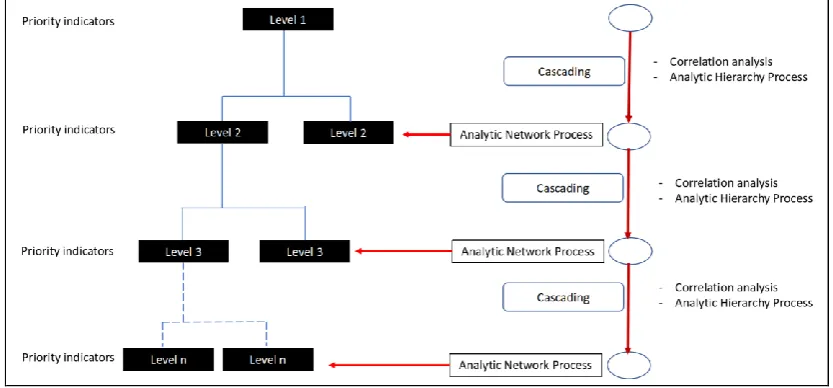
developed and analyzed which results in key performance indicators, every business level can determine its performance variables with the corporate performance as guidelines. The business level should align the variables with corporate level KPI in detailed manner. When an
organization is all the same measures of between strategy and operation, it is easy to cascade because strategic targets sum all of operational targets. Generally, it is very difficult to cascade because of different measures of between strategic objectives and operational goals (Figure 4.)
.
Fig. 4 Indicators, Vertical and Horizontal Linkages Validation and benchmarking are ultimately necessary. In
accordance with the KBPMS framework design
methodology, the validation of the proposed model with its KPIs can be carried out by asking other similar industry PMS experts ' opinion on how acceptable the projected performance indicators for the construction industry in common. Benchmarking can be carried out internally to identify each indicator's previous highest achievement and externally to identify the target for best practices. The results are then compared to each proposed KPI's acceptable target.
V. DISCUSSION AND CONCLUSION
The result of study indicates that current adopted PMS to overcome the relatively low performance of construction
companies in Indonesia has not been able to address the basic tenets required to solve the performance and competitiveness issues in the industry. The problem is most likely being perpetuated by the lack of appropriate PMS framework to be adopted by the industry.
The current PMS used in construction companies is positioned mainly on the Balanced Scorecard and Malcolm Baldrige Criteria for Performance Excellence (MBCfPE), but the implementation is not considered successful from top management to the lowest hierarchy. Moreover, there is no contextually developed framework that is considered appropriate to deal with the current dynamic condition of the construction industry,
[image:7.595.89.506.376.570.2]The new proposed conceptual framework of PMS is expected to be more suited to be implemented, considering that this framework includes specifically examined considerations, such as specific environmental factors of the construction industry, local culture, contents, and values, by selecting and determining appropriate measurement variables and indicators.
REFERENCES
1. Alarcón, L., & Serpell, A. (1996). Performance measuring,
benchmarking, and modelling of project performance. Proceedings for
the 5th International Conference of the International Group for Lean Construction (IGLC-5), The University of Birmingham, UK.
2. Alarcón, L., Grillo, A., Freire, J., & Diethelm, S. (2001). Learning from
collaborative benchmarking in the construction industry.Proceedings
for the 9th International Conference of the International Group for Lean Construction (IGLC-9), Singapore, 6–8 August 2001.
3. Amaratunga, D. (2000). Assessment of facilities management
performance.Journal of Property Management, 18(4), 258–266.
4. Barros Neto, J.P. (2002). The Relationship between strategy and lean
construction. Proceeding for 10th Conference of International Group
for Lean Construction (IGLC-10), Gramado, Brazil.
5. Bititci., U. S., Carrie, A. S., &McDevitt, L. G. (1997). Integrated
performance measurement systems: Adevelopment guide.International
Journal of Operations and Production Management, 17(6),522–535.
6. Bowen, P. A., Cattel, K. S., Hall, K. A., Edwards P. J., &Pearl, R. G.
(2002). Perceptions of time, cost and quality management on building
projects.Australasian Journal of Construction Economics and Building,
2(2), 48–56.
7. Fatima, I., & Wibisono, D. (2017). Main performance indicators for a
construction company in Indonesia. Asia Pacific Journal of Advanced
Business and Social Studies, 3(2), 77–89.
8. Ferreira, A., & Otley, D. (2009). The design and use of performance
management systems: An extended framework for
analysis.Management Accounting Research, 20, 263–282.
9. Forbes, L. H., Ahmed, S. M.,& Barcala, M. (2002). Adapting lean
construction theory for practical application in developing
countries.Proceedings for the first CIB W107 International
Conference: Creating a sustainable construction industry in developing countries, Stellenbosch, South Africa, 11–13 November 2002.
10. Hendry, C., Bradley, P., & Perkins, S. (1997). Missed a
motivator?.People Management, 15 May,20–5.
11. Johnson, G., Scholes, K., &Whittington, R. (2005).Exploring corporate
strategy: Text and cases (7th ed.), New Jersey, Prentice-Hall Financial Times, Pearson Education Limited.
12. Kaglioglou, M., Cooper, R., &Aouad, G. (2001). Performance
management in construction: A conceptual framework.Journal of
Construction Management and Economy, 19, 85–95.
13. Kaplan, R. S., & Norton, D. P. (1992). The balanced scorecard -
Measures that drive performance. Harvard Business Review, 7(1), 47–
54.
14. Kaplan, R. S., & Norton, D. P. (1996). The balanced scorecard:
Translating strategy into action, President and Fellows of Harvard College, USA.
15. Kaplan, R. S.,&Norton, D. P. (2000). The strategy-focused
organization: How balanced scorecard companies thrive in the new business environment, Boston, MA: Harvard Business School Press.
16. Lantelme, E. M. V., &Formoso, C. T. (2000). Improving performance
through measurement: The application of lean production and
organisational learning principles.Proceedings for 8th International
Conference of the International Group for Lean Construction, University of Sussex, Brighton.
17. Love, P.E.D., Li, H., Irani, Z., and Holt, G. D. (2000). Rethinking
TQM: Toward a framework for facilitating learning and change in
construction organisations. Total Quality Management. Bi-monthly for
Total Quality Management (Special Issue), 12(2), 107–116. MCB
Press. ISSN: 0954- 478X. DOI:
http://dx.doi.org/10.1108/09544780010318361.
18. Lynch, R. L, &Cross, K. F. (1995). Measure up!: Yardsticks for
continuous improvement,Blackwell (USA).
19. National Institutes of Standards and Technology (NIST). (2011).
Criteria for performance excellence program.
20. Neely, A., Mills, J., Platts, K., Gregory, M., &Richards, H. (1996).
Performance measurement system design: Should process based
approaches be adopted?. International Journal of Production
Economics, 46-47, 423-431.
21. Neely, A., Gregory, M., &Platts, K. (1995). Performance
measurement system design: A literature review and research agenda.
International Journal of Operation and Product Management, 15(4), 80–116.
22. Neely, A., Mills, J., Platts, K., Richards, H., Gregory, M., Bourne, M.,
& Kennerley, M. (2000). Performance measurement system design:
Developing and testing a process-based approach. International
Journal of Operation and Product Management, 20(10), 1119–1145.
23. Neely, A.,& Adams, C. (2001). Perspectives on performance: the
performance prism. Journal of Cost Management, 15, 7–15.
24. Oackland, J., &Marosszeky, M. (2006). Total quality in the
construction supply chain.(1sted.),Great Britain, Elsevier Ltd.
25. Rahayu, R.S, & Wibisono, D. (2013). Proposed performance
management system for Department of Transportation West Java
Province in land transportation sector.The Indonesian Journal of
Business Administration, 2(13), 1718–1737.
26. Robinson, H. S, Carrillo, P.M, Anumba, C.J., & Al-Ghassani, A.M.
(2005). Review and implementation of performance management
models in construction engineering organisations. Journal of
Construction Innovation, 5(4), 203–217.
27. Saaty, T.L. (1980).The Analytic Hierarchy Process,New York, USA.
McGraw-Hill Company,
28. Saaty, T.L. (1996).Decision making with dependence and feedback:
The analytic network process, Pittsburgh, USA, RWS Publications,
29. Saaty, T.L. (2008). Decision making with the Analytical Hierarchy
Process.International Journal Services Sciences, 1(1), 83–98.
30. Sammerville, J., & Robertson, H. W. (2000). A scorecard approach to
benchmarking for total quality construction.International Journal of
Quality & Reliability Management, 17(4/5),453–466.
31. Stoop, P.P.M. (1996).Performance management in manufacturing: a
method for short term performance evaluation and diagnosis. Unpublished Ph.D. thesis, Technische Universiteit Eindhoven,
Netherland in Wibisono, D. (2006).Konsep, desain, teknik
meningkatkan daya saing perusahaan, Jakarta, Penerbit Erlangga,
32. Wang, O., El-Gafy, M., &Zha, J. (2010). Bi-level framework for
measuring performance to improve productivity of construction
enterprises.Construction Resource Congress, 2, 970–979.
33. Wheelen, & Hunger. (2012). Strategic management and business
policy: Toward global sustainability(13thed.), New Jersey, Prentice Hall.
34. Wibisono, D. (2006).Manajemen kinerja: Konsep, desain, teknik
meningkatkan daya saing perusahaan,Jakarta, Penerbit Erlangga,
35. Wibisono, D. (2011).Manajemen kinerja korporasi & organisasi:
Panduan penyusunan indicator, Jakarta, Penerbit Erlangga,
36. Wibisono, D.,&Kosasih, O. (2011). Perancangan sistem manajemen
kinerja perusahaan: Studi kasus Perusahaan Dago Engineering.Jurnal
Manajemen Teknologi, 9(1), ISSN: 1412–1700.
37. Wibisono, D. (2012). How to create a world class company: Panduan