Data Inventory as the Development and Promotion Basis
of Universities Educational Programs
P. Zhelev1, I. A. Svetkina2, A.S. Zotova2,and A.A. Chudaeva2,* *Corresponding author: [email protected].
1 University of National and World Economy, Sofia, Bulgaria 2 Samara State University of Economics, Samara, Russia
Abstract. Digitalization affects universities, including management decision-making processes. Different management decisions require different data sets. The paper studies the issues of making managerial decisions at the university on the development and promotion of basic educational programs at the educational services market based on the results of data inventory. Two approaches are proposed: the study of data belonging to the university, and the search for the necessary data in the external environment. The article identifies the areas that need to be studied in order to make managerial decisions on ways to promote the main educational programs at the university, and analyzes the information accumulated both inside the university and in the external environment. The authors of the article proposed an algorithm for database inventory, which involves the identification of data sources, including digital traces, the analysis of the authority to use databases with the necessary registries of information systems and website directories. The result of data inventory should be the design of updating systems for the development and promotion of a university educational program. These actions will lead to the creation of an information system that will collect and process the diverse information needed to adjust the university’s strategy. As a result, the university should expand the functional system that accumulates and systematizes various data required to promote the university educational programs at the market.
Keywords: digital traces, data inventory, university educational programs, data sources, information system catalogues.
1 Introduction
An inventory of university data is carried out considering the digitalization process, which involves new approaches to the organization of educational and related processes in higher education. So, in July 2019, 26 universities in the Russian Federation signed a charter on digitalization of the educational space. The charter contains uniform principles for the formation of the market for IT solutions for universities and will facilitate their networking and the dissemination of best digital practices [1]. Today, the use of digital traces in the educational process is being actively discussed [2, 3]. It is assumed that the data about the previous educational experience, or digital traces, will allow universities to analyze the student development and tailor the curriculum personally for him [4, 2]. Starting in 2021, a digital service based on the student’s digital traces will be introduced in several Russian universities: it will evaluate
student performance, lecture activity, participation in the university’s public life, and overall behavior [5]. However, the organization of the educational process is preceded by the elaboration and development of educational program, the offer of the program at the market of educational services. Russian universities already have experience in applying data on potential consumers aiming to promote educational services on the market more effectively. So, the number of graduate students and those expelled in the first year of Tomsk State University (TSU) was reduced due to the fact that, during the admission campaign, the university began to analyze the social networks of applicants and scored the most motivated ones [6, 7]. Thus, the potential for using digital technologies as a tool for searching, ranking and organizing information for solving specific problems is huge.
Nowadays it is necessary to use digital tools not only as the educational tool [8, 9] but also in the way that allows to have real-time effective management decisions in the organization. Higher education institutions are no exception. For example, state universities operate in a highly competitive educational market and this leads to the need to transform and adapt digital methods of researching the catalog of educational products [10], including basic educational programs, tools for their development and promotion, as well as educational services consumers.
Questions of how modern technologies influence the study of the needs of the educational services market in educational programs are of specific interest within the framework of this study. Another important issue is what tools can be helpful in studying the data that are at the university’s disposal and information that influences the adoption of
2 Methods
The purpose of the study is structuring the data inventory process as the basis for decision-making on the creation, development and promotion of the university main educational programs at the educational services market. It is necessary to sort out the information available to the university and in open sources and find out whether it would be enough to justify management decisions to promote the main educational programs at the market. In order to perform this efficiently, it is necessary to develop catalogs of the information that is necessary for making managerial decisions in matters of promoting educational programs at the market, add decision models to the database available at the university.
The methods which were applied while performing the research were such as: systemic, activity-oriented, integrated, social and managerial approaches. The authors used theoretical and empirical research methods. Theoretical methods include analysis, synthesis, comparison, generalization, classification, and empirical: observation, analysis of documents and information array.
3 Results
Digitalization processes significantly affect the activities of higher education institutions and the effectiveness of managerial decision-making in them. The basis of management decisions is data, the collection and processing of which in the digitalization environment becomes, on the one hand, simpler and, on the other, a very complex process. To build an inventory algorithm for the data array that allows you to make informed management decisions, you should determine the goal and the tasks necessary to achieve it.
The selection of the tools for the development and promotion of university educational products based on the study of the consumers interests is possible using data inventory that involves two approaches: studying the database formed at the university (UDB) and searching for the necessary data in the external environment (EED). In our opinion, inventory and monitoring [11] of a complete database (UDB + EED) allows not only to form a support system for making managerial decisions, but also find reserves for creating new products and / or services.
To develop and make managerial decisions at the university for its main educational programs’ promotion at the market, the following tasks should be solved:
- to determine the characteristics of the target audience for main educational programs promotion (for undergraduate applicants - graduates of secondary vocational education and general educational organizations and their parents, for graduate applicants - graduates from different years of both the region and the country);
- to study the requirements for applicants for employment in the areas of training for which the university is accredited, as well as the requirements of professional standards and other regulatory documents for graduates;
- to study the opinions of educational program students and graduates about the quality of training and compliance with the requirements of employers, professional standards and other regulatory documents;
- to analyze the quality of graduates’ employment;
- to explore the capabilities of the university in terms of resources availability for educational programs implementation meeting market requirements;
- to develop / process educational program in accordance with market requirements; - to identify channels for promoting educational program at the market.
The solution of these tasks is possible by studying information, including digital, which the university accumulates, and searching for the necessary data in sources located in the external environment.
During the process of preparing for the inventory, we determined that the university has:
- the database of the university, which reflects data on applicants and their parents, on applicants for undergraduate studies and applicants submitting documents for graduate studies (the amount of data (gender, age, place of residence, etc.) is determined by the regulatory requirements of the Ministry of Education of the Russian Federation );
- regulatory framework (Consultant +, Guarantor, etc.), which allows to study the requirements for applicants for employment in the areas of study for which the university is accredited, as well as the requirements of professional standards and other regulatory documents for university graduates in areas of education which are accredited by the university;
- the University reports on the employment of graduates; - the list of educational programs implemented by the university.
In addition to the listed data, which the university has independently of whether there is a request for a specific management decision or not, it is necessary to find / collect the following information:
- opinions of applicants, students of educational programs, their parents about the quality of training and compliance with the requirements of employers, professional standards and other regulatory documents, - various surveys conducted by organizations external to the university;
- the results of universities monitoring, monitoring the employment of graduates;
- which educational programs that meet the requirements of the market are implemented by universities - competitors (universities are considered to be competitors offering educational programs in the same areas of training as the university that is developing a promotion strategy);
- which channels for promoting services are used at the market and which of them are the most popular and effective.
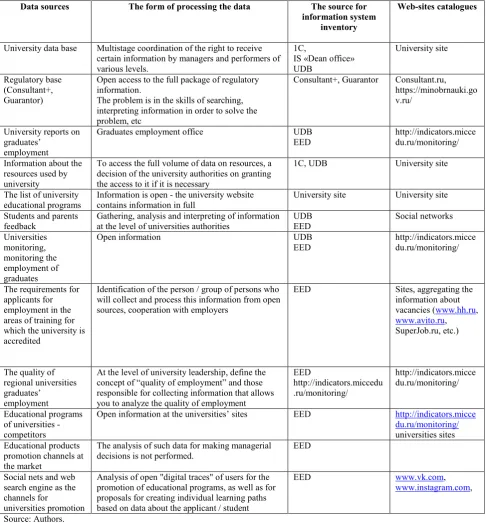
[image:3.595.53.540.173.697.2]To identify the necessary information, an inventory of the above data should be carried out. The results can be presented in Table 1.
Table 1. The sources of data necessary for making managerial decisions about educational programs promotion. Data sources The form of processing the data The source for
information system inventory
Web-sites catalogues
University data base Multistage coordination of the right to receive certain information by managers and performers of various levels.
1С,
IS «Dean office» UDB
University site
Regulatory base (Consultant+, Guarantor)
Open access to the full package of regulatory information.
The problem is in the skills of searching, interpreting information in order to solve the problem, etc
Consultant+, Guarantor Consultant.ru, https://minobrnauki.go v.ru/
University reports on graduates’
employment
Graduates employment office UDB
EED http://indicators.miccedu.ru/monitoring/
Information about the resources used by university
To access the full volume of data on resources, a decision of the university authorities on granting the access to it if it is necessary
1С, UDB University site
The list of university educational programs
Information is open - the university website contains information in full
University site University site
Students and parents feedback
Gathering, analysis and interpreting of information at the level of universities authorities
UDB EED Social networks Universities monitoring, monitoring the employment of graduates
Open information UDB
EED
http://indicators.micce du.ru/monitoring/
The requirements for applicants for employment in the areas of training for which the university is accredited
Identification of the person / group of persons who will collect and process this information from open sources, cooperation with employers
EED Sites, aggregating the
information about vacancies (www.hh.ru, www.avito.ru, SuperJob.ru, etc.)
The quality of regional universities graduates’
employment
At the level of university leadership, define the concept of “quality of employment” and those responsible for collecting information that allows you to analyze the quality of employment
EED http://indicators.miccedu .ru/monitoring/ http://indicators.micce du.ru/monitoring/ Educational programs of universities - competitors
Open information at the universities’ sites EED http://indicators.micce du.ru/monitoring/ universities sites Educational products
promotion channels at the market
The analysis of such data for making managerial decisions is not performed.
EED
Social nets and web search engine as the channels for
universities promotion
Analysis of open "digital traces" of users for the promotion of educational programs, as well as for proposals for creating individual learning paths based on data about the applicant / student
EED www.vk.com,
www.instagram.com,
Source: Authors.
The process of inventorying university data involves the analysis of digital traces (or digital footprints) for certain markers, which should be understood as a collection of information about user visits and user contributions during the time he spent in the digital space. For inventory purposes, digital traces should be classified. In our opinion, digital traces can be internal and external.
implementation of basic educational programs, information about the university, work programs of disciplines, term papers and student projects, etc.
External digital traces include data from sources external to the university (social networks, search forms, etc.). External digital traces form a “digital shadow” for the university, which is not structured, is constantly expanding and
does not obey the administrating procedures of the university. External digital traces are characterized either by the possibility of indirect control by the university, or by the inability to exercise control. External digital traces carry reputational risks for the university, which leads to the need to develop additional measures to promote the main educational programs of the university. One of the ways may be the latent promotion of educational programs through network users, which is a reference to the positive experience of students and graduates of educational programs in the Internet space. At the same time, users must be identified in the network as graduates of a specific educational program.
Also, digital traces are distributed in active and passive ways. In relation to the university and the educational program, passive digital traces are formed on the basis of data unintentionally created by the user - visiting various sites, social networks and resources associated with the university. This kind of information is automatically stored on the servers of providers, in web archives and data centers, and is reflected on site counters. The user leaves active digital traces consciously - for example, in social networks, choosing a university in which a person is studying or studied, participating in thematic groups with a university marker, posts, comments on discussions, etc. Analysis of the Vkontakte social network showed that the number of digital traces about SSEU is huge (and this number is not static, it increases every day): the number of individuals who have noted themselves as affiliated with SSEU is 37641, of groups containing in their name SSEU - 578, mentions of SSEU in the news - 21641, audio records - 61, video records - 1253 (data are given on the date of analysis).
Therefore, we note that an important part of the data inventory process is the quality control of digital traces with university markings. Unfortunately, often the quality of the data is poor, due to several reasons. Among them are the following: users' lack of understanding of the value of "digital traces" for decision-making, incl. strategic, the inability to structure the data in the context necessary for analytical purposes due to a lack of understanding by both developers and users.
Another point that should be considered is the answer to innumerous questions about the ethics and politics of processing such information. If the information is not kept forever, under what conditions should it be erased? Does the information produced through digital platforms impose any obligations on those who have access to it [12]?
When designing future information systems, the listed reasons should be considered in order to envisage measures aimed at eliminating them — this will improve the quality of the developed algorithms and the convenience of using information grouped as necessary.
For a project to promote a university degree, it is necessary to compare the goals and objectives with the available data. As the data in Table 1 show, the data available at the university will not allow us to solve the tasks and achieve the stated goal - there is a need to attract specialized companies and identify those responsible for collecting and analyzing the available data within the university.
4 Conclusion
The result of the inventory should be the design of system updates from tasks. We believe that it is necessary to develop catalogs of the information necessary for making managerial decisions in matters of promoting university educational programs at the educational services market and add decision models to the database available at the university. An IS can also be developed in which the collection and processing of external information necessary for developing a strategy for promoting educational programs will be carried out. The result, in our opinion, should be a target system that accumulates and systematizes the various data arrays needed to promote an institution of higher education on the market.
Acknowledgement
The research is done in the frame of project 574060-EPP-1-2016-KZ-EPPKA2-CBHE-SP “Enhancement of Higher Education and Corporate Sectors Integration in Accordance with New Social Environment” (ENINEDU) co-funded by the Erasmus+ Program.
References
1. D-Russia, 26 universities signed a charter on digitalization of the educational space (2019). URL:
http://d-russia.ru/26-universitetov-podpisali-hartiyu-o-tsifrovizatsii-obrazovatelnogo-prostranstva.html. Accessed:
10.10.2019. [in Rus.].
3. M. McGuirt, D. Gagnon, R. Meyer, Embracing innovation: 2015-2016 higher education industry Outlook Survey (KPMG, Amstelveen, The Netherlands, 2015).
4. B. Chechenova, The main features of the “mini-Islands”: new ways of gaining knowledge, student tutors and the
best digital footprint. 2035: In Progress (2019). URL:
https://ntinews.ru/in_progress/likbez/glavnye-fishki-miniostrova-novye-sposoby-polucheniya-znaniy-studenty-tyutory-i-luchshiy-tsifrovoy-sl.html. Accessed:
10.10.2019 [in Rus.].
5. N. Sokolov, K Gorshenin, On the digital footprint: An experiment will be launched in Russia to track artificial intelligence of student performance. RT News (2019). URL: https://russian.rt.com/russia/article/658196-studenty-ocenki-iskusstvennyi-intellekt. Accessed: 10.10.2019. [in Rus.].
6. TASS, The analysis of social networks helped the Tomsk University to reduce the number of “C” students and
expelled (2019). URL:
https://tass.ru/obrazovanie/6890954?fbclid=IwAR2n_oJUIZ_isEV_Vyfi2LL9LNcBjOKcezKy3wLzsYMpt56hD0Ql 0AEzy. Accessed: 10.10.2019. [in Rus.].
7. G.V. Mozhaeva, A.V. Slobodskaja, A.V. Feshhenko, Information potential of social networks to identify the educational needs of senior pupils. Open and Distance Education, 3(67), 25-31 (2017). [in Rus.].
8. J. Bleicher, P. Forrester, A Honal, E. Velinov, Virtual business projects in the classroom: Enhancing intercultural and business skills of students. In Gonzalez-Perez M.A., Lynden K., Taras V. (Eds.), The Palgrave Handbook of Learning and Teaching International Business and Management (pp. 747-768). Cham: Palgrave Macmillan (2019).
9. E. Velinov, E. Tiit, I. Denisov, Dealing with students’ aversion in global virtual teams: Evidence from Czech Republic and Estonia. In A. Belousova (Ed.), Proceedings of 2nd International Conference on Education Science and Social Development (ESSD 2019), Advances in Social Science, Education and Humanities Research, 298. Paris: Atlantis Press (2019). DOI: 10.2991/essd-19.2019.80.
10.A.G. Furin, I. I. Akhmatov, The concept of “educational product” of general education: The essence and features of formation in the educational cluster. Modern Problems of Science and Education, 2. Retrieved from: http://science-education.ru/ru/article/view?id=8717. Accessed: 10.10.2019 (2013). [in Rus.].
11.M.V. Khokhlova, S.V. Lukashov, The implementation of the principles of quality monitoring of the basic professional educational programs in engineering and technology at the university. Modern Problems of Science and Education, 5. URL: http://science-education.ru/en/article/view?id=27006. Accessed: 10.10.2019 (2017). [in Rus.]. 12.M. Kurzweil, M. Stevens, Setting the table: Responsible use of student data in higher education.