International Journal of Innovative Technology and Exploring Engineering (IJITEE) ISSN: 2278-3075,Volume-8 Issue-12, October 2019
ABSTRACT: Exploring Self-Similarities Of Action Sequences Over Time And Observing The Striking Stability Of Human Action Recognition. Developing An Action Descriptor That Captures The Structure Of Temporal Similarities And Dissimilarities Within An Action Sequence. Self-Likeness Descriptors Are Demonstrated To Be Steady Under Execution Varieties Inside A Group Of Activities When Person Haste Changes Are Overlooked. Changes Between Two Unique Occurrences Of A Similar Class Can Be Unequivocally Recouped With Dynamic Time Traveling. Adequate Activity Separations Are As Yet Held Along These Lines To Construct A View-Autonomous Activity Acknowledgment Framework. Strangely Self-Likenesses Are Registered From Various Picture Highlights Have Comparable Properties And Can Be Utilized In A Corresponding Manner. It Depends Powerless Geometric Properties And Joins Them With AI For Proficient Cross-See Activity Acknowledgment. It Has Comparative Or Better Execution Looked At Than Related Techniques And It Performs Well Even In Outrageous Conditions, For Example, Well Perceiving Activities From Top Perspectives.
Key Words —Human action recognition, human action synchronization, Local temporal descriptors, temporal self-similarities, View invariance
I INTRODUCTION
Visual acknowledgment of human activities have pulled in much consideration in the course of recent decades and remain a functioning examination zone of PC vision. A decent answer for the issue holds an unexplored potential for some applications, for example, the scan for and the organizing of substantial video files, video reconnaissance, human-PC connection, motion acknowledgment, and video altering. Late work has been exhibited trouble of the issue related with the huge variety of human activity information because of the individual varieties of individuals in articulation, act, movement, apparel, viewpoint impacts and camera movements, light varieties, impediments and disocclusions and diverting impacts of scenes environment and furthermore activities as often as possible include to rely upon controlled items, which include another layer of fluctuation. As a result of current strategies regularly resort to confined and improved situations with basic foundations, less complex kinematic activity classes, static cameras, or constrained view varieties. Different methodologies utilizing various builds has been proposed throughout the years for activity acknowledgment. These methodologies generally classified based on portrayal
Revised Manuscript Received on October 05, 2019.
D. Jaganathan: Assistant Professor, Department of Computer Science and Engineering, Vel Tech Rangarajan, Dr. Sagunthala R&D Institute of
utilized by the creators. Human outlines was regularly utilized as an activity portrayal in time development. With the assistance of room time or different kinds of neighborhood includes the demonstrating and acknowledgment of human movement have been tended to with an assortment of AI methods, for example, Support Vector Machines (SVMs), Hidden Markov Models (HMMs) and Conditional Random Fields (CRFs). The majority of the present techniques are utilized for activity acknowledgment and intended for constrained view varieties. A dependable and conventional activity acknowledgment framework must be powerful to camera parameters and various perspectives while watching an activity grouping. View varieties began from the changing and as often as possible obscure places of the camera. Like the multiview appearance of static items, the presence of activities may radically fluctuate starting with one perspective then onto the next. It's uniquely in contrast to the static case, anyway the presence of activities may likewise be influenced by the dynamic view changes of the moving camera. Multiview varieties of activities have been recently tended to utilizing epipolar geometry, by taking in stances seen from various perspectives or by a full 3D remaking. These strategies depend either on existing point correspondences between picture arrangements or/and on numerous recordings speaking to activities in different perspectives. Both of these doubts are obliging before long as a result of the inconvenience of surveying non stiff correspondences in accounts and 2 the inconvenience of gaining satisfactory video data spreading outline assortments for a few, movement classes. On this works, we address multi view activity attestation from a substitute point of view and stay away from different suppositions of past techniques. With the multifaceted nature to the geo-based frameworks above, this method require either the ID of body parts or the estimation of taking a gander at focuses between video movements. Its uniquely in contrast to the past view-based techniques, we don't expect multi view activity tests either for preparing or for testing. Our ways to deal with expands upon self-likenesses of activity successions after some time and for a given movement course of action and given sort of low measurement features. The figure detaches between expelled highlights for all plans of time spans and store realizes a Self Similarity Matrix (SSM). It guarantees SSM to be reliable under any view changes of a development. Figure 1, addresses our thought with an occurrence of a golf swing activity seen from two indisputable perspectives. In this perspective, we register SSMs as pair astute empties between all 2D revolves around the predicted hand
Independence Action Recognition using Self
Similarities
Despite the view combinations and close bearing focuses An and B stay close in the two perspectives, while the ousted course focuses A & C have enormous segments in the two projections. The representations of SSMs registered for the two groupings in Figure 1B and Figure 1D have a striking likeness in spite of the various projections of the activity. All the more for the most part, if body stances of an activity are comparable at minutes i.e., the separation between some activity descriptors at t1; t2 will be low for any perspective on an activity. In actuality, if the body presents are distinctive at t1; t2, the estimation of SSM of t1; t2 is probably going to be substantial for the majority of the perspectives and nontrivial activity descriptors.
Figure 1. Cross-see reliability of heading set up together self-closeness systems as for a clear model. (A) and (C) show, in perspective on development get MOCAP data and a golf swing association see from two one of a kind points of view. (B) and (D) address their different SMM for the bearing of one offer foreseen in relating view. In spite of the way that the two points of view are uncommon, the structures or the instances of the enrolled SSMs are in a general sense equivalent to.
II. SELF SIMILARITY MATRIX
Self-comparability grids are as of now showed up in the past under different explicit structures, including parallel repeat plots related to time arrangement, as referenced previously. In this section, we characterize such grids for various picture highlights, with precedents for a few activity classes, and begin examining their strength crosswise over perspectives.
For a succession of pictures I = { I1,I2,… ..IT} in discrete (x,y,t) space, a SSm of I is a square framework of size T*T,
[dij]i,j=1,2,…T =
where dij is the separation between certain low dimension highlights extricated from casings Ii and Ij individually. The askew relates to contrasting an edge with itself (no disparity) and henceforth, made out of zeros. The definite structures or examples of this framework rely upon the highlights and the separation measure utilized for registering the passages dij. The readied structure plans have monstrous significance for corresponding applications the diagonal value in the framework show periodically monitor the improvement. In this work, we depict dij as the euclidean segment in between the various highlights that remove from an activity movement. This kind of SSM is implied as the structure as given the Euclidean Distance Matrix (EDM).
Average examples of repeat plots and their significance - board 1 – distinctive examples of recur plots and their importance
SSM Pattern significance
Homogeneity The process is stationary
Fading in the corners Not stationary data.
Periodic/ quasi periodic patterns Cyclicities in process
Single isolated patterns Strong fluctuations in process
Diagonal lines(parallel to main diagonal)
Advancement of states is comparative at various ages.
Diagonal lines(orthogonal to main diagonal)
Evolution of states is similar at different times
Long bowed line structures Evolution of states at same
epoch but different velocities
A movement of opening an authority portal performed by two exceptional on-screen characters from broadly different points of view, these centers is depicted in Fig. 2. Fig. 2c and 2e exhibits the SSMs handled for these two exercises subject to one hand course, where red concealing shows higher characteristics and diminish blue concealing shows lower regards. The dynamic cases, red star in Figure 2B and 2D, relate to gorge of various locale or spread in plot of SSM. Set apart by maroon circles along the survey of the framework. The positive spread of these valleys relies on the width of the tops in the spatiotemporal forward and backward development of the activities, as showed up in
Figure 2B and
[image:2.595.47.288.214.251.2]2D.
Figure 2 Relationship in between proposed method in SSM portrayal and dynamic occurrences presented in. Two on-screen characters play out the activity of opening a bureau entryway, where the hand direction is appeared (b) and (d). The SSMs figured for these two activities dependent on one hand direction are appeared (c) and (e), separately. The "dynamic examples", set apart in red stars in (b) and (d), speak to valleys in the comparing SSM, portrayed by red circles in (c) and (e), separately. The spread of every valley relies upon the pinnacle width of the comparing dynamic occurrence.
2.1 Trajectory Based Self Similarity Matrix
In case a ton of M centers xm,,m = 1,2… ..M, scattered over an individual is "pursued" over the range of an action execution, the mean euclidean partition between all of the k sets of relating centers at any two minutes I and j of the course of action can be figured as
2 Eq 1
[image:2.595.312.528.394.479.2]International Journal of Innovative Technology and Exploring Engineering (IJITEE) ISSN: 2278-3075,Volume-8 Issue-12, October 2019
The general objective of the proposed works acknowledgment of activities in recordings independent of perspectives. The genuine calculation of SSM-pos necessitates that focuses extricated and followed in the information video. We expect that this errand is taken care of naturally by an outside module, for example, KLT point tracker. Note our procedure isn't restricted to a particular subset of centers the degree that the centers are scattered over moving body parts. The importance of SSM-pos in (3) ought to be balanced the course of action of tracks with self-self-assured length and starting time.
Eq 2
Where Sij {1, 2...M} is the set of indices point trajectories that are alive between frames i and j.
2.2 Image Based Self Similarities
To depict the spatial appearance of an individual at each picture format, we figure Histograms of Oriented Gradients (HoG) highlights. This sort of descriptor from the start used to perform and make human affirmation portrays territory shape measured by getting the point structure. In this execution, we utilize four container histograms for every one of 5 * 7 squares characterized on a bouncing box around the individual in each casing. Highlight remove dij between time moments I and j are figured as the euclidean separation between two HoG vectors extricated from edges Ii and Ij. We signify SSMs are processed utilizing HoG includes by SSM-hoard. Regardless of HoG highlights, we besides test the propose methodology by optical stream vector as information fuse. The relating SSM are hinted by SSM. Significantly additional absolute, we recognize, concerning point headings, that optical stream is given by another technique, Lucas and Kanade tally dependent on two sequential lodgings. We interface the bits of optical stream vectors dealt with for all pixels in a weaving bind in the region of an individual to a stream vector of size multiply of 2n. Segment dij of SSM grid by means the euclida detachment between the stream vectors identifying with the two edges Ii and Ij. For all intents and purposes, we develop and resize hopping limits solicitation to sidestep periphery impacts on the stream estimation and to ensure a comparative size of given stream vector beside an action progression. This method resize the stature to a regard proportionate to 150 pixel size and the measured width is set the best a motivating
force for the idea about game
[image:3.595.304.551.160.478.2]plan.
Figure 3 Instances of SSMs for various sorts of highlights and for various activities. Example from the central monitoring unit Mocap informational collection. Section given in
to various activities and survey points. Note the steadiness of SSMs over various perspectives along with individuals playing out a similar activity. (b) Examples as of the Weizman video informational index . Line 1: four bowing activities alongside physically extricate point directions utilized for processing SSM POS; lines 2, 3, and 4 speak to SSM POS, SSM hoard, and SSM, individually, for these given four twisting activities.
2.3 Permanence Structural of across SSM Views
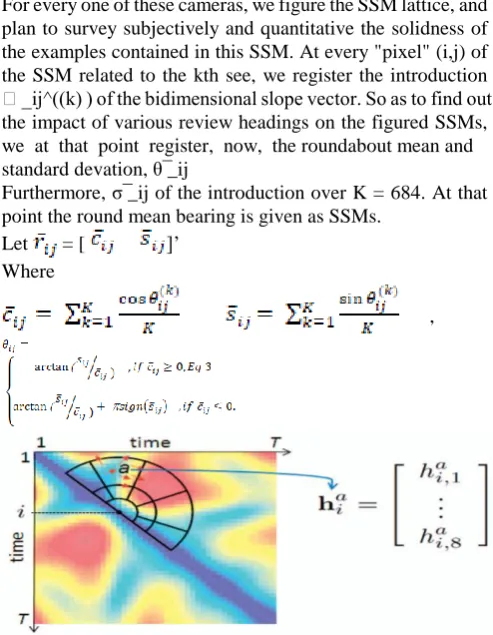
For every one of these cameras, we figure the SSM lattice, and plan to survey subjectively and quantitative the solidness of the examples contained in this SSM. At every "pixel" (i,j) of the SSM related to the kth see, we register the introduction _ij^((k) ) of the bidimensional slope vector. So as to find out the impact of various review headings on the figured SSMs, we at that point register, now, the roundabout mean and standard devation, θ ̅_ij
Furthermore, σ ̅_ij of the introduction over K = 684. At that point the round mean bearing is given as SSMs.
Let = [ ]’
Where
,
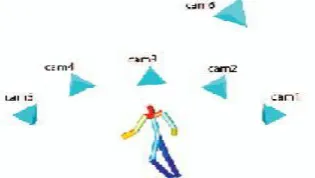
III. SSM BASED ACTION RECOGNITION The IXMAS informational collection is openly accessible and various specialists have announced their outcomes on this information set. Without falling back on designing an alternate trial setup to test see invariance, utilizing this informational index takes into account a snappy and reasonable correlation of our strategy to different techniques. The present outcomes for the IXMAS and video illuminating rundown with 11 class of activities played out various events by all of 10 entertainers and recorded simultaneously from five indisputable perspectives. Test that follow for all cameras and four activity classes.
The technique accomplishes sensible acknowledgment exactness notwithstanding for outrageous varieties in perspectives, for example, trying on top perspective when utilizing side perspectives just for preparing. Likewise, these table show that utilizing mutually HoG-based and optical flowbased SSMs yields preferable acknowledgment over utilizing both of.
Fig. 5. SSM-put together cross-see activity acknowledgment with respect to the CMU mocap information. An individual figure enlivened from the movement catch information and six virtual cameras used to recreate projections in our examinations.
[image:4.595.93.251.137.226.2]Fig 6 Accuracy of the cross-see activity acknowledgment utilizing SSM-POS to construct the sack of-highlights utilized by closest classifier.
Figure 7 Point of reference housings from the given IXMAS multi view movement enlightening accumulation: For four identified classes of action. And also the five viewpoints at
given snapshot of one execution of action are showed up.
Figure 8 Relative movement affirmation results for the identified IXMAS multi view action enlightening gathering: Result are discovered the center estimation of in excess of eleven action classes and ten subjects. Result in (an) are seemed changed sorts of SSMs and a comparable sack of-features SVM portrayal procedure. Results in (d) are obtain with a comparative pack of features SVM approaches, anyway using quantize value descriptor method of spatio temporal interest centers (STIPs) as opposed to quantized neighborhood SSM descriptors.
Fig. 9. Class-perplexity framework for development certification in the IXMAS instructive record: This tumult cross segment is gotten utilizing SSM-horde of multiscale SSM neighboring descriptors. It takes a gander at to the average issue arranged for all cross-camera insistence courses of action.
IV. CONCLUSION
[image:4.595.58.270.298.403.2] [image:4.595.303.526.403.642.2] [image:4.595.49.271.456.610.2]International Journal of Innovative Technology and Exploring Engineering (IJITEE) ISSN: 2278-3075,Volume-8 Issue-12, October 2019
with no persuading inspiration to depend upon the sensitive recuperation of 3D data structures or on the estimated of corresponding value crosswise over perspectives. The result just makes smooth assumption on the disagreeable confinement of a person involved in the edge. This absence of solid presumptions is probably going to make this methodology relevant to activity acknowledgment past controlled informational indexes when joined with present day procedures for individual discovery and following.
REFERENCES
1. T. Moeslund, A. Hilton, and V. Kruger, “A Survey of Advances in
Vision-Based Human Motion Capture and Analysis,” Computer Vision and Image Understanding, vol. 103, nos. 2-3, pp. 90-126, Nov.2006. 2. Betigeri, A. S., & Dixit, M. A. N. A. S. I. (2014). Modification In
Human Face Image For Personal Identification. International Journal of Applied Engineering Research and Development, 4(2), 13-22.
3. S. Carlsson, “Recognizing Walking People,” Int’l J. Robotics Research,
vol. 22, no. 6, pp. 359-370, 2003.
4. Ibidunni, O. S., Falola, H. O., Ibidunni, A. S., & Olokundun, A. M. (2014). Effects of Human Resource Waste on Productivity in Nigeria. International Journal of Human Resource Management and Research (IJHRMR), 4(3), 47-56.
5. C. Sminchisescu, A. Kanaujia, Z. Li, and D. Metaxas, “Conditional
Models for Contextual Human Motion Recognition,” Proc. IEEE CS Conf. Computer Vision and Pattern Recognition, 2005.
6. Babu, M. R., & Eimani, A. (2014). Human Resource Management: A
challenging scenario in the Indian context. International Journal of Research in Applied, Natural & Social Science, 2(2).
7. E. Bradley and R. Mantilla, “Recurrence Plots and Unstable Periodic
Orbits,” Chaos: An Interdisciplinary J. Nonlinear Science,vol. 12, no. 3, pp. 596-600, 2002.
8. Swathi, B. (2014). A comprehensive review on human resource
management practices. International Journal of Research in Business Management, 2(9), 21-28.
9. Imran N Juneo, Emilie Dexter, Ivan Laptep and Patrick Perez “ View
Independent Action Recognition Using Temporal Self Similarities”, vol no 33, no 1, January 2011.
10. Savitha, S. (2017). Solitude and Independence in Kate Chopin's The Awakening. International Journal of Linguistics and Literature (IJLL), 6(6), 1-6.
11. Mitsakis, F. V. (2014). Human resource development (HRD) for
societal development (SD): an overview. International Journal of Human Resources Management, 3(2), 1-12.
12. Gopinath, P. (2014). Human identification based on finger veins-a
review. International Journal of Humanities, Arts, Medicine and Sciences, 2, 29-34.
AUTHORSPROFILE
Jaganathan. D, working as Assistant Professor in Department of Computer Science and Engineering, Vel Tech Rangarajan Dr. Sagunthala R&D Institute of Science and Technology, Chennai, India. He is having eleven years of teaching. He completed his master in Information Technology from Sathyabama University, Chennai. He has published and presented more than 5 research papers in reputed journals and conferences. His Research Interest includes Data Mining, Network Security.