Instantly Decodable Network Coding: From
Point to Multi-Point to Device-to-Device
Communications
by
Mohammad Shahedul Karim
March 2017
c
Declaration
The contents of this thesis are the results of original research and have not been submitted for a degree to any other university or institution. Much of the work in this thesis has been published or has been submitted for publication in journals or conference proceedings as listed below:
Journal Articles and Conference Proceedings:
• M.S. Karim, P. Sadeghi, S. Sorour and N. Aboutorab, ‘Instantly Decodable Network Coding for Real-Time Scalable Video Broadcast’, EURASIP Journal on Advances in Signal Processing, pp. 1-24, 2016.
• M.S. Karim, S. Sorour and P. Sadeghi,‘Network Coding for Video Distortion Reduction in Device-to-Device Communications’, IEEE Transactions on Vehicular Technology, pp. 1-16, 2017.
• M.S. Karim, A. Douik, P. Sadeghi and S. Sorour, ‘On Using Dual Interfaces with Network Coding for Delivery Delay Reduction’, IEEE Transactions on Wireless Com-munications, pp. 1-15, 2017.
• M.S. Karim, A. Douik, S. Sorour and P. Sadeghi, ’Rate-Aware Network Codes for Completion Time Reduction in Device-to-Device Communications’, IEEE International Conference on Communications (ICC), pp. 1−7, May 2016.
The following articles are also the results of my doctoral study but not included in this thesis:
• M.S. Karim, A. Douik, and S. Sorour, ‘ Rate-Aware Network Codes for Video Dis-tortion Reduction in Point to Multi-point Networks’, IEEE Transactions on Vehicular Technology, pp. 1-15, 2017.
• M.S. Karim, P. Sadeghi, N. Aboutorab and S. Sorour, ‘In Order Packet Delivery in Instantly Decodable Network Coded Systems over Wireless Broadcast’, IEEE Interna-tional Symposium on Network Coding (Netcod), pp. 11-15, June 2015.
• M.S. Karim, N. Aboutorab, A.A. Nasir, and P. Sadeghi, ‘Decoding delay reduction in network coded cooperative systems with intermittent status update’, IEEE Information Theory Workshop (ITW), pp. 391-395, November 2014.
The research work presented in this thesis has been performed under the supervision of Associate Professor Parastoo Sadeghi (The Australian National University), Dr. Neda Aboutorab (The Australian National University), Assistant Professor Sameh Sorour (Uni-versity of Idaho), and some work in collaboration with Graduate Student Ahmed Douik (California Institute of Technology) as evident from the author list above. The substantial majority of this work is my own.
Mohammad Shahedul Karim
Acknowledgements
The work presented in this thesis would not have been completed without the support of a number of individuals and organizations and they are sincerely acknowledged below:
• I would like to express my gratitude to my supervisors Associate Professor Parastoo Sadeghi, Dr. Neda Aboutorab, Professor Rodney A. Kennedy and Dr. Sameh Sorour for their cordial supervision, immeasurable guidance, constructive criticism, supportive suggestions, persistent encouragement and endless patience throughout the course of my doctoral study. I am also grateful to my supervisors for being great mentors and for training me to become an independent researcher. Their constant words of wisdom and motivation have inspired me to pursue complex and challenging problems and adopt a systematic approach to solves these problems.
• I would also like to express my special thanks to my colleagues Ahmed Douik and Mohammad Esmaeilzadeh for having many discussions on the research problems and providing me constructive feedback on the research findings.
• I would like to thank the Australian National University for providing me a PhD scholarship. I feel fortunate to get the opportunity for being in the signal processing group at the Research School of Engineering. I would like to thank everyone in the group including the administrative staff because of whom I felt the friendly and relaxing environment.
Abstract
The network coding paradigm enhances transmission efficiency by combining information flows and has drawn significant attention in information theory, networking, communications and data storage. Instantly decodable network coding (IDNC), a subclass of network coding, has demonstrated its ability to improve the quality of service of time critical applications thanks to its attractive properties, namely the throughput enhancement, delay reduction, simple XOR-based encoding and decoding, and small coefficient overhead. Nonetheless, for point to multi-point (PMP) networks, IDNC cannot guarantee the decoding of a specific new packet at individual devices in each transmission. Furthermore, for device-to-device (D2D) networks, the transmitting devices may possess only a subset of packets, which can be used to form coded packets. These challenges require the optimization of IDNC algorithms to be suitable for different application requirements and network configurations.
In this thesis, we first study a scalable live video broadcast over a wireless PMP network, where the devices receive video packets from a base station. Such layered live video has a hard deadline and imposes a decoding order on the video layers. We design two prioritized IDNC algorithms that provide a high level of priority to the most important video layer before considering additional video layers in coding decisions. These prioritized algorithms are shown to increase the number of decoded video layers at the devices compared to the existing network coding schemes.
compared to the video and cooperation oblivious coding schemes.
We also consider a heterogeneous network wherein devices use two wireless interfaces to receive packets from the base station and another device concurrently. For such network, we are interested in applications with reliable in-order packet delivery requirements. We represent all feasible coding opportunities and conflict-free transmissions using a dual inter-face IDNC graph. We select a maximal independent set over the graph by considering dual interfaces of individual devices, in-order delivery requirements of packets and lossy chan-nel conditions. This graph based solution is shown to reduce the in-order delivery delay compared to the existing network coding schemes.
Acronyms
IDNC Instantly decodable network coding
D2D Device-to-device
PMP Point to multi-point
MDP Markov decision process
RLNC Random linear network coding
EW-IDNC Expanding window IDNC
NOW-IDNC Non-overlapping window IDNC
SVC Scalable video codec
GOP Group of pictures
SCM Symmetric connectivity matrix
FSM Feedback status matrix
PSNR Peak signal to noise ratio
DI-IDNC Dual interface IDNC graph
C-IDNC Cooperation aware IDNC graph
Contents
Acknowledgements v
Abstract vii
Acronyms ix
1 Introduction 1
1.1 Preliminaries . . . 1
1.1.1 Application Requirements . . . 1
1.1.2 Network Configurations . . . 4
1.1.3 Network Codes . . . 6
1.2 Thesis Contributions . . . 7
1.2.1 Layered Video Aware Network Codes in PMP Networks . . . 8
1.2.2 Content Aware Network Codes in D2D Networks . . . 9
1.2.3 Packet Order Aware Network Codes in Heterogeneous Networks . . . 10
1.2.4 Completion Time Aware Network Codes in D2D Networks . . . 11
1.2.5 Summary of the Contributions . . . 12
2 Background and Related Work 13 2.1 Network Coding . . . 13
2.2 Layered Video Aware Network Codes in PMP Networks . . . 16
2.3 Content Aware Network Codes in D2D Networks . . . 16
2.4 Packet Order Aware Network Codes in Heterogeneous Networks . . . 18
3 Layered Video Aware Network Codes in PMP Networks 21
3.1 Overview . . . 21
3.2 Scalable Video Broadcast System . . . 23
3.2.1 Scalable Video Coding . . . 23
3.2.2 Notations . . . 24
3.2.3 System Model . . . 24
3.2.4 IDNC Graph and Packet Generation . . . 29
3.3 Importance of Appropriately Choosing a Coding Window . . . 30
3.4 Guidelines for Prioritized IDNC Algorithms . . . 33
3.4.1 Feasible Windows of Video Layers . . . 33
3.4.2 Probability that the Completion Time Meets the Deadline . . . 35
3.4.3 Design Criterion for Prioritized IDNC Algorithms . . . 37
3.5 Prioritized IDNC Algorithms for Scalable Video . . . 38
3.5.1 Expanding Window Instantly Decodable Network Coding (EW-IDNC) Algorithm . . . 38
3.5.2 Non-overlapping Window Instantly Decodable Network Coding (NOW-IDNC) Algorithm . . . 40
3.6 Packet Selection Problem over a Given Window . . . 40
3.6.1 Maximal Clique Selection Problem over Critical Graph . . . 41
3.6.2 Maximal Clique Selection Problem over Non-critical Graph . . . 42
3.7 Heuristic Packet Selection Algorithm over a Given Window . . . 43
3.7.1 Greedy Maximal Clique Selection over Critical Graph . . . 44
3.7.2 Greedy Maximal Clique Selection over Non-critical Graph . . . 45
3.8 Simulation Results for a Real Video Sequence . . . 47
3.8.1 Scalable Video Test Sequence . . . 48
3.8.2 Simulation Results . . . 49
3.9 Conclusion . . . 54
3.10 Appendix A . . . 54
4 Content Aware Network Codes in D2D Networks 57 4.1 Overview . . . 57
4.2.1 Centralized Protocol for Implementing the System . . . 63
4.2.2 Importance of an Individual Packet . . . 65
4.3 Cooperation aware IDNC Graph . . . 66
4.3.1 Vertex Set . . . 66
4.3.2 Coding Conflicts . . . 67
4.3.3 Transmission Conflicts . . . 67
4.3.4 Maximal Independent Sets . . . 68
4.4 Minimum Video Distortion Problem Formulation . . . 69
4.5 Two-stage Maximal Independent Set Selection Algorithm . . . 72
4.5.1 Maximal Independent Set Selection Algorithm over Critical Graph . . 73
4.5.2 Probability that the Individual Completion Time Meets Deadline . . 74
4.5.3 Maximal Independent Set Selection Algorithm over Non-critical Graph 76 4.6 Calculations of Packet Importance for a Real Video Sequence . . . 78
4.7 Simulation Results . . . 81
4.8 Conclusion . . . 88
5 Packet Order Aware Network Codes in Heterogeneous Networks 89 5.1 Overview . . . 89
5.2 System Model and Delay Metrics . . . 90
5.2.1 Notations . . . 90
5.2.2 System Model . . . 91
5.2.3 Delay Metrics . . . 93
5.3 Delivery Delay Problem Formulation . . . 95
5.3.1 Delivery Delay Metric . . . 95
5.3.2 Problem Formulation . . . 98
5.4 Dual Interface IDNC graph . . . 99
5.4.1 Vertex Generation . . . 99
5.4.2 Edge Generation . . . 100
5.4.3 Maximal Independent Set . . . 101
5.4.4 Graph Construction Complexity . . . 102
5.5 Proposed Solution . . . 102
5.5.2 Delay Reduction Heuristic . . . 105
5.6 Simulation Results . . . 106
5.7 Conclusion . . . 110
5.8 Appendix A . . . 111
5.9 Appendix B . . . 114
5.10 Appendix C . . . 117
6 Completion Time Aware Network Codes in D2D Networks 119 6.1 Overview . . . 119
6.2 System Model and Parameters . . . 121
6.2.1 Network and Physical Layer Models . . . 121
6.2.2 Packet Reception Status . . . 122
6.3 Rate Aware IDNC Graph . . . 124
6.3.1 Vertex Generation . . . 124
6.3.2 Edge Generation . . . 125
6.3.3 Maximal Cliques . . . 126
6.4 Minimum Completion Time Formulation . . . 126
6.5 Completion Time Reduction Heuristic . . . 128
6.5.1 Characterizing the Completion Time Reduction Problem . . . 128
6.5.2 Greedy Maximal Clique Selection Algorithm . . . 129
6.6 Simulation Results . . . 130
6.7 Conclusion . . . 134
6.8 Appendix A . . . 134
6.9 Appendix B . . . 136
7 Conclusion, Observation and Future Directions 139 7.1 Thesis Conclusion . . . 139
7.1.1 Layered Video Aware Network Codes in PMP Networks . . . 140
7.1.2 Content Aware Network Codes in D2D Networks . . . 140
7.1.3 Packet Order Aware Network Codes in Heterogeneous Networks . . . 141
7.1.4 Completion Time Aware Network Codes in D2D Networks . . . 141
7.3 Future Directions . . . 143
7.3.1 Rate Aware Network Codes . . . 143
7.3.2 Intermittent Feedback Aware Network Codes . . . 144
7.3.3 Joint Routing and Network Coding . . . 145
List of Tables
1.1 Summary of the contributions in different chapters. . . 12
3.1 Probability expressions used in Case 1, where packetP1 is transmitted at time
slot t. With this transmission, the first layer completion probability before the deadline P[T1:1 ≤ 2] = (1−ǫ
2) +ǫ2(1−ǫ2) and both layers’ completion
probability before the deadlineP[T1:2≤2] = (1−ǫ
2)(1−ǫ1)(1−ǫ2) are shown. 31
3.2 Probability expressions used in Case 2, where packetP2 is transmitted at time
slott. With this transmission, the first layer completion probability before the deadline P[T1:1 ≤2] = (1−ǫ
2) and both layers’ completion probability before
the deadline P[T1:2 ≤2] =ǫ1(1−ǫ2)(1−ǫ1)(1−ǫ2) + (1−ǫ1)(1−ǫ2)(1−ǫ2)
are shown. . . 32 3.3 Summary of Figure 3.5. The efficient threshold valuesλand the corresponding
percentages of minimum and mean decoded video layers for EW-IDNC and EW-RLNC algorithms in different deadlines Θ. . . 52 3.4 Summary of Figure 3.6. The efficient threshold valuesλand the corresponding
percentages of minimum and mean decoded video layers for EW-IDNC and EW-RLNC algorithms in different number of devices M. . . 53
5.1 Mean delivery delay and completion time performances of different algorithms for a network composed of M = 5 devices andN = 10 packets . . . 107
List of Figures
2.1 A wireless A-R-B topology with three time slots . . . 14
3.1 L windows for an L-layer GOP withnℓ packets in theℓ-th layer. . . 26
3.2 IDNC graph corresponding to FSM in (3.2). . . 30
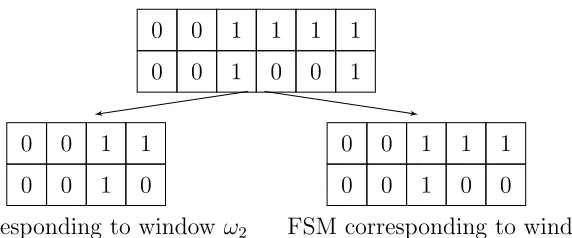
3.3 FSMs corresponding to the feasible windows in Example 6 . . . 34
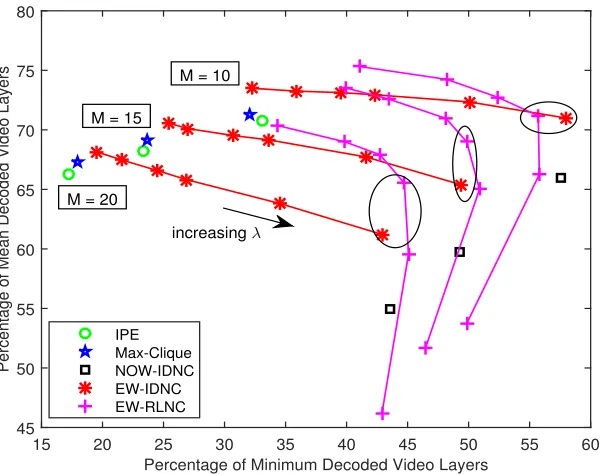
3.4 A closed GOP with 4 layers and 8 frames (a sequence of I, P and B frames). 48 3.5 Percentage of mean decoded video layers versus percentage of minimum de-coded video layers for different deadlines Θ . . . 50
3.6 Percentage of mean decoded video layers versus percentage of minimum de-coded video layers for different number of devices M . . . 51
3.7 Histogram showing the percentage of devices that successfully decode one, two, three and four video layers before the deadline . . . 53
4.1 A line network corresponding to SCM in (4.3). In this figure, the dotted red circles illustrate the coverage zones of individual devices and a solid line between two devices represents a channel connecting these two devices. . . . 61
4.2 Four LSMs for four devices corresponding to SCM in (4.3) and FSM in (4.5) 66 4.3 Cooperation aware IDNC graph corresponding to SCM in (4.3) and FSM in (4.5). . . 69
4.4 A closed GOP with 4 layers and 8 frames (a sequence of I, P and B frames). 79 4.5 The nearest decoded frames are used to conceal the loss of undecoded frames. 80 4.6 Mean PSNR versus different deadlines Θ. . . 82
4.7 Histogram showing the percentage of received PSNR at individual devices before the deadline corresponding to the line network in Fig. 4.1. . . 83
4.9 Mean PSNR versus different average connectivity indices ¯y. . . 85
4.10 Mean PSNR versus different minimum packet reception probabilities of channels 86 4.11 Mean PSNR versus different number of allowable time slots Θ . . . 87
4.12 Mean PSNR versus different number of devices M . . . 88
5.1 The dual interface IDNC graph corresponding to FSM in Example 11. . . 102
5.2 Mean delivery delay and completion time versus different number of devicesM.109 5.3 Mean delivery delay and completion time versus different number of packets N. . . 110
5.4 Mean delivery delay and completion time versus different average cellular and local area channel erasure probabilities ¯ǫ0 and ¯ǫ. . . 111
6.1 The rate aware IDNC graph G corresponding to system in Example 17 and CSM in (6.2). . . 126
6.2 Completion time versus different number of devices . . . 132
6.3 Completion time versus different number of packets . . . 133
Chapter 1
Introduction
1.1
Preliminaries
1.1.1
Application Requirements
Today’s wireless networks carry time critical and high quality applications ranging from video, news feeds, advertisements, social network services to file download [1]. Such di-verse traffic imposes various application requirements on the resource constrained wireless networks in terms of packet delivery deadline, interdependence of packets, and importance values of individual packets. These application requirements in addition to lossy wireless channels create a number of challenges for delivering data traffic to users without degrading the quality of service. In the past decade, researchers have made substantial efforts to inte-grate the application requirements into the wireless communications technology and protocol development [2, 3]. Similarly, in this thesis, we advocate for designing transmission schemes that are aware of application requirements and can meet the quality of service requirements of users using the scarce radio resources.
execution are crucial for effective coordination of the agents and therefore, new packets are required to be arrived quickly and get decoded immediately at the agents regardless of their order. Further, some applications are designed focusing on order-insensitivity to make them adaptive to the unreliable transport medium. An example of such a case is using multiple-description coding [6], in which each decoded packet brings new information and contributes to the overall quality of service. Therefore, for time-critical and order-insensitive applica-tions, it is crucial to design transmissions schemes that allow quick and reliable decoding of individual packets.
Second, we study time-critical and order-constrained applications that require quick and reliable in-order decoding of the packets [7–9]. For such applications, a packet can be used by the application layer only if that packet and all its preceding packets are decoded on time. For example, in cloud-based applications such as remote desktop control, Google Docs and Dropbox, packets usually represent instructions that need to be executed in order and on time. Besides, transmission control protocol (TCP) delivers packets in-order to the application layer. Therefore, out-of-order received packets can rapidly flood the devices’ storage buffer.∗ Such applications require the current and future technologies to prioritize transmitted packets following their order. However, several works demonstrate that in-order packet transmission causes a loss in the rate of packet delivery to the users in wireless networks, i.e., the throughput [7, 8]. These works also demonstrate that the throughput loss incurred by in-order packet transmissions can be reduced by striking the right balance between in-order delivery of packets and throughput maximization. Therefore, for time-critical and order-constrained applications, it is crucial to analyze the interplay between throughput and in-order decoding of packets to facilitate the design of efficient transmissions schemes.
Third, video streaming applications in wireless devices is a big share of today’s wireless data traffic and is expected to have a rapid growth in the foreseeable future [10]. Such growth leads to a heterogeneous video traffic which is encoded using a wide variety of standards, such as H.264, MPEG, divx, RealVideo, and WindowsMedia [11, 12]. For example, MPEG and H.264/AVC standards are employed in RealVideo and WindowsMedia codec to encode video sequences into a single layer with different spatial resolutions or signal-to-noise ratios.
From the network designers’ perspective, such a single layer video sequence has two distinct properties [11, 13–15]. First, it has unequally important packets such that some packets contribute more to the video quality compared to other packets. Second, it has a hard deadline such that the packets need to be decoded on-time to be usable at the applications. Clearly, the different video qualities can be provided by encoding a video sequence into different versions such that each version is encoded into a single layer with a fixed format. However, the limitations of creating multiple versions of one video sequence include an increased storage at the source server, proxy caches distributed throughout the network, and streaming multiple versions into the network for adapting to the variations in the available bandwidth.
Fourth, to overcome the drawbacks of a single layer video coding, scalable encoded video is a promising solution, which provides different video formats and qualities with one encoding [13, 16–18]. In fact, a large proportion of video traffic is expected to be scalable video, e.g., H.264/SVC extension of H.264/AVC, since it can provide heterogeneous quality of services to the users over wireless networks. In scalable video coding techniques, the video frames are compressed in the form of one base layer and several enhancement layers. The base layer provides the basic video quality, and each additional enhancement layer provides quality improvement. Such a scalable video has two distinct characteristics [18]. First, it has a hard deadline before which the video layers need to be decoded to be usable at the application. Second, the video layers exhibit a hierarchical order such that a video layer can be decoded only if this layer and all its lower layers are successfully received. Even though scalable video can tolerate the loss of one or more enhancement layers, this adversely affects the video quality experienced by viewers. Therefore, for layered video applications, it is crucial to analyse the progressive decoding of layers subject to a stringent deadline to facilitate the design of efficient transmission schemes.
1.1.2
Network Configurations
Point to multi-point (PMP) networks have become a cornerstone in the design of traditional wireless standards and networks, such as satellite networks, cellular access networks, WiFi-based networks and cable networks [1, 19, 20]. In these networks, a number of users receive their required contents exclusively from a central access point possessing all the contents. An example of such scenarios is a group of users who want to stream a live soccer match from a base station. In this scenario, the base station needs to deliver all packets on-time in order to prevent interruption of the stream at the users. However, wireless channels are error prone due to fading, shadowing, multipath and interference, which causes a low packet delivery ratio [1]. In fact, the average packet loss rate in harsh network conditions can be as high as 20%−40% [21, 22]. In addition to the lossy wireless channels, the proliferation of high quality applications creates a challenge for the service providers to meet the quality of service requirements of their subscribers using the limited network infrastructure and radio resources. For these constraints, it is important to analyze the transmission efficiency in wireless PMP networks and prevent severe degradation of the throughput, delay and quality of service.
To address an increasing throughput demand, communications and networking commu-nities have recently gone beyond the traditional PMP networks thanks to the proliferation of smart devices with improved computational, storage and connectivity capabilities. In particular, device-to-device (D2D) networks have been introduced to allow local exchange of received packets at the devices, e.g., using Bluetooth and IEEE 802.11 adhoc mode [23–25]. The advantages of using such short range technology is multifold. First, it offloads the cen-tral station to serve additional devices and increases the throughput of the network. Second, it increases the coverage zone of the network as devices can communicate to other devices via intermediate devices. Third, it reduces the cost associated with the deployment of new in-frastructure required for the growing network size and devices’ throughput demand. Finally, short-range channels are more reliable compared to long-range cellular channels because of smaller distances between the devices.
interference caused by simultaneous transmissions, a single device is allowed to transmit in each time slot. In the latter case, a group of devices, who are not necessarily close-by and are connected to each other via multiple hops, form a D2D network. Due to the spatial separation, a set of devices are allowed to transmit simultaneously if there is no destruc-tive interference by others. For these cases, the transmitting devices and their transmitted packets need to be efficiently selected in D2D networks [26, 27]. Furthermore, a device may possess a subset of packets, which are required by some devices and unwanted by others. Indeed, these challenges need to be analysed and resolved in the packet and device selection processes in order to preserve the full benefits of devices’ cooperations.
While many standards and networks are developed considering a device is connected to either a PMP network or a D2D network using its single interface, it is widely expected that the smart devices with multiple interfaces will be connected to multiple networks con-currently [28–30]. This leads to a heterogeneous network architecture with coexistence of cellular and D2D networks and an increase in the download rate at individual users as com-pared to a single interface network. In such scenarios, the smart devices use two wireless interfaces for simultaneous reception of packets from the base station using a long-range technology, e.g., LTE, and communication with nearby devices using a short-range tech-nology, e.g., IEEE 802.11 adhoc mode [31–35]. Given that cellular and local area channels operate concurrently using different parts of the spectrum, such heterogeneous network offers significantly higher throughput, lower delay and better quality of service compared to the single interface based networks [25, 34, 35]. However, to fully preserve these benefits, a het-erogeneous network needs to systematically select a transmitted packet for the base station, a set of transmitting devices and their transmitted packets while avoiding the service to a device with the same packet by multiple senders.
1.1.3
Network Codes
The fundamental principle of today’s networks is that the sender forwards data and the infor-mation is processed only at the end nodes. Such principle considerably limits the inforinfor-mation contained in a transmission and the number of devices benefitting from a transmission. This also increases the possibility of missing the throughput, delay and quality of service re-quirements of wireless users. Network coding is a relatively new paradigm that breaks this fundamental idea and advocates for combining several incoming packets at the sender or intermediate nodes of a network to generate outgoing packets [36–39]. In linear network coding [37], to retrieve the original packets at the devices, linear operations over a finite field are performed on the combined packets. Numerous works have demonstrated the ability of network coding to achieve a high transmission efficiency compared to the conventional un-coded transmissions. For example, random linear network coding (RLNC) [17, 40–44] have been studied extensively for efficient and low complexity data delivery in wireless networks and offering significant performance gains over conventional channel codes [45–49].
Another subclass of network coding, namely the instantly decodable network coding (IDNC), exploits the natural properties of overhearing and packet reception diversity in wireless networks to form an efficient packet combination [4, 5, 9, 50–54]. For the following advantages, IDNC has been widely considered for deployment in practical systems. First, IDNC aims to provide instant packet decodability upon successful packet reception at the devices, which allows a progressive recovery of the content as the devices decode more pack-ets. Second, the encoding process of IDNC is performed using simple XOR operations, which reduces coefficient reporting overhead. Third, the decoding process of IDNC is also performed using XOR operations, which is suitable for implementation in simple and cost-efficient devices [53, 55–58].
and network coding [26, 26]. In fact, there is a gap between the existing theory of IDNC and their direct utilization to various applications and network configurations. As a result, this thesis aims to analyze, design and optimize IDNC algorithms by addressing the challenges raised by a wide range of application requirements and network configurations. In particular, we are interested in developing IDNC frameworks by taking into account numerous applica-tion and network properties, such as layers of video, order of packets, unequal importance of packets, hard deadline, lossy wireless channels, and coding and transmission conflicts, which will be elaborated in the rest of this thesis.
Furthermore, similar to the most of the works on IDNC in literature, this thesis initially considers an abstraction of physical channel conditions such as a transmitted packet is ei-ther received or lost with an average erasure probability. Therefore, all transmissions are assumed to have a fixed transmission rate and require a fixed duration of time. Such channel model simplifies the analysis, design and optimization of IDNC solutions and facilitates the demonstration of its benefits in a variety of application requirements and network configu-rations. However, at the end of this thesis, we model physical channels with heterogeneous capacities, which requires intelligent selection of the transmission rate by the senders. For such scenarios, a packet transmission with a high rate will take a shorter time but will be only successfully received by the devices with high channel capacities. Therefore, to fully exploit the channel capabilities, the final chapter of this thesis demonstrates the significance of designing transmission rate aware IDNC solutions.
1.2
Thesis Contributions
The contributions of this thesis are the analysis, design and optimization of IDNC frame-works by taking into account a wide range of relevant application requirements and network configurations. In particular, we make the following four contributions:
• We study layered video aware IDNC for reducing the number of uncoded video layers before the deadline in PMP networks.
• We study content aware IDNC for reducing the video distortion in D2D networks.
networks with coexistence of cellular and D2D networks.
• We study completion time aware IDNC for reducing the packet recovery time in D2D networks.
In the following subsections, we elaborate the aforementioned four contributions.
1.2.1
Layered Video Aware Network Codes in PMP Networks
A recent report from Cisco [10] shows that cellular data traffic is doubling in each year and the share of video traffic is expected to grow from 55% in 2014 to 80% in 2019. This continuous growth of video traffic in addition to the limited radio resources create a number of challenges for the service providers to meet the quality of service requirements for their subscribers [59]. Within this large problem space, in this study, we focus on the problem of broadcasting a scalable video sequence from a base station to a set of devices subject to a bandwidth constraint. Such scalable coding technique compresses video frames in the form of one base layer and several enhancement layers, and imposes order and deadline constraints on decoding the layers [18]. Even though scalable video can tolerate the loss of one or more enhancement layers caused by the lossy wireless channels and limited radio resources, this adversely affects the video quality experienced by viewers.
problem as a two-stage maximal clique selection problem over an IDNC graph. Simulation results over a real scalable video sequence show that our proposed algorithms improve the received video quality compared to the existing IDNC algorithms. These contributions are detailed in Chapter 3, and the results are published in [60].
1.2.2
Content Aware Network Codes in D2D Networks
The rapid growth of video streaming applications in today’s networks leads to a heteroge-neous video traffic that is encoded using a wide variety of techniques, such as H.264, MPEG, divx, RealVideo, and WindowsMedia [12]. A big share of these traffic is encoded using a single layer coding technique, e.g., H.264/AVC [11, 15]. Such encoded video has unequally important packets towards the video quality and a hard deadline before which the video packets need to be decoded. To deliver a high quality video to the users and address the re-source limitations of cellular networks, a promising solution is D2D communications wherein devices exchange their partially possessed content with others using a short-range wireless technology, e.g., IEEE 802.11 adhoc mode [31–35]. Furthermore, due to the spatial separa-tion, a device can communicate to other devices directly (i.e., single-hop transmission) or via intermediate devices (i.e., multi-hop transmissions). In fact, multiple devices are allowed to transmit concurrently in the D2D network given there is no destructive collision due to transmissions by others [61].
two-stage maximal independent set selection algorithm, which has much lower modelling and computational complexities compared to the MDP formulation. Simulation results show that our proposed IDNC algorithms improve the received video quality compared to the IDNC algorithms in [26, 52, 56]. These contributions are detailed in Chapter 4, and the results are published in [62].
1.2.3
Packet Order Aware Network Codes in Heterogeneous
Net-works
To address a growing traffic load, it is widely expected that next generation networks will be heterogeneous in architecture, with coexistence of cellular and D2D networks, thanks to the proliferation of the smart devices with the improved connectivity capabilities [25, 29, 34]. In such networks, devices use two wireless interfaces to receive packets from the base station using a long-range technology, e.g., LTE, and to transmit or receive packets from other devices using a short-range technology, e.g., IEEE 802.11 ad-hoc mode [24,31]. A big share of today’s wireless traffic comes from time-critical and order-constrained applications requiring quick and reliable in-order decoding of the packets. For such applications in heterogeneous networks, it is crucial to prioritize in-order packet transmissions at the senders without incurring a significant loss in the throughput [8].
that the proposed IDNC algorithm effectively reduces the delivery delay compared to the existing network coding algorithms in [25, 63]. These contributions are detailed in Chapter 5, and the results have been submitted for publication in [64].
1.2.4
Completion Time Aware Network Codes in D2D Networks
In the aforementioned three studies, we model the condition of physical layer channels by erasure probabilities. Therefore, all transmissions are assumed to have a fixed physical-layer rate and require a fixed duration of time. On the contrary, the wireless channels are independent, heterogeneous, and dynamic in nature, which requires intelligent selection of the transmission rate by the senders. Furthermore, a packet transmission with a high rate will take a shorter time but will be only successfully received by the devices with sufficiently high channel capacities. In contrast, a packet transmission with a lower rate is expected to be received by more devices but will take a longer time. Therefore, a balance among these conflicting effects is necessary to fully exploit the channel capabilities and improve the quality of service of applications.
In this study, we are interested in time-critical applications, in which each packet is immediately used at the application layer and must be delivered on-time. For such time-critical applications, similar to the previous three studies, we adopt IDNC for enhancing the packet transmission efficiency and expediting the packet delivery process. Furthermore, to reduce the consumption of cellular resources and meet the devices’ demands, we consider a fully connected D2D network wherein devices cooperate with each other to recover their missing packets. Due to the spatial closeness and interference, a single device is allowed to transmit in each transmission in a fully connected D2D network.
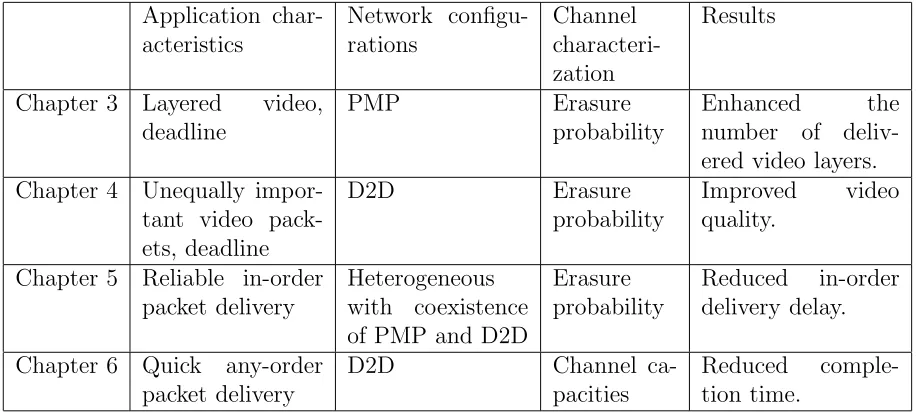
Table 1.1: Summary of the contributions in different chapters. Application char-acteristics Network configu-rations Channel characteri-zation Results
Chapter 3 Layered video, deadline
PMP Erasure
probability
Enhanced the number of deliv-ered video layers. Chapter 4 Unequally
impor-tant video pack-ets, deadline
D2D Erasure
probability
Improved video quality.
Chapter 5 Reliable in-order packet delivery
Heterogeneous with coexistence of PMP and D2D
Erasure probability
Reduced in-order delivery delay.
Chapter 6 Quick any-order packet delivery
D2D Channel
ca-pacities
Reduced comple-tion time.
between the transmission rate and the number of targeted devices with a new packet in each transmission. Simulation results show that our proposed IDNC algorithm reduces the completion time compared to the network coding algorithms of [65, 66] for D2D networks. These contributions are detailed in Chapter 6, and the results are published in [67].
1.2.5
Summary of the Contributions
Table 1.1 summarizes the contributions of this thesis in terms of application requirements, network configurations, channel characterizations and results.
Chapter 2
Background and Related Work
In this chapter, we present the related works to the problems of interest in this thesis.
2.1
Network Coding
The network coding paradigm has emerged from the pioneering work in [36] and advocates for the source and intermediate nodes to perform linear operations on incoming data packets to generate outgoing data packets. In linear network coding [37], which is an important subclass of network coding, to recover the original packets from the coded packets, a set of linear equations over a finite field are solved at the devices. In multicast networks, network coding can achieve the min-cut capacity of the network to each destination [37–39].
Although network coding was originally proposed for wired networks, this breakthrough idea has inspired significant effort in practical application of network coding to wireless networks [17, 40–44]. Indeed, the broadcast nature of the wireless medium offers an oppor-tunity for exploiting the throughput benefits of network coding. Inspired by the through-put gain in wired networks and the broadcast nature of wireless medium, a large body of works have studied network coding for wireless networks and demonstrated its bene-fits in increasing throughput, simplifying scheduling, reducing delay, and enhancing secu-rity [15, 32, 34, 53, 55–58, 68, 69]. To illustrate the basic concept of network coding, let us consider the following wireless example.
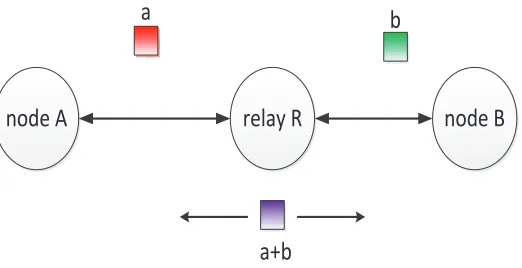
Example: Fig. 2.1 illustrates a bidirectional wireless topology, connecting A-R-B nodes
node A
relay R
node B
a
b
[image:34.595.176.437.108.242.2]a+b
Figure 2.1: A wireless A-R-B topology with three time slots
‘b’ and node A possesses packet ‘a’. Furthermore, node A wants to transmit its packet ‘a’ to
node B, whereas node B wants to transmit its packet ‘b’ to node A via the relay node R. Nodes
A and B transmit their packets in two time slots, and relay node R receives both packets. In
the third time slot, node R broadcasts the coded packeta⊕b to nodes A and B. Since nodes B
and A already possesses ‘b’ and ‘a’, they decode their missing packets ‘a’ and ‘b’, respectively
by re-XORing the coded packet. Here, relay node R transmits coded packet a⊕b in one time
slot instead of packets a, b in two time slots separately. As a result, network coding reduces
the number of required transmissions from four to three, and enhances throughput by 33.3%.
fact, MORE was implemented between the IP and MAC layers and was shown to achieve throughput gain of 22-45% for unicast scenarios and 35-200% for multicast scenarios over conventional uncoded transmission schemes. However, in RLNC systems, the devices need to collect a sufficient number of independent coded packets before decoding all the original packets simultaneously. Therefore, RLNC is more attractive to the delay tolerant applica-tions that uses a block of packets simultaneously. To provide different levels of protection to the coded bit streams of different significance, the authors in [75, 76] proposed power and bandwidth-efficient coded modulation scheme. In particular, a superposition coded modula-tion scheme was designed by using shaping techniques that reduce the interference between the fine-level code and the coarse-level code. The numerical results demonstrated that the superposition based scheme outperforms those without superposition coding by about 3 dB.
On the other hand, IDNC is a promising solution for time-critical applications requiring progressive decoding of packets at the devices. As discussed in Section 1.1.3, it can offer a low decoding delay by using simple XOR-based encoding and decoding operations [55, 77]. In addition to the delay reduction, in [53, 70], the authors showed that IDNC can achieve the optimal throughput for the two-device or three-device networks. In [4, 77], the authors employed IDNC to minimize the number of transmissions required for broadcasting a set of packets to a large number of devices. The throughput performance of the IDNC algorithms in [4, 77] was shown to be comparable to that of throughput optimal RLNC, while providing all the benefits of IDNC. Inspired by applications using each decoded packet immediately, in [5, 52, 70, 78], the authors adopted IDNC for wireless broadcast of a set of packets and served the maximum number of devices with a new packet in each transmission. All the aforementioned works showed that finding the optimal solution of the IDNC problem is NP-hard and therefore, proposed low-complexity heuristics by exploiting the properties of the optimal solution. Similarly, in this thesis, we aim to design simple and efficient IDNC frameworks by taking into account the application requirements and the network configurations discussed in Chapter 1.
2.2
Layered Video Aware Network Codes in PMP
Net-works
In this section, we discuss the network coding schemes designed for layered video trans-missions over PMP networks. A body of works [81–84] showed that combining the layered approach with network coding provides unequal error protection to different importance lay-ers and improves the quality of video delivered to the uslay-ers. These works used expanding window based RLNC strategies to form coded packets across different numbers of video lay-ers and include the packets in the lower video laylay-ers into all coded packets. In particular, the authors in [43] used a probabilistic optimization approach for selecting coding windows and ensuring high decoding probabilities for the important layers. In [44], the authors consid-ered a scalable video transmission with a hard deadline and used a deterministic optimization approach for selecting coding windows over all transmissions before the deadline.
For a layered video broadcast over PMP networks, the related IDNC works are [9, 85]. In [85], the authors proposed IDNC algorithms prioritizing a set of packets forming the base layer compared to another set of packets forming the enhancement layers. Similarly, in [9], the authors discussed the hierarchical order of video layers with motivating examples and proposed a heuristic IDNC algorithm. The heuristic in [9] struck a balance between the number of transmissions required for delivering the base layer and the number of transmis-sions required for delivering all video layers. However, both works [9, 85] ignored the hard deadline and did not strictly prioritize to deliver the base layer packets before the deadline in harsh network conditions. This is the scope of the study in Chapter 3.
2.3
Content Aware Network Codes in D2D Networks
proposed a randomized packet selection algorithm that has a high probability of achieving the minimum number of time slots. However, the works in [65, 86, 87] neither considered erasure channels nor considered addressing the hard deadline for high importance video packets.
Several other works including [56,88,89] adopted IDNC for time-critical applications and D2D networks. In [88, 89], the authors selected a transmitting device and its XOR packet combination to serve a large number of other devices with a new packet in each time slot. Inspired by the video streaming applications with hard deadline, [56] prioritized packets according to their contributions to the video quality and proposed a joint device and packet selection algorithm that maximizes the overall video quality in the current time slot. The aforementioned works [56,65,86–89] developed network coding schemes for a fully connected D2D network, wherein all devices are directly connected to other devices and a single device is allowed to transmit in each time slot.
2.4
Packet Order Aware Network Codes in
Heteroge-neous Networks
In this section, we discuss the network coding schemes designed for in-order packet delivery to the devices in heterogeneous networks. For time-critical and order-constrained applications, the authors in [9] proposed IDNC algorithms that allow in-order packet transmissions to the devices in PMP networks. The authors demonstrated that the order-aware IDNC algorithms provide quicker in-order packet delivery to the devices compared to the order-oblivious IDNC algorithms. In [63, 92], the authors extended the study of [9] by providing more efficient graph-based IDNC algorithms for ordered packet delivery. Nevertheless, these works [9,63,92] considered a single interface scenario wherein each device is connected to a single network and receives at most one packet in a time slot.
Several other works including [25, 59] demonstrated the performance benefits of using network coding and multiple interfaces of devices connected to multiple networks. In par-ticular, to improve the download rate at individual devices, the authors in [59] exploited multiple interfaces with RLNC. The benefits of their proposed solution are attested by im-plementing the system on a testbed consisting of seven Android phones. In [25], the authors considered a heterogeneous network with coexistence of cellular and D2D networks, and em-ployed both RLNC and IDNC to reduce the number of time slots required for broadcasting a set of packets. However, the work [25] neither considered applications with in-order packet delivery constraint nor integrated lossy channel characteristics into coding decisions. This is the scope of the study in Chapter 5.
2.5
Completion Time Aware Network Codes in D2D
Networks
optimal solution. Furthermore, the authors designed an online heuristic by analysing the properties of the optimal formulation. On the other hand, the authors in [88,89] extended the works in [93,94] to fully connected D2D networks. In particular, the authors suggested jointly selecting the transmitting device and XOR packet combination to serve a large number of devices with a new packet in each D2D transmission. However, most of the works on IDNC in literature, including the aforementioned works in [88, 89, 93, 94] considered that coding is performed at the network layer and modeled the condition of physical layer channels by erasure probabilities. Therefore, all transmissions are assumed to have a fixed physical-layer rate and require a fixed duration of time. On the contrary, the wireless channels are dynamic with heterogeneous capacities.
Chapter 3
Layered Video Aware Network Codes
in PMP Networks
3.1
Overview
Providing high quality live video over wireless networks is a challenging problem due to the lossy wireless channels and the large bandwidth requirements of video traffic. Within this large problem space, we focus on the efficient broadcast of a scalable video over wireless PMP networks using network coding. Such a scalable video imposes an order constraint on decoding the layers and has a hard deadline before which the video layers need to be decoded [13]. Therefore, using the scarce radio resources, as many video layers as possible need to be in-order delivered to the viewers before the deadline. In fact, the video coding community advocates for taking into account the interdependence of video layers and the hard deadline in designing a video-aware transmission scheme. On the other hand, network coding community has well established that network coding offers an increased throughput, simple scheduling, delay reduction and enhanced security in wireless PMP networks [40–43, 52]. This chapter bridges the gap between these two techniques and develops a unified video-aware network coded scheme that improves both video quality and throughput.
network with a small number of devices [93]. In particular, IDNC schemes can achieve the optimal throughput for the two-device or three-device system as shown in [53,70]. Moreover, as video streaming applications continue to proliferate, the wireless sender (e.g., the base station) often needs to support multiple simultaneously running applications with heteroge-nous video characteristics. Therefore, the sender can adopt IDNC to encode packets from different video sequences together. This allows immediate decoding of the received packets of different video sequences and immediate use of decoded packets at the applications, es-pecially when one or more video sequences are encoded using multiple description coding in addition to scalable video coding.
In this chapter, we are interested in designing an efficient IDNC framework that maxi-mizes the minimum number of decoded video layers over all devices before the deadline (i.e., improves fairness in terms of the minimum video quality across all devices). We consider that a service provider adopts a maxmin policy to improve fairness across all devices regardless of their channel conditions. With such a policy, some devices experiencing harsh channel conditions are prioritized over other devices experiencing good channel conditions with the aim of delivering an acceptable video quality to all devices. This may prevent a severe degradation of the quality of services at a device experiencing a poor channel condition.
For such scenarios, by taking into account the deadline, the coding decisions need to carefully balance coding only from the base layer versus coding from all video layers. While the former guarantees the highest level of priority to the base layer, the latter increases the possibility of decoding a large number of video layers before the deadline. In this context, our main contributions are as follows:
• We derive an upper bound on the probability that a given number of video layers are decoded by all devices before the deadline. Using this probability, we are able to approximately determine whether the broadcast of a given number of video layers can be completed before the deadline with a predefined probability.
proba-bility meets a predefined threshold, the algorithm considers additional video layers in coding decisions in order to increase the number of decoded video layers at the devices. In contrast, NOW-IDNC algorithm always selects a packet combination over the first video layer without exploiting the coding opportunities by including additional video layers.
• We use a real scalable video sequence to evaluate the performance of our proposed algorithms. Simulation results show that our proposed EW-IDNC and NOW-IDNC algorithms increase the minimum number of decoded video layers over all devices compared to the IDNC algorithms in [9, 52] that are oblivious to the in-order layer decoding and deadline constraints. Furthermore, the proposed algorithms also achieve a comparable performance compared to the expanding window RLNC algorithm in [43, 44] while preserving the benefits of IDNC strategies. It is also observed that EW-IDNC achieves a similar performance in terms of maximizing the minimum number of decoded video layers and significantly better performance in terms of maximizing the mean decoded video layers as compared to NOW-IDNC algorithm.
The rest of this chapter is organized as follows. The system model and IDNC graph are described in Section 3.2. We illustrate the importance of appropriately choosing a coding window in Section 3.3 and draw several guidelines for prioritized IDNC algorithms in Section 3.4. Using these guidelines, we design two prioritized IDNC algorithms in Section 3.5. We formulate the problem of finding an appropriate packet combination in Section 3.6 and design a heuristic packet selection algorithm in Section 3.7. Simulation results are presented in Section 3.8. Finally, Section 3.9 concludes the chapter.
3.2
Scalable Video Broadcast System
3.2.1
Scalable Video Coding
after successfully receiving all the packets of this layer and its lower layers. The first video layer (known as the base layer) encodes the lowest temporal, spatial, and quality levels of the original video and the successor video layers (known as the enhancement layers) encode the difference between the video layers of higher temporal, spatial, and quality levels and the base layer. With the increase in the number of decoded video layers, the video quality improves at the devices.
3.2.2
Notations
Throughout this chapter, we use calligraphic letters to denote sets and their corresponding capital letters to denote the cardinalities of these sets. Let N be a set. ThenN denotes the cardinality of the set N, e.g., N =|N |.
3.2.3
System Model
We consider a wireless sender (e.g., a base station or a wireless access point) that wants to broadcast a set ofN source packets forming a GOP,N ={P1, ..., PN}, to a set ofM devices, M ={U1, ..., UM}. A network coding scheme is applied on the packets of a single GOP as
soon as all the packets are ready, which implies that neither merging of GOPs nor buffering of packets in more than one GOP at the sender is allowed. This significant aspect arises from the minimum delivery delay requirement in real-time video streaming. Time is slotted and the sender can transmit one packet in a time slott. There is a limit on the total number of allowable time slots Θ used to broadcast the N packets to theM devices, as the deadline for the current GOP expires after Θ time slots. Therefore, at any time slot t ∈ [1,2, ...,Θ], the sender can compute the number of remaining transmissions for the current GOP as, Q= Θ−t+ 1.
In the scalable video broadcast system, the sender hasL scalable video layers and each video layer consists of one or more packets. Let set N ={P1
1, P21, ..., Pn11;...;P L
1, P2L, ..., PnLL}
denote all the packets in the Lvideo layers, with nℓ being the number of packets in theℓ-th
video layer. In fact, N = PL
ℓ=1nℓ. Although the number of video layers in a GOP of a
video stream is fixed, depending on the video content, nℓ and N can have different values
for different GOPs. We denote the set that contains all packets in the first ℓ video layers as
In this thesis, we consider that each transmitted packet is subject to an independent Bernoulli erasure at device Ui with probability ǫi. Such independent erasure probability in
the consecutive packet transmissions models the fast fading channel in wireless networks, wherein fading channel gain changes rapidly in an almost uncorrelated manner. Although this channel model does not describe all real-world scenarios, it indeed captures the essence of wireless broadcast and when the packet length is sufficiently long, or when time division duplex (TDM) is used to multiplex packets from different devices, so there is sufficient gap between transmitted packets of a device. On the other hand, the authors in [98] consider packet erasure correlations in designing and analysing network coding solutions. Indeed, such erasure correlations characterize and model physical channel differently, and subsequently trigger changes in coding solutions. Although interesting, such study on correlated channels is beyond the scope of my thesis.
Each device listens to all transmitted packets and feeds back to the sender a positive or negative acknowledgement (ACK or NAK) for each received or lost packet. We assume that the devices send feedback to the sender using dedicated control channels and the feedback is error-free. The sender uses such information to make efficient coding decisions. Here, we consider idealistic zero-delay feedback channels to study IDNC in video streaming ap-plications and, subsequently, examine the benchmark performance of IDNC solutions. Such consideration of zero-delay feedback channels is more sensible for networks with short range communications, dedicated control channels and full duplex communications. However, in many practical networks such as satellite networks, there is unavoidable delay associated with feedback channels, which may impact the performance of IDNC solutions. In fact, a body of works on IDNC [51, 89] show that when the feedback channels are subject to packet losses and several transmissions-delay, the degradation on the performance of IDNC solutions can be as low as 3%−4%.
After each transmission, the sender stores the reception status of all packets at all devices in an M ×N feedback status matrix (FSM) F= [fi,j], ∀Ui ∈ M, Pj ∈ N such that:
fi,j =
0 if packet Pj is received by device Ui,
1 if packet Pj is missing at device Ui.
(3.1)
Window 1
.
. .
n1
. . ... ... ... ...
n2 nL
Window L
[image:46.595.191.404.105.243.2]Window 2
Figure 3.1: Lwindows for an L-layer GOP with nℓ
packets in the ℓ-th layer.
F=
1 0 1 1 1 0 1 1 0 0
. (3.2)
In this example, we assume that packetsP1 andP2belong to the first (i.e., base) layer, packets
P3 and P4 belong to the second layer and packet P5 belongs to the third layer. Therefore, the
set containing all packets in the first two video layers is N1:2 ={P
1, P2, P3, P4}.
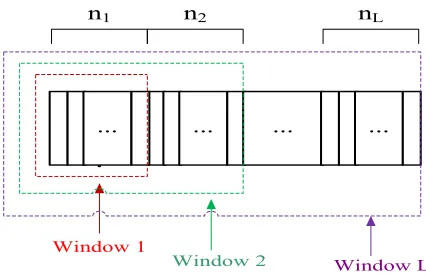
Definition 1 (Window). A window over the firstℓ video layers (denoted by ωℓ) includes all the packets in N1:ℓ ={P1
1, P21, ..., Pn11, ..., P ℓ
1, P2ℓ, ..., Pnℓℓ}.
There areL windows for a GOP with L video layers as shown in Figure 3.1. The FSM corresponding to the window ωℓ over the first ℓ video layers is an M ×N1:ℓ matrix F1:ℓ,
which contains the first N1:ℓ columns of the FSM F.
Based on the FSM, the following two sets of packets can be attributed to each device Ui
at any given time slot t:
• TheHas set of device Ui in the firstℓvideo layers (Hi1:ℓ) is defined as the set of packets
that are decoded by device Ui from the firstℓ video layers. In Example 1, the Has set
of device U2 in the first two video layers is H1:22 ={P1, P4}.
• The Wants set of device Ui in the first ℓ video layers (Wi1:ℓ) is defined as the set of
W1:ℓ
i = N1:ℓ \ H1:i ℓ. In Example 1, the Wants set of device U2 in the first two video
layers is W1:2
2 ={P2, P3}.
The set of devices having non-empty Wants sets in the first ℓ video layers is denoted by M1:ℓ
w (i.e., M1:wℓ =
Ui
Wi1:ℓ 6=∅ ). At any given FSM F1:ℓ at time slot t, device Ui
having non-empty Wants set in the first ℓvideo layers (i.e., Ui ∈ M1:wℓ) belongs to one of the
following three sets:
• The critical set of devices for the first ℓ video layers (C1:ℓ) is defined as the set of
devices with the number of missing packets in the first ℓ video layers being equal to the number of remaining Q transmissions (i.e., W1:ℓ
i =Q,∀Ui ∈ C1:ℓ).
• The affected set of devices for the first ℓ video layers (A1:ℓ) is defined as the set of
devices with the number of missing packets in the first ℓ video layers being greater than the number of remaining Q transmissions (i.e., W1:ℓ
i > Q,∀Ui ∈ A1:ℓ).
• The non-critical set of devices for the firstℓ video layers (B1:ℓ) is defined as the set of
devices with the number of missing packets in the first ℓ video layers being less than the number of remaining Q transmissions (i.e., W1:ℓ
i < Q,∀Ui ∈ B1:ℓ).
In fact,C1:ℓ∪ A1:ℓ∪ B1:ℓ =M1:ℓ w .
Definition 2 (Instantly Decodable Packet). A transmitted packet is instantly decodable for device Ui if it contains exactly one source packet fromWi1:L.
Example 2. Given the FSM F in (3.2), assume the base station broadcasts coded packet
P2 ⊕P3. In this case, coded packet P2 ⊕P3 is instantly decodable for device U1 as it can
reXOR this coded packet with previously received packet P2 to decode the new packet P3. On
the other hand, the same coded packet P2⊕P3 is not instantly decodable for device U2 as it
does not possess either of these packets.
Definition 3 (Targeted Device). A device Ui is targeted by packet Pj in a transmission when this device will immediately decode missing packet Pj upon successfully receiving the
transmitted packet. In Example 2, with coded packet P2⊕P3 transmission, we say device U1
Definition 4. (Individual Completion Time of a Single Device) At time slot t, individual completion time of deviceUi for the firstℓ video layers (denoted byTW1:ℓ
i ) is the total number
of transmissions required to deliver all the missing packets in W1:ℓ
i to device Ui.
Individual completion time of device Ui for the first ℓ video layers can be TW1:ℓ
i =
W1:ℓ
i , Wi1:ℓ+ 1, ... depending on the number of transmissions that device Ui is targeted with
a new packet and the channel erasures experienced by device Ui in those transmissions.
Example 3. Consider the FSM F in (3.2) and assume erasure-free transmissions. Let us consider the following transmission schedule in the successive four time slots:
1. Packet P1⊕P2 is transmitted in the first time slot.
2. Packet P3 is transmitted in the second time slot.
3. Packet P4 is transmitted in the third time slot.
4. Packet P5 is transmitted in the fourth time slot.
The evolution of the FSM after each time slot is given by:
1 0 1 1 1 0 1 1 0 0
⇒
t=1
0 0 1 1 1 0 0 1 0 0
⇒
t=2
0 0 0 1 1 0 0 0 0 0
⇒
t=3
0 0 0 0 1 0 0 0 0 0
⇒
t=4
0 0 0 0 0 0 0 0 0 0
. (3.3)
Let us also consider the packets of individual layers in Example 1. With the above FSM
evolution, device U2 decodes packets P1 and P2 of the first layer after the first transmission.
Therefore, the individual completion time of device U2 for the first video layer is TW1:1
2 =
1. On the other hand, device U2 decodes all five packets after the first two transmissions.
Therefore, the individual completion time of device U2 for all three video layers is TW1:3
2 = 2.
Definition 5. (Completion Time of all Devices) At time slott, completion time of all devices for the first ℓ video layers (denoted by T1:ℓ) is the total number of transmissions required to deliver all the missing packets from the first ℓ video layers to all devices in M1:ℓ
Example 4. With the FSM evolution in (3.3), both devices decode packetsP1 andP2 of the
first layer after the first transmission. Therefore, the completion time of all devices for the
first video layer is T1:1 = 1. On the other hand, both devices decode all five packets after
four transmissions. Therefore, the completion time of all devices for all three video layers is
T1:3 = 4 as the transmission schedule requires four time slots to complete the reception of all
packets by both devices.
Definition 6. (Completion Time of all Non-critical Devices) At time slot t, completion time of all non-critical devices for the first ℓ video layers (denoted by T1:ℓ
B ) is the total number of
transmissions required to deliver all the missing packets from the first ℓ video layers to all
non-critical devices in B1:ℓ.
3.2.4
IDNC Graph and Packet Generation
We define the representation of all feasible packet combinations that are instantly decodable by a subset of, or all devices, in the form of a graph. As described in [5, 77], the IDNC graph G(V,E) is constructed by first inducing a vertex vij ∈ V for each missing packet
Pj ∈ Wi1:L, ∀Ui ∈ M. Two vertices vij and vmn in G are connected (adjacent) by an edge
eij,mn ∈ E, when one of the following two conditions holds:
• C1: Pj = Pn, the two vertices are induced by the same missing packet Pj of two
different devices Ui and Um.
• C2: Pj ∈ Hm1:Land Pn∈ Hi1:L, the requested packet of each vertex is in the Has set of
the device corresponding to the other vertex.
Definition 7. In an undirected graph, all vertices in a clique are connected to each other with edges. A clique is maximal if it is not a subset of any larger clique [99].
v1,1 v1,3 v1,4 v1,5
[image:50.595.195.417.102.191.2]v2,2 v2,3
Figure 3.2: IDNC graph corresponding to FSM in (3.2).
Example 5. The IDNC graph G corresponding to FSM in (3.2) is shown in Fig. 3.2. An example of a maximal clique of this graph is κ ={v1,1, v2,2}, in which the sender transmits
P1⊕P2. Note that the maximal clique is just an edge, because no other larger clique exists
in the graph.
3.3
Importance of Appropriately Choosing a Coding
Window
In scalable video with multiple layers, the sender needs to choose a window of video layers and the corresponding FSM to select a packet combination in each transmission. In general, different windows lead to different packet combinations and result in different probabilities of completing the broadcast of different numbers of video layers before the deadline. To further illustrate this, let us consider the following FSM with M = 2 devices and N = 2 packets at time slot t:
F=
0 1 1 1
. (3.4)
In this scenario, we assume that packet P1 belongs to the first video layer and packet P2
belongs to the second video layer. We further assume that there are two remaining transmis-sions before the deadline, i.e., Q = 2. Given two video layers, there are two windows such as ω1 ={P1} and ω2 ={P1, P2}. With these windows, the possible packet transmissions at
time slot t are:
• Case 1: Window ω1 leads to packet P1 transmission since it targets device U2 and
M1:1
Table 3.1: Probability expressions used in Case 1, where packet P1 is transmitted at time
slot t. With this transmission, the first layer completion probability before the deadline
P[T1:1 ≤2] = (1−ǫ
2) +ǫ2(1−ǫ2) and both layers’ completion probability before the
deadline P[T1:2 ≤2] = (1−ǫ2)(1−ǫ1)(1−ǫ2) are shown.
P1(t) - P1(t) P1(t+ 1) P1(t) P2(t+ 1)
P[T1:1 ≤2] U1 - - -
-P[T1:2 ≤2] - (1−ǫ1)
U2 (1−ǫ2) - ǫ2 (1−ǫ2) (1−ǫ2) (1−ǫ2)
• Case 2: Window ω2 leads to packet P2 transmission since it targets devices U1 and
U2 and M1:2w ={U1, U2}.
(Case 1:) With packetP1 transmitted at time slott, we can compute the probabilities of
completing the broadcast of different numbers of video layers before the deadline as follows.
• The probability of completing the first video layer broadcast before the deadline can be computed as, P[T1:1 ≤2] = (1−ǫ
2) +ǫ2(1−ǫ2). Here, (1−ǫ2) defines the packet
reception probability at device U2 at time slot t and ǫ2(1−ǫ2) defines the probability
that packet P1 is lost at device U2 at time slot t and is received at device U2 at time
slot t+ 1.
Remark 1. It can be stated that the missing packets of all devices need to be attempted at least once in order to have a possibility of delivering all the missing packets to all
devices.
• Using Remark 1, the sender transmits packet P2 at time slot t+ 1. Consequently, the
probability of completing the broadcast of both video layers before the deadline can be computed as, P[T1:2 ≤ 2] = (1−ǫ
2)(1 −ǫ1)(1−ǫ2). This is the probability that
each missing packet is received in the first attempt.
A summary of probability expressions used for Case 1 can be found in Table 3.1.
(Case 2:) With packetP2 transmitted at time slott, we can compute the probabilities of
completing the broadcast of different numbers of video layers before the deadline as follows.
• The sender transmits packet P1 at time slot t+ 1. Consequently, the probability of
completing the first video layer broadcast before the deadline can be computed as,
P[T1:1 ≤2] = (1−ǫ
2). This is the probability that packet P1 is received at device U2