International Journal of Innovative Technology and Exploring Engineering (IJITEE) ISSN: 2278-3075, Volume-8 Issue-10, August 2019
Abstract: The reliability of structures in the reconstruction of buildings depends on quality control methods that can be destructive and non-destructive. Directions for improving the accuracy of methods for assessing masonry as a complete construction system are proposed in the paper. The factors to be taken into account when assessing the bearing capacity of the operating buildings have been stated. Margin of errors of a number of parameters using different methods of strength assessment have been determined.
Keywords: Reliability of building structures, reconstruction, restoration, masonry, methods of strength assessment, compressive strength.
I. INTRODUCTION
Modern materials and technologies allow to fulfill the reconstruction of historical buildings as well as to achieve the preservation and restoration of architectural monuments. Decision-making in the field of reconstruction or restoration is much more difficult due to the uncertainty of assessing the real state of buildings and structures [1-3]. Obtaining reliable and current measuring and analytical information is a major challenge. Assessment of bearing capacity reserves is the most important task in the process of obtaining primary information during restoration or reconstruction which serves as the basis for technical and technological decisions [4-6]. The need for this problem is confirmed by the results of the analysis of structural failure which led to accidents of buildings for 5 years in the period from 1999 to 2003 [7]. The number of accidents of stone buildings is about 45% as shown in Figure 1. The lack of relationship between the design and calculation of structures, methods of quality control in the performance of work and evaluation of the reserves of bearing capacity in operation is a problem of modern principles of reliability of building structures. It is important to assess the complex effect of quality control on the final result of construction products providing guaranteed indicators of the basic properties of structures as well as the required level of reliability [8-11]. Improvement of quality control methods and, in particular, assessment of strength indicators is the most important direction of modern development [12, 13]. The accuracy of control of physical and mechanical properties of materials and the correct
Revised Manuscript Received on August 05, 2019
L.F. Kazanskaya, Department of Building materials, Emperor Alexander I
St.Petersburg State Transport University, Saint-Petersburg , Russia
Yu.A. Belentsov, Department of Building materials, Emperor Alexander I
St.Petersburg State Transport University, Saint-Petersburg , Russia
[image:1.595.311.545.302.493.2]interpretation of the results is one of the important factors [14-17]. Reliable and timely quality control of materials is an integral part of the triad of reliability since the reliability is laid in the design then it is evaluated and provided in the construction process then it is maintained during operation [18]. Modern requirements to the level of reliability of structures are not always provided with a high level of accuracy of measuring and control operations [19-22].
Figure 1 Number of accidents of buildings and structures in various design solutions for the period 1999-2003 [7]
Evaluation of the bearing capacity of individual structures or buildings as a whole building system is an important component in the process of restoration or reconstruction. Often reconstructed buildings are built of brick and stone. Inspection of the state of the building and structures based on instrumental methods for assessing technical quality indicators is the basis for decision-making [23]. It is necessary to carry out tests at the assessment of reserves of bearing capacity of stone and brick designs as well as at the assessment of their quality, thus considering the following factors:
- the size of samples as well as their shape and quantity to assess the strength;
- bonding of masonry and other technological factors; - the height of sample and the number of rows of masonry; - the workability of fresh mortar, absortion properties of bricks and their humidity;
- the qualification of bricklayer;
Methods of Assessing the Strength of Masonry to
Ensure the Reliability of Reconstructed
Structures
Methods of Assessing the Strength of Masonry to Ensure the Reliability of Reconstructed Structures
- the availability of reinforcement, type and scheme of reinforcement;
- the masonry technology and the quality of raw materials taken in accordance with the permissible probability of failure.
-the variability of strength parameters of brick and hardened mortar depending on the coefficient of variation for strength and load [24,25].
Thus, the aim of the study is to improve the accuracy of methods for assessing the strength of masonry in terms of improving the reliability of reconstructed structures.
II. RESEARCHMETHODS
The solution of the stated task is based on several main ways. One can highlight the most significant of them:
1. Calculation method for determining the strength of masonry. It is based on the application of the Onishchik’s modified formula proposed in 1937. The strength of masonry depends on the strength of brick as well as compression and bending strength of mortar that are determined by destructive methods [25-27].
2. Non-destructive methods for determining the strength of masonry. They are based on the assessment of the strength properties of individual masonry materials and the transition to the strength of the entire masonry as discussed above.
3. Destructive methods based on the assessment of masonry strength in standard samples in accordance with GOST R 57290 2016/ EN 1052-1:1998 2016 "Masonry. Method for determination of compressive strength".
The calculation method has disadvantages. Using the calculated empirical formulas does not allow to take into account real characteristics of materials and the factors of masonry technology: type of brick and mortar, sizes, technology of construction, reinforcement, technological and strength characteristics of mortar, qualifications of bricklayer, etc. Average overestimation of the actual compressive strength of masonry compared with the calculated value is 1.7 times according to the analysis of experimental researches of many authors. At the same time the probability of exceeding the calculated strength over the actual strength even in laboratory conditions is only 13% which can lead to accidents of buildings and structures [28]. The use of non-destructive methods reduces the accuracy of the test, so it is difficult to make a reasonable decision about the reserve of load-bearing capacity of masonry [25,29-31]. The development of these methods seems to be effective in combination with destructive methods.
Destructive testing methods with the standard samples have their own features. Evaluation of real strength indicators is carried out according to normative documents GOST R 57290-2016 or EN 1052-1:1998-2016 in buildings under construction. Methods of this standard are difficult to apply to the masonry samples taken from the structure. Also, this standard is ambiguous reflects the strength of masonry in massive structures because of the size and number of samples for testing. There is no method of interpretation of the results providing the transition from the experimental values of
strength to the calculated parameters with the level of reliability of 95%.
The compressive strength of masonry perpendicularly to the horizontal joints is determined by the strength of masonry specimens loaded to the failure. Materials, design and the scheme of bonding of masonry in the samples must match the settings used in the actual construction. The test samples are subjected to uniform compression. The maximum load achieved is recorded. Regulatory compressive strength of masonry is determined by the strength of the individual testing specimens of masonry.
This approach allows us to proceed to the assessment of the reliability of brick structures by analogy with concrete. For the solution it is necessary to state the indicators of the required probability of failure-free operation Pf, which allows
stating the required safety factors in the transition from the actual strength to the calculated strength [31-33]. Numerical solutions depending on the main parameters of masonry material and loads depend on the level of responsibility of structures (normal, high responsible, etc.) [34].
For responsible reconstruction processes it is necessary to focus on destructive methods to guarantee strength indicators. The limiting factors for the application of destructive methods are the discrepancy between the size and shape of the standard samples according to the current standard and the sampling technology from existing structures as well as the lack of approved indicators of the safety factor that guarantee the reserves of the bearing capacity with the necessary level of reliability.
III. RESEARCHRESULTSANDDISCUSSION
It is necessary to scientifically approach to the metrological support of the process of measurement and evaluation of quality indicators. The requirements of the direct measurements involved in the process must be evaluated to ensure the accuracy of the control in determining the concrete compressive strength class. The compressive strength class of concrete is a guaranteed strength with the probability of 95% according to the test results of standard samples. Strength evaluation in standard samples is considered in the regulations as the direct method in terms of processing the results. However, the measurement accuracy indicators laid down in the standard GOST R 57290-2016/ EN 1052-1:1998-2016 are given as for indirect measurements including direct measurement of geometric dimensions and destructive force. Taking into account the fact that the accuracy of measurement by direct measurement methods in determining the strength is laid in the normative documents of GOST R 57290-2016/ EN 1052-1:1998-2016, the following can be noted:
- the permissible margin of error of the geometric
International Journal of Innovative Technology and Exploring Engineering (IJITEE) ISSN: 2278-3075, Volume-8 Issue-10, August 2019
- acceptable error is =2% for destructive force. Coefficient of variation of masonry will be the value determined from the strength formula:
for brick and mortar: νbr=0.25; νmor =0.13 [31], accordingly:
νmas=0.385
The coefficient of variation of masonry is νmas =0.47 according to the analysis of the results of experiments of different authors for 50 years [34] that confirms the above dependence.
The limit value of the variation coefficient of strength for masonry in the definition of strength is 47%. The instrumental margin of error distorts the test results and leads to the decrease of level of reliability of the building structure under adverse circumstances and it can also cause an accident.
Using destructive testing methods the error shall be determined as for indirect measurement methods based on known permissible errors of direct measurements. The error of the indirect method for determining the strength depends on the fact that the error values Δа, Δb, ΔP are much smaller than the values of a, b, P. Where a, b, P are the geometric dimensions and the destructive force measured during the test.
The formula for calculating the error according to the standard GOST R 57290-2016/ EN 1052-1:1998-2016:
(1) where
, ,
- are the coefficients of significance of directmeasurements. They are defined as the partial derivative of the function R = f (a, b, P)=P/a×b by the corresponding variable.
The significance coefficient for each component will be:
;
;
(2)
The influence of the margin of error of indirect measurement can be considered by the example of determining the strength for the maximum strength masonry based on normal-format bricks using standard samples. The minimum size of the standard sample is 510×120×600 mm. Compressive strength should be at 780 N/cm2 and the fracture load should be at 477360 N.
The margin of error of the indirect method at determining the strength will be:
Calculations show that the margin of error of the indirect method can reach about 2.5%, i.e. it is quite acceptable with the coefficient of variation of the masonry of 47%.
It is necessary to pay attention to the size of samples in the plan and type of mortar at deciding on the reconstruction or restoration of stone or brick structures. For example, lime mortars with higher deformability and lower strength were used in the construction of historical buildings [36,37]. According to the principles of scientific restoration similar materials should be used in the restoration of masonry [38-40].
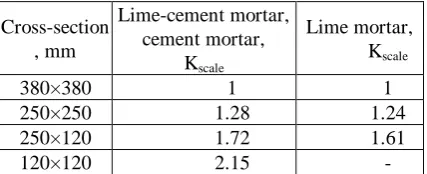
[image:3.595.321.535.499.586.2]Evaluation of the bearing capacity reserves of the structures of reconstructed and restored buildings should take into account that the representative dimensions of the samples are determined on the basis of the minimum size at which the magnitude of tensile transverse stresses will be manifested similar to the masonry of real structures. The thickness of the masonry walls is usually 1; 1.5 or 2 bricks that allows determining the size of the sample in the plan. It is necessary to take into account the scale factor of the cross section as the strength of the elements depends significantly on the size of sample [41-44]. The strength of the masonry in the samples with size of 380×380 mm in plan is taken as the basic value. The averaged coefficients of strength reduction depending on the geometric dimensions of the masonry samples and the type of mortar are given in Table 1 at experiments with silicate brick of the M150 strength grade.
Table 1 Scale factors at the evaluation of geometric dimensions of masonry samples
Cross-section , mm
Lime-cement mortar, cement mortar,
Kscale
Lime mortar, Kscale
380×380 1 1
250×250 1.28 1.24
250×120 1.72 1.61
120×120 2.15 -
It should be taken into account that the uniformity coefficient increases by 13% in the transition from 380×380 samples to 250×250mm samples.
The complexity of sampling from rectangular masonry leads to the need to select samples by drilling along the axis of the load application. The size in the plan of a cylindrical sample shall be more than 250 mm and the height shall be more than 5 numbers of rows.
Methods of Assessing the Strength of Masonry to Ensure the Reliability of Reconstructed Structures
General technical conditions" and European standards within the Ksaf=1,7÷3 [45] or by calculation depending on the functional purpose and responsibility of structures according to Table 2 [34].
Table 2 Safety factors depending on the responsibility level of structure
The
responsibility level
Pf β γн Кsafe
high 10-6 4,6 1,1 6,1
normal 10-3 3,0 1,0 3,9
low 10-2 2,25 0,8 2,3
Experimental verification of the above test methods in cylindrical samples for the reconstructed building showed that the deviation of the experimental data from the calculated data is about 20%. This significantly reduces the level of reliability of the estimated structures in terms of the probability of failure. The decrease of the level of reliability in terms of the probability of failure when using the standard technique will be at Ksafe=5.05 that corresponds to the probability of failure equal to Pf=2,3×10⁻⁴ [34]. This is enough, for example, for the design of architectural monuments which are subject to normal requirements for the level of reliability and failure-free.
IV.CONCLUSION
The above examples allow us to take a fresh look at the requirements of standards for determining the strength of the masonry of existing buildings that need to be reconstructed or restored.
Modern requirements of the construction industry require a balanced and reasonable solution in assessing the reserves of the bearing capacity of masonry with a guaranteed level of quality and reliability at all stages of the building life cycle. These requirements must be taken into account in the survey, design, construction as well as quality control. A significant role is given to improve the culture of production, quality control and reliability, which must be considered in a complex focused on the end result and high efficiency.
Directions for improving the accuracy of methods for assessing brickwork as a complete construction system are proposed in the paper. The factors to be taken into account when assessing the bearing capacity of the operated buildings and structures have been stated. Margin of errors of a number of parameters using different methods of strength assessment have been determined.
REFERENCES
1. Shangina, N., Pukharenko, Y., Kharitonov, A., & Kharitonova, T. Dry mixes for the restoration: basic principles of design. In MATEC Web of Conferences. 2017. (Vol. 106, p. 03021). EDP Sciences.
2. Asteris, P. G., Argyropoulos, I., Cavaleri, L., Rodrigues, H., Varum, H., Thomas, J., & Lourenço, P. B. Masonry Compressive Strength Prediction using Artificial Neural Networks. In International Conference on Transdisciplinary Multispectral Modeling and Cooperation for the Preservation of Cultural Heritage. 2018. (pp. 200-224). Springer, Cham.
3. Shakya, M., Varum, H., Vicente, R., & Costa, A. Empirical formulation for estimating the fundamental frequency of slender masonry structures. International Journal of Architectural Heritage, 2016,10(1), 55-66. 4. Montazerolghaem, M., & Jäger, W. Reliability Verification of
Unreinforced Masonry Wall. Modern Applied Science, 2016, 10(6). 5. Skrzypczak, I., Kujda, J., & Buda-Ożóg, L. The use of probabilistic
methods in assessing the reliability of masonry structures. Procedia Engineering, 2017, 193, 160-167.
6. Bakeer, T. Reliability assessment of vertically loaded masonry walls. Structural Safety, 2016, 62, 47-56.
7. Accidents of buildings and structures on the territory of the Russian Federation in 2003. Moscow, FCC, 2004 (in Russian)
8. Krasnoshchekov Yu. V. Probabilistic bases of calculation of building structures. Publishing center SibADI. Omsk, 2016, 214p. (in Russian) 9. Smirnova O. Concrete mixtures with high-workability for ballastless slab
tracks. Journal of King Saud University-Engineering Sciences, 2017, 29(4), 381-387
10. Heravi A.A., Smirnova O., Mechtcherine V. Effect of strain rate and fiber type on tensile behavior of high-strength strain-hardening cement-based composites (HS-SHCC). RILEM Bookseries. 2018. V. 15. pp.266-274. 11. Smirnova O.M. Obtaining the High-performance Concrete for Railway
Sleepers in Russia. Procedia Engineering, Volume 172, 2017, pp.1039-1043
12. Pichugin, S.F. Reliability estimation of industrial building structures. Magazine of Civil Engineering. 2018. 83(7). Pp. 24–37.
13. Smirnova O.M. Technology of Increase of Nanoscale Pores Volume in Protective Cement Matrix, International Journal of Civil Engineering and Technology, 9(10), 2018, pp. 1991–2000.
14. Kharitonov A., Marina Korobkova, Olga Smirnova. The influence of low-hard dispersed additives on impact strength of concrete. Procedia Engineering, Volume 108, 2015, pp.239-244.
15. Smirnova O. M. Rheologically Active Microfillers for Precast Concrete, International Journal of Civil Engineering and Technology, 9(8), 2018, pp. 1724–1732
16. Šoukal, F., Koplík, J., Ptáček, P., Opravil, T., Havlica, J., Palou, M. T., & Kalina, L. The influence of pH buffers on hydration of hydraulic phases in system CaO–Al2O3. Journal of Thermal Analysis and Calorimetry, 2016, 124(2), 629-638.
17. Smirnova O. M. Evaluation of superplasticizer effect in mineral disperse systems based on quarry dust . International Journal of Civil Engineering and Technology, 9(8), 2018, pp. 1733-1740.
18. Kazanskaya L. F., Grigoriev D. S., Makarov Yu. I. Micromechanical properties of the contact zone in concretes based on technogenic raw materials. Natural and technical Sciences. 2014, 2 (70). pp. 292-295. 19. Efremov I. V., Rakhimova N. N. Reliability of technical systems and
technogenic risk. 2013.Orenburg, OSU, 163 p.(in Russian)
20. Belentsov Yu.A., O.M. Smirnova. Influence of acceptable defects on decrease of reliability level of reinforced concrete structures. International Journal of Civil Engineering and Technology, 2018, 9(11), pp. 2999–3005.
21. Smirnova O.M. Compatibility of Portland cement and polycarboxylate-based superplasticizers in high-strength concrete for precast constructions. Magazine of Civil Engineering, No. 6, 2016. pp.12-22.
22. Kazanskaya L.F. and O.M. Smirnova. Supersulphated Cements with Technogenic Raw Materials. International Journal of Civil Engineering and Technology, 9(11), 2018, pp.3006–3012.
23. Asteris, P. G., Moropoulou, A., Skentou, A. D., Apostolopoulou, M., Mohebkhah, A., Cavaleri, L., ... & Varum, H. Stochastic Vulnerability Assessment of Masonry Structures: Concepts, Modeling and Restoration Aspects. Applied Sciences, 2019, 9(2), 243.
24. Shakya, M., Varum, H., Vicente, R., & Costa, A. Seismic vulnerability assessment methodology for slender masonry structures. International Journal of Architectural Heritage, 2018,12(7-8), 1297-1326.
25. Sýkora, M., Diamantidis, D., Holický, M., Marková, J., & Rózsás, Á. Assessment of compressive strength of historic masonry using non-destructive and destructive techniques. Construction and Building Materials, 2018, 193, 196-210.
26. Vasanelli, E., Calia, A., Colangiuli, D., Micelli, F., & Aiello, M. A. Assessing the reliability of non-destructive and moderately invasive techniques for the evaluation of uniaxial compressive strength of stone masonry units. Construction and Building Materials, 2016, 124, 575-581.
International Journal of Innovative Technology and Exploring Engineering (IJITEE) ISSN: 2278-3075, Volume-8 Issue-10, August 2019
thor-2 Photo 28. Smirnova O. Compatibility of shungisite microfillers with
polycarboxylate admixtures in cement compositions. ARPN Journal of Engineering and Applied Sciences. 2019. Vol. 14, No. 3. pp.600-610. 29. Ulybin A.V., Fedotov S. D., Tarasova D. S. Determination of concrete
strength during inspection of buildings and structures. The world of construction and real estate. 2012. No. 45. pp. 2-5.
30. Kharitonov, A. M., Y. M. Tikhonov, and Y. A. Belentsov. "Influence of concrete strength evaluation method accuracy on reliability levels of geotechnical structures." Geotechnics Fundamentals and Applications in Construction: New Materials, Structures, Technologies and Calculations, (2019): 135.
31. Belentsov Yu.A. Increase of anisotropic materials production efficiency. Thesis of doctor of technical Sciences in the scientific specialty "Building materials and products". Belgorod. 2010. 465p.
32. Smirnova O.M. and D.A.Potyomkin. Influence of Ground Granulated Blast Furnace Slag Properties on The Superplasticizers Effect, International Journal of Civil Engineering and Technology, 9(7), 2018, pp. 874–880.
33. Rzhanitsyn A. R. Theory of calculation of building structures for reliability. Moscow. Stroizdat, 1978. 239p. (in Russian)
34. Rayzer V. D. Theory of reliability in structural design. Moscow. DIA, 1998. 304p.(in Russian)
35. Belentsov Yu. A., Kharitonov A.M. Determination of the safety factor in assessing the quality of brick structures. Bulletin of civil engineers. 2016. 4 (57). pp. 105-110.
36. De Nardi, C., Brito de Carvalho Bello, C., Ferrara, L., & Cecchi, A. Self-healing lime mortars: an asset for restoration of heritage buildings. In Sustainable Materials Systems and Structures SMSS, 2019, Vol. 128, pp. 652-659.
37. Shaybadullina Arina, Yuliya Ginchitskaya and Olga Smirnova. Decorative Coating Based on Composite Cement-Silicate Matrix. Solid State Phenomena. 2018, Vol. 276, pp. 122-127
38. Koňáková, D., Čáchová, M., Vejmelková, E., Keppert, M., Jerman, M., Bayer, P., ... & Černý, R. Lime-based plasters with combined expanded clay-silica aggregate: Microstructure, texture and engineering properties. Cement and Concrete Composites, 2017, 83, 374-383.
39. Smirnova O.M. Development of Classification of Rheologically Active Microfillers for Disperse Systems With Portland Cement and Superplasticizer. International Journal of Civil Engineering and Technology, 2018, 9(10), pp. 1966–1973.
40. Nogueira, R., Pinto, A. P. F., & Gomes, A. Design and behavior of traditional lime-based plasters and renders. Review and critical appraisal of strengths and weaknesses. Cement and Concrete Composites, 2018, 89, 192-204.
41. Petrova, T., Smirnova, O. Influence of fine mineral fillers on properties of plasticized cement compositions. In Modern Building Materials, Structures and Techniques. Proceedings of the International Conference, 2010, Vol. 10, p. 250. Vilnius Gediminas Technical University, Department of Construction Economics & Property.
42. Kharitonov, A., Ryabova, A., & Pukharenko, Y. Modified GFRC for durable underground construction. Procedia engineering, 2016, 165, 1152-1161.
43. Smirnova O.M., Belentsov Y.A., Kharitonov A.M. Influence of polyolefin fibers on the strength and deformability properties of road pavement concrete. Journal of Traffic and Transportation Engineering (English Edition). 2019. 6(4): 407-417.
44. Domański, T., & Matysek, P. The reliability of masonry structures–evaluation methods for historical buildings. Czasopismo Techniczne, 2018, Vol. 9, 91108.
45. Marciukaitis G. V., Jonaitis B. B., Valavanis J. S., Gnip, I. Y. Evaluation of strength and deformability of masonry in compression according to SNiP II-22–81 and Eurocode 6. Building materials, 2004, p. 48-49.
AUTHORSPROFILE
Liliya Kazanskaya. Education: 1982-1987-Bashkir
State Agrarian University (Ufa, Russia), faculty of environmental construction, specialty: "Hydrotechnical construction"; qualification: engineer-hydrotechnician. 1996-1998 - Bashkir State Agrarian University (Ufa, Russia), specialty: "Economics and management of agricultural production"; qualification: economist-manager. Professional retraining: the program "Production and application of building materials, products and structures", Academy of construction and industrial production" (Moscow), 2016; the program "Economy and management at the transport enterprise", St. Petersburg, 2016; the program "Metrology, standardization and certification", Institute of industrial safety (Moscow), 2017.
1990-1994 - PhD education on the scientific specialty “Building materials and products” at the Department of building materials and technology of Petersburg State Transport University, Dissertation for the degree of doctor of technical sciences on subject “Sulphate-slag binders and concretes on their basis (on the basis of wastes of chemical industry of the South Ural region in Russia)”.
Jobs: Professor of the Department "Building materials and technologies" of Emperor Alexander I Petersburg State Transport University. Scientific interests: supersulphated binders, alkali-activated binders, hybrid binders, high-performance concrete, quality control methods, materials for transport constructions, methods of microstructure study, economics and management in transport construction
Yuriy Belentsov. Education: 1991 – 1996 - Petersburg
State Transport University (Saint-Petersburg, Russia), Faculty of Civil Engineering, specialty: "Civil and industrial Construction"; qualification: engineer-builder. 1998-2000 - Petersburg State Engineering Economic Academy, specialty: "General management of civil and industrial construction "; qualification: manager. 1996-2000 - PhD education on the specialty “Building materials and products” at the Department of buildings and technology of Petersburg State Transport University, Dissertation on subject "Improving the efficiency of production of composite anisotropic materials".
![Figure 1 Number of accidents of buildings and structures in various design solutions for the period 1999-2003 [7]](https://thumb-us.123doks.com/thumbv2/123dok_us/8186718.256538/1.595.311.545.302.493/figure-number-accidents-buildings-structures-various-design-solutions.webp)