Research Report DFE-RR157
A study of
recommendations
arising from serious
case reviews
2009-2010
Marian Brandon Peter Sidebotham Sue Bailey
Pippa Belderson
This research report was commissioned before the new UK Government took office on 11 May 2010. As a result the content may not reflect current Government policy and may make reference to the Department for Children, Schools and Families (DCSF) which has
now been replaced by the Department for Education (DFE).
ACKNOWLEDGEMENTS
The research team would like to extend our thanks to the Department for Education for their support in overseeing this project, particularly Jenny Gray, Isabella Craig and Julie
Wilkinson. Thanks are also due to the advisory group for their helpful advice and suggestions and to Jane Black from Norfolk LSCB and Ruth Pearson from Sheffield University for offering advice during the final drafting phase of the study.
AUTHORS
Dr Marian Brandon, Sue Bailey and Dr Pippa Belderson are members of the Centre for Research on the Child and Family in the School of Social Work and Psychology at the University of East Anglia, Dr Peter Sidebotham is a member of the Health Sciences Research Institute at the University of Warwick.
CONTENTS
Executive Summary 1
Chapter 1: Literature Context, Aims and Methodology 6
Chapter 2: The number of recommendations 10
Chapter 3: Thematic analysis of recommendations 13
Chapter 4: Matching the themes of the cases to the recommendations made 36
Chapter 5: A critique of the ‘SMART’ approach to recommendations and action plans 42
Chapter 6: Conclusion 47
List of tables
Table 1: Number of recommendations made in each of 20 Serious Case Reviews,
together with the agencies addressed 12
Table 2: The number of overview reports addressing specific themes in the
recommendations 14
Table 3 Extent to which themes in 20 cases are reflected in the recommendations 37
List of Figures
Figure 1: Numbers of overview reports included in each stage of analysis 9
Figure 2: A layered approach to a consideration of recommendation themes 13
1
EXECUTIVE SUMMARY
Introduction
This small study presents a critical, thematic analysis of recommendations from 33 of the serious case reviews (cases of child death or serious injury through abuse or neglect)
completed in 2009-2010. The central aim of the study was to consider what part
recommendations can play in aiding agencies and individuals ‘to learn lessons to improve the way in which they work both individually and collectively to safeguard and promote the welfare of children’ (HM Government 2010:246).
Key findings
• Overall, our impression of reading recommendations from the 33 cases is that they
are indeed becoming tighter and more clearly focused, although rarely are they few in number.
• In the 20 serious case reviews examined in depth, there were a total of 932
recommendations with an average of 47 per review. This is in spite of repeated calls
to make recommendations few in number.
• Breaking down recommendations into achievable actions has resulted in a further
proliferation of tasks to be followed through. Adding new layers of prescriptive activity leaves little room for professional judgement.
• Most recommendations concerned procedures and training. The route to grappling
with practice complexities like engaging hard to reach families, was usually more
training and the compliance with or creation of new or duplicate procedures. Fewer recommendations considered strengthening supervision and better staff support as
ways of promoting professional judgement or supporting reflective practice.
• There was rarely a research evidence base cited for the recommendation made: they
tended, instead, to be based on learning from the single case which was assumed to have wider implications.
• Action plans were thoughtful, well considered documents that tracked the
implementation of recommendations carefully. However, those recommendations
that were easy to implement rarely addressed complex matters of professional judgement.
• The interface between societal issues like deprivation and maltreatment rarely
featured in recommendations or action plans. Wider issues tended to be thought of
2
• Local Safeguarding Children Boards need to take responsibility for curbing this
self-perpetuating cycle of a proliferation of recommendations and tasks and allow
themselves to consider other ways of learning from serious case reviews. Recommendations may not be the best way to learn from these cases.
Background
To enable lessons from serious case reviews to be disseminated and implemented
effectively, Working Together (HM Government 2010) advises that recommendations should be few in number, focused and specific. Most analyses of recommendations assess
whether they are or can become Specific, Measurable, Achievable, Relevant and Timely
(SMART). Other learning about recommendations reflects more of a tension between, on the one hand, finding ways to act quickly on easy to audit learning before the impetus dissipates,
and on the other hand, striving for more considered, deeper learning to overcome the perennial obstacles to good practice.
Methodology
We used a staged approach in the analysis of recommendations. The first stage involved a
qualitative analysis of recommendations from all 33 cases to identify major themes. A sub-sample of 20 reports was then analysed to ascertain the number of recommendations made
and the extent to which they reflected the themes of the cases. The final stage of analysis involved a scrutiny of five action plans.
Findings
The number of recommendations
• Numbers of recommendations ranged from 10 to 94, with an average of 47 per
review. In total, across the 20 reviews, there were 932 recommendations. The
majority were targeted at children’s social care services (179), community health services (161), hospital trusts (92) or the police (85).
• The recommendations which occurred with the greatest regularity concerned training
and other aspects of managing the case and inter-agency working. Overall, the
3 Recommendation Themes
• To explore recommendation themes we developed a framework which focused on
the child at the centre of the serious case review, working outwards to consider the child’s family and environment, and out further to consider managing the case and the services which were (or were not) put in place to meet the child’s needs. Working
outwards yet further, we considered recommendations which addressed wider issues, or had regional and national implications for practice and/or policy.
• Recommendations which focused on the child and their family advocated taking a
broad view of the family’s circumstances, history and networks and taking account,
for example, of ‘hidden men’. They included seeing, hearing and keeping the child in mind especially when very young, disabled, missing from home, educated at home,
or overshadowed by parents’ needs.
• Aspects of managing the case highlighted the need for timely, careful decision
making at each stage of the referral, assessment and the ongoing safeguarding process. Avoiding drift in decision making about neglect cases and addressing
problems of high thresholds and access to children’s social care services, especially in neglect cases, were recommendation themes.
• The importance of understanding the limits of professional knowledge and the
need to seek and share expertise, for example about child development, were
features in a small number of recommendations. Insufficient professional challenge of parents and other professionals was emphasised in some recommendations.
However, the route to achieving more robust challenge and to grappling with other practice complexities like engaging hard to reach families, tended to be more training
and the compliance with or creation of new or duplicate procedures. There were few recommendations that considered strengthening supervision and better staff support
as ways of promoting professional judgement or supporting reflective practice. • A small number of recommendations highlighted the previously under explored
issues of staffing and workforce knowledge and capacity. This included criticism of the use of unqualified staff, particularly in children’s social care, but also in the police force and health visiting.
• National issues of ‘public health’ and more general messages from serious case
review recommendations included ‘safer sleeping’ advice, particularly avoiding
co-sleeping where alcohol or drugs had been consumed, and the danger to babies from being shaken.
4
homes, information sharing between children and adult services, disabled children and vulnerable migrant children. There were calls for increased participation of the armed forces in safeguarding, and better discussions with the Crown Prosecution
Service about plea bargaining and the impact of reduced sentences on children’s safety.
Do the recommendations match the themes of the case?
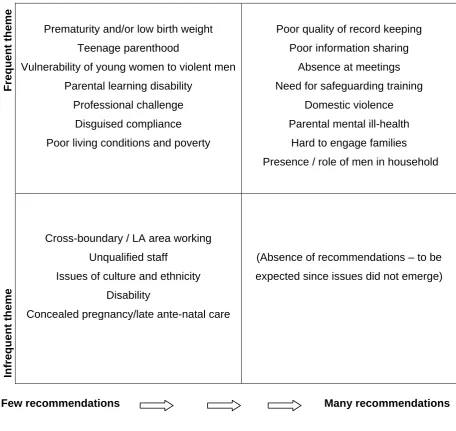
Most recommendations connected clearly to the case (and therefore were relevant). Common themes which mostly translated into recommendations were domestic violence,
parental substance misuse and parental mental ill health as well as the theme of ‘hidden men’. Regularly occurring themes which rarely translated into recommendations included
premature or low weight babies and teenage parenthood. Wider themes like poverty and poor quality living environments scarcely appeared in recommendations. Where there were
many recommendations they mostly included the kind of professional issues (like quality of recording) which lend themselves readily to crisp and measurable recommendations.
However there were often repetitive messages. While messages may need to be reinforced,
the imperative to fix everything may result in little getting or staying fixed.
Are the action plans ‘SMART’?
Action plans are the means by which recommendations are translated into workable actions and followed through. The analysis of five action plans showed that all had a range of
transparent methods for making sure that progress could be tracked. Where there were high numbers of recommendations, the action plans were accordingly long and detailed (they
ranged in length from 10-40 pages).
• Specific: The sub-division of recommendations produced greater clarity, but also
encouraged a proliferation of tasks to be achieved.
• Measurable: Easily measurable actions tended to be concrete activities like training
events and changes to procedures or demands for information. Moving
recommendations beyond the concrete appeared to be difficult, for example gauging
how the quality and impact of awareness raising/training sessions will be measured. • Achievable: Each plan contained delegated responsibility for ensuring that actions
were completed, suggesting that earlier criticisms (Rose and Barnes 2008) had been addressed.
• Relevant: Although recommendations mostly connected clearly to the case, many
5
recommendations had wider ranging validity, others were pertinent only to the single case. There is a risk of making potentially inappropriate or irrelevant decisions or procedures on the basis of a single case. Recommendations rarely drew explicitly on
wider research based evidence to substantiate their validity.
• Timely: The need for timeliness had been heeded in the action plans we saw.
Recommendations were accompanied by a timescale for implementation, and none of the action plans gave themselves a time frame beyond one year.
Recommendations have become more ‘specific, measurable, achievable, relevant and timely’ but this has resulted in a further proliferation of tasks to be followed through. Adding
new layers of prescriptive activity appears to leave little room for professional judgement. However, it is easier to be critical of the SMART approach than to create an alternative.
Where recommendations need to be made there is still value in this structured, methodical model but LSCBs should free themselves to construct a proportion of recommendations that
are not easy to audit or make SMART that might encourage deeper learning and take longer to embed. Perhaps more importantly, LSCBs should be less reliant on recommendations being the central plank of the learning process in serious case reviews.
Although, on the whole, action plans and recommendations were found to be well
considered, Local Safeguarding Children Boards need to take responsibility for
curbing what has become a self-perpetuating cycle of a proliferation of
6
Chapter 1: Literature Context, Aims and Methods
INTRODUCTION
The aim of this small study is to undertake a thematic and critical analysis of
recommendations from the overview reports of 33 of the serious case reviews (SCRs), which had been completed and were available from the year 2009-2010. Through an analysis of
these recommendations we consider what part they might play in aiding ‘agencies and individuals to learn lessons to improve the way in which they work both individually and collectively to safeguard and promote the welfare of children’(HM Government 2010).
LITERATURE CONTEXT
Before outlining the methodology of this small study and considering its findings, a brief
literature review is provided of analyses of recommendations stemming from reviews of child death or serious injury. The national study of learning from serious case reviews
(Sidebotham et al 2010) revealed mixed views about the value of recommendations. Some respondents indicated that the analysis of outcomes of recommendations and action plans is
the only way of knowing their impact on practice; others were concerned that emphasising recommendations and action plans was too simplistic, casting doubt on the fact that the
impact on practice was necessarily measurable. These contrasting views reflect the tension that exists between, on the one hand, finding ways to act quickly on easy to audit learning before the impetus dissipates, and, on the other hand, wanting slower, more considered
responses and deeper learning to overcome the perennial obstacles to good practice (Sidebotham et al 2010, Munro 2011b).
Earlier studies of cases from Wales (Brandon et al 1999, 2002) and England, (Sinclair and
Bullock 2002, Rose and Barnes 2008) found that recommendations tended to focus primarily on procedures and compliance with procedures. There was some suggestion from Rose and
Barnes’ study of cases from 2001-2003, that increasing the number and scope of procedures might serve to provide a sense of security to managers and agencies and
perhaps offer the illusion of a degree of control over unexpected future circumstances (Rose and Barnes 2008:45). The criticism of procedurally driven recommendations and the
emphasis on compliance rather than professional judgement has been echoed by later
7
particularly by the three reports that make up the Munro Review of Child Protection (Munro 2010, 2011a and 2011b). Rose and Barnes noted that beyond procedural matters, other recommendations grouped around improving communication, assessment of practice and
training needs – findings replicated, to a large degree, by most other published studies. Far fewer recommendations concerned organisational issues of management including
supervision and staffing (Rose and Barnes 2008, Devaney et al 2011, Hyland and Holme 2009).
Most analyses have focused on grouping and classifying types of recommendations and
assessing whether they are, or can become, Specific, Measurable, Achievable, Relevant and Timely (SMART) (Handley and Green 2004, Hyland and Holme 2009, Johnston et al
2011, Wirtz et al 2011, Douglas and Cunningham 2008, Devaney et al 2011).
Recommendations which have come to be expected from serious case reviews are those
where solutions are clear cut and straightforward and can be implemented at a local level in this kind of way (Fish et al 2008). Devaney and colleagues note from their Delphi study of the process of serious case reviews in Northern Ireland (carried out in 2008) that
recommendations did not always flow clearly from the review, could be repetitive, and concern matters already being addressed (Devaney et al 2011). Lack of relevance of
recommendations or missed recommendations were also found in Ofsted’s 2008 report of English serious case reviews.
It appears that some types of recommendations do not always readily fit into a SMART type
of framework. For child death review teams they include prevention strategies (Johnston et al 2011). For serious case reviews, they tend to cluster around actions linked to professional
knowledge and skills (Handley and Green 2004) and wider issues that require further thought and enquiry and perhaps a longer time scale to find national level solutions (Fish et
al 2008). Handley and Green suggest that ‘difficult to audit’ recommendations should be made sparingly even though they claim they could make the most difference to children (2004). Overall, Fish and colleagues criticise the current system for focusing too heavily on
factors at an individual level (Fish et al 2008), a point which is taken up in the final report of the Munro Review (2011b).
In relation to deriving benefit from recommendations in particular, the national study of
learning from serious case reviews (Sidebotham et al 2010) noted that there had been relatively little focus on recommendations in the biennial analyses of serious case reviews in
8 AIMS
The following research questions were identified:
• How many recommendations are there, and to which agencies do they relate? • What kind of recommendations are they, in terms of themes addressed?
• On an individual case basis, do the recommendations match the issues the case
raises? Are they the ‘right’ recommendations for the case?
• Are recommendations focused, specific, and capable of being implemented in a
timely way?
• Can recommendations easily translate into improving practice?
• Is there, on the other hand, learning from (some of) the cases which doesn’t
necessarily translate into recommendations?
METHODOLOGY
We examined the recommendations contained in 33 serious case reviews, completed between 2009-2010, supplied in anonymised form by the Department for Education. The
information initially made available varied in its completeness - while overarching Local Safeguarding Children Board (LSCB) recommendations were available for all 33 cases,
accompanying individual agency recommendations were available for 20 of these, five of which also contained LSCB (agency) action plans. The methodological approach taken here
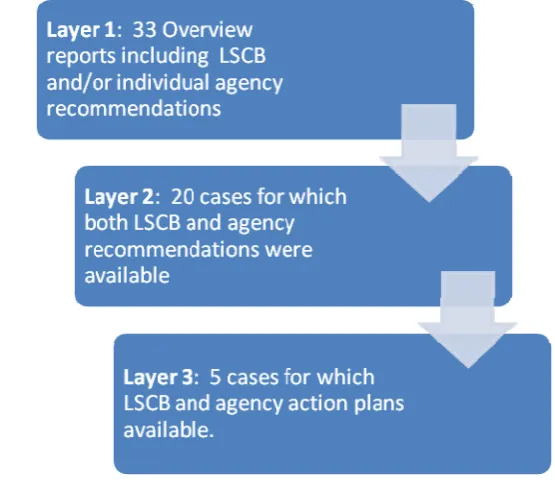
reflects the varying completeness of the data and was designed to ensure we utilise all the information available to us. Figure 1 (page 9) illustrates the ‘layered’ approach to analysis.
Layer 1
Key characteristics of the child and family, and details of the incident and agency
involvement were ascertained for the full sample of 33 cases. A qualitative analysis focusing on the recommendations sections from all 33 reports was then undertaken using Nvivo, a
specialist software programme for organising qualitative data and identifying underlying themes.
Layer 2
For some elements of the work, it was appropriate to consider only those 20 reports where individual agency recommendations were provided, in addition to the broader LSCB
• total numbers of recommendations and to which agency they related; • the frequency of major themes arising in the recommendations; and • the extent to which recommendations reflected the themes of the case.
Layer 3
The recommendations and action plans for the five cases for which full information was
[image:13.595.151.429.352.595.2]available were scrutinised in more detail, with a view to providing a critical appraisal of the extent to which recommendations were ‘SMART’ (Specific, Measurable, Achievable, Relevant and Timely).
Figure 1: Numbers of overview reports included in each stage of analysis
The initial sections of this report consider recommendations from two different viewpoints; firstly which agency they relate to (irrespective of the subject matter of the recommendation) and, secondly, the subject matter or theme they were addressing (irrespective of the agency
concerned). Later sections try to assess whether the themes of the case were translated into relevant and achievable recommendations, and whether the recommendations might
reasonably be expected to lead to better practice in safeguarding children.
10
Chapter 2: The number of recommendations
The Sample
Although only 33 reports were analysed, the cases are typical of those discussed in the
three biennial reviews which cover the period 2003-2009 (Brandon et al 2008, 2009, 2010), and the demographic characteristics of the children at the centre of the 33 reviews are
broadly similar to those from previous years. The 33 cases comprised 21 fatal incidents (64%) and 12 instances of serious injury to a child (36%). A total of 18 cases (55%)
concerned girls and 15 (45%) concerned boys. While 14 (42%) of the children were babies
under one year, 7 (21%) were aged between 1-5 years, 6 (18%) were aged 6-10 years and a further 6 (18%) were aged 11 years and over. This representativeness lends validity to this
small study.
The number of recommendations and agencies concerned
To enable the lessons to be disseminated and implemented effectively, Working Together to Safeguard Children (HM Government 2010) advises that recommendations should be few in number, focused and specific. Indeed one LSCB commented on ‘agencies swimming in a
sea of recommendations’ and made efforts to restrict the number and nature of
recommendations it made to critical areas that it thought would help agencies to make
significant changes.
The first research task was therefore to consider the total number of recommendations made
in each overview report. In the twenty SCRs we examined, where LSCB and specific individual agency recommendations were included (Layer 2), there was considerable
variation in the total number of recommendations in each overview report, ranging from 10 to 94, with an average of 47 per review. In total, across the twenty reviews, there were 932
recommendations. The majority of these were targeted at children’s social care (179), community health services (161), hospital trusts (92) or the police (85). Table 1 presents a
breakdown by review and broad agency category.
Given the repeated exhortations to produce only a small number of recommendations, this begs the question of why some reports contain not far short of one hundred? There were a
11
Some of the variation in number is accounted for by stylistic differences between report authors, with some writers grouping a number of related recommendations into a single one,
whilst others craft each separate required action into different recommendations. Of more significance is the fact that in some reviews there are a larger number of agencies
contributing to that review. The following are examples of reviews which concerned many agencies and contained a high number of recommendations:
• the SCR concerned two victims and the perpetrator who was also aged under 18.
The recommendations relate to agencies involved with all three young people;
• the family at the centre of the SCR moved frequently, and therefore
recommendations were often repeated to more than one local authority, hospital trust
or police force; and
• another SCR concerned a disabled child who had required help from a number of
health services (for example community paediatrics, health visiting, general practice, school nursing and hospital trust). This generated a high number of health
recommendations.
We also noted that the ten reviews relating to the death of a child tended to contain more recommendations (mean=55) than those ten concerning a non-fatal injury (mean=38).
Many of these cases were complex, which contributed to the high numbers of
recommendations. The tendency towards these high numbers may also be linked to LSCBs wanting to be seen to be taking the learning forward from the review very thoroughly.
12
Table 1: Number of recommendations made in each of 20 Serious Case Reviews, together with the agencies addressed
Serious Case Review our reference number LSCB / applicable to all agencie
s
involved
Children’s
Social
Care Early years
and
nursery LA or privat
e housing
Health over
view
Hospital trusts and Ambulance trusts Community health, HVs, School Nurses, CAMHS Adult mental health, drug & alco
hol team
Education Connexions Youth Offending Police Probation Voluntary pr
ovider
Miscellaneo
us: e.g.
Cafcass, employer Regional or national recommend
ations
Total
1 8 17 3 1 4 8 12 53
2 11 5 5 6 4 2 4 3 3 43
4 9 4 13
8 2 5 8 4 1 3 6 2 3 5 8 47
10 4 18 1 3 15 22 7 3 5 6 84
12 6 11 7 7 23 5 5 1 4 4 73
13 5 12 2 9 3 2 6 6 4 49
16 4 2 1 2 1 10
17 1 3 1 2 1 2 10
21 9 11 4 14 10 4 52
22 9 7 5 9 3 2 2 37
23 7 11 5 9 13 9 3 4 3 4 68
24 7 16 3 3 5 12 7 1 54
25 7 2 2 1 2 3 17
26 4 9 3 2 2 1 7 6 4 5 3 46
29 9 12 9 12 11 22 4 5 4 3 91
30 8 2 3 1 4 3 7 3 2 1 34
31 13 18 8 4 17 6 4 5 14 3 2 94
32 8 6 1 1 16
33 4 8 4 12 10 3 41
Total 135 179 22 31 50 92 161 25 31 17 26 85 18 28 22 10 932
Chapter 3: Thematic analysis of recommendations
We examined recommendations from all 33 serious case review overview reports, but paid
particular attention to those twenty reports where individual agency recommendations were given in addition to LSCB recommendations.
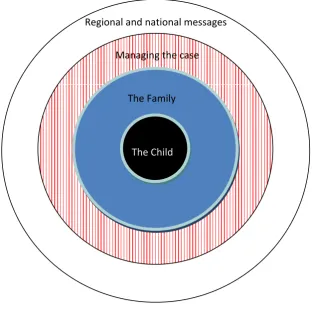
In exploring thematically the recommendations made, we developed a framework which
focused on the child at the centre of the serious case review. The framework then worked outwards through to a consideration of the child’s family and environment and subsequently to managing the case and the services which were (or were not) put in place to meet the
child’s needs. Finally those recommendations which addressed wider issues, or were
[image:17.595.95.408.376.704.2]deemed to have regional and national implications for practice and/or policy, are considered.
Figure 2: A layered approach to a consideration of recommendation themes
The Child The Family Managing the case Regional and national messages
14
In Figure 2 , the recommendations are grouped as to whether they concern: • the child as the primary focus;
• working with the family, to ascertain the whole picture of the family’s circumstances
and environment;
• the management of the case, including referral, assessment, procedures, recording,
multi-agency working together and sharing of information, staffing levels, staff skills and training; or
• regional and national recommendations.
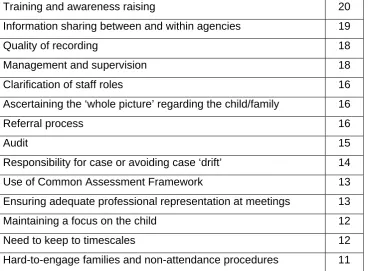
When analysing overview reports where individual agency recommendations were available, it became apparent that some themes occurred with great regularity irrespective of the
[image:18.595.69.438.417.688.2]precise context and the specific agency concerned. These themes are set out in Table 2, alongside the frequency with which they were addressed in the twenty reports studied.
Table 2: The number of overview reports addressing specific themes in the recommendations (maximum=20)
Training and awareness raising 20
Information sharing between and within agencies 19
Quality of recording 18
Management and supervision 18
Clarification of staff roles 16
Ascertaining the ‘whole picture’ regarding the child/family 16
Referral process 16
Audit 15
Responsibility for case or avoiding case ‘drift’ 14
Use of Common Assessment Framework 13
Ensuring adequate professional representation at meetings 13
Maintaining a focus on the child 12
Need to keep to timescales 12
Hard-to-engage families and non-attendance procedures 11
When compared with previous analyses of recommendations, for example Rose and Barnes’
15
appears that more attention is now being paid to management, staffing and organisational issues. The recommendations in the serious case reviews we examined were much more wide ranging and encapsulated these previously under-explored areas.
There were additional themes, pertinent to fewer cases, which will also be discussed in this report. The list of themes is not exhaustive, but topics have been selected which are of
particular interest or which may introduce a new slant to the discussion. Topics include the importance of challenge to both colleagues and parents, a number of issues around staffing
levels and competency, out of hours and weekend/school holiday provision and issues which contain a ‘public health’ message or have particular regional or national resonance.
In the following sections a number of recommendations from the SCR overview reports are
quoted to illustrate the points being made, and to give examples not only of the themes covered in the recommendation sections but also the means by which the concern is
translated into, for example, training, documentation and practice.
Focus on the child
Many sets of recommendations stressed the importance of practitioners, across many
different professions, employing a focused, child centred approach which demonstrated “an understanding of the child’s experience” and the ability to undertake a holistic assessment of the child’s needs:
“LSCB must satisfy itself that those processes of assessment and review are always informed by attempts to understand the situation from the viewpoint of the child”.
Maintaining a focus on the child was specifically mentioned with regard to:
• occasions when the child went missing from home; • the child was being educated at home;
• the importance of separate communication with children to ascertain their wishes and
feelings;
• the added importance/challenge of ascertaining wishes and feelings when the child is
very young, or when disability hinders him or her from communicating clearly; or • keeping the unborn child in mind (especially when the service is addressing the
16
“organisations must ensure that staff working with children always focus on the needs of the child, and never allow themselves to be distracted by the problems of the adults.”
The child’s family and environment
Many sets of recommendations explicitly mention the importance of considering the ‘whole
picture’. One LSCB notes the need to ensure that: “a broad view of the family’s circumstances is taken into account.” Among the recommendations the following sub-themes concerned aspects of the family and their environment:
• Cumulative concerns: “the threshold document be reviewed to ensure inclusion of cumulative concerns”. “(Police) officers should be reminded that incidents should not be taken in isolation.”
• Family history: that “professionals understand the importance of family history and how this must be taken into account in assessment and planning”. Likewise, “the Council make it a procedural requirement that historical information held by them in respect of the families of children about whom there are child protection concerns is accessed and used to inform case management decision.” “…This will require a strategy that includes training and skills development, audit of assessments and also cultural changes to existing practice.”
• Wider family members: many overview reports acknowledge the need to be aware of
the composition of the family, and this concern is addressed across all agencies:
“information must be updated about wider family networks” (in Probation Trust recommendation in relation to offenders). An NHS Care Trust recommendation related to reviewing records to ensure that details of all household members are
recorded; while a voluntary agency wished “to reinforce to all practitioners the
importance of including all relevant information in the Helpline service request form”. Health visiting records needed “to reflect assessment based on the framework and the recording of all essential data/family details to be contained within the child’s file.”
17
• Siblings: “Sibling groups known to the (Youth Offending) service should be case managed by either the same practitioner, or co working should be introduced to improve consistency of information gathering and the sharing of information.”
•
Home environment, poverty and multiple house moves: these factors were rarely explicitly mentioned in the sets of recommendations. This recommendation occurred in an information sharing context. “It is therefore important that universal services are alert to the possibility of very poor housing and its potential safeguarding implications for children. Arrangements for information sharing of concerns must be in place.”• Observation: “to ensure that formal assessment of children’s needs must include evidence of professional observation of the child and family in different environments, especially home.”
• Realism: “midwives must extend their investigations to ensure that the risk
assessment is based on solid information as opposed to promises of support. The tensions within the family and the inherent dynamics must be fully considered.” In one case a presumption of the grandmother’s ability to care for her grandchild had
been unduly optimistic.
Upon reflection, it appeared that recommendations arising from various aspects of the family’s circumstances and environment could often be divided into two main groups. Firstly
there were recommendations which addressed awareness raising within agencies and training of staff around issues such as domestic violence, substance abuse, ‘hidden men’
and cultural considerations. Secondly, and numerically greater, there were
recommendations around managing the case, where these family characteristics were present. These included referral and threshold procedures, assessments, protocols and
audits, case management and supervision of practitioners, the quality of recording and information sharing both within and between agencies. Some illustrative examples are
18
Illustrative examples of recommendations relating to family circumstances
Awareness raising / training
• In its publicity and training materials the LSCB and all member agencies should emphasise that it is not acceptable to tolerate lower standards of care or welfare on the part of any child on the grounds that he or she lives in a rural setting or comes from a family which has rural values or expectations.
• That the LSCB undertake or commission work to ensure that written guidance and training in respect of conducting assessments in child protection enquiries highlight the importance of establishing and understanding the role of male partners, or the fathers of any children, in the lives of those children.
• The LSCB to review whether or not there is sufficient and relevant multi-agency training provision in respect of how domestic violence and substance misuse can impact upon parenting. Such training should enable professionals to take on an approach of sensitive enquiry in order to elicit information that could be pertinent to identifying risk factors.
Managing the case
Assessment:
• GPs to undertake risk assessments on clients presenting with history of violent behaviour; this is particularly important if the client is also abusing drugs or alcohol or has know mental health problems. The risk assessment should consider the inter-relationship of identified health and social problems and how this was impacting on the risk to themselves or others (especially children / pregnant women).
Procedures
• The Ambulance Service to review policies and procedures in the Access and Response Communication Centres with specific reference to the handling of 999 calls involving mental illness, domestic violence and alcohol abuse.
Recording
• All ‘Care First’ document templates should include ethnicity, religion and disability. It is a requirement that practitioners record the ethnicity and language of service users.
• The impact of relationship breakups/new partners should be fully considered and explored. The details of new partners should be entered on each child’s record; this entry to be dated and signed.
Information – creating a web resource
• LSCB should explore the feasibility of setting up a web-based information system where staff from any agency can obtain information about specialised services for non-British service users from ethnic minorities.
Information sharing
19
Managing the case
This section discusses selected aspects of recommendations related to managing cases,
including dominant themes such as referral, assessment, procedures, recording, multi-agency working, sharing information, staffing levels, staff skills and training. In addition we
have considered some more specific issues pertinent to this sample of twenty cases.
Referral and assessment
• Timeframes and feedback
The issue of a timely response to children in need or child protection referrals was raised in a number of the recommendations, with a need to ensure that: “referrals are processed, prioritised and reviewed as efficiently as possible”, and should be in line with agency procedures. Other recommendations included a reminder that referrals from one agency to
another, initially made by telephone, must subsequently be confirmed in writing and the relevant forms completed. It was advocated that one route to verify that referrals were being
made and handled appropriately was by way of a routine audit of case files.
The importance of feeding back to the referrer the progress of the referral was addressed in a number of recommendations, particularly when the referral was not accepted, as in the
following instance:
“…the LSCB procedures should be modified to ensure that the local authority provides written feedback to referrers of the reasons that a child protection referral will not be acted on. The feedback should always give the name of a manager with whom the decision can be discussed further.”
Assessments needed to be undertaken to a high standard, by suitably qualified staff, and
“completed within timescales and in line with procedures.”
• Which assessment?
Of some concern in a number of overview reports was the decision making around the
thresholds for undertaking a pre-birth, initial or core assessment by children’s social care and the common assessment framework (CAF) by other agencies. Use of the CAF had not
20
in some areas, there had been significant recent investment in and promotion of the use of the CAF, as a means of holistic assessment, earlier identification of need and a basis for intervention.
Questions were however raised about staff awareness of the framework, clarity of roles and
responsibilities of the CAF team, how the assessment fitted with the referral process to Children’s Social Care (CSC) Services, the CAF process where a child protection plan was
being discontinued, and the means by which the effectiveness of the CAF assessment could be evaluated.
“The Safeguarding Children Board and its constituent members should ensure that practitioners in all agencies have clarity about their responsibilities and the appropriate levels of training and guidance to undertake competently an assessment using the Common Assessment Framework and should ensure that mechanisms are in place for evaluating the effectiveness of these assessments.”
It was particularly in neglect cases that thresholds for referral to children’s social care (CSC) appeared not to be met, and referrals were less likely to be accepted or did not progress.
Cases might have been ‘drifting’ for years – and as one overview report writer notes: “at what stage did the level of neglect suggest child protection procedures should have been invoked?”
“Where assessments indicate a child is suffering or likely to suffer significant harm through neglect, joint Section 47 investigations, involving CSC and the police, should be a
requirement.”
Some overview reports stressed the need to update assessments, and to capture the family’s changing circumstances, particularly with regard to a significant adult moving into the household. Often this need was translated via the recommendation into a new or a
revised procedure.
Recommendations were made with respect to the development and implementation of assessment tools by, amongst others, children’s social care, health visitors, paediatricians,
21
assessment tools was also raised. Some further discussion of assessment occurs in the later section on recording.
Professional challenge and curiosity
As highlighted by Lord Laming (2009), the importance of ‘respectful challenge’ of parents, colleagues and professional in other agencies, needs to be an integral part of professional
practice. A number of the SCR Overview Reports make reference to this concept, and indeed to Lord Laming, and around half of the recommendation sections address this at
some point:
“Health professionals will be reminded of their responsibilities to question and challenge other agencies, as well as health professionals, if they have reason to believe that the child protection process is not robustly safeguarding a child.”
This responsibility to challenge is reinforced through recommendations about training,
through both supervision and procedures on thresholds, assessments, decision making and rigorous follow up where there is a lack of response:
“The standards of training agreed by the Board (both single- and multi-agency) must immediately reinforce the messages from the Victoria Climbié Inquiry Report about
challenging other professionals, and must equip delegates with the confidence to contribute to Initial and Core Assessments and challenge a lack of response, or decisions and
assessments made by other agencies.”
Although the need for professional challenge is already set out in Working Together, extra (duplicate) procedures were considered necessary to reinforce this point in at least two reviews. This included questioning the decision not to call an Initial Child Protection Conference, or in ensuring that a particular staff member has a responsibility to challenge
other professionals:
22
In addition professionals should recognise the limits to their own knowledge, and know when to refer for a more specialist opinion, and to whom to refer in those circumstances. This was particularly emphasised in relation to paediatric expertise in unexplained injuries in young
children:
“The admission of children under 2 years, with unexplained injuries / unsatisfactory explanation of how injury occurred, to paediatric wards by specialities other than
paediatricians (i.e. via opthalmics; dental etc.) needs to be revised to include access to a paediatric assessment.”
Challenging parents, not just colleagues or other professionals, was alluded to in a small number of recommendations, as in a case of bruising to a pre-mobile baby:
“If a bruise is sustained to a baby who is pre-mobile the health visitor must gain a full history of how the bruise occurred and record the reaction of the care giver.”
Hard to engage families
The majority (14 out of 20) of cases in this sample featured at least some degree of poor
family and child engagement with services, and eleven of the reports contained
recommendations relating to this theme. Various strategies were proposed to improve
practitioners’ ability to respond to the challenges associated with working with hard-to-engage families. A number of reviews proposed further training and guidance to develop
professionals’ ability to work with hostile or hard to engage families:
“That the LSCB commission or undertake work to develop definitive practice guidance to support practitioners working with families who are highly resistant to intervention, using the evidence from this and other Serious Case Reviews to promote the guidance.”
Recourse to revision of procedures was again apparent in relation to this issue and included
the need for clear contingency plans and protocols relating to follow-up of non-attendance of appointments and refusal of services. The need for prompt action was stressed, so the case
was not allowed to drift.
Other recommended responses to non-attendance at appointments, were supervision (including for health professionals) and the perennial exhortation for effective and timely
23
plans of action and the reasons for non-engagement or a failure to engage was also emphasised:
“Staff must consider which engagement strategies would best enable a young adult (aged over 16) to attend appointments following a referral to the service and ensure that these are clearly recorded within the young person’s records.”
A further step recommended in one report was an audit of cases where poor engagement had been identified, to ensure compliance with procedures:
“That the LSCB undertake a consultation with local agencies to identify a sample of those families that currently met the definition of ‘highly resistant’ and confirm that the welfare of children in those families is adequately safeguarded notwithstanding the difficulties experienced in working with their parents.”
Another review drew attention to the related, but separate, issue of obtaining more
information about migrant families living in the local area who are hard to reach simply by not being visible to agencies:
“The inability of agencies to address the needs of migrant families is hampered by the lack of data about numbers in each area. There is an additional safeguarding issue both in the inability to plan appropriate support services and ensure these are accessible but also for families who may choose to avoid scrutiny by remaining ‘below the radar’.”
‘Gaps’ in continuity of service provision
A number of recommendations addressed times of heightened vulnerability of children for whom services were either not available (weekends, bank holidays, school holidays) or not
accessed because of lack of clarity about the provision of out of hours services. Brief examples of recommendations concerning these gaps in continuity of service are outlined
below:
• School holidays
Recommended strategies for dealing with this issue included training for schools and
24
implementation of new mechanisms to ensure school representation at all child protection meetings during school holidays.
• ‘Out-of-hours’ services
Improved provision and awareness-raising about availability of ‘out of hours’ services also featured in the recommendations. This included ensuring that all [Police] front-line staff and
supervisors were aware of the provision of “out of hours – at risk” intelligence checks. A further example concerned the process by which CSC accessed Magistrates’ Court Clerks
outside of normal office hours when seeking Emergency Protection Orders.
• Transition between services
This issue was well illustrated in one review, concerning a young baby, which drew attention
to an 11 day gap between midwifery discharge and the subsequent initial health visitor visit. A review of the arrangements between health visiting and midwives was therefore
recommended, with the aim of providing a continuity of support for families, and ensuring:
“that there is professional health advice and support available at key transition times when mothers are vulnerable to developing post-natal depression and need support to establish breast-feeding. It is necessary to reinforce safer sleeping messages and help to reduce the incidence of SUDI (Sudden Unexpected Death in Infancy).”
Record keeping
Many recommendations focused on upgrading systems or changes to forms to be made in the light of the learning from the SCR. Most usually, these advised the gathering of
particular additional details, to better inform the assessment process, for instance to “amend records to include specific question on ethnicity, religion and first language”. Other
recommendations surrounded the recording of information on adults involved with the child, for example guidance to GPs to highlight documentation on parents/carers suspected or
convicted of child abuse within the medical record, or in another case to record the identity of the adult accompanying a child to the Emergency Department.
Some SCR recommendations also stressed the need for children’s social care to comply with the requirement to include, and keep updated, a chronology of events in the top sheet
25
compliance with procedures, a recommendation reinforcing that this should be done may not be successful. Furthermore, it can only be checked if all records are regularly scrutinised.
In some cases, a recommendation was made to introduce an entirely new form of record, for instance a ‘social risk assessment form’ for midwives to complete with all antenatal patients,
or, in another review of a case featuring neglect, the devising of a tool: “that can be used by professionals to identify and record signs and symptoms of the neglect of children in an objective way, including the physical conditions in which children are living where this is the subject of concern. Individual agencies should modify the agreed template so as to make it available to staff in a convenient format, linking to their own recording systems.”
The importance of full, accurate and up-to-date information was a frequent theme, across all agencies. Overall, these recommendations reinforced the need to ensure records were
completed fully, relevant information included and any missing information was accounted for. More specifically, one recommendation drew attention to the difficulties arising from inaccurate spelling of names when inputting information.
Other recommendations placed emphasis on making records readily accessible, as in the
following Health recommendation:
“There should be a review of maternity records and action plan to ensure all safeguarding information is easily identifiable and accessible. This should include ensuring a copy of all safeguarding information such as referrals, minutes and reports from child protection meetings are stored within the records.”
Issues surrounding retention and disposal of records were also evident including a policy on
retaining and improving records of supervision, especially in safeguarding cases, with systems put in place to retain records.
A further, related, theme surrounded the need to ensure good use of information that was already available. In one example, the review recommended that the LSCB should review
the arrangements for collating information on children who go missing, to ensure that this information is seen as a whole rather than as a series of separate incidents.
26
The need for better information sharing, both between and within agencies, was central to many of the recommendations made, and was addressed in some respect in 19 out of the 20 reports. This included a plea for a shared record for children who are receiving service
from a variety of agencies:
“The IMR author considers that the use of a shared record…would enhance communication and improve care afforded to the child. The shared record could contain a basic log of actions and interventions that have been carried out so that the family and the professionals are aware of each other's actions ... this would provide greater continuity of care for the child and the family.”
Inter-agency information sharing was mentioned, with some frequency, in relation to a large number of agencies, teams and organisations in children’s social care, in many health
settings, in education and youth services, and in the criminal justice sector. The issue arose, but was mentioned less frequently, with regard to housing services, homeless projects, a number of voluntary providers of children’s services, and with the Children and Family Court
Advisory and Support Service (CAFCASS).
The need for better sharing of information within an agency was often cited regarding a specialist group or team in respect of the organisation as a whole; for example between the
leaving care team or the emergency duty team within the same service, between Education Welfare Officers and the Education Service and between the Child Abuse Investigation Unit
and the police force of which it was part. Of particular concern, in a number of instances, was the transfer of information when the patient/client/user moved; for example the transfer
of children’s records between schools, patients’ records when changing GP practice or between the out of hours GP service and the family GP. The handover between shifts in
Accident and Emergency could be a key point at which information was not adequately passed on.
A further issue which arose, and in relation to a number of organisations, was
cross-boundary information sharing. In this context access to records was mentioned with regard
to police forces in neighbouring areas, ambulance trusts in neighbouring areas, and children’s social care provision in nearby authorities or when an out-of-area provision was
27
Other issues which were addressed included; the desirability of a web-based information sharing resource for professionals (in the context of service provision for ethnic minorities), and protocols which needed to be established when it was felt that: “other professionals were inappropriately withholding information”, and in complex confidentiality situations “how to ensure that relevant information is shared….even when the young person has expressed a desire for the information not to be shared at meetings.”
Linked to the concern around information sharing between agencies was an issue of
attendance at meetings, to ensure that “all those who should be invited are invited”, and that the key people do indeed attend so that participants can contribute to meetings and “share information first hand.”
“Failures to consistently attend or provide reports should be monitored and raised at appropriate management levels to ensure compliance.”
In one of the reports, a police recommendation reminded staff in the Public Protection Unit
that attendance at all child protection conferences is mandatory. In one locality the
recommendation noted that “technology permits video conferring and multi-person telephone
conference” and required attendance, even if remote attendance, to become the accepted norm. Other recommendations noted that attendance should be monitored by senior
management, to ensure compliance with policies and facilitate effective information sharing.
Staffing
Recommendations were made with regard to staff in various contexts, including general staffing levels, the desirability of a new post or service, caseloads, delegation and the use of
unqualified staff, clarity of staff roles and staff competencies.
• Workforce capacity
Overview Report writers note that agencies have a duty to ensure that they have sufficient
28
resources for the designated and named child protection professionals” and, particularly at a time when budget reductions are in force, that recommendations need to be realistic and achievable.
No doubt with financial constraints in mind, recommendations were not often made about the
desirability of new posts. Specific instances where they were included a paediatric
radiologist, a CAMHS specialist intervention for Looked After children presenting with post
traumatic stress disorder, and a senior post within the leaving care team.
• Caseloads
Recommendations, on occasions, addressed caseloads, particularly with children’s social
care, where it was important to ensure that they were ‘within reasonable limits’. A specific recommendation was: “to review the health visitor caseload weighting tool, which should reflect vulnerability and disadvantage not numbers of children…This should help to reduce staff stress levels in areas of high deprivation and need.”
• Use of unqualified staff
Delegation and the use of unqualified staff was addressed in a small number of serious case reviews. There was emphasis on the need to ensure that competencies for each role are
clearly identified, and that staff have these necessary competencies:
“Non Social Work qualified staff, regardless of experience and knowledge, must not be undertaking the Duty function in the Referral and Assessment Team.”
“Children’s social care’s children with complex health and disabilities team should re-examine their use of unqualified workers. “
“The Police (authority) should review the current allocation of Child Protection Referrals to ensure that all officers investigating these cases are appropriately qualified and experienced.”
• Clarity of roles and responsibilities
There were a number of recommendations, addressed to a variety of agencies and
29
be improved through the usual recourse to the establishment of guidelines and procedures, and more training:
“The Education Support Team to develop a protocol with the Leaving Care team and relevant educations establishments (e.g. schools) to allow a greater understanding of each others’ roles and responsibilities.”
• Knowledge and skills of staff
Having clarified and codified the responsibilities of the post, other recommendations
addressed the need to ensure that the post-holder has the knowledge and skills to carry out
their role in safeguarding vulnerable children:
“The LSCB should examine the duties of the Named Doctors and Named Nurses for Safeguarding to ensure that the post holder has the mandate and capacity and systems to carry out the full role as envisaged by the Royal College of Paediatrics and Child Health.
Another recommendation called for a skills audit of the relevant staff: “Assessment of the individual member of staff’s performance, knowledge and skills forms part of their annual appraisal or performance review, and can be an opportunity to judge whether any further training or updating is required.”
Training and Awareness Raising
Recommendations about training and awareness raising were identified in all 20 reports resulting in some one hundred and twenty recommendations between them. Many of these
related to general awareness raising regarding safeguarding and case management. However, other recommendations suggested training about single issues which had been
relevant to the particular case, such as substance abuse, mental health, cultural issues, ‘hidden males’ and the identification of physical signs of abuse.
Recommended approaches to training and awareness raising identified within the 20 reports
are outlined below:
• Implementation of new training programmes, or a review of existing training
programmes to incorporate the learning from the SCR, or ensuring attendance of
30
• Induction training for newly appointed staff, for example: “Police Community Support Officers in the area should be given a safeguarding input as part of induction
training….a directive could be made to ensure that every appointed PCSO spends at least one week attached to their local Family Crisis Intervention Unit department where knowledge can be shared with them.”
• Leaflets and bulletins to provide guidance and reminders, for example: “Create and launch a leaflet providing guidance on the roles and functions of Designated Doctors and Designated Nurses; and also provide their contact details.”
• Creation of a web-based training resources, for example: [a website] “which will be accessible to all staff 24 hours a day. It will contain case studies to provide practical examples of cases like these.”
• LSCBs to develop systems or tools to monitor types of training offered, uptake and
impact of training.
• Refresher training/ regular training (as recommended ‘at least every 3 years’ in
Working Together 2010). For example: “It is essential that professionals receive refresher training in safeguarding at a level relevant to their post... This will provide an opportunity for professionals to renew their own learning in the light of their own practical experience.”
• Ensuring that Safeguarding Awareness training is tailored to meet the specific needs
of staff depending on their roles and responsibilities: For example: “Visiting Officers should be targeted for a more intensive level of training because of their face to face contact with customers, consideration should be given to providing this level of training to officers who undertake assessments when the only form of contact is a telephone call or the receipt of an application form.”
• Staff briefings and meetings regarding specific issues such as completion of a CAF
or Risk Management planning.
No recommendations were found, including those about training, which specifically
31
in a recommendation which required multi agency safeguarding training to emphasise that procedures alone will not protect children and that professionals need to consider the wider implications of each situation.
Public Health messages
A number of recommendations included what could be called ‘public health’ or more general messages. These related to how parents, carers and the community in general could be
made more aware of:
• ‘safer sleeping’ messages, particularly regarding co-sleeping where there are
concerns about alcohol and drug use;
• the ‘hidden harm’ to children of any age arising from parental drug or alcohol misuse; • the danger to babies from being shaken; and
• dangers arising from inappropriate babysitting and child care arrangements.
To achieve this awareness raising, mention was made of targeted communication and
advice, written guidance for professionals and commissioning of publicity material for the public, including information on the internet. One LSCB raised the particular issue of running
such campaigns in a largely rural county.
Recommendations for a wider regional or national audience
Some report authors take the opportunity to use the recommendation section to suggest
imaginative ways of extending the learning beyond the local setting, directing some of their recommendations at a wider audience than the LSCB or any of the agencies involved in their specific local serious case review. This audience divides between government departments,
professional bodies and other organisations. The government departments referred to include the then Department for Children, Schools and Families, including Government
Offices (at time of serious case review), the Department of Health, the Home Office and the Crown Prosecution Service and the Ministry of Justice; the professional bodies were for
example two Royal Colleges (of General Practitioners, and of Paediatrics and Child Health), and other organisations were Ofsted and C4EO.
32
While they are a rather disparate group of recommendations, there are some elements among them which are common to a number of LSCBs. The need for further research was addressed by two LSCBs, one requesting a national review of adolescent suicide and
para-suicide in ‘looked after children’, and the second requesting (through C4EO) further research in working with young people who are hard to engage.
• Incorporating messages into government thinking or policy
Some LSCBs considered that issues they had raised required cross-departmental
discussion within Government, or that a particular message needed to be relayed to a specific forum. Topics addressed, which were considered to merit consideration within a
Government department, included increased participation of the armed forces in safeguarding processes, the need for the then Department for Children, Schools and
Families (now Department for Education) to issue guidance and direction on the coordination and delivery of services to children with a disability and the lack of guidance on the
safeguarding of vulnerable migrant children. Two LSCBs recommended making
representations to the Munro review, one concerning the need to reflect ‘Think Family’ in the
re-write of Working Together and the other to clarify information sharing between adult mental health services and additional support children’s services:
“….what information adult mental health services can provide to children’s services where there are safeguarding concerns, rather than child protection concerns, and they do not have parental consent to share information.”
A specific point was raised by one LSCB about categorisation of ethnicity, and they wished
to raise nationally the issue of mixed Asian ethnicity classification. It was thought that a better awareness by professionals of the different cultural backgrounds of the parents might
have alerted them to the vulnerable position the child was placed in.
Another very specific recommendation concerned the need for discussion with the Crown Prosecution Service around the subject of plea bargaining and the subsequent sentence,
and the impact of this on safeguarding children issues. This related to a case where an offender posed a significant risk of harm to children, but the reduced sentence he received did not make him subject to Multi Agency Public Protection Arrangements. A different case,