Ymchwil gymde Social research Number: 37/20
ithasol
12
Evaluating the Foundation Phase:
Policy Logic Model and
Programme Theory
Evaluating the Foundation Phase:
Policy Logic Model and Programme Theory
Trisha Maynard1, Chris Taylor2, Sam Waldron2, Mirain Rhys2, Robin
Smith2, Sally Power2 and Jennifer Clement1
(1Canterbury Christ Church University)
(2Wales Institute of Social & Economic Research, Data & Methods
(WISERD), Cardiff University)
Views expressed in this report are those of the researchers and not necessarily those of the Welsh Government
For further information please contact: Name: Launa Anderson
Department: Knowledge and Analytical Services Welsh Government
Cathays Park Cardiff
CF10 3NQ
Tel: 029 2082 5274
Email: [email protected]
Welsh Government Social Research, 2013 ISBN 978-0-7504-8080-2
Table of contents
Glossary of acronyms ... i
Executive Summary ... ii
1 Introduction...1
2 The Context, Rationale and Aims of the Foundation Phase ...8
3 Building a Programme Theory for the Foundation Phase...18
4 The Foundation Phase: The Programme Theory ...30
5 The Inputs, Processes and Activities of the Foundation Phase...57
6 The Outputs, Outcomes and Impacts of the Foundation Phase ...63
7 Policy Logic Model: Discussion and Conclusions...67
References ...81
Appendix A. Framework for Analysis of Foundation Phase Documentation ..87
Index of Figures
Figure 1: Policy Logic Model (Version 1) for Evaluating the Foundation Phase ...1 Figure 2: Policy Logic Model and Programme Theory ...3
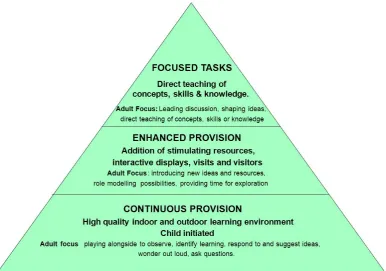
Figure 3: Child-initiated and Practitioner-initiated/Practitioner-directed Activity ...41 Figure 4: Curriculum Development Model (ELP Powerpoint Slide 93)...43
Index of Tables
Table 1: Documents Analysed and Acronyms Used ...34
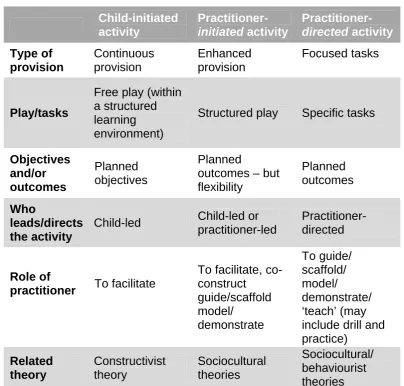
Table 2: Differentiation between Child-initiated, Practitioner-initiated and Practitioner-directed Approaches...46
Glossary of acronyms
ACCAC Awdurdod Cymwysterau, Cwricwlwm ac Asesu Cymru (Qualifications, Curriculum and Assessment Authority for Wales)
AoL Area of Learning CD Creative Development
CDAP Child Development Assessment Profile DAP Developmentally Appropriate Practice
DCELLS Department for Children, Education, Lifelong Learning and Skills
DO Desirable Outcomes
ELP Foundation Phase National Training Pack Module on Experiential Learning in Practice’ training pack (2007)
FE Further Education
FP Foundation Phase
HE Higher Education
KS1 Key Stage 1 National Curriculum KS2 Key Stage 2 National Curriculum KS3 Key Stage 3 National Curriculum KS4 Key Stage 4 National Curriculum
KUW Knowledge and Understanding of the World L&T Learning and Teaching Pedagogy
LLC Language, Literacy and Communication Skills LNF Literacy and Numeracy Framework
MD Mathematical Development
NAfW National Assembly for Wales
NC National Curriculum
OBS Observing Children
OECD Organisation for Economic Co-operation and Development OLH Outdoor Learning Handbook
P/A Play/Active Learning
PD Physical Development
PSDWCD Personal and Social Development, Well-Being and Cultural Diversity
RSG Revenue Support Grant
SF Skills Framework for 3-19 Year Olds
TLRP ESRC Teaching and Learning Research Programme TSO Training and Support Officers
UNCRC United Nations Convention on the Rights of the Child WISERD Wales Institute of Social & Economic Research, Data &
Methods
EXECUTIVE SUMMARY
Aims and Scope
1. The Foundation Phase is a Welsh Government flagship policy of early years education (for 3 to 7-year old children) in Wales. Marking a radical departure from the more formal, competency-based approach associated with the previous Key Stage 1 National Curriculum, it advocates a
developmental, experiential, play-based approach to teaching and
learning The Learning Country: a Paving Document (NAfW 2001a) notes that following devolution, Wales intended to take its own policy direction in order to ‘get the best for Wales’. Getting the best for Wales appeared to involve meeting the challenges of the globalised marketplace (raising levels of basic skills1); overcoming social disadvantage; building a strong, enterprising society that embraces multiculturalism; and promoting the language and traditions of Wales. Participation was seen as a key approach.
2. This report is the first in a series of reports from the independent evaluation of the Foundation Phase in Wales, commissioned by the Welsh Government and led by the Wales Institute of Social & Economic Research, Data & Methods (WISERD).
3. The aim of this report is to develop a policy logic model that outlines the objectives and intended outcomes of the Foundation Phase, including the context to its introduction, the theory, assumptions and evidence
underlying its rationale, and its content and key inputs. It is designed to assist in the ongoing evaluation of the policy.
4. This policy logic model is derived from an exploration of the extant documentation relating to the establishment, development, design and content, and implementation of the Foundation Phase, and provides what might be termed the ‘official discourse’ of the Foundation Phase as
outlined by the Welsh Government.
5. Underpinning the Foundation Phase are a number of important theories relating to early childhood development and education. Therefore, in
1
order to fully understand the context, rationale and design of the Foundation Phase the report also outlines in detail its ‘programme theory’. This provides the rationale for the approach, pedagogy and curriculum of the Foundation Phase, although it also underpins its context, aims and other inputs.
6. The policy logic model presented here should be regarded as tentative; it represents an initial version of the model. We expect that the model will be refined throughout the evaluation process possibly leading to a second version towards the end of the three-year evaluation.
7. The initial policy logic model is summarised in Figure 1, and includes the following components, as outlined in the HM Treasury’s Magenta Book for evaluating public policy:
• contextual conditions and problems • aims and objectives
• rationale • inputs
• processes and activities
• outputs and intermediate outcomes • outcomes
• impacts.
8. The report is structured in accordance with this initial policy logic model. Following an introduction to the Foundation Phase and this report, Chapter 2 outlines and discusses the context, rationale and aims of the Foundation Phase as presented in the ‘official discourse’. This chapter begins to highlight the importance of a programme theory in
understanding the Foundation Phase. Chapter 3, therefore, provides details on how we establish the programme theory before presenting and discussing this programme theory in Chapter 4. Chapter 5 continues to outline the policy logic model by emphasising the key inputs, processes and activities of the Foundation Phase. This is followed in Chapter 6 by a presentation of the intended outputs, outcomes and impacts of the
initial policy logic model, including questions about the nature, definition, content, and wider implications of the Foundation Phase.
Context, Rationale and Aims of the Foundation Phase
9. The Foundation Phase consultation document refers to ‘shortcomings’ in early years classes (particularly the use of overly-formal curriculum and pedagogy in reception classes) and sets out the main aims of the Foundation Phase and how these were to be achieved. This was essentially through the provision of developmentally appropriate
activities, adopting informal pedagogies and the integration of Desirable Outcomes (DO) with the programmes of study and focus statements in the Key Stage 1 National Curriculum.
10. Other non-UK countries where formal approaches to learning are delayed until children are older are identified; these may be seen as offering examples of best practice in this area.
11. Preparation for Key Stage 2 National Curriculum is also considered important, alongside the need to establish the necessary foundations for improved attitudes to learning amongst learners throughout their whole schooling and indeed for life. However, little reference is made to the causes or explanations that might underlie overall and differential levels of early years educational achievement.
12. The main aims of the Foundation Phase are officially set out as:
• raise children’s standards of achievement
• enhance their positive attitudes to learning
• address their developing needs
• enable them to benefit from educational opportunities later in their lives
• help them become active citizens within their communities. 13. In the official discourse for the Foundation Phase, there are no more
detailed objectives or related targets outlined.
introduction. For the purposes of this evaluation it is, however, necessary to try and explicitly outline this approach. We refer to this as the
Foundation Phase’s programme theory, and it is developed through a detailed analysis of the Foundation Phase materials and documentation.
The Foundation Phase Programme Theory
15. In order to develop a framework to support the analysis of the Foundation Phase documentation, we initially explored two broad approaches that are commonly seen to represent ‘good’ practice within the field of early childhood education: the early years ‘child-centred’ tradition underpinned by constructivist/developmental theory, and the programmes of Reggio Emilia in Italy, New Zealand (Te Whãriki) and Scandinavia that are underpinned by sociocultural theories. It is noted that these programmes have emergent or light touch frameworks/curricula.
16. The ‘Foundation Phase Framework’; ‘Learning and Teaching Pedagogy’; ‘Play/Active Learning’; ‘Observing Children’; and guidance documents relating to each of the Areas of Learning (AoL) were analysed. The ‘Experiential Learning in Practice’ training pack, the ‘Outdoor Learning Handbook’, the ‘Skills Framework’ and ‘National Curriculum’ and
‘Desirable Outcomes’ documents were also consulted. The analysis was multi-layered, iterative and reflexive: that is, documents were analysed on numerous occasions and in different ways to enable us to clarify, check and re-check issues and meanings within and across the documentation and to reconsider and question our initial assumptions. Findings were considered in relation to ‘approach’, ‘pedagogy’ and ‘curriculum’.
17. Approach: We find that the approach underpinning the Foundation Phase is explicitly developmental with a clear focus on the individual child. Development is seen as essentially linear, although not tied to
chronological age, and recognises individual variations in rate within and across all areas of development and learning. This approach broadly relates to a constructivist theory of learning.
18. Pedagogy: We find that aspects of suggested pedagogy also reflect constructivist theory although ideas resonating with sociocultural
the practitioner in supporting children’s learning and development. However, sociocultural ideas such as empowerment and play appear to be focused primarily on supporting effective learning rather than being seen as a ‘right’ or as a way of promoting personal growth. Similarly, when viewed through a sociocultural lens, links with the home may be viewed as an ‘early intervention’ rather than as a genuine bi-directional partnership.
19. An initial challenge for practitioners may be to identify what is meant by key terminology – this includes, ‘structured play’, ‘active learning’ and particularly ‘child-initiated’ and ‘practitioner-directed’ learning – and in determining the suggested balance between these two strategies. This may be particularly significant in the final year of the Foundation Phase. In addition, a small number of discrepancies are noted given recent developments in neuroscience and its application to education.
20. Curriculum: We find that to a greater or lesser extent, Area of Learning (AoL) descriptors and guidance documents reflect a commitment to a developmental approach and to constructivist and sociocultural
pedagogies. Sociocultural perspectives are also reflected in the placing of ‘Personal and Social Development, Wellbeing and Cultural Diversity’ at the core of the Foundation Phase.
21. In the Framework, initial focus statements for each AoL tend to
emphasise content and ways of working that are relevant to the earlier stages of the ‘learning continuum’, only referring briefly to more complex, higher level skills. This may suggest an emphasis on the development of early conceptual knowledge across the Foundation Phase and a ‘lighter touch’ approach to the statutory curriculum. However, ‘skills and range’ statements and, in particular, the guidance documents are much more explicit in detailing subject-related content and children’s progression in relation to this. This is particularly apparent in ‘Mathematical
Development’ and especially ‘Language, Literacy and Communication Skills’. This may suggest a particular emphasis should be placed on these AoLs.
documents: elements of the approach and pedagogy are distributed across various publications. The current analysis of Foundation Phase documentation reveals that there is no single clear explanation for the approach and pedagogy of the Foundation Phase that practitioners could use.
Inputs, Processes and Activities of the Foundation Phase
23. The Foundation Phase made statutory the delivery of seven Areas of Learning. These are:
• Personal and Social Development, Well-Being and Cultural Diversity (PSDWCD)
• Language, Literacy and Communication Skills (LLC)
• Mathematical Development (MD)
• Welsh Language Development (WLD) (in English-medium schools and settings)
• Knowledge and Understanding of the World (KUW);
• Physical Development (PD)
• Creative Development (CD).
24. Introductory focus statements for each AoL tend to emphasise approaches that may be adopted in earlier stages of the ‘learning continuum’, only referring briefly to complex, higher level skills. 25. Another key input is the statutory Foundation Phase End of Phase
Assessment, obtained through teacher assessment.
26. The major financial input in the Foundation Phase relates to new (higher) adult-to-child ratios –1:8 in nursery and reception classes; 1:15 in Years 1 and 2. Additional resources have also been made available to schools to develop their outdoor learning environments.
28. Originally a statutory Child Development Assessment Profile was introduced to provide a baseline measurement of child development. However, this was withdrawn during 2011/12 following concerns about its fit for purpose and the length of time the assessment took. A new
baseline tool is due to be developed.
29. The implementation of the Foundation Phase began with a Pilot phase in 2004/05 in 22 schools and 22 funded non-maintained settings. The final roll-out of the Foundation Phase to all schools and funded
non-maintained settings was delayed from the original timetable until 2008/09. In the meantime an additional 22 schools and 22 funded non-maintained settings were allowed to introduce the Foundation Phase in 2006/07 to link in with the Flying Start programme, an early years intervention for disadvantaged families and communities. In each phase the Foundation Phase was introduced sequentially to one or two cohorts of children. 30. The Welsh Government funded an evaluation of the Pilot phase schools
in 2004/06 and then later a study on the transition from the Foundation Phase to Key Stage 2 in 2009/10.
Outputs, Outcomes and Impacts of the Foundation Phase
31. The early years education of all children aged 3 to 7-years-old in Wales has now been through the Foundation Phase.
32. During the implementation and roll-out of the Foundation Phase, a
number of documents have been published for practitioners and parents. 33. The Foundation Phase is funded via two funding streams. The first is the
34. Despite the terms and conditions set out for the Foundation Phase Grant, there is limited data available on actual adult-to-child ratios in Foundation Phase classrooms.
35. Training and support has been provided through local authorities, although there is no national data relating to participation on training activities. Neither are there any targets for participation in training at the individual, school, local authority or national levels.
36. In the original documentation for the Foundation Phase there are few explicit outcomes or targets outlined. However, a range of outcomes can be identified, although most will take several years before the impact of the Foundation Phase can be ascertained:
• greater motivation and concentration and enhanced learning dispositions by age 7
• some improvement in educational average achievement by age 11+ (e.g. literacy, numeracy, Welsh language)
• reduced differential attainment between particular groups of children by age 11+ (e.g. by socio-economic status, gender, ethnicity)
• improved average educational achievement by age 15 and fewer school leavers with no qualifications
• higher rates of participation in post-compulsory education (FE and HE)
• improved wellbeing and strengthened dispositions to learning for all learners, particularly those from disadvantaged backgrounds
• lower rates of average non-attendance for all learners, particularly those from disadvantaged backgrounds
• improved social and emotional development amongst children, particularly those from disadvantaged backgrounds
• greater involvement of parents/carers in the education experience of children.
37. In addition, a number of broader impacts can also be identified as:
• improved preparation for learning for KS2 onwards
• increased participation in post-compulsory education (e.g. FE and HE) or other vocational training
• alleviating some of the impact of socio-economic disadvantage for learners
• increased social and emotional wellbeing for children and young
people
• improved inter-generational transmission of positive attitudes and influence on education and learning
• reduced socio-economic disparities within Wales.
Discussion and Conclusions
38. The development of this policy logic model will help guide the ongoing evaluation of the Foundation Phase, although it is expected that this model will develop as further information and evidence is gathered. 39. However, in preparing the initial policy logic model a number of issues
and questions have been identified that the evaluation must contend with and address as it develops. These can be summarised as:
• micro-level problems and conditions versus macro-level aims
• no predetermined indicators for measuring the impact of the Foundation Phase
• ‘qualitative dimensions’ of the Foundation Phase aims difficult to measure
• rationale for key components of the Foundation Phase not explicitly or formally set out
• no specific targets for some of the Foundation Phase inputs (e.g. participation in training)
• tensions in the underlying pedagogy and curriculum of the Foundation Phase
• formalising the informal nature of the Foundation Phase.
41. Furthermore, it is possible that the issues highlighted here could have limited the ability of the Welsh Government, schools and practitioners to implement the Foundation Phase successfully and completely. The ongoing evaluation will be able to explore this further.
42. The approach, pedagogy and curriculum promoted in the Foundation Phase appear to address the identified concerns and aims as set out in The Learning Country (NAfW 2001a) and the Foundation Phase
consultation exercise (NAfW 2003a). The adoption of an underpinning ‘developmental’ approach and a constructivist but largely sociocultural pedagogy – along with placing ‘Personal and Social Development, Well-being and Cultural Diversity’ at the core of the Foundation Phase – may ensure that children’s learning and development, including their
wellbeing, positive learning dispositions and positive attitudes to cultural diversity, are supported through appropriate, interesting and meaningful activities and experiences. This should lead to greater social competence and higher achievement in the longer term, and the motivation to become lifelong learners.
43. Retaining a statutory, detailed, skills-focused curriculum, particularly in relation to aspects of Mathematical Development and Language, Literacy and Communication Skills, and an expectation that practitioners will undertake some direct teaching, may ensure that young children,
particularly those from disadvantaged homes, are supported in the early development of literacy and numeracy; this may be crucial for their later achievement. This approach, which is echoed in the recent proposals to introduce a National Literacy and Numeracy Framework (LNF) for
44. We suggest there are two key challenges for Foundation Phase practitioners. The first is to ascertain what is meant by some of the terminology used in the documentation – particularly in relation to
pedagogy. The second is to ascertain how a play-based pedagogy, which is underpinned by a strongly developmental approach, can best be
integrated or intertwined with a detailed statutory curriculum in which expectations in relation to outcomes essentially remain unchanged. The extent to which practitioners have understood and responded to these apparently conflicting demands/requirements will be a key focus in evaluating the Foundation Phase.
45. Globalisation has opened up the world of early childhood programmes and the apparent long-term effects of these. Whether it is possible or appropriate to draw on programmes that have different culturally embedded philosophical and political roots and values has been questioned. Globalisation appears also to have stimulated a need for nations to ensure they have a well-educated workforce in order to compete in the global marketplace: one of the key drivers for the establishment of the Foundation Phase.
46. In relation to the effects of globalisation, one of the major tensions that has been considered is between programmes that fit within a ‘social pedagogy’ model associated with, for example, Scandinavian early years programmes, and the ‘school readiness’ or ‘pre-primary’ model found in, for example, England and the USA. However, instead of viewing these models in tension with one another, it is possible to see them as at either end of the same continuum.
47. An example of an approach that embraces school readiness but resonates with aspects of social pedagogy is ‘Developmentally
48. In recent years, the pressure of the globalised marketplace has led to early years programmes firmly underpinned by a model of social
pedagogy (such as the early years programmes of Sweden and Norway) now coming more under state control and incorporating aspects of the ‘school readiness’ or ‘pre-primary’ approach – that is, incorporating the teaching of early literacy and numeracy skills.
49. A key challenge faced by the Welsh Government then is not unique: how to support children’s wellbeing and their development as lifelong learners while also ensuring their later academic success. Programmes adopting sociocultural pedagogies may result in long-term benefits in relation to social development and motivation to pursue higher education, so addressing any concerns about pupil disaffection. However, teacher-initiated approaches involving ‘explicit teaching’ (‘practitioner-directed’ approaches) can reduce knowledge gaps in young children’s literacy and numeracy skills, which are strong predictors of children’s later academic success. These approaches may be particularly important as an
Figure 1: Policy Logic Model (Version 1) for Evaluating the Foundation Phase
Impacts
• Improved learning dispositions.
• Increase participation in post-compulsory education and lifelong learning.
• Increased basic skills within the population.
• Reduced impact of socio-economic disadvantage for learners. • Increased use of the Welsh language.
• Reduced socio-economic disparities within Wales. • Improved professional experience for teaching workforce.
Outcomes
• Status quo in average educational achievement by age 7. • Raised educational achievement by age 12 and 15.
• Reduced differential achievement between advantaged and disadvantaged groups.
• Lower rates of average non-attendance.
• Improved social and emotional development of young children. • Effective involvement of parents/carers in educational
experience.
• Greater active citizenship amongst young people.
Outputs and intermediate outcomes
• All 3 to 7-year-olds currently following the Foundation Phase.
• Framework and guidance documents published. • Training modules being
delivered.
• Annual FP conferences. • End of Phase Assessments; • Changes to physical learning Processes and activities
• Consultation and Action Plan (2003).
• Pilot Phase (2004/05). • Early Start Phase
(2006/07).
• Final roll-out (2008/09). • Development of
Framework for Children’s Learning and supporting guidance materials by ACCAC (2003/05). • Evaluation of pilot phase.
Aims and objectives
• Raise children’s standards of achievement. • Enhance their positive attitudes to learning. • Address their developing needs.
• Enable them to benefit from educational opportunities later in their lives.
• Help them become active citizens within their communities.
Inputs
• Seven statutory Areas of Learning.
• End of Phase Assessments.
• Higher adult-to-child ratios (1:8 for 3 to 5-year-olds, and 1:15 for 5 to 7-year- olds).
• Funding to improve outdoor learning environments. • Training and Support Contextual conditions and problems
• Concern about adoption of formal approaches to teaching and learning in reception classes and KS1.
• Concerns about quality and standards, particularly in KS1. • ‘Disaffection’ towards education and learning amongst school
leavers.
• Weak international comparisons in relation to later educational achievement.
• Social disadvantage (including health and wellbeing) and its relationship with education.
• Concerns about development of the Welsh language.
Rationale
Development of a new curriculum that links and strengthens the principles and practices of preschool ‘Desirable Outcomes’ with KS1 programmes of study and focus statements (NAfW, 2003a:9). Utilises
1 Introduction
1.1. This report is the first of a series of reports from the independent evaluation of the Foundation Phase in Wales commissioned by the Welsh Government, led by the Wales Institute of Social & Economic Research, Data & Methods (WISERD). The three year evaluation (2011-2014) has four main aims:
• to evaluate how well the Foundation Phase is being implemented and highlight ways in which improvement can be made
• to evaluate what impact the Foundation Phase has had to date
• to assess the value for money of the Foundation Phase
• to put in place an evaluation framework for the future tracking of outputs and outcomes of the Foundation Phase.
1.2. The Foundation Phase appears to mark a radical departure from the more formal, competency-based approach to early childhood education that has sometimes been associated with the National Curriculum. Drawing on evidence from good early years programmes in
Scandinavia, Reggio Emilia and New Zealand (Te Whãriki) that indicate the adoption of an overly formal curriculum and extensive formal teaching before the age of six or seven can result in lower standards of attainment in the longer term, it promotes an experiential, play-based approach to learning for children aged 3 to 7-years-old. It emphasises the centrality of the child and the significance of children’s wellbeing and advocates a balance of child-initiated and practitioner-directed2 (or practitioner-initiated) activities within stimulating indoor and outdoor environments.
1.3. One of the first stages to this evaluation is the development of a ‘policy logic model’ that outlines the objectives and intended outcomes of the
Foundation Phase and “describes the theory, assumptions and
evidence underlying the rationale for a policy. It does this by linking the
2
intended outcomes (both short and long-term) with the policy inputs, activities, processes and theoretical assumptions” (HM Treasury 2011:41).
1.4. The aim of this report, then, is to present an initial policy logic model for the Foundation Phase. This is primarily to aid the design and progress of the evaluation, by identifying what might be termed the ‘official discourse’ of the Foundation Phase as outlined by the Welsh Government. A policy logic model attempts to explain how the policy is intended to achieve its objectives, and in turn to help “clearly identify the evaluation objectives and research questions which will direct the evaluation approach, and inform the types of data and information that need to be collected” (HM Treasury 2011:39). This is achieved through an exploration of the extant documentation relating to the
establishment, development and implementation of the Foundation Phase, published by the Welsh Government since devolution in 1999 and leading up to the beginning of the evaluation in 2011. The main policy document that underpins this new early years curriculum is the Foundation Phase Framework for Children’s Learning for 3 to 7-year-olds in Wales, supported by a series of additional guidance
documents.
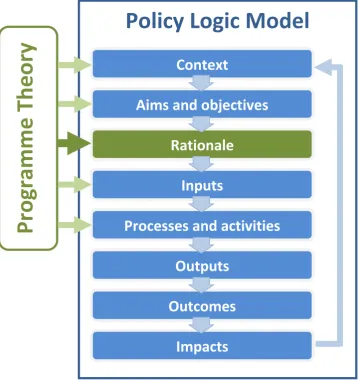
1.5. In developing a policy logic model for the Foundation Phase, the report attempts to outline and describe the context for the introduction of the Foundation Phase, its aims, its educational rationale (including the underpinning theoretical approach and suggested pedagogy), its inputs (including its statutory curriculum), its processes and activities, and its intended outcomes (Figure 2).
the ‘programme theory’ of the Foundation Phase. This contributes to the policy logic model in a number of ways (Figure 2), particularly in establishing the rationale for the Foundation Phase, and provides the approach, pedagogy and curriculum that practitioners are expected to use.
Figure 2: Policy Logic Model and Programme Theory
Policy
Logic
Model
1.7. However, it is helpful to see the policy logic model and the programme theory as distinct in two key ways. First, their origins are somewhat distinct – we see the policy logic model as a result of policy
Context
Aims
and
objectives
Rationale
Inputs
Processes
and
activities
Outcomes
Impacts
Outputs
Programme
Theory
development and making, whereas the origins of the programme theo that underpins much of the policy, are based on educational theories derived from research in education, psychology, neuroscience and sociology, and fro
ry
m an exploration of other early years programmes in ther countries. 1.8. ng lds some been
ort is devoted to discussing the Foundation Phase programme theory.
1.9. the ver, in of cial port o
Second, they are enacted differently – many elements of the Foundation Phase can be characterised as a series of policy
instruments, enacted through legislation, funding and inspection; but a key dimension to the Foundation Phase is a new approach to teachi and learning, enacted through guidance and curricular materials to encourage practitioners to approach the education of 3 to 7–year-o differently. This means that the approach, pedagogy and to
extent the curriculum of the Foundation Phase are largely
‘recommended’, and are not mandatory in the same way that other inputs of the Foundation Phase can be ‘enforced’. Consequently, the
way in which the programme theory is understood (by policy-makers), then presented (to practitioners) and then enabled (by practitioners) is possibly critical in understanding how the Foundation Phase has implemented and what impact that has had. Therefore, given its importance and complexity, much of the rep
also considers the impact of recent research from early years
education and its cognate disciplines on the underlying rationale and esign of the Foundation Phase.
1.10.
the
tion is
variety of methods for analysing the impact f the Foundation Phase.
1.11.
d
f the
lum,
er than its distinctiveness from the early schooling of five years ago.
d
It should also be noted that in an evaluation of this nature the policy logic model at this stage can only be tentative and will be refined as evaluation progresses. This is the same approach as taken by the interim evaluation of the Welsh Government programme, Flying Start (White and McCrindle 2010). One of the main aims of the evalua to develop an evaluation framework for the future impact of the Foundation Phase. This may include the development of a second, more comprehensive, policy logic model, one that is based on further detailed evidence on the content and implementation of the Foundation Phase, and from testing a
o
It is also worth noting that the Foundation Phase is not a
1.12.
ncerns
s a new approach to teaching and learning in early years education.
1.13. the
e of e underpinning influences and theories of learning in Chapter 3.
1.14.
arising
s. Issues of clarity and oherence are also addressed in this chapter.
1.15.
sses and activities used the development of the Foundation Phase.
1.16.
a on on the intended outcomes and impacts of the Foundation hase.
The report attempts to outline a policy logic model for the Foundation Phase and is structured accordingly. Chapter 2 begins by outlining the context to the establishment of the Foundation Phase and importantly, the need to shift from the previous Key Stage 1 National Curriculum. It explores the initial consultation document on the proposed Foundation Phase and ascertains, in relation to classroom practice, the co
that appeared to pave the way for reform. This leads in to an
introduction of the ‘official’ rationale and aims of the Foundation Phase. This highlights the importance of the underlying theories and principle – the programme theory – in the development of
In order to develop the programme theory, a detailed analysis of published documents relating to the Foundation Phase was
undertaken. In order to build a framework for analysis, we explore the key elements of a number of these programmes and describe som th
Chapter 4 then sets out to present the programme theory based on this analysis. It begins with a brief description of how we went about the analysis of documentation before presenting our findings: summ
and commenting on the key issues in relation to the approach, pedagogy, curriculum and associated outcome
c
Chapter 5 continues to outline the remaining elements of the policy logic model, emphasising the key inputs, proce
in
Chapter 6 concludes the presentation of a policy logic model by reporting the key outputs of the Foundation Phase thus far, alongside discussi
1.17. In developing a policy logic model, a number of key issues and questions are identified to help inform the development of the
evaluation of the Foundation Phase. These are presented in Chapter 7, and are then followed by a discussion about the nature and definition of the Foundation Phase. The report concludes by discussing the
Foundation Phase in a wider frame and considers how the pressures of globalisation appear to be affecting early education policies even in countries that have previously been committed to a model of social pedagogy: that is, there has been a move towards ‘school readiness’. It briefly outlines the many similarities and also some of the differences between the key elements of ‘Developmentally Appropriate Practice’, an approach that embraces ‘school readiness’ but resonates with
2 The Context, Rationale and Aims of the Foundation Phase
2.1 Following devolution in 1999, the National Assembly for Wales set out a ten-year strategy for education and lifelong learning in The Learning Country: a Paving Document (NAfW 2001a). This policy was to herald
a new era of education policy divergence in Wales. Jane Davidson, then Assembly Minister for Education and Lifelong Learning, noted in the foreword: “we share key strategic goals with England – but we often need to take a different route to achieve them. We shall take our own policy direction, where necessary, to get the best for Wales” (2001:2). In particular, the latter identified the need to “build stronger foundations for learning in primary schools” (p.12) and to “give every child a flying start” (p.15). The Learning Country (2001a) also identified the need to promote equality of opportunity and to tackle social
disadvantage.
2.2 ‘Getting the best for Wales’ involved attending to the country’s specific priorities. These included meeting the challenges of the globalised marketplace (technological and competitive pressures from within Europe and beyond, ibid 2001:1), particularly given the relatively low skills base, and addressing social disadvantage and inequality of
opportunity. There was therefore a perceived need to lift the knowledge and skills base, raise standards of literacy and numeracy and promote a culture of lifelong learning, support and improve health and wellbeing, build an enterprising and creative culture that celebrates diversity and promotes the traditions and language of Wales (2001).
2.3 In turn, The United Nations Convention on the Rights of the Child (UNCRC) (e.g. Children and Young People: A framework for
partnership (Welsh Government 2000)) has played a part in developing
schools” (NAfW 2001:2); through encouraging the participation of children and young people on community life; and, for example, through establishing schools’ councils.
2.4 These policy aims were later developed in The Learning Country 2: Delivering the Promise (2006) to ensure that all children and young
people:
• have a flying start in life and the best possible basis for their future growth and development
• have access to a comprehensive range of education, training and
learning opportunities, including acquisition of essential personal
and social skills
• enjoy the best possible physical and mental, social and emotional health, including freedom from abuse, victimisation and exploitation • have access to play, leisure, sporting and cultural activities
• are listened to, treated with respect, and are able to have their race
and cultural identity recognised
• have a safe home and a community that supports physical and emotional wellbeing
• are not disadvantaged by any type of poverty.
2.5 In terms of early years education, The Learning Country (2001a) noted the government’s intention to consult on whether, and if so how best to, integrate the current Desirable Outcomes for Children’s Learning
before Compulsory School Age (ACCAC, 1996) into the primary school
curriculum and to enable practitioners to support “children’s rounded progress” (2001:20) through a proposed Foundation Phase for children aged 3 to 7-years-old.
2.6 This led to a consultation document, The Learning Country: The Foundation Phase – 3 to 7 years (2003a), which identified ten
have been from Estyn inspections and reports. These ‘shortcomings’ were identified as:
Early years education
• The percentage of ‘very good’ standards and teaching is generally low.
• Children spend too much time doing tasks while sitting at tables rather than learning through well-designed opportunities for play. They do not have enough opportunity to develop their language skills by talking about their activities. The emphasis on sedentary non-interactive desk-based work does not contribute well to developing independence and decision-making.
• Too little emphasis is placed on developing children’s creative expression and cultural understanding.
• There is less progress in promoting children’s language, literacy and communication skills than in the other areas of learning.
• Too often, children are introduced to the formal skills of reading and
writing before they are ready, with heavy formality and with the risk that some will lose both confidence and a love of learning.
• In some settings, adults do not give children a good start in learning Welsh.
• Almost half of the settings do not plan or assess effectively and do not keep records that are easily understood by anyone other than the person who compiled them.
• There is more ‘good’ and ‘very good’ work in nursery schools and
units than in reception classes.
• In some classes, the high child-to-adult ratio means that there are insufficient staff to provide the support and range of experiences required.
• The unsatisfactory condition of buildings often limits both the indoor and outdoor space available for play and practical activities.
Key Stage 1
• Pupils’ standards of achievement have weaknesses in some
• The quality of teaching has some weak aspects in almost 40% of classes.
• In some classes, teachers do not set work that meets the needs of individual pupils and they are not given enough opportunities to develop independence, not least as learners.
• There is a gap between Year 1 and Year 2 in the percentage of
‘good’ and ‘very good’ standards in almost all subjects. The
percentage of pupils achieving ‘good’ and ‘very good’ standards in Year 1 has been lower than in Year 2 for the last three years.
• There is a gap between the amount of ‘good’ and ‘very good’
teaching, particularly in English, mathematics and science, between Year 1 and Year 2. The quality of teaching in Year 1 has been lower than in Year 2 in most subjects over the last three years.
• Many teachers make limited use of assessment to promote high standards.
• Parents are given informative assessment reports about their children’s progress in only about a quarter of primary schools.
• Y Cwricwlwm Cymreig is given limited attention in some classes and pupils do not gain enough knowledge about other cultures.
2.7 Many of these ‘shortcomings’ demonstrated concern about the use of formal approaches to teaching and learning in the first few years of schooling. As noted above, it was maintained that, “Teachers introduce formal learning too soon, before some pupils are ready” (The Learning Country: The Foundation Phase – 3 to 7 years, NAfW 2003a:5). It was
argued that this could result in “some children underachieving and attaining lower standards” (NAfW 2003a:14). This was seen as
2.8 The same document pointed to a number of countries where formal approaches to learning are delayed until children are older. This international comparison (in achievement and in the perceived quality of education) tends to permeate many Welsh Government policy documents, with a clear view that the best practice from around the world should be considered in developing education policies in Wales, and particularly in developing the Foundation Phase.
2.9 The report noted that in countries such as Australia, Sweden,
Denmark, Finland and Norway there is little or no formal teaching of literacy and numeracy until the children are older. As a result, “when children in these countries are introduced to the more formal literacy skills, they make rapid progress” (Ibid: 11). In relation to language development, the main focus of this phase, therefore, should be on “developing children’s speaking and listening skills, as these will form a sound basis for future success in reading and writing” (Ibid: 11).
2.10 The original consultation document for the Foundation Phase
suggested, therefore, that a new programme should be “designed to provide a better preparation for, and a sound complement to, learning at Key Stage 2” (NAfW 2003a:6).
2.11 It is important to note that very little reference to the particular issues relating to education achievement (e.g. KS1 attainment) is given in much of the early Foundation Phase documentation. Although some reference to pupil achievement was noted in the original Foundation Phase consultation document (above). This is particularly striking given, as will be shown later, one of the key aims of the Foundation Phase is to raise children’s standards of achievements.
2.12 However, The Learning Country (NAfW 2001a) did highlight the need to maintain progress in improving levels of Key Stage 2 achievement – noting that the 60 to 70 per cent target range for pupils aged 11
(NAfW 2001a) also highlighted the need to reduce the gap in achievement between boys and girls (p.19). Although it is again notable that there is little reference to differential attainment of any group of children in the early Foundation Phase documentation. The Learning Country: Vision into Action (NAfW 2003b) also primarily
focused on standards of achievement in Key Stages 2, 3 and 4, and noted that low levels of achievement in GCSEs (at age 15) can lead to increased disaffection towards education and learning after compulsory education.
2.13 However, during the inception of the Foundation Phase it is perhaps notable that there was little mention or discussion of the (growing) research evidence to support the claim that intervention in early years education and provision is central to later educational achievement, although this may have been implied. Critically, little attention is given to the details of that research evidence other than that early
intervention would have positive outcomes (e.g. Melhuish 2004). This was not really acknowledged until the Foundation Phase was already being developed (e.g. The Learning Country 2: Delivering the Promise (NAfW 2006).
2.14 The overarching aim of the Foundation Phase was, therefore, to provide a new statutory curriculum for 3 to 7–year-olds (The Learning Country 2001a). And in line with the issues highlighted above, the main
aims of the FP, as set out in the original proposals, were to:
• raise children’s standards of achievement
• enhance their positive attitudes to learning
• address their developing needs
• enable them to benefit from educational opportunities later in their lives
2.15 Other than the main aims, it is notable that there were no further
detailed objectives and related targets. Only one of these main aims (to raise standards of achievement) could be immediately and reliably measured.
2.16 The proposals for a Foundation Phase for children aged 3 to 7-years-old, published in 2003, built on the findings of the ‘Hanney’ Report3 (NAfW 2001b) (The Education and Lifelong Learning Committee’s Policy Review Laying the Foundations: Early Years Provision for Three Year Olds) and the Desirable Outcomes for Children’s Learning Before
Compulsory School Age (ACCAC 1996). They were informed by
“sound evidence from a comprehensive literature review” (foreword, NAfW 2003a) along with evidence from discussions with and findings presented by, amongst others, Estyn, the Assembly’s Early Years Advisory Panel and key stakeholders.
2.17 It was maintained that the proposal for a Foundation Phase drew heavily on evidence gained from “research into good practice in Wales and beyond” (2003a:1). The approach set out was therefore
deliberately eclectic and there were explicit and implicit references to programmes from across Europe and beyond and in particular from Scandinavia, New Zealand (Te Whãriki) and Reggio Emilia in Northern Italy.
2.18 The proposals confirmed that this would be achieved by “adapting and integrating the Desirable Outcomes with the programmes of study and focus statements in the current KS1 National Curriculum” (NAfW 2003a:9).
3
2.19 A more appropriate – developmentally appropriate – approach that would enable children to “benefit from educational opportunities later in their lives… [and so] reach their potential” (Ibid 2003a:6), was
proposed. This was a ‘child-centred’ approach to learning4, that
strengthens, clarifies and extends the principles and practice set out in Desirable Outcomes (ACCAC 1996:9,14) and incorporates a holistic curriculum – a curriculum based on Areas of Learning rather than separate subjects.
2.20 In relation to pedagogy, the report noted that “the most effective early years programmes emphasise exploration, problem-solving, active involvement, language development and different types of play” (NAfW 2003a:9) as well as practical activities and investigation (p.5). This included play and exploration in the outdoor environment (p.13). The report maintained that maximum use should be made of the outdoor environment (p.15) which “features strongly in the experiences offered to young children in many countries, including those with climates similar to or more variable than our own” (p.13) so providing children with opportunities for “real life problem solving and enabling children to learn about, enjoy and care for the environment” (p.13).
2.21 A clear role for the practitioner working “alongside groups of children and individuals, responding spontaneously to their needs and interests and challenging and motivating them to move to the next stage in their learning” (p.13) was set out. It maintained, also, that in the last year of the Foundation Phase, “or earlier for those who show readiness” (p.15) children should also be “progressively introduced to more formal ways of working” (p.13).
2.22 Other issues highlighted in the proposal were that children’s personal and social development and wellbeing should be placed at the core of the Foundation Phase – as in Denmark, Reggio Emilia and New
4
Zealand (p.11); that teachers should encourage children’s independence and decision-making – as in Denmark, Germany, Reggio Emilia and New Zealand as well as in the High/Scope
programme (p.10); their creative and expressive skills and observation – as in Reggio Emilia and Spain (p.12); and support children as lifelong learners – for example, developing children’s thinking skills (p.9) and strengthening their dispositions to learn (p.10) – as promoted in New Zealand).
2.23 The significance of children’s early home learning experiences was also recognised, as was the need to give attention to developing children’s bilingualism and multi-cultural understanding (pp.12-13) (as promoted in New Zealand) so as “to ensure children develop an understanding of their roles as future citizens of a bilingual and multi-cultural society” (p.6).
2.24 In summary, therefore, the stated rationale for introducing the Foundation Phase was a concern that the current overly formal curriculum and pedagogy was inappropriate for young children and may be detrimental to their later learning and attainment. In line with effective early years programmes found across Europe and beyond, more formal approaches should be delayed and progressively
introduced only when children are developmentally ready. Active, play-based approaches to learning in both indoor and outdoor environments should support the development of children’s language and thinking skills, for example, and their positive dispositions to learning. The Foundation Phase curriculum would result from the adaption and integration of the Desirable Outcomes with the programmes of study and focus statements in the Key Stage 1 National Curriculum.
based on an understanding and interpretation of a number of key educational theories and on the practice and policies in early years education from a number of different countries around the world. As will be demonstrated, the particular way the Foundation Phase developed in Wales meant that there was no a priori design or model for this new approach or curriculum. To some extent this was implicit in the
concerns about the previous Key Stage 1 and the underlying rationale for the new Foundation Phase. However, in order to fully understand what the Foundation Phase is, how it is intended to be delivered, and hence how it should be evaluated, this approach needs to be made explicit. We refer to this as the programme theory for the Foundation Phase, which we believe underpins much of the policy logic model (see Figure 2). Consequently, the report now attempts to develop this
3 Building a Programme Theory for the Foundation Phase
3.1 Given the preceding rationale for the Foundation Phase, it is useful to outline two broad theoretical positions that are inherent to the western early years tradition: ‘constructivist’ and ‘sociocultural’. While these theories often sit side-by-side within early years programmes, they represent different views about how children construct meaning, and significantly, how adults may best support children. While
constructivists emphasise the individual construction of meaning through action on the world, socio constructivists maintain that this cannot be achieved without others – it is a social process. Sociocultural theory shares this focus on the ‘social’ although emphasising the
importance of shared activity within particular contexts and cultures. For this report, as Anning et al. (2009), we use the term ‘sociocultural’ to incorporate a broad range of linked theories that emphasise the ‘social’ including socio constructivism.
The Early Years Tradition
3.2 Early years programmes in the western world, to a greater and lesser extent, resonate with ideas proposed by the ‘early years pioneers’. The construct of the child within the early years tradition is in opposition to the Puritan Child tainted by original sin and in need of discipline (see James and James 2008); to John Locke’s child as a ‘blank slate’ (tabula rasa) in need of instruction and guidance; and to the poor child of the Elementary Tradition, whose education was focused on passivity and obedience (Smith 1931) a narrowly defined curriculum (the ‘3Rs’), traditional (drill and practice) teaching methods and firm discipline. The key ideas of the most celebrated pioneers are briefly described below.
intervention and punishment. For Rousseau, childhood was and should be preserved as a time of innocence. While drawing on Rousseau’s ideas, Johann Pestalozzi (1746-1827) wanted to see how these could be implemented in practice. He believed in educating the whole child and maintained that children should be allowed to follow their own interests and draw their own conclusions. He wanted children to
engage in practical activity, and to develop their powers of observation and reasoning rather than memorising ‘meaningless words’. Friedrich Froebel (1782-1852) attended Pestalozzi’s training institute but was an idealist and saw true education as founded on religion and nature. He believed children were born good and learned through experience and free self-activity; through play, children, like God, were inventive and creative. The kindergarten was therefore a place in which children could grow and develop in harmony with nature.
3.4 Maria Montessori (1870-1952), who worked in a poor inner-city
3.5 In different ways and for different purposes, then, the pioneers all supported ‘child-centred’ education which, in broad terms, sees the child as intrinsically curious and capable; values free play and first-hand learning which stems from individual children’s interests and cuts across subject boundaries; and views the teacher as guide and
facilitator rather than as instructor (Kwon, 2002). In western societies, this tradition, drawing on a constructivist theory of learning, arguably underpins what is still seen by many practitioners today as ‘good’ early years education.
The Developing Child
3.6 Constructivist ideas about learning have their roots in the theories of Jean Piaget – even though his primary concern was children’s development and not their education. Piaget saw thought as internalised action (e.g. Piaget and Inhelder 1969) and divided cognitive development – the development of logical thought – into a number of discrete stages that determine and constrain how the child makes sense of the world. Progress through these stages – for example, the development from the simple and concrete to the more complex and abstract – is seen as largely dependent on the child’s active exploration of and experimentation on the world (learning through cause and effect) and the processes of assimilation and accommodation of new experiences, triggered by a sense of
disequilibrium between new and existing understandings. In this way it has been argued that learning is motivated by an attempt to regain cognitive equilibrium (Siegler 1998).
3.7 According to constructivist theories, then, children make meaning through acting on the world5, through building on what they already know (the development of increasing complex schema). It is generally
5
assumed therefore that development leads learning. Constructivist teachers provide resources and activities that are appropriate to the child’s current stage of development, support their play and active learning, their investigative and problem solving skills and monitor their ‘readiness’ to move on to the next stage. It has been suggested that as a result of the power of the early years tradition, play may be seen by Foundation Phase practitioners as something belonging to the child: it is the child’s way of making sense of the world and something with which teachers should not interfere (Maynard and Chicken 2010).
3.8 Walkerdine (1990) refers to the intertwining of the two discourses of child-centred pedagogy and developmental psychology with its focus on the individual child. ‘Child development theory’ – which underpins the idea of ‘developmentally appropriate’ practice – has been
extensively criticised (e.g. Dahlberg et al. 2006). Burman (2007) for example, states that within this theory learning tends to be portrayed as narrow, linear and measurable; the universal as opposed to unique child progresses through a series of stages – a ladder of competence – with milestones marking what all children of a certain age should be doing, so attempting to shape all children in predetermined ways (O’Loughlin 2009).
3.9 Robson (2006) notes that there is considerable scepticism amongst researchers about whether “all development subscribes to a single pattern, across time and across cultures” (2006:16) and that it has been suggested that these theories may marginalise and disadvantage children from particular cultural groups (Cannella 2005). Referring to the work of Siegler (2000), Robson notes that cognitive development is now seen as a “much messier business, typified by the metaphor of a spider’s web, or overlapping waves” (Robson 2006:17). Child
The Social Child (in a cultural context)
3.10 Like constructivist theory, sociocultural theories also view children as active meaning makers but place social interaction as central to
children’s learning and development and emphasise the role of culture, collaborative activity and interactions with more knowledgeable others (adults or children). Through their actions and interactions in particular contexts, the child is seen to internalise cultural tools such as language and number and to appropriate cultural meanings. It is argued that those working with young children therefore need to understand the families and communities in which children live – they should “take culture seriously” (Brooker 2011:147).
3.11 Vygotsky’s concept of the zone of proximal development (zpd) is of importance here. Vygotsky defined the zpd as “the distance between the actual developmental level as determined by independent problem solving and the level of potential development as determined through problem solving under adult guidance or in collaboration with more capable peers” (Vygotsky 1978:86). He maintained “the only good learning is that which is in advance of development” (Vygotsky 1978:89). Teachers can ‘scaffold’ (Wood, Bruner and Ross, 1976) children’s learning6; for example, they can provide the child with support in order to work at the level of ‘potential’ development,
dismantling the scaffold – or ‘fading’ as the child demonstrates that he or she is capable of completing the task alone (Wood and Wood 1996).
3.12 Within the range of ideas that can be identified as sociocultural, Jordan (2009) differentiates between ‘scaffolding’, in which the teacher usually has a clear learning objective, demonstrates and models skills and provides feedback on cognitive skills, and ‘construction’. In co-construction, teacher and child are equal and active participants. The teacher does not have a pre-determined content outcome in mind and
6
is willing to follow the child’s lead, drawing on his or her own contextual and cultural understandings and experiences and making links “across time and activities” (2009:50). The purpose of co-construction is the creation of shared meaning, but, Jordan maintains, it is more likely to involve children in higher order thinking given their involvement in authentic valued experiences. The idea of ‘guided participation’ (Rogoff 2003), where learning takes place as a result of a range of authentic activities within particular contexts – some intentional, others not – may be seen as a bridge between co-construction and scaffolding.
3.13 Sociocultural theories emphasise the importance of shared action and ‘talk’, the significance of culture and identify a clear role for the teacher who can scaffold or support – confirm, challenge or extend – children’s understanding or thinking – through skilful interactions or ‘provocations’ (Maynard and Chicken 2010). The emphasis on the appropriation and internalisation of particular attitudes, values and strategies first
developed through shared action and interaction, also indicates the power of imitation and of a powerful role for the teacher in modelling particular learning characteristics (see, for example, Claxton 2008).
3.14 Resonating with sociocultural perspectives, Claxton and Carr (2004) refer to ‘positive learning dispositions: put simply, a ‘disposition’ is an individual’s characteristic way of responding to the environment. Dispositions to learning, many of which are innate, can be
strengthened or weakened through teachers’ actions and interactions when working with children. Claxton and Carr maintain that if we want children to become better lifelong learners – to strengthen or develop positive dispositions to learning such as confidence, curiosity, tenacity, resilience, playfulness, reciprocity and so on – we need to think about the way teachers work with children.
the development of positive learning dispositions but these are not emphasised or valued; an ‘inviting’ environment where the chance to ask questions, for example, is clearly valued; and a ‘potentiating’ (powerful) environment in which positive dispositions are actively stretched and developed often through shared experiences in which children as well as adults take responsibility for directing activities.
3.16 As indicated above, it is maintained that competent learners should be afforded opportunities to choose between activities and experiences that are appropriate to their interests and development and be supported by warm, responsive adults; children should be heard, valued and feel in control. This also relates to the theory of ‘self
determination’. This theory has gone through a number of revisions but essentially Deci and Ryan (2002) identify three basic psychological needs that support healthy human functioning – allowing the individual to reach his or her potential. These are:
• competence (feeling effective in one’s ongoing interactions with the social environment and experiencing opportunities to exercise and express one’s capacities)
• relatedness (feeling connected to others, having a sense of belonging with other individuals and with one’s communities)
• autonomy (feeling comfortable with one’s behaviour).
3.17 Deci and Ryan (2002) indicate the need to support children’s intrinsic motivation which resonates, also, with Dweck’s (2000) work
demonstrating that such a focus is vital if children are to develop a ‘mastery orientation’ towards learning as opposed to ‘learned
ourselves and in our relationships” (Goleman 1999:317), thus
incorporating self-awareness, self-regulation, motivation and empathy.
Three Early Years Programmes
3.18 We noted above that the Foundation Phase proposals referred to programmes from across Europe and beyond, but particularly
emphasised early childhood education in ‘Reggio Emilia’ in Northern Italy, New Zealand (Te Whãriki) and Scandinavia. While drawing to an extent on constructivist theory, these programmes are all underpinned by sociocultural theories – theories that emphasise the significance of, for example, relationships, participation and culture. Aasen and Waters (2006) have argued that if wellbeing is to be placed at the core of the Foundation Phase, then there is a need for policy makers and
practitioners to adopt a sociocultural view of the child.
3.19 In describing these three programmes, we draw extensively on the OECD document ‘Five Curriculum Outcomes’, published in 2004, which resulted from a workshop for the national co-ordinators of early childhood policy hosted in Stockholm in 2003. Within the OECD report, the description of Reggio Emilia was based on notes by Dr Carlina Rinaldi; information about Te Whãriki was based on a presentation by Professor Helen May; and the Swedish curriculum was described by Professor Ingrid Pramling.
Reggio Emilia
relationships – between people and between ideas and the environment – leads to an emphasis on communication and ‘truly listening’ to the child (OECD 2004:12). The focus of practitioners is on the children’s expression and their theories and meaning-making. Young children are encouraged to explore their theories and
experiences symbolically representing these through different modes of expression – words, gestures, discussion, mime, movement, drawing, painting and so on – the hundred languages of children.
3.21 Reggio Emilia supports an emergent curriculum, determined by children in collaboration with each other and their teachers, that is conceived of as a journey or a voyage of discovery (OECD 2004:13); there are no planned goals or standards as these would “push schools towards teaching without learning” (Malaguzzi 1993). Teachers are co-learners or co-researchers, a resource and a guide. Teachers carefully listen to observe and ‘document’ children’s work and the “growth of community in the classroom” (OECD 2004:15) provoking,
co-constructing and stimulating thinking and children’s collaboration with peers. Environment is seen as important: the third teacher.
Documentation provides a visible memory of what children have done and said; provides insight into children’s learning processes; and provides parents and the community with information about what happens in school.
Te Whãriki
This was accepted and following broad consultation (including parents) Te Whãriki was developed with family/parent/community links and Mãori Language and culture as its main pillars.
3.23 Te Whãriki translates as a ‘woven mat’ for all to stand on and this is seen as a metaphor that represents its inclusivity of multiple
perspectives, cultures and approaches. It is a framework of agreed principles and approaches that are underpinned by a sociocultural approach based on a desire to nurture children’s learning dispositions promote bi-culturalism and reflect the realities of children’s lives. The guiding principles of the framework are that it should: reflect the holistic development of children; promote children’s empowerment; strengthen family and community links; promote learning through responsive and reciprocal relationships.
3.24 The five key strands for learners are wellbeing, belonging, contribution, communication and exploration. Three to four broad goals are
identified for each strand. These relate, for example to the nurturing of children’s emotional wellbeing, knowing the limits of acceptable
behaviour; developing verbal communication skills for a range of purposes and experiencing the cultures’ stories and symbols and valuing play, including spontaneous play. Goals and strands are further developed with suggested or possible learning outcomes, most of which are broad and holistic.
The Swedish Curriculum