0022-538X/06/$08.00⫹0 doi:10.1128/JVI.80.4.1680–1687.2006
Copyright © 2006, American Society for Microbiology. All Rights Reserved.
Structure-Function Analysis of the Epitope for 4E10, a Broadly
Neutralizing Human Immunodeficiency Virus Type 1 Antibody†
Florence M. Brunel,
1Michael B. Zwick,
2Rosa M. F. Cardoso,
3Josh D. Nelson,
2Ian A. Wilson,
3,4Dennis R. Burton,
2,3and Philip E. Dawson
1,4*
Departments of Chemistry and Cell Biology,1Department of Immunology,2Department of Molecular Biology,3
and Skaggs Institute for Chemical Biology,4The Scripps Research Institute, La Jolla, California 92037
Received 18 May 2005/Accepted 27 November 2005
The human immunodeficiency virus type 1 (HIV-1) neutralizing antibody 4E10 binds to a linear, highly conserved epitope within the membrane-proximal external region of the HIV-1 envelope glycoprotein gp41. We have delineated the peptide epitope of the broadly neutralizing 4E10 antibody to gp41 residues 671 to 683, using peptides with different lengths encompassing the previously suggested core epitope (NWFDIT). Peptide bind-ing to the 4E10 antibody was assessed by competition enzyme-linked immunosorbent assay, and theKdvalues
of selected peptides were determined using surface plasmon resonance. An Ala scan of the epitope indicated that several residues, W672, F673, and T676, are essential (>1,000-fold decrease in binding upon replacement with alanine) for 4E10 recognition. In addition, five other residues, N671, D674, I675, W680, and L679, make significant contributions to 4E10 binding. In general, the Ala scan results agree well with the recently reported crystal structure of 4E10 in complex with a 13-mer peptide and with our circular dichroism analyses. Neutralization competition assays confirmed that the peptide NWFDITNWLWYIKKKK-NH2could effectively inhibit 4E10 neutralization. Finally, to limit the conformational flexibility of the peptides, helix-promoting 2-aminoisobutyric acid residues and helix-inducing tethers were incorporated. Several peptides have signifi-cantly improved affinity (>1,000-fold) over the starting peptide and, when used as immunogens, may be more likely to elicit 4E10-like neutralizing antibodies. Hence, this study represents the first stage toward iterative development of a vaccine based on the 4E10 epitope.
A major goal in human immunodeficiency virus type 1 (HIV-1) vaccine development is to elicit broadly neutralizing antibodies (6, 20, 25). Such antibodies target conserved epitopes on the HIV-1 surface glycoprotein gp120 and the transmembrane glycoprotein gp41, which interact nonco-valently to form a trimer of heterodimers on the virion surface (10, 37). A few broadly neutralizing human monoclonal anti-bodies (MAbs) against gp120 (6a, 35a) and against gp41 have been identified (34, 42). In particular, MAbs 2F5, Z13, and 4E10 recognize conserved linear epitopes in the membrane-proximal external region of gp41, and these epitopes have been identified as promising vaccine leads (39).
However, design of immunogens able to elicit antibodies akin to the anti-gp41 neutralizing MAbs has proven elusive. For instance, antibodies elicited against recombinant synthetic gp41 and sequences corresponding to the 2F5 core linear epitope are typically nonneutralizing (12, 15, 19, 22, 24, 27). This lack of success may be a result of the failure of the synthetic gp41 peptides to adopt a conformation similar to that of the corresponding peptide epitopes on gp41 prior to, or during, the fusion process. Restricting the peptide to adopt a specific ensemble of relevant conformations might enhance the probability of eliciting neutralizing antibodies. The epitope for the neutralizing antibody 2F5 adopts a largely extended
pep-tide structure, and mimicking such a conformation is quite challenging (29). In contrast, a recent crystallographic struc-ture suggests that the 4E10 epitope adopts a largely helical structure, which is more amenable to structural constraint (9). Antibody 4E10 is the most broadly neutralizing monoclonal antibody that has been discovered, as characterized by a sensitive, single-round infectivity assay (3, 26). Thus, the 4E10 epitope rep-resents a good template for the design of a peptide antigen to elicit neutralizing antibodies. In order to engineer a synthetic immunogen capable of eliciting 4E10-like antibodies, a multistep strategy is envisioned. The first step is to characterize the epitope and determine its essential features. The core epitope has been described as WF(D/N)IT (3), but the importance of the flanking residues, especially at the C terminus, has been suggested from a mutation study on the virus and from the recent crystal structure of a peptide that included nine gp41 residues (residues 670 to 678) bound to the antibody (9, 40). Despite the wealth of mu-tagenesis and structural data for 4E10, there have been no de-tailed studies on synthetic peptides encompassing the 4E10 epitope. Therefore, the peptide length was first assessed to accu-rately delimit the full extent of the epitope and an Ala scan was performed on this expanded epitope to identify key amino acids for binding to 4E10.
Synthetic peptides may elicit neutralizing antibodies only if they bind in a conformation similar to that of the peptide epitope of gp41 in the context of the virus. The crystallographic structure suggests that the 4E10 epitope adopts a largely heli-cal structure (9). Among the different techniques available to increase the helicity of a peptide are the formation of con-strained cyclic peptides and the substitution of the unnatural
* Corresponding author. Mailing address: Departments of Chemistry and Cell Biology, The Scripps Research Institute, 10550 N. Torrey Pines Rd., CVN-6, La Jolla, CA 92037. Phone: (858) 784-7015. Fax: (858) 784-7319. E-mail: [email protected].
† Supplemental material for this article may be found at http://jvi .asm.org/.
1680
on November 8, 2019 by guest
http://jvi.asm.org/
amino acid 2-aminoisobutyric acid (Aib) (17, 23). Introduction of a lactam bridge between a glutamic acid and a lysine at positions i and i⫹4 (where i⫹4 represents the 4th amino acid toward the C terminus compared to the amino acid in position i), as well as i and i⫹3, is one of the best ways to constrain a peptide and increase its helical content (35). We have recently shown that thioether tethers are also useful for increasing the helicity of a peptide (5). Peptides that encompassed the 4E10 epitope were designed and synthesized to incorporate helix-promoting lactam bridges, thioether tethers, and Aib residues.
MATERIALS AND METHODS
Materials. Boc-amino acids, MBHA resin, and 2-(1H-benzotriazol-1-yl)-1,1,3,3-tetramethyluronium hexafluoro phosphate (HBTU) were obtained from
Peptides International (Louisville, KY).N,N-Diisopropylethylamine (DIEA),
fluoro tetramethylformamidinium hexafluorophosphate (TFFH), and anisole were obtained from Sigma-Aldrich (St. Louis, MO). All solvents
(high-perfor-mance liquid chromatography [HPLC]-gradeN,N-dimethylformamide [DMF],
dichloromethane, and acetonitrile) of high purity were purchased from Fisher. Trifluoroacetic acid was obtained from Halocarbon Products (River Edge, NJ). HF was purchased from Matheson Gas (Cucamonga, CA). The following re-agents were obtained from the National Institutes of Health AIDS Research and Reference Reagent Program: pNL4-3.Luc.R-E- (13) (contributed by N. Landau), U87.CD4.CCR5 cells (4) (contributed by H. Deng and D. Littman), JR-FL, TZM-bl cells (contributed by J. Kappes, X. Wu, and Tranzyme, Inc.)
(36), HIV-1SF162(contributed by J. Levy) (11), and HIV-1JR-CSF(contributed by
I. Chen) (8, 21). gp41 was purchased from Viral Therapeutics, Inc. (Ithaca, N.Y.). HIV immunoglobulin (HIVIG) was provided by John Mascola (VRC, Bethesda, Md.). HIV-1 neutralizing serum from patient FDA2 (31) was prepared from blood drawn on 9 February 2005. 4E10 immunoglobulin G (IgG) was generously provided by Hermann Katinger, Gabriela Stiegler, and Renate Kunert.
CD.For the circular dichroism (CD) spectroscopy, an Aviv spectropolarimeter
model 203-02 was used, with cells of 0.1 cm in length, a wavelength step of 0.5 nm, and a bandwidth of 1.0 nm. One to three scans were reported. The exact peptide concentrations were determined by UV measurements at 280 nm on a Gison UV detector, model 116.
Peptide synthesis.The peptides were synthesized manually using solid-phase peptide methodology on a C-terminal amide yielding MBHA resin, using in situ neutralization cycles for Boc–solid-phase peptide synthesis (33). Aib was acti-vated using 0.5 mmol Boc-Aib-OH, 0.5 mmol TFFH, and 0.7 ml DIEA in 1.5 ml DMF for 15 min, 25°C. The activated amino acid was added to the deprotected polypeptide resin without prior neutralization and coupled for 20 min. When necessary, double couplings were performed. The N terminus of the peptides was left unprotected. Solubilizing tails were introduced on the C-terminal end of the peptide to allow easier synthesis of multiple compounds. Following chain assem-bly, the peptides were cleaved from the resin with HF and 10% anisole for 1 h at 0°C. The peptides were purified by HPLC. Analytical reversed-phase HPLC
was performed on a Rainin HPLC system equipped with a Vydac C18column (10
m, 1.0 by 15 cm, flow rate of 1 ml/min). Preparative reversed-phase HPLC was
performed on Waters 4000 HPLC system using Vydac C18columns (10m, 5.0
by 25 cm) and a Gilson UV detector. Linear gradients of acetonitrile in water– 0.1% trifluoroacetic acid were used to elute bound peptides. Peptides were characterized by electrospray ionization mass spectrometry on an API-III triple quadruple mass spectrometer (Sciex, Thornhill, Ontario, Canada). Peptide
masses were calculated from the experimental mass/charge (m/z) ratios from all
of the observed protonation states of a peptide by using MacSpec software (Sciex). All observed peptide masses agreed with the calculated average masses within 0.5 Da.
SPR.Surface plasmon resonance (SPR) experiments were performed using a
BIAcore 2000 instrument (Uppsala, Sweden).
Chip preparation.CM5 chips were coated with around 2,200 response units of Fab 4E10. The carboxyl groups on the chip were activated with
1-ethyl-3-(3-dimethylaminopropyl)carbodiimide hydrochloride (EDC) andN
-hydroxysuccin-imide (NHS). Fifty micrograms of Fab (prepared as described in reference 9) was
diluted in 10 mM sodium acetate, pH 4.5; a flow rate of 5l/min was used.
Unreacted carboxyl groups were blocked with 1 M ethanolamine at pH 8.5. The control was treated in the same fashion without any antibody present.
SPR measurements.Different amounts of free peptides were then passed over
the surfaces at 30 or 50l/min for 2 min. Regeneration was done in HPS-EP
buffer with 0.25 NaCl (BIAcore) in 10 min. The amount of salt was increased compared to that in the commercial buffer to reduce the nonspecific binding.
Data evaluation.For data evaluation, the BIAevaluation software was used.
RI and Rmaxwere controlled, and double referencing was done (0 concentration
and start point). Analyses were performed to achieve the best curve fitting and
small chi2
(⬍1).
ELISAs.Fifty percent inhibitory concentrations (IC50s) were determined by
competitive enzyme-linked immunosorbent assay (ELISA) using a constant con-centration of biotinylated peptide and IgG with a variable concon-centration of gp41
peptides. Microwells were coated overnight at 4°C with 50l phosphate-buffered
saline (PBS) containing neutravidin (Pierce; 4g/ml). Wells were washed twice
with PBS containing 0.05% Tween 20 and blocked with 4% nonfat dry milk in PBS for 45 min at 37°C. Meanwhile, a mixture of a biotinylated 4E10-epitope
peptide, SLWNWFDITNWLWRRK(biotin)-NH2, (20 nM), IgG 4E10 (0.2 nM),
and the competing peptide analogue (threefold dilution series starting at 10M)
in 0.4% nonfat dry milk, 0.02% Tween, and PBS was incubated in a separate 96-well plate at 37°C for 2 h. After washing the blocked plate, the mixture of 4E10, biotinylated peptide, and competing peptide was added to the wells. After 20 min at room temperature, the wells were washed five times, and a 1:500
dilution of goat anti-human IgG F(ab⬘)2–horseradish peroxidase conjugate
(Pierce) was added. Following incubation at room temperature for 40 min, the
wells were washed five times, and developed by adding 50l of
tetramethylben-zidine (TMB) solution (Pierce) according to the manufacturer’s instructions.
After⬃20 min, wells containing TMB solution were stopped by adding 50l of
H2SO4(2 M), and the optical density at 450 nm was read on a microplate reader
(Molecular Devices). The concentration of competitor peptide corresponding to
a half-maximal signal (IC50) was determined by interpolation of the resulting
binding curve. Each peptide competitor was tested in duplicate in at least two separate experiments.
HIV-1 neutralization assays. Neutralization assays were performed in two
different formats. In the first, replication-competent HIV-1SF162was assayed for
neutralization using TZM-bl cells as indicator cells (36). Alternatively, a
pseudotype assay was used in which recombinant HIV-1JR-CSFvirions,
compe-tent for a single round of infection, were generated using the luciferase reporter plasmid pNL4-3.Luc.R-E-, as described previously (13, 41), and the pseudovirus was assayed for neutralization using U87.CD4.CCR5 cells as target cells (4). In
all cases, the competitor peptide NWFDITNWLWYIKKKK-NH2(60g/ml)
and different concentrations of IgG 4E10 were preincubated for 30 min at 37°C, and then this mixture was added (1:1 by volume) to HIV-1, and the resulting mixture was incubated for a further 1 h at 37°C. The mixture of peptide, 4E10, and HIV-1 was then added (1:1 by volume) to the target cells, and the assay was developed using luciferase reagent (Promega) following a 48- to 72-h incubation at 37°C. The degree of virus neutralization was determined as a percentage reduction of viral infectivity against an antibody-free control. All experiments were performed in triplicate and repeated at least twice with similar results.
RESULTS
Characterization of the full 4E10 peptide epitope.In order to identify the minimal gp41 peptide sequence that binds tightly to 4E10, a series of peptides were synthesized and 4E10 binding was measured by ELISA. Previous studies had identi-fied residues NWFDIT (gp41 residues 671 to 676) to be an important part of the core 4E10 epitope (34, 42). The impor-tance of W680 had also been shown from an alanine scan of the gp41 membrane-proximal external region (MPER) on the virus, using 4E10 neutralization as a readout, and was also suggested from analysis of the crystal structure of an 13-amino-acid peptide (named “KGND”, including gp41 residues 670 to 678 bound to 4E10) (9, 40). Therefore, an extended sequence, NWFDITNWLW, corresponding to gp41 residues 671 to 680 was selected as a starting point to identify the full linear epitope. The resulting peptide, NWFDITNWLWKKKK-NH2,
had an IC50of 40 nM (Table 1, 84-1). A C-terminal polylysine
tail was introduced to improve peptide solubility (⬎2 mg/ml in PBS was attained for most analogs used in these studies). The polylysine tail is not expected to make direct interactions with
on November 8, 2019 by guest
http://jvi.asm.org/
the 4E10 antibody, consistent with the poor binding of WNW FDITNKKKK-NH2(178-1, Table 1).
The extent of the 4E10 peptide epitope was further charac-terized by extending this sequence toward the N and C termini. N-terminal extensions of the epitope did not improve 4E10 binding (Table 1, 84-1 compared to 84-2 and 84-4). C-terminal extension of the sequence up to the transmembrane domain (residue 683) increased 4E10 binding by fourfold with respect to our starting point (Table 1, 84-1 compared to 94-1). These results suggest that residues 671 to 683 of gp41 (NWFDIT NWLWYIK) represent the shortest linear epitope with opti-mal affinity for 4E10. A peptide encompassing this sequence with a solubilizing lysine tail, NWFDITNWLWYIKKKK-NH2,
had an IC50of 10 nM, an improvement of 4-fold over our starting
peptide and an improvement over 1,000-fold compared to KGND, the 13-mer used in the crystal analysis (Table 1).
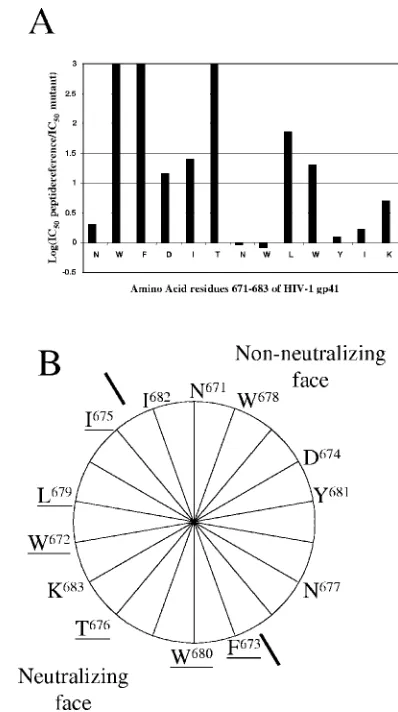
Alanine scan.The importance of individual amino acid side chains can be assessed by performing an alanine scan. Alanine was individually substituted for each amino acid in the opti-mized epitope (residues 671 to 683). The effects of these mu-tations on the IC50are shown in Fig. 1A. Mutations at W672,
F673, and T676 resulted in a major decrease in binding to the 4E10 antibody (over 1,000-fold) and confirm that these three residues are crucial for peptide recognition by 4E10. The next major increase in IC50was observed when L679 was mutated to
alanine. The importance of this residue had not been predicted in prior reports. Four other residues (N671, D674, I675, and W680) also showed a decrease in binding of 20- to 30-fold when alanine substitutions were performed. The other residues in the sequence could be replaced with alanine without any major decrease in 4E10 binding (fivefold or less).
Introduction of constraints.A recent structural study of the 4E10-peptide complex showed that the bound conformation of the peptide is helical (9). Therefore, helix-inducing constraints were introduced, including Aib residues and side-chain tethers (Table 2). Peptides in which “WF” was not included in the cyclic tether showed substantially increased binding to 4E10, indicating that these particular constraints on “WF” interfere with binding (Table 2, 74-2). Constraints in the center and C terminus resulted in peptides with a tighter binding to 4E10 compared to peptides with a constraint found in the N termi-nus, suggesting that increasing the helical character in the central region is favorable for 4E10 binding (Table 2, 104-2). These results are consistent with the crystal structure of “KGND” bound to the antibody in which the helix begins to
“unwind” at residue W672, where the N terminus of the␣-helix abuts the antibody combining site (9). Tightly binding peptides (IC50of 10 nM) were obtained that incorporated either Aib
residues or thioether tethers.
Circular dichroism spectroscopy.To determine the relative helicity of the gp41 peptide analogs, each one was analyzed in solution by CD spectroscopy. The tightest-binding peptides were all helical, with minima close to 207 and 222 nm. How-ever, a further increase in helicity did not always result in an increase in binding: 94-1 is more helical than 84-1 and has a smaller IC50(10 nM versus 40 nM, Tables 1 and 2); however,
119, which is more helical than 94-1, had the same IC50(10
nM, Table 2; Fig. 2, right panel). Nevertheless, the imposed constraints increased helicity in solution without diminishing
FIG. 1. (A) Effects of Ala substitutions (along the epitope) on 4E10 binding to synthetic peptides. The bars represent the ratio log (IC50_peptide reference/IC50_mutant). (B) Helical wheel
representa-tion of gp41 (671 to 683). The key binding residues for 4E10 are underlined and are all found on the same side of the helix. The values for the log (IC50_mutant/IC50_peptide reference) of W672, F673, and
T675 represent a minimum, since the IC50increased by a factor of
greater than 1,000 when Ala was substituted for those amino acids. IC50s were measured in two sets of experiments. For W672, F673, I675,
T676, and W680, Ala substitutions were performed on the 14-mer NWFDITNWLWKKKK-NH2(IC50⫽40 nM). For the rest, the
[image:3.585.42.284.90.175.2]sub-stitutions were performed on the 17-mer SLWNWFDITNWLWYI KKKK-NH2(IC50⫽10 nM).
TABLE 1. Amino acid sequences and 4E10 binding data (IC50andKd) of some of the unconstrained peptide analogs
Analog Sequencea IC
50(nM) Kd(nM)b
84-1 NWFDITNWLWKKKK-NH2 40 100
84-2 WNWFDITNWLWKKKK-NH2 120 ND
84-4 SLWNWFDITNWLWKKKK-NH2 120 ND
104-1 NWFCITOWLWKKKK-NH2 40 ND
94-1 NWFDITNWLWYIKKKK-NH2 10 20
178-1 WNWFDITNKKKK-NH2 ⬎10,000 ND
KGND KGWNWFDITNWGK-OH ⬎10,000 ND
aThe amino acids shown in bold belong to the native sequence. O represents
N-acetyl ornithine.
bND, not determined.
on November 8, 2019 by guest
http://jvi.asm.org/
[image:3.585.316.515.250.606.2]4E10 binding. Slightly shorter, structurally constrained pep-tides with tight binding to 4E10 (IC50⫽ 10 nM) were also
identified (Table 2, compounds 102-1 and 104-2).
In general, the constrained peptides that adopt a helical conformation in solution bind with greater affinity to 4E10 than similar peptides that are poorly structured in solution. In one example, a side-chain-tethered peptide, 104-2 [NWFc (CITO)WLWKKKK-NH2], was found to have an increased
helical content relative to its unconstrained counterpart, as determined by the appearance of two minima in the CD spec-trum (gray triangles, Fig. 2, left panel). [c(CITO) indicates the presence of a bridge linking the side chains of cysteine and ornithine.] The binding affinity of the cyclic peptide to 4E10 was improved by fourfold (104-1 in Table 1 compared to 104-2 in Table 2). Note that the extended native sequence is also quite helical (squares, Fig. 2, right panel). The CD spectra of all the other peptides mentioned in this article can be found in the supplemental material.
SPR.The affinities of several peptide analogues were mea-sured using SPR to validate the ELISA. Three peptides were picked to represent a range of affinities on related peptides. For each peptide,Kdvalues and on (kon) and off (koff) rates
were determined: 84-1 (IC50⫽40 nM),Kd⫽100 nM,kon⫽
1.49⫻ 105M⫺1s⫺1, andk
off⫽0.0149 s⫺
1; 74-2 (IC
50⫽230
nM),Kd⫽ 277 nM, kon ⫽ 1.75⫻ 105 M⫺1s⫺1, andkoff⫽
0.0485 s⫺1; and 104-2 (IC
50⫽10 nM),Kd⫽17 nM,kon⫽2.02⫻
105M⫺1s⫺1, andk
off⫽0.00336 s⫺1. TheKdvalues obtained from the Biacore analysis were in good agreement with the ELISA results and were all within a factor of 1.2 to 2.5 higher than the corresponding IC50values, as determined by ELISA
(Tables 1 and 2). The on rates of the three peptides are very similar, as is typically observed for the structurally similar pep-tide analogs (1). In contrast, the off rates vary by an order of magnitude, consistent with the various stabilities of the bound peptides as reflected by a well-positioned thioether tether (104-2) versus a poorly positioned thioether tether (74-2) com-pared to the linear peptide 84-1. TheKdof the tightest-binding linear peptide (94-1; IC50, 10 nM) was also analyzed by SPR
and was found to be 20 nM.
The affinity-optimized native sequence, as well as the se-quences of several of the constrained peptides, all bind the 4E10 neutralizing antibody with affinities in the nanomolar range (Kd,⬃20 nM). Their IC50s were determined by ELISA
to be around 10 nM. Note that an IC50 of 0.25 g/ml was
determined for recombinant gp41 (residues 541 to 682 accord-ing to HxB2) (Viral Therapeutics, Inc., Ithaca, NY), which, if we assume gp41 has an average molecular mass of 25 kDa and is largely monomeric in solution, is equal to an IC50of around
10 nM (data not shown). However, this value can only be considered a rough approximation and may differ substantially if gp41 is not monomeric in solution.
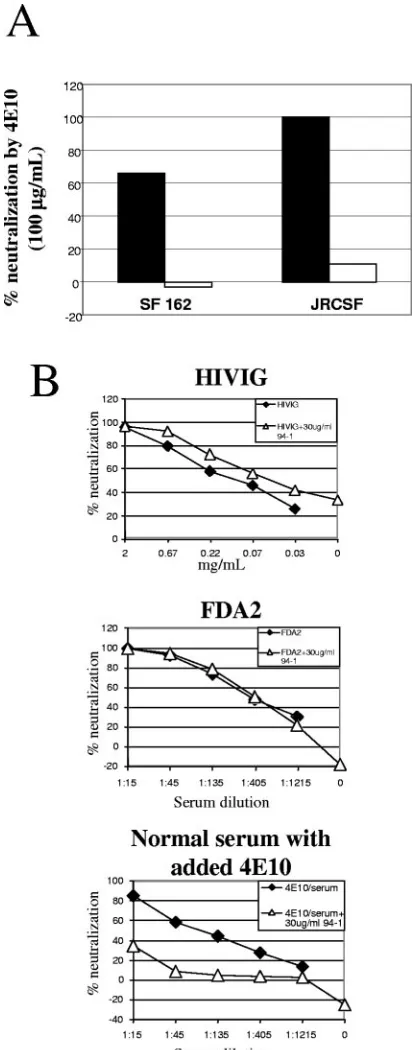
Effect of the peptide on HIV-1 neutralization by 4E10. To further investigate the interaction of peptide analogs and 4E10, the inhibitory effect of the best analogs on neutralization by 4E10 was assessed. Peptide 94-1 [NWFDITNWLWYIKKKK-NH2] produced the most favorable and reproducible inhibition
[image:4.585.41.285.90.165.2]of 4E10 neutralization in initial experiments. This peptide could block the neutralization by 4E10 of replication-compe-tent primary isolates, SF162 and JRCSF, at 30g/ml (Fig. 3A). The peptide also blocks neutralization under conditions in which normal serum was spiked with 4E10 (Fig. 3B). Under similar conditions, this peptide does not block neutralization by polyclonal IgG from HIV-1-infected donors (HIVIG) or by
[image:4.585.55.530.520.695.2]FIG. 2. CD spectra of free 4E10-epitope peptides with or without helix-promoting constraints. The presence of two minima is consistent with a helical conformation. An acyclic compound (black circles) is compared to its cyclic analog (gray triangles) (left panel). Two native linear sequences of the 4E10 epitope are compared to an Aib-containing analog (black triangles) (right panel). deg., degrees.
TABLE 2. Amino acid sequences and 4E10 binding data (IC50andKd) of some of the constrained analogs
Analog Sequencea IC
50(nM) Kd(nM)b
KGND KGWNWFDITNWGK-OH ⬎10,000 ND
102-1 NWFDITNWLWKBKBK-NH2 10 ND
102-2 KKBNWFDITNWLWKBKBK-NH2 10 ND
119 NWFDITNWLWYIKBKBKK-NH2 10 ND
74-2 CWFOITNWLWKKKK-NH2 230 277
104-2 NWFCITOWLWKKKK-NH2 10 17
a
The amino acids shown in bold belong to the native sequence. B indicates Aib. The amino acids underlined are in a cyclic conformation.
b
ND, not determined.
on November 8, 2019 by guest
http://jvi.asm.org/
the reference serum, FDA2 (Fig. 3B). These results show that the peptide interacts with the 4E10 antibody, preventing it from interacting with (i.e., neutralizing) the virus, but the 4E10-like antibodies are not present in appreciable titers in the polyclonal and serum samples tested. We noticed in our initial experiments that some peptides enhanced infectivity of the virus, whereas others inhibited it, but such effects were typically nonspecific, as a vesicular stomatitis virus G-pseudotyped virus was similarly affected (data not shown). The reasons for these observations are unknown but may be due to differences in cell viability, membrane perturbation, or other properties of the peptides.
DISCUSSION
While most of the surface of gp41 is thought to be hidden within the native trimer prior to fusion, some epitopes of gp41 appear to be somewhat accessible during, and more so follow-ing, receptor activation, when gp41 switches from the native configuration through a pre-hairpin intermediate to the post-fusion structure (2, 14, 16, 32). Specifically, the MPER of gp41 encompasses the epitopes for three neutralizing antibodies (4E10, 2F5, and Z13). However, immunogens incorporating MPER sequences have failed to elicit antibodies with the breadth and potency associated with these existing neutralizing antibodies (2, 12, 15, 19, 22, 24, 27). One explanation for the failure of at least some of these immunogens is that the peptide epitopes have been minimized to the extent that they adopt a largely unstructured conformation in solution and that immu-nogens based on extended MPER sequences or those with greater constraints should be better candidates (2). Alterna-tively, it has been proposed that to be effective immunogens, MPER sequences may require a membrane context, since the binding affinity of 4E10 and 2F5 to gp41 peptides increases in the presence of a membrane (28). A final concern has been raised by Haynes et al., who suggest that 2F5 and 4E10 cross-react with autoantigens, such as cardiolipin, and that MPER epitopes could mimic autoantibody epitopes (18). In this case, the B cells making antibodies to the MPER would be clonally deleted or suppressed, and this would explain the failure of MPER immunogens. An alternative explanation of any cross-reactivity observed, at least for 4E10, is that it arises from the highly hydrophobic nature of the binding site of this antibody (7). In any case, it is clear, however, that a detailed character-ization of the 4E10 peptide epitope and the synthesis of pep-tide antigens that mimic the structure of this epitope are valu-able steps toward the use of the design of immunogens eliciting antibodies to the MPER.
We decided to focus on the human monoclonal antibody 4E10 as it is the most broadly neutralizing antibody described to date. A recent crystallographic study shows that the peptide KGWNWFDITNWGK (called “KGND”) adopts a largely
he-FIG. 3. Neutralization experiments with the peptide representing the newly optimized epitope and its solubilizing tail, NWFDITNWL WYIKKKK-NH2. (A) Ability of peptide
NWFDITNWLWYIKKKK-NH2to block neutralization of HIV-1 by 4E10. Replication-competent
HIV-1 strains (SF162 and JR-CSF) produced in human peripheral blood mononuclear cells were assayed for neutralization by 4E10 (100
g/ml) in TZM-bl cells, in the presence (white bars) or absence (black bars) of an excess of peptide. (B) Effect of peptide NWFDITNWL WYIKKKK-NH2on neutralization of HIV-1 by polyclonal antibodies
and sera. HIV-1JR-FL, pseudotyped using the pNL4-3.Luc reporter
plasmid, was assayed for neutralization using pooled polyclonal IgG from HIV-1-seropositive individuals (HIVIG), broadly neutralizing serum from the FDA2 individual, and normal human serum spiked
with 4E10 at 200g/ml in the undiluted serum. Neutralization assays were performed using U87.CD4.CCR5 cells as target cells, in the pres-ence (open symbols) or abspres-ence (closed symbols) of peptide NWFDIT NWLWYIKKKK-NH2(Note that the zero point in serum dilution
cor-responds to 30g/ml of 94-1 being present.)
on November 8, 2019 by guest
http://jvi.asm.org/
[image:5.585.59.265.75.600.2]lical structure with all of the crucial amino acids for binding being presented on the same side of the helix (9) We refer to the residues that are not involved in binding to the antibody as the “nonneutralizing face,” in keeping with the same terminol-ogy used for the trimeric envelope spike (38) (Fig. 1B). The 4E10 epitope is not trivial to mimic because it is not a perfect ␣-helix throughout its entire length and the crucial residues “WF” are in a 310-helical structure, which is frequently
ob-served to terminate␣-helical structures. Thus, designing a per-fect␣-helix might not generate the optimal candidate for im-munization.
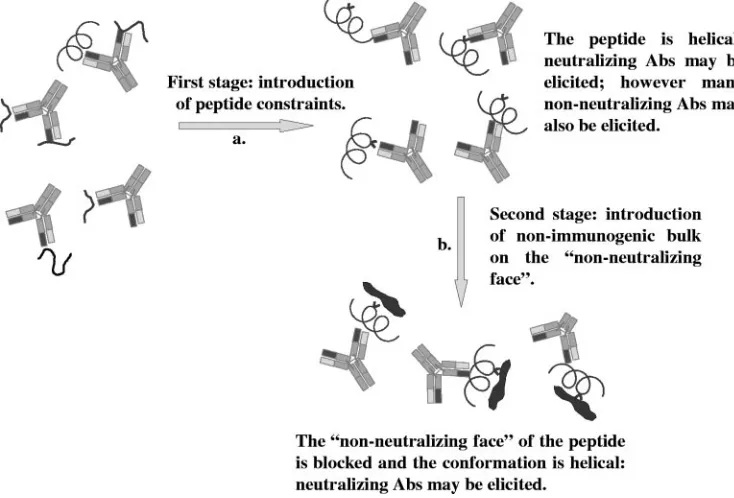
The ability of a peptide to elicit a strong immune response is not predictive of its ability to elicit neutralizing antibodies. This problem has been encountered for 2F5 (12, 15, 19, 22, 24, 27). Furthermore, the affinity of an antibody for a particular anti-gen (antianti-genicity) is not necessarily predictive of the ability of the same antigen to elicit that antibody (immunogenicity). To develop an effective antigen, we envision a multistep strategy. Initially, the particular epitope is characterized: in this case, by first identifying the length of the peptide that gives the tightest binding to the antibody and then performing alanine mutations to find the key amino acids. The next stage consists of restrict-ing the peptide conformation to the one adopted when bound to the neutralizing antibody (in this case, a helical conforma-tion). This step has been satisfactorily achieved in the present study. The last stage will consist of the replacement of unnec-essary parts with less immunogenic substituents to mask the “nonneutralizing face” without perturbing the constrained conformation. This final step will ensure that only the side of the helix which is involved in the binding to the antibody will be available to the immune system (Fig. 4). Masking the “non-neutralizing” face is a principle that has been suggested to
focus the immune response (28, 30). Finer modifications will be evaluated iteratively and empirically in subsequent stages.
In this study, we have identified the optimal length of the peptide epitope as NWFDITNWLWYIK (residues 671 to 683). A peptide containing this epitope and a solubilizing tail has an IC50of 10 nM in peptide competition experiments and
a Kd of 20 nM (as measured via BIAcore) (Table 1). This peptide also blocked neutralization of different HIV-1 strains by 4E10.
In order to identify permissive sites for further modification to the 4E10 epitope, an Ala scan was performed. Alanine substitution at residues W672, F673, and T676 resulted in a major loss of binding to 4E10 (over 1,000-fold decrease) (Fig. 1). Because substitution in these positions also slightly in-creased the helicity (CD; see the supplemental material), the loss of binding does not then appear to result from a loss of helical structure. These binding results are in agreement with the 4E10 crystal structure in complex with the “KGND” pep-tide (9), where W672, F673, and T676 make intimate contacts with the antibody. Mutation of these amino acids on the virus also decreased neutralization of the mutant virus by 4E10 (40). Taken as a whole, these studies confirm that W672, F673, and T676 are important components of the 4E10 epitope.
[image:6.585.106.473.70.319.2]Surprisingly, mutation of L679 to alanine resulted in a major decrease in 4E10 binding (70-fold). The importance of this residue could not have been foreseen from the crystal structure since L679 was replaced with a glycine spacer in the 13-mer used in the crystal data (9). The mutation L679A resulted in a small decrease in the helical character of the peptide, but not enough to account for the observed 70-fold loss in binding. Therefore, we believe that L679 makes direct contact with the antibody. During the Ala scan on the virus, L679 was not found
FIG. 4. Schematic of the vaccine design process where constraints are introduced. (a) The peptides are constrained to a helix conformation via the introduction of an Aib or tether constraint. (b) The “nonneutralizing face” is blocked with the introduction of nonimmunogenic bulk so antibody is preferentially elicited against the neutralizing face.
on November 8, 2019 by guest
http://jvi.asm.org/
to be critical, as the L679A virus could still be neutralized. The differences in the effect of Ala substitutions on peptide/affinity versus HIV-1 neutralization by 4E10 are discussed below (40). The substitutions I675A and W680A also resulted in major increases in IC50(20- to 30-fold). The importance of I675 is
predicted from the crystal structure, where it was found that I675 makes contact with the antibody, but less than W672, F673, and T676 (9). The I675 substitution also resulted in a slight decrease in helical character, which could have affected the 4E10 binding. W680A resulted in a pronounced loss of binding of the peptide to 4E10, while the helical character was improved. The importance of W680 had been seen in the mutation study performed on the virus, as the W680A muta-tion decreased neutralizamuta-tion of the mutant virus by 4E10 (40) and was also suggested from the crystallographic analysis, even though the tryptophan had been replaced by a lysine to obtain a soluble peptide for crystallization (9). Alanine substitutions on the “nonneutralizing face” usually did not result in major increases in IC50, with the exception of D674A. The alanine
substitutions N671A and D674A resulted in a disruption of the peptide conformation (CD; see the supplemental material). These two residues do not make contact with 4E10 in the crystal structure (9); therefore, they apparently play an impor-tant role in stabilizing the structure of the peptide in a helical conformation. Also, the Ala scan on the virus shows that N671 and D674 are not critical for neutralization (40). Similarly, mutations of I682 and K683 strongly decrease the helical con-tent of the peptide (CD; see the supplemental material), which may explain the lower affinity of the respective mutants. These residues also play an important role in stabilizing the peptide structure, but probably do not make contact with the antibody. Finally, N677, W678, and Y681 could be mutated to alanine with no major effect on the binding affinity to 4E10 (increase of less than twofold) or on the peptide structure.
The Ala scan allowed us to refine the synthetic peptide epitope of 4E10 as NWFDITnwLWyIK, with the uppercase letters as important residues (among them W, F, T, and L are the major residues) and the lowercase letters as replaceable ones. We believe that appropriate modifications of residues as N677 and W678 (found on the nonneutralizing face of the helix) should not affect binding to 4E10 but could result in a reduction of the immunogenicity of this side of the helix. The importance of some of the residues concurs with mutagenesis experiments performed on the virus, in which neutralization resistance oc-curred with the substitutions W672A, F673A, and W680A (40). However, in general, these results show how peptides in solu-tion may behave quite differently from the corresponding re-gion on a folded protein that is anchored to a membrane. In our study, both faces of the helix are exposed to water, whereas the “nonneutralizing” face on the virus may be interacting with neighboring protomers of gp41 or gp120 within the trimer or with the membrane. This difference in the surrounding envi-ronment could explain the differences between the Ala scans on the peptide and those on the virus. Moreover, the Ala substitutions in the viral protein may affect the entry kinetics of the virus, causing enhanced susceptibility of the virus to 4E10 without affecting the intrinsic affinity to the membrane-proxi-mal external region epitope.
The next step of our strategy focused on limiting the con-formational diversity of the peptides by designing analogs that
are constrained to adopt a conformation in solution similar to that of the peptide bound to 4E10. In the crystal structure, the 4E10 epitope peptide is in a largely helical conformation. Pep-tides derived from the native gp41 sequence are generally helical in PBS buffer (Fig. 2, squares, right panel). In order to reduce alternative peptide conformations, constraints were in-troduced to further enhance this helical propensity through the use of cyclothioethers, lactams, and reversed lactam bridges, as well as Aib-containing analogs. The presence of a helical con-formation is generally associated with strong 4E10 binding.
We introduced constraints closer to the N terminus of the sequence, initially forming thioether tethers (residues 670 to 674 or 671 to 674). These peptides did not show significant binding to the antibody. When we moved the position of cy-clization toward the center or the C terminus to constrain residues 674 to 677 or 674 to 678, we saw an increase in binding: the cyclic ether formed between residues 674 and 677 is among our best derivatives (Table 2). This result is in agree-ment with the crystal structure, as the peptide is more␣-helical toward the center and the C terminus. The incompatibility of N-terminal tethers may be due to a steric clash with the 4E10 binding pocket or the transition of the␣-helix to a 310helix at
the N terminus (9).
In summary, cyclic and acyclic analogs (native or Aib con-taining) were identified in which the tight binding to 4E10 (10 nM) was maintained (Table 2) and yet the possible backbone conformations adopted by the different analogs were re-stricted. Although, in some cases, further enhancement of he-licity or structure did not increase 4E10 binding, we anticipate that the more rigid peptides will be more specific immunogens. Compatibility of an Aib substitution with tight 4E10 binding is very promising for the use of such peptides in the design of a vaccine. Not only does the presence of an Aib residue increase the helicity, it also destabilizes alternative conformations. Such stability may be particularly useful in the presence of denatur-ing adjuvants. In addition, Aib introduces a minimal structural modification, reducing the chances of directing an immune response to the constraint. Therefore, the sequences described here would appear to be useful candidates for immunization studies. The best analogs from each series (an Aib-containing peptide, a lactam, and a thioether) are now being assessed in immunization studies.
ACKNOWLEDGMENTS
We thank Peter Wright and Linda Tennant, TSRI, for assistance with CD and Laure Jason-Moller, BIAcore, for advice on BIAcore. We are thankful to Hermann Katinger, Gabriela Stiegler, and Renate Kunert, Vienna, for providing us with 4E10 IgG.
We acknowledge support from the American Foundation for AIDS Research (to F.M.B. and R.M.F.C.), the Elizabeth Glaser Pediatrics AIDS Foundation (to M.B.Z.), the NIH (AI 058725 to M.B.Z, AI 33292 to D.R.B, GM46192 to I.A.W., and MH062261 to P.E.D.), the Neutralizing Antibody Consortium of the International AIDS Vaccine Initiative, the Pendleton Trust, and the Skaggs Institute for Chemical Biology.
REFERENCES
1.Baggio, R., G. J. Carven, A. Chiulli, M. Palmer, L. J. Stern, and J. E. Arenas.
2005. Induced fit of an epitope peptide to a monoclonal antibody probed
with a novel parallel surface plasmon resonance assay. J. Biol. Chem.280:
4188–4194.
2.Barbato, G., E. Bianchi, P. Ingallinella, W. H. Hurni, M. D. Miller, G. Ciliberto, R. Cortese, R. Bazzo, J. W. Shiver, and A. Pessi.2003. Structural
on November 8, 2019 by guest
http://jvi.asm.org/
analysis of the epitope of the anti-HIV antibody 2F5 sheds light into its
mechanism of neutralization and HIV fusion. J. Mol. Biol.330:1101–1115.
3.Binley, J. M., T. Wrin, B. Korber, M. B. Zwick, M. Wang, C. Chappey, G. Stiegler, R. Kunert, S. Zolla-Pazner, H. Katinger, C. J. Petropoulos, and D. R. Burton.2004. Comprehensive cross-clade neutralization analysis of a panel of anti-human immunodeficiency virus type 1 monoclonal antibodies.
J. Virol.78:13232–13252.
4.Bjo¨rndal, A., H. Deng, M. Jansson, J. R. Fiore, C. Colognesi, A. Karlsson, J. Albert, G. Scarlatti, D. R. Littman, and E. M. Fenyo.1997. Coreceptor usage of primary human immunodeficiency virus type 1 isolates varies according to
biological phenotype. J. Virol.71:7478–7487.
5.Brunel, F. M., and P. E. Dawson.2005. Synthesis of constrained helical peptides by thioether ligation: application to analogs of gp41. Chem.
Com-mun. (J. Chem. Soc. Sect. D)20:2552–2554.
6.Burton, D. R., R. C. Desrosiers, R. W. Doms, W. C. Koff, P. D. Kwong, J. P. Moore, G. J. Nabel, J. Sodroski, I. A. Wilson, and R. T. Wyatt.2004. HIV
vaccine design and the neutralizing antibody problem. Nat. Immunol.5:233–
236.
6a.Burton, D. R., J. Pyati, R. Koduri, S. J. Sharp, G. B. Thornton, P. W. H. I. Parren, L. S. W. Sawyer, R. M. Hendry, N. Dunlop, P. L. Nara, M. Lamac-chia, E. Garratty, E. R. Stiehm, Y. J. Bryson, Y. Z. Cao, J. P. Moore, D. D. Ho, and C. F. Barbas.1994. Efficient Neutralization of primary isolates of
HIV-1 by a recombinant human monoclonal-antibody. Science266:1024–
1027.
7.Burton, D. R., R. L. Stanfield, and I. A. Wilson.2005. Antibody vs. HIV in
a clash of evolutionary titans. Proc. Natl. Acad. Sci. USA102:14943–14948.
8.Cann, A. J., J. A. Zack, A. S. Go, S. J. Arrigo, P. L. Green, Y. Koyanagi, S. Pang, and I. S. Y. Chen.1990. Human immunodeficiency virus type 1 T-cell
tropism is determined by events prior to provirus formation. J. Virol.64:
4735–4742.
9.Cardoso, R. M., M. B. Zwick, R. L. Stanfield, R. Kunert, J. M. Binley, H. Katinger, D. R. Burton, and I. A. Wilson.2005. Broadly neutralizing anti-HIV antibody 4E10 recognizes a helical conformation of a highly conserved
fusion-associated motif in gp41. Immunity22:163–173.
10.Chan, D. C., and P. S. Kim.1998. HIV entry and its inhibition. Cell93:681– 684.
11.Cheng-Mayer, C., and J. A. Levy.1988. Distinct biological and serological properties of human immunodeficiency viruses from the brain. Ann. Neurol.
23(Suppl.):S58–S61.
12.Coeffier, E., J. M. Clement, V. Cussac, N. Khodaei-Boorane, M. Jehanno, M. Rojas, A. Dridi, M. Latour, R. El Habib, F. Barre-Sinoussi, M. Hofnung, and C. Leclerc. 2000. Antigenicity and immunogenicity of the HIV-1 gp41 epitope ELDKWA inserted into permissive sites of the MalE protein.
Vac-cine19:684–693.
13.Connor, R. I., B. K. Chen, S. Choe, and N. R. Landau.1995. Vpr is required for efficient replication of human immunodeficiency virus type-1 in
mono-nuclear phagocytes. Virology206:935–944.
14.Eckert, D. M., and P. S. Kim.2001. Mechanisms of viral membrane fusion
and its inhibition. Annu. Rev. Biochem.70:777–810.
15.Eckhart, L., W. Raffelsberger, B. Ferko, A. Klima, M. Purtscher, H. Katinger, and F. Ruker.1996. Immunogenic presentation of a conserved gp41 epitope of human immunodeficiency virus type 1 on recombinant
sur-face antigen of hepatitis B virus. J. Gen. Virol.77:2001–2008.
16.Finnegan, C. M., W. Berg, G. K. Lewis, and A. L. DeVico.2002. Antigenic properties of the human immunodeficiency virus transmembrane
glycopro-tein during cell-cell fusion. J. Virol.76:12123–12134.
17.Ghiara, J. B., D. C. Ferguson, A. C. Satterthwait, H. J. Dyson, and I. A. Wilson.1997. Structure-based design of a constrained peptide mimic of the
HIV-1 V3 loop neutralization site. J. Mol. Biol.266:31–39.
18.Haynes, B. F., J. Fleming, E. W. St Clair, H. Katinger, G. Stiegler, R. Kunert, J. Robinson, R. M. Scearce, K. Plonk, H. F. Staats, T. L. Ortel, H. X. Liao, and S. M. Alam.2005. Cardiolipin polyspecific autoreactivity in two broadly
neutralizing HIV-1 antibodies. Science308:1906–1908.
19.Joyce, J. G., W. M. Hurni, M. J. Bogusky, V. M. Garsky, X. Liang, M. P. Citron, R. C. Danzeisen, M. D. Miller, J. W. Shiver, and P. M. Keller.2002. Enhancement of alpha-helicity in the HIV-1 inhibitory peptide DP178 leads to an increased affinity for human monoclonal antibody 2F5 but does not elicit neutralizing responses in vitro. Implications for vaccine design. J. Biol.
Chem.277:45811–45820.
20.Klausner, R. D., A. S. Fauci, L. Corey, G. J. Nabel, H. Gayle, S. Berkley, B. F. Haynes, D. Baltimore, C. Collins, R. G. Douglas, J. Esparza, D. P. Francis, N. K. Ganguly, J. L. Gerberding, M. I. Johnston, M. D. Kazatchkine, A. J. McMichael, M. W. Makgoba, G. Pantaleo, P. Piot, Y. Shao, E. Tramont, H. Varmus, and J. N. Wasserheit.2003. The need for a global HIV vaccine
enterprise. Science300:2036–2039.
21.Koyanagi, Y., S. Miles, R. T. Mitsuyasu, J. E. Merrill, H. V. Vinters, and I. S. Chen.1987. Dual infection of the central nervous system by AIDS viruses
with distinct cellular tropisms. Science236:819–822.
22.Liang, X., S. Munshi, J. Shendure, G. Mark III, M. E. Davies, D. C. Freed, D. C. Montefiori, and J. W. Shiver.1999. Epitope insertion into variable loops of HIV-1 gp120 as a potential means to improve immunogenicity of
viral envelope protein. Vaccine17:2862–2872.
23.Marshall, G. R., and H. E. Bosshard.1972. Angiotensin. II. Studies on the
biologically active conformation. Circ. Res.31(Suppl. 2):143–150.
24.Marusic, C., P. Rizza, L. Lattanzi, C. Mancini, M. Spada, F. Belardelli, E. Benvenuto, and I. Capone.2001. Chimeric plant virus particles as immuno-gens for inducing murine and human immune responses against human
immunodeficiency virus type 1. J. Virol.75:8434–8439.
25.Mascola, J. R., and G. J. Nabel.2001. Vaccines for the prevention of HIV-1
disease. Curr. Opin. Immunol.13:489–495.
26.Mehandru, S., T. Wrin, J. Galovich, G. Stiegler, B. Vcelar, A. Hurley, C. Hogan, S. Vasan, H. Katinger, C. J. Petropoulos, and M. Markowitz.2004. Neutralization profiles of newly transmitted human immunodeficiency virus
type 1 by monoclonal antibodies 2G12, 2F5, and 4E10. J. Virol.78:14039–
14042.
27.Muster, T., R. Guinea, A. Trkola, M. Purtscher, A. Klima, F. Steindl, P. Palese, and H. Katinger.1994. Cross-neutralizing activity against divergent human immunodeficiency virus type 1 isolates induced by the gp41 sequence
ELDKWAS. J. Virol.68:4031–4034.
28.Ofek, G., M. Tang, A. Sambor, H. Katinger, J. R. Mascola, R. Wyatt, and P. D. Kwong.2004. Structure and mechanistic analysis of the anti-human immunodeficiency virus type 1 antibody 2F5 in complex with its gp41
epitope. J. Virol.78:10724–10737.
29.Pai, E. F., M. H. Klein, P. Chong, and A. Pedyczak.October 2000. World Intellectual Property Organization patent WO-00/61618.
30.Pantophlet, R., I. A. Wilson, and D. R. Burton.2004. Improved design of an antigen with enhanced specificity for the broadly HIV-neutralizing antibody
b12. Protein Eng. Des. Sel.17:749–758.
31.Parren, P. W. H. I., M. Wang, A. Trkola, J. M. Binley, M. Purtscher, H. Katinger, J. P. Moore, and D. R. Burton.1998. Antibody neutralization-resistant primary isolates of human immunodeficiency virus type 1. J. Virol.
72:10270–10274.
32.Sattentau, Q. J., J. P. Moore, F. Vignaux, F. Traincard, and P. Poignard.
1993. Conformational changes induced in the envelope glycoproteins of the human and simian immunodeficiency viruses by soluble receptor binding.
J. Virol.67:7383–7393.
33.Schnolzer, M., P. Alewood, A. Jones, D. Alewood, and S. B. Kent.1992. In situ neutralization in Boc-chemistry solid phase peptide synthesis. Rapid,
high yield assembly of difficult sequences. Int. J. Pept. Protein Res.40:180–
193.
34.Stiegler, G., R. Kunert, M. Purtscher, S. Wolbank, R. Voglauer, F. Steindl, and H. Katinger.2001. A potent cross-clade neutralizing human monoclonal antibody against a novel epitope on gp41 of human immunodeficiency virus
type 1. AIDS Res. Hum. Retrovir.17:1757–1765.
35.Taylor, J. W.2002. The synthesis and study of side-chain lactam-bridged
peptides. Biopolymers66:49–75.
35a.Trkola, A., M. Purtscher, T. Muster, C. Ballaun, A. Buchacher, N. Sullivan, K. Srinivasan, J. Sodroski, J. P. Moore, and H. Katinger.1996. Human monoclonal antibody 2G12 defines a distinctive neutralization epitope on the gp120 glycoprotein of human immunodeficiency virus type 1. J. Virol.
2:1100–1108.
36.Wei, X., J. M. Decker, H. Liu, Z. Zhang, R. B. Arani, J. M. Kilby, M. S. Saag, X. Wu, G. M. Shaw, and J. C. Kappes.2002. Emergence of resistant human immunodeficiency virus type 1 in patients receiving fusion inhibitor (T-20)
monotherapy. Antimicrob. Agents Chemother.46:1896–1905.
37.Weissenhorn, W., A. Dessen, S. C. Harrison, J. J. Skehel, and D. C. Wiley.
1997. Atomic structure of the ectodomain from HIV-1 gp41. Nature387:
426–430.
38.Wyatt, R., and J. Sodroski.1998. The HIV-1 envelope glycoproteins:
fuso-gens, antifuso-gens, and immunogens. Science280:1884–1888.
39.Zwick, M. B.2005. The membrane-proximal external region of HIV-1 gp41:
a vaccine target worth exploring. AIDS19:1725–1737.
40.Zwick, M. B., R. Jensen, S. Church, M. Wang, G. Stiegler, R. Kunert, H. Katinger, and D. R. Burton.2005. Anti-human immunodeficiency virus type 1 (HIV-1) antibodies 2F5 and 4E10 require surprisingly few crucial residues in the membrane-proximal external region of glycoprotein gp41 to neutralize
HIV-1. J. Virol.79:1252–1261.
41.Zwick, M. B., R. Kelleher, R. Jensen, A. F. Labrijn, M. Wang, G. V. Quinnan, Jr., P. W. H. I. Parren, and D. R. Burton.2003. A novel human antibody against human immunodeficiency virus type 1 gp120 is V1, V2, and V3 loop dependent and helps delimit the epitope of the broadly neutralizing antibody
immunoglobulin G1 b12. J. Virol.77:6965–6978.
42.Zwick, M. B., A. F. Labrijn, M. Wang, C. Spenlehauer, E. O. Saphire, J. M. Binley, J. P. Moore, G. Stiegler, H. Katinger, D. R. Burton, and P. W. H. I. Parren.2001. Broadly neutralizing antibodies targeted to the membrane-proximal external region of human immunodeficiency virus type 1
glycopro-tein gp41. J. Virol.75:10892–10905.