C
2012. The American Astronomical Society. All rights reserved. Printed in the U.S.A.
RESONANCES REQUIRED: DYNAMICAL ANALYSIS OF THE 24 Sex AND HD 200964 PLANETARY SYSTEMS
Robert A. Wittenmyer, Jonathan Horner, and C. G. Tinney
Department of Astrophysics, School of Physics, Faculty of Science, The University of New South Wales, NSW 2052, Australia;[email protected]
Received 2012 July 25; accepted 2012 November 4; published 2012 December 5
ABSTRACT
We perform several suites of highly detailed dynamical simulations to investigate the architectures of the 24 Sextantis and HD 200964 planetary systems. The best-fit orbital solution for the two planets in the 24 Sex system places them on orbits with periods that lie very close to 2:1 commensurability, while that for the HD 200964 system places the two planets therein in orbits whose periods lie close to a 4:3 commensurability. In both cases, the proposed best-fit orbits are mutually crossing—a scenario that is only dynamically feasible if the planets are protected from close encounters by the effects of mutual mean-motion resonance (MMR). Our simulations reveal that the best-fit orbits for both systems lie within narrow islands of dynamical stability, and are surrounded by much larger regions of extreme instability. As such, we show that the planets are only feasible if they are currently trapped in mutual MMR—the 2:1 resonance in the case of 24 Sex b and c, and the 4:3 resonance in the case of HD 200964 b and c. In both cases, the region of stability is strongest and most pronounced when the planetary orbits are mutually coplanar. As the inclination of planet c with respect to planet b is increased, the stability of both systems rapidly collapses.
Key words: methods: numerical – planetary systems – planets and satellites: individual (24 Sex b, 24 Sex c, HD 200964b, HD 200964c) – stars: individual (24 Sextantis, HD 200964)
Online-only material:color figures
1. INTRODUCTION
Systems of multiple extrasolar planets provide rich labo-ratories for testing theories of planet formation and dynam-ical evolution. Radial-velocity planet-search programs, with observational baselines approaching 20 years, often discover that apparent single-planet systems show evidence for additional planets. These discoveries are due to a combination of increased time coverage and ongoing improvements in measurement precision arising from innovation and refinement in instrumen-tation, observing strategies, and analysis techniques (Vogt et al.
2010; Mayor et al.2011). The former enables the detection of Jupiter-analog planets with orbital periodsP 10 yr (Wright et al.2009; Jones et al. 2010; Wittenmyer et al.2012b), and the latter permits the robust detection of planets of ever lower mass. Wright et al. (2009) showed that at least 28% of planetary systems surveyed by Doppler programs host multiple plan-ets. Recent results from theKeplerspacecraft, with some 885 multiply transiting planet candidates (Fabrycky et al. 2012), have vastly increased the pool of these fascinating and valuable planetary systems.
A number of recent studies have highlighted the need for observational detections of multiple-planet systems to be sup-ported by dynamical investigations that test whether the orbits of the proposed planets are dynamically feasible. These inves-tigations can reveal that the planetary system configuration as reported is catastrophically unstable (Horner et al.2011,2012a; Wittenmyer et al.2012a; Hinse et al.2012; Go´zdziewski et al.
2012). Alternatively, detailed dynamical simulations of systems close to mutual mean-motion resonance (MMR) can provide important additional constraints on the parameters of the plan-ets (e.g., Horner et al. 2012c; Robertson et al. 2012a). This is critical because any commensurability between the orbital periods of two planets can result in either extreme stability or instability, depending on the precise orbits of the planets involved. For example, Robertson et al. (2012a) presented re-vised orbits for the two Jovian planets in the HD 155358 sys-tem (Cochran et al.2007), potentially placing them in mutual
2:1 MMR. The dynamical stability analysis of Robertson et al. (2012a) showed that, for the orbital architecture presented in that work, the 2:1 MMR was indeed a region of long-term sta-bility, serving as further evidence that the new orbital parameters are correct. In the HD 204313 three-planet system (S´egransan et al. 2010), a similar dynamical analysis reveals that the ob-served two outermost Jovian planets must be trapped in mutual 3:2 MMR (Robertson et al. 2012b), an unusual architecture which dynamical mapping showed to be an island of extreme stability in the system. In that case, the dynamical analysis was critically necessary to constrain the HD 204313 system archi-tecture, demonstrating that the two gas giant planets are locked in the 3:2 MMR.
The intriguing results of these detailed stability investigations have prompted us to take a close look at other planetary systems which appear to be in or near low-order MMRs. In recent years, a number of surveys (Hatzes et al. 2005; Sato et al. 2005; Johnson et al.2006,2011a; D¨ollinger et al.2007; Wittenmyer et al.2011) have discovered a significant number of planetary systems orbiting intermediate-mass stars (M∗ > 1.5M). These stars have proven to be a fertile hunting ground for interesting planetary systems. Of particular interest are the two low-order resonant giant-planet pairs in the 24 Sex (2:1) and HD 200964 (4:3) systems (Johnson et al. 2011b). For both systems, the best-fit radial-velocity solutions result in crossing orbits, an architecture which can only be dynamically stable on long timescales if the planets are protected from mutual close encounters by resonant motion.
In their study of 24 Sex and HD 200964, Johnson et al. (2011b) performed small-scale n-body dynamical simulations which showed, as expected, that the long-term stable solutions were restricted to the 2:1 (24 Sex) and 4:3 (HD 200964) MMRs. The authors noted that their simulation results could not yet conclusively confirm that the planets were in resonance, and urged further, more detailed dynamical investigation.
Table 1
Planetary System Parameters
Planet Period T0 e ω K Msini a
(days) (JD-2400000) (deg) (m s−1) (M
Jup) (AU)
24 Sex b 455.2±3.2 54758±30 0.184±0.029 227±20 33.2±1.6 1.6±0.2 1.338±0.024
24 Sex c 910±21 54941±30 0.412±0.064 172±9 23.5±2.9 1.4±0.2 2.123±0.049
HD 200964 b 613.8+1.3
−1.4 54916±30 0.040−+00..0402 288+47−112 34.5+2−1.7.5 1.84−+00..1408 1.601±0.002 HD 200964 c 825.0+5−3.1.1 55029±130 0.181+0−0..024058 182.6
+67.7
−57.1 15.4±3.2 0.895 +0.123
−0.063 1.944±0.041
that would be highly unstable, were it not for the influence of such resonances, including the Hilda asteroids (Franklin et al.
1993), Jovian and Neptunian Trojans (Morbidelli et al.2005; Sheppard & Trujillo 2006; Lykawka & Horner 2010; Horner et al.2012b) and, most famously, the dwarf planet Pluto and its brethren, the Plutinos (Malhotra1995; Friedland2001). Taken in concert with the growing catalog of resonant exoplanets, these populations highlight the important role resonant dynamics plays in the formation and evolution of planetary systems. Indeed, astronomers studying the formation and evolution of our solar system have learned a great deal about the extent, pace, and nature of the migration of the giant planets through studies of the system’s resonant small body populations (e.g., Malhotra
1995; Morbidelli et al.2005; Lykawka et al.2009; Broˇz et al.
2011), revealing that the formation of our solar system was most likely a relatively chaotic process.
In this paper, we apply our highly detailed dynamical analysis techniques to the extremely interesting 24 Sex and HD 200964 planetary systems. In Section2, we briefly describe the simula-tion methods and initial condisimula-tions. Secsimula-tion3gives the results, and we give our conclusions in Section4.
2. NUMERICAL METHODS
To study the dynamics of the two planetary systems pro-posed in Johnson et al. (2011b), we performed two main suites of dynamical simulations—one for each of the planetary sys-tems studied. We followed the strategy we have successfully employed to study the dynamics of a number of other exoplan-etary systems (e.g., Marshall et al. 2010; Horner et al. 2011; Wittenmyer et al.2012a; Horner et al.2012c), and followed the dynamical evolution of a large number of different architectures for each system using the Hybrid integrator within then-body dynamics package MERCURY (Chambers1999). In each case, we placed the better constrained of the two planets in ques-tion (24 Sex b and HD 200964 b) on its nominal best-fit orbit at the start of our integrations. The orbital parameters of the planets simulated in this work are shown in Table1.1 For the other planet (24 Sex c and HD 200964 c), we then tested 41 unique orbital semimajor axes, distributed uniformly across the full±3σ range allowed by the uncertainties in that planet’s or-bit. For each of these 41 possible semimajor axes, we tested 41 unique eccentricities, again spread evenly across the full±3σ range of allowed values. For each of these 1681a−evalues, we tested 15 values of the longitude of the planet’s periastron,ω, and 5 values of its mean anomaly,M, each spanning the appro-priate±3σerror ranges. In this way, a total of 126,075 potential architectures were tested for each system.
1 The orbital solutions for the planets were taken from the Exoplanets Data Explorer Web site,http://exoplanets.org, on 2012 March 27. We note that there are very small differences between the elements presented in that explorer and those presented in Johnson et al. (2011b). These are, however, far smaller than the 1σerrors on the values, and have no effect on our results or conclusions.
In each of our simulations, we followed the evolution of the two planets involved for a period of up to 100 Myr, until they were either ejected from their system, collided with one another, or were thrown into their central star. The times at which collisions and ejections occurred were recorded, which allowed us to create dynamical maps of the system’s stability (Figures1and3).
In addition to the main suites of integrations discussed above, we performed five additional suites of integrations for each of the two planetary systems to investigate the influence that the mutual inclinations of the planetary orbits would have on their stability. In this, we followed Wittenmyer et al. (2012a), and considered cases where planet c was initially moving on an orbit inclined by 5◦, 15◦, 45◦, 135◦, and 180◦ with respect to that of planet b. Due to the significant computational overhead in performing such runs, the resolution of these subsidiary investigations was lower than for the main runs. For each of these additional runs, a total of 11,025 trials were carried out.
3. RESULTS AND DISCUSSION
3.1. The 24 Sextantis System
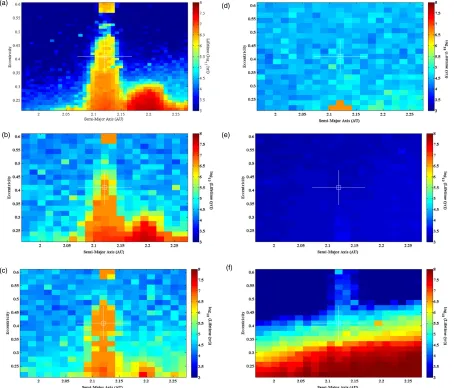
Figure1shows the results of our dynamical simulations for the 24 Sex 2:1 resonant system. At each point in the (a, e) grid, the small colored cell represents the mean survival time of 75 variants of the two-planet system—each with a unique initial combination of longitude of periastron and mean anomaly for the outer planet. The initial orbital parameters for the inner planet were held fixed, as noted in the previous section. The best-fit orbit for the outer planet is shown as an open box with crosshairs indicating the 1σuncertainties in semimajor axis and eccentricity. The orbital solution of Johnson et al. (2011b) lies directly on the narrow region of stable orbits, with mean survival times>106yr. This is strong evidence that the planets are truly in 2:1 resonance—that the resonance isrequiredfor the stability of the system. Nearly all of the surrounding parameter space is highly unstable, with survival times typically less than 104yr. An additional small region of stability can be seen centered at a∼2.2 AU, for eccentricities below around 0.3. That region is the result of an overlapping web of weak, high-order resonances that congregate in the region 2.174–2.243 AU.2 Interestingly, exactly the same feature can be seen in Figure 9 of Robertson et al. (2012a). The HD 155358 planetary system is somewhat analogous to that around 24 Sex, in that it features two planets that are most likely trapped in mutual 2:1 MMR. In that case,
Figure 1.Dynamical stability for the 24 Sex system as a function of the initial semimajor axis and eccentricity of the outer planet. The nominal best-fit orbit for that planet is marked by the open square, and the 1σuncertainties are shown by the crosshairs. The 2:1 resonance appears as a narrow strip of stability which coincides with the outer planet’s best-fit orbit (Johnson et al.2011b).
(A color version of this figure is available in the online journal.)
(a)
(b)
(c)
(d)
(e)
(f)
Figure 2.Dynamical stability for the 24 Sex system, but for six values of inclination between the two planets. Panels (a)–(f) represent mutual inclinations of 0◦, 5◦, 15◦, 45◦, 135◦, and 180◦, respectively. Panel (a) is a duplicate of Figure1, shown here for ease of comparison. As in previous figures, the color bar represents the log of the mean survival time.
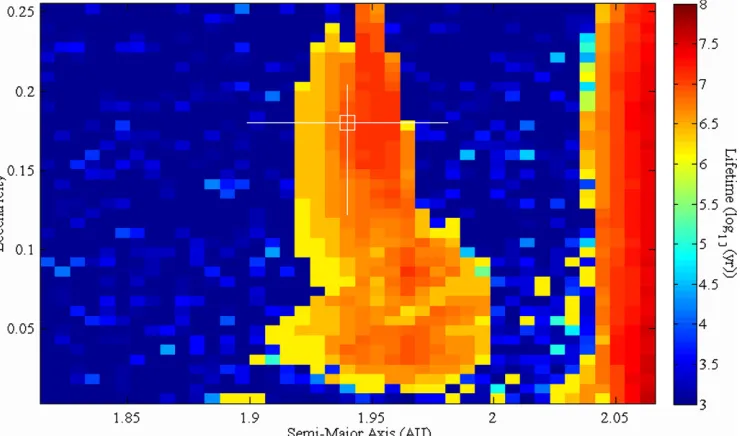
[image:3.612.82.536.317.705.2]Figure 3.Dynamical stability for the HD 200964 system as a function of the initial semimajor axis and eccentricity of the outer planet. The nominal best-fit orbit for that planet is marked by the open square, and the 1σuncertainties are shown by the crosshairs. The 4:3 resonance appears as a narrow strip of stability which coincides with the outer planet’s best-fit orbit (Johnson et al.2011b).
(A color version of this figure is available in the online journal.)
HD 155358c is most likely moving on an orbit that is somewhat less eccentric than that proposed for 24 Sex c, and so their Figure 9 shows the dynamical stability of that system to lower eccentricities. As the eccentricity of the outermost planet falls, the broad region of stability offered by these overlapped high-order resonances broadens until it merges with that offered by the protection of the 2:1 MMR. We note, however, that the stability region for 24 Sex c offered by those higher order resonances lies well away from the central±1σ of the allowed orbital architectures for the system. Hence it seems far more reasonable to conclude that the planets in this system are, most likely, trapped in mutual 2:1 MMR.
If the two planets were scattered to their present locations by a distant body, or by mutual chaotic interactions during their migration (Barnes et al.2011; Marzari & Weidenschilling2002), it is possible that they have some non-zero inclination relative to each other. To explore the effect of mutually inclined scenarios, we performed a subsidiary suite of integrations for a range of mutual inclination angles: 5◦, 15◦, 45◦, 135◦, and 180◦ (i.e., coplanar but retrograde). These runs were set up as previously described, except at lower resolution: each scenario consists of a grid of 21 values ofa, 21 ofe, 5 ofω, and 5 ofM(11025 total trial systems). The results are given in Figure2, and show that the system becomes generally more unstable when the planets depart from a prograde, coplanar configuration. Notably, the two retrograde scenarios had dramatically shorter lifetimes (panels (e) and (f)). We note that while the retrograde coplanar case (panel (f)) shows a long-term stable region in the lower right, that region is quite far from the 1σuncertainty on the orbit, much like our previous work on the proposed HU Aquarii planetary system (Wittenmyer et al.2012a).
3.2. The HD 200964 System
Figure3shows the results for the HD 200964 4:3 resonant system. As in Figure1, the open box with crosshairs shows the best-fit parameters for the outer planet (Johnson et al.2011b).
Once again, we see that the radial-velocity solution for this system, with the planets in a 4:3 resonance, lies within a nar-row region of orbital stability surrounded by highly unstable parameter space. As was the case for the 24 Sex system, this dynamical map shows that the resonance is required for the system’s stability. This result is also intriguing in light of the finding by Rein et al.2012that traditional dynamical scenarios were unable to form the HD 200964 planets in the observed 4:3 resonance. An interesting feature of the 4:3 resonant protection is that the region of stability does not extend all the way to zero eccentricity—in other words, some small, non-zero eccentricity is required for HD 200964c to be dynamically stable within the 4:3 MMR with HD 200964b. This instability at very low eccentricities is observed in the solar system’s Plutino popu-lation (trapped in 3:2 MMR with Neptune; see, e.g., Figure 6 of Robertson et al.2012b), and was also observed in some of the more extreme integrations of the planetary system orbiting HD 142 (Wittenmyer et al.2012b).
(a)
(b)
(c)
(d)
(e)
[image:5.612.56.560.54.494.2](f)
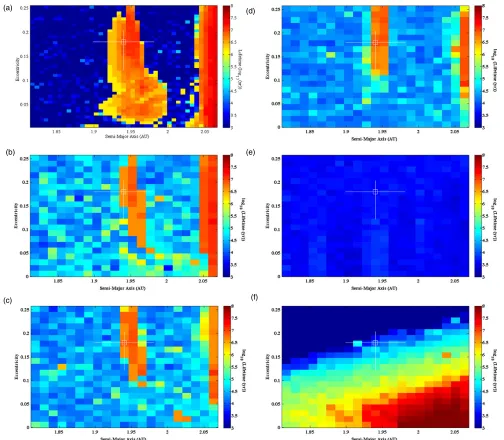
Figure 4.Same as Figure2, but for the HD 200964 system. As for 24 Sex, mutual-inclination scenarios are much less stable than the prograde-coplanar scenario in panel (a).
(A color version of this figure is available in the online journal.)
between 3 and 5 Hill radii beyond the orbit of the innermost planet. For objects on near-circular orbits, the Hill radius can be approximated as
RH =a3
m 3M,
whereaandmare the semimajor axis and mass of the planet in question, andMis the mass of the central star. For HD 200964, the sharp boundary between unstable and stable orbits at around 2.05 AU once again lies between three and four Hill radii beyond the orbit of the innermost planet. Interestingly, we note that Chambers et al. (1996) find that a system of two planets on low eccentricity, low inclination orbits “is stable with respect to close encounters if the initial semimajor axis difference,Δ, measured in mutual Hill radii,RH, exceeds 2
√
3, due to conservation of energy and angular momentum.” The mutual Hill radius,RHM
is defined as
RH M = 3
mb+mc
3M
ab+ac
2
,
As for the 24 Sex system, we also considered mutually inclined scenarios, running a further series of simulations as described in Section 3.1. The results for the HD 200964 system (Figure 4) are the same: the mean lifetime decreases significantly when the planets are inclined by more than 90◦with respect to each other (retrograde orbits). Again, the most stable configuration was prograde and coplanar (panel (a), identical to Figure3).
4. CONCLUSIONS
Both the 24 Sex and HD 200964 systems host giant planets in close resonances (Johnson et al.2011b). We have performed detailed dynamical simulations testing the 3σ range of allowed parameter space for these two systems. Our results have further constrained the orbital parameters, with the best-fit solutions falling directly in narrow (∼1σ width) strips of long-term stability. We also find that the stability of both systems is strongly dependent on the mutual inclinations of the planets involved, with coplanar orbits offering by far the greatest potential for dynamically stable solutions to be found. This work demonstrates the utility of such dynamical mapping for better understanding the architectures of multiple-planet systems. The results of this work confirm that the resonant configurations are indeed required for long-term stability in the 24 Sex and HD 200964 systems. This adds them to a very short list of low-order resonant exoplanetary systems, which are extremely valuable test cases for understanding giant-planet formation and migration processes.
We gratefully acknowledge fruitful discussions with John Johnson which helped in the development of this paper. R.W. is supported by a UNSW Vice-Chancellor’s Fellowship. J.H. is supported by ARC Grant DP0774000. The work was sup-ported by iVEC through the use of advanced computing re-sources located at the Murdoch University, in Western Australia. This research has made use of NASA’s Astrophysics Data Sys-tem (ADS), and the SIMBAD database, operated at CDS, Stras-bourg, France. This research has also made use of the Ex-oplanet Orbit Database and the ExEx-oplanet Data Explorer at exoplanets.org.
REFERENCES
Barnes, R., Greenberg, R., Quinn, T. R., McArthur, B. E., & Benedict, G. F. 2011,ApJ,726, 71
Broˇz, M., Vokrouhlick´y, D., Morbidelli, A., Nesvorn´y, D., & Bottke, W. F. 2011,MNRAS,414, 2716
Chambers, J. E. 1999,MNRAS,304, 793
Chambers, J. E., Wetherill, G. W., & Boss, A. P. 1996,Icarus,119, 261 Cochran, W. D., Endl, M., Wittenmyer, R. A., & Bean, J. L. 2007,ApJ,
665, 1407
Deck, K. M., Holman, M. J., Agol, E., et al. 2012,ApJ,755, L21 D¨ollinger, M. P., Hatzes, A. P., Pasquini, L., et al. 2007,A&A,472, 649 Fabrycky, D. C., Lissauer, J. J., Ragozzine, D., et al. 2012, arXiv:1202.6328 Franklin, F., Lecar, M., & Murison, M. 1993,AJ,105, 2336
Friedland, L. 2001,ApJ,547, L75
Go´zdziewski, K., Nasiroglu, I., Słowikowska, A., et al. 2012, MNRAS, 425, 930
Hatzes, A. P., Guenther, E. W., Endl, M., et al. 2005,A&A,437, 743 Hinse, T. C., Lee, J. W., Go´zdziewski, K., et al. 2012,MNRAS,420, 3609 Horner, J., Hinse, T. C., Wittenmyer, R. A., Marshall, J. P., & Tinney, C. G.
2012a, arXiv:1209.0608
Horner, J., Marshall, J. P., Wittenmyer, R. A., & Tinney, C. G. 2011,MNRAS, 416, L11
Horner, J., M¨uller, T. G., & Lykawka, P. S. 2012b,MNRAS,423, 2587 Horner, J., Wittenmyer, R. A., Hinse, T. C., & Tinney, C. G. 2012c,MNRAS,
425, 749
Johnson, J. A., Clanton, C., Howard, A. W., et al. 2011a,ApJS,197, 26 Johnson, J. A., Marcy, G. W., Fischer, D. A., et al. 2006,ApJ,652, 1724 Johnson, J. A., Payne, M., Howard, A. W., et al. 2011b,AJ,141, 16 Jones, H. R. A., Butler, R. P., Tinney, C. G., et al. 2010,MNRAS,403, 1703 Lykawka, P. S., & Horner, J. 2010,MNRAS,405, 1375
Lykawka, P. S., Horner, J., Jones, B. W., & Mukai, T. 2009,MNRAS,398, 1715 Lykawka, P. S., Horner, J., Jones, B. W., & Mukai, T. 2011,MNRAS,412, 537 Malhotra, R. 1995,AJ,110, 420
Marshall, J., Horner, J., & Carter, A. 2010,Int. J. Astrobiol., 9, 259 Marzari, F., & Weidenschilling, S. J. 2002,Icarus,156, 570 Mayor, M., Marmier, M., Lovis, C., et al. 2011, arXiv:1109.2497
Morbidelli, A., Levison, H. F., Tsiganis, K., & Gomes, R. 2005, Nature, 435, 462
Rein, H., Payne, M. J., Veras, D., & Ford, E. B. 2012,MNRAS,426, 187 Robertson, P., Endl, M., Cochran, W. D., et al. 2012a,ApJ,749, 39 Robertson, P., Horner, J., Wittenmyer, R. A., et al. 2012b,ApJ,754, 50 Sato, B., Kambe, E., Takeda, Y., et al. 2005, PASJ,57, 97
S´egransan, D., Udry, S., Mayor, M., et al. 2010,A&A,511, A45 Sheppard, S. S., & Trujillo, C. A. 2006,Science,313, 511
Vogt, S. S., Wittenmyer, R. A., Butler, R. P., et al. 2010,ApJ,708, 1366 Wittenmyer, R. A., Endl, M., Wang, L., et al. 2011,ApJ,743, 184
Wittenmyer, R. A., Horner, J., Marshall, J. P., Butters, O. W., & Tinney, C. G. 2012a,MNRAS,419, 3258