85 |
P a g e
NODE VERIFICATION IN WIRELESS NETWORK
Pratik Singh
1, Dr. Bhawna Mallick
21,2
Department of Computer Science and Engineering,
Galgotias College of Engineering & Technology, Greater Noida(India)
ABSTRACT
Proof of user identity on network is just like challenge for current scenario. Node verification is the vital procedure for wireless communication. We proposed a verification technique that use hash code for verification and also proposed 2D cryptography technique to maintain data integrity and confidentiality during transmission.
Keywords: Verification, Cryptography, And Hash Code, Security Attacks, Security Analysis.
I. INTRODUCTION
Security is an encapsulated concept includes authenticity of user, integrity and confidentiality of data during
transmission. In wireless communication there are more threats for breach the security due to the openness of
wireless network and no boundary limitations. It is free for access and anyone can easily access the network or
steel the identity of other to access the network in the absence of proper security mechanisms. So verification of
node is a primary step regarding to verify the authenticity of a user. There are a number of verification
techniques exist some of our as digital signature, certification , mapping of pilot symbols, third party verification
in this a trusted third party verify the nodes who participate in communication. Verification is required in every
field of networks such as sensor network (WSN), mobile ad-hoc networks (MANETs), vehicular ad-hoc
networks (VANETs).
In this paper, we proposed a node verification technique in which receiver verify the sender before receiving the
data. If receiver verify then message accept otherwise reject the message. It exists on physical layer based on
hash code. A unique hash code generated from message and transmits with message to verify the sender. We
also consider other security threats which break the confidentiality and integrity of data during transmission
such as impersonate attack, Substitution attack, replay attack, jamming attack etc. some data is very confidential
such as military data, research data, transaction data which security is a major issue during transmission. For this
we proposed a 2D cryptography technique, encrypt data before transmission at sender node and decrypt at
receiver node. We also analyze our proposed techniques against various security threats. The paper is organized
as follows. In section II, we discuss about the system model, followed by the discussion on the security issues
and analysis in section III. Simulation and results are discussed in section IV, simulation and result. Finally, in
86 |
P a g e
II. CONSIDER SCENARIO
We consider a scenario fig.1 in wireless network there is a sender, a receiver and a passive attacker, and a active
attacker. Sender sends a message via insecure wireless network. Passive attacker only performs
detection/monitoring or traffic analysis of data and ruptures the confidentiality of data but
Fig.1.Proposed Scenario
active attacker not only split the confidentiality but also ruptures the integrity of data through inject her own data that is
called impersonate attack and if replace data then it is called substitution attack.
III. PROPOSED HASH CODE GENERATION ALGORITHM 1
In this section, we propose a simple and efficient hash generation algorithm. Our proposed algorithm works as a
hash function. The hash function takes the input message of any size but return the output in a fixed size
hexadecimal code. In this algorithm, and hash code is generated by the use of message and shared key.
Hash code =G (M,K) (1)
Generated hash code is impracticable to find another message that yields the same hash code. If there is any
change in either key or message then generated hash is also
Differ.
Algorithm 1: Hash Code Generation
Initialize
Enter message (M)
Enter shared key (K)
begin
Convert message into ASCII
Perform xor operation on each ASCII value
For i = 1:length(M)
X(i) = bitxor (M(i), K)
Add all values after bitxor to get a single no.
len=length(X);
for i=1:len;
N=X(i)+N;
87 |
P a g e
Maximize no.while (N<65535)
N=M*2;
end
Convert decimal no. into hexadecimal
Hash_Code = dec2hex(N)
end
IV. PROPOSED 2D POLYNOMIAL CRYPTOSYSTEM
After generating the hash code from message now message is encrypted by proposed 2D polynomial
cryptography algorithm 2 and yields cipher text data C. In this we consider a 2D polynomial equation and based
on that perform symmetric encryption.
C = encrypt (M, key) (3)
After performing encryption on message, cipher text is concatenate with the hash code and yields data D which
will be modulate
D=C + hash code (4)
T=modulate (D) (5)
Now Signal T transmitted to receiver by a reference signal but there is reference signal equal to the modulated
signal. So receiver receives
Y=h.T+w . (6)
Where h is channel estimation and w is noise. Receiver recovers T from received signal Y and demodulates it.
After get combine data receiver separate the hash code and encrypted message from the combine data and
decrypt the encrypted message (C) as equation (7), the procedure of equation (7) described in algorithm 3.
M = decrypt (C, key) (7)
Thus regenerate the hash code from equation (8) by use the shared key and message
Re_hash code =G (M, K) (8)
This regenerated hash code compared with the received hash code if both the hash codes are same then the
88 |
P a g e
Algorithm 2: 2-D Polynomial Encryption
Intialize
Enter message (M)
Enter key for encryption (key)
begin
Convert m into ascii values
M=ASCII(M)
: for i=1:len(M)
enc(i)=power((key+M(i)),2);
end
convert ascii code into character
cipher_text = char(enc)
C=cipher_text
end
Algorithm 3: 2-D Polynomial Decryption
Initialize
Enter key for decryption (key)
begin
Construct a 2D polynomial
p= key2+2*key*m-enc
Find roots(r1,r2) of polynomial (p)
If (r1>0)
Decrypt=r1
Else
Decrypt=r2
End
Plain_text=char (Decrypt)
end
V. SIMULATION AND RESULT
For simulation we use MATLAB R2010A. QPSK modulation technique is used to modulate the data at
transmission bit rate is 1000000. Channel (h) is assumed to be ideal and the length of messages is varying
according to our requirements and assumed that shared key k is known to both transmitter and receiver.
89 |
P a g e
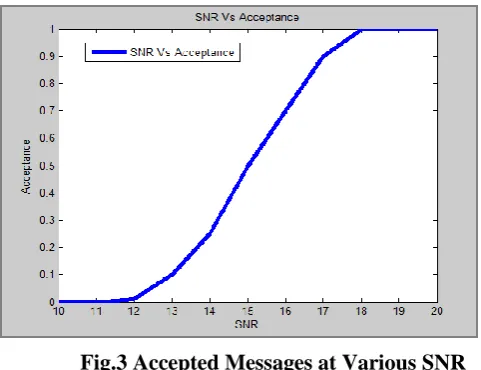
Fig. 3 shows that acceptance rate is directly proportional to the SNR (Signal to Noise Ratio) as the SNRincreases acceptance rate also increases.
Fig.3 Accepted Messages at Various SNR
We also focus the subject of message length on the acceptance of message at receiver. Fig. 4 shows the effect of
msg. length on acceptance rate, there is acceptance rate is inversely proportional to the msg. length, as length of
messages increases acceptance rate decreases.
Fig.4 Acceptance at Various Message Sizes
In table 1, show that for various keys and messages, proposed algorithm of hash code generation generate
different hash codes, if there are hash code generate for same message with, in both cases we get two different
hash codes and vice versa of these cases at serial no. 3, 4and 8 that we use same key for two different messages
then also generated two different hash codes, which show that our proposed hash code generation algorithm
90 |
P a g e
TABLE 1
S.
NO.
MESSAGE KEY HASH
CODE
1 node verification 23 EDC0
2 node verification 67 C280
3 engineering and technology 56 84A0 4 computer science 56 A120
5 Hash code depend on key and message 45 F168 6 Alice is a better sender 55 DA78
7 Bob is a attacker 89 8788
8 Bob is a attacker 56 A2A0 9 wireless sensor network 123 8A98
10 Hash code depend on key and message 45 F168
VI. SECURITY ANALYSIS
In this section we perform the security analysis of proposed techniques against various security threats
6.1
Passive Attacks:
A passive attacker only observed the data during transmission and extract the importantdetails , lose the confidentiality of data but in our proposed scheme encryption is perform on data before it
transmitted . So there is no hazard to lose the confidentiality of data.
6.2 Substitution Attacks: In this, active attacker replace the message and insert her its own message with a
previous captured hash code, so receiver accept this message but in proposed verification scheme hash code is
generated from message and key and hash code generating function is very sensitive, if a single bit of message
change then the generated hash code must be change.
6.3 Impersonation Attacks
:
In this active attacker may be more fury and try to generate her own hash codefor their messages and send her own generated hash code with the messages to Bob and hope he will be
accepted it. In proposed scheme the hash code generation function depends on message as well as shared key, so
it is challenging to detect the shared key.
VII. CONCLUSION
In this research paper, we have proposed a hash code based sender node verification scheme in wireless and
hash code is directly generate from message and shared key, then perform encryption on message before
transmission, so the confidentiality of data maintain during transmission where hash code is used to verify the
sender node, Simulation of proposed hash code generation algorithm illustrate that our algorithm satisfy all the
properties of a hash code and each time generate a unique hash code. We also focus on the noise and message
size impact on verification rate and analyzed the proposed scheme against various security threats which
91 |
P a g e
REFERENCES
[1] Horn G., Preneel B., “Authentication and Payment in Future Mobile Systems.” ComputerSecurity -
ESORICS’98, Lecture Notes in Computer Science, 1485, 1998, pp. 277-293.
[2] X. Tan, K. Borle, W. Du, and B. Chen, “Cryptographic link signatures for spectrum usage authentication
in cognitive radio,” in Proc. of the fourth ACM conf. on Wireless network security, Hamburg, Germany,
Jun. 2011.
[3] L. Lamport, “Password authentication with insecure communication,” Commun. of the ACM, vol. 24, no.
11, pp. 770–772, 1981.
[4] Paul L. Yu, John S. Baras ,"Physical-Layer Authentication ",IEEE transactions on information forensics
and security, vol. 3, no. 1, march 2008.
[5] B. Danev, H. Luecken, S. Cˇ apkun, and K. Defrawy, “Attacks on Physical layer Identification,” in
WiSec ’10: Proceedings of the 3th ACM Conference on Wireless Network Security. ACM, 2010, pp. 89–
98.
[6] Dan Shan, Kai Zeng, Weidong Xiang, Paul Richardson, and Yan Dong "PHY-CRAM: Physical Layer
Challenge-Response Authentication Mechanism for Wireless Networks",IEEE Journal on selected areas
in communications, vol. 31, no. 9, september 2013.
[7] Marco Baldi, Marco Bianchi, Nicola Maturo, Franco Chiaraluce”A Physical Layer Secured Key
Distribution Technique for IEEE 802.11g Wireless Networks” IEEE wireless communications letters,
vol. 2, no. 2, april 2013.
[8] Kapil M., Borle Biao Chen ,Wenliang Du “A Physical Layer Authentication Scheme For Countering
Primary User Emulation Attack” IEEE 2013 .
[9] Xianru Du∗, Dan Shan∗, Kai Zeng,"Physical Layer Challenge-Response Authentication in Wireless
Networks with Relay",IEEE INFOCOM 2014 - IEEE Conference on Computer Communications 2014.
[10] Liang Zhou, Dan Wu, Baoyu Zheng, Mohsen Guizani” Joint Physical-Application Layer Security for