AAEE2012CONFERENCE Melbourne, Australia www.aaee.com.au/conferences/2012/
Curriculum Development and Educational Research: the
barriers to good practice and what to do about
them
Lesley Jollya; Lyn Brodieb; Juliana Kaya Prpicc; Caroline Crosthwaitea; Lydia Kavanagha, and Laurie Buysd
University of Queenslanda , University of Southern Queenslandb, University of Melbournec, Queensland University of Technologyd
Corresponding Author Email: [email protected]
BACKGROUND
Curriculum change is acknowledged to be a difficult process to initiate and maintain (Graham 2012). Over the last two years we conducted an ALTC-funded evaluation of the use of the Engineers Without Borders (EWB) Challenge projects in first-year engineering. We asked the question ”what works for whom under what circumstances” in recognition of the complexity of curriculum development, and given that different aspects of the process play out differently in different settings. Phase 2 of the project involved three University participants’ trialling implementation recommendations resulting from the earlier stage of the evaluation. Results indicate that knowledge of best practice methods does not always directly relate to successful implementation. Thus, consideration needs to be given regarding how knowledge is translated into practice.
PURPOSE
This paper examines the barriers and aids to successful curriculum change and recommends strategies academic staff can use to embed best practice and the results of educational research in their curricula.
DESIGN/METHOD
Phase 1 of our study used a multi-method approach, incorporating survey, in-depth interviews, observation and focus group strategies with 13 participating Australian Universities. Phase 2 used observation, staff diaries and collaborative critical reflection within an ethnographic framework with a subset of three participant universities. Analysis involved a discursive critical collaboration between participants, as well as thematic analysis.
RESULTS
Three significant issues emerge relating to curriculum development including: a) aligning assessment criteria and project goals, b) consistency in course delivery, and c) collaboration. These themes will be explored particularly relating to impacts for implementing course curriculum changes and our roles as course designers, colleagues and role models for our students.
CONCLUSIONS
Our discussion is situated in the context of recent research on curriculum change. For instance, researchers have found that change “has to be radical and widespread in order to stick” (Graham 2012). We use our data to explore what counts as radical and how to attain a wide spread.
KEYWORDS
Introduction
Over the last two years a group of 13 Australasian universities, led by the University of Queensland, have been involved in an evaluation of the use of the Engineers Without Borders Challenge in first-year engineering courses (Jolly, Crosthwaite and Kavanagh 2010; 2011). This project was funded by ALTC and bears the title Curriculum Renewal in
Engineering Through Theory-Driven Evaluation. This paper takes up the issue of using research results for curriculum change: attaining it and maintaining it.
Curriculum change is acknowledged to be a difficult process to initiate and maintain (Graham 2012, Heywood 2005). All the authorities agree that a mixture of top-down and bottom-up consultation and collaboration is needed (Desha 2010, Walkington 2002), starting with leadership from those who have done the research or at least consulted the literature to find well-justified rationales for the change. These leaders then need to consult extensively with all stakeholders to develop a sense of ownership and buy-in which will ensure ongoing collaboration. But the authorities also agree that ultimately curriculum change depends on the teacher in the classroom doing what is needed and, given that “people prefer to keep on doing what they have always done” (Desha 2012: 139), change initiatives often founder in not getting the teacher’s support or not managing knowledge transfer when there is a new teacher unfamiliar with the change (Graham 2012, Heywood 2005). We are reminded very strongly of Heywood’s (2005, p. 193) observation that “ignoring the element of human behaviour in curriculum change is the reason why so much change fails”.
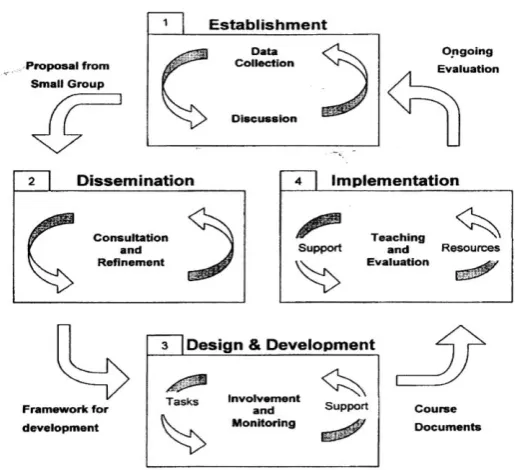
The most recent report on curriculum change in engineering by Ruth Graham (2012) concentrates on widespread changes involving whole departments and concludes that changes need to be “radical and widespread in order to stick” (Graham 2012) as well as enjoying the support of heads of school/department. This finding is supported by Walkington (2002) who provides detailed and much quoted advice for bringing about curriculum change in engineering requiring extensive and recursive cycles of collaboration and consultation (Figure 1). Starting with a proposal based on previous research, this model moves through refinement and modification of the proposal in discussion with stakeholders, then to
development of curriculum materials that everyone involved can agree on, and finally to an implementation stage which involves ongoing evaluation and modification. In what follows we will refer to this model to explain where in the change process each of our cases found themselves and to clarify what barriers emerged.
Figure 1: Recommended change process (Walkington 2002)
Focus of this paper
In comparing the implementation of the EWB projects across so many different sites and curricula, we used a Realist approach (Pawson and Tilley 1997) to ask the question ”what works for whom under what circumstances?” Phase 2 of the project involved three University participants adjusting their practice in ways that took up either the relevant contexts (i.e. the features of the conditions in which the EWB projects operated) or
mechanisms (i.e. the process of how participants acted and reacted to the EWB resources and processes) identified in the earlier stage of the evaluation. Results indicate that
knowledge of best practice methods does not always directly relate to successful implementation. Thus, consideration needs to be given regarding how knowledge is translated into practice. In this phase, the primary research question has been “What
contexts and mechanisms inhibit and support research-based change?” Our data shows that collaboration, between staff, between students and between staff and students, appears to be significant and raises challenging questions for curriculum design.
Methodology
Realist methodologies start from the observation that the relationship between causal mechanisms and their effects are dependent on contingent circumstances of context (Sayer 1984, Pawson & Tilley 1997, Sochacka 2011). On the basis of this recognition of generative causation, Realist evaluation research stresses the linked concepts of mechanism, context and outcome for understanding and explaining interventions. Mechanisms describe what it is about interventions that bring about outcomes. The process of how participants act and react to resources and processes, the choices they make, is known as the mechanism. Whilst identifying critical mechanisms is a step in the evaluation, it must be recognised that these mechanisms work differently in different contexts. Context should not be confused with location but rather refers to circumstances. Outcomes covers the consequences of
interventions both intended and unintended which result from the interaction of contexts and mechanisms. While not necessarily making hard and fast distinctions about the success or otherwise of a program (since success is also relevant to circumstances), a good evaluation can explain a complex set of interactions and outcomes and test these conjectures
objectives, a Realist evaluation seeks first to describe how participants expect the
intervention to work and then examines the stages of this program logic for supportive and inhibiting factors.
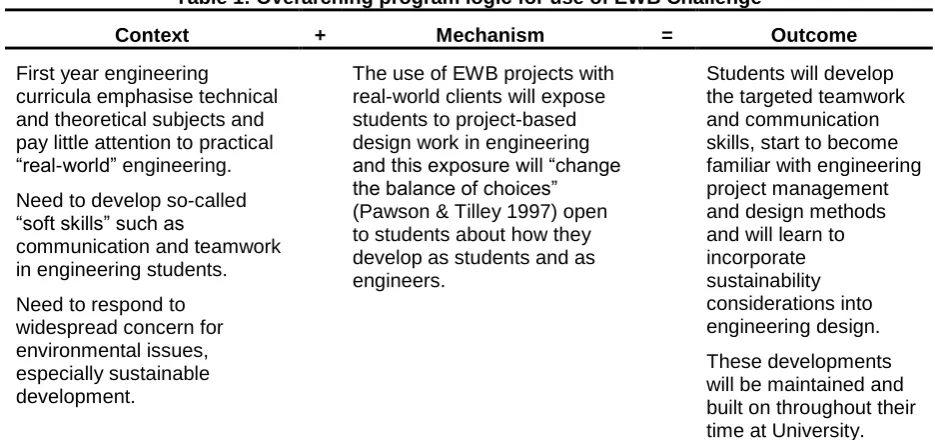
[image:4.595.63.531.204.424.2]In this project we established 14 separate program logics (one university used the Challenge in two different departments) through extended interviews with staff using the standard Wisconsin model approach (Jolly, Crosthwaite and Kavanagh 2010, 2011) and analysis of course documents. Ignoring for the present the differences between sites, there was enough that was common across them all for us to propose an overarching program theory for the use of the EWB Challenge (Table 1).
Table 1: Overarching program logic for use of EWB Challenge
Context + Mechanism = Outcome
First year engineering
curricula emphasise technical and theoretical subjects and pay little attention to practical “real-world” engineering.
Need to develop so-called “soft skills” such as
communication and teamwork in engineering students.
Need to respond to widespread concern for environmental issues, especially sustainable development.
The use of EWB projects with real-world clients will expose students to project-based design work in engineering and this exposure will “change the balance of choices” (Pawson & Tilley 1997) open to students about how they develop as students and as engineers.
Students will develop the targeted teamwork and communication skills, start to become familiar with engineering project management and design methods and will learn to incorporate sustainability considerations into engineering design.
These developments will be maintained and built on throughout their time at University.
The contexts identified in Table 1 are those operating at the most generic level and they each played out differently in different sites, prompting a range of mechanisms amongst teaching staff to do with course design and pedagogy. Those mechanisms in turn became the contexts in which students encountered and responded to the projects and this cascade of factors resulted in variation of the observed outcomes (Jolly et al 2012). Data about each of the implementations was collected through observation of classes, interviews and focus groups with staff and students, analysis of documents such as course outlines and student work and an exit survey offered to all participating students (N = approx. 4500).
Preliminary analyses were presented to participants in a workshop in 2011 and opportunities were identified to test the findings through examination of three instances of change to existing contexts and mechanisms that were proposed for 2012. It is these implementations that allow us to reflect here on how change can be attained and maintained. While our conclusions will not strike many readers as original, they are unbusual in being supported by empirical evidence.
Phase 2 implementations
Site 2 adopted the EWB Challenge projects (although not the Challenge competition) in a new third year multidisciplinary course which included students from all faculties at that university. Here the focus was on what outcomes would be achieved and what the impact of multidisciplinary teamwork would be. In Site 3 it was felt that more structure in the curriculum and more scaffolding of learning could improve outcomes. The fact that this was a large fully online course presented challenges to achieving observable and uniform change.
In both Site 2 and Site 3 this phase of the project could be seen as a kind of action research in that members of the research team were involved in planning and monitoring the changes made and were in constant dialogue with the relevant course controllers. Further data was collected at all three sites through face-to-face and online observations, debriefing
interviews, and reflective diaries kept by the staff and students. Analysis of this information drew on the thematic categories identified in the first phase of research and was refined through constant debriefing and checking back with the staff involved. Space constraints force us to summarise this very rich material here.
Results
Site 1
This site was a place where the EWB Challenge had been implemented for several years in what could be described as radical and widespread curricular change involving the
institutionalisation of a common first year and increased use of project-based teaching methods. At first the EWB projects were mandated for all subject areas but this provoked strong opposition from some departments and staff. In Walkington’s terms, the process had been short-circuited by going straight from Stage 1, the proposal by a small group, to Stage 4, Implementation. In 2010 a new co-ordinator undertook extensive collaboration with staff to arrive at an implementation that would have greater acceptance in the faculty. This meant redeploying some staff who were not used to or interested in the course and allowing some disciplines to pursue non-EWB projects. Even the non-EWB projects, however, were required to pursue the outcome described in Table 1 through a strong emphasis on engineering in context.
These projects were first tried in 2011 with varying degrees of success (Jolly, Crosthwaite
and Kavanagh 2011). We have reported elsewhere that the use of a Demo Day where
students developed models of their design solutions and tried them out under competitive conditions was motivating for students, but in the case of some projects it created tensions between what could be accomplished for a single demonstration and the longer-term goals of projects such as the community-based water purification projects proposed by EWB. For instance one group working on water purification abandoned a fruitful solution because it would be too slow for Demo Day. Staff in charge of the course realised the problem at once and redesigned the assessment criteria for 2012 so that such tensions were not created.
In this case the change was a relatively minor one, typical of the small-scale change that is constantly happening in all curricula (Heywood 2005) and required little collaboration to bring it about. However, it built on an extensive collaborative process similar to that described by Walkington (2002) which created the necessary trust and acceptance amongst a large teaching team, but at the price of a compromise over the extent to which the EWB projects would be used.
Site 2
teaching team consisted of the course controller and one tutor, assisted by some guest lecturers throughout semester.
The course was designed to be responsive to students’ needs as they emerged over the course of semester. It was run mainly in workshop style and through intense collaboration with students over learning outcomes in a process the course controller called “co-creating learning intent” (Prpic and Hadgraft 2011): similar to the kind of inclusive process described by Walkington (2002). The objectives of the course included:
Show evidence of grappling with complex problems through the lenses of your own and others perspectives
Demonstrate learning consultative skills with stakeholders
Demonstrate the ability to make and lead a case taking into account your own and others’ perspectives
Demonstrate the use and integration of the knowledge developed over the course of your degree
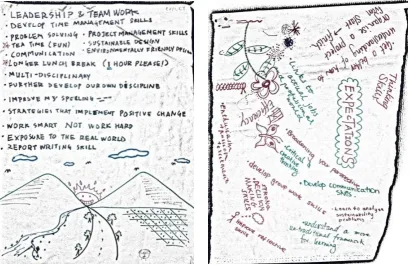
[image:6.595.77.488.441.713.2]Of course the challenge with such objectives is to reach a common understanding of what is meant by them and what will count as achievement of them. Time was spent in this course negotiating this in a process similar to Walkington’s first stage of developing the proposal. Student groups were asked to articulate their own understandings of the expected outcomes and Figure 2 shows two examples of the results. The very layout of these posters indicate a range of styles from a linear journey with a list of skills that can be checked off, to something more free-form and open-ended, there is still considerable overlap between them and the traditional outcomes being sought by those using the EWB projects in other contexts. During the course of the semester the tutor identified (reflexive journal weeks 3 and 10) a ‘nodding effect’ in some students. That is to say that although they were happy to go along with the activities they were not really getting it. This was reflected in a bi-modal result in student evaluations which suggested that either students committed to the process and loved it or just went along with it and remained unsatisfied.
Figure 2: What students wanted to get out of the course (Site 2)
I am happy to say that I think I have learnt more important skills in this subject than in any other one I have studied at university. Not only have I gained a large knowledge base about the focus of the subject (Vietnam, An Minh, housing, infrastructure and materials) but I have also gained much insight into my learning styles, my weaknesses, my strengths and the benefits that comes with analysis of oneself.(Final reflective essay).
Significantly, the personal style of the course controller was identified by both students and tutor as a factor in the success of the collaborative approach.
Site 3
The third site was one where a long-standing online course built on problem based learning (PBL) principles and using the EWB projects for most of its content was felt to need
rejuvenation. It is notoriously difficult to foster effective group work online and it was felt that a more explicit use of PBL principles would alter the course context by making objectives and process clearer to tutors and students alike. Allowing them a greater range of choices in how they would respond and learn. A set of week-by-week guidelines for tutors and revised and simplified assessment rubrics were developed in concert with the research team and in line with what we had discovered seemed to work elsewhere.
In previous years a core cohort of trained and committed tutors had been built up, but in 2011 the course controller was told she could not use most of these people and instead had to use full-time academics. Ten out of the 12 people thus assigned to the course had never had any contact with it or any other PBL course before, were not familiar with the rationale and processes used and, as it turned out, were likely to be unsympathetic and resistant to the underpinning pedagogy. While the course controller lobbied for more suitable
appointments, this all took time and the course had already begun when the final staff list was arrived at. It included three members of staff who didn’t want to teach on the course and whose attitudes varied from passive aggressive to explicitly undermining. The course
controller set up meetings and tried to make personal contact with these staff members in order to refine the design and get greater tutor involvement but got no response. In terms of Walkington’s model it was once again a short-circuiting of the change model through lack of staff participation in collaboration efforts.
The attitudes and behaviours of these three staff members created difficulties for the course controller who had to deal with student complaints about inconsistent treatment by the various tutors. An online staff forum was used to try to help develop consensus but was either ignored by the alienated staff or used to belittle the course controller’s efforts and announce a refusal to apply the published rubrics. In the stress of managing this situation the plans for well-structured activities and tutor responses for each week began to slip and even the experienced and committed tutors tended to revert to what had been done in previous years. In one instance this involved one tutor giving advice about problem solving in terms of a model that had been used in previous years but abandoned in this year’s changes, to the confusion of students.
Despite all these difficulties, the student evaluations of the course improved and in focus groups students said that they understood what the course was about and why it was important. Significantly they also said that although they began by hating the teamwork aspects, by the end they were finding that teamwork was keeping them on track, not only in this course but in all their other courses.
Conclusions
Site 1 already had a history of gaining that acceptance through negotiation with involved staff before this project began so that although it seemed that their case suggested that small scale change could be implemented fairly readily, this was only possible because of broad agreement on what the course was about and how it should be pursued. The earlier round of collaboration over course design meant that some aspects of the course that the originators may have wanted to retain, such as the universal use of the EWB projects, had to be
modified. At the same time the process revealed those staff who were unsuited to the course as it was being designed and they could be redeployed. Here we note that Graham’s review of curriculum change in engineering finds that the support of the Head of School is essential and we propose that this is one example of the kind of support that change agents need. Site 3 similarly illustrates that collaborative change processes such as Walkington’s are two-way streets. Initiators of change must do their best to engage and accommodate a range of legitimately different views, but those in the wider group also need to be prepared to give serious consideration to new ideas. Such processes take time and we were probably at fault in trying to bring in relatively large scale changes in too short a span of time with a team that was not fully on board. It may have been better to leave the course as it was for another semester and use the experience of its difficulties to open up a collaborative consultation with involved staff about how to make it better. However, it is fair to say that there was a certain amount of pressure from the faculty management to do something quickly to improve student evaluations of the course and academics often find themselves under such time pressures. Again, a supportive Head of School may be able to play an important role here in bringing pressure on staff members who were not fully committed to the course or removing them, but initiating enthusiasts need to make sure they are not trying to do too much too soon.
Site 2 allowed us the opportunity to examine the impact of unusual collaborative teaching methods on the students themselves. We think this is significant for a number of reasons. Firstly, the first stage of the research demonstrated (Jolly et. al. 2012) that the most common mechanism triggered in students by the necessity to work in teams is that of dividing the work up and all going away and doing it separately. This mechanism creates the risk that students only learn about the part of the project they worked on. Some collaboration would seem to be necessary to reach all learning goals but it is rarely explicitly taught or required in our sample. There are often introductory lectures on teamwork and peer review
arrangements requiring students to rate each others’ performance, but little advice is offered as to what a collaborative performance should look like and students tend to rate each other for raw input (whether they delivered on time and the quality of their delivery) rather than process behaviours. At Site 2, active learning techniques and structured reflections were used to encourage students to become equal partners with the course controller in designing the course and its outcomes. However, the ‘nodding effect’ and the bi-modal evaluation results suggest that some students were paying lip service only to their collaboration in creating this course. This draws our attention to another potential problem for implementing change. Where there are power differentials between those proposing the change and those being asked to take part, collaboration may be nominal only. The equivalent situation for staff in a collaboration might be those who don’t make objections to a change but may not
implement it effectively because of their lack of buy-in. Some of this was seen in Site 3 also. The best advice we can glean from our cases here is that compromise might have to be accepted. Thus in site 1 the initial insistence on all students undertaking EWB projects had to be modified to gain the acceptance of some staff members. Importantly, however, the staff in this site identified that the important educational principle was to teach students about
compromise, the central educational principle needs to be maintained and not compromised away.
We have started by considering how to make best use of research results in bringing about curriculum change and finished by discussing the necessity for collaboration. This is an attribute we often claim to want to see in our students, but as the cases discussed here indicate, we appear to have an imperfect grasp of the process ourselves. Even where we attempt it, we run into barriers of time and lack of organisational support. It is worth
considering whether, when we require our students to demonstrate effective teamwork, we make sufficient allowance for comparable problems in their learning contexts.
References
Desha, C. (2010) An Investigation Into the Strategic Application and Acceleration of Curriculum Renewal In Engineering Education for Sustainable Development. PhD Dissertation, Griffith University.
Graham, R. (2012) Achieving Excellence in Engineering Education: the ingredients of successful change. A report to the Royal Academy of engineering, London: RAE.
Heywood, J. (2005) Engineering Education Research and Development In Curriculum and Instruction. Piscataway, N.J. Wiley-IEEE Press.
Jolly, L., Crosthwaite, C., Kavanagh, L. (2010) An evaluation of the EWB Challenge – implications for future curriculum change. Paper presented at annual Australasian Association for Engineering Education conference, Sydney, December 2010.
Jolly, L., Crosthwaite, C., Kavanagh, L. (2011)The impact of curriculum content in fostering inclusive engineering: data from a national evaluation of the use of EWB projects in first year engineering. Paper presented at annual Australasian Association for Engineering Education conference, Freemantle, December 2011.
Jolly, L., Brodie, L., Prpic, J.K., Crosthwaite, C., Kavanagh, L., Buys, L. (2012) Improving Teaching with Research: the Role for Theory-Driven Evaluation. Paper presented to conference on Improving student Learning, Lund, Sweden, August 2012.
Mark, M., Henry, G, and Julnes, G. (2000) Evaluation: an integrated framework for understanding,
guiding, and improving policies and programs. San Francisco: Jossey-Bass.
Pawson, R., Tilley N. (1997). Realistic Evaluation. London: Sage.
Prpic, J., Hadgraft, R. (2011) Interdisciplinarity as a path to inclusivity in the engineering classroom. Paper presented at annual Australasian Association for Engineering Education conference, Freemantle, December 2011.
Sayer A. (1984) Method in Social Science: a Realist Approach. London: Hutchinson.
Sochacka, N. (2011) Realistic Analysis of Socio-Technical Interventions in the Context of Urban Water Management. PhD Dissertation. University of Queensland.
Walkington J. (2002) A process for Curriculum Change in Engineering Education. European Journal of Engineering Education 27(2): 133-148.
Acknowledgements
This research was funded by an Australian Learning and Teaching Council grant PP10-1647.