10. Conservation planning for a
changing climate
R. L. Pressey
Australian Research Council Centre of Excellence for Coral Reef Studies, James Cook University, Townsville QLD 4811 Australia (Email: [email protected])
Abstract
A crucial objective for the selection and spatial design of conservation areas is to promote the adaptation of species and natural processes to changing climates.
Key considerations include:
• New patterns and combinations of threats;
• Adjustment of conservation targets to account for climate-related issues; and
• Identification, protection and/or restoration of climatic gradients to promote spatial adjustments by species.
These issues are discussed with examples from regional planning in South Africa. The paper ends with a list of unresolved issues that need to be addressed if conservation planning is to deal effectively with climate change.
Introduction
Conservation planning is the process of locating, configuring, and maintaining conservation areas, areas of land, sea or freshwater that are managed for the persistence of natural values. This
management includes strict reservation, a wide variety of off-reserve mechanisms, and restoration. Systematic conservation planning (Margules & Pressey 2000) identifies configurations of
complementary areas that achieve explicit, and generally quantitative, objectives.
Since its origin in the early 1980s, systematic conservation planning has influenced decisions by major organisations such as The Nature Conservancy (Groves et al. 2002), shaped policy, legislation and conservation on the ground (Knight et al. 2006), and has featured in well over 200 presentations at meetings of the Society for Conservation Biology.
The field’s hundreds of publications reflect not only advances in ideas, techniques and relevance, but also its short history and main limitations (Pressey et al. 2007). Most publications concern biodiversity pattern, that is, the elements of biodiversity that can be mapped and regarded as static (Pressey 2004). Planners have done less well at promoting the persistence of the myriad ecological and evolutionary processes that maintain and generate biodiversity (Balmford et al. 1998). Most systematic methods have also assumed implicitly that threats to biodiversity are absent or static (Pressey et al. 2004). Previous losses of biodiversity might be recognised, even perhaps the legacies of continuing loss from past threats, but the rates and patterns of dynamic threats have often not been anticipated. These limitations are being addressed, but still present important challenges to conservation planners.
The context for conservation planning as a response to climate change is shaped by several considerations:
• The need to deal with uncertainties in predictions of climatic changes, species adjustments to these changes, and the effectiveness of planning responses;
• The potential for conservation planning to address not just adaptation but also mitigation (e.g. carbon sequestration, carbon trading, planting for biofuels); and
• Limitations on resources and space that require conservation planners to make difficult choices between conflicting conservation objectives because not all can be achieved.
Three broad aspects of conservation planning are relevant to adaptation to climate change: (1) spatial design, or the configuration of individual conservation areas and whole systems of conservation areas; (2) the application of conservation mechanisms, recognising constraints and opportunities related to tenure, land use, budgets and other factors; and (3) management, or the maintenance and monitoring of established conservation areas, recognising progressive changes within and outside these areas (e.g. fire, weeds, surrounding land uses).
Spatial design for climate change
This short paper outlines some aspects of the selection and spatial design of conservation areas to promote the adaptation of species and natural processes (Pressey et al. 2007) to changing climates. There are several important issues for selection and design.
First, conservation planning must address new patterns of threats (e.g. projected rises in sea level, spatial changes in agricultural suitability) and new combinations of threats (e.g. altered fire regimes combined with the spread of invasive species).
Second, conservation targets the quantitative interpretations of conservation objectives (e.g. hectares of each vegetation type, numbers of populations of rare species), will need to be adjusted to account for climate-related issues. Some of these are: altered vulnerability of species to new threats; population sizes required for genetic adaptation to climate and associated changes; and identification of
populations within the ranges of species that might be pre-adapted to make the required changes for genetic adaptation and shifts in distributions.
Third, is the need for identification, protection and/or restoration of climatic gradients to promote spatial adjustments by species. These gradients vary in steepness (change in climatic parameters per horizontal kilometre). Very steep, short gradients are likely to be easiest to maintain. Long gentle gradients are likely to present serious difficulties in many regions.
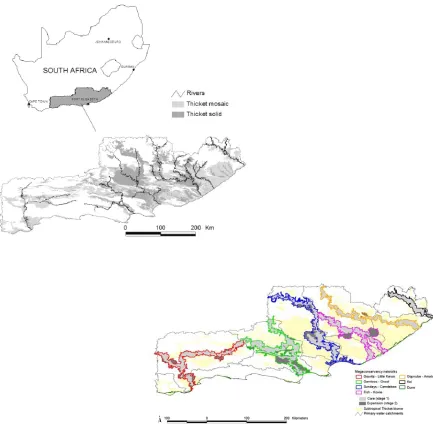
Fig. 1. (a, left) Upland to lowland environmental gradients in the Cape floristic region of South Africa; and (b, right) Macroclimatic or phytogeographic gradients (reprinted with permission from Blackwell Publishing)
[image:3.595.93.526.283.718.2]
Other aspects of spatial design are now also receiving attention. For several reasons, much of this work has also focused on the Cape Floristic Region. The reasons include its global significance for biodiversity, narrow endemism of many plant species, steep climatic gradients, and very good
biological data, at least for some plant groups such as the Proteaceae. Williams et al. (2005) addressed the problem of species-specific design for climate change, recognising predicted range shifts each decade, dispersal distances per decade, and the need to plan for adequately connected patches of native vegetation to allow for range shifts.
Planning ahead for climate change
Hannah et al. (2007), working both in the Cape and Mexico, demonstrated the efficiencies of planning ahead for climate change, rather than planning for biodiversity patterns as they are now and then later adding further conservation areas to deal with range adjustments. Work is also underway to
understand how patch dynamics such as fire (Syphard et al. 2006) and coral bleaching (Hughes et al. 2007) might respond to climate change and how the spatial design of conservation areas will need to take these altered dynamics into account.
Some remaining challenges for selection and spatial design include:
• The variable effectiveness of corridors or spaced patches of native vegetation along climatic gradients in terms of dispersal rates of species and the possible need for translocating plants and animals;
• The variable effectiveness of corridors or spaced patches of native vegetation along climatic gradients in terms of their inherent suitability for dispersal interacting with the effectiveness of management mechanisms and restoration;
• Important questions about how planners should respond to the inevitable uncertainties of predicting the directions and magnitudes of climatic changes and biological responses;
• The need to address spatial design for climate change in generalised ways because actual responses to climate change can be predicted only for a small minority of species;
• The inevitable lateral gaps between corridors or sequences of patches of native vegetation along climatic gradients mean that not all species will be located near them and have access to them, especially in regions, such as the Cape Floristic Region and South-Western Western Australia, that have many localised endemics;
• The need for difficult tradeoffs between multiple conservation objectives, of which design for climate change is only one, competing for limited resources and space (Pressey et al. 2007). These tradeoffs are exacerbated by the need to commit substantial resources to protect or create entire corridors or sequences of patches of native vegetation that are functional for species range shifts.
There is considerable potential to address these challenges in Australia and to develop and implement planning approaches here that promote the persistence of biodiversity in the face of climate change.
References
Balmford, A., Mace G. M. & Ginsberg J. R. (1998) The challenges to conservation in a changing world: putting processes on the map. In: Conservation in a changing world. (eds G. M. Mace, A. Balmford & J. R. Ginsberg) pp. 1-28. Cambridge University Press, Cambridge.
Cowling R. M., Pressey R. L., Rouget M. & Lombard A. T. ( 2003) A conservation plan for a global biodiversity hotspot - the Cape Floristic Region, South Africa. Biological Conservation112, 191-216.
Groves C. R., Jensen D. B., Valutis L. L., Redford K. H., Shaffer M. L., Scott J. M., Baumgartner J. V., Higgins J. V., Beck M. W. & Anderson M. G. (2002) Planning for biodiversity conservation: putting conservation science into practice. BioScience52, 499-512.
Hughes, T. P., Rodrigues M. J., Bellwood D. R., Ceccarelli D., Hoegh-Guldberg O., McCook L., Moltschaniwskyj N., Pratchett M. S., Steneck R. S. & Willis, B. (2007) Phase shifts, herbivory, and the resilience of coral reefs to climate change. Current Biology17, 1-6.
Knight, A. T., Driver A., Cowling R. M., Maze K., Desmet P. G., Lombard A. T., Rouget M., Botha M. A., Boshoff A. F., Castley J. G., Goodman P. S., MacKinnon K., Pierce S. M., Sims-Castley R., Stewart W. I. & von Hase A. (2006) Designing systematic conservation assessments that promote effective implementation: best practice from South Africa. Conservation Biology20, 739-750.
Margules C. R. & Pressey R. L. (2000) Systematic conservation planning. Nature405, 243-253.
Pressey R. L. (2004) Conservation planning and biodiversity: assembling the best data for the job. Conservation Biology18, 1677-1681.
Pressey, R. L., Cabeza M., Watts M. E., Cowling R. M. & Wilson K. A. (2007) Conservation planning in a changing world. Trends in Ecology and Evolution (in press).
Pressey, R. L., Cowling R. M. & Rouget M. (2003) Formulating conservation targets for biodiversity pattern and process in the Cape Floristic Region, South Africa. Biological Conservation112, 99-127.
Pressey, R. L., Watts M. E. & Barrett T. W. (2004) Is maximizing protection the same as minimizing loss? Efficiency and retention as alternative measures of the effectiveness of proposed reserves. Ecology Letters7, 1035-1046.
Rouget, M., Cowling R. M., Lombard A. T., Knight A. T. & Kerley G. I. H. (2006) Designing large-scale conservation corridors for pattern and process. Conservation Biology20, 549-561.
Rouget, M., Cowling R. M., Pressey R. L. & Richardson D. M. (2003) Identifying spatial components of ecological and evolutionary processes for regional conservation planning in the Cape Floristic Region, South Africa. Diversity and Distributions9, 191-210.
Syphard A. D., Franklin J. & Keeley J. E. (2006) Simulating the effects of frequent fire on southern California coastal shrublands. Ecological Applications16, 1744-1756.
Telstra is a proud partner of the WWF Building Nature's Safety Net initiative.
© WWF-Australia. All Rights Reserved.
Editors:
Martin Taylor PhD
Protected Areas Policy Manager
WWF-Australia, PO Box 15404, City East Q4002 (Email: [email protected])
Penelope Figgis AO
Vice-Chair Australia and NZ region
IUCN World Commission on Protected Areas (Email:[email protected])
Please cite this publication as: Taylor M. & Figgis P. (eds) (2007) Protected Areas: Buffering nature against climate change. Proceedings of a WWF and IUCN World Commission on Protected Areas
symposium, 18-19 June 2007, Canberra. WWF Australia, Sydney.
ISBN: 1 921031 20 4
WWF-Australia Head Office GPO Box 528
Sydney, NSW, Australia 2001 Tel: +612 9281 5515
Fax: +612 9281 1060 wwf.org.au
Published August 2007 by WWF-Australia. Any reproduction in full or in part of this publication must mention the title and credit the above-mentioned publisher as the copyright owner.
The opinions expressed in this publication are those of the authors and do not necessarily reflect the views of WWF.