This is a repository copy of
A Game Theoretic Handover Optimization for Dense Small
Cells Heterogeneous Networks
.
White Rose Research Online URL for this paper:
http://eprints.whiterose.ac.uk/148692/
Version: Accepted Version
Article:
Alhabo, M, Zhang, L, Nawaz, N et al. (1 more author) (2019) A Game Theoretic Handover
Optimization for Dense Small Cells Heterogeneous Networks. IET Communications, 13
(15). pp. 2395-2402. ISSN 1751-8628
https://doi.org/10.1049/iet-com.2019.0383
© The Institution of Engineering and Technology. This paper is a postprint of a paper
submitted to and accepted for publication in IET Communications and is subject to
Institution of Engineering and Technology Copyright. The copy of record is available at the
IET Digital Library.
[email protected]
https://eprints.whiterose.ac.uk/
Reuse
Items deposited in White Rose Research Online are protected by copyright, with all rights reserved unless
indicated otherwise. They may be downloaded and/or printed for private study, or other acts as permitted by
national copyright laws. The publisher or other rights holders may allow further reproduction and re-use of
the full text version. This is indicated by the licence information on the White Rose Research Online record
for the item.
Takedown
If you consider content in White Rose Research Online to be in breach of UK law, please notify us by
IET Communications
Research Article
Game theoretic handover optimisation for
dense small cells heterogeneous networks
ISSN 1751-8628 Received on 8th April 2019 Revised 5th June 2019 Accepted on 26th June 2019 doi: 10.1049/iet-com.2019.0383 www.ietdl.org
Mohanad Alhabo
1, Li Zhang
2, Naveed Nawaz
3, Hayder Al-Kashoash
41College of Electronic Engineering, Ninevah University, Mosul, Iraq
2School of Electronic and Electrical Engineering, University of Leeds, Leeds, UK 3University of Engineering and Technology, Lahore, Pakistan
4Technical Institute/Qurna, Southern Technical University, Basra, Iraq E-mail: [email protected]
Abstract: Ultra-dense deployment of small cells is capable of enhancing the cellular network performance in terms of capacity improvement and coverage expansion. However, this deployment results in high interference and frequent handovers, and hence, high-energy consumption is expected. In this study, the authors formulate a non-cooperative game approach in which all base stations compete in a selfish manner to transmit at higher power. Each base station in the network is considered as a player in the game. The solution of the game is obtained by finding the optimal point, namely the Nash equilibrium. The proposed method, named efficient handover game theoretic, targets to manage the handover in dense small cell heterogeneous networks. Each player in the game optimises its payoff by adjusting the transmission power so as to enhance the overall performance in terms of throughput, handover, energy consumption, and load balancing. In order to choose the preferred transmission power for each player, the payoff function takes into account the gain of increasing the transmission power, energy consumption, base station load, and unnecessary handover. The cell selection is performed using the technique for order preference by similarity to an ideal solution (TOPSIS). A game theoretical approach is implemented and evaluated for dense small cell heterogeneous networks to validate the enhancement achieved in the proposed method. Results show that the proposed game theoretical approach provides a throughput enhancement while reducing the power consumption in addition to minimise the unnecessary handover and balance the load between base stations.
Q2
Nomenclature
Nsc total number of small cells
Vue user velocity
θk user direction
N(x,y) Gaussian distribution with mean x and standard deviation (SD) y
SINRbsk signal-to-interference-plus-noise ratio received from cell
k
Pbsk→ue
r downlink received power from cell k
Tbsk→ue
r user equipment data rate from cell k
Lbs,k load of cell k
Pbstmax maximum base station transmission power Dbs density metric
Nho unnecessary handover metric
S number of players
Ak set of possible strategies for player Sk ϕk payoff function for player Sk Uk utility function
Ek energy cost function Lk load cost function
Nhok unnecessary handover cost function H Hessian matrix
G Jacobian matrix
Pk Lagrangian function uk,vk Lagrangian multipliers wjsd SD weight for attribute j
1 Introduction
The significant increase in the number of smart user equipment (UE) associated with the cellular network has led to a huge demand for network coverage capacity enhancement. The massive
deployment of small cells (SCs) is considered as an efficient solution to cope with such demand [1]. Generally, the ultra-dense deployment of SCs is foreseen as one of the key technologies of the fifth generation (5G) networks. This kind of SC deployment can also help in offloading the traffic from the already deployed macrocell (MC) base stations, however, new challenges are introduced including the interference, handover (HO) issues, and hence, higher signalling overhead, which results in an increase in power consumption. Many types of research dealing with the problem of HO have been accomplished in the literature. Singoria
et al. [2] propose a call admission control to reduce the
unnecessary HO in the heterogeneous network (HetNet). The velocity of the user received signal strength (RSS) and the time required to sustain the minimum RSS for ensuring service continuity are used as HO metrics. Only low-speed UEs are allowed to perform HO to SC, while medium-speed UEs are only permitted to perform HO to SC when their traffic type is real-time traffic such as conversational traffic. In [3], we proposed a method to minimise the number of target SCs and reduce the unnecessary HOs in HetNet. A SC target list is obtained by using the distance between the UE and the SC in addition to the UE's angle of movement. Fast UEs are not permitted to perform HO to SCs. The results show improved performance in terms of SC list reduction, unnecessary HO minimisation, and network throughput enhancement. Alhabo et al. [4] proposed a method to reduce both the unnecessary HO and HO failures. An estimated time of stay (ToS) is used to remove a SC, which could lead to an unnecessary HO or HO failure, from the target HO SC list. The UE can perform HO to the SC, which gives the sufficient signal-to-interference-plus-noise ratio (SINR) and has enough resources. The time threshold and SINR are also used to find a compromise between unnecessary HO and HO failure. Results reveal that both the unnecessary HO and HO failures have been minimised. An inbound HO method for throughput improvement and load balancing is proposed in [5]. The influence of interference and predicted ToS is combined to perform off-loading from MC tier to
SC tier. An inbound HO margin based on the current serving cell load and interference level is derived so as to obtain the traffic off-loading. Results show that this method has reduced the unnecessary HO and failure probability in addition to enhancing the throughput. In [6], the authors proposed a HO method for load balancing HetNets. The users are off-loaded from the congested cells by using the influence of interference. The proposed method utilises a modified A3 HO triggering condition taking into account the cell load and the interference. The results reveal enhancement in performance in terms of throughput and load balancing. Alhabo and Zhang [7] proposed two modified weighted technique for order preference by similarity to an ideal solution (TOPSIS) methods for the purpose of HO management in HetNets. The first method takes into account the entropy weighting strategy for HO metrics weighting, while the second method uses a standard deviation (SD) weighting strategy. Results reveal that the proposed methods have minimised the number of unnecessary HOs and radio link failures probability, in addition to enhancing the mean user throughput.
In this study, we propose a game theoretical solution, named efficient HO game theoretic (EHO-GT), using a dynamic transmission power for the base stations to enhance the performance in terms of throughput and energy efficiency. This is done by deploying a mathematical game where each base station competes to transmit power. The payoff function is defined to consider the gain from increasing the base station transmission power (the utility function) against the cost resulted from energy consumption, base station load, and unnecessary HOs performed to this base station. In order to solve the game, we proved the existence of at least one Nash equilibrium (NE). We then propose a novel EHO-GT game approach and evaluate the network performance in terms of power consumption, average SC load, unnecessary HO, and throughput. The cell selection for HO takes place by deploying multiple attribute TOPSIS technique. The remainder of this paper is organised as follows. In Section 2, an overview of the literature works is given. Section 3 presents the system model used in this work. Section 4 illustrates the proposed game theoretic approach, game solution, and TOPSIS cell selection. While Section 5 presents the results and their analysis. Finally, Section 6 draws the conclusions of this paper.
2 Related works
The energy efficiency is considered as one of the most challenging problems in dense SC HetNets. Therefore, a proper solution is needed to address it. In [8], the authors presented a power consumption mechanism, which deals with the trade-off between data traffic load and energy consumption. This mechanism improved energy efficiency by using a greedy method to switch the cell between active and idle modes. In [9, 10], centralised switching techniques are proposed to adjust the base station powers into on/off modes and transfer the UEs to the neighbouring base stations targeting to minimise the energy consumption. In [11], a method that permits the base station to modify its transmission power based on the data traffic load is presented. The base stations can minimise their transmission power rather than going into passive mode. In [12], we proposed a multi-attribute HO decision-making method, which jointly considers the HO problem and UE energy efficiency in HetNets. The analytical hierarchy process is used to obtain the weights of each HO metric while a grey rational
analysis is used to select the best target for HO. The results show a reduction in the number of unnecessary HOs and link failures and improvement in the UE mean energy efficiency. In [13], the authors proposed a method to enhance the energy efficiency in HetNets via power and sub-channel allocation. A resource optimisation problem is formed using convex optimisation. Results show that this method has reduced energy consumption compared to the conventional method. In [14], the authors proposed an energy efficiency method for HetNets. The base stations are distributed according to the Poisson point process distribution. The base station goes to sleep mode when its traffic load goes down aiming to maximise the energy efficiency in the network. Huang et al. [15] presented a method considering the UE association and power control in HetNets. The joint optimisation problem is formulated using a log-utility model. Results show improvement in utility energy efficiency compared to the conventional method. In [16], the authors proposed an adjustable utility function and a bargaining cooperative game for power coordination for HetNets. Results reveal that this method has enhanced energy efficiency. However, the authors of [13–16] neglected to consider the unnecessary HO and density of SCs as cost function, which may result in a high number of unnecessary HOs and an uneven load distribution in the network. Tao et al. [17] presented a sleeping mechanism for SCs to reduce the energy consumption in the network. In the MC edge, the SCs go to sleep mode and the resulted coverage gap will be compensated by the nearby range expanded SCs. The UEs connected to the sleeping SCs will be handed over to the MC. The results show improvement in energy efficiency compared to the conventional method. However, the unplanned sleeping for SCs at the MC edge may cause a link failure and result in HO failure. Additionally, handing over the UEs from the sleeping SCs to the MC may increase the unnecessary HOs and underutilise the SCs resulting in an unbalanced load.
Basically, if the base station is not activated at the right time, a connection failure will happen to cause UE's dissatisfaction. Moreover, most literature works did not consider the UE's mobility in dense SC environment. When switching the base stations between on and off modes there will be an additional increase in the signal overhead due to handing over the UEs, which were associated with an idle mode cell, to a new cell. Therefore, in this study, we consider a game theoretical approach to dynamically allow each base station to adjust its transmission power considering the state of the network in terms of the cost incurred due to the power adjusting. The proposed work considers the gain and cost in the formulation of the game. After reaching the optimum power for all base stations in the game, the base station selection is performed using the multiple attribute decision-making TOPSIS technique.
3 System model
For the sake of clarity, we define a list of symbols as depicted in Nomenclature section.
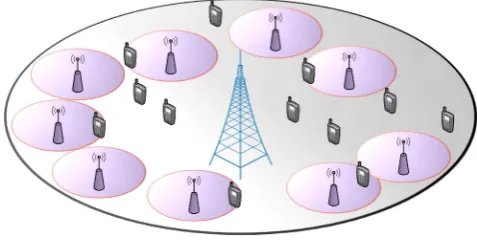
The system model in this study consists of a two-tier HetNet, which is formed by a single MC and dense SC base stations deployed under the umbrella MC coverage area as depicted in Fig. 1.
The set of all base stations in the network S= {0, 1, 2, …,Nsc}, where 0 represents the MC, which covers a radius of 500 m and Nsc
is the total number of SCs, where each is deployed randomly according to a uniform distribution and covers a radius of 100 m. The minimum distance constraint is also taken into account to make sure that the overlapping between SCs exists. The minimum distance between MC site and SC site is set to 75 m and the SC to SC site distance is set to 40 m [1]. Users are uniformly distributed and their mobility can be defined using two parameters: UE velocity, Vue, and UE direction, θk. These two parameters can be
defined as Gaussian distribution and are updated accordingly using the following equations [18]:
Vue= N(vm,vstd), (1)
θk= Nθm, 2π−θmtan
Vue
2 Δt, (2)
Q4
Q5
Fig. 1 HetNet system model
[image:3.595.50.289.51.175.2]where vm represents the mean velocity of the UE, vstd denotes the
SD of the UE velocity, θm is the previous direction of the UE, Δt is
the period between two updates of the mobility model, and N(x,y) is a Gaussian distribution with mean x and SD y. The propagation model between the MC and the UE is defined as
PLm→ue= 128.1 + 37.6 log10(dm→ue) +ξ∗, (3)
where dm→ue is the distance between the UE and the MC in
kilometres and ξ∗ is a Gaussian distribution random variable with
zero mean and 12 dB SD [19]. For SC, the path loss is defined as
PLsci→ue= 38 + 30 log10(dsci→ue) +ξ∗, (4)
where dsci→ue is the distance between the UE and SC i in metres. The downlink SINR received from cell k at the UE is
SINRbsk=
Pbsk→ue
r
∑bs∈S,bs≠bskPbsr →ue+σ2
, (5)
where σ2 is the noise power and (∑bs∈S,bs≠bskPbsr →ue) represents
the summation of the downlink power from the neighbouring cells except cell k, i.e. the interfering cells.
The data rate at the UE received from cell k is given by the Shannon capacity formula as
Tbsrk→ue= BWlog2(1 + SINRbsk) . (6) Assuming that all the UEs in cell k have the same quality of service requirement in terms of packet arrival size. Thus, the load on cell k can be written as
Lbs,k=
∑
∀ UEs
packet arrival rate ⋅ mean packet size
Tbsk→ue
r . (7)
4 EHO-GT approach
4.1 HO game formulation
The proposed EHO-GT method is formulated mathematically using game theory. Players in the game compete to increase their transmission power. Basically, the action played by one player in the game has an influence on the payoff of other players. The proposed game is governed by the following:
• All base stations in the game can transmit power at a range of [0,
Pbst
max ].
• All base stations in the game share a density-specific metric Dbs.
• Each base station in the game has a load metric, Lbs,k, which
defines the current load on the base station.
• Each base station in the game has an unnecessary HO metric, Nho,
which defines the fraction of unnecessary HO compared to the total HOs in the cell.
The game is defined as Γ = S, (Ak)k∈S, (ϕk)k∈S , where S is
the number of players, Ak is the set of possible strategies for player Sk and ϕk is the payoff function for player Sk. Thus, the game
components are listed below
leftmirgin=* Players: represent the base stations in the network, (S1, …,Sk, …,Sn), ∀k∈S.
leftmiirgiin=* Strategies: each base station has a set of actions
A= (A1, …,Ak, …,An), ∀k∈S, where Ak= 0,Pbst,k
max
is the strategy set for player Sk, and hence, A= Πkn= 1Ak.
leftmiiirgiiin=* Payoff function: it defines the cost for player Sk to
transmit power at Pbst,k. In this study, we define the payoff function
Q6
using the gain (utility function) and cost function, which includes the energy cost, load cost, and unnecessary HO cost, all of which are defined below:
• Utility function Uk: represents the gain of player Sk for playing
strategy ak. The utility function here means the profits acquired
by each base station by increasing its transmission power Pbst,k
aiming to maximise its gain. There are different types of utility functions, such as linear, logarithmic and exponential [20]. The utility function used in this study is the exponential utility where it has a strict concave property and its second derivative is negative, i.e.
Uk(ak) =α1 − e−Pbs,k
t
, (8)
where α is a predefined weighting factor and Pbst,k is the
transmission power of player Sk. Each player aims to increase its
transmission power so as to maximise its utility function. • Energy cost function Ek(ak,a−k): energy consumption is one of
the most critical issues in dense SC HetNets. When a player increases its transmission power to maximise its utility, this will cause a negative impact by increasing the energy consumption in the network. Additionally, the dense SCs' deployment also means more power needed for operating the network. Thus, we define the energy consumption cost function as
Ek(ak,a−k) =β DbsPbst,k, (9)
where β is a predefined weighting factor for energy cost
function and Dbs is the density metric of the network [21] in a
given coverage area, which can be obtained by using
Dbs= ∣S∣πRsc 2
πRm2
, (10)
where Rsc and Rm are, respectively, the SC and MC radii. The
denominator represents the area of the umbrella base station, i.e. the MC coverage area. We set up the number of SCs to 50, which means that Dbs≃ 2 and hence, the dense SCs' scenario is
obtained.
• Load cost function Lk(ak,a−k): represents the cost for player Sk of
playing an action. Higher load means more consumption of power, thus, we define the load cost as follows:
Lk(ak,a−k) =λ Lbs,kPbst,k, (11)
where λ represents a predefined weighting factor for load cost
function and Lbs,k is the load on base station k.
• Unnecessary HO cost function Nkho(ak,a−k): higher number of
HOs means higher signalling overhead and hence higher energy consumption, in addition to uneven load distribution between cells. Therefore, we incorporate the transmission power on the cost function such that
Nkho(ak,a−k) =δ NkunhoPbst,k, (12)
where δ is a predefined weighting factor for unnecessary HO
cost function and Nkunho is the fraction of the number of
unnecessary HO compared to the total number of HOs to base station k. We regard the HO as an unnecessary when an UE remains one second or less in the base station and then perform another HO.
It is worth noting that the weighting parameters α, β, λ and δ
can be adjusted by the network service provider reflecting the priority of each function on the network performance. Now, the payoff function for player Sk∀k∈S can be written as
ϕk(ak,a−k) =α1 − e−Pbs,k
t
−β DbsPbst,k−λ Lbs,kPbst,k −δ NkunhoPbst,k,
(13)
where α> 0, so that the second derivative of ϕk(ak,a−k) will be
negative all time, i.e. concave function.
The solution of the non-cooperative game Γ = S, (Ak)k∈S, (ϕk)k∈S can be reached by finding the optimal
transmission power for each player, i.e. the NE. This means that all players in the game reach optimal strategy ok∗=Pbst,k
∗
, where no player can improve its payoff function by changing its current played strategy, where ok∗= Pbst, 1
∗
, …,Pbst,k
∗
, …,Pbst,n
∗ .
Theorem 1: The game Γ = S, (Ak)k∈S, (ϕk)k∈S is a concave n
-person game, which has at least one NE.
Proof: The strategy set Ak= 0, …,Pbst,k
max
for player Sk is closed
and bounded ∀k∈S, which means that Ak is a compact set.
Let the two points x,y∈Ak and ζ= [0, 1], where A= Πkn= 1Ak.
The strategy vector Ak is convex ∀k∈S if for any x,y∈Ak and
ζ= [0, 1], ζx+ (1 −ζ)y∈Ak.
Let the Hessian matrix H of the differentiable payoff function
ϕk(ak,a−k) =α1 − e−Pbs,k
t
−β DbsPbst,k−λ Lbs,kPbst,k−δ Nkunho Pbst,k
be
as follows:
H= ∂2
ϕ
∂Pbst, 1 2
∂2
ϕ
∂Pbst, 1Pbst, 2
… ∂
2
ϕ
∂Pbst, 1Pbst,n ∂2
ϕ
∂Pbst, 2Pbst, 1 ∂2
ϕ
∂Pbst, 2
2 …
∂2
ϕ
∂Pbst, 2Pbst,n
⋮ ⋮ ⋱ ⋮
∂2
ϕ
∂Pbst,nPbst, 1 ∂2
ϕ
∂Pbst,nPbst, 2
… ∂
2
ϕ
∂Pbst,n
2
. (14)
By taking the second derivative of the payoff function ϕk, it is
obvious that H is negative definite at Pbst,k using the leading
principle minor of H, which means that it reaches a local maximum at Pbst,k [22] as depicted in (15). Therefore, the payoff
function ϕk is strictly concave in Ak, ∀k∈S.
ϕk′′ = −αe−Pbs,k
t
for main diagonal elements
0 otherwise (15)
where (ϕk″< 0) to meet the strict concave condition.
Theorem 2: The non-negative weighted sum ω(Pbst,k,q) is
diagonally strictly concave if the symmetric matrix [ G(Pbst,k,q) +G′(Pbst,k,q)] is negative definite ∀k∈S, where q is
the positive vector, q= [q1,q2, …,qn] [23].
Proof: We can express the non-negative weighted sum
ω(Pbst,k,q) as the summation of ϕk, i.e.
ω(Pbst,k,q) =
∑
k= 1n
qkϕk(Pbst,k), ∀k∈S,qk≥ 0 (16)
For each fixed q, a related mapping g(Pbst,k,q) is defined as the
gradients ∇kϕk(Pbst,k), i.e.
g(Pbst,k,q) =
q1∇1ϕ1(Pbst, 1)
q2∇2ϕ2(Pbst, 2) ⋮
qn∇nϕn(Pbst,n)
, (17)
where g(Pbst,k,q) is the pseudo-gradient of ω(Pbst,k,q) and ∇kϕk(Pbst,k) =αe−Pbs,k
t
−β Dbs−λ Lbs,k−δ Nkunho, ∀k∈S.
As stated earlier, when the symmetric matrix [G(Pbst,k,q) +G′(Pbst,k,q)] is negative definite, then ω(Pbst,k,q) is
diagonally strictly concave [23]. Therefore, we define the Jacobian matrix G(Pbst,k,q) of g(Pbst,k,q) with respect to Pbst,k as follows:
G(Pbst,k,q) =
q1 ∂
2ϕ
∂Pbst, 1 2 q1
∂2ϕ ∂Pbst, 1Pbst, 2
… q1 ∂
2ϕ ∂Pbst, 1Pbst,n
q2 ∂2
ϕ
∂Pbst, 2Pbst, 1
q2 ∂2
ϕ
∂Pbst, 2
2 … q2 ∂2
ϕ
∂Pbst, 2Pbst,n
⋮ ⋮ ⋱ ⋮
qn ∂
2
ϕ
∂Pbst,nPbst, 1
qn ∂
2
ϕ
∂Pbst,nPbst, 2
… qn ∂
2
ϕ
∂Pbst,n
2 .
(18)
Obviously, the symmetric matrix G(Pbst,k,q) +G′(Pbst,k,q) is
negative definite ∀Pbst,k∈S, therefore, the non-negative weighted
sum ω(Pbst,k,q) is diagonally strictly concave. This means that the
game Γ = S, (Ak)k∈S, (ϕk)k∈S has a unique NE (Theorem 2 [23]).
4.2 HO game solution
In the previous section, we mathematically proved the existence of NE, we need to compute the optimal game solution for each player
Sk. This is done by choosing a strategy that maximises its payoff
function ϕk(Pbst,k). The optimal transmission power Pbst,k
∗
∀k∈S is
in the range 0 ≤Pbst,k≤Pbst,k
max
. Therefore, the optimisation problem can be written as
maximise Pbs,t k∈Ak
ϕk(Pbst,k,Pbst, −k),
subject to Pbst,k≥ 0, Pbst,k≤Pbst,k
max
, ∀k∈S.
(19)
To solve the above non-linear optimisation problem, we define the Lagrangian function Pk and the Lagrangian multipliers uk and vk
for player Sk, ∀k∈S as follows:
Pk=ϕkPbst,k,Pbst, −k +ukPbst,k+vkPbst,k
max
−Pbst,k, (20)
The Karush–Kuhn–Tucker conditions [24] of the maximisation problem for player Sk are
uk,vk≥ 0,
Pbst,k≥ 0, Pbst,k
max
−Pbst,k≥ 0, ∇Pbs,t kϕk(Pbs,k
t ,P bs, −k t ) +u
k∇Pbs,t k(Pbs,k
t )
+vk∇Pbs,t k(Pbs,k
tmax−P
bst,k) = 0, uk(Pbst,k),vk(Pbst,k
max
−Pbst,k) = 0.
The problem above can be solved as follows:
• When Pbst,k= 0 and vk= 0
αe0
−β Dbs−λ Lbs,k−δ Nkunho+uk= 0
uk=β Dbs+λ Lbs,k+δ Nkunho−α
The solution Pbst,k= 0 is feasible, if the condition (uk> 0) holds
and it is as follows:
β Dbs+λ Lbs,k+δ Nkunho≥α
• When Pbst,k=Pbst,k
max
and uk= 0
αe−Pbs,t k−β D
bs−λ Lbs,k−δ Nkunho−vk= 0 vk=αe−Pbs,k
t
−β Dbs−λ Lbs,k−δ Nkunho
The solution Pbst,k=Pbst,k
max
is feasible, if the condition (vk> 0) holds and it is as follows:
β Dbs+λ Lbs,k+δ Nkunho≤αe−Pbs,k
t
• When uk= 0, vk= 0 and (0 <Pbst,k<Pbst,k
max )
αe−Pbs,t k−β D
bs−λ Lbs,k−δ Nkunho= 0
e−Pbs,t k= β Dbs+λ Lbs,k+δ Nk
unho
α
Pbst,k= ln
α
βDbs+λLbs,k+δNkunho
Therefore, the game solution for player Sk, ∀k∈S, is the
optimum transmission power Pbst,k
∗
, which can be expressed as follows:
Pbst,k
∗ =
0 if conditionA
Pbst,k
max
if conditionB
ln α
βDbs+λLbs,k+δNkunho
otherwise
(21)
where condition A and condition B, respectively, are
βDbs+λLbs,k+δNkunho≥α, (22)
βDbs+λLbs,k+δNkunho≤αe−Pbs,k
t
. (23)
The optimum transmission power Pbst,k
∗
is the NE and the solution of the game.
4.3 Cell selection
After adjusting the transmission power for each cell, we use multiple criteria HO including data rate, UE velocity, and cell load.
We adopt one of the well-known multiple attribute decision marking techniques, i.e. TOPSIS [25], to select the proper HO target cell. The three criteria are all weighted based on the SD weighting technique [26] to rate the importance of each metric on HO decision. The SD weighting technique computes the weights of each metric in terms of the SD and gives a small weight for a metric if the value of this metric is identical for all available cells. In other words, metrics with small SD are given smaller weights and vice versa. The best cells are ranked according to TOPSIS and the highest ranked cell is chosen as the HO target.
The cell selection for HO using TOPSIS procedures can be expressed as follows:
Step 1: The decision matrix, D, is formed by mapping the
alternatives against the attributes as shown
D=
x11 x12 x1n x21 x22 x2n x31 x32 x3n
⋮ ⋮ ⋮
xm1 xm2 xmn
, (24)
where each row represents one alternative, and the columns represent their correspondent attributes, n= 1, …, 3,
m= 0, 1, 2, …,Nsc, xi j represents the value of the jth attribute (HO
metric) for the ith alternative (base station).
Step 2: The decision matrix is then normalised as shown in (25)
xi jnorm= xi j ∑im= 1ai j2
, xi jnorm∈ [0, 1], (25)
where xi jnorm is the jth normalised attribute of the ith alternative.
Step 3: The normalised matrix is weighted. Thus, the weighted
normalised decision matrix can be written as
Dn,w
=
x11norm⋅w1 x12norm⋅w2 x13norm⋅w3
x21norm⋅w1 x22norm⋅w2 x23norm⋅w3
x31norm⋅w1 x32norm⋅w2 x33norm⋅w3
⋮ ⋮ ⋮
xmnorm1 ⋅w1 xnormm2 ⋅w2 xmnorm3 ⋅w3
=
d11 d12 d13
d21 d22 d23
d31 d32 d33
⋮ ⋮ ⋮
dm1 dm2 dm3
(26)
subject to
∑
j∈nwj= 1, (27)
where di j is the jth weighted normalised attribute of the ith
alternative, i.e. d11=x11norm⋅w1, d12=x12norm⋅w2 and so on. The SD weighting technique [26] measures the weights of each attribute in terms of the SD. It gives a small weight for an attribute if the value of this attribute is identical for all available alternatives. The weights can be measured using the SD technique as
wsdj = σj ∑kn= 1σk
, (28)
σj= m1
∑
i= 1m
(xi jnorm−μj)2, (29)
μj= 1
m
∑
i= 1m
xi jnorm, (30)
where σj and μj are, respectively, the SD and the mean value of the jth normalised attribute.
Step 4: The weighted normalised decision matrix is used to find
the ideal positive solution (best alternative, which has the best attribute values, denoted as z+
) and the ideal negative solution (worst alternative, which has the worst attribute values, denoted as z−
) by
z+
= ( max i∈mDi j
n,w∣j∈ j+
), ( min i∈mDi j
n,w∣j∈ j−
)
= d1+,d2+,d3+ ,
(31)
z−
= ( min i∈mDi j
n,w∣j∈ j+
), ( max i∈mDi j
n,w∣j∈ j−
)
= d1 −
,d2 −
,d3 −
, (32)
where j+
is the set with the attributes having a positive impact (i.e. the higher value the better), and j−
is the set with the attributes having a negative impact (i.e. the lower value the better).
Step 5: Measure the Euclidean distance between each
alternative and both the positive and negative ideal solutions as
dist+=
∑
j= 1
n
(Di jn,w−d j
+)2, ∀i= 1, …,m (33)
dist−
=
∑
j= 1
n
(Di jn,w−d−j)2, ∀i= 1, …,m (34)
Step 6: The ranking network vector, Rn, is obtained so as to
measure
Rn= dist −
max (dist− )−
dist+ min (dist+
), ∀i= 1, …,m. (35)
Step 7: The ranking network vector is then ranked in
descending order and the best alternative from Rn vector is chosen as a target (i.e. the HO target cell)
HOtarget= arg max
i∈mRn(i) . (36)
5 Performance and results analysis
In this section, the proposed EHO-GT method is implemented, evaluated, and compared against the conventional method, in which the cells are not able to optimise their transmission power, in terms of power consumption, average SC load, unnecessary HO probability, and throughput. The conventional method adopts TOPSIS for cell selection. Each cell in the network dynamically adjusts its transmission power according to the solution of the EHO-GT method. Then, the cell selection is performed using the TOPSIS technique. Simulation parameters are listed in Table 1.
5.1 Power consumption
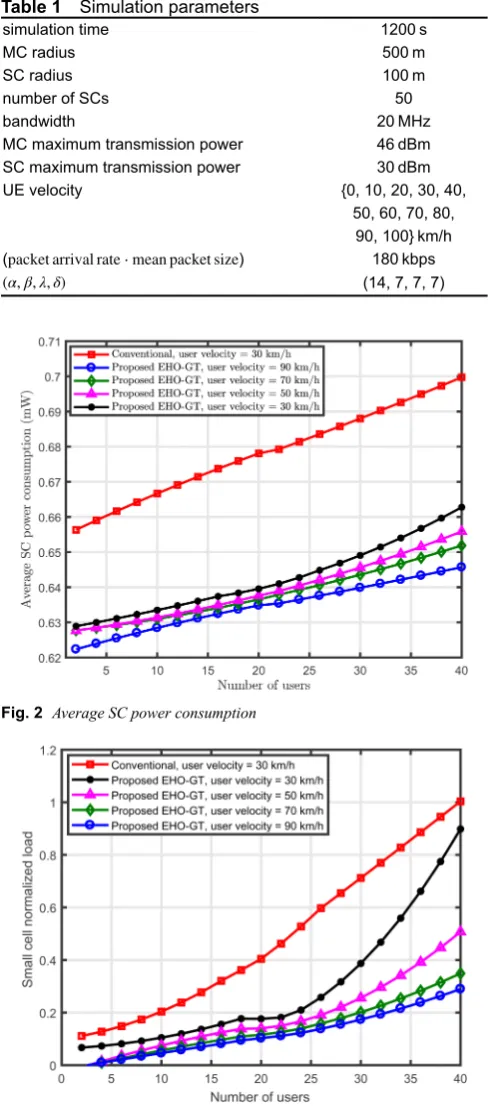
For different velocities, the average SC power consumption with regard to the number of users is depicted in Fig. 2. Comparing the proposed EHO-GT method with the conventional method at 30 km/h, at all user densities the EHO-GT gives better performance. For example, when the number of users is 20, the EHO-GT has a 6.5% reduction in the average SC power consumption compared to the conventional method. It is observed for the proposed EHO-GT method that the higher the velocity the lower consumption in power. This is because more SC will increase their transmission power when low speed users approach their coverage area. On the other hand, low power consumption for higher velocities is due to the association of the users with MC and reducing the transmission power of SCs.
5.2 Average load
The average SC load versus the number of UEs with the consideration of different velocities is depicted in Fig. 3. It can be seen that for all velocities the proposed EHO-GT method has outperformed the conventional method as the latter does not optimise the transmission power prior to HO. For the proposed EHO-GT method, at high velocity (e.g. 90km/h), the SC load is the lowest because most high-speed users will be connected to the MC due to reducing/deactivating the SC transmission power. The opposite is happening with a low velocity of 30 km/h because more users will be associated with the SC and the load increase with the increase of the number of users.
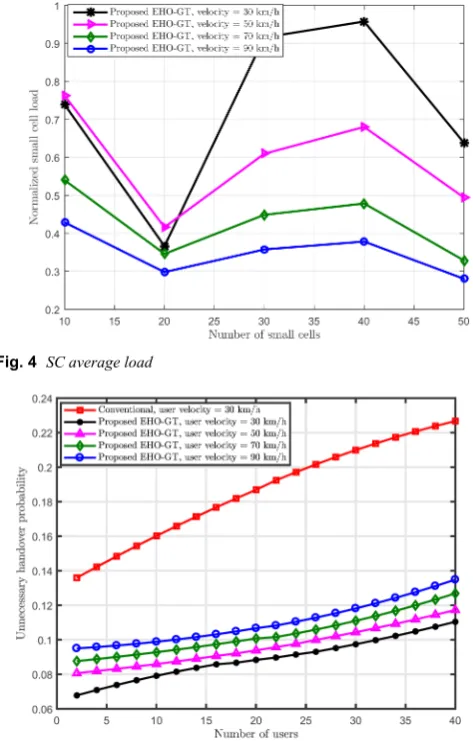
Furthermore, in Fig. 4, for 40 UEs and variable densities of SCs, the average SC load is shown. When the SCs is 10–20, the SC
[image:7.595.42.289.50.604.2]Q7 Table 1 Simulation parameters
simulation time 1200 s
MC radius 500 m
SC radius 100 m
number of SCs 50
bandwidth 20 MHz
MC maximum transmission power 46 dBm SC maximum transmission power 30 dBm
UE velocity {0, 10, 20, 30, 40,
50, 60, 70, 80, 90, 100} km/h
(packet arrival rate ⋅ mean packet size) 180 kbps
(α,β,λ,δ) (14, 7, 7, 7)
Fig. 2 Average SC power consumption
Fig. 3 SC average load
load gets reduced because the load will be distributed among the increased number of SCs. When the number of SCs is 20–40, the SC load gets increased because some of the SCs will go to sleep mode causing an increase in the load in the active SCs. Additionally, when the number of SCs is 40–50, the load gain will sharply reduce due to the distribution of load among the increased number of SCs.
5.3 Unnecessary HO
Fig. 5 shows the probability of unnecessary HO with respect to the number of users and for different velocities. We defined the unnecessary HO when the UE starts a HO process to cell k and leaves the cell after one second. We can observe that our proposed EHO-GT method has outperformed the conventional method. For instance, comparing the two methods at 20 UEs and at a velocity of 30 km/h, the EHO-GT has about 51% reduction in the unnecessary HO and this percentage increases with the increase in the number of UEs. Generally, with the EHO-GT, the lower the velocity the lower the unnecessary HO since high-speed UEs are likely to cause frequent HOs. The unnecessary HO increases with the increase in the UE numbers (i.e. load increases) affecting the load and unnecessary HO terms in the payoff function in (13), and hence, the increase occurs.
5.4 Throughput
For different UE densities, the averaged SC throughout is depicted in Fig. 6. It is obvious that the EHO-GT method has outperformed the conventional method. For the EHO-GT, the average SC throughput for high-speed UEs is the lowest compared to the lower speed UEs because the former tends to select the MC while the latter tends to select the SC in TOPSIS cell selection. Generally, the average SC throughput for all UE densities goes down after a
Q8
40 km/h velocity because the high-speed UEs connect to the MC and few numbers of UEs connect to the SC.
6 Conclusion
In this study, we used the game theory approach to optimise the transmission power of the SC aiming to find the optimal power for all cells in the network. The payoff function for each player (each cell) is formulated mathematically using utility (gain) and cost functions where each cell selfishly aims to increase its transmission power to improve its utility. The cost function includes the influence of SC density, cell load, and unnecessary HO. The proposed EHO-GT method is solved mathematically by finding the NE. The cell selection is then performed by deploying the multiple criteria TOPSIS technique to choose the best HO target cell. Furthermore, we have implemented, evaluated and compared the proposed EHO-GT method with the conventional method where the power optimisation policy is not present. Simulation results reveal that the proposed EHO-GT method outperformed the conventional method in terms of power consumption, SC average load, unnecessary HO, and throughput. For example, with 30 km/h velocity and 20 users, the proposed EHO-GT method has an improvement of 6.5, 43, 51 and 81% over the conventional method in terms of power consumption, average SC load, unnecessary HO, and average SC throughput, respectively. The achieved results validate the efficiency of our proposed method, which can be adopted in an ultra-dense SC environment.
7 References
[1] Chu, X., Lopez-Perez, D., Yang, Y., et al.: ‘Heterogeneous cellular networks: theory, simulation and deployment’ (Cambridge University Press, 2013) [2] Singoria, R., Oliveira, T., Agrawal, D.P.: ‘Reducing unnecessary handovers:
call admission control mechanism between WiMAX and femtocells’. 2011 IEEE Global Telecommunications Conf. (GLOBECOM 2011), 2011, pp. 1–5 [3] Alhabo, M., Zhang, L.: ‘Unnecessary handover minimization in two-tier
heterogeneous networks’. 2017 13th Annual Conf. on Wireless On-demand Network Systems and Services (WONS), 2017, pp. 160–164
[4] Alhabo, M., Zhang, L., Nawaz, N.: ‘A trade-off between unnecessary handover and handover failure for heterogeneous networks’. 23th European Wireless Conf. in Proc. of European Wireless 2017, VDE, 2017, pp. 1–6 [5] Alhabo, M., Zhang, L., Oguejiofor, O.: ‘Inbound handover interference-based
margin for load balancing in heterogeneous networks’. 2017 Int. Symp. on Wireless Communication Systems (ISWCS), 2017, pp. 1–6
[6] Alhabo, M., Zhang, L.: ‘Load-dependent handover margin for throughput enhancement and load balancing in HetNets’, IEEE Access, 2018, 6, pp. 67718–67731
[7] Alhabo, M., Zhang, L.: ‘Multi-criteria handover using modified weighted TOPSIS methods for heterogeneous networks’, IEEE Access, 2018, 6, pp. 40547–40558
[8] Son, K., Kim, H., Yi, Y., et al.: ‘Base station operation and user association mechanisms for energy-delay tradeoffs in green cellular networks’, IEEE J. Sel. Areas Commun., 2011, 29, (8), pp. 1525–1536
[9] Oh, E., Krishnamachari, B., Liu, X., et al.: ‘Toward dynamic energy-efficient operation of cellular network infrastructure’, IEEE Commun. Mag., 2011, 49, (6), pp. 56–61
[10] Yildiz, A., Girici, T., Yanikomeroglu, H.: ‘A pricing based algorithm for cell switching off in green cellular networks’. 2013 IEEE 77th Vehicular Technology Conf. (VTC Spring), 2013, pp. 1–6
Q9
Q10
Q11
Q12
Fig. 4 SC average load
Fig. 5 Unnecessary HO probability
Fig. 6 Average SC throughput versus UE velocity
[image:8.595.316.544.48.226.2] [image:8.595.45.282.49.420.2][11] Merwaday, A., Güvenç, I.: ‘Optimisation of FeICIC for energy efficiency and spectrum efficiency in LTE-advanced HetNets’, Electron. Lett., 2016, 52, (11), pp. 982–984
[12] Alhabo, M., Zhang, L., Nawaz, N.: ‘GRA-based handover for dense small cells heterogeneous networks’, IET Commun., 2019
[13] Fang, F., Cheng, J., Ding, Z.: ‘Joint energy efficient subchannel and power optimization for a downlink NOMA heterogeneous network’, IEEE Trans. Veh. Technol., 2019, 68, (2), pp. 1351–1364
[14] Li, Y., Zhang, H., Wang, J., et al.: ‘Energy-efficient deployment and adaptive sleeping in heterogeneous cellular networks’, IEEE Access, 2019, 7, pp. 35838–35850
[15] Huang, X., Xu, W., Shen, H., et al.: ‘Utility-energy efficiency oriented user association with power control in heterogeneous networks’, IEEE Wirel. Commun. Lett., 2018, 7, (4), pp. 526–529
[16] Yang, C., Li, J., Anpalagan, A., et al.: ‘Joint power coordination for spectral-and-energy efficiency in heterogeneous small cell networks: a bargaining game-theoretic perspective’, IEEE Trans. Wirel. Commun., 2015, 15, (2), pp. 1364–1376
[17] Tao, R., Liu, W., Chu, X., et al.: ‘An energy saving small cell sleeping mechanism with cell range expansion in heterogeneous networks’, IEEE Trans. Wirel. Commun., 2019, 18, (5), pp. 2451–2463
[18] Zhang, H., Ma, W., Li, W., et al.: ‘Signalling cost evaluation of handover management schemes in LTE-advanced femtocell’. 2011 IEEE 73rd Vehicular Technology Conf. (VTC Spring), 2011, pp. 1–5
Q13
Q14
[19] Stüber, G.L.: ‘Principles of mobile communication’ (Springer Science & Business Media, 2011)
[20] Nguyen-Vuong, Q.-T., Ghamri-Doudane, Y., Agoulmine, N.: ‘On utility models for access network selection in wireless heterogeneous networks’. 2008 Network Operations and Management Symp. (NOMS 2008), 2008, pp. 144–151
[21] Bulusu, N., Estrin, D., Girod, L., et al.: ‘Scalable coordination for wireless sensor networks: self-configuring localization systems’. Int. Symp. on Communication Theory and Applications (ISCTA 2001), Ambleside, UK, 2001
[22] Nikaidô, H., Isoda, K.: ‘Note on non-cooperative convex game’, Pacific J. Math., 1955, 5, (5), pp. 807–815
[23] Rosen, J.B.: ‘Existence and uniqueness of equilibrium points for concave n -person games’, Econometrica, 1965, pp. 520–534
[24] Kuhn, H., Tucker, A.: ‘Nonlinear programming’. Proc. Second Berkeley Symp. on Mathematical Statistics and Probability, 1951, pp. 481–492 [25] Mehbodniya, A., Kaleem, F., Yen, K.K., et al.: ‘Wireless network access
selection scheme for heterogeneous multimedia traffic’, IET Netw., 2013, 2, (4), pp. 214–223
[26] Wang, Y.-M., Luo, Y.: ‘Integration of correlations with standard deviations for determining attribute weights in multiple attribute decision making’, Math. Comput. Model., 2010, 51, (1), pp. 1–12
Q15
IET-COM20190383
Author QueriesQ Please make sure the supplied images are correct for both online (colour) and print (black and white). If changes are required please supply corrected source files along with any other corrections needed for the paper.
Q All equations too long to fit within a single column are automatically floated to the bottom of the page and a '(see equation below)' or '(see (equation number) and (equation number)' left in their place. This is done automatically by our new XML transform, so please specify in your corrections very clearly where they should be broken as your paper is edited by non-experts.
Q1 Please confirm the changes made in the article title. Please note that it is the IET's house style to remove words such as 'Novel', 'New' and 'Study of' as well as 'A', 'An' and 'The'.
Q2 Please reduce the number of words in the Abstract to 200 words. Q3 Please provide department details if any in all affiliations.
Q4 Please check the edits made to the sentence "Additionally, handing over the...".
Q5 Table 1 has been moved to the Nomenclature section and all other tables have been renumbered. Please check and confirm. Q6 IET style for matrices and vectors is to use bold italics. Please check that we have identified all instances.
Q7 Please check the edits made to the sentence "Furthermore, in Fig. 4, for...".
Q8 Please check the edits made to the sentence "Additionally, when the number of SCs is
Q9 Please check your references thoroughly as we have updated them according to Crossref, and not all information may be correct. Q10 Please provide the location of the publisher (country) in Refs. [1, 19].
Q11 Please provide conference location in Refs. [2, 3, 4, 5, 10, 18, 20, 24]. Q12 Please confirm the inserted page numbers as per crossref.org in Ref. [9]. Q13 Please provide volume number and page range in Ref. [12].
Q14 Please confirm the inserted volume number, issue number and page numbers as per crossref.org in Ref. [17]. Q15 Please provide volume number in Ref. [23].