A Model and Architecture
for Situation Determination
Graham Thomson, Sotirios Terzis
and Paddy Nixon
Pervasive and Global Computing Group
University of Strathclyde
Glasgow, UK
Abstract
Automatically determining the situation of an ad-hoc group of people and devices within a smart environment is a significant challenge in pervasive computing systems. Current ap-proaches often rely on an environment expert to correlate the situations that occur with the available sensor data, while other machine learning based approaches require long training periods before the system can be used. Fur-thermore, situations are commonly recognised at a low-level of granularity, which limits the scope of situation-aware applications. This pa-per presents a novel approach to situation de-termination that attempts to overcome these issues by providing a reusable library of gen-eral situation specifications that can be eas-ily extended to create new specific situations, and immediately deployed without the need of an environment expert. A proposed archi-tecture of an accompanying situation determi-nation middleware is provided, as well as an analysis of a prototype implementation.
1
Introduction
Automatically determining the situation of an ad-hoc group of people and devices within a
Copyright c 2006 Graham Thomson, Sotirios Terzis, Paddy Nixon. Permission to copy is hereby granted provided the original copyright notice is repro-duced in copies made.
smart environment is a significant challenge in pervasive computing systems. Situation identi-fication provides essential context information used by situation-aware applications to influ-ence their operation, silently and automatically adapting the computing machinery contained within an environment to its inhabitants’ be-haviours.
Current approaches to situation determina-tion can be broadly categorised as either spec-ification based, where the situations are de-scribed by a specification of the events that occur, and learning based, where sensor read-ings are automatically correlated to a set of situations. For specification-based approaches such as [6, 8], an expert of the local environ-ment is required to specify the correlation of the available sensor data with the situations that occur, often in an ad-hoc manner. As the amount of available sensor data and number of situations increases, it becomes increasingly difficult for an expert to decipher and specify correlations. With learning-based approaches such as [21, 18] a training period must be con-ducted, during which several examples of each situation are collected and analysed, before the system can be used. These factors impede swift adaptation to the evolving set of situations that will occur in an environment over time.
Situations are commonly recognised at a coarse level of granularity, which limits the scope of situation-aware applications. For ex-ample, in [21, 18] only a general ‘meeting’ sit-uation may be recognised, which prevents ap-plications from tailoring their behaviour to the many different types of meeting that a user may attend. Furthermore, at this level of granular-ity we are limited to determining whether or not a person or device is involved in a situa-tion. This prevents applications from tailoring their behaviour to the role a person or device is playing within a situation, such as whether a user is a speaker or an audience member in a presentation.
of people and devices in the environment. The properties are identified with common names defined in a standard ontology.
A standard library of situation specifications can then be provided. Situations from the li-brary can be deployed immediately in an en-vironment without the need for an environ-ment expert. These situations enable various levels of granularity, including ‘group meet-ing’ and ‘PhD progress meetmeet-ing’ in addition to a ‘meeting’ situation, as well as recogni-tion of the distinct role a person or device is playing within the situation. New situa-tions particular to an environment can be cre-ated as simple variations of those in the li-brary. We also provide the ability for users to customise situation specifications to their particular habits, such as a particular super-visor only holds PhD progress meetings in his office. Furthermore, the roles and situations defined in the library can be re-used by applica-tion developers to construct new situaapplica-tion spec-ifications by assembling these high-level com-ponents, rather than specifying new situation specifications from scratch.
The structure of this paper is as follows: Sec-tion 2 presents our approach to situaSec-tion spec-ification, Section 3 describes how specifications are extended to incorporate uncertainty, Sec-tion 4 proposes an architecture for situaSec-tion de-termination and a description and analysis of a prototype implementation are given in tion 5, Section 6 surveys related work and Sec-tion 7 presents conclusions and future work.
2
Situation specifications
In our approach, the situation refers to the ac-tivity a single person or a group of people are conducting. A situation is characterised by the properties of the people involved in the situa-tion and the properties of the tools, or devices, they are using.
A role is the basic building block of a situ-ation specificsitu-ation, and describes a part of the overall situation we wish to recognise. A role contains a set of Boolean expressions based on the observable properties of people and devices. All of the expressions in the role hold when the part of a situation it describes is occurring in
the environment. A full situation specification can be built up by assembling a collection of roles.
Location information is commonly regarded as essential for describing situations [11]. A location property is defined for people and de-vices. Our approach requires that an under-lying location infrastructure is available and can provide the distance between two objects, and the symbolic coordinates of the location of an object. Example symbolic coordinates in-clude ‘Room L10.01’ and ‘Ric’s desk’. Both of these primitives are commonly supported by location systems [7]. In addition to this, we require location types of symbolic coordinates, similar to those employed by Look et al. [17]. These types indicate the category or function of the location. For example, symbolic coordi-nate ‘Room L10.01’ may have types ‘Meeting area’ and ‘Room’, while ‘Ric’s desk’ would have the type ‘Desk area’.
Two properties are defined for roles them-selves. These are a timestamp, that indicates the time at which the role started to occur in the environment, and cardinality, which indi-cates how many occurrences of the role are hap-pening simultaneously in the environment.
Expressions within a role may refer to the properties of people and devices. They may include the standard comparison operators, the Boolean operators ¬, ∧, ∨, and⇒, as well as other type specific operators.
A situation specification is similar in struc-ture to a role. Its expressions are based on a collection of roles and may refer to their timestamp and cardinality properties as well as the properties of the people and devices they specify, and also the current time. The expres-sions may include the same set of operators as a role. All of the expressions in the specifica-tion hold when the situaspecifica-tion is occurring in the environment.
A computer is playing the presentation equip-ment role when it is running presentation soft-ware as the active application. A presentation is occurring when a speaker, three or more au-dience members, and one or more computers that have presentation software active are in the same room.
2.1
Specification inheritance
A situation can be expressed at different lev-els of abstraction through specification inher-itance. This provides a simple way to create new specifications as refinements of another, and to allow situation-aware applications to in-terpret the same situation at the appropriate level of abstraction.
Figure 2 provides an example of specification inheritance. Three situations are described at increasing levels of abstraction. These are SmartLab group meeting, group meeting, and a general meeting situation. A meeting is occur-ring when two or more people are gathered in the same meeting area. A group meeting is oc-curring when three or more people are gathered in the same meeting area and at least 70% of them are members of the same group. A Smart-Lab group meeting is occurring when a group meeting is occurring for the group ‘SmartLab’. When a specification inherits from another, all of the expressions from both specifications must hold when the role or situation is occur-ring. For example, when a group meeting is occurring, all of the expressions in the group meeting specification and the meeting specifi-cation will hold. Furthermore, the expressions of the role or situation may refer to the enti-ties from either specification. For example, the SmartLab group meeting specification can refer to the entities of the group meeting specifica-tion.
2.2
Customisations
Existing situations can be refined to a partic-ular environment or person using specification customisation. Figure 3 provides an example of this. A PhD meeting situation is defined that occurs when a PhD student and one or more of their supervisors are gathered in the same meeting area. In addition, a customisation is
defined that states that a particular PhD su-pervisor John only holds PhD meetings in his office L10.01.
When a specification is customised, all of the expressions from the role or situation specifica-tion and the customisaspecifica-tion specificaspecifica-tion must hold when the role or situation is occurring. For example, when the John PhD meeting cus-tomisation has been defined and a PhD meet-ing is occurrmeet-ing, all of the expressions in the PhD meeting specification and the customisa-tion specificacustomisa-tion will hold. Furthermore, the expressions of the customisation may refer to the entities from either specification. For ex-ample, the John PhD meeting customisation can refer to the entities of the PhD meeting specification.
2.3
Specification resolution
The resolution of a situation reflects the level of detail to which we can tell that a person or a device is involved in that situation. For example, at a low resolution we may only be able to report whether a person or a device is involved in a situation or not. At a higher resolution we may be able to report which role they are playing. In the presentation example in Fig. 1, we can tell that in addition to being an attendee of a presentation, either a person is a speaker or an audience member. At a higher resolution still, we may report that a person or device is playing a more specific role, for example, different types of audience member may be defined.
high-role: speaker entities: p:Person expressions:
p.location has type ‘Speaker area’
role: audience member entities: p:Person expressions:
p.location has type ‘Audience area’
role: presentation equipment entities: c:Computer expressions:
presentation software is active application on c
situation: presentation roles:
s:speaker a:audience member e:presentation equipment expressions:
s.cardinality = 1 a.cardinality >= 3 e.cardinality >= 1
‘Room’ of s.p.location = ‘Room’ of a.p.location ‘Room’ of s.p.location = ‘Room’ of e.c.location
Figure 1: A presentation specification.
role: meeting attendee entities: p:Person expressions:
p.location has type ‘Meeting area’
situation: meeting roles: m:meeting attendee expressions:
m.cardinality >= 2
‘Meeting area’ of m.p.location = ‘Meeting area’ of m.p.location
role: group member attendee inherits: meeting attendee entities: g:Group
expressions: p is a member of g
situation: group meeting inherits: meeting roles:
gma:group member attendee ma:meeting attendee expressions:
gma.cardinality >= 3, ma.cardinality >= 0 gma.g = gma.g, gma.p.id != ma.p.id gma.cardinality >= 0.7 *
(gma.cardinality + ma.cardinality) ‘Meeting area’ of gma.p.location =
‘Meeting area’ of ma.p.location
situation: SmartLab group meeting inherits: group meeting
expressions: gma.g = ‘SmartLab’
Figure 2: Various meeting situations defined using specification inheritance.
role: PhD supervisor inherits: meeting attendee entities: phd:Person expressions: p supervises phd
role: PhD student inherits: meeting attendee expressions: p is a PhD student
customisation: John PhD meeting customises: PhD meeting expressions:
sup.p.id = JOHN_ID ->
‘Room’ of sup.p.location = L10.01
situation: PhD meeting inherits: meeting roles:
stu:PhD student sup:PhD supervisor expressions:
stu.cardinality = 1 sup.cardinality >= 1 stu.p.id = sup.phd.id
‘Meeting area’ of stu.p.location = ‘Meeting area’ of sup.p.location
level inference capability we allow alternative situation specifications of varying resolution.
Example high and low resolution alterna-tive presentation specifications are given in Fig. 4. The high resolution presentation spec-ification requires that ‘Speaker area’ and ‘Au-dience area’ locations are available. The low resolution specification requires only that room level locations are available. When both ver-sions of the presentation situation are detected, the system will prompt the user for their prefer-ence of which version is reported and remember their decision for future use.
2.4
Overlapping situations
In the specifications we have looked at so far, all have assumed that situations are independent. It is desirable to make situations independent so that ‘smaller’ situations can still be recog-nised within ‘larger’ situations. For example, a group of eight people may be recognised as be-ing involved in a group meetbe-ing situation, while at the same time, three of these people are in-volved in a ‘working at a whiteboard’ situation. However, there are cases where we may wish to avoid situations overlapping. Given the group meeting specification from Fig. 2 and the PhD meeting specification from Fig. 3, when a group meeting is occurring where the four group members present consist of two sets of a PhD student and one of their supervisors, it is impossible to tell whether it is a single group meeting that is occurring, or two PhD meetings. This confusion has arisen because the PhD meeting specification is incomplete. What is actually meant is that a PhD meet-ing is occurrmeet-ing whenonly a PhD student and one or more of their supervisors are gathered in a meeting area. To incorporate this into the specification, a lack of another person can be expressed as a ‘someone else’ role that has a cardinality of 0. In other cases where overlap should be avoided, situation specifications can be differentiated through user customisation of a specification with environment-specific de-tails. In order to assist the user in this task we require that the system is able to explain why situations occurred, for example, which people and devices where considered to be in which roles.
3
Incorporating
uncer-tainty
So far, we have only considered specifying sit-uations using properties and expressions that have crisp Boolean values. In a pervasive en-vironment, many properties shall be captured using sensors, which may be limited in their accuracy and reliability. This will affect the level of confidence we can have that the value of the property is correct, and whether a situ-ation based on these properties is really occur-ring. Even for properties that are not sensed, factors such as the passing of time may alter the confidence that their value is correct. To effectively incorporate such properties into sit-uation specifications, we must interpret their level of confidence appropriately.
For properties such as these, an associated confidence value is defined. This is a real num-ber ranging from 0 to 1, indicating no confi-dence to complete conficonfi-dence that the value is correct. The confidence of a property may be fixed and known a-priori, for example it may be specified in the manual of the sensing equipment, or it may be estimated dynamically, which may be based on other factors about the property such as its freshness or source.
Fuzzy logic provides an appropriate frame-work to incorporate and combine the confi-dence values of properties in a situation spec-ification. An alternative approach to incorpo-rating uncertainty is to use probabilistic tech-niques such as Bayesian networks [21, 18, 19]. In this work, we have chosen to employ fuzzy logic over probabilistic techniques for the fol-lowing practical reasons:
role: speaker entities: p:Person expressions:
p.location has type ‘Speaker area’
role: audience member entities: p:Person expressions:
p.location has type ‘Audience area’
role: presentation equipment entities: c:Computer expressions:
presentation software is active application on c
role: presentation attendee entities: p:Person expressions:
p.location has type ‘Meeting area’
situation: presentation roles:
s:speaker, a:audience member e:presentation equipment expressions:
s.cardinality = 1, a.cardinality >= 3 e.cardinality >= 1
‘Room’ of s.p.location = ‘Room’ of a.p.location ‘Room’ of s.p.location = ‘Room’ of e.c.location
situation: presentation roles:
a:presentation attendee e:presentation equipment expressions:
a.cardinality >= 4 e.cardinality >= 1 ‘Room’ of a.p.location =
‘Room’ of e.c.location
Figure 4: Alternative presentation specifications at high (top) and low (bottom) resolution.
must be restructured at runtime to incorporate the varying number of people and device in the environment, and in which the number of nodes increases exponentially with the number of peo-ple, devices, and properties.
Efficient reasoning Situation determina-tion attempts to match descripdetermina-tions of sev-eral situations against the properties of an arbitrary-sized group of people and devices. This is an instance of the many pattern / many object pattern match problem, for which the Rete algorithm is a very efficient solution [12]. Rete-based fuzzy rule engines have mature tool support and are freely available [3].
Improved scalability In a situation de-termination system, the uncertainty associated with several properties may share the same source. For example, all objects within an en-vironment may have their location determined by the same location system. Let us assume that a party situation is defined as twenty or more people gathered in a specific room. Fur-thermore, let us assume that the location of each person is reported by the same location system at a confidence of 0.9, which is the maximum confidence supported by the system. Treating the locations as independent, under a probabilistic scheme the confidence value is interpreted as a probability and these are com-bined for each person’s location by multiplying the probabilities together. Therefore, the
max-imum probability of a party situation occurring is 0.920
≈0.12. If the party was defined with thirty or more people the maximum probabil-ity would be ≈ 0.04. As the number of peo-ple increases, the maximum probability we can have in the situation occurring decreases, de-spite the fact the uncertainty stems from a sin-gle source. Under a fuzzy logic model, as shall be demonstrated later in this section, the max-imum confidence we could have that the party situation is occurring would be the minimum confidence of a person’s location, which would be 0.9 independently of the number of people at the party.
To illustrate how fuzzy logic can be incorpo-rated, consider again the presentation example in Fig. 1. A person is playing the role of a speaker when their location contains the type ‘Speaker area’. This role can be represented as a fuzzy if / then rule where the expression forms the antecedent or predicate (if part) and whether the role is occurring or not forms the consequent (then part). The antecedent and consequent are represented as fuzzy sets. These fuzzy sets are defined by monotonic functions that map the level of confidence to the degree of membership in the fuzzy set, and take the form µF S←(c∈C) for the fuzzy setF S and
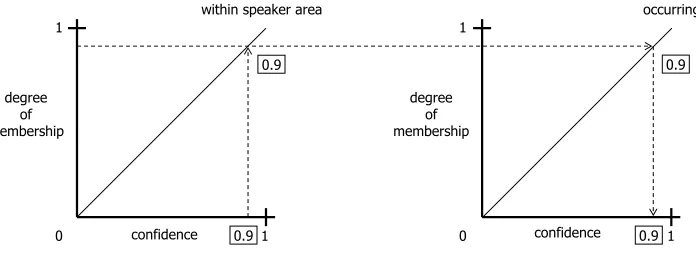
fuzzy set, the domain will be confidence and the membership function will be µF S[c] ← c,
that is, the level of confidence is equivalent to the degree of membership.
As all fuzzy sets are defined by monotonic functions, simple monotonic reasoning can be used. This has the advantage that a role’s ex-pected confidence value can be estimated di-rectly from the confidence of its expressions without employing complex composition and defuzzification methods [9].
If we takeec to be the confidence that per-son p’s location contains the type ‘Speaker area’ and rc to be the confidence that per-son p is playing the speaker role, and have the expression represented by the fuzzy set ‘within speaker area’ and the role presented by the fuzzy set ‘occurring’, we can construct the fuzzy rule:
if ec is within speaker area
then rc is occurring
Given this fuzzy rule and the confidence value ofec, the confidence value ofrccan be in-ferred by using a method of implication known as monotonic selection. Under this scheme,
µF S[c] is calculated for the antecedent and the
consequent has the confidence value that has the equivalent degree of membership asµF S[c],
that is, cc ←µF Sc[µF Sa[ca]], where cc and ca
are the confidence values andF ScandF Sa are
the fuzzy sets of the consequent and antecedent respectively.
An example for the speaker role is shown in Fig. 5. The confidence that person p’s location contains the type ‘Speaker area’ is 0.9. The results is µ[0.9] = 0.9. This ‘carries over’ to the occurring fuzzy set and is translated to a confidence value of 0.9.
More complex roles such as the presentation role in Fig. 1 that have several expressions will be represented by a fuzzy rule that has several antecedents. Therefore, we must have a way to combine multiple degree of membership values. Antecedents may be combined using the fuzzy intersection operator (∧) where the minimum degree of membership is selected, or the fuzzy union operator (∨) where the maximum de-gree of membership is selected. The confidence values of each of expressions in the presenta-tion specificapresenta-tion will be combined by fuzzy
in-situation: presentation roles:
s:speaker a:audience member e:presentation equipment expressions:
s.cardinality = 1, s.confidence >= 0.8 a.cardinality >= 3, a.confidence >= 0.8 e.cardinality >= 1
‘Room’ of s.p.location = ‘Room’ of a.p.location ‘Room’ of s.p.location = ‘Room’ of e.c.location
Figure 7: The presentation specification in-cluding expressions concerning confidence.
tersection. Expressions that do involve uncer-tainty, such as the cardinality expressions, are treated as having a confidence value of 1 when true and 0 when false. Figure 6 illustrates how the confidence values of the presentation spec-ification are combined.
Note that the meaning of¬,⇒and role car-dinality also changes when considering confi-dence. The ¬ operator returns the comple-ment of a confidence value, 1−c. For a min-imum confidence threshold t, a ⇒ b is inter-preted as “if a has confidence≥t, thenb”, and
role.cardinality ≥X is interpreted as “role is
occurring X or more times simultaneously, each with a confidence≥t”.
As an example, the presentation role shown in Fig. 1 is restated in Fig. 7 including the nec-essary additional expressions required to incor-porate reasoning with confidence. For this ample, we can see that the only additional ex-pressions required are those to specifying the desired confidence threshold for the speaker and audience member roles. All other mech-anisms for incorporating uncertainty are han-dled automatically and do not burden the spec-ification author.
1
1 within speaker area
0 1
1 occurring
confidence confidence
degree of membership degree
of membership
0.9
0.9 0.9
[image:8.612.133.481.186.316.2]0.9 0
Figure 5: An example of determining the confidence value of a consequent fuzzy set using monotonic selection.
0 1
1 occurring
confidence degree
of membership
0.8
0.8
1
1
` Room' of s.p.location = ` Room' of a.p.location
confidence degree
of membership
0.9 0.9
0
1
1
` Room' of s.p.location = ` Room' of e.c.location
confidence degree
of membership
0.8 0.8
0 s.cardinality = 1 a.cardinality > = 3 e.cardinality > = 1
1.0 1.0 1.0
min 0.8
[image:8.612.124.484.486.642.2]a specific environment or the habits of a partic-ular person in a straightforward manner. High-resolution situations can be supported that in addition to identifying which situation a per-son or device is involved in, identify which role the person or device is playing within the situation. Moreover, alternative specifications can be described such that situation recogni-tion can adapt to the informarecogni-tion available in the environment. Uncertainty associated with sensed properties can incorporated naturally into a situation specification, requiring only a few additional expressions.
4
A
situation
determina-tion architecture
A situation determination system has several distinct characteristics that must be supported by an architecture. It is an open system, as it must incorporate a variety of people and het-erogeneous devices, the number and identity of which may not be known in advance and will change over time. The data describing the properties of people and devices, as well as new and customised situation specifications, are in-herently distributed. Recognition of situations is a responsive process, as it must continually monitor changes in the environment and report the situations occurring. Situation-aware ap-plications are often adaptive, tailoring their be-haviour to the current situation. Both recogni-tion of situarecogni-tions and adaptarecogni-tion of applicarecogni-tion behaviour must be performed autonomously. Given these characteristics, an agent-based ar-chitecture is the most appropriate [15].
Our architecture is designed to support sit-uation determination within a small physically bounded space, such as a single room or the rooms within a floor of a building. The archi-tecture is illustrated in Fig. 8. The following types of agents are defined:
An area server agent (ASA) An area server agent performs situation determination for all of the people and devices within a bounded physical space, such a room. It runs on a dedicated server. The ASA will have knowledge of all library situation specifications, as well as any additional specifications and cus-tomisations particular to the space it governs.
ASA ASA PSA
PSA
PSA PSA
PSA PSA
PSA PSA DA
DA
DA DA
DA DA DA DA
DA DA
SAA SAA
SAA SAA
SAA SAA
Figure 8: An example deployment showing the architecture of the situation determination sys-tem. The rounded rectangle represents the physical are the ASA governs.
A personal server agent (PSA) This agent represents a person. Each person is as-sumed to wear or carry a device that hosts this agent. Typically this device would be a PDA or a mobile phone. A PSA will have knowledge of the person’s properties, as well as any situation specifications and customisations particular to the person.
A device agent (DA) This agent repre-sents a device and has knowledge of the device’s properties. For devices with sufficient capabil-ity, the DA is hosted on the device itself. For devices with limited resources, the DA will be hosted on the area server or another appropri-ate device, and act as a proxy. A general DA is defined that provides facilities to communicate with the agent infrastructure that are common to all DAs. The code required to access prop-erties of a device must often be customised to a specific device or platform. Therefore, device and platform specific DAs are defined that ex-tend the general DA that can access the prop-erties of the device. A DA does not carry any additional specifications and customisations.
customi-sations that are particular to the application. A SAA may run on any appropriate device.
Agents can discover and communicate with each other via an agent platform substrate. In our architecture, agents can connect to the agent platform either through a wired or wire-less network. The agent platform is advertised on both networks using a well-known name and is discovered through an ad-hoc network discovery protocol. Within the agent plat-form, agents may be discovered by their iden-tity (white-page look up) or by the services they provide (yellow-page look up).
Once connected to the agent platform, a PSA discovers the ASA using yellow-pages lookup. It will then carry out the following conversation with the ASA: 1) the PSA sends a message to the ASA identifying which type of agent it is, as well as the description of any additional or cus-tomised specifications it has, 2) upon receiving this message, the ASA adds any new specifica-tions to the active specification set, and then analyses this set to discover which roles of that agent type it requires to be informed of, and sends these back in a reply to the PSA, 3) the PSA analyses this set of roles to determine which of them it can support, given the set of properties it has available and their supported level of resolution, 4) the PSA then monitors the supported roles and sends a message to the ASA when they hold or cease to hold. If the set of roles required by the ASA changes, for example in response to new or customised sit-uations being introduced, the ASA sends the PSA a message informing it of these changes and the PSA filters these and updates its mon-itoring appropriately.
Both a DA and SAA may connect to the agent platform through either the wired or wireless network depending on whether they are hosted on a fixed or mobile device. In both cases, the ASA is again discovered using yellow-pages look up. When a DA discovers the ASA, it will conduct a conversation similar to that of the PSA, with the exception that it shall not send any additional or customised specifi-cations.
When a SAA discovers the ASA, it carries out the following conversation: 1) the SAA sends a message to the ASA informing it of the situations it wants to be notified about, 2)
the ASA then monitors the situations of inter-est and sends a message to the SAA when they occur and when they cease to occur. If the sit-uations that the SAA is interested in change, the SAA sends a message to the ASA inform-ing it of the changes and the ASA updates its monitoring appropriately.
The ASA supports an ‘explain’ request that may be issued by other agents in the system. In response, the ASA sends a message containing the specifications, customisations, and values of properties of the situations that it believes are currently occurring. The request may spec-ify a filter on the situations for which an expla-nation is required, such as only the situations a particular person is involved in, or only the sit-uations that are occurring in a particular room. This information is not only useful for debug-ging the system, but also helps to identify suit-able properties that can be used to customise and refine situation specifications to a particu-lar environment.
The architecture’s star topology offers the following advantages: a) redundant determina-tion effort is eliminated as the situadetermina-tions for all of the people and devices in the environ-ment is performed once, b) all of the customised specifications from each PSA can be combined to give greater situation recognition accuracy, c) the ASA is likely to be more powerful than a PSA and so can perform the determination more quickly, and d) it reduces the drain on the battery power of each PSA’s mobile host. Given that an ASA is hosted on powerful com-puter and governs a small physical space, we consider these advantages to outweigh the typ-ical disadvantages of a centralised architecture, where the ASA is a single point of failure and may be a communication bottleneck. In cases where the physical area is large, or when only limited computing power is available, a hierar-chical deployment of ASAs can be used. In this deployment, the physical space is divided into smaller sub-areas, each with its own ASA. The situation determination process is then coordi-nated between all ASAs. We recognise this as an area of future work.
simple set of behaviours.
5
Prototype
implementa-tion and analysis
We have constructed a prototype implementa-tion of our situaimplementa-tion determinaimplementa-tion system and an initial test application. We developed the person and area server agents and the general device and situation-aware application agents. Two extended device agents were also devel-oped, one for desktop or laptop computers run-ning Windows, and one for Pocket PCs runrun-ning Windows Mobile. The person agent reported location, identity, group membership, and oc-cupation properties for a person. The device agents were able to report which applications were running on the device, the currently ac-tive application, and the person using the de-vice. Location information was self-reported by the user. These properties were chosen as they do not involve uncertainty which simplified the development of the initial test implementation, and formed an adequate basis for a sufficiently interesting and complex set of situations.
The following situations were defined: check-ing e-mail, surfcheck-ing the web, readcheck-ing, and cod-ing which extended a general ‘uscod-ing an appli-cation’ specification, and group meeting, PhD meeting, and demonstrators’ meeting which ex-tended a general ‘meeting’ specification.
Recognition of situations is performed by the ASA using the JESS rule engine [5]. Situation specifications are translated offline into a set of JESS rules. The ASA maintains a record of all the situations that the people and devices within its area are involved in. SAAs can then be notified immediately of the situations they request. Our implementation of the architec-ture is based on the JADE agent framework [4]. JADE provides all of the standard agent func-tionality required by our system.
As an initial test of the system, we devel-oped an availability checker application. This presents a list of the current situations for a particular person who the user selected from a drop-down list. The application was simple to write, requiring only a single agent class and GUI to be written. The agent itself was very simple, it extended the SAA agent configuring
it such that a single, immediate update of all the current situations was received. Each of the situations listed above were identified ac-curately by the availability checker.
The code footprint of the person agent and the availability checker application is small and can be accommodated comfortably on a mobile device. The total size of a PSA is under 7KB, and the availability checker application is under 6KB for both the agent and GUI. The average size of the situation specifications used in this analysis requires approximately 2KB of JESS code.
To test the responsiveness of our system a special PSA was created that received updates of its own situations. The time was measured from when the PSA sent a message to the ASA with an update that changed the situation of the PSA’s representative, until the PSA re-ceived the message informing it of the change to its situation. The PSA was hosted on a HP Pocket PC h5500 with a 400 MHz Intel XS-cale processor and 128 MB RAM. The ASA was hosted on a desktop PC with a 1.8GHz Intel Pentium 4 processor and 512 MB RAM. The PSA and ASA were connected via a WEP encrypted 802.11 wireless network. The results are given in Fig. 9 and show that the round trip situation update time increases proportionally to the number of active situations and PSAs.
We also measured the average cumulative CPU time for a single situation update on the ASA over all nine situations with eight PSAs. JESS, that updates the record of which situ-ations are occurring, consumed 38.66% CPU time, JADE, which sends, receives, and de-codes agent messages, consumed 58.06% CPU time, and the custom situation determination code, that inserts updates into the JESS en-gine, consumed 3.28% CPU time.
The complexity of a Rete-based rule engine such as JESS is known to have the complexity
O(RF P) whereR is the number of rules,F is the number of facts in the knowledge base and
Scenario 1 Scenario 2 Scenario 3
Ave
ra
g
e
t
ime
i
n
ms
0
2
0
4
0
6
0
8
0
1
0
0
1
2
[image:12.612.107.272.278.425.2]0
Figure 9: This figure shows the round trip sit-uation update time between a single PSA and ASA. In scenario 1, the active situation set of the ASA contained only a single situation and only one PSA sending updates. In scenario 2, the active situation set contained all nine situ-ations and eight PSA sending updates. In sce-nario 3, the active situation set contained all nine situations and sixty-four PSA sending up-dates. The average round trip situation update time is averaged over 100 situation changes.
the role. To keep track of cardinalities, an ad-ditional bookkeeping fact is required for each role, as well as an additional pattern in its LHS of the activation and deactivation rules. If we take R to be the number of roles,P to be the number of people and devices, andE to be the average number of expressions per role includ-ing cardinality bookkeepinclud-ing, the complexity is
O(2R(P+R)E), or O(2R2
E+ 2RP E) which is quadratic on the number of roles.
As described in the previous section, this complexity can be shared amongst several ASAs in a hierarchical deployment. For exam-ple, if the load on the host of an ASA whose range is a floor of a building becomes too great, an ASA can be assigned to each room of the floor. For an area that experiences a sudden in-flux of a large number of people, the ASA could become a communication bottleneck. However, in a typical office environment for which this system has been designed, it is not expected that such a large, sudden influx of people will occur.
6
Related work
Several recent projects have shown success in automatically identifying fine-grained activi-ties of people. Philipose et al. presented an approach where activities such as holding a telephone handset and adjusting a thermostat were recognised by tagging household objects with radio frequency identification (RFID) tags which were detected by a small RFID reader worn on the wrist when in close proximity [20]. In [19], Patterson described a system that in-ferred whether a person was travelling by bus, by foot, or by car, based on a series of GPS co-ordinates. Both of these approaches are based on Bayesian networks and the problems in-volved in using this representation to recognise the situation of ad-hoc group of people and de-vices have been described in Section 3. How-ever, these projects are complementary to our work and may be used to provide properties of people and devices from which situations are inferred.
requirements for context-aware applications. Dey et al. described a toolkit that supported the acquisition of low-level context informa-tion from sensor data that could be combined via a set of ‘widgets’ to form higher-level con-texts [10, 6]. In both of these approaches a per-son’s activity is provided as an atomic piece of context information rather than automatically inferred from other context. Moreover, our ap-proach focuses on the provision of a reusable library of general high-level situation specifica-tions that can be deployed and customised by a non-expert, rather than the low-level context requirements of a specific context-aware appli-cation.
A strand of the GAIA project [21] enabled recognition of low-resolution situations within a specific ‘active space’ by training a Bayesian network classifier on a fixed set of properties of the space. In [18], Oliver et al. presented a system that recognised low-resolution situa-tions within a specific office environment. A layered approach was used in which a hidden Markov model (HMM) was trained on each cat-egory of sensor within the environment, e.g. audio sensors and video sensors, which then formed the input to a higher-layer HMM that recognised the situation. In both these cases, the situations are tightly bound to the static set of properties of the particular environment and are therefore not transferable to other en-vironments. Other smart space projects in-clude Georgia Tech’s Aware Home [16], the University of Colorado at Boulder’s Adaptive House [1] and Microsoft’s EasyLiving [2]. Our approach seeks to provide transferable situa-tion specificasitua-tions for an ad-hoc group of peo-ple and devices, rather than those of a particu-lar space, without requiring an explicit training phase.
7
Conclusions
and future
work
In this paper, we have presented a novel ap-proach to situation determination based upon a reusable library of situation specifications that can be deployed immediately by non-expert users. Situation specifications may be extended and customised to recognise fine-granularity
situations of particular people and environ-ments. We have also presented a supporting agent-based architecture and an initial proto-type implementation. Preliminary experimen-tation and analysis demonstrated that our ap-proach can accurately identify situations for ad-hoc group of people and devices with suffi-cient responsiveness for a large number of peo-ple, devices, and situations.
An extended evaluation of the current ar-chitecture which incorporates uncertainty and fuzzy reasoning is currently underway. More-over, a fuller application-based evaluation of the system is planned, with the development of a mode-manager application in which the mode of operation of a device is automatically set to that most appropriate for its current situation, and a situation-enhanced file management ap-plication that allows users to search for files indexed by the situations in which they were used. Furthermore, we intend to continue our evaluation of the middleware onto a larger de-ployment, covering an extended set of situa-tions and types of device agent.
About the Authors
Graham Thomson is a PhD student in the De-partment of Computer and Information Sci-ences at the University of Strathclyde. He re-ceived his BSc in Software Engineering from the University of Strathclyde. Contact him at the Univ. of Strathclyde, Dept. of Computer and Information Science, Livingstone Tower, 26, Richmond Street, G1 1XH Glasgow, Scot-land; [email protected].
Richmond Street, G1 1XH Glasgow, Scotland; [email protected].
Paddy Nixon Paddy Nixon is the Profes-sor of Distributed Systems and head of the Systems Research Group (SRG) in the De-partment of Computer Science in the Univer-sity College Dublin Ireland. Contact him at [email protected].
References
[1] The adaptive house. See: http://www.cs.colorado.edu/ ˜mozer/house/.
[2] Easy living. See: http://research.microsoft.com/easyliving/.
[3] Fuzzyj toolkit. See: http://www.iit.nrc.ca/IR public/fuzzy/ fuzzyJToolkit2.html.
[4] Jade - java agent development framework. See: http://jade.tilab.com/.
[5] Jess, the rule engine for the java platform. See: http://herzberg.ca.sandia.gov/jess/.
[6] Daniel Salber Anind K. Dey and Gre-gory D. Abowd. A conceptual frame-work and a toolkit for supporting the rapid prototyping of context-aware applications.
HCI Journal, 16(2-4), 2001.
[7] Christian Becker and Frank Durr. On lo-cation models for ubiquitous computing.
Personal Ubiquitous Comput., 9(1):20–31, 2005.
[8] H. Chen, T. Finin, and A. Joshi. A context broker for building smart meeting rooms. InProceedings of the Knowledge Represen-tation and Ontology for Autonomous Sys-tems Symposium, 2004 AAAI Spring Sym-posium. AAAI, March 2004.
[9] Earl Cox. The fuzzy systems handbook: a practitioner’s guide to building, using, and maintaining fuzzy systems. Academic Press Professional, Inc., San Diego, CA, USA, 1994.
[10] Anind K. Dey and Gregory D. Abowd. Cybreminder: A context-aware system
for supporting reminders. In Proceed-ings of the 2nd international symposium on Handheld and Ubiquitous Computing, pages 172–186. Springer-Verlag, 2000.
[11] Anind K. Dey and Gregory D. Abowd. Towards a better understanding of con-text and concon-text-awareness. InConference on Human Factors in Computing Systems (CHI 2000), The Hague, The Netherlands, April 2000.
[12] Charles Forgy. Rete: A fast algorithm for the many patterns/many objects match problem. Artif. Intell., 19(1):17–37, 1982.
[13] Karen Henricksen and Jadwiga Indul-ska. A software engineering framework for context-aware pervasive computing. In
PerCom, pages 77–86. IEEE Computer Society, 2004.
[14] Jadwiga Indulska, Karen Henricksen, Ted McFadden, and Peter Mascaro. Towards a common context model for virtual com-munity applications. In2nd International Conference on Smart Homes and Health Telematics (ICOST), 2004.
[15] Nicholas R. Jennings and Michael J. Wooldridge. Applications of intelligent agents. In Agent Technology: Founda-tions, ApplicaFounda-tions, and Markets, pages 3–28. Springer-Verlag: Heidelberg, Ger-many, 1998.
[16] Cory D. Kidd, Robert Orr, Gregory D. Abowd, Christopher G. Atkeson, Irfan A. Essa, Blair MacIntyre, Elizabeth D. My-natt, Thad Starner, and Wendy New-stetter. The aware home: A living laboratory for ubiquitous computing re-search. InCoBuild, volume 1670 ofLecture Notes in Computer Science, pages 191– 198. Springer, 1999.
[18] Nuria Oliver, Ashutosh Garg, and Eric Horvitz. Layered representations for learn-ing and inferrlearn-ing office activity from multi-ple sensory channels.Comput. Vis. Image Underst., 96(2):163–180, 2004.
[19] Donald J. Patterson, Lin Liao, Dieter Fox, and Henry A. Kautz. Inferring high-level behavior from low-high-level sensors. In Anind K. Dey, Albrecht Schmidt, and Joseph F. McCarthy, editors, Ubicomp, volume 2864 ofLecture Notes in Computer Science, pages 73–89. Springer, 2003.
[20] Matthai Philipose, Kenneth P. Fishkin, Mike Perkowitz, Donald J. Patterson, Di-eter Fox, Henry Kautz, and Dirk Hah-nel. Inferring activities from interactions with objects.IEEE Pervasive Computing, 3(4):50–57, 2004.