Dynamics of Information Diffusion
Minkyoung Kim
A thesis submitted for the degree of
Doctor of Philosophy at
The Australian National University
c
Except where otherwise indicated, this thesis is my own original work.
List of Publications
1. Minkyoung Kim, David Newth, and Peter Christen, “Macro-level Information
Transfer in Social Media: Reflections of Crowd Phenomena," Neurocomputing, Elsevier, 2015 (Accepted).
2. Minkyoung Kim, David Newth, and Peter Christen, “Uncovering Diffusion in
Academic Publications using Model-Driven and Model-Free Approaches," In Proceedings of the 7th IEEE International Conference on Social Computing and Networking (SocialCom’14), Sydney, Australia, December 2014, Pages 564–571 (Full Paper, Acceptance rate 28%).
3. Minkyoung Kim, David Newth, and Peter Christen, “Macro-Level
Informa-tion Transfer across Social Networks,” In Proceedings of the 23rd InternaInforma-tional World Wide Web Conference (WWW’14), Seoul, Korea, April 2014, Pages 321– 322 (Poster Paper, Invited from research track, Invitation rate 16%).
4. Minkyoung Kim, David Newth, and Peter Christen, “Trends of News Diffusion
in Social Media based on Crowd Phenomena,” In Proceedings of the Workshop on Social News on the Web (SNOW) at the 23rd International World Wide Web Conference (WWW’14), Seoul, Korea, April 2014, Pages 753–758 (Full Paper).
5. Minkyoung Kim, David Newth, and Peter Christen, “Modeling Dynamics of
Diffusion across Heterogeneous Social Networks: News Diffusion in Social Me-dia,”Entropy, MDPI, Volume 15, Issue 10, October 2013, Pages 4215–4242.
6. Minkyoung Kim, David Newth, and Peter Christen, “Modeling Dynamics of
Meta-Populations with a Probabilistic Approach: Global Diffusion in Social Media,” In Proceedings of the 22nd ACM International Conference on Infor-mation and Knowledge Management (CIKM’13), San Francisco, United States, October 2013, Pages 489–498 (Full Paper, Acceptance rate 16.86%).
7. Minkyoung Kim, David Newth, and Peter Christen, “Modeling Direct and
In-direct Influence across Heterogeneous Social Networks,” In Proceedings of the 7th Workshop on Social Network Mining and Analysis (SNA-KDD) at the 19th ACM SIGKDD International Conference on Knowledge Discovery and Data Mining (KDD’13), Chicago, United States, August 2013, Article Number 9 (Full Paper, Acceptance rate 30%).
8. Minkyoung Kim, Lexing Xie, and Peter Christen, “Event Diffusion Patterns
in Social Media,” In Proceedings of the 6th International AAAI Conference on Weblogs and Social Media (ICWSM’12), Dublin, Ireland, June 2012, Pages 178– 185 (Full Paper, Acceptance rate 20%).
Acknowledgments
I am thrilled to fill in this page. This is personally the most valuable page out of this thesis. Without people mentioned in this page, this dissertation work would not have been possible. I am privileged to take this opportunity to express my appreciation for their efforts, considerations, respect, and unfailing trust.
First and foremost, I would like to thank my supervisors, Peter Christen (Research School of Computer Science, Australian National University), David Newth (Center for Complex Systems Science, CSIRO), Lexing Xie (Research School of Computer Sci-ence, Australian National University), and Robert Ackland (Australian Demographic and Social Research Institute, Australian National University). Thanks to Peter’s con-tinuous encouragement, unsparing guidance, and valuable feedback never even late, my PhD study could be on the right track. I have learned a lot from his devoted supervision, the way of sharing research ideas with group members, and friendly atmosphere he creates. I am also deeply grateful to David who has given confidence in my research, has shared interesting research ideas, and has shown wise generos-ity. My research has benefited from his insightful and analytical views on complex systems. I would also like to thank Lexing who motivated my first year PhD study. Thanks to her valuable advice and deep insight, I could begin my PhD study at a good starting point. I am full of gratitude to Robert who, as a social scientist, has given different and interesting point of views on my research. His very constructive and helpful comments have guided my study to be more consistent and coherent. No words can express my greatest appreciation to my supervisory panel.
I would like to thank ANU, Research School of Computer Science, and CSIRO for their financial supports for my PhD study including PhD scholarships and travel funding for international trips for my paper presentations.
I am thankful to my fellow PhD students in our data mining group who have encouraged, have shown friendships, and have shared, sometimes tough and some-times also tough, PhD lives with each other without losing sense of humor. Thanks to their careful considerations, my PhD life has been full of wonderful memories.
On the personal front, I thank my parents, Youngsam and Insun, and parents-in-law, Donghan and Namhee, who have shown unfailing trust, love, and sacrifices. Without their moral supports, I could not even start my PhD study.
My enormous gratitude goes to my soulmate for sharing difficulties from my PhD study as well as happiness from our lives. Thanks to his supports, encouragements, and respect, my PhD experience has been pleasant and joyful. The way he has shown his absolute faith to me is the most invaluable thing I have learned during my PhD.
Abstract
Real diffusion networks are complex and dynamic, since underlying social structures are not only far-reaching beyond a single homogeneous system but also frequently changing with the context of diffusion. Thus, studying topic-related diffusion across multiple social systems is important for a better understanding of such realistic situa-tions. Accordingly, this thesis focuses on uncovering topic-related diffusion dynamics across heterogeneous social networks in both model-driven and model-free ways.
We first conduct empirical studies for analyzing diffusion phenomena in real world systems, such as new diffusion in social media and knowledge transfer in academic publications. We observe that large diffusion is more likely attributed to interactions between heterogeneous social networks as if they were in the same net-works. Thus, external influences from out-of-the-network sources, as observed in previous work, need to be explained with the context of interactions between hetero-geneous social networks. This observation motivates our new conceptual framework for cross-population diffusion, which extends the traditional diffusion mechanism to a more flexible and general one.
Second, we propose bothmodel-drivenandmodel-freeapproaches to estimate global trends of information diffusion. Based on our conceptual framework, we propose a model-driven approach which allows internal influence to reach heterogeneous pop-ulations in a probabilistic way. This approach extends a simple and robust mass ac-tion diffusion model by incorporating the structural connectivity and heterogeneity of real-world networks. We then propose a model-free approach using information-theoretic measures with the consideration of both time-delay and memory effects on diffusion. In contrast to the model-driven approach, this model-free approach does not require any assumptions on dynamic social interactions in the real world, providing the benefits of quantifying nonlinear dynamics of complex systems.
Finally, we compare our model-driven and model-free approaches in accordance with different context of diffusion. This helps us to obtain a more comprehensive un-derstanding of topic-related diffusion patterns. Both approaches provide a coherent macroscopic view of global diffusion in terms of the strength and directionality of influences among heterogeneous social networks. We find that the two approaches provide similar results but with different perspectives, which in conjunction can help better explain diffusion than either approach alone. They also suggest alternative op-tions as either or both of the approaches can be used appropriate to the real situaop-tions of different application domains.
We expect that our proposed approaches provide ways to quantify and under-stand cross-population diffusion trends at a macro level. Also, they can be applied to a wide range of research areas such as social science, marketing, and even neuro-science, for estimating dynamic influences among target regions or systems.
Contents
List of Publications iv
Acknowledgments v
Abstract vi
1 Introduction 1
1.1 Motivation . . . 1
1.2 Approach of Research . . . 2
1.2.1 Step 1 – Empirical Analysis . . . 2
1.2.2 Step 2 – Proposal of Approach . . . 2
1.2.3 Step 3 – Estimation with Proposed Approach . . . 2
1.2.4 Step 4 – Comparison and Interpretation . . . 3
1.3 Thesis Overview . . . 3
1.3.1 Part I – Real-world Diffusion Phenomena . . . 3
1.3.2 Part II – Model-Driven Approach . . . 4
1.3.3 Part III – Model-Free Approach . . . 5
1.3.4 Part IV – Comparison of Approaches . . . 5
1.4 Scientific Contributions . . . 6
1.4.1 Part I – Real-world Diffusion Phenomena . . . 6
1.4.2 Part II – Model-Driven Approach . . . 6
1.4.3 Part III – Model-Free Approach . . . 7
1.4.4 Part IV – Comparison of Approaches . . . 7
2 Overview and Survey 9 2.1 Concepts and Definitions . . . 9
2.1.1 Fundamental Graph-Theoretic Concepts . . . 9
2.1.2 Structure of Networks . . . 10
2.1.3 Information-Theoretic Measures . . . 13
2.1.4 Definitions of Terminology . . . 15
2.2 Survey of Real-World Diffusion Studies . . . 16
2.2.1 Inference of Diffusion . . . 16
2.2.2 Diffusion Space . . . 16
2.2.3 Identification of Target Information . . . 17
2.2.4 Structural and Temporal Patterns of Diffusion Networks . . . 17
2.2.5 Diffusion Factors . . . 18
2.2.6 Fundamental Frameworks of Diffusion Processes . . . 19
Contents viii
2.2.7 Effects of Structure and Heterogeneity of Populations on
Diffu-sion . . . 19
2.2.8 Information-Theoretic Measures of Information Flow . . . 20
2.2.9 Topic-Related Diffusion . . . 21
2.3 Nomenclature . . . 22
I Real-world Diffusion Phenomena 23 3 News Diffusion in Social Media 24 3.1 Introduction . . . 24
3.2 Preparation and Analysis of Social Media Data . . . 26
3.2.1 Data Collection . . . 26
3.2.2 Target Documents Selection . . . 26
3.2.3 User Identification . . . 28
3.3 Document Labeling with Real-world News . . . 29
3.3.1 Real-world News Identification . . . 29
3.3.2 Document Labeling with Identified News Items . . . 32
3.4 News Diffusion Patterns . . . 33
3.5 Underlying User Network . . . 36
3.6 Conclusion . . . 37
4 Knowledge Diffusion in Academic Publications 38 4.1 Introduction . . . 38
4.2 Preparation and Analysis of Academic Publication Data . . . 40
4.2.1 Data Collection . . . 40
4.2.2 Fundamental Statistics . . . 42
4.3 Computer Science Citation Networks . . . 45
4.3.1 Premier Conference Citation Networks . . . 45
4.3.2 Subdomain Linkage Patterns . . . 49
4.4 Research Keywords across Subdomains . . . 50
4.5 Diffusion in Social Media vs Academic Publications . . . 53
4.6 Conclusion . . . 53
II Model-Driven Approach 55 5 Dynamic Influence Model 56 5.1 Introduction . . . 56
5.2 Conceptual Diffusion Framework . . . 58
5.3 Fundamental Framework: Bass Model . . . 60
5.3.1 Background . . . 60
Contents ix
5.4 Dynamic Influence Model . . . 61
5.4.1 Problem Statement . . . 61
5.4.2 Model Formulation . . . 62
5.4.3 Comparison of Influence Assumptions . . . 64
5.5 Conclusions . . . 65
6 Estimating Real-World Diffusion with a Model-Driven Approach 66 6.1 Introduction . . . 66
6.2 Evaluation of Model Performance . . . 68
6.2.1 Synthetic Data Generation . . . 68
6.2.2 Experiments on Synthetic Data . . . 70
6.3 Dynamic Influence in Social Media . . . 72
6.3.1 Data Preparation . . . 72
6.3.2 Experiments on Real Data . . . 73
6.3.3 Interpretations of Experimental Results . . . 74
6.4 Dynamic Influence in Academic Publications . . . 77
6.4.1 Data Preparation . . . 77
6.4.2 Experiments on Real Data . . . 79
6.4.3 Interpretations of Experimental Results . . . 83
6.5 Discussion . . . 84
6.6 Conclusions . . . 84
III Model-Free Approach 86 7 Macro-level Information Transfer 87 7.1 Introduction . . . 87
7.2 Information-theoretic Measures . . . 89
7.2.1 Fundamental Measures . . . 89
7.2.2 Bias Correction . . . 89
7.2.3 Mutual Information . . . 90
7.3 Macro-level Information Transfer across Social Systems . . . 91
7.3.1 Conceptual Framework . . . 91
7.3.2 Macro-level Information Transfer . . . 92
7.3.3 Time-delay and Memory Effects . . . 94
7.3.4 Applications of Information-theoretic Measures . . . 95
7.4 Conclusion . . . 95
8 Estimating Real-World Diffusion with a Model-Free Approach 97 8.1 Introduction . . . 97
8.2 Statistical Significance of Information Transfer . . . 99
8.3 Macro-level Information Transfer in Social Media . . . 99
8.3.1 Data Preparation . . . 99
Contents x
8.3.3 Topic-related Diffusion: Time-delay and Memory Effects . . . 102
8.3.4 Topic-related Diffusion: Strength and Directionality of Influence 104 8.4 Macro-level Information Transfer in Academic Publications . . . 105
8.4.1 Data Preparation . . . 106
8.4.2 Transfer Entropy with Time-delay and Memory Effects . . . 106
8.4.3 Topic-related Diffusion: Time-delay and Memory Effects . . . 109
8.4.4 Topic-related Diffusion: Strength and Directionality of Influence 110 8.5 Discussion . . . 112
8.6 Conclusion . . . 112
IV Comparison of Approaches 114 9 Comparisons of the Model-Driven and Model-Free Approaches 115 9.1 Introduction . . . 115
9.2 News Diffusion in Social Media . . . 116
9.2.1 Diffusion Patterns from Model-Driven Approach . . . 116
9.2.2 Diffusion Patterns from Model-Free Approach . . . 120
9.2.3 Strength and Directionality of Influence from two Approaches . 123 9.3 Knowledge Diffusion in Academic Publications . . . 125
9.3.1 Diffusion Patterns from Model-Driven Approach . . . 125
9.3.2 Diffusion Patterns from Model-Free Approach . . . 128
9.3.3 Strength and Directionality of Influence from two Approaches . 132 9.4 Discussion . . . 133
9.4.1 Model-Driven vs. Model-Free Approaches . . . 133
9.4.2 Applications to Other Research Fields . . . 134
9.5 Conclusion . . . 135
10 Conclusion and Future Directions 137 10.1 Summary of Contributions . . . 138
10.1.1 Empirical Analysis . . . 138
10.1.2 Approaches . . . 139
10.1.3 Comparisons and Interpretations . . . 139
10.1.4 Implications of the Findings from Real World Systems . . . 140
10.2 Future Directions . . . 140
10.2.1 Inference of Heterogeneous Networks . . . 140
10.2.2 Trace of Evolving Information . . . 140
10.2.3 Synchronization of Global Diffusion . . . 141
10.2.4 Social Roles in Global Diffusion . . . 141
10.2.5 Unified Framework . . . 141
10.3 Closing Remarks . . . 141
Contents xi
B Proof of Equations 145
List of Figures
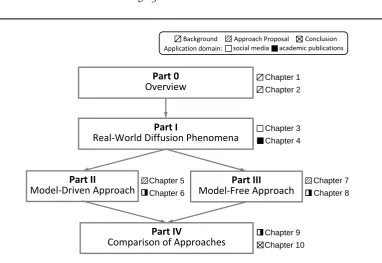
1.1 Thesis outline. . . 3
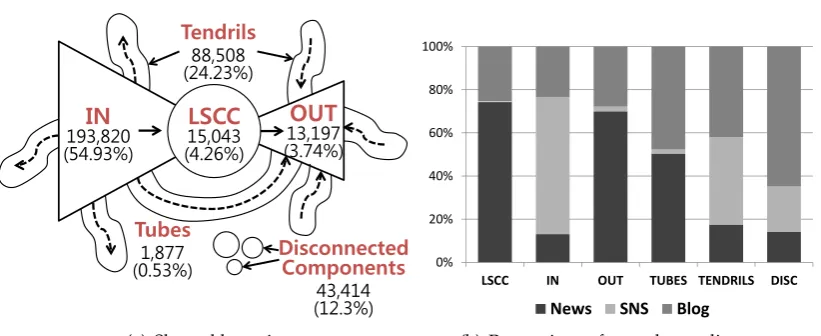
2.1 Overview of the bow-tie model consisting of six components. . . 11
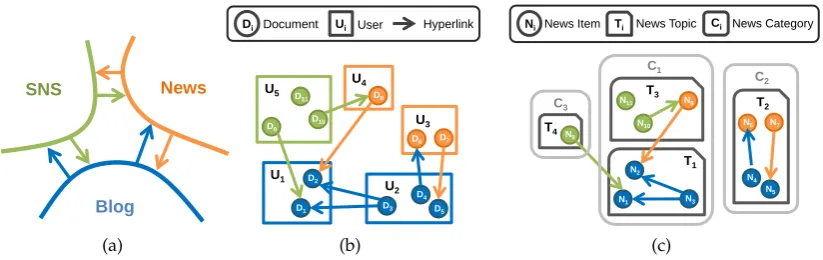
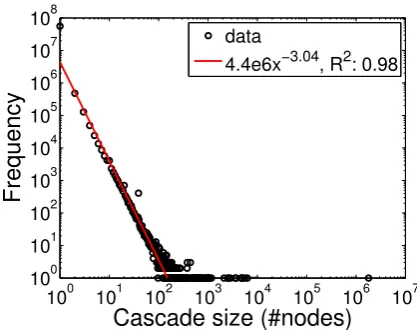
3.1 Overview of diffusion in social media. . . 25
3.2 Distribution of hyperlink cascade sizes. . . 27
3.3 Distributions of hyperlink cascade sizes. . . 29
3.4 An example snapshot of the Wikipedia Current Events. . . 30
3.5 Document labeling with identified news items. . . 31
3.6 Normalized linkage patterns between news topics. . . 34
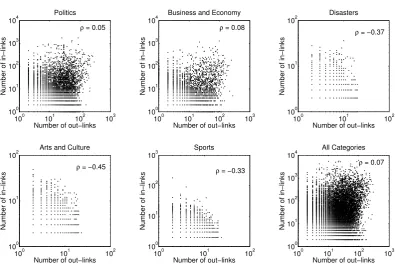
3.7 Scatter plots of in- and out-degrees of documents. . . 35
3.8 Reachability of user network. . . 36
4.1 Conceptual structure of academic citation networks. . . 39
4.2 In- and out-degree distributions of computer science publications. . . . 43
4.3 Largest connected premier conference network in computer science. . . 44
4.4 Degree distributions and scatter plots of in- and out-degrees of the premier conference network. . . 45
4.5 Reachability of the premier conference network. . . 47
4.6 Normalized linkage patterns between subdomains in computer science. 48 5.1 Conceptual framework for diffusion. . . 57
6.1 Unique structures of influence flows among three meta-populations. . . 68
6.2 Synthetic data generation reflecting dynamic influences among three meta-populations. . . 69
6.3 Distributions of model fitting errors with 48 synthetic datasets. . . 70
6.4 Estimation of parameter values of our model with 48 synthetic datasets. 71 6.5 Example cases of model fitting results with real datasets. . . 74
6.6 Distributions of estimated parameter values with real datasets. . . 75
6.7 Averages and standard deviations of cumulative adoption rates. . . 76
6.8 Time-evolving cumulative adoption rates. . . 80
6.9 Dynamic influence among three clusters (Core, Data, and Systems). . . 81
6.10 Estimated internal influence. . . 82
7.1 Conceptual framework for macro-level information transfer across so-cial systems. . . 91
7.2 Transfer entropy with time-delay and memory effects. . . 94
LIST OF FIGURES xiii
8.1 Probability of discrete states of stochastic processes. . . 100 8.2 Transfer entropy between online social systems. . . 101 8.3 Transfer entropy between online social systems for each news category. 102 8.4 Changes of significant transfer entropy ratios. . . 102 8.5 Outgoing and incoming transfer entropy for each media type. . . 103 8.6 Memory effects on the directionality of influence. . . 104 8.7 Outgoing and incoming transfer entropy for different news categories. . 105 8.8 Outgoing and incoming transfer entropy for each cluster (d=k =1). . 106 8.9 Outgoing and incoming transfer entropy for each cluster (d=1). . . 107 8.10 Summary of memory effects on diffusion. . . 107 8.11 Outgoing and incoming transfer entropy for each cluster (k=1). . . 108 8.12 Changes of significant TE ratios when varying the length of time-delay
and memory. . . 109 8.13 Information pathways across clusters, Core, Data, and Systems. . . 111
9.1 Distinct diffusion patterns. . . 118 9.2 Distributions of the estimated parameter values for each diffusion
pat-tern. . . 119 9.3 Changes of significant TE ratios for each diffusion pattern. . . 121 9.4 Changes of significant TE ratios for each direction. . . 122 9.5 Comparison of the diffusion patterns between driven and
model-free approaches. . . 123 9.6 Unique structures of relations among social systems. . . 124 9.7 Distinct diffusion patterns. . . 126 9.8 Distributions of the estimated parameter values for each diffusion
pat-tern. . . 127 9.9 Changes of significant TE ratios for each diffusion pattern. . . 129 9.10 Changes of significant TE ratios for each direction. . . 130 9.11 Comparison of the diffusion patterns between the model-driven and
model-free approaches. . . 131 9.12 Unique structures of influence flows across social systems. . . 132 9.13 Conceptual comparison between the model-driven and model-free
List of Tables
2.1 Table of common symbols used in this thesis. . . 22
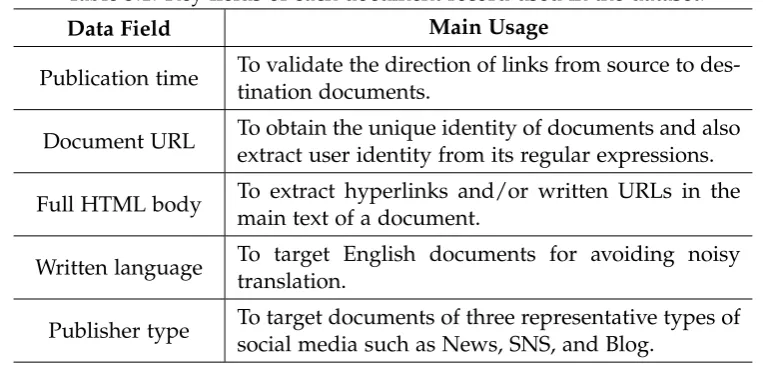
3.1 Key fields of each document record used in the dataset. . . 26
3.2 Identified users in social media from 60 million English documents. . . 28
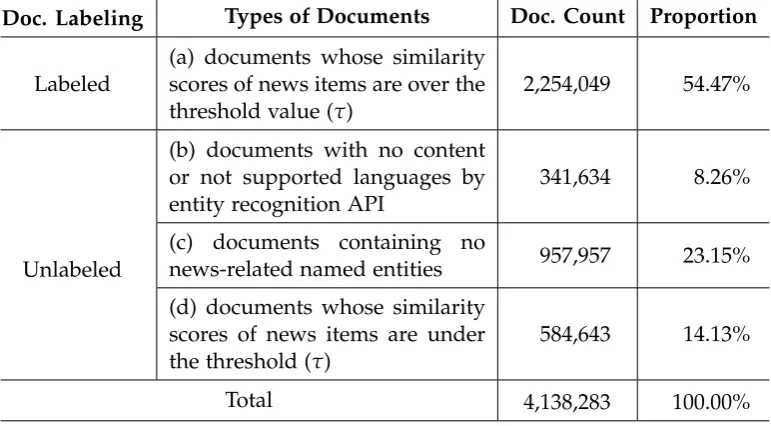
3.3 Results of document labeling. . . 33
3.4 Document clusters by conducting normalized cut. . . 34
4.1 Information used from the DBLP dataset. . . 40
4.2 Information used from Microsoft Academic Search dataset. . . 41
4.3 Identified twenty-four computer science subdomains. . . 42
4.4 The most highly cited conferences from the top-ranked conferences. . . 46
4.5 Distributions of subdomains for each bow-tie component. . . 47
4.6 Clustered 24 subdomains in computer science. . . 49
4.7 Selected research keywords in computer science. . . 51
4.8 Continued from Table 4.7. . . 52
5.1 Table of symbols for Chapter 5. . . 59
6.1 Table of symbols for Chapter 6. . . 67
6.2 Selected news topics and the corresponding news categories. . . 72
6.3 Averages and standard deviations of model fitting errors. . . 73
6.4 Selected research keywords from the list of the top 100 keywords. . . . 79
6.5 Averages and standard deviations of model fitting errors. . . 79
7.1 Table of symbols for Chapter 7. . . 88
8.1 Table of symbols for Chapter 8. . . 98
8.2 Behavioral characteristics of clusters. . . 108
A.1 Table of all symbols used in this thesis. . . 142
Chapter1
Introduction
This chapter introduces the motivation and general outline of our research method-ology, and then presents a detailed overview of the thesis including its main scientific contributions.
1
.
1
Motivation
Users of online services are able to access increasingly large volumes of information with much less time and efforts than ever before. For instance, online users are being kept frequently updated on their interested content through varieties of feed readers (aggregating news feeds such as Flipboard and Google Reader), or social media ag-greators (integrating social networks such as TweetDeck and Hootsuite), or through news agency’s active participations to social networking platforms. Such open web environment enables unlimited digital content to be navigated without the need to hop multiple social media platforms. In addition, the ubiquitous use of mobile de-vices delivers new information in real time. Such easy and high accessibility to a wide range of information not only makes underlying social networks far-reaching across multiple social platforms, but also leads their connectivity patterns to change dynamically in accordance with the context of information.
These dynamic and complex networks can be observed in various application domains such as hyperlink networks on the Web [43, 105, 136], academic citation networks across multiple disciplines [38,92, 140], and even cortical networks across different brain regions [55,150,164]. That is, studying significant patterns of (social) interactions in the real world is meaningful as they are possibly applicable to diverse research fields due to universal properties of real-world networks [15,37,127,182].
However, previous diffusion studies have mostly focused on diffusion within a single homogeneous system such as Twitter or Facebook, and thus influences from out-of-the-network sources have been regarded as only external influence. In ad-dition, prior work covering heterogeneous populations has not assessed dynamic influences formed among multiple (social) systems and has often been without the diverse context of diffusion. In this regard, the research presented in this thesis is aboutuncovering dynamics of topic-related global diffusion across heterogeneous
social networks, beyond a single homogeneous social system.
§1.2 Approach of Research 2
For studying information diffusion, we aim to address a number of key research questions including: (1) How does information spread across multiple social sys-tems? (2) How do we categorize heterogeneous social networks into a meaningful set and understand its intra- and inter-relationships? (3) How do diffusion patterns vary according to different information topics? (4) How do we estimate diffusion trends across multiple populations?
We expect that the ways of answering these questions can help to study dynamics of complex systems in other research areas.
1
.
2
Approach of Research
In order to understand such cross-population diffusion phenomena in the real world, our research is conducted based on four scientific methods throughout the thesis.
1.2.1 Step1– Empirical Analysis
We first analyze real-world diffusion phenomena in two different application do-mains: news diffusion in social media and knowledge diffusion in academic pub-lications. Findings from these empirical analyses become the basis for developing our new approaches in the next step. In this step, we construct explicit citation net-works through hyperlinks in the main content of web documents in social media, and through the bibliography in academic publications, and analyze diffusion patterns across heterogeneous social systems.
1.2.2 Step2– Proposal of Approach
Based on the empirical findings from Step 1, we design a new conceptual framework for diffusion processes. Following this conceptual design, we propose an approach. In this step, we propose two model-driven and model-free approaches with different aspects. That is, a model-driven approach is based on the assumption of underly-ing social interactions in a probabilistic way, while a model-free approach does not require any assumptions on the dynamic and complex interactions in the real world.
1.2.3 Step3– Estimation with Proposed Approach
§1.3 Thesis Overview 3
Part I
Real-World Diffusion Phenomena
Part II
Model-Driven Approach Model-Free Approach Part III
Part IV
Comparison of Approaches
Chapter 3 Chapter 4
□social media academic publications ■
□ ■
Chapter 7
Chapter 8 Chapter 5
Chapter 6
Chapter 9
Chapter 10
Part 0
Overview Chapter 1 Chapter 2
Application domain:
▨ ▨
Approach Proposal ▨
□ □ □Background
□
[image:18.595.129.512.74.337.2]□Conclusion
Figure 1.1: Thesis outline.
1.2.4 Step4– Comparison and Interpretation
We finally compare our approaches, the model-driven and model-free approaches, from Step 2 based on the estimation results from Step 3. We examine how they are different or similar and interpret what they provide for obtaining meaningful insights into cross-population diffusion phenomena in the real world. This comparison of the two different approaches aims to provide a comprehensive macroscopic view of topic-related global diffusion.
1
.
3
Thesis Overview
This dissertation focuses on dynamics of information diffusion at a macro level based on the research steps discussed in the previous section. Figure1.1 shows the overall thesis outline by mapping the thesis chapters to corresponding thesis parts as well as application domains. As the figure illustrates, this thesis consists of four main parts and ten chapters. The first two chapters give an overview of this dissertation work. Chapter 1 provides introduction of the thesis including motivation, outline, and contributions. In Chapter2, we define the concepts used in this thesis and dis-cuss related work. The rest of the thesis outline is described in detail in the following subsections.
1.3.1 Part I – Real-world Diffusion Phenomena
§1.3 Thesis Overview 4
respectively. In common, identifying trending topics is important to trace global dif-fusion across different social systems. Additionally, categorizing information topics enables us to find common or distinct diffusion patterns between different categories, and to obtain higher level views from an aggregation of individual topic diffusion within a same category.
In Chapter 3, we analyze news diffusion patterns in social media by constructing different levels of underlying networks, such as document, authorship, and informa-tion networks [91]. We target trending news items by referring to Wikipedia event profiles. We observe that news spreads across different types of social media, such as mainstream news, social networking sites, and blogs, beyond a single social plat-form, and the majority of users (55%) cite to a small fraction of prolific users (4%) from different types of social media platforms, a notable departure from the balanced traditional bow-tie model of web content.
In Chapter4, we focus on knowledge diffusion patterns in computer science [89]. Based on the constructed citation networks, we analyze linkage patterns between top-ranked conferences in computer science as well as between its different subdomains. We observe that premier conferences lead computer science research and that they are not only interconnected but also clustered along their common research interests. The majority of conferences (51%) cite to a small proportion of other conferences (10%) belonging to different subdomains, showing a similar pattern of a skewed bow-tie as occurred in Chapter3.
In common across the two application domains, the underlying network spans multiple social systems. The majority of individuals in the network obtain new infor-mation from a smaller proportion of other individuals from different social systems, i.e. external sources, and the connectivity of the network is far-reaching across the systems. That is, external influence is not ignorable, and underlying networks are heterogeneous in real-world diffusion.
1.3.2 Part II – Model-Driven Approach
From the empirical analyses of real-world diffusion in Part I, we found that large diffusion is attributed to interactions between heterogeneous populations. However, most prior work has focused on diffusion within a homogeneous population such as local contact networks in a single social platform (e.g., Twitter or Facebook). In this respect, our research aims to uncover macro-level diffusion mechanisms across heterogeneous social networks.
In Chapter 5, we design a new conceptual framework for cross-population dif-fusion, which allows direct interactions between different social networks as if they were in the same networks. Accordingly, we propose a macro-level diffusion model, namedDynamic Influence Model, with a probabilistic approach by incorporating two main features of real-world networks,heterogeneityandstructural connectivity[85,86], which has not been studied in previous research.
§1.3 Thesis Overview 5
academic publication, from Part I. Based on the evaluation of our model, we esti-mate real-world diffusion at a macro level in terms of the strength and directionality of influence [84, 85, 86, 89]. We find that influences between heterogeneous social networks vary with the topics of information, leading to different diffusion patterns.
1.3.3 Part III – Model-Free Approach
As mentioned in the previous subsection, most studies have focused on micro-level diffusion within a single homogeneous system, and their models are based on as-sumptions that social interactions are from sampled snapshots of current social net-works. In this regard, in Part II we proposed a macro-level diffusion model which estimates influence of diffusion across multiple social networks without the need of knowledge of local network structures in detail. However, this model-driven ap-proach is based on the assumption of a real-world network property, i.e. a power-law degree distribution, and thus it still needs to estimate the value of the scaling ex-ponent for the power-law tail. In this context, in Part III we aim to discover an approach of estimating diffusion without any assumptions on dynamically changing social interactions in the real world.
In Chapter7, we propose a model-free approach which estimates macro-level in-formation transfer across heterogeneous social systems by using inin-formation-theoretic measures [87, 89, 90]. This is enabled by considering a stochastic process at a sys-tem level and by defining the syssys-tem’s signal at a population level. Time-delay and memory effects are also considered so that we can understand how recent and long adoption histories of information in a source system have effect on diffusion in a destination system.
In Chapter8, we estimate macro-level information transfer in the social media and academic publication domains as we did in Chapter 6. This enables us to compare the proposed approaches based on these estimation results in Part IV. We analyze topic-related information pathways across different social systems using the transfer entropy with time-delay and memory effects. We find that the estimated topic-related diffusion trends from this model-free approach exhibit similar inter-relationships to those from the model-driven approach in terms of the strength and directionality of influence. Inter-relationships among the systems are varied with news categories or research keywords in our target application domains, leading to different diffusion patterns [87,88,89,90].
1.3.4 Part IV – Comparison of Approaches
Finally, we compare our proposed model-driven (PartII) and model-free (PartIII) ap-proaches with respect to common and different characteristics of the apap-proaches [87,
88, 89, 90]. Applying both approaches to different real-world domains helps us to compare and generalize the methods in a more consistent way.
§1.4 Scientific Contributions 6
examine how the two approaches estimate and distinguish the patterns. In com-mon across the domains, heterogeneous social systems in transitive relations have more opportunities to bring about synchronous diffusion patterns across them, but the strength as well as balance of intra- and inter-relationships within and between the systems are also important to lead to cross-population diffusion. That is, syn-chronous diffusion needs strong intra-relationships as momentum to make individu-als to move to a certain state, i.e. critical mass, within each system, which is triggered by strong inter-relationships between different social systems.
Finally, in Chapter 10, we conclude this thesis by summarizing all the main find-ings and contributions, and discuss future directions for this research.
1
.
4
Scientific Contributions
In this section, we summarize the main contributions of our study for each part of the thesis. All citations provided in the previous and current sections refer to our publications from this dissertation work.
1.4.1 Part I – Real-world Diffusion Phenomena
We provide major characteristics of structural diffusion patterns across heteroge-neous social networks in social media [91] and academic publications [89]. These application domains have drawn large attention from diverse research areas, and thus our empirical findings can provide the research communities with fundamen-tal statistics as a background. Most studies have focused on site-specific diffusion of particular keywords or quotes, but our study attempts to discover cross-population diffusion of non-site specific topics for obtaining more universal diffusion patterns in the real world. Thus, identifying trending topics is important to trace global dif-fusion across heterogeneous populations. Accordingly, we propose a novel method to identify note-worthy news by presenting each news item with named entities that embody the “5W1H”, i.e. Who, What, Where, When, Why, and How, of journalistic prac-tice. Categorizing trending topics provides higher level views of diffusion patterns by aggregating individual topic diffusion within a same information category. By con-structing different levels of underlying networks, such as document, authorship, and information linkage patterns, we provide interpretations of structural connectivity, social interactions, and relationships between different information topics.
1.4.2 Part II – Model-Driven Approach
§1.4 Scientific Contributions 7
single social system into multiple systems as if the underlying network were homo-geneous, and thus it extends the traditional diffusion mechanism to a more general and flexible one. Based on our conceptual framework, we propose a macro-level diffusion model, called Dynamic Influence Model, by considering both heterogene-ity and structural connectivheterogene-ity of real-world networks in a probabilistic way. Our proposed model can improve the accuracy of diffusion models dealing with a homo-geneous population within a single social system only, since it does not neglect the effects of interactions between different populations on diffusion and differentiate the strength of each population’s influence on others. That is, this model provides both intra- and inter-relationships among heterogeneous populations in terms of the strength and directionality of influence. By applying this approach to our target ap-plication domains, we provide topic-related diffusion patterns across heterogeneous social networks, which provides a way of understanding cross-population diffusion phenomena in the real world [84,85,86,89].
1.4.3 Part III – Model-Free Approach
We propose a model-free approach of estimating macro-level diffusion without any assumptions on social interactions [87,88, 89, 90], which not only provides benefits of studying nonlinear dynamics of complex systems but also gives an abstract view of cross-population diffusion. We define a stochastic process at a system level and the systems’ signals transmitted to other systems at a population level, which can be applicable to a variety of real-world scenarios. This conceptual framework enables us to estimate macro-level information transfer across heterogeneous social systems in terms of the strength and directionality of influence. To the best of our knowledge, this is the first attempt to apply this macro-level model-free approach to social media and academic publications. Estimation results can be comparable with the outcomes from the model-driven approach, which provides opportunities to enhance the per-formance of both approaches. When estimating information transfer from a source to a destination system, the effects of time-delay and memory (the length of adop-tion histories) are all considered. That is, behavioral characteristics of different social systems can be obtained, which helps to better understand the context of diffusion. By applying this approach to our target application domains, we provide different ways of understanding topic-related diffusion across heterogeneous social networks.
1.4.4 Part IV – Comparison of Approaches
§1.4 Scientific Contributions 8
similar results but with different perspectives, which in conjunction can help to ob-tain a more coherent overall picture of diffusion dynamics than either approach alone [88,89,90]. They also suggest alternative options to choose a more appropriate approach according to the conditions of different application domains. Finally, inter-preting crowd phenomena with respect to both approaches suggests diverse aspects of diffusion analytics and further provides a more comprehensive understanding of topic-related diffusion.
We expect that our proposed approaches can help to quantify and understand cross-populations diffusion in a wide range of research areas including neuroscience, social science, and marketing for estimating functional connectivity of the human brain, and dynamics of influence among social organizations or countries.
Chapter2
Overview and Survey
In this chapter, we first describe the common and fundamental concepts used in this thesis as preliminaries and define relevant terminology and notation. Then, we discuss related work on analyzing real-world diffusion phenomena, modeling diffusion processes, and predicting future behavior at individual or group levels with information-theoretic measures.
2
.
1
Concepts and Definitions
We review the basics of graph-theoretic terms, concepts of network structures, and information-theoretic measures, which are all used for studying diffusion dynamics in this thesis.
2.1.1 Fundamental Graph-Theoretic Concepts
Graph: a graph G consists of two sets V andE as G = (V,E), where V represents
a set of vertices or nodes and E denotes a set ofedges or links. The order of G is the number of vertices |V|, and the size of G is the number of edges |E|. Each edge is associated to two vertices (not necessarily distinct), called endpoints. An edge is called a self-loop or loop if it joins a single endpoint to itself. If an edge’s two end-points are designated as thetailand theheadfor each, then it is called adirected edge. Otherwise, it is called aundirected edge. A directed edge is also called anarc.
Adjacentandneighbors:if two verticesvanduare two endpoints of an edgee, then
a vetexvisadjacentto vertexu. The two adjacent verices are calledneighbors.
Degree: the degree of a vertex v, denoted by d(v), is the number of edges incident
with the vertex or equivalently to the number of its neighbors. If a vertex v has no neighbors, i.e. d(v) = 0, then the vertex is called an isolate. The Euler’s handshaking
lemmastates that the sum of the vertex degrees in any graphs is equal to twice the
number of edges as:
∑
v∈V
d(v) =2|E|
§2.1 Concepts and Definitions 10
Indegreeandoutdegree: theindegreeof a vertexv, denoted bydin(v), is the number
of arcs whose endpoints are designated toward the vertexv(the number of incoming arcs). Theoutdegreeof a vertexv, denoted bydout(v), is the number of arcs whose end-points are designated toward neighbors of the vertexv(the number of outgoing arcs).
Directed graph: if all of a graph’s edges are all directed, then it is called a directed
graphordigraph.
Undirected graph: if all of a graph’s edges have no designations of head and tail
(unordered pairs of endpoints), then it is called aundirected graph.
Simple graph: if a graph has no self-loops or multi-edges (slings), then it is called a
simple graph.
Trivial graph: if a graph consists of only one vertex without any edges, then it is
called atrivial graph.
Clique: if a subset of vertices in an undirected graph are all connected between every
pair of vertices, then they are called aclique.
Complete graph: if all pairs of vertices are adjacent, then a graph is said to be
com-plete, and this graph is its own maximal clique.
Subgraph: a subgraph Gs of a graph G = (V,E)consists of a subset of E and their
endpoints asGs= (Vs,Es), whereEs⊆EandVs ={v,u:(v,u)∈Es}.
2.1.2 Structure of Networks
The structural properties of complex networks in the real world have drawn large attention across diverse research areas [37,53,127,128,181]. We review fundamental structural properties representing networks.
Connected component: if there is a path between two vertices in an undirected
graph, the two vertices are called connected. A connected componentis a maximal set of nodes whose every pair of vertices is connected.
Connectivity: when the removal of a set of vertices makes a connected graphG
dis-connected, we call this set of vertices as acutorvertex cut. TheconnectivityofGis the size of a minimal cut, and the graphGis calledk-connected when its connectivity is more thank.
Density: thedensitymeasures the proportion of the current edges to the maximum
di-§2.1 Concepts and Definitions 11
SCC
IN
OUT
Disconnected
Components
Tubes
Tendrils
Figure 2.1: Overview of the bow-tie model consisting of six components: SCC, IN, OUT, Tendrils, Tubes, and Disconnected.
rectionality between vertices, and thus its maximum possible number of edges is
1
2|V|(|V| −1), and its density is
2|E|
|V|(|V|−1). For a directed graph, its maximum num-ber of arcs is|V|(|V| −1), and its density is accordingly measured as |V|(||VE||−1).
Weakly connected component: If all arcs are replaced with undirected edges in a
directed graph, and every pair of verticesvanduin the graph has a undirected path between v and u, then this directed graph is called weakly connected. A weakly
con-nected componentis a maximal (largest) weakly connected subgraph.
Strongly connected component: A directed graph is calledstrongly connectedif every
pair of verticesvanduin the graph has a bidirectional path, i.e. a directed path from
v to u and a directed path fromu to v. Astrongly connected componentis a maximal (largest) strongly connected subgraph.
Triad: a triple of connected vertices is called atriador atriangle.
k-core: a subgraph is called k-core if every vertex in the subgraph is adjacent to at
leastkother vertices in the subgraph.
Bow-tie model: the bow-tie model, introduced by Broder [40], visualizes the
§2.1 Concepts and Definitions 12
Degree distribution: there are variations of vertices’ degrees in a graph. Thedegree
distribution means the probability distribution of the degrees in the graph.
Accord-ingly, the degree distribution, denoted by P(k), is obtained by counting the number of vertices with degreek. If a graph hasnvertices in total andnkvertices with degree
k, then the graph has a degree distribution of degreekas:
p(k) = nk
n .
Binomial distribution: if the total number of vertices of a graph is n, where each
vertex has independent probability pto be connected and 1−pto be not connected, then the graph has abinomial distributionof degreek as:
p(k) =
n−1
k
pk(1−p)n−1−k . (2.1)
Multinomial distribution: the binomial distribution allows only two possible
out-comes, success (p) and failure (1−p), of each trial, but the multinomial distribution
generalizes the binomial distribution by extending a Bernoulli trial to m possible outcomes as:
p(k1, ...,km) =
n!
k1! ...km!
pk1
1 ...pkmm , when ∑mi ki =n
0 otherwise,
(2.2)
Power law degree distribution: if a graph’s degree distribution follows a power law,
then the graph has apower-law distributionas:
p(k)∝k−α , (2.3)
whereαis a parameter that scales its power-law tail. Networks whose degree
distri-butions follow a power law are calledscale-free networks[127].
Riemann zeta function: Equation (2.3) can be rewritten as:
p(k) =Ck−α , (2.4)
whereCis a constant, andαis an exponent scaling the power-law tail. For all possible
degrees k, the degree distribution p(k) adds up to 1 as ∑∞k=1p(k) = 1. Note thatk
starts at 1, since p(0)would be infinite. Thus,Cin Equation (2.4) can be obtained as:
C= 1
∑∞k=1k−α
= 1
§2.1 Concepts and Definitions 13
whereζ(α)is theRiemann zeta function[172]. ζ(s)is a function of a complex variable s that analytically adds up infinite series as ∑∞n=1 n1s and converges when <(s) > 1. Real-world networks are scale-free networks, and they exhibit a power-law degree distribution whose power law exponentαis typically in the range 2<α<3 [48,127].
Thus, this function is needed for normalization of a power-law distribution, and consequently Equation (2.3) can be rewritten as:
p(k) = k
−α
ζ(α) , (2.6)
wherek >0,α>1, and p(0) =0.
2.1.3 Information-Theoretic Measures
The main purpose of information theory, as introduced by Shannon [154], is to re-produce original massages which are initially generated by an information source, pass through a noisy communication channel after being encoded, and are decoded at a receiver. Regardless of its initial objectives, information-theoretic concepts have been applied and extended across diverse research areas, such as computer science, physics and neuroscience, as nonparametric statistics.
An information source produces messages x, and they are considered as possible values of a random variable X. Information-theoretic quantities are obtained based on a probability distribution function p(x)of the random variable X. We review the fundamental information-theoretic measures used in this thesis as follows.
Entropy: in information theory, information is considered as the amount of
uncer-tainty. That is, no uncertainty provides no additional information. If p(x) is the probability that a message x is observed, then information I(x) of observing the message is represented as:
I(x) =log 1
p(x) . (2.7)
Note that we express all entropies as bits, so all logarithms are taken to the base 2 throughout the thesis. An information source produces messages each of which has a fixed probability to be observed. Thus, the average amount of information obtained by a message is:
hIi=
∑
x
p(x)I(x) . (2.8)
This is the definition of entropy exhibiting the average amount of information. Thus, entropy measures the degree of uncertainty of predicting the messages pro-duced by the information source, and is represented as:
H(X) =−
∑
x
§2.1 Concepts and Definitions 14
Joint entropy: thejoint entropyof two random variables X and Y measures the
un-certainty of the joint distribution ofX andYas:
H(X,Y) =−
∑
x,y
p(x,y)logp(x,y) . (2.10)
Conditional entropy: theconditional entropyof X givenY is the average uncertainty
about X when we have knowledge ofY. Specifically, the entropy of X given a mes-sageY=yis:
H(X|Y=y) =−
∑
x
p(x|y)logp(x|y) . (2.11)
Thus, the conditional entropy of XgivenYbecomes the average uncertainly over all the possible outcomes ofYas:
H(X|Y) =
∑
y
p(y)H(X|Y= y)
=−
∑
y
∑
xp(y)p(x|y)logp(x|y)
=−
∑
x,y
p(x,y)logp(x|y) . (2.12)
Mutual Information:themutual informationis information between two random
vari-ablesXandY, and it measures the reduction inX’s uncertainty due to the knowledge ofY, or vice versa as:
I(X;Y) = H(X)−H(X|Y) =H(Y)−H(Y|X)
=−
∑
x,y
p(x,y)log p(x,y)
p(x)p(y) . (2.13)
Note that the mutual information I(X;Y) is the Kullback-Leibler divergence [109] of the joint distribution p(x,y)from the product distribution p(x)p(y). The Kullback-Leibler divergence between two probability distribution p(x)andq(x)is defined as
DKL(pkq) =∑xp(x)log
p(x)
q(x).
Transfer Entropy: the mutual information can be extended to a collection ofn
ran-dom variables, i.e. a ranran-dom process, Xn andYn as I(Xn;Yn). This is a symmetric measure such that I(Xn;Yn) = I(Yn;Xn). The transfer entropy (TE), introduced by Schreiber [153], enables us to obtain the directionality between two stochastic pro-cessesXandYas:
TEY→X= H(Xt|Xt−1:t−k)−H(Xt|Xt−1:t−k,Yt−1:t−l) , (2.14)
§2.1 Concepts and Definitions 15
2.1.4 Definitions of Terminology
Diffusion network: a diffusion network consists of individuals who are involved in
spreading a new idea or information through contact neighbors in the network.
Information cascade: chain reactions of adopting new information are called
infor-mation cascadein this thesis.
Social system: we follow the definition of a social system by Talcott Parsons [137],
which consists of individuals who interact and influence each other’s behavior. We consider a population belonging to a single social system as ahomogeneous population
exhibiting the same behavioral characteristics within the system’s boundary. We call a homogeneous population’s interaction network a homogeneous social network as its narrower concept. As we discussed in Chapter1, social interactions are far-reaching across different social media platforms in social media, and thus the underlying networks span multiple social systems. In this context, we call populations from different social systems heterogeneous populations, and their interaction networks are accordingly considered asheterogeneous social networks.
Meta-populations: we consider ameta-population scheme [29] which categorizes
het-erogeneous populations into a small number of meta-populations according to the characteristics of target meta-populations in diverse application domains. This helps to obtain a more simple and clearer macroscopic picture of global diffusion.
Social media: the term “social media” has been widely used, but with different and
limited understanding [76]. In general, social media has been understood as user generated contents which are easily accessible by other users [12, 35, 185]. In more detail, Kaplan and Haenlein [76] defined the concept of social media as a group of internet-based applications allowing the creation and exchange of user generated contents on the ideological and technological foundations of Web 2.0. In this thesis, we follow this detailed and comprehensive definition of Kaplan and Haenlein.
§2.2 Survey of Real-World Diffusion Studies 16
2
.
2
Survey of Real-World Diffusion Studies
Collective behavior often emerges from sporadic interactions between individuals in a contact network. Such dynamic behavior consequently forms large complex diffu-sion networks in the real world such as the Internet [45,56,139,176,187], online so-cial networks [11,66,94,105,115,122], email networks [77,116,129,148,160], mobile phone networks [18,54,71,96,131], collaboration networks [27,34,67,101,125,184], cortical networks [16,55,112,150,164], metabolic and protein networks [28,36,58,73,
74], and so on. Thus, analyzing the linkage patterns of real-world complex networks is a meaningful first step towards a systematic understanding of the underlying dif-fusion mechanisms.
2.2.1 Inference of Diffusion
Online diffusion tracking has been conducted from different perspectives. For in-stance, information diffusion can be defined on shared keywords or similar text between documents [11, 66], on shared quotes called meme phrases[103], on recom-mendations [102,106], on hyperlinks [43,105,123], or on site-specific actions such as retweets, mentions, or hashtags in Twitter [75,98,147]. However, inferring diffusion with the shared meme is implicit, and even inference with explicit hyperlinks can be noisy because there are an increasing number of spam-hyperlinks on web pages. In order to avoid a noisy tracking of diffusion in social media, we try to collect hy-perlinks in the main text of a document to generate accurate and explicit citation networks, and extract key memes to observe the information evolving patterns [91], which is discussed in detail in Chapter3.
However, it is still challenging to unveil the exact sources that have brought the spread (e.g., adopting new behaviors or ideas, purchasing a product, etc.). That is,
an influenceris not explicitly acknowledged by its individualinfluenced, and thus it
is hard to collect or define real diffusion networks such as explicit consumer net-works [72]. In this regard, more recently there has been an attempt to model diffu-sion without explicit knowledge of underlying network structures [186]. Neverthe-less, diffusion processes are not independent on diffusion contents [13,123,147], and thus it is meaningful to discover the interplay between them. Accordingly, one of our research goals is to understand how diffusion mechanisms across heterogeneous populations varied with the topics of information [84, 85, 86, 89,90], which will be discussed in Chapter6,8, and9from the aspects of our model-driven and model-free approaches.
2.2.2 Diffusion Space
§2.2 Survey of Real-World Diffusion Studies 17
which leads to heterogeneous social networks becoming more interconnected than ever before [85]. Such emergent phenomena of complex social networks have been investigated in a wide spectrum of diffusion spaces.
When it comes to social media, the diffusion boundary, covered by previous stud-ies, has been mostly limited to a single social networking platform such as Twit-ter [75,98,123, 147] or Facebook [24, 167]. The interactions between different social media platforms have also been common interest, such as blogosphere [11, 105], blogosphere-to-news [62, 63, 103], or blogosphere-to-YouTube [43]. In order to ob-tain a global view of diffusion in social media, our research extends the diffusion space from the blogosphere to mainstream news to social networking sites (SNS), i.e. blogosphere-news-SNS [91], which is discussed in Chapter3,6,8, and9.
Similarly, in academic publications, knowledge spreads through complex path-ways within a local research community [190], within a single research domain such as computer science [19,156], or across diverse disciplines [38,92,140]. In our study, we also investigate academic publications in computer science, and focus on global diffusion trends across different subdomains viewed as heterogeneous populations, which is presented in Chapter4,6,8, and9.
2.2.3 Identification of Target Information
The operational definition for identifying target information in diffusion has in-cluded a number of text clusters as approximated events [68], Twitter hashtags [49,
51, 98, 183], which are manually grouped into broad topical themes [147], or meme phrases which are commonly observed across diverse media and are thus consid-ered as reflecting real-world events [103]. The authors of [33] designed a two-step approach to first cluster the input Twitter stream and then perform event versus non-event classification on the clusters based on their statistical features. However, these identified streams can be platform-specific topics. For instance, the authors of [98] found that only 3.6% of Twitter’s trending topics exist in the hot search keywords from Google.
Our research aims at understanding cross-population diffusion, and thus identi-fying trending topics covering multiple populations is essential. This enables us to trace beyond the bounds of site-specific (local) diffusion. Finally, categorizing the topics of information enables us to obtain higher-level interpretations, such as com-mon or distinct diffusion patterns between different categories. Detailed steps of targeting and identifying information topics are described in Chapter3and4.
2.2.4 Structural and Temporal Patterns of Diffusion Networks
net-§2.2 Survey of Real-World Diffusion Studies 18
work [106], online diffusion networks [61], or diverse real-world networks [119], firm innovation [14,141,151], contagion of obesity [46], happiness [57] or disease [138,144,
179], and brain functionality [10, 32, 41, 164]. Accordingly, there has been increas-ing attention to the universal structural properties of large complex networks such as relatively small characteristic path lengths, high clustering coefficients, power-law degree distributions, and the presence of community structures [15,26,37,182].
Human activity such as blogging and tweeting often shows periodicities (weekly and yearly regularity). Traffic in the blogosphere leads to a seven-day periodicity due to aweekend effectof sharply dropping off at weekends [105]. Such periodicity is also found in our study of news diffusion in social media covering mainstream news, the blogosphere, and social networking sites [91]. In addition, heavy-tailed dynamics has been observed in the popularity of blogs, the distribution of blog sizes, bursty patterns in blog activity [43,64,105], and information cascades in social media [91].
These universal properties [37, 124, 128] of user behaviors can serve as one of the parameters in modeling spreading processes on networks. Our model-driven ap-proach [85] assumes one of these real-world network properties, a power-law degree distribution, which is discussed in detail in Chapter5.
2.2.5 Diffusion Factors
Studies on diffusion models have mainly focused on three factors affecting infor-mation propagation such as social structure (e.g., peer influence or connectivity), node characteristics (e.g., individual interests or receptivity), and the nature of tar-get information (e.g., endogenous or exogenous information). Individual or com-bined parameters can be one of the essential factors in successful information diffu-sion [13,20,22,165].
There have been attempts to separate peer influence and peer similarity (ho-mophily) effects on information propagation so that more detail and accurate level of interpretations is achieved [20, 22]. For instance, user behavior contagion (e.g., the purchase of a product and adoption of a new idea) is possibly due to the direct recommendation or exposure to information from socially connected neighbors, or due to the similar preferences between users. Meanwhile, the nature of information items needs to be considered as an additional important factor of information spread. The authors of [13] assign every information item two parameters, endogeneity and
exogeneity. The endogeneity of the item quantifies its tendency to spread through the
underlying connections between nodes, and the exogeneity quantifies its likelihood to be acquired by a node, independently of the underlying network.
ap-§2.2 Survey of Real-World Diffusion Studies 19
proach estimates macro-level diffusion across heterogeneous meta-populations, and thus it considers node characteristics at a meta-population level rather than an indi-vidual node level. Details are discussed in Chapter5,6and9.
2.2.6 Fundamental Frameworks of Diffusion Processes
One of the best ways to understand effects of network properties from empirical studies is to build mathematical models. There have been attempts to model a dif-fusion process on contact networks for understanding its underlying mechanisms from different research fields such as social science, marketing, medicine, physics, and computer science.
In the early 1960s, adopting behaviors were classified in the social sciences into five categories in terms of the timing of adoption, such as innovators, early adopters, early majority, late majority and laggards [146]. In the marketing literature, this idea was mathematically represented with a conditional likelihood of adoption by the Bass Model [30]. This model consists of likelihoods of “innovation” and “imitation”, which correspond to the concept of external and internal influences in computer science literature [85,107,123], respectively.
The mathematical modeling of epidemics has also been an active field of re-search across different disciplines such as epidemiology [17, 39, 79, 157], physics [37, 120, 126, 138], mathematics [78, 149], and computer science [44, 83, 118, 189] for the description of the diffusion of pathogens, knowledge, and innovation. De-pending on the stage of the disease, such as susceptible (denoted by S, those who can contract the infection), infected (I, those who have contracted the infection and are contagious), andrecovered(R, those who have recovered from the disease), there have been several commonly used baseline models to describe the general proper-ties of epidemic spreading processes; namely, thesusceptible-infected (SI) model, the
susceptible-infected-susceptible (SIS) model, and the susceptible-infected-recovered (SIR)
model [21,23,70].
In this thesis, the Bass Model is considered as a fundamental framework for our model-driven approach in Chapter5due to its simplicity and robustness [31], which are important to model the dynamics of heterogeneous populations. Compared to the Bass Model, epidemic models are too complicated to incorporate the heterogene-ity and structural connectivheterogene-ity of social networks at the same time. That is because we need to consider distinct stages of disease for each population such as S, I, and
R, the transmission rate between different stages, and the diffusion factors discussed in the previous subsection. However, this epidemic approach can be one of future research topics.
2.2.7 Effects of Structure and Heterogeneity of Populations on Diffusion
§2.2 Survey of Real-World Diffusion Studies 20
[31,95,107,110,130,188]. Its fundamental assumption is that each individual meets completely at random and has an equal chance of coming into contact with every other individuals (fully mixed, ormass-action approximation) [127]. This simplicity has enabled intuitive interpretation and has led to a wide range of extensions of the model [31]. Also, the traditional approach of epidemic models [23] disregards un-derlying contact networks and assumes that a population is homogeneous and fully connected in the same way as traditional macro-level diffusion models [30,127]. This is a strong assumption, but it allows for models in the form of systems of ordinary differential equations for the fraction of individuals in the various compartments
(Susceptible, Infected, andRecovered) [37].
However, many real-world networks exhibit non-uniform but heavy-tailed degree distributions [175], as discussed earlier. In terms of network structures, there has been interest in the effect of network topologies on the diffusion, such as cluster density and reachability [97,151], and degree distributions [107]. The authors of [25] make an assumption of two levels of mixing based on the SIR model. Each node belongs both to the network as a whole, and to one of a specified set of subgroups within the network such as families. Accordingly, there has been interest in the effect of clustering on the propagation of diseases. For instance, disease transmission much more likely takes place within subgroups than transmission between subgroups [25,
97]. The authors of [107] incorporated degree distributions into the Bass Model, but their assumption of a linear influence of the number of neighboring adopters does not guarantee the probabilistic constraint. Details are discussed in Chapter5.
All these studies are still limited to a single social platform or a homogeneous population. One extension of the Bass Model allows heterogeneous populations such as multinational diffusion of a product. For example, the adoption rate of a consumer product in one country indirectly influences that in other countries [95, 142]. How-ever, this extension disregards the effect of network topologies on diffusion. The authors of [132] integrated different layers of single social networks into a weighted composite network scheme, such as Bluetooth proximity networks, call log networks, affiliation networks, and friendship networks, for 55 university students. They fo-cused on homogeneous social networks represented by multi-layered networks with different levels of importance, but our study covers heterogeneous social networks with intra- and inter-network interactions.
In contrast to the previous studies, our research aims at considering the effects of structures and heterogeneity of populations on diffusion at the same time. Accord-ingly, we propose the Dynamic Influence Model in Chapter5and apply the proposed model to real-world diffusion in Chapter6.
2.2.8 Information-Theoretic Measures of Information Flow
§2.2 Survey of Real-World Diffusion Studies 21
where heterogeneous social networks are interconnected. In this regard, there have been attempts to estimate diffusion trends without any assumptions on complex and dynamic social interactions in the real world by using information-theoretic measures such as the mutual information and transfer entropy.
Extensive research on such information-theoretic measures has been conducted in diverse areas including computer science [60, 177, 178, 180], neuroscience [133,
134, 135, 143, 173], and economics [99, 108, 113]. When it comes to social media, the predictability of user behavioral patterns has drawn attention, such as individ-ual or group level future interactions [180], information pathways between Twitter users without explicit follower-followee relationships [177, 178], and classifications of Twitter user behaviors [60].
These studies focus on homogeneous population within a single social platform alone. However, as discussed earlier, heterogeneous social networks are increasingly interconnected across multiple social media platforms (e.g., CNN, BBC, Facebook, Twitter, WordPress, and Tumblr). Our research proposes a model-free approach in Chapter 7 which shows a way of estimating inter-relationships between heteroge-neous populations at a macro level. Also, we apply the proposed model-free ap-proach to real-world diffusion in Chapter8.
2.2.9 Topic-Related Diffusion
These modeling approaches can be applied to technological and commercial domains where rapid and efficient spread of information or service is often desired such as marketing campaigns [102, 121]. One of the crucial studies has focused on identi-fying influential nodes [81, 82, 100, 104]. From the perspective of recommendation performance, the authors of [163] predict the destination of information flow, and ranks users based on the estimated time of how quickly information will reach to them. The authors of [114] predict the size of diffusion of a specific item. In com-mon, these researches assume a peer influence-based influence propagation on the underlying networks and no distinctions between different information items. Ac-cordingly, learning approaches to the probabilities of influence between nodes has been proposed by harnessing the observation of the spread of a particular informa-tion item [62, 65]. Also, they regard identical propagation of diverse information items.
§2.3 Nomenclature 22
Table 2.1: Table of common symbols used in this thesis.
Symbol Description
a(t) The number of new adopters at timet
A(t) The number of cumulative adopters until timet
f(t) The proportion of new adopters at timet
F(t) The proportion of cumulative adopters until timet
pi Probability of external influence on a meta-populationi
cji Probability of influence of a meta-population
jon a
meta-populationi
α Power law coefficient
X,Y,Z Stochastic processes (an ordered set of random variables)
TEY→X Transfer entropy fromYtoX
TEout Outgoing transfer entropy
TEin Incoming transfer entropy
k Markov order for the previous states ofX
l Markov order for the previous states ofY
d The length of time-delay
Our ultimate research goal is to obtain a comprehensive understanding of topic-related diffusion across heterogeneous populations. This is enabled by comparing our model-driven and model-free approaches with respect to information topics in different real-world application domains, such as social media and academic publi-cations. Chapter9discusses overall insights from the comparisons in depth.


![Table 3.4: Document clusters by conducting the normalized cut [155] on the largestcascade of all news categories combined.](https://thumb-us.123doks.com/thumbv2/123dok_us/1779392.132016/49.595.207.423.118.323/table-document-clusters-conducting-normalized-largestcascade-categories-combined.webp)