The Gambia - European Community
Cooperation
Joint Annual Report 2006
Table of content
LIST OF ACRONYMS... 4
EXECUTIVE SUMMARY... 5
1. UPDATE ON THE POLITICAL, ECONOMIC, SOCIAL AND ENVIRONMENTAL SITUATION ... 6
1.1 Update on the political situation... 6
1.2 Update on the economic situation ... 7
1.3 Update on the social situation ... 8
1.4 Update on the environmental situation ... 9
2. OVERVIEW OF PAST AND ONGOING COOPERATION ... 9
2.1 Focal sectors (and macroeconomic support) ... 10
2.1.1 Focal sector 1 Transport ... 10
2.1.1.1 Results ... 10
2.1.1.2 Progress in activities... 10
2.1.1.3 Degree of integration of cross cutting themes (gender issues, environmental issues and institutional developments and capacity building) ... 11
2.1.2 Focal sector 2 Rural Development ... 11
2.1.2.1 Results ... 11
2.1.2.2 Progress in activities... 11
2.1.2.3 Degree of integration of cross cutting themes (gender issues, environmental issues and institutional developments and capacity building) ... 11
2.1.3 SESP ... 12
2.1.4 Macroeconomic support ... 13
2.2. Projects and programmes outside focal sectors... 13
Technical Cooperation Facility ... 13
Institutional Support to the NAO ... 14
Support to the 2006-2008 Electoral Cycle in The Gambia ... 15
2.3. Utilisation of resources for NSAs ... 15
2.4. Utilisation of B envelope ... 15
2.5. Other instruments ... 15
EIB ... 16
CDE... 16
CTA... 16
FMO Stabex Transfers 1999 ... 16
SFP ... 16
Regional Projects: Procordel, PACE, RSP II, Predas ... 17
EU/ACP Energy Facility ... 18
EU/ACP Water Facility... 18
3. ASSESSMENT OF PERFORMANCE INDICATORS ... 19
4. DONOR COORDINATION AND HARMONISATION... 20
5. DIALOGUE IN COUNTRY WITH THE NAO AND NSAS ... 20
6. CONCLUSIONS... 21
LIST OF ACRONYMS
ACP African, Caribbean, Pacific
ACP Agriculture Credit Programme (in the ASPA
context)
ADB African Development Bank
APO Agriculture Producer Organisation
ASPA Agric-business Service Plan Association
APRC Alliance for Patriotic Reorientation and
Construction
AU African Union
BADEA Arab Bank for Economic Development in Africa
BPNRU Book Production materials and Resources Unit
CDE Centre for Development Enterprise
CED Customs and Excise Department
CFAA Country Financial Accountability Authority
CILLS Committee for Control of Drought in the Sahel
CIRDES Centre de Recherche-Dev. sur l’Elevage en Zone
Sub-Humide
COLEACP Pesticides Initiative Programme
CPMS Cooperative Produce Marketing Societies
CRD Central Revenue Department
CSO Civil Society Organisation
CSP Country Strategy Paper (plan)
CSS Country Support Strategy
DDF Divisional Development Fund
DFID Department for International Development
DOSE Department of State for Education
ECO European Commission Office
ECOWAS Economic Council of West African States
ECSPPs European Commission Supported Programmes
and Projects
ECSU European Commission Support Unit
EDF European Development Fund
EIB European Investment Bank
EUMS European Union Member State
EPA Economic Partnership Agreement
ERP Economic Recovery Programme
ESAF Extended Structural Adjustment Facility
FA Financing Agreement
FAO Food and Agricultural Organisation
GDP Gross Domestic Product
GGC Gambian Groundnut Cooperation
GRA Gambian Road Authority
GTZ German Technical Development
HLEC High Level Economic Committee
HoD Head of Delegation
IBSC Institution Building Support Committee
IDA International Domestic Agency
IMF International Monetary Fund
ICT Information and Communication Technology
IFMIS Integrated Financial Management Information
System
ILRI International Livestock Research Institute
ITC International Trypano-tolerance Centre
JICA Japanese International Co-operation Agency
HIPC Heavily Indebted Poor Country
MDFT Multi-Disciplinary Facilitation Team
M&E Monitoring & Evaluation
MTEF Medium Term Expenditure Framework
MSU Management Support Unit
NAO National Authorizing Officer
NARI National Agriculture Research Institute
NASACA National Village Savings and Credit Association
NBD North Bank Division
NBD-FP North Bank Division Forestry Project
NEFCOM National Economic Fiscal Commission
NGP National Governance Policy
NIA National Intelligence Agency
NIP National Indicative Programme
NTP National Transport Plan
OAU Organisation of African Unity
OMVG Organisation for the Development of The Gambia
River basin
PACE Pan African Control of Epizootic
PCU Programme Coordination Unit
PDF Programme Development Forum
PER Public Expenditure Review
PICC Programme Implementation Consultative
Committee
PMU Programme Management Unit
PPP People Progressive Party
PRA Participatory Rural Appraisal
PROCORDEL Collaborative Research Programme on Trypanosomiasis
PRSP Poverty Reduction Strategy Paper
PSD Programme for Sustainable Development
RIP Regional Indicative Programme
RSP Regional Solar Programme
RVT Rural Vocational Training
SASP Structural Adjustment Support Programme
SDRD Support to Decentralised Rural Development
Programme
SESP Support to Education Sector Programme
SMP Seed Multiplication Programme
SPACO Strategy for Poverty Alleviation Co-ordination
Office
SPA-II Strategy for Poverty Alleviation II
SWS Solar Water System
TA Technical Assistance
TAC Technical Advisory Committee
TANGO The Association of Non-Governmental
Organisations
TBA Traditional Birth Attendance
TIPE II Training Information Programme for the
Environment
TORs Terms of Reference
URD Upper River Division
VDC Village Development Committee
VISACA Village Savings and Credit Association
VHW Village Health Worker
WAEMU West African Economic Monetary Union
WB World Bank
WD Western Division
WDC Ward Development Committee
WP Work Programme
EXECUTIVESUMMARY
The Gambia, which remains among the poorest countries in the world, ranks 155 out of 177 countries on the 2006 UNDP Human Development Report. Agriculture provides the highest employment (about 70% of the population), most of whom engage in groundnut cultivation. The groundnut farmers who in the past were the wealthiest among the farming community are now the poorest. The food security situation is precarious and domestic production only satisfies 50% of the country’s food needs, thus making the Gambia a net food importer.
The Gambia is very much dependent on international trade for its revenue. About 40 percent of total revenue and 50 percent of tax revenues are derived from taxes on international trade. In the context of the Integrated Framework (IF), a Diagnostic Trade Integration Study (DTIS) has been carried out and the European Commission will most probably be the donor Facilitator of the IF.
The Government of the Gambia in November 2006 adopted the Poverty Reduction Strategy Paper (PRSP) II document, spanning from 2007 to 2011, and has concluded a new Poverty Reduction Growth Facility (PRGF) programme with the IMF in October 2006. The PRGF, aiming at strengthening the operational independence of the CBG, will pave the way for an important debt relief under the Multilateral Debt Relief Initiative and the enhanced Heavily Indebted Poor Countries (HIPC) Initiative.
On the political scene, the Presidential elections held on 22 September 2006 were won again by the incumbent President. There was an attempted military coup on 21st of March 2006, and the treason
trial involving 14 alleged plotters is ongoing.
Generally, access to basic health services is good, although there are still some pockets in the rural areas with poor access. The literacy rates for the Gambia now stand at 65%. The new and evolving phenomenon of illegal migration particularly to Europe has witnessed some Gambian youth taking up this adventure. This has led to the signing of a memorandum of Understanding between government and Spain in October 2006. Major environmental challenges remain low human and institutional capacities at all levels and lack of appropriate waste management systems.
The Country Strategy Paper (CSP) under the 9th EDF/NIP for 2002-2007 signed in 2003, and amended
in 2005 at the mid-term review had a total amount of € 58.2 M of which € 53.5 M was for envelop A dedicated to two focal sectors (rural development and transport) and a non focal sector (capacity building). After the end of term review (ETR) carried out in 2006, the new allocation of envelope A is € 49,775,550, to which a maximum of € 5,300,000 will be added, following decommitments on 7th, 8th
and 9th EDF global commitments. One of the conclusions of the ETR is to abort the envisaged
programme of Support to Decentralization and Local Development (€ 4.4 M).
Both the primary and secondary commitments were low during the first half of the 9th EDF
implementation period, but have become satisfactory at the end of 2006 following the signing of the works contract of the 9th EDF Transport programme (€39 M). However, secondary commitments in
the rural development sector remain low, as well as disbursement rates.
The national authorities are waiting for the EC approval of the Financing Proposals for Technical Cooperation Facility II and the Support to Non-State Actors Programme, submitted in the first half of 2007. Moreover, a Framework of Mutual Obligations (FMO) Stabex Transfers 1999 is under preparation and will tackle emerging problems of the Groundnuts sub-sector.
The programming exercise for the 10th EDF is ongoing with an indicative financial envelope of
is now replaced by a Governance Focal Sector, having Decentralization and Local Development as a key programme component. Supports to the Education Sector will likely be continued under the Budget Support Programme along with health.
1.UPDATEONTHEPOLITICAL,ECONOMIC,SOCIALANDENVIRONMENTALSITUATION
1.1 Update on the political situation
The Gambia gained her independence from Britain in 1965 and became a Republic in 1971. The country had since then maintained a multiparty democracy until 1994 when a military coup disrupted the democratic process. The country returned to civilian rule in 1996 through Presidential elections, won by Dr.Yahya A.J.J. Jammeh the leader of the 1994 military coup. The Parliamentary elections held in 1997 were also dominated by representatives of the ruling party.
Presidential and Legislative elections were again held in 2001 and 2002 respectively, and Dr Yahya A.J.J. Jammeh was re-elected President. The Presidential elections held on 22 September 2006, and contested by three Presidential candidates were again won by the incumbent President. There was an attempted military coup on 21st of March 2006, and the treason trial involving 14 alleged plotters is
ongoing. 6 of the 10 tried in a military court martial have already been convicted in April 2007 and sentenced to jail terms ranging from 10 years to life imprisonment.
Following the 1994 military coup, the 1970 Constitution of the First Republic was replaced by the 1997 Constitution of the Second Republic through a referendum. Executive power is exercised either directly by the President, or indirectly through Cabinet. The Cabinet is appointed by the President, and currently comprises 15 secretaries of State, of which four are female, including the Vice-President. Legislative power is vested in a unicameral National Assembly, comprising 53 members. 48 were elected in January 2007 for a five-year term by direct universal suffrage and the President nominated five. Altogether, the opposition occupies 6 seats in the National Assembly.
Judicial power is vested in the courts, with the Supreme Court being the final court of appeal for The Gambia. A Commercial Court was established in 1998 to handle cases relating to contracts, but most commercial litigation is handled through the High Court as the Commercial Court has a severe backlog of cases. There is an Alternative Dispute Resolution (ADR) mechanism to assist in handling the backlog of cases and the ADR Secretariat has been established recently.
The Constitution also ushered in a well-needed reform of the electoral system, established the Independent Electoral Commission (IEC), the office of the Ombudsman and paved the way for a new Local Government Act (2002). Although the term limit to the Presidency was advocated for, the 1997 Constitution failed to make provision for such a term limit.
Issues of major concern to the international community, human rights organizations and a cross-section of Gambians on the state of political governance are: frequent arrests and detentions, perceived suppression of press freedom and interference with the Judiciary.
There is still public concern over the administration of justice, and perceived low public and investor confidence in areas such as, accessibility, affordability, and expediency in the dispensation of justice. The government is implementing the Legal Strategy (2005). However, its accelerated implementation would require multi-donor support.
Overall, The Gambia continues to make gains in the promotion of freedom of association, worship, gender parity and the protection of women’s and children’s rights. The Government has established a Governance Commission, but a National Human Rights Commission does not exist. However, the Gambia hosts the African Commission on Human and Peoples’ Rights (ACHPR) which provides analysis and reports on human rights issues in AU member states.
1.2 Update on the economic situation
The Gambia ranks 155 out of 177 countries on the 2006 UNDP Human Development Report with a Human Development Index of 0,479 and has a GDP per capita of 281 US$ in 2004. The economy is primarily agrarian, with agriculture employing about 70% of the labour force and accounts for about 30% GDP. Services account for over 50% of GDP, attributed to the re-export trade, financial services, ICT and tourism. The manufacturing sector contributes 5% to GDP reflecting the low level of manufacturing activities.
The economic situation has been stabilising from 2004 with an overall GDP growth rate of 5.3%. Growth picked up in 2005 at a rate of 6.9%, and by the end of 2005, average annual inflation had dropped from 8% in 2004 to 4% in 2005, while the Treasury bill rate dropped significantly by 12% from 27%.
The Balance Of Payment (BOP) data indicate that the c.i.f. value of merchandise imports, including re-export, was $197 million in 2004 and the net foreign assets (NFA) of the Monetary Authorities exceeded the D2 billion mark in 2005; hence usable foreign reserves was equivalent to 4.9 and 4.5 months of import cover in 2004 and 2005, respectively. The BOP recorded a surplus of D240 million in 2006 while the gross external reserve rose from D93.7 million in 2005 to D99.2 million in 2006. The country has witnessed a significant rise in private remittances from Gambians in the Diaspora, constituting a major source of foreign exchange (19.8% - IMF 2004).
The Gambia’s last PRGF (2002-2005) went off-track soon after approval in 2002, mainly due to exogenous shocks, weakness in public spending control mechanisms and irregularities at the Central Bank of The Gambia (CBG). To re-establish a track record of policy implementation with the IMF, the authorities undertook a Staff Monitored Programme (SMP) from October 2005 - March 2006. Subsequently, a new PRGF programme was concluded in October 2006 and adopted by the Board in March 2007. It is anticipated that the HIPC completion point triggers would be satisfied by mid-2007. Reforms on the fiscal front especially in revenue administration have strengthened revenue collections during 2004 to 2006. Better expenditure planning and the introduced cash rationing mechanism have restored fiscal discipline.
In June 2006, the Board of Directors of the Millennium Challenge Corporation (MCC) decided to suspend The Gambia’s eligibility for assistance citing a pattern of actions inconsistent with MCC’s selection criteria, amongst which human rights abuses, increased restrictions on political rights, civil liberties, and press freedom by the Government, as well as worsening economic policies and anti-corruption efforts (cf MCC press release from June 16, 2006).
The medium-term macroeconomic objective is to make progress towards external sustainability, limit government’s domestic borrowing to ensure downward trend on interest rates and create fiscal space for increased growth-promoting and poverty-reducing spending.
1.3. Update on the social situation
The Gambia’s population stood at 1.4 million people in 2006 based on an annual growth rate of 2.8% from 2003. The population density is estimated at 128 persons per square kilometre in 2003, one of the highest in Africa.
Overall, the population is predominantly youth, about (51%), with slightly higher female proportion (50.7%). About 50.4% of the population lives in the urban and peri-urban areas, mainly in the Greater Banjul Area including Western Division. The high concentration of the population in the urban and peri-urban areas poses social and environmental problems such as housing, sanitation and social infrastructure.
Agriculture provides the highest employment (about 70% of the population), most of whom engage in groundnut cultivation. The groundnut farmers who in the past were the wealthiest among the farming community are now the poorest. The 2006 ground marketing season registered the least commercial volumes of domestic exports (less than 7,000 tons). The formal private sector was visibly absent from the marketing operations.
The Gambia is among the poorest countries in the World. Though the country has implemented programmes aimed at addressing poverty since 1994, poverty reduction continues to be evasive with the proportion of people living in poverty being on the rise instead. Using the upper poverty line, based on per capita consumption, the head count index is calculated at 61.2%. It is also observed that poverty which was in the past defined as a rural phenomenon has recently increased in urban areas. Data obtained in 2003 indicate that overall poverty has been on the increase in both rural (from 61% in 1998 to 63% in 2003) and urban (from 48% to 57%) areas.
The food security situation particularly at the household level is precarious. This is due to the inability of farmers, who are predominantly subsistent, to produce surpluses to provide for the general population. Domestic production only satisfies 50% of the country’s food needs, thus making the Gambia a net food importer.
Unemployment has become a major issue because of the rising trend within a labour force dominated by youths. Government, in recognition of this fact formulated the National Employment Policy in 2001 to reverse the situation. A GAMJOBS programme jointly formulated by UNIDO and the government has been launched.
The migratory patterns take the form of internal (rural – urban), and outward migration which is mainly towards the sub-region and secondarily to Europe and the rest of the world. There is also inward migration of refugees as well as economic migrants mainly from Senegal and secondarily from ECOWAS member states.
The new and evolving phenomenon of illegal migration particularly to Europe has witnessed some Gambian youth taking up this adventure. The matter is of concern to both the Government and people of the Gambia and has led to the signing of a memorandum of Understanding between government and Spain in October 2006 to curb illegal migration to Spain.
and active respiratory infection, all of which are influenced by malnutrition. The maternal mortality rate remains high compared to other countries in the sub-region, yet the trends suggest the possibility of meeting the MDG targets by 2015. The prevalence rate for HIV/AIDS, specifically HIV-1, is relatively low but has manifested sharp increases in recent years from 0.6% in 1995 to 2.1% in 2004. Malaria continues to be a health challenge, and is the number one killer disease in the country.
The Gambia has also made significant strides in improving literacy rates which now stands at 65%. Current trends indicate the Gambia will attain primary school enrolment national targets, although completion rates need to be increased.
The Gambia’s Cabinet has in November 2006 approved the PRSP II – the national policy framework for the operationalization of the country’s long-term development strategy VISION 2020.
1.4 Update on the environmental situation
The Gambia has long been committed to environmental protection and bio-diversity conservation as demonstrated by the various policies, laws and institutions put in place for sustainable environmental management. Prominent among the instruments are the all-embracing Gambia Environmental Action Plan (GEAP), adopted in 1992 and the National Environmental Management Act (NEMA). Some problems still remain particularly attitudes towards the protection of forest resources and their sound management, the proliferation of bush fires, over grazing contributing to land degradation. Major challenges remain the low human and institutional capacities at all levels, high levels of waste particularly industrial effluent and lack of appropriate waste management systems, and also poor sanitation. Furthermore, poor access to scientific and technological information has been identified as a major constraint. Based on the above analysis, the Gambia may not likely meet the MDG targets related to environmental sustainability. It is anticipated that The State of the Environment Report will be updated by the 3rd quarter of 2007.
2. OVERVIEW OF PAST AND ONGOING COOPERATION
The Gambia – EC Cooperation has over the years evolved in scope and financial threshold, yet remained consistent with the development policies and strategies of both partners. The Country Strategy Paper (CSP) under the 9th EDF/NIP for 2002-2007 signed in 2003, and amended in 2005 at the mid-term review had a total amount of € 58.2 M of which € 53.5 M was for envelop A dedicated to two focal sectors (rural development and transport) and a non focal sector (capacity building). After the end of term review (ETR), the new allocation of envelope A is € 49,775,550, to which a maximum of € 5,300,000 will be added, following decommitments on 7th, 8th and 9th EDF global commitments.
Both the primary and secondary commitments were low during the first half of the implementation period, but have become satisfactory at the end of 2006 following the signing of the works contract of the 9th EDF Transport programme (€39 M). However, secondary commitments in the rural development sector, and payments remain low and emphasis should be put on this weakness in 2007. The low level of absorption capacity has been of great concern to Government and beneficiaries of the cooperation. However, the joint resolve of the political leadership, NAO and EC Chargé d’Affaires has reversed the trend resulting in absorption rates of over 80% by end December 2006. TCF II and Support to Non-State Actors are the remaining up coming programmes under the 9th EDF.
The national authorities and the EC, after exchange of views, reached agreement on the draft conclusions of the 9th EDF ETR.
The 10th EDF CSP has an indicative financial envelope of €63.2M (€76M could be the final figure,
Focal Sectors (Infrastructure) is retained with continued emphasis on transport. The Rural Development Focal Sector which concentrated on rural water supply and support to Local Government Authorities is now replaced by a Governance Focal Sector, having Decentralization and Local Development as a key programme component. The water supply component is being supported by 8th
EDF RIP and 9th EDF NIP whose validity extends up to end of 2008 and 2010 respectively. Supports
to the Education Sector will likely be continued under the Budget Support Programme along with health.
2.1 Focal sectors (and macroeconomic support)
2.1.1 Focal sector 1: Transport (9 ACP GM 004, 9 ACP ROC 012, 9 ACP SE 015)
The Support to The Gambia National Transport Plan focuses on the rehabilitation (or upgrading or rehabilitation and maintenance) of 5 main trunks of road (Soma-Basse, Basse-Velingara, with the portion of road between Sabi-Vellingara in Senegal, the North-South Trans-Gambia road at the level of Soma, Mandinaba-Seleti, and Barra-Amdallai) and also comprises Technical Assistance to the newly created Road Authority for the setting-up of a Road Fund for the preservation and maintenance of the road network.
The feasibility study for the five road sections started in 2002. However, the company in charge of the study and the preparation of the tender dossier filed for bankruptcy in March 2003, and only resumed operations in 2004 under the responsibility of an insolvency manager and after formed a merger with another company. These led to delays in the finalisation of the feasibility study (which showed that the original amount earmarked for the road was by large underestimated) as well as in the preparation of the tender dossier. As a result the financial and economic component of the study had to be revised; this was done in December 2004.
In the framework of the 9th EDF mid-term review, it was agreed to increase the original amount
allocated to the project from € 15 to 36 M from the NIP Gambia (including € 8 M from balances from previous EDFs, small transfers from other sectors, and a € 8.5 M transfer from envelope B). Taking into account additional € 3 M from the NIP Senegal (for the financing of the part of the road between Sabi and Vellingara) and € 5 M from the 9th EDF RIP, the total funding allocated to the project
amounts to € 44 M (€ 35.8 M for the roads, € 2 M for supervision, € 2 M for institutional support, € 0.2 M for audits and evaluation, and € 4 M for contingencies).
The Financing agreement has been signed the 17th of November 2005.
2.1.1.1 Results
The Tender Dossier for the Works was finalised in January 2006 and launched on March 22nd 2006. As the civil works contract amount increased to € 39,4 M, the Contracting Authority requested EC to use the contingencies reserve and to replenish the contingency reserve of the Financing Agreement through a further financial allocation.
The Civil Works contract was signed mid December 2006. The year 2006 has seen a slow pace of implementation of this project, however, it is expected that year 2007 will see the start of the civil works.
2.1.1.2 Progress in activities
The Financing Agreement:
Civil Works contract: At the time of reporting, the civil works contractor has started mobilizing, and start of work is expected to take place in July 2007.
Services Contract for the Supervision of the Civil Works: The Tender for the Supervision was cancelled during the first semester of 2006 due to flaws in the procedure. This was followed by the immediate re-launch of the procurement which started in July 2006. However, it was finalised and signed in April 2007, as additional documents had to be presented by the Contractor to allow the endorsement of the contract
Institutional Support Component: The institutional support component is included in the Financing Agreement mentioned above.
In order to help the authorities prepare an action plan for the setting up of a Road Fund and to draft the Terms of Reference for Technical Assistants to be recruited for the long-term institutional support, a short-term TA financed under the TCF, was recruited in July 2005, initially for 6 months but later extended until end of July 2006. At the time of reporting the national authorities and the EC are working together in finalising the various documents required for the successful launching of the tender for the long-term TAs.
2.1.1.3 Degree of integration of cross cutting themes (gender issues, environmental issues and institutional developments and capacity building)
The integration of cross-cutting issues in the Cooperation programmes is now being accorded high priority. The Gambia’s environment profile was developed in 2006 as part of the preparation of the 10th EDF CSP. Terms of reference for the updating of the Gambia’s State of the Environment Report
were prepared in 2006, and the study will be done in 2007. A gender profile for the country will be formulated in 2007. Institutional development and capacity building have been prioritised as key areas of development in the 10th EDF CSP.
2.1.2 Focal sector 2: Rural development
The 9th EDF initial allocation for this sector was € 11.2 M (€ 6.8 M for water supply and € 4.4 M for
support to decentralisation). The support to decentralisation component was dropped during the ETR and the funds (4.4 millions EUR) de-committed.
The financing agreement for the support to rural development programme (SDRD) under the 8th EDF expired in June 2004. The Local Government Finance and Audit Act, was passed in April 2004. The Local Government Service Scheme is yet to finalised and adopted. Financial Procedure Manual has not yet been prepared. The delay in passing these legislations created a difficult institutional context between Central Government and the Councils regarding the framework for decentralization and local development. An evaluation of the SDRD project was finalized in 2005.
2.1.2.1 Results
RWSSS (9 ACP GM 005, 9 ACP GM 006)
The Financing agreement for the Rural Water Supply Sector Support (RWSSS) was signed in March 2006. Of the € 6.8 M, at least € 3 M will be dedicated to construction of 26 additional solar water supply systems, continuing the NIP support to the Regional Solar Programme RSP-II. This project is delayed, and efforts will have to be made in 2007 to speed up implementation.
At the time of reporting, the first Programme Estimate for RWSSS is being finalised for implementation beginning July 2007. The tenders for the supplies and Technical Assistance have been prepared. The Coordinator for the Programme has been appointed in June 2007.
2.1.2.3 Degree of integration of cross cutting themes (gender issues, environmental issues and institutional developments and capacity building)
The well conceived framework of the RWSSS project, as well as the historical and positive experience of RSP II, suggest considering that all these crosscutting issues will be well integrated also into the future frame of operationalization.
2.1.3. Support to the Education Sector (SESP, 8 ACP GM 005, 9 ACP GM 003)
Education was a focal sector under the 8th EDF. The Financing Agreement for SESP was signed in
June 1999 for a period of 5 years. In June 2004, the National authorities and the EC agreed to extend the Financing Agreement to June 2006. In June 2006 another extension, until the 31st December 2006
was granted as well as an additional allocation of € 0.6 M from the 9th EDF to cover the Vocational
Training assistance.
The specific objectives of the programme were to improve access to, the quality and efficiency of basic education, focusing on rural areas of the country; and to provide an effective framework for conducting demand-driven rural vocational training programmes.
The programme experienced a number of implementation problems namely; the non award of an important part of classroom construction and furniture supplies (this component represented 63% of the total budget of the programme). This led to a low global commitment rate of about 55%. .
The first phase of the classroom construction programme comprised 44 classroom blocks, 5 staff quarters and multipurpose laboratories, awarded in 21 small contracts to 17 Gambian contractors in November 2003 and May 2004. Only 4 contractors completed the works on schedule by August 2005. The second phase of the classroom construction programme was tendered in 2006 as a single lot but was never awarded, and was subsequently aborted.
The provision of improved water supply facilities to the schools was a component of the Programme to be implemented in collaboration with the EC funded Regional Solar Program (RSP) II. Unfortunately the local open tenders launched in 2006 for the supply of different materials and units, were cancelled due to non-compliance with EDF procedures.
The BPMRU (Book Production and Material Resources Unit) of the DoSE has been provided with equipment and maintenance tools, and some staff members trained overseas in language, copy and design editing. In 2006 an international open tender for the procurement of an image setter was launched but no offers were received.
To monitor standards of achievement and learning outcomes, the Standards and Quality Assurance Directorate (SQAD) has been equipped with computers and a heavy duty photocopier, and five officers were trained on administration, records management, inspection services etc.
As part of the SESP activities, a National Technical Education and Vocational Training (TVET) policy and strategy was formulated in 2002. As a result, a National Training Authority (NTA) was established in 2003 and charged with the responsibility of implementing the TVET Policy. The NTA has been provided with two vehicles and equipment.
2006, and Vocational Qualifications Standards have been developed in six pilot areas. A national survey on Training Needs in the labour market has been completed and the outcome of the household survey has been presented at the conference. The Labour Market Information System (LMIS) is yet to be established
Some supporting activities to the TAs consultancy could not be realised in 2006, like: medium and short term consultancies to the NTA; buying of a vehicle to the NTA; short term training to the NTA and the PCU of the DoSE.
A final evaluation of the project is foreseen to be launched during the second half of 2007.
2.1.4. Macroeconomic support (if applicable)
The 8th EDF NIP had a € 4.255 M Poverty Reduction Budget Support Programme dedicated to the
public expenditure in education and health in the context of the 2002 government budget. However, the funds were never disbursed because the country did not have a programme with the IMF. The Government of the Gambia concluded a new Poverty Reduction and Growth Facility (PRGF) with the IMF in October 2006 and it was adopted by the Board in March 2007, thus opening up the possibility for future EC budget support.
2.2. Projects and programmes outside focal sectors
The 9th EDF Non-focal sector projects have a resource allocation of €7 M dedicated to institutional
support to the NAO, a Technical Cooperation Facility (TCF) and support to Non-State Actors. These interventions are also envisaged under the 10th EDF. A TCF II will also be financed in 2007.
• Technical Cooperation Facility (TCF, 9 ACP GM 002)
The project purpose is identification and implementation of actions under the NIP/RIP and other EDF funds together with improved awareness among key actors in The Gambia of general development and trade issues and of EU policies in these areas.
In 2006 the TCF permitted to fund these activities:
- short-term technical assistance in relation to the capacity building component (road Authority and Road Fund) of the Transport programme
- mapping study, feasibility study and draft Financing Proposal for the preparation of the Support Programme to Non-State Actors
- the feasibility study for the preparation of the Support to Decentralisation and Local Development (SDLD) Programme. The final report of the feasibility study and the draft financing proposal have been handed over to the EC Delegation in December 2006. This project has been dropped at the ETR and will most likely be financed under the “good governance” component of the 10th EDF.
- the performance, organisational and financial audit of the Institutional Support to the National Authorising Officer
- study to assess the aflatoxin problem in the groundnuts sub-sector in The Gambia - consultancy for the closure of old STABEX transfer commitments
- consultancy for the development of a Roadmap for the privatisation process of the Groundnuts sub-sector in The Gambia. The procurement was launched in December 2006 and the study started in March 2007.
As the contracting period of the TCF ended on 3rd of April 2007, a decommitment of 1,200,000 Euro
submitted and should be approved by the headquarters in 2007. TCF II will among other things facilitate the implementation of 9th EDF programmes and the programming and formulation of 10th EDF programmes.
• Institutional Support to the National Authorising Officer (9 ACP GM 001)
The purpose of the project is to reinforce permanent national capabilities to maximize community aid absorption capacity, efficiency and coherence of EC aid. In particular, the project is meant to provide support to the various EC funded projects on project cycle management and monitoring as well as financial procedures. The main activities carried out in 2006 were:
Result Area 1, Programming, Monitoring and Co-ordination:
- dialogue and consultative fora for the EC Supported Programs; the NAO-EC strategic meetings and the NAOSU-EC operational meetings have been regular; the meetings between the Finance and contracting sections of NAOSU and EC have kicked-off but not in a regular manner. Steering committees of the individual programmes and projects are in existence, but have not been very functional
- support to the operationlization of the 9th EDF funded Transport and Rural Water Supply Sector Support programmes; support to the formulation of the SDLD Programme; contribution to the formulation of the 10th EDF CSP and NIP
- organisation of awareness raising and sensitization sessions on the Gambia-EC cooperation targeting both State and Non-State actors
- faced with the lack of the expected TA and the ending of the contract with the local staff, the M&E (Monitoring &Evaluation) functions of NAOSU have not been robust. Coupled with the weak M&E staffing in all programmes and projects, M&E functions and reporting continue to be a key problematic area for EC Supported Programs
Result Area 2, Finance, Contracts and Procedures:
- reinforcement of the capacities of administrators and accountants of EC Supported Programs was emphasized. Training targeting Procurement, Contracting and Financial management was carried out. Working sessions with accountants and admin staff responsible for local purchases, assets and petty cash management were also organised. A financial control policy manual has been developed and an implementation plan is being prepared
- the recruitment of a Technical Assistant for Procurement & Finance was delayed because of the cancellation of the first launch due to flaws in the procurement process. After the re-launch of the process, the contract has been finalised and the TA is now in place (starting from the 10th of April 2007)
Result Area 3, General administration:
- for greater effectiveness in human resource management and administrative support services a training needs assessment was carried out and the training plan has been implemented to a great extent - a new staff performance appraisal and management system has been introduced in NAOSU. Documentation and records management has been enhanced. Performance of the NAO Support Unit has been assessed through a performance, organizational and financial audit which started in September 2006 and ended in February 2007. Moreover an external Monitoring Mission in December assessed the Programme.
In March 2006 the amount of 690.000 Euro was decommitted from the program budget. Considering this, the committed funds represent the 93.7% of the total budget, of which 57.8% has been actually paid so far.
• Support to the 2006-2008 Electoral Cycle in The Gambia (9 ACP GM 008)
The Support to the 2006 – 2008 electoral cycle in The Gambia is a project which the EC co-funds jointly with DFID and UNDP. The EC contributed 535,000 Euro to the "basket fund", which is administered by UNDP. Together with the Independent Electoral Commission (IEC), the donors, including EC, form a Steering Committee, which meets regularly since the initiation of the project in mid-2006. Presidential elections took place in September 2006 and legislative elections in January 2007. The local government elections are scheduled for sometime in 2008.
The project aims at building the capacities of the IEC staff, electoral observers and the media, and to conduct public outreach and voter education., and has contributed towards a better organization of the elections. Furthermore, it has been possible to involve the civil society in voter education and in the observation of the elections, through the Civil Society Organisation coalition. This coalition subsequently delivered a professional statement on their observations. Despite its low capacity, the involvement of the Gambia Press Union in a media monitoring exercise should be seen as a positive achievement, showing that the civil society has a role to play also in this sphere.
A general problem has been the low turnout in the elections, despite the project's efforts to carry out public outreach and voter education. The project will fund a conference, bringing all stakeholders together in finding a solution how to remedy this situation for the upcoming local government elections.
2.3. Utilisation of resources for NSAs
In anticipation of the9th EDF support programme to Non-State Actors, 8th EDF resources have been used to provide interim support measures to a few networks of NSAs including the Gambia Chamber of Commerce and Industry (GCCI), The Association of Non-Governmental Organizations (TANGO) and the ad hoc Agricultural Producer Organization (APO) forum. Part of this support was channelled via the 8th EDF support to decentralised rural development (SDRD). The support to Non-State Actors,
in particular the support to community based projects, were channelled via the local area councils. The 9th EDF Support to Non State Actors project amounting to about € 2.5M has been formulated (FIP
approved in November 2006), and the Financing Proposal has been sent to Brussels for approval. The project aims to strengthen the capacities of NSAs to enable them play an active role in the development process and in public life. Implementation is expected to start in January 2008.
2.4. Utilisation of B envelope
Besides the € 0.8 M contribution to the African Peace Initiative, only three transfers have so far been made. € 1.8m was mobilized under the FLEX instrument and the resources were added to the 9th EDF
RWSSS programme (9 ACP GM 06). € 0.535 M has been allocated as EC contribution to the multi-donor Support to the 2006 – 2008 electoral cycle in The Gambia. € 8.5M was reallocated to the 9th
EDF Transport programme at the time of the MTR.
2.5. Other instruments
• European Investment Bank (EIB)
In 2006 the EIB continued its attempt to identify eligible projects in the Gambia, especially in the energy, infrastructure and the financial sector. In the energy sector, the EIB looked at national and international large projects. At the national level the EIB had several contacts and meetings with the promoters of an Independent Power Production project and possible co-financiers of this project as well as with the management of NAWEC. The promoters of this project applied for a grant from the Energy Facility.
The EIB participated in meetings organised by the Organisation for the Development of the Gambia River Basin (OMVG) where presentations on the Sambangalou and Kaleta hydroelectric complexes and the interconnecting transmission line for the OMVG member countries were made.
The EIB also contributed to the definition of the Terms of Reference for the update of the feasibility studies (done in 1997) for the construction of a bridge along the Trans-Gambia highway connecting Senegal and The Gambia. The result of these studies, financed by the ADB, will trigger a donor conference in order to define the financing structure of this project entrusted by the Governments of both countries to OMVG for its development.
In the financial sector, the EIB had contacts with foreign banks (Nigerian) having subsidiaries in the Gambia to discuss how the EIB could support their expansion in The Gambia.
• Centre for Development of Enterprises (CDE)/Proinvest
The Gambia Tourism Authority (GTA) alongside other partners in Europe and West Africa are implementing a 20-month project in the tourism sector, partly funded (67%) by Proinvest. The project titled “Sustainable Tourism Business Promotion in West Africa (2006-2007)”, aims to bring eco-tourism and community-based tourism entrepreneurs from both Europe and Africa together, to negotiate and sign co-operative and other business deals to support sustainable tourism.
• Technical Centre for Agricultural and Rural Cooperation (CTA)
In March 2006, CTA and NAOSU jointly organised a two-day information seminar in the Gambia. The main theme of the seminar was the role of information and communication in agricultural development. Information and communication is considered a key problem in agricultural development in ACP countries, hence the focus of the seminar. The Gambia was also represented at a regional training seminar organised by CTA in Ghana in August 2006. CTA continues to provide its publications to NAOSU and NARI.
• STABEX “Transfers cotton, groundnuts and sesame 1999”
In 2005 a revised Framework of Mutual Obligations (FMO) was prepared for 1.28 million Euro for the rehabilitation of 55 Km of feeder roads in the North Bank division (in the major groundnut producing areas) with a small component for capacity building of Local Area Councils and communities to maintain the roads. The new FMO proposed the use of a classical project approach for the upgrading of the feeder roads supervised by the Road Authority which will be receiving substantial support from the EC under the 9th EDF support to Gambia’s National Transport Plan programme.
However, after several “rapid alerts” from DG SANCO, related to exports to the EU of groundnuts showing a high level of aflatoxins, it was decided to redirect the FMO to address this quality issue. A new FMO is being prepared and should be submitted to the headquarters by mid July 2007. The revised FMO will target direct interventions in the groundnuts sub-sector.
In the fisheries sector The Gambia benefited from the national component of the SFP project aimed at improving the sanitary conditions for fishery products in all ACP/OCT countries, thus facilitating access for local fishery products to the global market. The main activities were training of the Competent Authority of the Department of Fisheries and the private sector and the preparation of new draft fisheries and aquaculture legislations. The project ended in April 2007. The Gambian Government submitted to the ACP Secretariat a request for a 3 year extension.
• Regional projects:
Procordel (ITC) 7 ACP RPR 093 (REG/6157); € 8 M (2.9 ITC); April 2000 to April 2004 (extended to March 2005)
The project came to an operational end in March 2005. There are some problems with regard to the justification of some of the expenditures incurred by the project, which have so far impeded the financial closure of the project. The audit initially scheduled to take place during 2006 will be launched in 2007, covering other regional projects (RSP II and PACE).
Pan AfricanControl of Epizootic (PACE) 8 ACP TPS 32; € 72 M (€ 0.6 M for the Gambia)
The Gambia PACE programme started implementation only in August 2001, almost two years after the start of the regional Programme. In part this was due to the staggered start for the 32 countries, but it also reflected local difficulties in preparing the first Work Programme. The Gambia did not benefit from the previous Phase of PACE owing to the political circumstances in 1994. All these factors put PACE Gambia at a comparative disadvantage with other participating countries. The last Program Estimate ended in May 2006 and no additional extension was possible. This program will be object of an audit during 2007, together with RSP II and PROCODEL.
Regional Solar Project Phase II (RSP II)
8 ACP ROC 042: RIP/CILSS; Total € 26.6 M (€ 2 M from RIP for The Gambia)
The overall objective of the project is to contribute to the improvement of living and health conditions of the rural populations (in the region) by providing them with sustainable water supply.
The implementation of RSP-II is directly linked to the National Indicative Programme (NIP). RSP-II effectively started in April 2002. In The Gambia, the Village Water Supply (VWS) component of the Support to Decentralised Rural Development Programme (SDRD, 8th EDF, starting Dec.1999) was its host programme up to 30 June 2004. The RWSSS water project under EDF-9 (FA signed in March 2006) is the RSP-II’s future host. Implementation of RSP-II in The Gambia has not encountered any particular difficulties. The programme in The Gambia appears well ahead of the other RSP-II countries. A total of 35 complete solar units were procured and installed in the period 2002-2005, of which 9 RSP-II funded. The 9 new solar water supply systems financed under RSPII benefit some 18,000 persons.
Recently, the program has experienced delays and difficulties in implementation, including contracting for solar systems supplies, and also delays in closures of past programme estimates from 2004 and 2005.
A Water-Policy study was carried out under RSPII during the second half of 2005. The Country is close to the validation and endorsement by the National Assembly of the Water Policy. The Water Policy has not yet been implemented as this should be carried out through Technical Assistance for the institutional support foreseen under RWSSS, which is recording some delays.
The programme is a CILSS initiative funded by the 8th EDF. Work Programme 2 started in January
2005. The main objectives of PREDAS are:(i) To help the member countries to design, adopt and implement their household energy strategies and; (ii) To identify, consolidate and promote know-how in the field of household energies.
Over 70% of the activities for Work Programme 2 have been executed ranging from 2 training workshops (labelling and Forest Regulations) and development of project proposals; The Gambia PREDAS Steering Committee adopted its Household Energy Strategies (HES) at the technical levels. The implementation of WP 3 (2006) identified 21 activities which include: testing an ethanol stove and fuel for The Gambia; conducting a donor’s conference for the Household energy sector for The Gambia once the HES obtains political support and a work plan developed.
One of the early constraints indicated by the project is the lack of response by the private sector to the activities of PREDAS, and the lack of NGO involvement in domestic and alternative energy in The Gambia.
• EU/ACP Energy Facility
Under the call for proposal only one proposal having national coverage was submitted. The evaluation is still ongoing and a reply from EC HQ has not been received yet. The Gambia was also included in other regional proposals (three) currently under evaluation.
• EU/ACP Water Facility
High interest has been shown in the second call for proposals. In the context of urban and peri-urban areas, NAWEC has almost finalised a Master Plan. Decentralised administrations and UN Agencies (i.e. UNESCO) have also shown their interest in the facility. Of the proposals received for the second call, only one was admitted to the second stage of the evaluation. Unfortunately, even if it was finally considered eligible for funding, it was not scored high enough to be among the projects benefiting from a grant.
• Thematic budget lines Community Budget lines
In 2006, two projects were financed in The Gambia under the budget line 21 02 13 (ex B7-6002), which is co-financing with NGOs. One of these projects came to an end during the year. In December 2006, another contract was signed under the budget line co-financing with NGOs and project implementation started in 2007.
Voluntary Service Overseas
“Phase II – Income Generation Project for Women in the Upper River Division – The Gambia” is a project with a total budget of € 444,703 and an EC contribution of € 333,527. Voluntary Service Overseas (VSO) has been engaged with 31 women’s groups (kafos) in the Upper River Division (URD) through two local CBOs, WAD and WASDA, to help them develop income generating opportunities. Volunteers have been working in URD alongside the CBOs to ensure that they have the appropriate capacity to meet the aims of the project. The second phase of the project to consolidate training and management has been running from February 2003 to December 2006.
members towards the activities. Communication between the CBOs and kafos on development issues has also improved. Moreover, there has been strong advancement on gender equity and participation in decision-making. According to an external Monitoring exercise in 2006, all project results have been fully or largely achieved. However, some inhibiting factors have been the high inflation which led to approximately a doubling of commodity prices, flooding resulting in lost crops and deteriorating roads. The initial managerial skills of the CBOs were not adequate, delaying the project implementation. Short-term sustainability has not been addressed by the project.
Concern Universal
LIFE is a five year EC co-funded project, running from October 2004 to December 2009. It has a total budget of € 991,542 with an EC contribution of € 743,657 of the budget. The project aims at alleviating poverty in the North Bank & Western Divisions of The Gambia. This is done by training women and youths in sustainable horticultural, livestock and agro-forestry practices, which increase household income and food availability without compromising future use of natural resources.
The first two years of implementation saw significant achievements. A major achievement was attaining the challenging goal of having 80% of the student enrolments being women in the long-training courses. 40 students graduated from long-term long-training in the second year. All 38 first year students have been provided with resettlement loan packages and 90% of them serve as auxiliary workers in their communities. Since March 2006, 150 students (135 being women) have benefited from short-term training courses. The short-term students have carried out step-down trainings with in total 4959 farmers. 13 new vegetable gardens, 8 orchards and one woodlot have been established, while 11 old gardens and three woodlots have been rehabilitated. A total of 46 women's vegetable grower's cooperatives have also been created and women groups have been linked with micro-finance institutions. Moreover, progress has been made in the promotion of the use of bio-pesticides, rainy season vegetable production, compost manure making, planting of live fencing tress for gardens, orchards and wood-lots. Training has also been carried out on gender awareness and bush fire control. Furthermore, local partner organisations have been trained on horticultural production and project coordination.
Constraints in the project implementation have included hiking prices of materials that has caused frustration among the implementing partners. The procurement of adequate materials for the vegetable gardens has been addressed by reallocation of funds. Another problem has been the lack of adequate water supply for watering of vegetables in year one gardens, which has affected vegetable production. One way of remedying this problem has been to train workers on how to repair irrigation pumps, as well the digging of new wells.
3. ASSESSMENT OF PERFORMANCE INDICATORS
Generally, the performance indicators relating to the planned EDF funded interventions in the identified sectors were well defined at the time of preparing the 9th EDF CSP. However, the change in
context over time has rendered some of them irrelevant, and/or unachievable, for instance the one related to the Farafeni bridge (still ongoing discussions on the ownership of the bridge), and some related to the transport sector, as the Gambian Roads and Technical Services Authority, expected to be created in 2002, has been only created at the end of 2006, and is only starting to be operational in 2007.
Regarding the Transport Focal Sector, the delays in the start of programme implementation also account for the disparity between the plans and actual outcomes.
Performance in the Non-Focal sector has been relatively satisfactory, with most of the capacity building targets realized. The Macroeconomic framework has also improved significantly as evidenced in the steady incremental economic growth and sustainable economic reforms. However, a lot remained to be desired with respect to Aid absorptive capacities, measured in terms of commitment and disbursement rates. A table detailing an assessment of the 9th EDF CSP & NIP indicators is herewith annexed (Annex N. 7).
4. DONOR COORDINATION AND HARMONISATION
Information is regularly shared with major donors, in a number of donor coordination meetings and in an annual donor coordination roundtable led by UNDP.
Much of the development cooperation between the Gambia and EU Member States has over the years been streamlined within the context of the ACP-EU Partnership. However, DfID has a local presence, and is mainly involved in financial governance, the Judiciary and Civil society capacity building. Other development partners include multilateral funding institutions like the World Bank, IMF, UN Agencies, the ADB/ADF, BADEA, the Kuwaiti Fund, the Saudi Fund, the Islamic Development Fund and the OPEC Fund. Over the years The Gambia has initiated and sustained bilateral cooperation arrangements geared towards facilitating trade, technical, educational and cultural agreements (with USA, Republic of China – Taiwan, Libya, Iran etc.).
The Government of the Gambia has has established the Aid Coordination Unit within the Department of State for Finance (DoSFEA) which is expected serve as the focal point for coordination of all development assistance. However, pending the full operationalization of the Unit, different government agencies still deal directly with different development partners in country. DoSFEA currently coordinates development assistance from multilateral development agencies. The Office of the President coordinates development assistance from UNDP, while the Department of State for Foreign Affairs coordinates bilateral development assistance.
As part of steps towards improving coordination and harmonization of development assistance DfID, WB, IMF and UNDP are jointly supporting the national governance policy and programme. The EC currently supports the cycle of elections 2006-2008 together with UNDP and DFID. Moreover, in 2006 several coordination meetings took place with the World Bank for the preparation of the SDLD programme and in the context of the Integrated Framework, and a good coordination took place with the IMF in the context of the preparation of its Poverty Reduction Growth Facility (PRGF).
Some projects under the 10th EDF might be co-financed with other donors (DfID) for instance in the
field of decentralisation, judiciary and civil service reform. However, due to the rather small donors’ community, it has not proved easy to have a joint analysis and response, even though the World Bank CAS and the EC 10th EDF programming exercises process were rather concomitant.
5. DIALOGUE IN COUNTRY WITH THE NAO AND NSAS
The cooperation situation between 2002 and 2006 in terms of political dialogue and EU aid disbursement rates have not been satisfactory compared to previous years.
key actors are now functioning. All these are contributing to an atmosphere of better relations and trust among the actors of the cooperation.
6. CONCLUSIONS
The economic situation has been stabilising from 2004 with an overall GDP growth rate of 5.3%, and an inflation rate of 2% for the first six months of 2006. Fiscal discipline has been restored with better expenditure planning, accountability and revenue administration. The Gambia has concluded a new PRGF programme with the IMF in October 2006. This will pave the way for an important debt relief under the Multilateral Debt Relief Initiative and the HIPC Initiative.
The Gambia remains among the poorest countries in the world, ranking 155 out of 177 countries on the 2006 UNDP Human Development Report. Agriculture employs about 70% of the population, most of whom engage in groundnut cultivation. The groundnut farmers who in the past were the wealthiest among the farming community are now the poorest. The new and evolving phenomenon of illegal migration particularly to Europe has led to the signing of a memorandum of Understanding between government and Spain in October 2006.
The Government of the Gambia in November 2006 adopted the Poverty Reduction Strategy Paper (PRSP) II document, spanning from 2007 to 2011. In the context of the Integrated Framework (IF), a Diagnostic Trade Integration Study (DTIS) has been carried out in 2006 and the validation workshop of the final report will take place in July 2007. Upon request of the Gambian Government, the European Commission accepted to be the donor Facilitator of the IF.
On the political scene, the Presidential elections held on 22 September 2006 were won again by the incumbent President. There was an attempted military coup on 21st of March 2006, and the treason
trial involving 14 alleged plotters is ongoing.
There is public concern over the state of political governance, with frequent arrests, perceived suppression of press freedom and interference with the Judiciary, and on the slow pace of the decentralisation process, particularly the transfer of competences and financial resources from central to local government authorities.
As regards development cooperation, the draft conclusions of the ETR of the 9th EDF/NIP carried out in 2006, and now contested by the Gambian Government, decided to abort the envisaged programme of Support to Decentralization and Local Development (€ 4.4 M). The new allocation of envelope A is € 49,775,550, to which a maximum of € 5,300,000 will be added, following decommitments on 7th, 8th and 9th EDF global commitments. The programming exercise for the 10th EDF is ongoing with an
indicative financial envelope of €63.2M to which the Incentive Tranche will be added.
Under the Support to The Gambia National Transport Plan, which focuses on the rehabilitation of 5 main trunks of road and also Technical Assistance to the newly created Road Authority, the civil works contract amounting to € 39,4 M has been awarded in December 2006. The supervision contract has also been awarded in 2007. The process for the recruitment of the long-term Technical Assistance for institutional support component is ongoing..
As regards rural development, the Financing agreement for the Rural Water Supply Sector Support (RWSSS) was signed in March 2006. Of the € 6.8 M, at least € 3 M will be dedicated to construction of 26 additional solar water supply systems. The Programme Coordinator has been appointed and the first Programme Estimate is expected to start in the second half of 2007. The procurement processes for the supplies and technical assistance are ongoing.
The Support to the Education Sector Programme (SESP) ended on 31st December 2006. The
At the time of reporting, the national authorities are waiting from the EC approval of the already submitted Financing Proposals for the Support to Non-State Actors, and for the Technical Cooperation Facility (TCF) II that will inter alia, fund the institutional support to the National Authorising Officer. In 2006 the EC supported the 2006-2008 Electoral Cycle in The Gambia, by contributing alongside DFID and UNDP to a `basket fund` administrated by UNDP. Two projects were financed in The Gambia in 2006 under the NGO co-financing budget line. One of these projects came to an end during the same year, while the other started in 2007.
Information is regularly shared with major donors, in a number of donor coordination meetings and in an annual donor coordination roundtable led by UNDP. Much of the development cooperation between the Gambia and EU Member States has over the years been streamlined within the context of the ACP-EU Partnership. There is however, room for improvement with respect to the level of dialogue and quality of communication within the cooperation. The Government of the Gambia has established the Aid Coordination Unit within the Department of State for Finance, yet to become operational.
7. ANNEXES
• General Annex: - Country at a glance (annex1)
- Key macroeconomic and MDG indicators (annex 2)
• Annexes with a retrospective character: financial situation for: - 9th EDF and any previous EDFs (annex 3)
- Regional projects (annex 4) - Budget lines (annex 5)
• Annexes with a prospective character
- indicative time table for commitments (up to end 2007) and disbursements (up to the end of 2008) (annex 6)
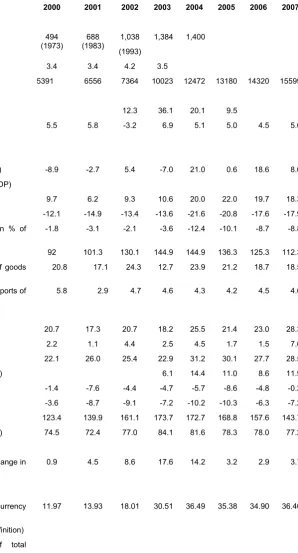
ANNEX 2 Table of macroeconomic indicators
2000 2001 2002 2003 2004 2005 2006 2007
Basic data
1 Population (in 1000) 494
(1973) (1983) 688 1,038 (1993)
1,384 1,400
- annual change in % 3.4 3.4 4.2 3.5
2a Nominal GDP (in millions GMD) 5391 6556 7364 10023 12472 13180 14320 15599
2b Nominal GDP per capita (in millions GMD)
2c - annual change in % 12.3 36.1 20.1 9.5
3 Real GDP (annual change in %) 5.5 5.8 -3.2 6.9 5.1 5.0 4.5 5.0
4 Gross fixed capital formation (in % of GDP)
International transactions
5 Exports of goods and services (in % of GDP) -8.9 -2.7 5.4 -7.0 21.0 0.6 18.6 8.6
- of which the most important: … (in % of GDP)
6 Trade balance (in % of GDP) 9.7 6.2 9.3 10.6 20.0 22.0 19.7 18.3
7 Current account balance (in % of GDP) -12.1 -14.9 -13.4 -13.6 -21.6 -20.8 -17.6 -17.9
8 Net inflows of foreign direct investment (in % of
GDP) -1.8 -3.1 -2.1 -3.6 -12.4 -10.1 -8.7 -8.8
9 External debt (in % of GDP) 92 101.3 130.1 144.9 144.9 136.3 125.3 112.3
10 Service of external debt (in % of exports of goods
and non-factor services) 20.8 17.1 24.3 12.7 23.9 21.2 18.7 18.5
11 Foreign exchange reserves (in months of imports of goods and non-factor services)
5.8 2.9 4.7 4.6 4.3 4.2 4.5 4.6
Government
12 Revenues (in % of GDP) 20.7 17.3 20.7 18.2 25.5 21.4 23.0 28.3
- of which: grants (in % of GDP) 2.2 1.1 4.4 2.5 4.5 1.7 1.5 7.0
13 Expenditure (in % of GDP) 22.1 26.0 25.4 22.9 31.2 30.1 27.7 28.5
- of which: capital expenditure (in % of GDP) 6.1 14.4 11.0 8.6 11.9
14a Deficit (in % of GDP) including grants -1.4 -7.6 -4.4 -4.7 -5.7 -8.6 -4.8 -0.2
14b Deficit (in % of GDP) excluding grants -3.6 -8.7 -9.1 -7.2 -10.2 -10.3 -6.3 -7.2
15 Debt (in % of GDP) 123.4 139.9 161.1 173.7 172.7 168.8 157.6 143.7
- of which: external (in % of total public debt) 74.5 72.4 77.0 84.1 81.6 78.3 78.0 77.2
Other
16 Consumer price inflation (annual average change in
%) 0.9 4.5 8.6 17.6 14.2 3.2 2.9 3.7
17 Interest rate (for money, annual rate in %)
18 Exchange rate (annual average of national currency
per 1 €) 11.97 13.93 18.01 30.51 36.49 35.38 34.90 36.40
19 Unemployment (in % of labour force, ILO definition)
ANNEX 2 BIS
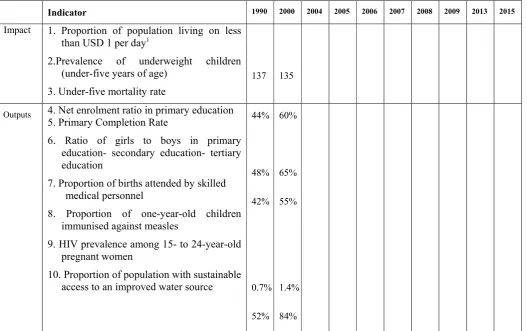
Table of indicators for the MDGs
Indicator 1990 2000 2004 2005 2006 2007 2008 2009 2013 2015
Impact 1. Proportion of population living on less than USD 1 per day1
2.Prevalence of underweight children (under-five years of age)
3. Under-five mortality rate
137 135
Outputs 4.Net enrolment ratio in primary education 5. Primary Completion Rate
6. Ratio of girls to boys in primary education- secondary education- tertiary education
7. Proportion of births attended by skilled medical personnel
8. Proportion of one-year-old children immunised against measles
9. HIV prevalence among 15- to 24-year-old pregnant women
10. Proportion of population with sustainable access to an improved water source
44%
48%
42%
0.7%
52% 60%
65%
55%
1.4%
TITLE GLOBAL COMMITMENT GLOBAL COMMIT. INDIV. COMMIT RAC % RAC
TITLE INDIVIDUAL COMMITMENT AMOUNT ONGOING
INDIV. COMMIT.
PAYMENTS ON ONGOING INDIV.
COMMIT.
RAP % RAP
9 EDF ON ONGOING GLOBAL COMMITMENTS 48.006.964 38.653.339 9.353.625 19%
9 EDF ON ONGOING INDIVIDUAL COMMITMENTS 38.653.339 1.065.604 37.587.735 97%
8 EDF ON ONGOING GLOBAL COMMITMENTS 36.484.907 29.231.880 7.253.026 20%
8 EDF ON ONGOING INDIVIDUAL COMMITMENTS 20.160.944 15.977.297 4.183.647 21%
7 EDF ON ONGOING GLOBAL COMMITMENTS 18.530.000 18.389.213 140.787 1%
7 EDF ON ONGOING INDIVIDUAL COMMITMENTS 4.618.510 4.400.373 218.137 5%
TOTAL ON ONGOING GLOBAL COMMITMENTS ( 7+ 8+ 9th EDF ) 103.021.871 86.274.432 16.747.438 16%
YEAR of GLOB. Commit. ACCOUNTING
NUMBER of GLOBAL commit.
END date of imple-
mentat°