Journal of Global Pharma Technology
Available Online at:
www.jgpt.co.in
RESEARCH ARTICLE
Evaluation of Enzymes Liver and Kidney Function in Serum
People the Exposures at Risk of Chemicals Volatile in the Lab
Pharmaceutical Samarra
Methaq N. Mahmood1*, Mohammed H. Mahal
2,
Human E. Mohammed2, Batol I.
Dheeb2, Thaer A. Tariq1, Ahmed J. Mohammed
11. Department of Chemistry-College of Applied. Sciences-University.of.Samarra-Iraq.
2. Department.of.Pathological.Analyzes-College.of Applied Sciences-University of Samarra-Iraq.
*Corresponding Author: Methaq N. Mahmood
Abstract
Included the present examination procedure of making sense of the value, sum, or nature of something of certain numbers that change identified with the synthetic substances in living things in the squandering almost no while working or delivering something of the functions of the liver represented by the enzymes ALT and AST and organ that creates urine represented by the creatinine and the Uric acidin blood of people workers in the public company for medicine Samarra from exposure at risk of materials chemical dangerous and unstable used in the making of medicine compared of people non-workers as a group control in the city of Samarra, a total of 60samples 30samples from workers in the public company for medicine Samarra from exposure at risk of materials chemical dangerous and unstable 30 control non-workers group their ages ranged from 30 to 45 years, and after the separation of serum managed and did/done tests (related to the chemicals in living things) own research. Results
showed big increased(P˂0.05) at levels of the enzymes ALT and AST in the group exposure at
risk of materials chemical dangerous and unstable as compared with the control group, As showedresults increased (a lot)( P˂0.05) at levels of the creatinine in the group exposure at risk of materials chemical dangerous and unstable as compared with the control group, Whereas the Uric acid had a big drop in group exposure at risk of materials chemical dangerous and unstable as compared with the control group.
Keywords: Exposed volatile chemical, ALT, AST, Creatinine, Uric acid
Introduction
Over the last few years, attention has been paid to work-related sicknesses and related to working on the job exposure to different chemicals and industrial parts/areas. The result of increasing health and cultural knowledge of the importance of safety of the work conditions and the reduction of health risks resulting from pollution.
And using different body-structure-related and disease-related indicators in different industries [1].In relation to chemicals. A hazard] is a set of inherent properties of the Substance, mixture, Article] or process that may cause bad effects to organisms. Or the
health of the Earth/the surrounding conditions. There are two. Broad types of dangers/risks connected with dangerous chemicals.
Typical sudden and short-term health effects include headaches, nausea or vomiting and skin (slow chemical breakdown of something rust, etc.), while long-lasting health effects include breathing disease, skin swelling, nerve damage or cancer.
Physicochemical-dangers/risks - These
are-physical-or-chemical-properties- of the substance,-mixture or-article that present/ cause risks to-workers-other than health risks, as they do not-happen as a result of the-related to the body function of living things-interaction of the chemical with people. They arise through-inappropriate handling or use and can often result in injury to people and/or damage to property because of the built-in-physical-danger/risk.
Examples-of
physicochemical-hazards-include flammable, causing slow chemical destruction, explosive, chemically reactive
andoxidizing chemicals
[2].The-test/evaluation-of health-risks
from-dangerous-chemicals involves-gaining an-understanding of the-situations-where people can be exposed-to, or come-into contact-with
the-chemicals, including-the extent of
exposure-and how often-this can happen. Health risk depends on hazard- seriousness/ level and-level of exposure,-and this way-depends on-both the type of chemical-and also the-nature of the-work-itself [3].
The drug-based industry is also exposed to chemicals in (more than two, but not a lot of) ways, including micro-dust used in the preparation of grains, germ-killing drugs, fly dust from the germ-killing substance suspension process, and the sterilization of substances used in the preparation of mouth drops, drinks and ointments.
These processes lead to exposure through (breathing in)[4].And enter these substances to the body and then appear side effects on the body by the coming into view of different sicknesses and so lead to damage to the disease-fighting system and cellular in the body and the production of body-damaging chemicals [5].
Because of (related to surrounding conditions or the health of the Earth) pollution, many risks to the body-structure-related aspects and (related to working on the job) health, especially to people exposed to it directly and continuously, especially in the field of drug-based industry, it was necessary to permit
the flow of the current study on the workers of the General Company for the manufacture of medicines in Samarra.
Experimental
Materials and Methods
The disposable detaler to careful studying or deep thinking) kits given by different ylods of a person's lifeMorocco companies are used to guess a number some of the related to the chemicals in living things studies.
Collection of Medical Samples/Examples
Conducted the present study in the city of Samarra, collected samples of people workers in the public company for medicine Samarra, was 50 samples are classified to 30 samples from exposure at risk of materials chemical dangerous and unstable used in the making of medicine, and 20 samples was a non-exposure at risk of materials chemical dangerous and unstable control. Ages were a rang 30-45 year, withdrawn 5 ml of the blood by syringe disposable.
Then put blood samples after withdrawal collecting into gel tubes free of from anticoagulant and separating the serum by the device that spins something at a high speed (3500 r.pm) for 10 min. The serum is divided into four parts using open drove tube per sample and save on the degree of freezing until tests biochemical.
Tests of Parameters
In this examination was speculated (number) of Serum Alanine Aminotransferase - ALT movement and Guess of Serum Aspartate Aminotransferase-AST action [6], Guess of Serum Creatinine [7] and Guess of Serum Uric Acid [8,9].
Results and Discussion
Procedure of making sense of the value, sum, or nature of something of Enzymes Liver in Serum People the Exposures at Risk of Chemicals Dangerous and unstable Alanine Aminotransferase-ALT:
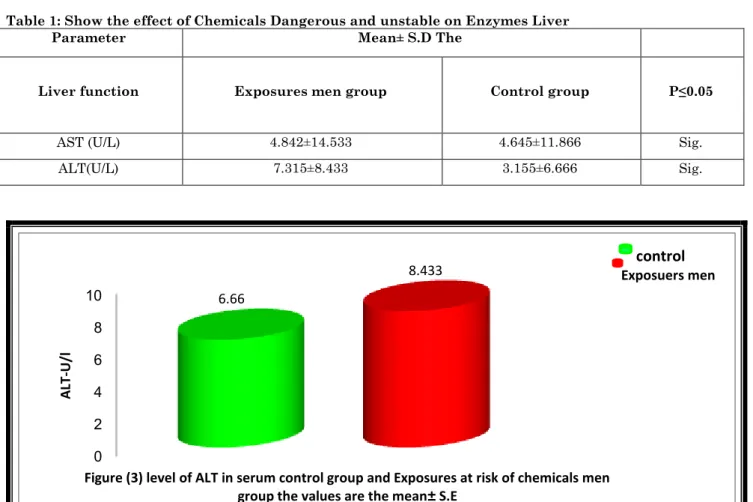
Table 1: Show the effect of Chemicals Dangerous and unstable on Enzymes Liver Mean± S.D The
Parameter
P≤0.05 Control group
Exposures men group Liver function
Sig. 4.645±11.866
4.842±14.533 AST (U/L)
Sig. 3.155±6.666
7.315±8.433 ALT(U/L)
6.66
8.433
A
LT
-U/l
Figure (3) level of ALT in serum control group and Exposures at risk of chemicals men
group the values are the mean±S.E
control Exposuers men
Aspartate Aminotransferase-AST:
The results of the present study showed that the levels of AST iitiaailtsyis[increased (p≤0.05) in Exposures at risk of chemicals dangerous and unstable men group when-compared with control group show (Table1) (Figure4). Relate the increase of activity ALT and AST enzyme to Serum People the Exposures at risk of chemicals dangerous and unstable compared with the control group.
ALT is an enzyme involved in the move from one place to another of an amino gathering from alanine and present in the cytoplasm. ALT is found in various tissues however is most regularly associated with the liver. Subsequently, ALT is a decent biomarker of hepatocellular injury. [10] AST is a protein associated with the move (starting with one spot then onto the next) of an amino gathering from aspartate.
Over 80% of AST is available in the mitochondria and the staying 20% of AST is available in the cytoplasm. Thus, cytosolic AST (cAST) rapidly shows up in the blood from a hurt cell however mitochondrial AST (mAST) stays in the center regions of a hurt cell.
Thus, mAST in the blood mirrors the more awful cell harm or passing (of skin or other living tissue. [11] In the instance of alcoholic liver infection, basically the mitochondria are harmed. Thus, AST expands more than ALT [10].Unlike the layer bound chemical, the cytosolic compound does not spill into the blood. Healthy plasma films ought to be difficult to enter to macromolecules, for example, enzymes.
It is commonly acknowledged that expanded cytosolic protein in the blood happens auxiliary to cell layer harm or cell passing (of skin or other living tissue). [12] Therefore, expanded AST and ALT are biomarkers of related damage as opposed to liver-related hurtful, irate behaviors [10].
Measurement of (organ that creates urine) function by Evaluation of Creatinine in Serum People the Exposures at Risk of
Chemicals Dangerous and unstable. The
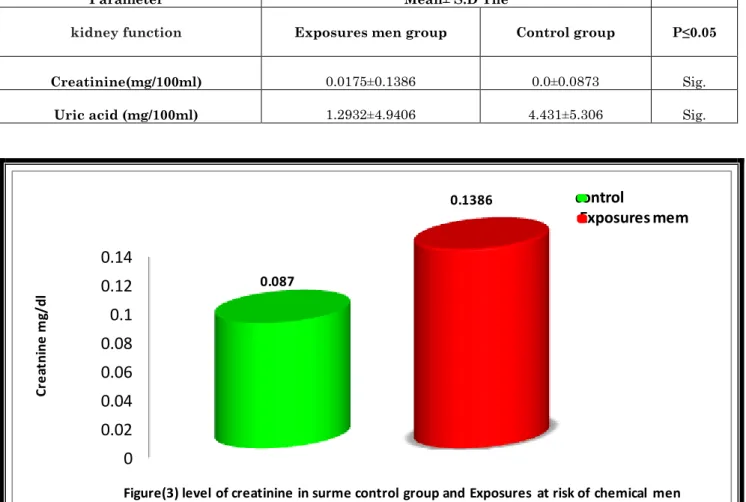
Table 2: Show the effect of Chemicals Dangerous and unstable on some kidney function.
Mean± S.D The Parameter
P≤0.05 Control group
Exposures men group kidney function
Sig. 0.0±0.0873
0.0175±0.1386
Creatinine(mg/100ml)
Sig. 4.431±5.306
1.2932±4.9406
Uric acid (mg/100ml)
0
0.02
0.04
0.06
0.08
0.1
0.12
0.14
0.087
0.1386
C
re
at
n
in
e
m
g/
d
l
Figure(3) level of creatinine in surme control group and Exposures at risk of chemical men
group the values are the men ±S.E
control
Exposures mem
procedure of making sense of the value, sum, or nature of something of Uric acid in Serum People the Exposures at Risk of Chemicals Dangerous and unstable. The results of the present study showed that the levels of Uric
acid increased (a lot) (p≤0.05) in Exposures at risk of chemicals dangerous and unstable men group when compared with control group show (Table2) (Figure4).
4.6
4.8
5
5.2
5.4
5.306
4.940
U
ri
c
ac
id
m
g/
d
l
Figure (4) level of Uric acid in surme control group and exposures at risk of hemical meen
group the values are the mean±S.E
control
Exposures men
The usual functions of the organs that create urine .The (organs that create urine) assume an extremely important job in the regulation
poisonous substances, both coming from the outside of something entering the body from the outside and endogenous produced in the body , are such that delivers a great deal with next to no waste eliminated via the organs that create urine.
The organ that creates urine ability to purify the blood is large/relatively large. In the adult, the filtration of blood through millions of glomeruli results in the production of about 125 ml of first or most important) urine every minute, which goes along with/matches up to a production of 180 l/day. First or most important urine consists of an ultra filtrate of plasma. In the kidney-related tubules, the tubular cells usually reabsorb more than 99.9% of the substances (amino acids, small proteins, sugars, etc , salts, and fluid that the body needs to keep/hold.
The substances that are not reabsorbed are collected in the urine and (gave off/pushed out) from the body. Sometimes, the organs that create urine may also actively give off push out substances such as some drugs and poisonous chemicals, and the purification of the blood this way becomes even producing more with less waste [13]. The organs that create urine also have important endocrine functions. They produce chemicals produced by the body, which control the blood pressure, and a chemical produced by the body, which stimulates the production of red blood cells in the (deep inside of the bones erythropoietin.
Another chemical produced by the body from the organs that create urine is calcitriol. It is produced in the (organs that create urine) from vitamin D activated in the liver. It stimulates the mental concentration/picking up of a liquid of silvery metal/important nutrient from the intestinal area of land and the usual/ commonly and regular mineralization of the bone and uses/puts into action negative reactions or responses to something/helpful returned information for the production of parathyroid chemical produced by the body release of fluid) [13].
Preventing [renal disease and failure is therefore very important, Knowledge about the causes] of kidney-related sicknesses is limited as disease where blood sugar swings wildly , arteriosclerosis, and different types of (related to the body attacking itself) and [hereditary sicknesses are important causes, but in many cases, the (cause of a disease remains unknown.
Certain drugs and chemicals, such as phenacetine and ethylene glycol, are known to bring out sudden and short-term and long-lasting failure. more than two, but not a lot of chemicals eg, polychlorinated dangerous and unstable hydrocarbons and metal eg, cadmium, mercury, lead and chromium can also use put into action more sneaky and harmful nephrotoxic effects, are the view of poisonous nephropathies has been given by WHO [14].
References
1. Layer RW, Ghoodrich BF (1963) Chem.
Rev., 63-489.
2. Managing risks of hazardous chemicals in
the workplace Code of practiceP7-19(2013).
3. Dayagi S, Degani Y (1970) The Chemistry
of Carbon-Nitrogen Double Bond, Ed. S. Patrai, Wiley-Inter Science, New York., 239.
4. Reddelien G, Danilof H (1922) Chem.
Abst., 16-1761.
5. Wilkinson G, Gillard RD, McCleverty JA
(1987) Comprehensive Coordination
Chemistry. 1st. ed., Pergamum Press., Oxford, England, II: 715-735.
6. Britman S, Frankel S (1957) Am. J. Clin.
Path., 28: P56-63.
7. Henry JB (1984) Clinical Diagnosis and
management 17th edition, Sauders
Publisher.
8. Burtis CA, Ashwood ER (1999) Tietz
textbook of clinical chemistry. 3rdED. USA.W. B. Saunders Company, 490 (482): 500.
9. Fossati P, Prencipe L, Berti G (1980) Use
of 3, 5-dichloro-2-hydroxybenzene sulfonic
acid /4-aminophenazone chromogemc
system in directenzymic assay of uric acid in serum and urine. Clin. Chem., 26: 227-231.
10.Kim YJ (2008) Interpretation of liver
11.Kamiike W, Fujikawa M, Sumimura J, Miyata M, Kawashima Y, Wada H, TAgawa K (1989) Differential patterns of leakage of cytosolic and mitochondrial enzymes.Clin Chim Acta, 185: 265-270. 10.1016/0009-8981(89)90216-7(1989).
12.Solter PF (2005) Clinical pathology
approaches hepatic injury. Toxical.
Pathol., 33(1):9-16.
13.Fels LM, Bundschuh I, Gwinner W, Jung
K, Pergande M,
Graubaum HJ, et al (1994) Early urinary
markers of target nephron
segments as studied in cadmium toxicity. Kidney Int., 46 (47): 81-8.
14.World Health Organization (WHO) (1991)
Principles and methods