The Eternal Triangle
Adam McBride
Based on a presentation at the SMC Conference, University of Stirling, 28 April 2001
Introduction
The story starts one lunchtime in August 1998. A group of bright young postgraduates are perusing the problems set in the 1998 International Mathematical Olympiad which I had brought back from Taiwan. The problems are tough. (You can see for yourself in my
article in SMC Journal 28, pages 13-15.) I expected the students to run into trouble sooner or later but I had hoped that they would get a little further than the first problem. Among all these experts in things like fluid mechanics and numerical analysis, none knew what a cyclic quadrilateral was. (However, there were some novel suggestions!)
Although this does not quite represent the end of civilisation, it is nevertheless a poor show and epitomises the lack of basic geometrical knowledge among the vast majority of today's undergraduates in science and engineering. Forty years ago when I was a lad, life was rather different. Geometrical deductions were part of the curriculum for a large
percentage of each cohort. This percentage was almost certainly too large, with many pupils finding the going very hard indeed. The 'solution' adopted was to do away with almost everything and introduce new approaches, with topics like transformation geometry and tessellations becoming flavour of the month.
One major casualty in this revolution was the idea of proof in mathematics. Geometry provided an excellent vehicle for developing powers of deductive reasoning, which are needed in all branches of mathematics. Undergraduates embarking on a first course in analysis are hit by a double whammy. The dreaded and are bad enough but, in
addition to learning what is tantamount to a foreign language, students have to string the 'words' together to form sentences and logical arguments. A 'proof' produced nowadays by a typical student usually contains most of the right words but all in the wrong order.
engineers are being short-changed by the way geometry is taught at present. At the other end of the spectrum are lots of people who will get through life perfectly happily without knowing that the altitudes of a triangle are concurrent. How to satisfy the needs of a disparate population is a challenge that needs to be faced.
Let's go back to the postgraduates eating their sandwiches in 1998. I decided there and then to give them a course of lectures on the geometry of the triangle. The response was remarkable. The topic was totally different from the usual material of such courses and they loved it! At one level they were exposed to sustained logical arguments. At another level they could appreciate the elegance of many of the results.
● Two non-parallel lines intersect at a point but we keep coming across sets of three
concurrent lines (medians, altitudes, etc.)
● In general two circles either intersect at two distinct points or miss each other
completely but we keep coming across circles which touch.
● Three non-collinear points are sufficient to determine a circle. What then is the
likelihood of nine interesting points lying on one circle?
We have no right to expect any of these flukes and yet they are all nestling inside the humble triangle.
Come with me as we attempt to unravel the mysteries of what's going on. For some
readers this will be a voyage of discovery, while for others it may be more of a trip Down Memory Lane. The material contains opportunities for the lowest attainers to draw pretty pictures as well as opportunities to teach high attainers how to construct rigorous proofs. For everyone, there is the chance to wallow in the sheer beauty of it all.
Congruent Triangles
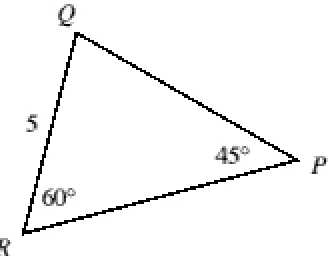
Any triangle has three sides and three angles. However, we do not need all six bits of information to determine a triangle uniquely. For example, suppose we know that
Draw a line segment of length 2 cm to represent . Form an angle of and head off in
this direction for a distance of 3 cm to arrive at . The three vertices and are now
Figure 1: triangles given SAS
If the three triangles shown in Figure 1 were made of cardboard, any one could be placed exactly on top of either of the others. In this sense the triangles are regarded as equivalent or congruent. Knowing the lengths of the sides and , as well as the size of the
included angle , we can calculate the length of and the size of the angles at and . Here are four ways of proving two triangles congruent.
● SSS (side-side-side)
● SAS (side-angle-side; two sides and the included angle)
● AAS (angle-angle-side; two angles and the corresponding side)
● RHS (right angle-hypotenuse-side).
SAS was the one discussed above. To illustrate AAS consider and
. Note that and correspond to and respectively.
Hence and are corresponding sides. We say that is congruent to and
write .
(Note that we use and not because correspond to respectively in
Figure 2.)
[image:3.612.387.551.570.699.2]In contrast, knowing the three angles of a triangle is not enough to specify a triangle
uniquely (although it would be unique up to similarity, rather than congruence). Likewise two pairs of angles and a pair of non-corresponding sides are not sufficient.
In days of yore, before the advent of vectors, the proofs in school geometry books were based fairly and squarely on the use of the four cases of congruence listed above. We are talking here of books like those by Walker and Millar (12s 3d in old money) or White and Morrison. It is instructive to recall what such proofs looked like. (I'll only include two in detail now, but those of a frail disposition may wish to jump ahead.) Let us consider the (internal) bisectors of the angles of a triangle. As a starter for ten, we need
Theorem 1 The locus of a point equidistant from two intersecting straight lines is the bisector of the angle between them.
[image:4.612.185.429.342.528.2]There is actually quite a lot to be done here as we shall now see.
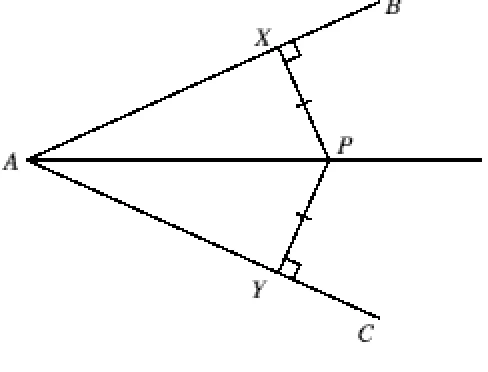
Figure 3: equidistant from and
Part 1 We shall prove that any point which is equidistant from two intersecting lines lies on the bisector of the angle between them. Let us set things up in Figure 3.
Given:- Straight lines and meeting at ;
any point equidistant from and .
Construction:- Join . Draw perpendicular to respectively.
Proof:- In and ,
1. (given; is equidistant from and )
2. ( is a common side of the two triangles)
3. (right angles, by construction).
∴ (RHS).
∴ .
∴ is on the bisector of .
Don't relax yet. We are only half finished!
[image:5.612.187.428.428.605.2]Part 2
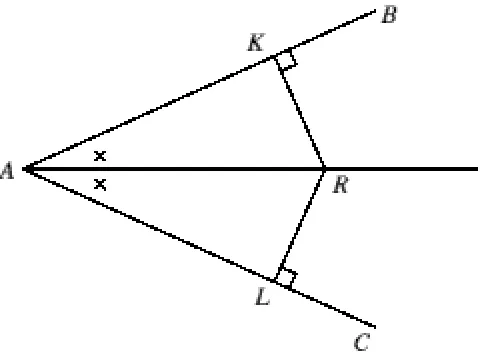
Figure 4: on the bisector of
Given:- Straight lines and meeting at ,
RTP:- is equidistant from and .
Construction:- Draw , perpendicular to respectively as in Figure 4.
We want to prove that .
Proof:- In and
1. (given)
2. (right angles, by construction)
3. (common side)
∴ (AAS; is opposite the right angle in both triangles).
∴ .
∴ is equidistant from and .
Only now can we add Q.E.D. (quod erat demonstrandum) if we wish!
Theorem 2 The internal bisectors of the three angles of a triangle are concurrent. The point of
[image:6.612.180.430.543.688.2]concurrence is called the incentre and is the centre of the inscribed circle which touches the three sides of the triangle.
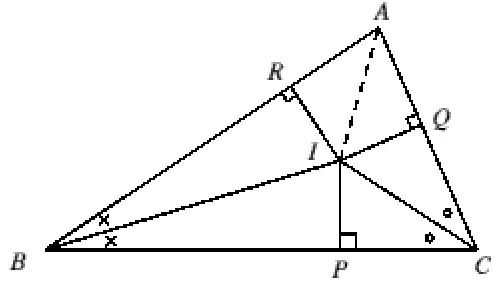
Given:- .
RTP:- The bisectors of , and are concurrent.
Construction:- Draw and , the bisectors of and , respectively which
meet at , as shown in Figure 5.
Draw perpendicular to respectively.
Join .
We shall show that bisects .
Proof:- is the bisector of .
∴ is the locus of points equidistant from and (Theorem 1, Part 2).
∴ .
Similarly .
∴ .
∴ is equidistant from and .
∴ lies on the bisector of (Theorem 1, Part 1).
Also, since , is the centre of a circle which passes through and
therefore touches the three sides of .
Q.E.D.
Commentary
● a clear statement of the result
● a diagram with relevant points labelled
● a clear statement of what we are given
● a clear statement of what we are trying to prove
● some constructions, if required
● a proof based on congruent triangles (and using results proved previously).
Note the use of '∴' for 'therefore' rather than the all-pervasive '⇔' which is frequently
misused and abused nowadays. Theorem 1 also highlights the difference between a
statement and its converse (i.e. versus ).
Note Those of a frail disposition can rejoin us here!
Triangle Centres
There are four well-known (?) sets of three lines, associated with a triangle , which
meet at a point.
● The medians meet at the centroid,
● The altitudes meet at the orthocentre,
● The (internal) angle bisectors meet at the incentre,
● The perpendicular bisectors of the sides meet at the circumcentre, .
is the centre of the circumcircle of , i.e. the unique circle which passes through
the three vertices of the triangle.
The letters , , and will be used for these special points from now on.
As mentioned earlier, we have no right to expect three lines to be concurrent. Yet here we
have four such 'flukes'. However, these are not all independent of each other.
Theorem 3 Given that the perpendicular bisectors of the sides of any triangle are concurrent, it follows that the altitudes of any triangle are concurrent.
Proof:- We shall adopt a streamlined version of the style used in Theorem 1 and 2.
Through each vertex draw a line parallel to the opposite side (i.e. lines through
parallel to respectively). Let these intersect at as shown in Figure 6.
It is not hard to prove that and are parallelograms so that , both
being equal to .
Figure 6: altitude of
Let be the altitude of through . Since and are parallel, is
perpendicular to . From above, it follows that is the perpendicular bisector of
. By a similar argument applied to the other two altitudes of , we see that the
altitudes of are the perpendicular bisectors of the sides of . By assumption,
the perpendicular bisectors of are concurrent. Hence the altitudes of are
concurrent.
Q.E.D.
Here is another interconnection.
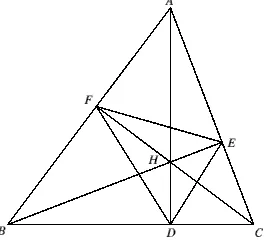
Figure 7: pedal triangle of
Figure 7 contains a lot of rich structure. At this stage, the dreaded cyclic quadrilateral surfaces. (For younger readers in the same boat as the postgraduates, a cyclic quadrilateral is a quadrilateral whose four vertices all lie on a circle.) In the diagram, is the
orthocentre of . We know that
∴ is a cyclic quadrilateral (opposite angles supplementary).
∴ (angles in same segment of circle ).
Similarly since is a cyclic quadrilateral.
Also since is a cyclic quadrilateral.
∴ (relabelling angles).
∴ .
We have therefore proved the following result.
Theorem 4 The altitudes of a triangle are the angle bisectors of the corresponding pedal triangle.
Euler Line
Next let us investigate connections between various triangle centres. To get the full
flavour, we shall work with a scalene triangle, i.e. one in which the sides all have different lengths. (If the original triangle is isosceles or equilateral, diagrams will degenerate. For
example, if is equilateral, , , and coincide.)
Use of some package such as Geometer's Sketchpad or Cabri Geomètre may suggest
various results. For example, it looks as though , and lie on a line and that
trisects . Can this be true?
Theorem 5 The centroid , the orthocentre and the circumcentre of a (scalene) triangle lie on a straight line, called the Euler Line of the triangle. Further, in vector notation,
[image:11.612.191.419.382.653.2]Proof:-
Figure 8: Euler line of
Let A' be the mid-point of , so that is the perpendicular bisector of and is
It is a standard result that .
Let be the point on the line through and such that , as shown in Figure
8.
We shall prove that is actually .
In and
1. (from above)
2. (vertically opposite angles).
∴ and are similar.
∴ .
∴ is parallel to .
∴ (extended) is perpendicular to (since ).
∴ lies on the altitude of through .
Similarly lies on the altitudes of through and .
∴ is the orthocentre of .
∴ are collinear and .
Q.E.D.
Greek geometers. (Euler discovered this in the 18th century.) We shall meet the Euler line again in a moment.
Meanwhile, let us turn our attention to circles related to a triangle. We have already met the incircle and the circumcircle, but that's only a start.
The 9-point circle
Given that three non-collinear points determine a circle uniquely, the likelihood of nine special points lying on a circle seems remote indeed. However, we are in for another wonderful surprise.
Theorem 6 Given , there is a circle passing through the following nine points:
the mid-points of , , respectively
the feet of the altitudes , , respectively
the mid-points of , , respectively.
Further, the centre of the circle is the mid-point of and the radius of the circle is
Figure 9: 9-point circle
Proof:- To start with we shall use vectors and take , the circumcentre, as origin (a shrewd choice!).
Let , , .
By definition of the circumcircle,
By a standard result .
∴ (Theorem 5).
Also ( is the mid-point of ).
Now ( is the mid-point of ).
∴ (by(*)).
Similarly .
∴ and lie on the circle with centre and radius .
Next .
∴ .
∴ .
Similarly .
∴ and lie on the circle with centre and radius .
From above and .
∴ is the mid-point of .
However subtends a right-angle at .
∴ is a diameter of the circumcircle of and
is the centre of this circle.
∴ .
Similarly .
Q.E.D.
For your further amazement, we can state
Theorem 7 The 9-point circle of is also the 9-point circle of each of , and .
Proof:- Consider in Figure 9. It is enough to prove that the 9-point circle of is the unique circle passing through the mid-points of the sides , and . However, these are the
points, and in the notation of Theorem 6 and do indeed lie on this circle.
The same applies to and .
Q.E.D.
Three more circles now come into the picture. We consider one in detail, with the other
two being similar. We shall bisect of internally as before. However, we now
Figure 10 : escribed circle opposite
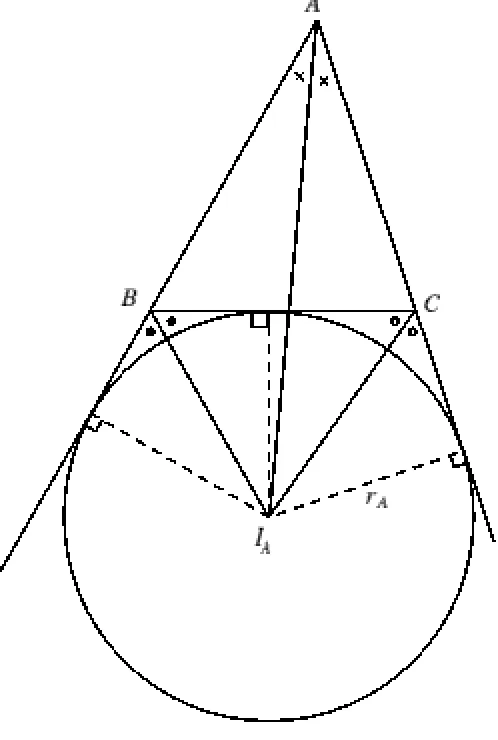
Theorem 8 The internal bisector of and the external bisectors of and are concurrent at a point , which is the centre of a circle which touches internally and the sides and
externally (in the sense that and are extended beyond and ).
Definition In the notation of Theorem 8, is called the excentre of opposite and the corresponding circle is called the escribed circle opposite .
There are excentres and escribed circles opposite vertices and as well.
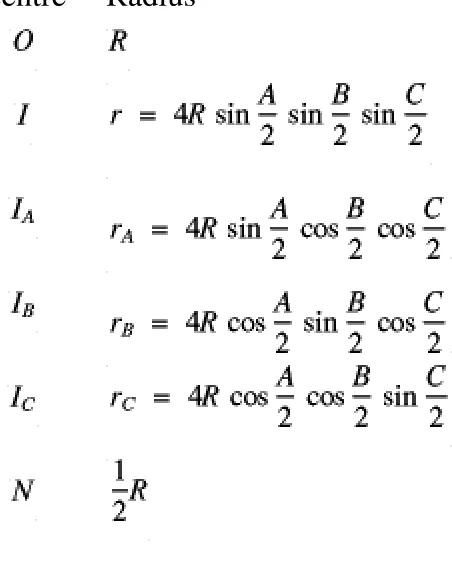
Relations between the various circles
Circle Centre Radius
Circumcircle
Inscribed
Escribed, opposite
Escribed, opposite
Escribed, opposite
[image:18.612.266.492.41.330.2]Nine-point
Table 1
Calculation of the radii of the inscribed and escribed circles involves the use of
trigonometric identities and is left as an exercise for the reader. Here are two more such exercises.
● , so that .
●
However, rather than dwell on algebraic manipulation, we turn to yet another remarkable result, proved by Karl Feuerbach in 1822.
Theorem 9 (Feuerbach's Theorem)
The 9-point circle of a triangle touches the inscribed circle and each of the three escribed circles.
Challenge Starting with a large scalene triangle, construct every special point and circle mentioned so far, using only a straight edge (with no scale) and a pair of compasses. If you succeed, frame the
drawing and hang it on the wall in your classroom.
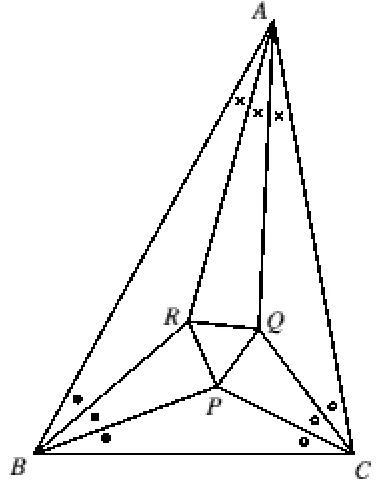
While we are in this neck of the woods, look at the diagram below in which the angles of
[image:19.612.210.400.159.404.2]an arbitrary triangle have been trisected. What do you think is true of ?
Figure 11: Morley's theorem
Theorem 10 (Morley's Theorem; 1899)
(i) is equilateral.
(ii) Each side of has length , where is the circumradius of
.
The formula for the side-length is reminiscent of those in Table 1. However, there is one new feature. You can bisect an angle using a straight edge and compasses but you cannot trisect an angle in this way. The reason must wait for another time.
Actually this is only the tip of the iceberg. For example, look again at Theorem 9. The
9-point circle of contains 4 more interesting points, where it touches the inscribed
and escribed circles of . Moreover, Theorem 7 tells us that we'll get another 4
interesting points from each of , and . So our 9-point circle now has
25 interesting points lying on it!
As for interesting points inside a triangle, and are a mere drop in the ocean.
Find hundreds more 'triangle centres' at the website
http://cedar.evansville.edu/~ck6
which is lovingly maintained by Clark Kimberling.