White Rose Research Online URL for this paper:
http://eprints.whiterose.ac.uk/91066/
Version: Published Version
Book Section:
Brooks, Sally Heather orcid.org/0000-0002-1005-1245, Burges-Watson, Duika, Draper,
Alizon et al. (3 more authors) (2013) Chewing on Choice. In: Abbots, Emma-Jayne and
Lavis, Anna, (eds.) Why we eat how we eat. Critical Food Studies . Farnham: Ashgate
Publishing Ltd .
[email protected] https://eprints.whiterose.ac.uk/ Reuse
Items deposited in White Rose Research Online are protected by copyright, with all rights reserved unless indicated otherwise. They may be downloaded and/or printed for private study, or other acts as permitted by national copyright laws. The publisher or other rights holders may allow further reproduction and re-use of the full text version. This is indicated by the licence information on the White Rose Research Online record for the item.
Takedown
If you consider content in White Rose Research Online to be in breach of UK law, please notify us by
Chewing on Choice
Sally Brooks, Duika Burges Watson, Alizon Draper, Michael Goodman, Heidi Kvalvaag and Wendy Wills
Introduction
The concept of ‘individual choice’ has become central to contemporary understandings of the relationship between food, health and wellbeing. Drawing on four research projects in which the authors have recently been engaged (Brooks 2010; Goodman et al. 2012; Kvalvaag 2012), this chapter explores how and why the concept of choice has become so central to explanations for ‘why we eat how we eat’. We explore the multifarious ways and means through which discourses of ‘food choice’ have been deployed and gained political and material ‘real world’ salience in a number of different contexts; locating ‘choice’ theoretically – as a concept borrowed from neoclassical economics to augment biomedical theories with a thinking subject – and politically, as an indeterminate and ‘slippery’ concept adaptable to shifting policy platforms. The multiple manifestations and consequences of this slipperiness are explored through the cases of: food and nutrition policymaking in the UK over the last 25 years; an international nutrition system generating policies and programmes for ‘beneiciaries’ in the developing world; and the strategies of an increasingly high-proile alternative food movement.
This chapter is organized as follows. We begin by tracing the emergence of choice as a core concept guiding food and health policy; inding its origins in the a priori separation of the thinking subject from the physical body in early medical science. In this case, the slipperiness of ‘choice’ is a result of its conceptualization as ‘clean thought’, disconnected from both embodied experience and societal context. Secondly, we examine the operationalization of the concept in UK food and nutrition policy between 1976 and 2010 through a critical discourse analysis of selected key policy documents published during this period. Several ‘frames’ of choice, are identiied, all of which accommodate discourses of choice that are complex, overlapping and contradictory. Furthermore they have changed over time; relecting the shifting balance of inluence between different stakeholders in food and nutrition policy.
trace attempts of alternative food movements (AFNs) to reframe food choice as an ethico-political act from numerous angles and with varying outcomes. Considering the discourses of choice articulated by AFNs, this section explores the politics embedded in individual food choice and the various rationales for opening up and/or closing down food choice in AFNs. In this case, recent developments in what might be called the ‘taste turn’ in food studies converge with new developments in human biology, which are only touched upon here, to provide a starting point for the re-mapping of the conceptual and political terrain of food choice, health and eating through a consideration of the socialized and ‘visceral’ aspects and geographies of food (Goodman 2011). We conclude by considering, briely, what a ‘chewing over’ of individual choice might mean for further research and scholarship.
Forming Choice: Theorizing Action Without a Body
In this section we explore the origins of ‘choice’ as a core concept informing contemporary policies on food and health. The concept of choice, we argue, is the product of the co-evolution of three distinct bodies of knowledge concerning ‘the body’, ‘food’ and ‘eating’ (Kvalvaag 2012). We begin by exploring how ‘the body’ came to be understood within modern medicine from the Enlightenment era onwards. Secondly, we trace the development of nutrition as the science of food and food-body interaction. Thirdly, we turn our attention to how the act of ‘eating’ has been conceptualized. This analysis highlights ‘individual choice’ as an explanatory concept for action able to co-exist with established sciences of body and food premised on the analytical severance of the thinking subject from the material body (Kvalvaag 2012).
The production of knowledge about the human body is the mandate of medical science (Porter 1996). Medical science, or biomedicine, emerged in late ifteenth-century Europe; at a time when modern science was developing in search of ‘the’ true knowledge, cleansed of all myth and superstition. Such knowledge could only be accessed through systematic empirical method (Porter 1996), which required the isolation of both scientist and object of study from all personal and contextual disturbances (Haraway 1997). This was consistent with the Cartesian separation of mind and body, which made it possible to study ‘the body’ as an object independent of ‘the person’. A dualistic model became established which divided modern science into natural science (the study of nature and objects) and human science (the study of subjects and meaning) (Hawson 2004). Thus the study of the human body – understood as a physical object – was deined as a natural, not a human science.
examination of its functions in terms of biochemical processes – its physiology. Thus the science of the body was deined in terms of two complementary disciplines – anatomy and physiology – with the laboratory as its central arena (Shier et al. 2008). From this knowledge of ‘normal’ anatomy and physiology, it became possible to identify and treat disturbance and abnormality (Shier et al. 2008). Thus ‘medical treatment’ was understood as acting upon an identiied abnormality in order to restructure the anatomy (through surgery) and/or restore the physiology (through medicine).
Food, together with oxygen, is essential for bodily existence and development (Shier et al. 2008). Formal knowledge of food is generated by nutritional science, through the study of chemical and biochemical aspects of food (Andersen and Drevon 2007). As with medical science, the study of processes through which food and body interact once food has entered the body is bounded by the parameters of natural science. The science of nutrition emerged from biomedicine and is, to a large extent, constituted by the same coniguration of theory, method, equipment and laboratory as the science of the body. Nutrition science can be summarized in terms of three types of research enquiry (Andersen and Drevon 2007). The irst of these is basic research on the chemical content of food; in terms of proteins, carbohydrates, fat, vitamins etc. This is the foundation of nutritional science, on which other, more recent branches of nutritional research are based (Andersen and Drevon 2007).
The second type of enquiry in nutritional science examines interactions between food and the body after ingestion (Aas 2008). From these studies, scientiic knowledge about how, why and where biological decomposition of food occurs in the digestive system – how different foods affect the body and what the body does with food that has been digested – is derived (Andersen and Drevon 2007). The third area of study is the mapping of diets. Translating diets, reported or observed, into chemical compounds analysable in terms of anatomic and physiological variables (BMI, blood sugar, cholesterol etc.) enables physiological correlations between food and the body (or in the case of epidemiology, food and populations) to be made. These studies generate knowledge about what kinds of food promote health and cause illness (Andersen and Drevon 2007).
individualism in the social sciences, the key difference between them is their understanding of meaning and will (Gunnerius 2003).
In neoclassical economic theory the unit of analysis is the autonomous, rational individual who chooses whatever brings maximum beneit – as long as s/he is provided with the right information (Cooper et al. 2010). Behavioural theory also focuses on the individual. This branch of psychology, however, developed in a positivistic tradition, mirrors natural science. For behaviourists there is, in principle, no difference between studying materiality (objects) and studying human behaviour (Gunnerius 2003). As with economic theory, the psychological mechanisms in behaviourism are to avoid discomfort and achieve reward (Gunnerius 2003). What distinguishes behaviourism is that action is theorized as an automatic (rather than a calculated) response to external stimuli. Individuals do not choose – they react (Teixeria 2011). Despite these differences, however, understandings of ‘food intake’ are in both cases premised on a dualistic model that has separated the natural world (of body and food as objects) from the human world of taste and preference, skill and action. As such, both theories serve to bridge the analytical gap between food and body without disturbing the established paradigm.
It is in light of the prior analytical treatment of the ‘body’, ‘food’ and ‘eating’ that we now come to the question of ‘choice‘. Firstly, we showed how established physiological understandings of body and food lack both a subject to act and context of interaction. In this context, theories of action have been imported, highly selectively, from those social science disciplines best placed to deliver an individual subject independent of body, food and societal context. Individual choice as a concept derived from neoclassical economic theory serves this purpose. Premised on the existence of the rational, sovereign, choosing subject – the neoclassical perspective severs ‘the individual’ from all embodied knowledge and experience (e.g. taste, texture) as well as societal inluence and constraints (e.g. culture, social class). ‘Choice’ is thus valorized as ‘clean thought’ (Kvalvaag 2012).
other hand, a physiological determinism endorsed by behavioural theories that deny a role for choice.
Operationalizing Choice:
The Case of UK Food and Health Policy (1976–2010)
Individual ‘choice’ has been operationalized in one political, discursive arena; that of recent UK food policy. As commentators have observed, the dominant approach in food and nutrition policy in the UK (as in many other high income countries) over the last 20–30 years has been a focus on achieving better public health outcomes via behaviour change; speciically by changing food choices (Coveney 2003, Caraher and Coveney 2007). Given the growing evidence of the limited effectiveness of such approaches, particularly in the context of widening health inequalities, the continued reliance on an approach privileging choice as a pathway of change is puzzling. While some studies have explored choice in UK health policy and found it to be an indeterminate, but a nonetheless important organizing principle (Clarke 2005; Clarke et al. 2006; Greener 2009), there has been no critical examination of the concept of choice in UK food policy.
Food and nutrition emerged as a public health priority in the UK in the 1970s. Previously, food policy had been primarily concerned with agricultural production, relecting a post-war preoccupation with food security. During the 1970s, however, alarm about rising oil and food prices converged with new concerns about diet-related non-communicable diseases, and, very gradually, food started to appear on the health policy agenda (Murcott 1994). While there were no signiicant developments during the 1980s,1 from the early 1990s onwards there
has been a succession of policy documents linking food and health. How has the concept of choice been put to work in these policies spanning 25 years? Using a critical discourse analysis approach (Fairclough 2001; Shaw 2010) we explored the uses and meanings of the term ‘choice’ in a series of policy documents.2 From
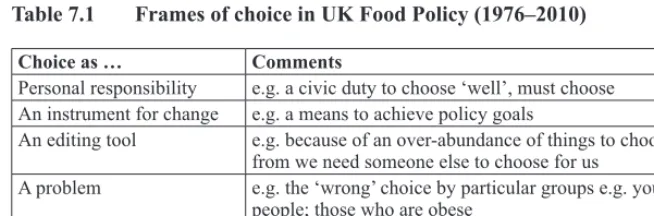
this analysis we identiied ive frames (Schön and Rein 1994), each of which represents a distinct articulation of the relationship between subject, body and food (see Table 7.1).
1 Whilst not a policy document, the National Advisory Committee on Nutrition Education (NACNE) discussion document published in 1983 caused quite a stir with its
recommended intakes of fat, salt and ibre.
2 This paper analyses the different ways in which the following UK policy documents construct choice: Prevention and Health (1976); The Health of the Nation (1992); The Scottish Diet Action Plan (1996); Food Standards Agency: ‘A Force for Change’ (1998);
Choosing a Better Diet (2005); Food Matters (2008); and Healthy Lives, Healthy People
Table 7.1 Frames of choice in UK Food Policy (1976–2010)
Choice as … Comments
Personal responsibility e.g. a civic duty to choose ‘well’, must choose An instrument for change e.g. a means to achieve policy goals
An editing tool e.g. because of an over-abundance of things to choose from we need someone else to choose for us
A problem e.g. the ‘wrong’ choice by particular groups e.g. young people; those who are obese
As freedom e.g. choice as sovereign, as a right and policy goal
It should be noted that these frames are by no means commensurate. Choice is framed variously as an action that we do (e.g. because we must, or something we do improperly), as a pathway to achieve change (e.g. via individual choices or others choosing for us) and as an object (e.g. freedom of choice as a policy goal). Secondly, while all frames were identiied across all the documents, the extent to which different frames were emphasized has varied between documents and over time. These dimensions of variation are manifestations of the indeterminacy of the concept of choice identiied earlier.
It is interesting to note how these policy documents position the role of personal responsibility. Only the oldest document we considered, Prevention and Health
(1976), frames making healthier choices as an issue of civic responsibility. For example, this document includes statements such as ‘the weight of responsibility for his own state of health lies on the shoulders of the individual himself’ (p. 38). Documents from the 1990s and 2000s illustrate a move away from choice as individual responsibility towards an acknowledgement that consumers might (or should) desire healthier choices and that they need help in order to do this. Regulatory bodies (like the Food Standards Agency), the private sector (as seen in
Healthy Lives, Healthy People) and government itself (in TheScottish Diet Action Plan) are each highlighted as in some way responsible for helping consumers make better choices.
The corollary of this discourse of responsibility is that someone, usually the individual consumer, is perceived as a ‘problem chooser’ who has failed to self-govern and make the ‘right’ choices. Prevention and Health (1976) speaks bluntly of ‘public apathy’, ‘self poisoners’ and positions some individuals as ‘reckless’ in the light of their choices. By 2010 when Healthy Lives, Healthy People, the most recent of the documents analysed, was published the language had been tempered but certain groups of individuals, notably teenagers and young people, were still viewed as problem choosers because of their ‘harmful lifestyles’ (see also Aphramor et al., this volume).
in the early 1990s it was argued that freedom of choice should be constrained as little as possible. Freedom of choice for both consumers and the food industry was an a priori condition for the terms of reference of the new FSA (Food Standards Agency 1998). Later policies maintained this position and in 2008 Food Matters
highlighted that individuals enjoyed greater freedom to choose food from a wider range of retailers. Paradoxically, of course, it is this freedom that is also considered a problem. ‘Problem choosers’ exercise too much freedom, whether individual consumers making ‘unhealthy choices’ or the food industry developing too many ‘unhealthy’ or unsustainable products from which to choose.
The Scottish Diet Action Plan (1996) was the irst policy document to be
explicit in allocating the role of ‘choice editing’ to the food industry. Retailers, in particular, are highlighted as being well placed to guide consumers towards healthier food items, through point of sale materials, for example. Even small independent retailers, it is suggested, can edit consumer choices. This choice-editing role is developed further in the cross-governmental approach advocated in
Food Matters (Cabinet Ofice 2008). This document highlights the need for choice
editing, not only to reduce the ‘burden’ on consumers in making healthier choices, but also to guide them towards broader food sustainability goals. Referring to ‘evidence that consumers are looking to retailers to make some of the more dificult environmental and ethical trade-offs on their behalf’ (ibid.: 60), it suggests supermarkets adopt environmental and ethical screening criteria in their product selection. Here the term ‘choice editing’ is used interchangeably with ‘screening’ (ibid.: 61). Moreover, this document goes further in acknowledging the limits to individual responsibility for choice, through its overarching frame of choice as an ‘instrument for change’ in the context of a cross-governmental initiative to ‘facilitate a public debate about food that fosters cultural and behavioural change’ (ibid.: 36).
The most recent of the documents analysed; Healthy Lives, Healthy People
Box 7.1 A nudge in the right direction? ‘Bigging up healthier favourites’
A recent article in The Grocer magazine, aimed at the food industry, highlights a new initiative to ‘big up’ the fruit and vegetable content of ‘some of the nation’s favourite dishes’.
Source: ‘New obesity plans “big up” healthier favourities’ by Ian Quinn, The Grocer, 10 September 2011.
In summary, this analysis highlights that choice is, indeed, a dominant theme within UK food policy discourse, but it is neither a monolithic nor a stable concept. Rather it is indeterminate and slippery. Despite identifying ive frames of choice, the discourses they reveal are complex, overlapping and contradictory. These contradictions betray an unresolved tension between two parallel ‘explanations’ for individual action. Neoclassical economics, purportedly the hegemonic social science discipline of our day, posits a rational, choosing subject. Our analysis of policy documents is revealing of the attempts by governmental actors to explain the gap between such simplistic constructions and the daily, lived, embodied decisions and actions of individuals living in modern society. In the process, a drift towards behaviourism is discernible. While retaining the language of choice, policies increasingly defer to actors best placed to shape the choices of those apparently unable to do so for themselves; even if these actors represent a food industry largely responsible for the range and quality of ‘good’ and ‘bad’ choices available.
‘From spaghetti Bolognese to chicken korma, plans have been drawn up by leading supermarkets and suppliers to boost the fruit and veg content of their products at the expense of fatty, high energy density ingredients’.
‘In some cases the radical plans will even see consumers encouraged to eat bigger portion sizes that satisfy their appetites while providing more low energy density food’. This strategy, it is argued, ‘will have a broad appeal as many customers view low-calorie foods as a major turn-off’.
Exporting Choice? Engineering Choice in Pursuit of ‘Development’
We now shift our focus to the developing world, tracing the ways in which ‘individual choice’ has been reframed for export from ‘the North’ to ‘the South’. This has been a relatively recent development within an international nutrition system3 traditionally oriented towards ‘needs’ rather than ‘choices’. International
nutrition (the branch of nutrition science concerned with nutrition-related research, policy and practice in low and middle income countries) has historically been concerned with closing the gap between the (deicient) nutritional status of disadvantaged groups in developing countries and an ‘ideal’ nutritional standard of some kind.
While precise deinitions and measures have been a subject of contestation and debate over the years (for example, see Sommer and Davidson 2002), the international nutrition community has maintained its commitment to what Pacey and Payne (1981) call the ‘ixed genetic potential view’ of nutrition, which is based on the premise that ‘there is an optimal or preferred state of health, ixed for each individual, and determined by his or her genetic potential for growth, resistance to disease, longevity and so on’ (Pacey and Payne 1981: 37). However, given the challenges inherent in measuring ‘genetic potential’, the default position has been to ‘assume that the standards of body size and food intake observed in ‘well-fed’ and ‘healthy’ populations approximate to this optimum’ (Pacey and Payne 1981: 37–8). In other words, the ield of international nutrition is based on a model that accepts aggregated data on ‘well fed’ bodies in industrialized nations as the yardstick for assessing nutritional ‘deiciencies’ of individuals and populations in developing countries.
Given this starting point, it is not surprising that international nutrition policy discourse has tended to downplay (individual) choice in favour of more pressing (generic) needs. In practice, however, the interventions employed – from community-based education for behaviour change to national policies enforcing mandatory salt iodization – are clearly based on implicit assumptions about the relationship between individual choice and desired public health changes to nutrition and health. The example of micronutrient programming is illustrative. Since the 1990s, vertical micronutrient delivery initiatives, such as industrial food fortiication and pharmaceutical supplementation, have been favoured by international development agencies and donors with their eye on the millennium development goals (MI 2001). In marked contrast with the UK policy context discussed earlier, a key characteristic – even selling point – of these vertical programmes is their explicit removal of individual choice as a potential obstacle
to the achievement of ‘impact at scale’. On the other hand, many NGOs advocate community-based behaviour change strategies (such as the promotion of market gardening) as a more sustainable alternative (Delisle 2003). In each case, however, ‘beneiciaries’ are constructed as ‘problem choosers’: The difference lies in whether the solution is to ‘improve’ people’s choices or obviate choice altogether.
Recent developments in international biofortiication research suggest that the question of how to inluence individual choice is becoming a more central concern in international nutrition policy. Biofortiication is a new and evolving interdisciplinary science bridging agriculture and public health (CIAT and IFPRI 2002) in which a network of international agricultural research centres (the CGIAR) has assumed a key role. Based on an assumption, clear evidence for which remains elusive, that resource-poor farmers in developing countries cannot access a balanced diet and therefore have no choice but to subsist on the staple crop that is most readily and/or cheaply available, global biofortiication initiatives, such as HarvestPlus (the Biofortiication Challenge Program of the CGIAR4), are
developing technologies to increase the micronutrient content of a series of staple crops through biological methods (plant breeding and/or genetic engineering).
These global biofortiication initiatives continue the well-established tradition of setting programme-wide goals with respect to an ‘ideal nutritional standard’ (Brooks 2010). HarvestPlus, for example, is organized around a matrix of ‘breeding targets’ that specify the required nutrient level by crop (e.g. rice, wheat, maize, sweet potato, cassava, bean) and micronutrient (e.g. iron, zinc, pro-vitamin A). These targets indicate the minimum level of nutrient required to achieve ‘impact’, regardless of context. In addition, the use of biological rather than chemical methods has enabled promoters to present biofortiication as a one-time investment that capitalizes on the multiplier effect built into seed (re)production systems. As such, these initiatives take the logic of pre-existing, large-scale micronutrient delivery systems a step further by embedding nutrition ‘in the seed’ in a method conceived as inherently scalable across space and over time (Brooks 2010). The parallel advocates draw with water luoridation is illustrative: ‘The [required nutrients] will get into the food system much like we put luoride in the water system. It will be invisible, but it will be there to increase intakes’ (Bouis 2004: 8).
In the policy discourses surrounding these global biofortiication initiatives, human bodies are invisible. Instead, beneits are presented as accruing directly to ‘nutritionally disadvantaged’ populations in non-speciic locations (CIAT and IFPRI 2002: 5). In this context, the growing body of empirical research on micronutrients and choice carried out under the auspices of HarvestPlus is noteworthy. Of course the range of choices considered in these studies is already narrowed since, as mentioned earlier, target populations are assumed not to have the luxury of choosing among diverse dietary items, only between different varieties of a speciied staple. Furthermore, the problem of ‘choice’ is
conceptualized by a community of agricultural economists irmly rooted in the neoclassical tradition (Brooks 2011) as a question of how to induce poor (but nevertheless rational) consumers to ‘switch’ from non-biofortiied to biofortiied varieties (Stein et al. 2005). Various methods for assessing ‘willingness to pay’ for biofortiied crops are currently being tested in Sub Saharan Africa in this vein (De Groote et al. 2011; Meenakshi et al. 2010). A consistent feature of this work is a view of ‘user’ engagement as necessary for securing acceptance for pre-deined products (Brooks 2010; cf. Ashby 2009).
The development of sophisticated methods for engineering choice for biofortiied crops belies a reliance on simple causal pathways linking (the right) consumer choices with desirable public health and socio-economic outcomes (for example, see Stein et al. 2005). Such a formulation denies the bio-cultural diversity that still exists in many developing country agri-food systems (Johns and Sthapit 2004), in which ‘individuals’ are both consumers and producers, and local markets display an array of seed and crop varieties adapted to diverse agro-ecologies, seasonal conditions, farming systems, tastes and cultural occasions (for examples see Asia Rice Foundation 2004; Castillo 2006). Research partners from the international nutrition community have yet to draw attention to this point, perhaps because the approach does not represent a signiicant shift of paradigm given the widespread acceptance of large-scale micronutrient delivery programmes that claim large-scale impact (Brooks 2010), despite the dearth of evidence in support of these claims (for example, see Latham 2010).
The current coniguration of global biofortiication research relects its membership of a new generation of centralized programmes featuring public-private partnerships whose shared aim is to extend the reach of an increasingly privatized formal seed sector at the expense of informal institutions adapted to local economies, cultures and agro-ecologies (cf. Brooks et al. 2009). Meanwhile, evidence exists that some of the ‘traits of interest’ pursued by the plant geneticists employed by these programmes have often been there all along, in the form of traditional varieties maintained by farming communities, often speciically for their nutritional beneits (for example, see Frei and Becker 2004). That indings such as these do not register in oficial biofortiication policy discourse is indicative of a tendency to conlate variety (as represented by an expanded range of certiied seeds available through commercial channels) with genuine diversity that ‘relects the many dimensions of difference inherent in the heterogeneity [that] exists in particular places’ (Brooks and Loevinsohn 2011: 3, see also Stirling 2007).
are the chosen mechanisms through which, it is believed, people will be induced to make the ‘right’ choices. As such, these programmes contribute to the broader trends in which the choice as diversity emergent from human-environment interactions over time in particular places is being gradually displaced by mechanisms designed to extend choice as variety to individualized consumers in an abstract ‘marketplace’.
Reframing Choice through Tasti-ness? Articulations of Choice in/by AFNs
In addition to theorizations of choice and its embeddedness in national and international food policy, choice is also ‘put to work’ by the movements and in the politics of Alternative Food Networks (AFNs) (Goodman et al. 2012). Indeed, choice is always present in the discourses of AFNs and here we present three of these discourses to illustrate wider points about how choice, eating and politics are embedded in these networks. Although the ways in which these movements frame ‘choice’ differ from those found in public policy they are, nevertheless just as slippery, ambiguous and contradictory. Furthermore, they are also shifting, particularly with the transformation of ‘alternative’ foods from being fringe items to becoming familiar supermarket fare.
The politics of choice, in one way or another, greatly inform and indeed motivate AFN movement actors and, as far as can be understood, consumers. Yet, there is also a great diversity of interpretations of what choice is, should be, how it should be articulated and to what ends by these movements and their academic commentators. At one extreme, there are parts of the movement that champion individual choice as the seemingly only, but also ‘right’ and ‘best’ way to articulate AFNs. This irst discourse is encapsulated in the words of Harriet Lamb, the executive director of the Fairtrade Foundation, in a biopic of the travels of the ‘queen of fairtrade’:5
She energetically mimes out British supermarket shoppers, whizzing round in a hurry, loading up their trolleys at breakneck speed. ‘Imagine this is a shop’, she says. ‘And I’m going shopping. Shopping, shopping [she wails like a baby] and I’m quickly taking tea, coffee, sugar from the shelves. Quick, quick, quick. Then I’m looking for cheap tea, cheap coffee. If I’m only buying cheap coffee then the price for you is also low.’ Suddenly she raises a hand, and her voice, and
addresses in absentia the great British shopper. ‘STOP!’ she exclaims. ‘STOP! Don’t buy cheap coffee! If you buy cheap coffee then it is bad for the workers.
Look for Fairtrade. Ah, ‘Fairtrade. From Rwanda’
5 This quotation is taken from a biopic entitled ‘On the road with the queen of
Choice here takes on a moral-ethical, political and economic function in that it is the ‘right’ thing to do as an individual consumer, signalling to the supermarket that consumers do not wish to buy ‘cheap’ coffee and buying into fair trade provides economic development to the farmers at the other end. For these tropes, ‘real’ and ‘fair’ food comes at a cost that needs to be borne by consumers out of their desire and obligation to pay the ‘real costs’ of these often higher-priced foods. Food labelling is crucial here, as a means to provide consumers with the information they need to make the ‘right’ choice. In a very real way, this deployment of choice in AFNs seems to combine many of the policy approaches described above – especially that in the consumer-facing ‘nudge’ model of change, often used in addition and parallel to the industry-led nudge model described above – whereby more information provided to consumers (on labels here) sees them making the right choice as responsibilized and rational thinking consumers.
At another extreme are those AFN movement actors who work to take choice
out of the equation, articulating that food should be healthy, safe, accessible, and ‘fair’ for everyone. Much of this rhetoric is about ‘transformations’ towards a socially and environmentally just food system, most often through regulatory and governance structures that work to change the provisioning of food from the outset. This second discourse is exempliied in one of the ‘key messages’ that resulted from Food Justice: The Report on the Food and Fairness Inquiry that was executed and published by the Food Ethics Council (2010). In summarizing the committee’s indings, the report states that; ‘business as usual is not an option’ in creating a more just and ethical food system, instead, ‘we must fundamentally change the way we live’ (ibid.: 80). In this, ‘… solving social justice problems in the food sector generally pointed towards wider social and economic policy, for example, unemployment, beneit levels, competition and inance’ (81). Here, ‘“ethical consumption” is just one of the ways in which people can potentially act upon their values in relation to food and farming’ (83); rather, there is … scope for promoting social justice through food policy’ (81) and, seemingly most importantly, ‘to enable people to change their behaviour, we need to address the inequalities that underpin their behaviour’ (83).
This suggests that, at a deeper level, we will not be able to choose our way to healthier, safer and fairer foods. Indeed, many activists and movement actors in this camp are suspicious and rather critical of the power of choice as a form of politics. ‘Choice editing’ is nevertheless entertained here as in food policy (see Lang 2010), but more as an element of this second discourse in AFNs in that it is about removing opportunities for choosing ‘bad’ foods and/or other commodities based on social, environmental and other criteria.
analysis but concludes differently, arguing that, while more choice for alternative foods such as fair trade and organic foods are indeed needed as a way to ‘battle back’ against conventional food systems, the focus in the irst instance should be on the ways that food multinationals have actually constrained consumer choice within a bounded series of goods designed to make a proit. Finally, Barnett et al. (2011) in their treatise on fair trade as a form of ethical consumption, argue that, in actuality, so-called individual consumer choice and practice is instead thoroughly socialized, much of it through the politicized actions of NGOs and food movement groups themselves. Choice is not an individualized act. Rather, it is an act that has social consequences through the ability of these ‘consumption singularities’ to be globalized ‘citizenly’ acts that have implications for poor farmers through the mechanisms of fair trade movements and markets.
All these accounts, however, appear to steer clear of the role of taste in the politics of these choices and/or their effects. This is not to say that taste is not a key element in the marketing of these ‘quality’ foods, far from it. Indeed, a third discourse can be identiied in which many AFNs, have successfully deployed ‘taste’ to make inroads into conventional markets and expanded marketability of their products by telling consumers that they ‘taste’ better. In the UK, for example, there has been a noticeable shift of focus in the marketing of fair trade coffee; with quality and taste irst and foremost and the moral economy of development taking a back seat to the desire to be seen as ‘better tasting’ (for more, see Goodman et al. 2011). As a manager at an organic, fair trade put it recently, ‘I think with [our company], taste is the irst thing, and then the fact that it’s organic and then the fact it’s ethical’ (Goodman 2010: 110).
These developments suggest that AFNs can be, and often are, as much about the bodily affects of (good) taste as they are about the minded knowledge of improving the conditions of production. In this case, AFNs are not only working across the mind-body dualism of choice but they are ‘engineering’ choices in such a way that consumers (or at least those who can afford these quality items) have no choice but to purchase them due to their quality and taste. In this way, some AFNs – in addition to the use of labels and information about themselves – are using taste and quality as a set of marketing techniques rather than a site of politics. Ironically, these techniques tread very closely to strategies increasingly deployed by the ‘conventional’ food industry in their attempts to ‘nudge’ consumers towards AFNs as a ‘way of life’ rather than as the articulated expression of individualized choice. Here nudging here takes on a ‘visceral’ quality that moves beyond the simple provisioning of knowledge and information about what is a ‘good’ choice or not.
Alison and Jessica Hayes-Conroy and others (2008, 2010; Longhurst et al. 2009) in their bid for understanding the ‘visceral geographies’ of food, food choice and AFNs in particular. Building on Elspeth Probyn’s (2001) Carnal Appetites, for the Hayes-Conroys, understanding the visceral geographies of food is about engaging with the sensual, lived, ‘gut’ responses we have to food, part of which means engaging with the importance, ambiguities, complexities and problematic of taste, tasti-ness and disgust. Thus ‘studying food [choice] in this way could allow [us] to make a powerful link between the everyday judgements that bodies make (e.g. preferences, cravings) and the ethico-political decision-making that happens in thinking through the consequences of consumption’ (2008: 462). Taste, and by proxy, choice is both ‘differential’ and ‘particular’ (468) and contextualized, contingent and situated. Thus exploring visceral geographies and the role of taste in AFNs and other food networks becomes one of the ways we can understand the ways in which power ‘surrounds and penetrates the human relationship with food’ and, indeed, food choice (469).
Conclusion: Chewing Tasty Politics
This chapter has traced the origins of ‘choice’ as a concept informing food and health policy to early developments in the medical sciences in the late ifteenth century. In particular, an a priori severing of the thinking subject from the material body has delimited theorization of the act of eating to two narrow formulations: as either a product of rational choice (by a subject without a body) or a ‘gut-level’ conditioned response (by a body that cannot choose). In the space between such contradictory and context-free explanations for individual action, ‘choice’ has proved an elastic concept that has been stretched to its limits in the justiication of policies designed to steer consumer behaviour in desired directions. But desired by whom and for whom? Herein lies the conundrum that lies at the core of food and health policy discourses characterized by an increasing deference to the transnational food industry and its purportedly ‘essential’ role in food policymaking.
access to choice as well as the rich bio-cultural diversity that has traditionally characterized foodways in much of the developing world – and are ultimately undermined by globalized programmes founded on reductionist thinking originating in a different place and time.
The location of ‘choice’ in discourses of AFNs muddies the waters yet further, mirroring, to a great extent, its multiple and contradictory uses in ‘conventional’ food systems. These dynamics highlight the need for more and better conceptual tools to understand choice: within a framework that incorporates a Bourdieusian sense of class and culture, ‘taste’ and ‘distinction’ (Kvalvaag 2012). The organoleptic ‘turn to taste’ of recent scholarship on AFNs, led by Allison and Jessica Hayes-Conroy (2008, 2010), therefore represents a welcome point of departure. These studies re-establish the missing link between ‘everyday judgements that bodies make’ and the political, ‘minded’ decisions based on careful consideration of the consequences of consumption (Hayes-Conroy 2008: 462). Interestingly, parallel developments in human biology – notably in neurology and epigenetics (Hart 2008) – are also challenging the established dualistic paradigm, suggesting new possibilities for interdisciplinary engagement (Gordon and Lemond 1997; Kvalvaag 2012). Central to these discussions should be a thorough ‘chewing over’ of the visceralities of food choice and eating, not only in national and international policymaking, but also in the alternative food movements working to create better, and better ‘choose-able’ food futures.
References
Aas, A.-M. 2008. Lifestyle Intervention and Insulin in the Treatment of Type 2 Diabetes: The Effect of Different Treatment Modalities on Body Weight and Cardiovascular Risk. University of Oslo: Faculty of Medicine.
Amerman, E.C. 2010. Exploring Anatomy & Physiology in the Laboratory. Morton Publishing Company.
Andersen, L.F. og Drevon C.A. 2007. Ernæringsepidemiologi, in Mat og Medisin, edited byDrevon, Blomhoff, and Bjørneboe. Kristiansand: Høyskoleforlaget, 30–39.
Ashby, J.A. 2009. Fostering farmer irst methodological innovation: Organisational learning and change in international agricultural research, in Farmer First Revisited: Innovation for Agricultural Research and Development, edited by I. Scoones and J. Thompson. London: Practical Action Publishing, 39–45. Asia Rice Foundation. 2004. Rice in the Seven Arts. Los Baños, Philippines: Asia
Rice Foundation.
Bouis, H. 2004. Hidden hunger: The role of nutrition, fortiication and biofortiication, World Food Prize International Symposium: From Asia to
Africa: Rice, Biofortiication and Enhanced Nutrition, Des Moines, IA. [Online]. Available at: http://www.worldfoodprize.org/documents/ilelibrary/images/ borlaug_dialogue/2004/transcripts/bouis_transcript_E097EB8C8381E.pdf [accessed: 30 September 2011].
Bourdieu, P. 1984. Distinction. A Social Critique of the Judgement of Taste. London: Routledge & Kegan Paul.
Brooks, S. 2010. Rice Biofortiication: Lessons for Global Science and
Development. London, UK: Earthscan.
Brooks, S. 2011. Is international agricultural research a global public good? The case of rice biofortiication. Journal of Peasant Studies 38, 67–80.
Brooks, S. and Loevinsohn, M.E. 2011. Shaping agricultural innovation systems sensitive to food insecurity and climate change. Natural Resources Forum
5(3), 185–200.
Brooks, S., Thompson, J., Odame, H., Kibaara, B., Nderitu, S., Karin, F. and Millstone, E. 2009. Environmental Change and Maize Innovation in Kenya: Exploring Pathways In and Out of Maize. STEPS Working Paper 36. Brighton: STEPS Centre.
Cabinet Ofice. 2008. Food Matters: Towards a Strategy for the 21st Century. London: HSMO.
Caraher, M. and Coveney, J. 2007. Public health nutrition and food policy. Public Health Nutrition 7(05), 591–8.
Castillo, G.T. 2006. Rice in Our Life: A Review of Philippine Studies, Manila, Philippines, Angelo King Institute, De La Salle University and Philippine Rice Research Institute.
CIAT and IFPRI. 2002. Biofortiied Crops for Improved Human Nutrition:
A Challenge Programme Proposal presented by CIAT and IFPRI to the CGIAR Science Council. Washington, D.C. and Cali: International Centre for Tropical Agriculture and International Food Policy Research Institute.
Clarke, J. 2005. New Labour’s citizens: Activated, empowered, responsibilized, abandoned? Critical Social Policy 25(4), 447.
Clarke, J., Smith, N. and Vidler, E. 2006. The indeterminacy of choice: Political, policy and organisational implications. Social Policy and Society 5(03), 327– 336.
Cooper, Z., Doll, HA., Hawker, D.M., Byrne, S., Bonner, G., Eeley, E., O’Connor, M.E. and Fairburn, G. 2010. Testing a new cognitive behavioral treatment for obesity: A randomized controlled trial with three-year follow-up. Behaviour Research and Therapy 48(8), 706–13.
Coveney, J. 2003. Why food policy is critical to public health. Critical Public Health 13(2), 99–105.
Delisle, D. 2003. Food diversiication strategies are neglected in spite of their potential effectiveness: Why is it so and what can be done? 2nd International Workshop, Food-based Approaches for a Healthy Nutrition, 23–8 November, Ouagadougou.
Department of Health. 1991. The Health of the Nation: A Consultative Document on Health in England. London: HSMO.
Department of Health. 2004. Choosing Health: Making Healthy Choices Easier. London: HSMO.
Department of Health. 2005. Choosing a Better Diet: A Food and Health Action Plan. London: HSMO.
Department of Health. 2010. Healthy Lives, Healthy People White Paper: Our Strategy for Public Health in England. London: HSMO.
Department of Health and Social Security. 1976. Prevention and Health: Everybody’s Business. London: HSMO.
Fairclough, N. 2001. The discourse of new labour: Critical discourse analysis, in
Discourse as Data: A Guide for Analysis, edited by M. Wetherell, S. Taylor and S.J. Yates. London: Sage, 229–66.
Food Standards Agency. 1998. A Force for Change. London: HSMO.
Frei, M. and Becker, K. 2004. Agro-biodiversity in subsistence-oriented farming systems in a Philippine upland region: Nutritional considerations. Biodiversity and Conservation 13, 1591–610.
Gillespie, S., McLachlan, M. and Shrimpton, R. 2004. Combating Nutrition: Time to Act. Washington, DC: World Bank.
Goodman, D., DuPuis, E.M. and Goodman, M. 2012. Alternative Food Networks: Knowledge, Practice and Politics. London: Routledge.
Goodman, M. 2011. Towards visceral entanglements: Knowing and growing the economic geographies of food, in The Sage Handbook of Economic Geography, edited by A. Leyshon, R. Lee, L. McDowell and P. Sunley. London: Sage, 242–57.
Goodman, M. 2010. The mirror of consumption: Celebritization, developmental consumption and the shifting cultural politics of fair trade. Geoforum 41, 104–16.
Gordon, E.W. and Lemond, M.P. 1997. An interactionist perspective on the genetics of intelligence, in Intelligence, Heredity and Environment, edited by R.J. Sternberg and E. Grigorenko. New York: Cambridge University Press, 323–40.
Greener, I. 2009. Towards a history of choice in UK health policy. Sociology of Health and Illness 31(3), 309–24.
Gunnerius, W. 2003. Aktør, handling og struktur. Grunnlagsproblemer I samfunnsvitenskapene. Oslo: Tano Aschehoug.
Guthman, J. 2007. The Polyanyian way?: Voluntary food labels and neoliberal governance. Antipode 39, 456–78.
Guthman, J. 2008b. ‘If they only knew’: Color blindness and universalism in California alternative food institutions. Professional Geographer 60(3), 387–97.
Haddad, H. and Gillespie, S. (eds) 2003. The Double Burden of Malnutrition in Asia: Causes, Consequences, and Solutions. CA: Sage.
Hart, S. 2008. Brain, Attachment, Personality. An Introduction to Neuroaffective Development. Copenhagen: Karnac.
Hausman, D.M. and Welch, B. 2010. Debate: To nudge or not to nudge. Journal of Political Philosophy 18, 123–36.
Haraway, D. 1997. Modest Witness@Second Millennium. The FemaleMan© meets OncoMouse™. London: Routledge.
Hayes-Conroy, A. and Hayes-Conroy, J. 2008. Taking back taste: Feminism, food and visceral politics. Gender, Place and Culture 15(5), 461–73.
Hayes-Conroy, A. and Hayes-Conroy, J. 2010. Visceral difference: Variations in feeling (slow) food. Environment and Planning A 42, 2956–71.
Hayes-Conroy, J. and Hayes-Conroy, A. 2010. Visceral geographies: Mattering, relating and defying. Geography Compass 4(9), 1273–82.
Howson, A. 2004. The Body in Society. An Introduction. Cambridge: Polity Press. Hunter, D.J. 2011. Is the big society a big con? Journal of Public Health 33, 13–14. Independent. 2009. Harriet Lamb: On the road with the queen of fairtrade
(28 February) [Online]. Available at: http://www.lalettredelacheteur.com/ LDAENG/archives/539 [accessed: 24 May 2012].
Johns, T. and Sthapit, B.R. 2004. Biocultural diversity in the sustainability of developing-country food systems. Food and Nutrition Bulletin 25, 143–55. Kvalvaag, H. 2012. Hvorfor er livsstilsendring vanskelig? Kropp, mat og livsstil
som praksis og (ernærings-) vitenskap. Trondheim: Norwegian University of Science and Technology.
Lang, T. 2010. From ‘value-for-money’ to ‘values-for-money’? Ethical food and policy in Europe. Environment and Planning A 42, 1814–32.
Latham, M. 2010. The great vitamin A iasco. World Nutrition 1, 12–45.
Longhurst, R., Johnston, L. and Ho, E. 2009. A visceral approach: Cooking ‘at home’ with migrant women in Hamilton, New Zealand. Transactions of the Institute of British Geographers 34, 333–45.
Meenakshi, J.V., Banerji, A., Manyong, V., Tomlins, K., Hamukwala, P., Zulu, R. and Mungoma, C. 2010. Consumer Acceptance of Provitamin A Orange Maize in Rural Zambia. Working Paper 4. Washington, DC: HarvestPlus.
MI 2001. The Micronutrient Initiative 1990–2000: A Decade of Progress, a Lifetime of Hope. Ottawa: Miconutrient Initiative.
Morris, S., Cogill, B. and Uauy, R. 2008. For the Maternal and Child Undernutrition Study Group. Effective international action against undernutrition: Why has it proven so dificult and what can be done to accelerate progress? Lancet 371, 608–21.
Murcott, A. 1994. Food and Nutrition in War Britain, in Understanding Post-War British Society, edited by P. Catterall. London: Psychology Press, 155–78. Pacey, A. and Payne, P. (eds) 1981. Agricultural Development and Nutrition.
Rome and New York: FAO/UNICEF.
Patel, R. 2007. Stuffed and Starved: From Farm to Fork, the Hidden Battle for the World Food System. London: Portobello Books.
Porter, R. (ed.) 1996. The Cambridge Illustrated History of Medicine. Cambridge: Cambridge University Press.
Probyn, E. 2000. Carnal Appetites: Food, Sex, Identities. London: Routledge. Schön, D.A. and Rein, M. 1994. Frame Relection: Towards the Resolution of
Intractable Policy Controversies. London, Basic Books/Harper Collins. Scottish Ofice. 1996. Eating for Health: A Diet Action Plan for Scotland.
Edinburgh.
Shaw, S. 2010. Reaching the parts that other theories and methods can’t reach: How and why a policy-as-discourse approach can inform health-related policy.
Health 14(2), 196.
Shier, D., Butler, J. and Lewis, R. 2008. Hole’s Essentials of Human Anatomy and Physiology. New York: McGraw-Hill.
Sommer, A. and Davidson, F.R. 2002. Assessment and vontrol of Vitamin A deiciency: The annecy accords. Journal of Nutrition, Proceedings of the XX International Vitamin A Consultative Group Meeting 2845s–2850s.
Stein, A.J., Meenakshi, J.V., Qaim, M., Nestel, P., Sachdev, H.P.S. and Bhutta, Z.A. 2005. Analysing the Health Beneits of Biofortiied Staple Crops by
Means for the Disability-Adjusted Life Years Approach A Handbook Focusing on Iron, Zinc and Vitamin A. Washington, DC and Cali, International Centre for Tropical Agriculture and International Food Policy Research Institute. Stirling, A. 2007. A general framework for analysing diversity in science,
technology and society. Journal of the Royal Society Interface 4, 707.
Teixeria, P.J., Patrick, H. and Mata, J. 2011. Why we eat what we eat: The role of autonomous motivation in eating behaviour regulation. Nutrition Bulletin
36(1), 102–7.