This is a repository copy of
Structure and function of a bacterial Fasciclin I Domain Protein
elucidates function of related cell adhesion proteins such as TGFBIp and periostin
.
White Rose Research Online URL for this paper:
http://eprints.whiterose.ac.uk/75432/
Article:
Moody, Robert G. and Williamson, Mike P. (2013) Structure and function of a bacterial
Fasciclin I Domain Protein elucidates function of related cell adhesion proteins such as
TGFBIp and periostin. FEBS Open Bio, 3. pp. 71-77. ISSN ISSN: 2211-5463
https://doi.org/10.1016/j.fob.2013.01.001
[email protected]
https://eprints.whiterose.ac.uk/
Reuse
Unless indicated otherwise, fulltext items are protected by copyright with all rights reserved. The copyright
exception in section 29 of the Copyright, Designs and Patents Act 1988 allows the making of a single copy
solely for the purpose of non-commercial research or private study within the limits of fair dealing. The
publisher or other rights-holder may allow further reproduction and re-use of this version - refer to the White
Rose Research Online record for this item. Where records identify the publisher as the copyright holder,
users can verify any specific terms of use on the publisher’s website.
Takedown
If you consider content in White Rose Research Online to be in breach of UK law, please notify us by
j o u r n a l h o m e p a g e :w w w . e l s e v i e r . c o m / l o c a t e / f e b s o p e n b i o
Structure and function of a bacterial Fasciclin I Domain Protein elucidates function of
related cell adhesion proteins such as TGFBIp and periostin
夽
Robert G. Moody, Mike P. Williamson
*Dept. of Molecular Biology and Biotechnology, Firth Court, Western Bank, University of Sheffield, Sheffield S10 2TN, UK
a r t i c l e
i n f o
Article history:
Received 20 December 2012
Received in revised form 3 January 2013 Accepted 7 January 2013
Keywords: NMR structure Cell adhesion Biofilm Autoinhibition Domain interface
a b s t r a c t
Fasciclin I (FAS1) domains have important roles in cell adhesion, which are not understood despite many structural and functional studies. Examples of FAS1 domain proteins include TGFBIp (βig-h3) and periostin, which function in angiogenesis and development of cornea and bone, and are also highly expressed in cancer tissues. Here we report the structure of a single-domain bacterial fasciclin I protein, Fdp, in the free-living photosynthetic bacteriumRhodobacter sphaeroides, and show that it confers cell adhesion propertiesin vivo. A binding site is identified which includes the most highly conserved region and is adjacent to the N-terminus. By mapping this onto eukaryotic homologues, which all contain tandem FAS1 domains, it is concluded that the interaction site is normally buried in the dimer interface. This explains why corneal dystrophy mutations are concentrated in the C-terminal domain of TGFBIp and suggests new therapeutic approaches.
C
2013 The Authors. Published by Elsevier B.V. on behalf of Federation of European Biochemical Societies. All rights reserved.
1. Introduction
Members of the fasciclin I family of proteins (FAS1) occur in a wide range of vertebrates, invertebrates and microorganisms. A bioinfor-matics study concluded that the domain fold is ancient, traceable back to the Last Universal Common Ancestor [1], implying a likely common function across all phyla. They are generally cell-surface and membrane-anchored proteins involved in homophilic cell ad-hesion or symbiotic processes. One of the earliest and best studied
examples isDrosophilaFAS1, which is expressed during embryonic
development, and guides axons from axon-generating neural cells to other target neurons or muscle cells [2–4]. FAS1 domains do not span the membrane, but are attached to the membrane via a lipid link that is developmentally regulated, resulting in variable levels of soluble and membrane-anchored proteins during embryogenesis [5,6]. Examples in mammals include transforming growth factor-β -induced gene product (TGFBIp, formerly known asβig-h3) [7], pe-riostin [8–10], also known as osteoblast-specific factor 2 (OSF-2) [11], and stabilins 1 and 2, also known as scavenger receptor FEEL-1 and -2 proteins [12]. Mutations in TGFBIp are linked to corneal dystrophies, while periostin is required for development of tooth, bone and heart [13]. Many of these mammalian proteins are found expressed at high
夽
This is an open-access article distributed under the terms of the Creative Commons Attribution License, which permits unrestricted use, distribution, and reproduction in any medium, provided the original author and source are credited.
Abbreviations:FAS, fasciclin; Fdp, Fasciclin I Domain Protein * Corresponding author. Tel.: +44 114 222 4224; fax: +44 114 222 4243.
E-mail address:m.williamson@sheffield.ac.uk(M.P. Williamson).
levels by tumour cells, presumably because of their roles in cell adhe-sion and angiogenesis, and they have been proposed both as tumour markers and therapeutic targets [13–15]. Several have been shown to bind to integrin cell surface receptors [8,10,16,17] including periostin which is suggested to be a ligand forαvβ5integrin [16]. Knock-out
mutations seldom exhibit discernible phenotypes. However, when combined with mutations in other linked signal transduction loci, distinct phenotypes can be observed, as shown by accompanying mutations in theabltyrosine kinase inDrosophila, which results in defective axon tracts [2]. Amongst plants, fasciclin I-like domains oc-cur widely as a major subgroup of the cell surface arabinogalactan proteins required for plant growth and development [18,19], and as theArabidopsis thalianaSOS5 protein required for normal cell expan-sion [20,21]. Microbial fasciclin I proteins include the antigenic MPB70 protein secreted byMycobacterium bovis, identical toM. tuberculosis MPT70 [22], and proteins important for symbiotic relationships of cyanobacteria [23] and in cnidarian–algal associations [24]. MPB70 is homologous to OSF-2, and adhesion of MPB70 to bone in neonates has been implicated in osteitis following BCG vaccination [25]. In symbiotic rhizobia such asSinorhizobium meliloti, the fasciclin I pro-tein Nex18 is required for normal nodule formation with leguminous plant partners [26].
FAS1 domains in animals almost always occur in pairs:Drosophila FAS1 has two tandem pairs, as do TGFBIp and periostin, while the sta-bilins have seven tandem copies [27]. The best characterized system is TGFBIp, where a large number of mutations have been identified that lead to corneal dystrophies [28,29]. Over half of these derive
2211-5463/$36.00c2013 The Authors. Published by Elsevier B.V. on behalf of Federation of European Biochemical Societies. All rights reserved.
72 Robert G. Moody, M.P. Williamson / FEBS Open Bio 3 (2013) 71–77
from only two sites, one in FAS1 domain 1 (FAS1-1) and one in do-main 4 (FAS1-4). However, almost all the other mutations are found in FAS1-4, the exception being one in the interface between FAS1-3 and FAS1-4.
Despite their low overall sequence conservation, fasciclin I do-mains are easily identifiable due to the presence of two conserved sequence motifs called H1 and H2. Several FAS1 structures have been reported, namely the crystal structure of a FAS1 domain pair from Drosophila[30], NMR and crystal structures of the FAS1-4 domain from TGFBIp [31] (Yoneyama et al., unpublished), and the
single-domain MPB70 [32]. No clear binding site or mode of action has
emerged [27,30], although a conserved Asp-Ile sequence was shown to be important [8]. In view of the growing clinical importance of FAS1 domains, a greater understanding of the function of these domains is urgently required.
Here we report on the identification of a new member of the fasciclin I family, Fdp (Fasciclin I Domain Protein), a simple
single-domain protein found in the photosynthetic bacteriumRhodobacter
sphaeroides, which is confirmed as a member of this protein family by determination of its structure. Our study defines a possible role for Fdp in adhesion properties of whole cells, which may be of sig-nificance for the bacterium in its natural environment. We identify a probable binding site on Fdp. On comparison to animal FAS1, we con-clude that the physiological binding site of FAS1 is buried in a domain interface, and discuss therapeutic implications.
2. Materials and methods
2.1. Bacterial strains and growth conditions
Escherichia colistrains were cultured aerobically in LB. Where
ap-propriate, media were supplemented with 50 µg ml−1 ampicillin
and/or 50µg ml−1kanamycin, or 500µg ml−1 carbenicillin.
Plas-mid transfer intoR. sphaeroideswas by conjugative transfer fromE. coliS17-1 [33].R. sphaeroidesNCIB 8253 was cultured at 34◦C in M22+
medium [33];fdpmutants were cultured in M22+ containing 20µg
ml−1kanamycin. Complementation plasmid pRKfdpwas constructed
by inserting a 1.1 kbBamHIfragment possessing the intactfdpgene into replicative pRK415 [34], and verified by sequencing.
2.2. Expression of recombinant fdp
Regions 57 to 470 (relative to ATG, where A is
posi-tion 1) of fdp were amplified by PCR using primers 5′
-TCAGCCATATGGAAACCGGAGACATCGTGGA-3′(NdeI site underlined)
and 5′-GCTAGGATCCGCATCAGGCGCCCGGCATCAGCAC-3′(BamHI site
underlined), using pSUP202fdp-13 as template. The 413-bp fragment was isolated and cloned intoSmaI-digested pBluescript-SK to give pBlFDPtr. The presence of inserts with correct sequence was veri-fied by restriction digest analysis and sequencing. Thefdpfragment ofBamHINdeI-digested pBlFDPtr was cloned into pET14b (Novagen). The final expression construct, pETfdptr, expresses a Fdp protein with
an N-terminal MGSS(H)6SSGLVPRGSHM sequence followed by Fdp
starting at E19. Fdp was expressed and purified as described [35] and verified by N-terminal sequencing, electrospray mass spectrometry and Western blotting.
2.3. NMR studies
The fdpgene was cloned into a pET14b vector and expressed
inE. coliBL21[DE3]. Labelled protein was produced by growth and IPTG induction in M9 minimal medium containing13C and15N. Cells
were disrupted by sonication and the protein was purified using Ni-NTA chromatography (Qiagen). NMR experiments were recorded on Bruker DRX-500, 600 and 800 spectrometers at 298 K, using 1–2 mM
protein in 50 mM sodium phosphate pH 7.0, 0.03% NaN3, in H2O
con-taining 10% D2O. Processing and analysis of the spectra was carried out
using Felix (Felix NMR Inc., San Diego, CA). Molecules were viewed with Pymol (DeLano Scientific, California;http://www.pymol.org). NOEs were assigned manually as much as possible, with a starting set of 1506 unambiguously assigned NOEs. The structure was calculated in CNS 1.1 [36] using a final set of 1788 distance restraints obtained from NOESY spectra (approximately 13 restraints per residue), and 148 angle restraints from TALOS [37]. Hydrogen bond restraints were added at a later stage in the structure calculation, after the secondary structure was already clearly established, to avoid biasing the cal-culation. Analysis of the structures calculated using the final set of restraints showed that 50 out of 100 structures calculated had closely similar energies and structures. Thirty of these were refined in ARIA 1.2 using explicit water refinement [38], which resulted in slightly worse restraint violations and a greater difference from ideal values, but a better Ramachandran distribution.
2.4. Cell adherence assays
R. sphaeroides(∼9.6×10⁷cells) were suspended at 34◦C in 10 ml
M22+, 10 mM glucose, and 200µl aliquots introduced into 96-well
microtitre plates fitted with 96-peg lids (68.1 mm2submersed area).
Adherent cells attached to pegs were counted after 5 days. Pegs were then removed and submersed in sterile distilled water to remove loosely-bound cells and transferred to 200µl 14-strength Ringer’s diluent. Attached cells were removed into diluent using a sonicating water bath for 5 min. Suspensions of adherent cells were then spread-plated onto LBA agar for enumeration. Plates were incubated at 34◦C
for 5 days. Additional assays were performed based on the crystal violet assay [39].
2.5. Isolation of the fdp gene and construction of insertionally-inactivated fdp mutants
The fdp gene is located on chromosome 1 (locus RSP1409;
http://genome.ornl.gov), between two oppositely transcribed genes (one homologous to the endopeptidase Clp ATP-binding chain B ofMesorhizobium loti, and the other homologous to molybdopterin
binding domains of oxidoreductase enzymes). Therefore,fdpis not
co-transcribed with any flanking genes and forms a single-gene
operon, and inactivation of fdpis not expected to exert any
po-larity effects on flanking genes. Sequencing and restriction
map-ping of the fdp region in the NCIB 8253 strain confirmed that
the arrangement is identical to that of the 2.4.1 sequenced strain.
An fdp fragment possessing the entire gene was amplified by
PCR using primers 5′-ATGCATCGCCTCGTCGATCCGCAGC-3′ and 5′
-CCGGGCTATGTGGGCTACGATGAG-3′. PCR was performed with 5%
DMSO. The 1.9 kb product was purified and digested withBamHI.
The 1.0 kb BamHI fdp fragment was then purified and labelled
with digoxygenin using random priming. To isolatefdp-harbouring
clones from a R. sphaeroides genomic DNA library by Southern
hybridization, the labelled PCR product was used to screen a R.
sphaeroidesNCIB 8253 genomic library [40]. Hybridization was
per-formed overnight at 65◦C. Membranes were washed in 0.2 × SSC,
and detection offdp-containing clones was by chemiluminescence.
One positive clone (pSUP202fdp-13) possessed fdpapproximately
centrally on a 4.0 kbHindIII fragment. This fragment was isolated and ligated intoHindIII-digested pUC19 to give pUCfdpH4-8 which
has a unique SgrAI site which cleaves at base position 84 in the
fdp gene. The 0.9 kb XmaI-ended Tn5 kanamycin resistance
cas-sette of pUX-Km [41] was isolated and ligated intoSgrAI-digested pUCfdpH4-8. The orientation of the kanamycin cassette in the clones was checked by restriction digestion, and also by PCR using primers
and 5′-TTGGTGGTCGAATGGGCAGGTAGCC-3′ (in the kanamycin
re-sistance gene). The correct construct was called pUCfdp4-KM. The 4.9 kbHindIIIfdp::kan fragment was isolated and cloned intoHin
dIII-digested pSUP202. The resulting plasmid pSUPfdpKM was checked
by restriction analysis and introduced intoR. sphaeroidesNCIB 8253. Kanamycin-resistant transconjugants were screened by Southern hy-bridization to check for loss of the suicide plasmid, and insertion of the kanamycin resistance cassette at the correct chromosomal posi-tion. Additional confirmation was obtained by PCR using the primers above with mutant genomic DNA as template.
3. Results
3.1. Structure of fdp
Thefdpgene is designated ORF RSP1409 on chromosome 1 in theR. sphaeroides2.4.1 database (http://genome.ornl.gov/microbial/rsph). The protein is predicted to possess 155 residues (excluding initiating fMet), with residues 1–18 (RKTLLALSLGLLAAPAFA) constituting a sig-nal peptide for translocation across the inner membrane. This results in a mature 137-residue protein, possessing the N-terminal sequence ETGDIVETATGA. Here, we number the protein as in the full-length sequence, so that the first residue is residue 19. By PSI-BLAST, the closest sequence similarity (60% identical; 74% similar) is toS. meliloti Nex18. Fdp is also related (39% identity; 55% similarity) toM. bovis
MPB70 major secreted protein andDrosophilaFAS1-4 (29% identity)
(Fig. 1a). The sequence similarities are striking, since FAS1 domains generally exhibit low overall sequence conservation (<20%) [30]. The two regions of high conservation recognized for the FAS1 superfamily (H1 and H2) are also strongly conserved in Fdp. It is a single-domain protein, and is not co-transcribed with any other gene.
Fdp was expressed inE. coliwith an N-terminal His6tag for
pu-rification, as residues 19–155 of the full-length protein, which corre-sponds to the mature protein after cleavage of the N-terminal signal sequence. It constituted 12% of total solubleE. coliproteins and typical yields were 7.5 mg per litre of culture.
The NMR spectrum was sharp and well resolved and was assigned using standard triple resonance experiments on double labelled pro-tein [42]. NMR spectra (particularly15N relaxation experiments, not
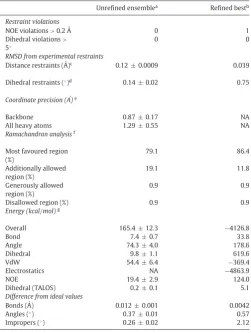
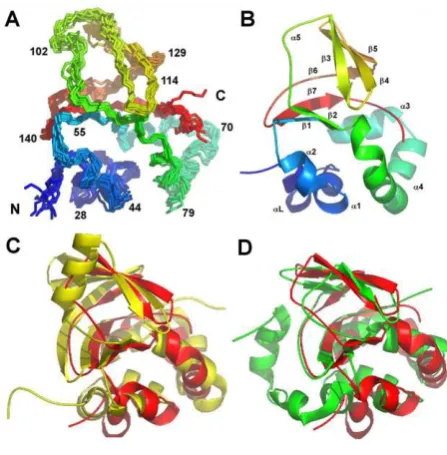
shown) indicate that the protein behaves as a monomer in solution, even at NMR concentrations. The structure was calculated using sim-ulated annealing based on distance and angle restraints, and is shown inFig. 2, with structural statistics inTable 1. It is anα+βstructure, consisting of a wedge-shapedβ-sandwich of approximately 30 ˚A di-ameter made up of twoβ-sheets, with sixα-helices covering one face of the wedge. The structure is similar to those of other FAS1 domains whose structures have been determined: backbone RMSDs to TGFBIp, FAS1-4 and MBP70 are 2.4, 2.4 and 2.2 ˚A respectively (Fig. 2C and D). The structure of Fdp does not contain the helixα5 present in FAS1-4 (Fig. 2C), and has therefore a clearer split between theα-domain and theβ-domain than does FAS1-4.
3.2. Fdp is involved in adherence properties of whole cells
Three independent insertionally inactivatedfdpknockout mutants
were constructed inR. sphaeroidesand compared with wild type in
adherence assays. Growth rates of mutant and wild type strains were similar under aerobic, semi-aerobic and anaerobic (photosynthetic) conditions, and there were no significant differences in levels of pho-tosynthetic complexes as revealed by spectrophotometric analyses of dark/semi-aerobically cultured cells (data not shown). The assay measured the ability of stationary phase cells to clump together and thereby adhere to pegs in 96-well plates. Cell adherence was
sig-nificantly reduced in thefdpmutants compared with the wild type
strain (Fig. 3), from 8.8×10³cells mm−2in wild type to 0.87±0.15
[image:4.595.312.564.72.406.2]× 102cells mm−2in the three mutants, confirming a clear role for
Table 1.
Structural statistics for Fdp structure determination.
Unrefined ensemblea Refined bestb
Restraint violations
NOE violations>0.2 ˚A 0 1 Dihedral violations>
5◦
0 0
RMSD from experimental restraints
Distance restraints ( ˚A)c 0.12±0.0009 0.039
Dihedral restraints (◦)d 0.14±0.02 0.75
Coordinate precision ( ˚A)e
Backbone 0.87±0.17 NA
All heavy atoms 1.29±0.55 NA Ramachandran analysisf
Most favoured region (%)
79.1 86.4
Additionally allowed region (%)
19.1 11.8
Generously allowed region (%)
0.9 0.9
Disallowed region (%) 0.9 0.9
Energy (kcal/mol)g
Overall 165.4±12.3 −4126.8
Bond 7.4±0.7 33.8
Angle 74.3±4.0 178.6
Dihedral 9.8±1.1 619.6
VdW 54.4±6.4 −369.4
Electrostatics NA −4863.9
NOE 19.4±2.9 124.0
Dihedral (TALOS) 0.2±0.1 5.1 Difference from ideal values
Bonds ( ˚A) 0.012±0.001 0.0042
Angles (◦) 0.37±0.01 0.57
Impropers (◦) 0.26±0.02 2.12
aEnsemble of 30 lowest energy structures picked from 100 in CNS 1.1. bBest structure after energy refinement in water using ARIA 1.2.
c1788 Restraints, consisting of 619 intra-residue, 494 sequential, 304 medium-range
(2≤i−j≤4), 317 long-range (i−j>4) and 27 pairs of hydrogen bond restraints.
d148 (74ϕand 74ψ) obtained from TALOS.
eAfter alignment of backbone atoms of residues 22–154. fCalculated using Procheck-NMR [54].
gCalculated using CNS 1.1 and ARIA 1.2.
Fdp in ability to adhere to external surfaces (Fig. 3A). This effect was confirmed to be specific for thefdpmutants and not attributable to the presence of the kanamycin resistance cassette present in these mutants by conducting experiments with other unrelated mutants containing this cassette, in which levels of adherent cells were com-parable to wild type (data not shown).
An alternative adherence assay used crystal violet to measure ad-herence to the well [39]. In this assay, adherence was only reduced 2.5-fold (Fig. 3B). However, when the mutants were transformed with
the complementation vector pRKfdp, almost full complementation
(91%) by thefdpgene was achieved.
74 Robert G. Moody, M.P. Williamson / FEBS Open Bio 3 (2013) 71–77
Fig. 1. Sequence alignments of FAS1 domains. (A) Alignments based on structural similarity. Sequences are those of the four FAS1 domains with three-dimensional structures: The DrosophilaFAS1-3/4 pair (DFAS1: PDB1o70, domain 4); the fourth FAS1 domain of human TGFBIp (TGFBI: PDB2vxp); theM. bovissecreted protein MPB70 (MPB70: PDB1nyo); and Fdp (Fdp: PDB1w7d). The NMR structure of the fourth FAS1 domain of human TGFBIp (PDB1x3b) is very similar to the crystal structure and was not used as an independent structure. Colour code: inDFAS1, yellow denotes residues described here as being interacting residues. In TGFBIp, blue denotes R555, one of the two major sites giving rise to corneal dystrophy. Other disease-causing sites are indicated in cyan. The sequence YH, suggested as a possible binding site [16], is shown in magenta. In MPB70, cyan indicates suggested interaction sites [32]. Highly conserved and completely conserved residues are indicated on Fdp in yellow and red respectively. Locations of regular secondary structure, and the conserved regions H1 and H2, are indicated below the sequences. (B) Domains 1 through 4 fromDrosophilaFAS1, TGFBIp and periostin, each of which contains four tandem FAS1 domains. The alignments encompass the two regions (separated by a blue box) discussed here as being binding sites. Comparisons are more reliable in the second sequence, which is longer and better conserved. Conserved residues are highlighted in green; the important DI/V sequence is marked by asterisks. Domains 2 and 4 are more highly conserved. (For interpretation of the references to colour in this figure legend, the reader is referred to the web version of this article.)
Fig. 2. The solution structure of Fdp. (A) 10 overlaid structures, shown as a rainbow view, from blue at the N-terminus to red at the C-terminus. Only backbone atoms (Cα, C′, N) are shown. (B) Best structure as a cartoon, same colour scheme and orientation.
Theα-helix andβ-sheet numbering is indicated. Labelling of helices and sheets follows that in [30]. This means that the first helix isαL rather thanα1,α4 has a large bend in the middle,α5 is a helical turn rather than a full helix, andβ6 is a short strand followed by a longer extended strand. (C) Best fit superposition toDrosophilaFAS1-4 (Fdp red, FAS1 yellow). (D) Best fit superposition toM. tuberculosisMPB70 (Fdp red, MPB70 green). Superpositions and RMSD values in the text were based on the most highly conserved regions of secondary structure, corresponding to residues 45–50, 55– 65, 82–94, 102–104, 114–122, 126–128 and 135–151 from Fdp. (For interpretation of the references to colour in this figure legend, the reader is referred to the web version of this article.)
oxygen-dependent regulatory system (Phillips-Jones et al., unpub-lished observations).
[image:5.595.44.268.300.528.2]Our results do not provide any information on the nature of the binding partner of Fdp, except that Fdp shows no indications of dimer-izing, even at NMR concentrations, implying that homomeric interac-tions are unlikely. There are also no other identified fasciclin domains
Fig. 3. Adherence ofR. sphaeroidesNCIB 8253 strains. (A) Viable cells growing in biofilm attached to 68.1 mm2pegs following 5 days aerobic growth at 34◦C. WT, wild
type; Fdp1, Fdp2 and Fdp3, mutants possessing an insertionally-inactivatedfdpgene; control, uninoculated medium (incorporating extremely low cell numbers that arise upon sonication). Standard deviation derived from nine replicate samples. (B) Biofilm formation during complementation studies of Fdp1 using pRKfdpdetermined by crystal violet staining, and expressed as a percentage of total culture growth in wells. Culturing was after 5 days at 34◦C. Fdp1/pRKfdpis a complementation by Fdp1 harbouringfdp
inserted on pRK415. Standard deviation derived from nine replicate samples. Similar results were obtained for the other mutants.
in theR. sphaeroidesgenome, further ruling out homomeric inter-actions. In eukaryotic homologs, the ligand is a cell-surface integrin glycoprotein, which is the most likely type of binding partner.
3.3. Database
The atomic coordinates for FDP have been deposited with the
Pro-tein Data Bank; PDB:1w7e(ensemble) and PDB:1w7d(minimized
best structure).
4. Discussion
4.1. Location of the protein interaction site
[image:5.595.316.539.303.396.2]Fig. 4. The binding surface on Fdp. (A) The surface of Fdp in partially transparent view. Conserved regions H1 and H2 are shown in red and blue respectively. They form a large patch at the top of the structure, run through the protein as two parallelβ strands, and emerge on the opposite face. The N and C termini are indicated by spheres. (B) Suggested binding surface of Fdp; residues 50, 52 and 136–144, all other residues being green. Acidic residues are shown in red, basic in blue, hydrophobic in cyan, and hydrophilic in magenta. The key binding residues D136 and V137 are indicated. The orientation is the same as in (A). The orange surface is domain 3 ofDrosophilaFAS1, from the crystal structure of domains 3 and 4 [30], oriented so that domain 4 aligns with Fdp. For clarity, domain 4 is not shown. (For interpretation of the references to colour in this figure legend, the reader is referred to the web version of this article.)
The ubiquity of this domain across phyla suggests that it may rep-resent an evolutionarily ancient cell adhesion domain, most likely functioning by binding to cell-surface proteins [1,18]. We therefore looked for residues that are conserved across a wide range of species, and are likely to be functionally important. To this end, we have pre-pared a new sequence alignment that is based on structural similarity rather than simply sequence similarity, using the existing structures as guides. Our structure of Fdp is important in guiding the align-ment, because of the low level of sequence similarity between ex-isting sequences, and the presence of insertions and deletions. The alignment is shown inFig. 1, and identifies a number of highly con-served residues, in particular the H1 and H2 regions previously iden-tified (Fig. 1a). These regions are adjacent in the structure, and form a large surface patch, followed by twoβ-strands that form the pro-tein core and emerge on the opposite surface (Fig. 4A). Thus much of the conserved sequence appears to be essential because of its role in maintaining the structure, leaving the most likely binding site as the contiguous surface patch comprising residues 136–144 from H2 plus K50 and D52 from H1 (Fig. 4B).
There have previously been several attempts to identify binding sites on FAS1 domains. An analysis ofM. tuberculosisMPB70, based on highly conserved residues and disease-inducing mutations, identified the same region as being important, together with other residues on the opposite face of the protein that were suggested to form a second interaction site [32]. The best-supported site is the two residues DI or DV (136–137 in Fdp), at the start of H2. These residues have been shown to be important in cell adhesion of TGFBIp via integrinα3β1,
since mutations in these positions showed loss of function, and syn-thetic pentapeptides containing this sequence blocked cell adhesion [8,17,46].
Other binding sites have also been proposed. In particular, residues Tyr71-His72 were suggested to form an alternative binding site spe-cific forαvβ5integrin [16]. However, His72 is largely buried in both
Fdp and FAS1, implying that it is unlikely to be involved in protein recognition [47]. In addition, several hydrophobic residues flanking Tyr71-His72 were identified as important for interaction withαvβ5
integrin [16]. In Fdp these are generally either absent or buried, again making it unlikely that this site is important for Fdp. We conclude that the most likely binding site for FAS1 domains is residues 136–144 plus 50 and 52 (Fig. 1a).
It is of course possible that the remarkable conservation of the H1 and H2 regions, from bacteria to plants and humans, is unrelated to function, and that our imputation of a binding region here is incorrect.
Against this we would argue that the cell adherence function of the fasciclin I domain is strongly conserved, and that as far as is known, the ligand type is also conserved [1]; that Fdp has a 29% sequence identity withDrosophilaFAS1-4, this being a high enough similarity to make similarity of function very likely [48]; that the conserved residues identified here are surface-exposed and have no obvious structural role; and that most studies to date on a range of FAS domains have agreed in highlighting this region as the most likely binding site.
4.2. Corneal dystrophy mutations affect structural integrity not binding
There have been detailed studies of mutations in TGFBIp, which lead to a range of corneal dystrophies, characterized by amyloid-like protein deposits in the eye. Over half of the cases studied are caused by two mutations, at R124 in FAS1-1 and R555 in FAS1-4. The equivalent position to R555 is not well conserved in Fdp (Fig. 1; inFig. 2it is residue 75, just above the textα4 inFig. 2B). In theDrosophilaFAS1 structure, the equivalent residue is in a turn, and it was concluded that it should also be exposed in TGFBIp, and consequently mutations here could affect interactions with other proteins [30]. It is however diametrically opposite to the interaction site suggested here, and in our structure corresponds to a partially buried valine. We therefore suggest that mutations of R555 may lead to restructuring of the loop, and thus perturbation to the adjacent H1/H2 strands. In support of this suggestion, we note that different mutations at R555 can have either stabilizing or destabilizing effects [49,50]. Almost all the other disease-causing mutations are at sites that are buried in Fdp, and are therefore likely to lead to instability and consequent amyloid formation, rather than loss of interactions, as also suggested by others [27,29,30,32].
4.3. The interaction site is at the dimer interface
The N-terminus of Fdp is immediately adjacent to the proposed binding site, while the C-terminus is on the opposite face of the pro-tein (Fig. 4). Assuming that the membrane attachment site is in its usual location at the C-terminus, then the Fdp binding site is in the most exposed region of the protein, as expected.
There is an important difference for eukaryotic homologs. In these proteins, the FAS1 domains generally occur in pairs. Our most detailed understanding comes from the crystal structure of the FAS1-3/4 pair fromDrosophila, in which there is a substantial domain interface of 1700 ˚A2[30]. Mutational studies of the homologous TGFBIp, discussed
above, implicate the C-terminal domain as being by far the most im-portant for function. The importance of the C-terminal domain can
also be seen by sequence comparisons ofDrosophilaFAS1, TGFBIp
76 Robert G. Moody, M.P. Williamson / FEBS Open Bio 3 (2013) 71–77
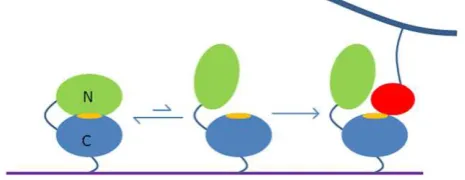
Fig. 5. A model for the function of eukaryotic FAS1 domains. The binding site (orange) is located on the C-terminal domain of a pair of FAS1 domains, and is normally hidden by binding of the domain to its N-terminal partner. Access to the binding site requires dissociation of the N-terminal domain, and is therefore less favourable than it would be for the C-terminal domain on its own. Binding of a ligand (red) [or activation by other means such as binding of a third protein or post-translational modification] opens up the binding site on the C-terminal domain. The FAS1 pair and its ligand are shown as being anchored to cell walls. (For interpretation of the references to colour in this figure legend, the reader is referred to the web version of this article.)
is long enough to allow considerable flexibility.
4.4. Implications of the binding site location
It is common to observe binding sites that are obscured by weak intramolecular binding. Such behaviour is often termed autoinhibi-tion [53], and is used to regulate binding, such that the binding site is not available ‘accidentally’, only presenting when a genuine ligand binds. This reduces the probability of incorrect signal transmission. It can also be used to create further binding sites. Data presented here suggest that autoinhibition may be occurring in eukaryotic homologs of Fdp, with the binding site being the C-terminal domain, and its N-terminal partner serving as an inhibitor (Fig. 5). This may explain why the affinity of FAS1 proteins for their ligands is apparently weak; it also suggests that single C-terminal FAS1 constructs may bind more tightly. It is therefore likely that antagonists based on the C-terminal FAS1 domain would bind more tightly to their ligands than the full-length protein, and could form the basis for useful drug targets.
Acknowledgements
We thank Mary Phillips-Jones, Eun-Lee Jeong and Sam Broad versity of Leeds) for advice and plasmids, Peter J.F. Henderson (Uni-versity of Leeds, UK) for helpful discussions and for reading an early version of the manuscript, Samuel Kaplan (University of Texas Health Science Center, USA) for discussions and provision of unpublished information, Richard Tunnicliffe for help with structure calculation and Arthur Moir (University of Sheffield) for protein N-terminal se-quencing. This work was funded through a White Rose Studentship (RGM).
References
[1] Burroughs A.M., Balaji S., Iyer L.M., Aravind L. (2007) Small but versatile: the extraordinary functional and structural diversity of theβ-grasp fold. Biol. Direct. 2, 18.
[2] Elkins T., Zinn K., McAllister L., Hoffmann F.M., Goodman C.S. (1990) Genetic analysis of aDrosophilaneural cell-adhesion molecule: interaction of fasciclin-I and Abelson tyrosine kinase mutations. Cell. 60, 565–575.
[3] McAllister L., Goodman C.S., Zinn K. (1992) Dynamic expression of the cell ad-hesion molecule fasciclin-I during embryonic development inDrosophila. De-velopment. 115, 267–276.
[4] McAllister L., Rehm E.J., Goodman C.S., Zinn K. (1992) Alternative splicing of micro-exons creates multiple forms of the insect cell-adhesion molecule fasciclin-I. J. Neurosci. 12, 895–905.
[5] Zinn K., McAllister L., Goodman C.S. (1988) Sequence analysis and neuronal expression of fasciclin-I in grasshopper andDrosophila. Cell. 53, 577–587. [6] Hortsch M., Goodman C.S. (1990)Drosophilafasciclin-I, a neural cell adhesion
molecule, has a phosphatidylinositol lipid membrane anchor that is develop-mentally regulated. J. Biol. Chem. 265, 15104–15109.
[7] Horiuchi K., Amizuka N., Takeshita S., Takamatsu H., Katsuura M., Ozawa H. et al. (1999) Identification and characterization of a novel protein, periostin, with restricted expression to periosteum and periodontal ligament and increased expression by transforming growth factorβ. J. Bone Miner. Res. 14, 1239–1249. [8] Kim J.E., Kim S.J., Lee B.H., Park R.W., Kim K.S., Kim I.S. (2000) Identification of
motifs for cell adhesion within the repeated domains of transforming growth factor-beta-induced gene,βig-h3. J. Biol. Chem. 275, 30907–30915.
[9] Sasaki H., Auclair D., Kaji M., Fukai I., Kiriyama M., Yamakawa Y. et al. (2001) Serum level of the periostin, a homologue of an insect cell adhesion molecule, in thymoma patients. Cancer Lett. 172, 37–42.
[10] Gillan L., Matei D., Fishman D.A., Gerbin C.S., Karlan B.Y., Chang D.D. (2002) Periostin secreted by epithelial ovarian carcinoma is a ligand for avb3and avb5
integrins and promotes cell motility. Cancer Res. 62, 5358–5364.
[11] Takeshita S., Kikuno R., Tezuka K., Amann E. (1993) Osteoblast-specific factor II: cloning of a putative bone adhesion protein with homology with the insect protein fasciclin-I. Biochem. J. 294, 271–278.
[12] Adachi H., Tsujimoto M. (2002) FEEL-1, a novel scavenger receptor within vitro bacteria-binding and angiogenesis-modulating activities. J. Biol. Chem. 277, 34264–34270.
[13] Ruan K., Bao S., Ouyang G. (2009) The multifaceted role of periostin in tumori-genesis. Cell. Mol. Life Sci. 66, 2219–2230.
[14] Kudo Y., Siriwardena B.S.M.S., Hatano H., Ogawa I., Takata T. (2007) Periostin: Novel diagnostic and therapeutic target for cancer. Histol. Histopathol. 22, 1167– 1174.
[15] Nummela P., Lammi J., Soikkeli J., Saksela O., Laakkonen P., Holtta E. (2012) Transforming growth factor beta-induced (TGFBI) is an anti-adhesive protein regulating the invasive growth of melanoma cells. Am. J. Pathol. 180, 1663– 1674.
[16] Kim J.E., Jeong H.W., Nam J.O., Lee B.H., Choi J.Y., Park R.W. et al. (2002) Identi-fication of motifs in the fasciclin domains of the transforming growth factor-β -induced matrix proteinβig-h3 that interact with the avb5integrin. J. Biol. Chem.
277, 46159–46165.
[17] Park S.W., Bae J.S., Kim K.S., Park S.H., Lee B.H., Choi J.Y. et al. (2004)β ig-h3 promotes renal proximal tubular epithelial cell adhesion, migration and proliferation through the interaction with a3b1integrin. Exp. Mol. Med. 36,
211–219.
[18] Huber O., Sumper M. (1994) Algal-cams – isoforms of a cell adhesion molecule in embryos of the algaVolvoxwith homology toDrosophilafasciclin-I. EMBO J. 13, 4212–4222.
[19] Johnson K.L., Jones B.J., Bacic A., Schultz C.J. (2003) The fasciclin-like arabino-galactan proteins of arabidopsis. A multigene family of putative cell adhesion molecules. Plant Physiol. 133, 1911–1925.
[20] Borner G.H.H., Sherrier D.J., Stevens T.J., Arkin I.T., Dupree P. (2002) Prediction of glycosylphosphatidylinositol-anchored proteins in arabidopsis. A genomic analysis. Plant Physiol. 129, 486–499.
[21] Shi H.Z., Kim Y., Guo Y., Stevenson B., Zhu J.K. (2003) TheArabidopsisSOS5 locus encodes a putative cell surface adhesion protein and is required for normal cell expansion. Plant Cell. 15, 19–32.
[22] Nagai S., Matsumoto J., Nagasuga T. (1981) Specific skin-reactive protein from culture filtrate ofMycobacterium bovisBCG. Infect. Immunity. 31, 1152–1160. [23] Paulsrud P., Lindblad P. (2002) Fasciclin domain proteins are present in Nostoc
symbionts of lichens. Appl. Environ. Microbiol. 68, 2036–2039.
[24] Reynolds W.S., Schwarz J.A., Weis V.M. (2000) Symbiosis-enhanced gene ex-pression in cnidarian–algal associations: cloning and characterization of a cDNA, sym32, encoding a possible cell adhesion protein. Comp. Biochem. Physiol. A: Mol. Integr. Physiol. 126, 33–44.
[25] Ulstrup J.C., Jeansson S., Wiker H.G., Harboe M. (1995) Relationship of secre-tion pattern and MPB70 homology with osteoblast-specific factor-2 to osteitis followingMycobacterium bovisBCG vaccination. Infect. Immunity. 63, 672–675. [26] Oke V., Long S.R. (1999) Bacterial genes induced within the nodule during the
Rhizobium–legume symbiosis. Mol. Microbiol. 32, 837–849.
[27] Thapa N., Lee B.-H., Kim I.-S. (2007) TGFBIp/βig-h3 protein: a versatile matrix molecule induced by TGFβ. Int. J. Biochem. Cell. Biol. 39, 2183–2194. [28] Munier F.L., Frueh B.E., Othenin-Girard P., Uffer S., Cousin P., Wang M.X. et al.
(2002) BIGH3 mutation spectrum in corneal dystrophies. Invest. Ophthalmol. Vis. Sci. 43, 949–954.
[29] Kannabiran C., Klintworth G.K. (2006) TGFBI gene mutations in corneal dystro-phies. Hum. Mut. 27, 615–625.
[30] Clout N.J., Tisi D., Hohenester E. (2003) Novel fold revealed by the structure of a FAS1 domain pair from the insect cell adhesion molecule fasciclin I. Structure. 11, 197–203.
[31] Yoo J.-H., Kim E., Kim J., Cho H.-S. (2007) Crystallization and preliminary crystal-lographic analysis of the fourth FAS1 domain of humanβig-h3. Acta Crystallogr. Sect. F Struct. Biol. Cryst. Commun. 63, 893–895.
[32] Carr M.D., Bloemink M.J., Dentten E., Whelan A.O., Gordon S.V., Kelly G. et al. (2003) Solution structure of theMycobacterium tuberculosiscomplex protein MPB70 – from tuberculosis pathogenesis to inherited human corneal disease. J. Biol. Chem. 278, 43736–43743.
[33] Hunter C.N., Turner G. (1988) Transfer of genes coding for apoproteins of reac-tion center and light-harvesting LH1 complexes toRhodobacter sphaeroides. J. Gen. Microbiol. 134, 1471–1480.
[34] Keen N.T., Tamaki S., Kobayashi D., Trollinger D. (1988) Improved broad host range plasmids for DNA cloning in gram-negative bacteria. Gene. 70, 191–197. [35] Potter C.A., Ward A., Laguri C., Williamson M.P., Henderson P.J.F., Phillips-Jones
[36] Brunger A.T., Adams P.D., Clore G.M., DeLano W.L., Gros P., Grosse-Kunstleve R.W. et al. (1998) Crystallography & NMR system: a new software suite for macromolecular structure determination. Acta Crystallogr. D Biol. Crystallogr. 54, 905–921.
[37] Cornilescu G., Delaglio F., Bax A. (1999) Protein backbone angle restraints from searching a database for chemical shift and sequence homology. J. Biomol. NMR. 13, 289–302.
[38] Linge J.P., Williams M.A., Spronk C., Bonvin A., Nilges M. (2003) Refinement of protein structures in explicit solvent. Proteins: Struct. Funct. Bioinf. 50, 496– 506.
[39] Djordjevic D., Wiedmann M., McLandsborough L.A. (2002) Microtiter plate as-say for assessment ofListeria monocytogenesbiofilm formation. Appl. Environ. Microbiol. 68, 2950–2958.
[40] Hunter C.N., Coomber S.A. (1988) Cloning and oxygen-regulated expression of the bacteriochlorophyll biosynthesis genesbchE,bchB,bchAandbchCof Rhodobacter sphaeroides. J. Gen. Microbiol. 134, 1491–1497.
[41] Duggan P.S., Parker S.D., Phillips-Jones M.K. (2000) Characterisation of a Rhodobacter sphaeroidesgene that encodes a product resemblingEscherichia colicytochromeb561andR. sphaeroidescytochromeb562. FEMS Microbiol. Lett.
189, 239–246.
[42] Moody R.G., Phillips-Jones M.K., Williamson M.P. (2007) NMR assignment of the Rhodobacter sphaeroidesfasciclin-1 domain protein (Fdp). Biomol. NMR Assign. 1, 11–12.
[43] Jefferson K.K. (2004) What drives bacteria to produce a biofilm? FEMS Microbiol. Lett. 236, 163–173.
[44] Roh J.H., Smith W.E., Kaplan S. (2004) Effects of oxygen and light intensity on transcriptome expression inRhodobacter sphaeroides2.4.1 – Redox active gene expression profile. J. Biol. Chem. 279, 9146–9155.
[45] Yu N.Y., Wagner J.R., Laird M.R., Melli G., Rey S., Lo R. et al. (2010) PSORTb 3.0: improved protein subcellular localization prediction with refined localization
subcategories and predictive capabilities for all prokaryotes. Bioinformatics. 26, 1608–1615.
[46] Park S.J., Park S., Ahn H.C., Kim I.S., Lee B.J. (2004) Conformational resemblance between the structures of integrin-activating pentapetides derived fromβig-h3 and RGD peptide analogues in a membrane environment. Peptides. 25, 199–205. [47] Clout N., Hohenester E. (2003) A model of FAS1 domain 4 of the corneal protein
βig-h3 gives a clearer view on corneal dystrophies. Mol. Vis. 9, 440–448. [48] Feng D.F., Doolittle R.F. (1996) Progressive alignment of amino acid sequences
and construction of phylogenetic trees from them. Methods Enzymol. 266, 368– 382.
[49] Elavazhagan M., Lakshminarayanan R., Zhou L., Ting L.W., Tong L., Beuerman R.W. et al. (2012) Expression, purification and characterization of fourth FAS1 domain of TGFβIp-associated corneal dystrophic mutants. Protein Expr. Purif. 84, 108–115.
[50] Runager K., Basaiawmoit R.V., Deva T., Andreasen M., Valnickova Z., Sørensen C.S. et al. (2011) Human phenotypically distinct TGFBI corneal dystrophies are linked to the stability of the fourth FAS1 domain of TGFBIp. J. Biol. Chem. 286, 4951–4958.
[51] Orecchia P., Conte R., Balza E., Castellani P., Borsi L., Zardi L. et al. (2011) Identi-fication of a novel cell binding site of periostin involved in tumour growth. Eur. J. Cancer. 47, 2221–2229.
[52] Basaiawmoit R.V., Oliveira C.L.P., Runager K., Sørensen C.S., Behrens M.A., Jon-sson B.H. et al. (2011) SAXS models of TGFBIp reveal a trimeric structure and show that the overall shape is not affected by the Arg124His mutation. J. Mol. Biol. 408, 503–513.
[53] Williamson M.P. (2011) How Proteins Work. New York: Garland Science. [54] Laskowski R.A., Rullmann J.A.C., MacArthur M.W., Kaptein R., Thornton J.M.