White Rose Research Online [email protected]
Universities of Leeds, Sheffield and York
http://eprints.whiterose.ac.uk/
This is the published version of an article inNew Voices in Translation Studies (8)
White Rose Research Online URL for this paper:
http://eprints.whiterose.ac.uk/id/eprint/76377
Published article:
Summers, CS (2012) Translating the Author-Function: The (Re)Narration of Christa Wolf. New Voices in Translation Studies (8). 170 - 187. ISSN 1819-5644
Translating the Author-Function:
the (re)narration of Christa Wolf
Caroline Summers
University of Manchester, U.K.
ABSTRACT
Narrative theory continues to offer new perspectives on the intercultural transfer of texts. Embedded in new narratives, the text opens up to new interpretations, resulting in the loss and acquisition of meaning. The writer’s persona or author-function (Foucault 1977) is also renegotiated by cultural transfer, as it is cumulatively and dynamically constructed through readings of an author’s texts and their interaction with literary or biographical contexts. The translated author-function may differ considerably from domestic perceptions of the author, and may also interact with these as in the case of the East German writer Christa Wolf, whose international author-function has served for contrast (if not conflict) with her reception in the German Democratic Republic and united Germany. This was particularly marked during the 1990s, when revelations about Wolf’s earlier involvement with the East German Stasi led to censure by the German media and literati. This paper demonstrates how the translation of Wolf’s texts and the construction of her international author-function have renegotiated her position within her domestic literary field.
KEYWORDS: author-function, GDR, narrative theory, Wolf.
Introduction
What might cause an author to be simultaneously attacked by journalists and writers in her own country and publicly defended by intellectuals from across the Atlantic? In 1993, three years after the official German reunification, the East German writer Christa Wolf
controversially revealed that from 1959 to 1962 she had worked as an unofficial informant for the Stasi, the secret police of the socialist former German Democratic Republic (GDR). Wolf, an author known for her strong socialist values but also for her difficulties in reconciling her vision of socialism with its dictatorial incarnation in the East German regime, was bombarded in Germany with accusations of betrayal. However, the same year saw the publication of
Wolf’s Was bleibt (1990) [What Remains] in English translation. The translation of Wolf’s
autobiographical account of an author’s observation by Stasi agents, a text that had been attacked by German reviewers for appearing to offer criticism of the regime from the pen of a state poet, suggested that the revelations had not had such a detrimental effect on Wolf’s international status. This was also indicated by the explicit support extended to Wolf by academics and journalists outside Germany, in the USA in particular. Now, almost twenty years since the Stasi scandal, Wolf has regained a position of prominence in the German
literary field. This paper applies narrative theory to Foucault’s notion of author-function as a
construction that varies in different social, temporal and linguistic contexts, to examine how an Anglophone narrative of Wolf’s authorship, constructed and circulated through translation, was instrumental in enabling her to regain a position of respectability and authority in her German ‘source culture’.
Translated into over thirty languages, Wolf is the most internationally recognised writer from the former GDR. As demonstrated and explored in sociological theories of translation,
including the narrative approach (see e.g. Baker 2006), so much depends on the agents
from the source and from other translations. The stories we use to narrate our own existence may not be the same as those that shape the experiences of others, and the translated text is subject to relocation in new narratives as it travels between cultures. Widespread translation therefore does not indicate internationally unified understanding of the author: the
recontextualisation of the writer and her texts through translation into various languages can bring about any number of interpretive shifts. As we will see, the narrative model can be
applied to the literary concept of a writer’s author-function (Foucault 1977; 1981), according
to which authorship functions as a discursive category that endows texts with meaning. The author-function draws together experiences, assumptions and expectations to construct an idea of who a writer ‘is’: emerging from dominant understandings of authorship and cultural identity, as well as from readings of an author’s texts, it can differ greatly between
environments of reception.
There have been few attempts to critically examine Wolf’s writing in translation, and these
have focused on criticism of Divided Heaven (1965), the translation of Wolf’s 1963 text Der
geteilte Himmel (Koerner 1984; von Ankum 1993). Nonetheless, as Marilyn Sibley Fries’ insightful account of Wolf’s ‘place’ in the American literary field suggests, Wolf’s example shows clearly how the differences between a writer’s author-functions can have considerable
impact on the reception of texts and events (Sibley Fries 1992). Differing responses to Was
bleibt and the Stasi controversy demonstrate how contrasting understandings of the author engage with and at times challenge one another. As we will see here, the author-function constructed through the translation of Wolf’s writing into English, whilst inevitably drawing on her authorial presence at home, has crucially reconfigured her ‘original’ author-function.
This is reflected not only in responses to Was bleibt but also in the translation and critical
reception of Wolf’s 1969 text, Nachdenken über Christa T. [The Quest for Christa T.].
Perhaps having been selected for translation on the basis of its controversial status in the GDR, the text was quickly published in English and received good reviews, establishing Wolf as an
‘international’ author through her positioning in an Anglophone literary field. Nachdenken
über Christa T. and Was bleibt, published twenty-one years apart (or twenty-three years, in English translation), complement one another as examples of the sometimes tacit, sometimes explicit dynamic between a writer’s author-functions. Different but not self-contained, parallel but constantly engaging with one another, Wolf’s author-functions demonstrate the bilateral relationship between texts and their translations, and between different receiving cultures.
The author-function as a translated narrative
Foucault understands discourse as a constantly revised and self-revising pattern of practices infused with ideologies, in which truth and meaning are inherently provisional and contingent. As one of the numerous ideological and institutional constraints imposed upon this contingent
discourse, the name of an author is assigned a particular function. For Foucault, the
1997; Gergen and Gergen 1997): it is context-dependent, self-regulating, always evolving and invites a variety of interpretive outcomes. This paper demonstrates how the two theories can be productively brought together to explain the interpretive transformation undergone by translated writers and their texts.
Various narrative models exist: the most useful identify different types or levels of narrative, distinguishing, for example, between individual and supra- individual accounts (e.g. Carr 1997; Gergen and Gergen 1997), or between abstract stories that transcend the conscious world and more concrete stories that occur within a person’s horizons of experience (e.g. Crites 1997). The author-function is both individual and supra-individual, because it centres on an
individual figure whilst at the same time situating that individual within social and cultural institutions. It is both abstract and concrete, bringing together the biography of a living individual with more abstract concepts such as prevalent understandings of authorship. Thus the author-function is situated at a point of convergence between the narratives of the individual writer and those in which he or she is embedded.
Significantly for Wolf, Foucault’s author-function “as he receives it from his epoch, or as he modifies it in his turn” (Foucault 1981:59) reflects a bilateral relationship between the event and the narrative, in other words a dual dynamic of influence between the writer’s product and the authorial narrative. The author’s behaviour is prescribed by the author-function but can also cause changes to the function itself: for example, a text may be less well received if it does not appear to bear a relation to the existing author-function, but earlier texts may also be re-interpreted, as later textual ‘events’ reposition the author-function. Just as “we are never more (and sometimes less) than co-authors of our own narratives” (MacIntyre 1997:251), the author-function is shaped by the individual writer even as it is imposed upon him or her. As
we will see in the case of Was bleibt, the temporal positioning of a text in the authorial
narrative can make a significant difference to its status. As the writer’s career progresses, certain texts feature more prominently in accounts of the author’s work, and causal links are drawn between a writer’s texts and his or her biography in an attempt to find out why a text was written.
Baker (2006, 2007) discusses the relevance of a theory of framing to the narrative model.
Taken from Goffman, framing reflects the conceptualisation of the event as an important part of the interpretation process: “an individual’s framing of an activity establishes
meaningfulness for him” (Goffman 1974/86:345). The framing of an event or narrative prioritises certain thematic or causal links over others and encourages a particular interpretive approach. A narrative might itself act as a frame, for example an American narrative of the GDR as a repressive culture that frames Wolf’s writing to suggest political dissidence in her often ambiguous and questioning narrative style. The structures that guide interpretation of a text are generated by signifiers whose meaning and relationships to other signifiers may modulate: framing a text as ‘East German literature’, for example, contextualises it within expectations about the political and cultural context of the writing that themselves vary over time and space. The author-function frames a writer’s texts by offering an interpretive lens that prefigures responses to the text, drawing on previous texts and their reception, for example, or from biographical information.
External elements of the text, or paratexts, act as frames in their role as “thresholds of
interpretation” (Genette 1997). Paratexts are divided by Genette into peritexts (around the text
and within the same volume, such as cover blurb or additional notes) and epitexts (located
indication of how a text might be read (Genette 1997:5). In translation, these elements occupy “a crucial – indeed revelatory – position at the interface of the domestic and the foreign” (Harvey 2003:50): they frame the translation in order to present it to the reader. For example, the translated or “foreign” status of a text might be obvious or concealed, information about the author and his or her domestic culture might be made available in various ways, or a focus on particular aspects of the writing might be encouraged either explicitly through notes and blurb or implicitly through details such as cover art. Paratexts play an important role, since “it is only in circulation that a text assumes its significance, and the paratext is perhaps the most useful site for understanding how, for whom, and at what potential cost that significance was constructed” (Watts 2000:42-43). Decisions made in the presentation of the translated text are representative of the narrative frames in which the target culture positions the text, and
indicate how texts and their authors may be perceived in translation.
The author-function in translation has, until now, been neglected: applications of Foucault’s theory to translated texts have explored the possibility of a ‘translator-function’ (Díaz-Docaretz 1985; Hermans 1999), but have not engaged with the construction of translated authorship. The translated author-function will be understood here as constructed not solely within the narrative frames of the receiving culture, but inevitably also in parallel to the existing author-function in the source culture, establishing a bilateral relationship between the two: exploring the construction of translated authorship challenges the originality and
authority of the ‘source’ text. The author-function in translation emerges partly from the responses of a new receiving environment to the same and similar data as the source-culture function, such as biographical data about the author. It draws on some of the same narratives as the original, which may be framed differently (such as supra-individual or supra-national narratives of political values that may be evaluated differently depending on the dominant narratives of the receiving culture). These manifest themselves in the paratexts to the translation, which indicate the dominant contextual and interpretive approaches of the receiving culture.
Despite strong links between author-functions, difference is inevitable as linguistic and cultural transfer positions texts (and their authors) in a new network of narratives. The translated author-function does not represent a one-for-one exchange any more than the translated text or the translated sentence. The potential for different interpretations of Wolf is pinpointed by Marylin Sibley Fries as the source of the writer’s protection against harsh moral censure abroad:
Contrary to the West German (not to mention the East German) reception, we shied away from drawing political conclusions like those of Raddatz or Reich-Ranicki. It is possible that many of us unconsciously wanted to project our outdated political hopes of the seventies onto this author; for us, Wolf played a similar role to the one she had played in the GDR. Nonetheless, in this country
she never became the political-moral example that she was obviously held to be at
home – hence our confusion over the vehement discussion of her ‘fall’ (Sibley
Fries 1992:178, my translation and emphasis).
Sibley Fries notes that a reluctance to interrogate the political and GDR-specific aspects of Wolf’s writing prevented her from becoming a moral role model in America, protecting her from a fall from grace like the one she experienced at home during the early 1990s. We will
see this at work in the American (and British) response to the translation of Was bleibt and to
This paper concentrates on peritexts and epitexts, on the grounds that these most explicitly create an author-function by ‘presenting’ the text. The less visible role of linguistic detail, although not under the spotlight here, is no less important: the text implicitly offers an encounter with the writer in her ‘own words’, making the words of the translation an active part of the author-function. A more extensive analysis would show how the language of the translations also repositions Wolf in narratives of aesthetic and political traditions, in a similar way to the more explicit interpretive frames discussed here. Wolf’s example demonstrates very clearly that the author-functions not only coincide but also challenge and reconfigure one another, blurring the distinction between ‘original’ and ‘translation’. To examine this
interaction, we will now look at two contrasting examples of Wolf in translation that constitute turning points in her authorial- narratives in Germany and abroad.
Turning points in the author-function:
Christa T.
and
Was bleibt
Nachdenken über Christa T.
Nachdenken über Christa T. [The Quest for Christa T.], published in 1969 and translated into English in 1970, is one of Wolf’s best-known texts in Germany and abroad. Through
memories, letters and imagined encounters, the book presents the narrator’s reflections on the life of her dead friend, who found it difficult to reconcile her emotional responses to the world with the socialist role models offered to her. As the first of Wolf’s texts to be released in
translation by a publisher based in an Anglophone target culture,1 it established for her the
basis of an ‘international’ author-function in literary canons outside the GDR and FRG.2 We
will see here how Wolf’s author-function as established through the English translation of
Christa T. differed even at this initial stage from her existing function in the GDR. As her text was re-situated in a new social context dominated by different narratives, for example of individualism and non-socialist aesthetics, Wolf’s apparent divergence from her domestic author-function (through her critical engagement with socialism) contributed to the emergence of a new, Anglophone ‘Wolf’.
Having been told in 1967 by GDR publishers that the view of socialism presented in Christa
T. was too ambiguous and self-critical, and that “maybe something like this could be
published in ten years’ time” (Hilzinger 1999:227; my translation), Wolf made changes to her text and resubmitted it in 1968. The book’s exploration of the relationship between the
individual and the socialist collective was met with suspicion by the GDR’s socialist government, and Wolf’s questioning approach to socialism did not correlate with dominant narratives of the writer as the mouthpiece for the state, challenging her author-function “as [she] receive[d] it from her epoch” (Foucault 1981:59). A limited print-run was eventually permitted, and two ambivalent reviews criticized the text’s ambiguous approach to socialism whilst acknowledging its attempts to embody principles of Socialist Realism (Kähler 1969; Haase 1969). However, production was halted later that year because of the continuing polemic surrounding the book. Meanwhile, the West German publisher Luchterhand
1
The only Wolf t ranslation in English to predate The Quest for Christa T. is of Der geteilte Himmel [The Divided Heaven] (Wolf 1963), which appeared in English translation in 1965 through the GDR publisher Seven Seas Publications (Wolf 1965), and attracted almost no attention in Anglophone literary discourse.
2 Venuti (1998:310) has highlighted the particular significance of the A me rican literary fie ld in determining
‘international’ trends as a result of economic capital, and has criticised the American tendency to only translate that which comp le ments existing trends (or narratives): this view of the litera ry system in the USA reflects the considerable symbolic va lue of The Quest for Christa T. in Wolf’s authorial narrative, as the mo ment of her
published Christa T. in spring 1969, pre-empting the eventual appearance of the GDR edition later the same year. Perhaps encouraged by East German uncertainty about Wolf’s text, West German reviews inflated its critical engagement with socialist principles to the status of a revolutionary critique, most famously in prominent critic Marcel Reich-Ranicki’s comment that “Christa T. dies of leukaemia but she suffers from the GDR” (Reich-Ranicki 1969; my translation). Little attention was paid, for example, to the role of the subjective in rethinking socialist literature, a narrative emphasised by Wolf in her essayistic writing and influential in the development of her author-function in the GDR (e.g. Wolf 1966). No longer
contextualised by this narrative, Wolf’s break from Socialist Realist norms was framed in West Germany as a dissident nod towards ‘Western’ aesthetics and values. A different author-function was already beginning to emerge in West Germany, whereas at home, Wolf’s
challenge to the political and aesthetic narratives in which her author-function had been constructed engendered a highly critical response to her latest text.
The English translation of Christa T., however, was different again and did not frame it
primarily within the political narratives dominant in West and certainly East German
responses. Although Wolf’s divergence from the socialist narrative attracted interest (e.g. New
York Times 1969), the paratexts of The Quest for Christa T. distanced it from narratives of socialism not by citing Wolf’s conflict with the demands of the governing Sozialistische Einheitspartei Deutschlands (SED), but by excluding such narratives in the presentation of the text. First, we might consider the peritexts: the first edition of the translation, published in the USA, features on its cover the lone figure of a woman holding a red flower, almost blending in to the brown background on either side of the contrasting white path she walks along (Figure 1). The image draws attention to the solitary figure, and to the simultaneous fears of standing out and blending in, encouraging empathy with the isolated individual and framing the text as the narrative of a singular protagonist.
Figure 1: Front cover of The Quest for Christa T. (Farrar Straus Giroux, Wolf 1970)
As far as the background to Wolf and her text is concerned, the book contains no additional
information: it does not frame Christa T. as ‘other’ but rather implicitly suggests (through
[image:7.596.237.357.462.645.2]When The Quest for Christa T. was first published in East Germany, there was an immediate storm: bookshops in East Berlin were given instructions to sell it only to well-known customers professionally involved in literary matters; at an annual meeting of the East German Writers Conference, Mrs Wolf’s new book was condemned. Yet the novel has nothing explicitly to do with politics (Wolf 1970).
The narratives of socialism and socialist literature that contextualised the text’s reception and publication difficulties in the GDR are explicitly excluded here, suggesting other causes for the book’s problematic status. Instead of its political ambiguity, the individualism of the text is framed by the cover image as the focus of the text, and thus perhaps as a principal source of objections in the GDR. This impression is strengthened by what the reader ‘knows’ from familiar narratives about the GDR, i.e. that it is a culture of repression. The peritexts offer minimal references even to socialism, eliding this frame to Wolf’s author-function in favour of a focus on “the story of a sensitive woman as recalled by her friend […] the story of an individual crushed by the pressures of uniformity” (quoted on the back cover). By excluding political narratives and focusing instead on an abstract narrative of the individual in a
repressive state, the peritexts frame Christa T. as an act of artistic resistance or even
dissidence, a powerful word in the context of narratives of totalitarianism in which the GDR was embedded. With little information about Wolf or her text to contradict this, readers are encouraged to follow suit.
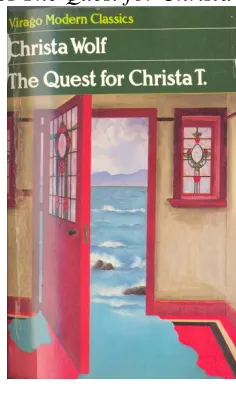
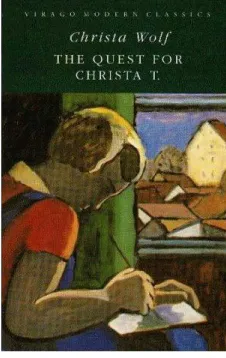
The UK edition of the translation, first published in 1982 by Virago, does contain a small paragraph on Wolf inside the book, but here too she is distanced from the East German institution of which the West was so suspicious, by the cautious label “a committed socialist of independent temper”. The lexical value of ‘committed’ and ‘independent’ mitigates Wolf’s socialism by framing her as a dedicated but critically-minded supporter of socialist values. The front cover (Figure 2) shows an image of water flowing in through a red, open door, framing the book in an abstract narrative of memory or thoughts as they are seen to rush into the space that opens for them. Later editions emulate the frame of individuality seen in the American edition, selecting for the cover art a solitary writing figure (Figure 3). This might also frame the text with a selective, introverted focus on the writer’s experience rather than the broader narratives on which Wolf’s text draws. We might say of both Virago editions, then, that the frames offered by the peritexts shift the focus away from the interaction between knowledge and experience, reality and ideals, and onto more abstract concepts of memory, writing and individualism.
[image:8.596.237.355.579.777.2]Figure 3: Front cover of The Quest for Christa T. (Virago, Wolf 1995)
In other words, the peritexts exploit the narratives of repressive literary and political culture
evoked by the term East German writer in order to invoke a view of the GDR as a culturally
barren state, and exclude details of the perceived incompatibility between Wolf’s text and the
political narratives in which it was embedded; in doing so, they re-frame Christa T. as a work
of literature that was hindered in the GDR because of its celebration of the individual and of creative writing.
Similarly, the epitexts and especially reviewers’ responses to the English translation avoided framing Wolf’s text in terms of its political implications and focused on its apparently unique status as high-quality writing from the GDR:
In a desert – and the [East German] literary scene is a desert – you have to look out patiently for any sign of life, but the sight of a beautiful flower may suddenly
overwhelm you. Such a book is The Quest for Christa T (Tempel 1970).
Again, the book is framed by a narrative of the GDR as culturally deprived, and narratives of
engagement with socialism and socialist realism are excluded: Ernst Pawel in the New York
Times even describes Wolf’s writing as apolitical, referring to her “disdain of politics” (Pawel 1971). Both British and American reviewers narrated the obstacles to the book’s publication as a punishment inflicted on Wolf for asking questions and writing imaginatively. Pawel, again, claimed that the controversy surrounding the book in the GDR had arisen because Wolf “chose to exercise her imagination in a world where – for some very good reasons – the mere possession of it constitutes an indictable offence”. The framing of the text encouraged by the cover design, to focus on the experience of the individual, is also seen in the reviews, where critics commented on the novel’s attention to “individual resilience in the face of evil and adversity” (McHaffle 1982) and the book’s reminder to “not undervalue the individual human life, from which alone the collective draws its value” (Webb 1971).
The translation of Nachdenken über Christa T. re-emplotted Wolf and her text in a new social
context in which framing by different narratives established a new author-function for Wolf, different but by nature not independent from her authorial narrative in the GDR. By excluding
the narratives of socialism in which Wolf’s text was embedded, it distanced Christa T. from a
narrative of the author’s engagement with socialism more effectively than the explicitly
anti-socialist West German readings. Framed instead as an individualist, innovative text, Christa T.
[image:9.596.240.353.92.271.2]relationship with political power. This narrative, salient in both Germanies in the aftermath of the Third Reich (and again later, as we will see, after German reunification), seems
significantly less important to the profile of Wolf and her text in the Anglophone literary
market. As the discussion of Was bleibt and its translation will demonstrate, outside of
Germany the relationship between intellectuals and the institutions of power of the twentieth
century has not been so meticulously narrated, and the paratexts to Christa T. show a
tendency to frame the text by highlighting Wolf’s imaginative aesthetics rather than the question of her political allegiance.
Retrospectively, Christa T. is described by Marilyn Sibley Fries as “a work from the GDR
that one doesn’t have to read as such” (1992:178; my translation) and by Sonja Hilzinger as the text that “established the international fame of the GDR author Christa Wolf” (1999:229; my translation). The significance of the text is evident even from a brief analysis of paratexts, which introduce Wolf to an Anglophone literary field and frame her as an international author
engaged with supra-individual, overarching abstract narratives. Christa T. marked the
beginning of Wolf’s author-function in English translation and was isolated from all mention of Divided Heaven, which had been almost entirely unacknowledged by Anglophone
reviewers and has been criticised for simplifying Wolf’s writing and attempting to strengthen the socialist realism of the text (Koerner 1984; von Ankum 1993). The marginalisation of earlier texts, and of the public narratives of socialism relative to the original text, in favour of metanarratives of the (creative) individual and of ‘universal’ humanism, re-framed Wolf as a creative talent struggling against a repressive environment and positioned her text as a work of creative dissidence, distancing her from the institutions with which she attempted to engage. It could be argued that this distance was key to Wolf’s acceptance into the American and international literary canon: independent from the dictatorial institutions of the GDR and seen to be struggling against them, she was perceived to be ‘one of us’ rather than ‘one of them’ in the geo-political binaries of East and West that defined experiences during the Cold War.
Wolf’s Anglophone author-function, framed in its paratexts by narratives of the individual, the humanist writer and of oppressed creativity, is distanced from the politicised authorial narratives of the GDR (although paradoxically it is precisely the dominance of a political narrative in Wolf’s GDR author-function that caused her to attract the attention of the
international market). Shifts in the narratives that frame the author-function and the exclusion of details about Wolf’s political involvement offer and encourage a different view of Wolf. Leaping forward in time, we will see how the divergence of this author-function from Wolf’s author-function in the GDR and in reunified Germany was to be crucial to her domestic rehabilitation after her fall from grace in the 1990s.
Was bleibt
Was bleibt [What Remains], published in 1990, recounts a day in the life of a female writer under observation by the Stasi. The text explores the psychological strain of living under constant observation, implying specific criticism of the GDR’s institutions that is seldom to be found in Wolf’s writing. The strength of this criticism made it arguably the most
controversial of all Wolf’s texts in Germany, placing her at the centre of the Literaturstreit
been framed as compatible with the narratives of the ruling SED. More importantly for some, the text had been written in 1979 and kept unpublished, a fact which soon led to claims that Wolf had protected her own interests by not making the story public until it was safe to do so, rather than publishing it when it might have contributed to change. The situation was
exacerbated for Wolf in 1993, when she revealed that from 1959-62 she had attended meetings with Stasi agents in order to pass on information about other writers. Germans on both sides of the former divide felt betrayed by this revelation about a writer who had publicly struggled for a better socialism: along with other public figures such as the writer Heiner Müller, Wolf stood accused of gross deception and her respectability as an author was called into question.
However, the fervour of many German responses was not echoed in the international field,
where Was bleibt was not published in translation until 1993 (Wolf 1993). Similarly, the Stasi
revelations did not provoke such strong condemnation outside Germany and in fact attracted
support for Wolf: most remarkably, a public letter in Die Zeit from 174 American academics
defended her against the attacks launched by her German critics, showing international support for Wolf that can be argued as a contributing factor to the eventual re-acceptance of
Wolf by the German literary field (Zeit 1993). We will see here how the frames that
contextualised Wolf’s Anglophone narrative now interacted explicitly with her domestic author-function, directly challenging German responses to Wolf’s text and to the revelations, and encouraging her rehabilitation into the German literary field.
Divided opinions: the
Literaturstreit
and the Stasi revelations
Ironically mirroring criticism of the Christa T. manuscript as a text before its time, German
reviewers criticized Wolf for having waited eleven years to publish Was bleibt and denounced
it as coming too late to make a difference. Even before publication, reviewers such as Frank
Schirrmacher and Ulrich Greiner condemned the hypocrisy of an account of suffering coming
from a perceived Staatsdichterin (state poet) of the GDR, and Wolf was criticized for trying
to reconfigure herself as a victim of the government she had once endorsed (Schirrmacher 1990; Greiner 1990: both reprinted in Anz 1991). Wolf became the focal point of the
Literaturstreit, a heated debate in the German media during the years of Reunification and for some time afterwards that questioned the roles played by East German intellectuals in
endorsing or upholding the SED regime. The debate drew on a supra-individual narrative of victims and perpetrators that had been a particularly resonant frame for individual narratives in both Germanies after 1945 and was equally strong in the period after reunification: a specific narrative of the GDR as a repressive and dictatorial state combined with the supra-national narrative of victimhood to emplot writers in a moral binary of complicity and dissidence.
As Schirrmacher’s and Greiner’s criticism suggests, Was bleibt problematized the framing of
Further afield, at a distance from the narratives of socialist and personal loyalty in which the debates about Wolf and Reunification were so deeply embedded, the non-German-speaking
media were more supportive of Wolf, if they commented on the Literaturstreit at all. In the
newspapers, reports in the New York Review of Books and the Times Literary Supplement
were sympathetic (Binder 1990) to Wolf’s situation in the debate and suggested that attacks against her were unnecessarily strong (Graves 1990) but remained distant from the narratives of betrayal that so strongly characterized the German treatment of the subject: they defended as political naivety what her German critics interpreted as duplicity. The literary periodical
Granta published a translated excerpt of Was bleibt in its Summer 1990 edition, ‘What Went Wrong?’: the edition focuses on the violent outcomes of the revolutions of 1989 and looks retrospectively at the oppressive socialist states of eastern Europe. Framed in this account of the violence of the revolutions and the brutality of East European governments (particularly if we consider the other victim narratives in the edition as paratexts to Wolf’s story), Wolf is emplotted as a victim of the Stasi, and there is no note on the more ambiguous implications of
the text which were discussed so heatedly in Germany. The Granta edition incorporates the
story chronologically into Wolf’s authorial narrative without reference to its provenance much earlier in her career, and its credentials as a victim narrative are thus not called into
question. The text was also considerably abridged for the Granta publication: substantial
sections of the narrative are omitted, generally more reflective passages where the narrator considers her internalisation of the repressive system in which she lives, leaving her suffering (i.e. her victim narrative) even more prominent in the text as the narrative of self-examination is removed as a frame for the story.
Unfortunately for Wolf, withdrawal from the German media and the limited spread of the debate outside Germany were not enough to defuse the attacks of German critics on her political and moral integrity prompted by her Stasi revelations in January 1993. Though Wolf’s file shows she provided minimal information, and the notes on her activity are
incomparable to the 42 volumes of information recorded about her and her husband Gerhard
(Bathrick 1995:224), the revelations led to further public and heavy criticism in Germany. However, again, this new scandal had little effect on her international appeal. Coverage of the controversy in American and British newspapers maintained an unspoken assumption that it
was not the place of the foreign media to condone or condemn. The Guardian, for example,
asked:
Did she say much? No. Was anybody seriously hurt by it? Probably not. When was it? From 1959 to 1962. Does it matter what she did all those years ago, when she believed she was helping to build a new, truly socialist society? Does it matter that she may only have owned up because the news was going to break at any moment? (Christy 1993)
The article refers to Wolf as a “literary heroine of the Cold War”, cautioning that “we should hesitate before passing judgment”. As Christy’s attitude indicates, the chronological
Aftermath of a scandal: the English translation
By the time the translation of Was bleibt was published in April 1993, Wolf’s Stasi
involvement had already been made public in both German and non-German media. The translation, then, was emplotted in different social narratives from the original, not only by linguistic and cultural transfer but by the passage of time between the publication of the original and translated texts: the Anglophone media responses to the Stasi revelation outlined above can be counted in the epitext to the translation, framing Wolf’s Stasi involvement (and
therefore the ‘hypocritical’ nature of her account in Was bleibt)as a much less serious offence
than in the German media. Wolf’s revelation might easily have been detrimental to her
standing as an international author, showing her to have collaborated (however briefly) with a corrupt and dictatorial system of government; however, as already suggested by Anglophone
responses to the German controversy and as shown by the publication of What Remains and
Other Stories, as well as the release of a collection of some of her translated essays (Wolf 1993b), the scandal did not significantly damage her standing in the Anglophone world. In contrast to the sensationalist publicity and criticism experienced by Wolf in Germany in the
early 1990s, the publication of What Remains and Other Stories was unobtrusive and
unhurried.3 Released in a collection with other stories and despite being the title story in the
collection, ‘What Remains’ did not attract particular attention, invite debate or even alert the
reader to the political narratives it evoked so powerfully in Germany. As with the Granta
edition, the story is framed by the other items in the collection which act as peritexts as well
as texts in their own right. The effect here is different from that achieved by Granta: rather
than framing the text so specifically within one narrative, here the other stories diminish the impact of ‘What Remains’ by emplotting it as part of a set rather than a stand-alone text. Thus the story does not assume the same individual significance in the English translation as it does in the German.
Elsewhere in the peritext, the back cover claims that the collection “sheds light on [Wolf’s] work as an artist and political figure, and as a woman” and does no more than allude to the controversies around the “widely debated title story”. It frames the collection as “a fascinating introduction to Wolf’s work”, suggesting that, far from being rejected, Wolf’s writing was given a new lease of life in the Anglophone literary community. The front cover, like the
paratexts to the Granta edition, helps to frame Wolf’s story as a victim narrative by showing
the figure of a woman walking down a street, watched by face-like houses on either side (Figure 4).
3
Figure 4: Front cover of What Remains and Other Stories (Farrar Straus Giroux, Wolf 1993a)
With no additional information such as a translator’s note or biographical note on the author, the peritext all but excludes the Stasi revelations from the frame it constructs around the stories. This treatment is not dissimilar to the exclusion of Wolf’s socialism from the
presentation and reviews of the translation of Christa T.: rather than dwell on Wolf’s dubious
political connections, the translation makes minimal reference to the specific politics of her biography and elects to focus on the narrative of the individual and the apparently universal applicability of her experience, using open categories such as “artist”, “political figure” and “woman” to indicate the inclusive public narratives evoked by the text.
Maintaining less of a silence on the subject, critical responses contributing to the epitext of
What Remains did discuss the implications of the Stasi revelations for Wolf’s authorial persona, some reflecting on the loss of trust in Wolf’s characteristic honesty (Sage 1993). Crucially however, most reviews did not suggest that Wolf’s political actions of the past should encourage a re-evaluation of her writing, instead taking the stance that it was “not a matter, here, of judging an author’s work by the author’s private life” (Eder 1993). Opinions
varied on the standard of the writing in What Remains: positive reviews, like Herbert
Mitgang’s article in the New York Times, praised Wolf’s approach to “universal themes” and
even claimed that “because of its totalitarian framework, the time could be either the Nazi or the Communist era”, playing down the specificity of Wolf’s still recent GDR experience
(Mitgang 1993). More negative responses such as Gabriele Annan’s review in the Observer or
Michael Hofmann’s article in the London Review of Books criticized the “puritan tone” and
“clumpy” style of the narrative (Annan 1993; Hofmann 1993). Though obviously differing in their evaluation of the text, these responses consistently demonstrate an emphasis on abstract universality and on narrative style, rather than on the particular political narratives framing Wolf and her text.
[image:14.596.235.357.84.270.2]The American academics’ letter to Die Zeit seems to confirm this. The letter denounced the “indignant moralising” unleashed on Wolf, claiming that it did not do justice to her writing. Pointing out that “we lack the comforting certainty that in the same situation we would have behaved differently”, it argued that revelations about Wolf’s political activity should not distract readers from the quality of her writing, and even suggested that a conspiracy of male critics is behind an attempt to ruin her:
We have little understanding for the self-righteous gesturing of – particularly male – critics, who attempt to condemn Christa Wolf’s actions of more than thirty years ago from a safe distance and to reduce the person and the (self) critical writer
Christa Wolf to her short- lived, evidently inconsequential Stasi activity (Zeit 1993;
my translation).
This epitext is one of the most explicit interactions between Wolf’s author-functions at home and abroad. Clearly establishing support from an American literary community, it emplots Wolf as an international writer, externally encouraging her rehabilitation into her own domestic literary field. The letter made a distinction between the writer’s politics and her
writing, claiming that Wolf’s omission of her own Stasi involvement from Was bleibt
lessened the autobiographical but not the literary value of the text. It demonstrates the
dominance of the abstract aesthetic narrative as a frame for Wolf’s American author-function: arguing a distinction between the politics and the writing, her advocates emplot her Stasi involvement as human error, rather than as political duplicity. The letter indicates the exclusion of specific political narratives from Wolf’s Anglophone author-function. Whereas her role as a public intellectual in the GDR and subsequently in unified Germany positioned her as a voice in literary as well as political narratives, in America in particular her author-function has been explicitly framed in narratives of the (innovative) subjective aesthetic, female writing and ‘universal’ themes, in comparison with which public narratives of socialism and her own individual narrative have been excluded or marginalized.
It seems, then, that the scandal faced by Wolf at home did not damage her popularity in
America and the UK. In 1995, Christopher Middleton’s translation of Christa T. was
rereleased by its American publisher Farrar Straus Giroux, and the UK publisher Virago
released new editions of Christa T. and two translations of Wolf’s other pre-Reunification
texts as part of the Virago Modern Classics series. Up until her death at the end of 2011, Wolf continued to be internationally active, giving readings and holding guest lectureships in
various countries. The Literaturstreit and the Stasi controversy, although contextually
significant to Wolf’s work, have continued to be viewed in the Anglophone academy and media as debates whose importance should not be exaggerated: they are generally given only fleeting mention in Anglophone studies of Wolf (Finney 1999; Resch 1997), and obituaries for her in British and American newspapers referred to her Stasi involvement in neutral or mitigating terms, explaining that Wolf ‘had been used by the Stasi’ (Webb 2011) or ‘had briefly served as an informant for the East German secret police in the early 1960s’ (Binder and Weber 2011).
2010 for Stadt der Engel oder The Overcoat of Dr. Freud (Wolf 2010) marked the respect in which she had once again come to be held by her colleagues and readers in Germany. Like the Anglophone obituaries, German posthumous tributes to Wolf made little of her Stasi
collaboration in the context of her life and work, and some even omitted to mention it altogether (Harms 2011). It can be argued that, via the supra-national and supra-individual public and metanarratives that dominate in national and international literary spheres, the non-controversial, non-emphasized emplotment of the scandals in Wolf’s author-functions outside Germany encouraged the subsequent rehabilitation of her author-function in Germany.
Conclusion
It has indeed been suggested that the differences between Wolf’s Anglophone and German
author-functions were a key contributing factor to her resilience to the Literaturstreit and
Stasi scandal, and to her rehabilitation in the German literary field: Marilyn Sibley Fries comments that Wolf’s ability to overcome the criticism aimed at her “is partly to do with the fact that her reception outside of Germany in some respects was more balanced and simple than in Germany” (1992:174; my translation). It certainly seems that, of the differing
responses provoked by Was bleibt and its translation and by the Stasi revelations, the more
sympathetic approach encouraged by American and British critics has won out over the absolute moral judgments initially imposed on Wolf in Germany. However, the terms
“balanced” and “simple” are revealed as highly problematic by the narrative approach, which understands all interpretations as selective and therefore in some way biased. Wolf’s
reception outside of Germany, whilst less strongly characterised by certain narratives, was no more ‘correct’ or objective than her reception at home. Sibley Fries’ comment reflects an Anglo-American view of Wolf: narrative theory shows that it is important to move away from this idea of an objective understanding of an author, and instead to see how understandings of Wolf have varied between temporal and geographical positions.
As we have seen, the ‘author’ is a narrative that is not constructed by the writer alone, or even solely within the source culture. Wolf’s example shows unmistakeably how, framing the writer in the narratives of a receiving culture, the author-function inevitably varies between original and translated texts. We have seen how its emergence relies on the narratives in which it is embedded as well as on differing manifestations of itself, and how the bilateral dynamic between author-functions belies a narrative of translation as the unilateral transfer of meaning. Certainly for Wolf, the author-function often perceived as derivative or secondary (i.e. that of the translations) has been instrumental in the development of her international but also her ‘original’ or source-language author-function. As we have seen from Wolf’s case, the narrative model can be used to develop Foucault’s concept of the author-function, offering valuable insights into the construction of authorship and its variation between receiving cultures.
Author’s Email Address:
References
Ankum, Katharina von (1993) ‘The Difficulty of Saying “I”: Translation and Censorship of
Christa Wolf’s Der geteilte Himmel’, Studies in Twentieth Century Literature 17,
223-241.
Annan, Gabriele (1993) ‘Clump, clump, clump, clump’, Observer, 2 May 1993.
Anz, Thomas (1991) Es geht nicht um Christa Wolf: Der Literaturstreit im vereinten
Deutschland, Frankfurt am Main: Edition Spangenberg.
Baker, Mona (2006) Translation and Conflict: A Narrative Account, Manchester: St Jerome
Publishing.
Baker, Mona (2007) ‘Reframing Conflict in Translation’, Social Semiotics 17:2, 151-169.
Bathrick, David (1995) The Powers of Speech: The Politics of Culture in the GDR, Nebraska:
University of Nebraska Press.
Binder, David (1990) ‘Despite All German Literati Keep Jousting’, New York Times, 24
August 1990.
Binder, David and Bruce Weber (2011) ‘Christa Wolf Dies at 82; Wrote of the Germanys’,
New York Times, 1 December 2011.
Bruner, Jerome (1991) ‘The Narrative Construction of Reality’, Critical Inquiry 18, 1-21.
Carr, David (1997) ‘Narrative and the Real World: An Argument for Continuity’, in Lewis P.
Hinchman and Sandra K. Hinchman (eds) Memory, Identity, Community: The Idea of
Narrative in the Human Sciences, Albany: State University of New York Press, 7-25.
Christy, Desmond (1993) ‘Storyteller to the Stasi’, Guardian, 4 February 1993.
Crites, Stephen (1997) ‘The Narrative Quality of Experience’, in Lewis P. Hinchman and
Sandra K. Hinchman (eds) Memory, Identity, Community: The Idea of Narrative in the
Human Sciences, Albany: State University of New York Press, 26-50.
Diaz-Diocaretz, Myriam (1985) Translating Poetic Discourse: Questions on Feminist
Strategies in Adrienne Rich, Amsterdam & Philadelphia: John Benjamins.
Eder, Richard (1993) ‘Dance of the Marionettes’, L.A. Times, 25 April 1993.
Finney, Gail (1999) Christa Wolf, New York: Twayne Publishers.
Foucault, Michel (1977) ‘What is an Author?’, trans. by Donald F. Bouchard and Sherry
Simon, in Donald F. Bouchard (ed) Language, Counter-Memory, Practice, Ithaca, N.Y.:
Cornell University Press, 113-138.
Foucault, Michel (1981) ‘The Order of Discourse’, trans. by Ian McLeod, in Robert Young
(ed) Untying the Text: A Poststructuralist Reader, London: Routledge and Kegan Paul,
48-78.
Genette, Gérard (1997) Paratexts: Thresholds of Interpretation, trans. by Jane E. Lewin,
Cambridge: Cambridge University Press.
Gergen, Kenneth J. and Mary M. Gergen (1997) ‘Narratives of the Self’ in Lewis P.
Hinchman and Sandra K. Hinchman (eds) Memory, Identity, Community: The Idea of
Narrative in the Human Sciences, Albany: State University of New York Press, 161-184.
Goffman, Erving (1974/86) Frame Analysis: An Essay on the Organisation of Experience,
Boston: Northeastern University Press.
Graves, Peter (1990) ‘Not Above Reproach’, Times Literary Supplement, 24 August 1990.
Greiner, Ulrich (1990) ‘Mangel an Feingefühl’, Zeit, 1 June 1990.
Haase, Horst (1969) ‘Nachdenken über ein Buch’, Neue deutsche Literatur 4, 174-185.
Harms, Ingeborg (2011) ‘Schwäche wusste sie in Stärke zu verwandeln’, Frankfurter
Allgemeine Zeitung, 1 December 2011.
Harvey, Keith (2003) ‘“Events” and “Horizons”: Reading Ideology in the “Bindings” of
Translations’, in María Calzada Pérez (ed) Apropos of Ideology – Translation Studies
Hermans, Theo (1999) ‘Translation and Normativity’ in Christina Schäffner (ed) Translation and Norms, Clevedon: Multilingual Matters, 50-71.
Hilzinger, Sonja (1999) ‘Entstehung, Veröffentlichung und Rezeption’ in Christa Wolf,
Werke in 12 Bänden [Volume II: Nachdenken über Christa T.], Munich: Luchterhand, 223-232.
Hofmann, Michael (1993) ‘In the Doghouse’, London Review of Books, 27 May 1993.
Kähler, Hermann (1969) ‘Christa Wolfs Elegie’, Sinn und Form 1, 251-261.
Koerner, Charlotte (1984) ‘Divided Heaven: By Christa Wolf? A Sacrifice of Message and
Meaning in Translation’, The German Quarterly 57, 213-230.
MacIntyre, Alasdair (1997) ‘The Virtues, the Unity of a Human Life, and the Concept of a
Tradition’ in Lewis P. Hinchman and Sandra K. Hinchman (eds) Memory, Identity,
Community: The Idea of Narrative in the Human Sciences, Albany: State University of New York Press, 254-257.
McHaffle, Margaret (1982) ‘See No Evil’, Times Literary Supplement, 4 June 1982.
Mitgang, Herbert (1993) ‘Books of the Times; Refracting and Author through Reality and
Fiction’, New York Times, 31 March 1993.
New York Times (1969) ‘East Germans Denounce Novel on Woman’s Travail’, 3 June 1969.
Pawel, Ernst (1971) ‘The Quest for Christa T.’, New York Times, 31 January 1971.
Reich-Ranicki, Marcel (1969) ‘Christa Wolfs unruhige Elegie’, Zeit, 23 May 1969.
Resch, Margit (1997) Understanding Christa Wolf: Returning Home to a Foreign Land,
Columbia, S.C.: University of South Caroline Press.
Sage, Lorna (1993) ‘The Secret Sharer’, Independent, 25 April 1993.
Schirrmacher, Frank (1990) ‘Dem Druck des härteren, strengeren Lebens standhalten’,
Frankfurter Allgemeine Zeitung, 2 June 1990.
Sibley Fries, Marilyn (1992) ‘Christa Wolf’s “Ort” in Amerika’ [Christa Wolf’s ‘Place’ in
America], in Ute Brandes (ed) Zwischen gestern und morgen: Schriftstellerinnen der
DDR aus Amerikanischer Sicht [Between Yesterday and Today: Female Writers of the GDR from an American Perspective], Berlin: Peter Lang, 169-182.
Somers, Margaret R. and Gloria D. Gibson (1994) ‘Reclaiming the Epistemological “Other”:
Narrative and the Social Constitution of Identity’, in Craig Calhoun (ed) Social Theory
and the Politics of Identity, Oxford and Cambridge MA: Blackwell, 37-99.
Tempel, Gudrun (1970) ‘Fiction in Germany: A Great Story’, Times Saturday Review, 21
March 1970.
Venuti, Lawrence (1998) The Scandals of Translation, London: Routledge.
Watts, Richard (2000) ‘Translating Culture: Reading the Paratexts of Aimé Césaire’s Cahier
d’un retour au pays natal’, TTR xiii (2): 29-46.
Webb, Kate (2011) ‘Christa Wolf Obituary’, Guardian, 1 December 2011.
Webb, W. L. (1971) ‘Complex Fatality’, Guardian, 27 May 1971.
Wolf, Christa (1963) Der geteilte Himmel, Halle: Mitteldeutscher Verlag.
Wolf, Christa (1965) Divided Heaven [Der geteilte Himmel], trans. by Joan Becker, Berlin
(GDR): Seven Seas Publishers.
Wolf, Christa (1966) ‘Selbstinterview‘, Dimension I, 31-35.
Wolf, Christa (1969) Nachdenken über Christa T., Halle: Mitteldeutscher Verlag.
Wolf, Christa (1970) The Quest for Christa T. [Nachdenken über Christa T.], trans. by
Christopher Middleton, New York: Farrar Straus Giroux.
Wolf, Christa (1976) Kindheitsmuster, Berlin (GDR): Aufbau.
Wolf, Christa (1980) A Model Childhood [Kindheitsmuster], trans. by Ursule Molinaro and
Hedwig Rappolt, New York: Farrar Straus Giroux.
Wolf, Christa (1982) The Quest for Christa T. [Nachdenken über Christa T.], trans. by
Wolf, Christa (1984) Patterns of Childhood [Kindheitsmuster], trans. by Ursule Molinaro and Hedwig Rappolt, New York: Farrar Straus Giroux.
Wolf, Christa (1990a) Was bleibt, Munich: Luchterhand.
Wolf, Christa (1990b) ‘What Remains’ in What Went Wrong?, Granta, Summer 1990,
141-158.
Wolf, Christa (1993a) What Remains and Other Stories, trans. by Heike Schwarzbauer and
Rick Takvorian, Chicago: Chicago University Press and New York: Farrar Straus Giroux.
Wolf, Christa (1993b) The Author’s Dimension, trans. by Jan van Heurck, Chicago: Chicago
University Press.
Wolf, Christa (1995) The Quest for Christa T. [Nachdenken über Christa T.], trans. by
Christopher Middleton, new edition, London: Virago.
Wolf, Christa (2010) Stadt der Engel oder The Overcoat of Dr. Freud, Berlin: Suhrkamp.
Zeit (1993) ‘Das Kind mit dem Bade: Amerikanische Germanisten solidarisieren sich mit