Arabic.
White Rose Research Online URL for this paper:
http://eprints.whiterose.ac.uk/81520/
Book Section:
Dickins, J (2013) Definiteness, genitives and two kinds of syntax in Standard Arabic. In:
Kuty, R, Seeger, U and Talay, S, (eds.) Nicht nur mit Engelzungen: Beiträge zur
semitischen Dialektologie. Festschrift fuer Werner Arnold zum 60. Geburtstag.
Harrassowitz Verlag , 59 - 72. ISBN 3447069260
[email protected] https://eprints.whiterose.ac.uk/ Reuse
Unless indicated otherwise, fulltext items are protected by copyright with all rights reserved. The copyright exception in section 29 of the Copyright, Designs and Patents Act 1988 allows the making of a single copy solely for the purpose of non-commercial research or private study within the limits of fair dealing. The publisher or other rights-holder may allow further reproduction and re-use of this version - refer to the White Rose Research Online record for this item. Where records identify the publisher as the copyright holder, users can verify any specific terms of use on the publisher’s website.
Takedown
If you consider content in White Rose Research Online to be in breach of UK law, please notify us by
in Standard Arabic
JAMES DICKINS University of Leeds
Abstract
This article deals with Standard Arabic – i.e. the variety of Arabic including Clas-sical and Modern Standard Arabic, regarded as a single synchronic entity (ignoring historical developments, which are, for current purposes, irrelevant). It considers the relationship between the -n of nunation (tanw n) and the definite article al-(plus allomorphic variants). Henceforth, I shall for brevity refer to the -n of nuna-tion (tanw n) as -n and the definite article al- as al-. I consider first the relationship between al- and -n in relation to (i) standard triptote nouns, (ii) diptote nouns, (iii) non-declinable nouns, and (iv) dual and sound plural nouns, concluding that -n is neither simply an indefinite marker, as sometimes claimed (e.g. HOLES 1995: 41; BADAWI, CARTER and GULLY 2004: 96), nor an absolute state marker, as also claimed (e.g. LYONS 1999; RETSÖ 1984–1986; 2010), but has something of both functions. I go on to consider al- and -n in relation to (i) pronoun suffixes, and (ii) genitive annexes. I use the following terminology: annexion-head meaning roughly the same as mu f (cf. BADAWI,CARTER and GULLY 2004: 131) in traditional Arabic terminology (also termable annexed term, e.g. WATSON 1993: 173, or genitive head in English), and annex (WATSON 1993: 173) meaning roughly the same as mu f
ilay-hi (cf. BADAWI,CARTER and GULLY 2004: 131) (also termable genitive modifier in English). I argue that -n, al-, pronoun suffixes and genitive annexes commute with one another (incorporating also recursive elements), to give one form of syntax. In the linguistic model underpinning this paper – extended axiomatic functionalism (DICKINS 1998, 2009) – this can be termed lexotactic. I also show, however, that these structures can be subject to a second, different, form of syntactic analysis, in extended axiomatic-functionalism termed delotactic.
1. The relationship between -al and -n
I consider the relationship between -al and -n in the case of triptote nouns (Section 1.1), diptote nouns (Section 1.2), and dual and sound plural nouns (Section 1.3) – representing all the major classes of nouns with respect to the operation of -n. 1.1 The relationship between -al and -n: triptote nouns
Consider the following:
al-bait-u ‘the house’
I will take it that both al- and -n are morphemes.1 (I also take it that the nomina-tive -u is a morpheme, but as case-endings are irrelevant this paper, I will ignore these.) It is clear that al- and -n substitute for one another: one can have either al-before bait-u or -n after it, but not both al- and -n. More technically, al- and -n can be said to commute with one another. The notion of commutation is chiefly
asso-ciated with phonology, where it refers to “a process of sound substitution to show contrastivity. It is especially encountered in the phrase ‘commutation test’, which
is a systematic use of the substitutability technique of minimal pairs for
establish-ing phonemes” (CRYSTAL 2008: 90). Consider the following from English:
Table 1 pin bin tin sin
Here /p/ in ‘pin’, /b/ in ‘bin’, /t/ in ‘tin’, and /s/ in ‘sin’ commute. Specific com-parison between /p/, /b/, /t/ and /s/ in an otherwise identical context (with
fol-lowing ‘in’ in all cases) is a commutation test, and minimal pairs are ‘p’ in relation to ‘b’, ‘p’ in relation to ‘t’, ‘p’ in relation to ‘s’, ‘b’ in relation to ‘t’ – and so on for all combinations of two initial elements. The fact that all the different forms /pin/, /bin/, /sin/ and /tin/ represent (realise) different words demonstrates that /p/, /b/, /s/ and /t/ are different phonemes. Commutation can also be applied to grammar (morphology and syntax). Thus, in the case of al-bait-u ‘the house’ and bait-u-n‘a house’, we can represent the commutational relationship as in Table 2.
Table 2
bait-u al-
bait-u -n
Here, al- and -n commute with one another. There is one obvious difference be-tween commutation in phonology and that in grammar. In the case of phonology, commutation can only be established where the realisational sequencing is the
same. We can plausibly say that ‘p’ and ‘b’ commute with one another in ‘pin’ and ‘bin’ but not that ‘p’ and ‘b’ commute with one another in ‘pin’ and ‘nib’. This is
because phonology relates directly to phonetics, i.e. is realised directly by phonet-ic forms. There has to be a fairly direct relationship between phonologphonet-ical form and phonetic form for the claimed phonological form to be plausible. In the case of grammar, by contrast, the relationship between abstract analytical structures and concrete phenomena is not so direct, grammar being more abstract than pho-nology. A language may have both prepositions and postpositions: the grammati-cal (syntactic) relationship between a noun and a preposition in such a language is, however, likely to be best analysed as the same as that between a noun and a postposition. Analogously, in the case of al-bait-u‘the house’ and bait-u-n‘a house’,
although al- precedes the noun and -n follows it, we can legitimately analyse them as commuting with one another. Given that al-bait-umeans ‘the house’ and bait-u-n
means ‘a house’, and that al- is traditionally (and reasonably) accepted to mean
‘the’ (i.e. to denote definiteness) it initially seems reasonable to say that -n means
‘a’ (i.e. denotes indefiniteness). (This analysis will be revised in Section 3.1.) 1.2 The relationship between al- and -n: diptote nouns
As well as triptotes, Arabic has a second major class of declinable nouns, diptotes. Here, what is significant about these is that they never take -n. (As we are not interested in case endings in this paper, we can ignore the fact that diptotes have somewhat different case endings from triptotes.) Consider the following:
al-a r ’-u ‘the desert’
a r ’-u ‘a desert’
To analyse this pair, we need to introduce the notion of commutation with zero. Consider the following in phonology.
Table 3 pin in
Just as ‘p’ may commute with ‘b’ (as in ‘pin’ vs. ‘bin’) so it may commute with nothing (as in ‘pin’ vs. ‘in’): what is more technically known as commutation with
zero. This could be represented as in Table 4 (where Ø stands for ‘zero’): Table 4
pin Øin
Al- a r ’-u‘the desert’ vs a r ’-u‘a desert’ can analogously be analysed as a case of commutation with zero, as in Table 5:
Table 5
a r ’-u al- ‘the desert’
a r ’-u Ø ‘a desert’
In the case of al-a r ’-u ‘the desert’ vs a r ’-u ‘a desert’, definiteness is clearly marked by al- (as it is in al-bait-u), but indefiniteness is marked by Ø (zero – i.e. nothing at all).
1.3 The relationship between -al and -n: masculine sound plural and dual nouns Consider the following:
mudarris- -n ‘two teachers’
al-mudarris- -n ‘the two teachers’
mudarris- -n ‘[more than two] teachers’
al-mudarris- -n ‘the [more than two] teachers’
I will assume here (and argue in Section 2.3) that the -n at the end of mudarris- -n
‘two teachers’ and mudarris- -n ‘[more than two] teachers’ is the same -n mor-pheme which occurs at the end of bait-u-n. In the case of mudarris- -n ‘two teac
h-ers’ vs. al-mudarris- -n ‘the two teachers’ and mudarris- -n ‘[more than two]
al-mudarris--n and al-mudarris- -n. Here, there seems to be no case for describing -n as a marker of indefiniteness, given its co-occurrence with al-. Dual and sound plural forms constitute something of a problem for the commutational analysis which I have put forward in earlier sections. The solution which I shall adopt is to consid-er both al- and -n in the case of dual and masculine sound plural nouns to occupy the same grammatical ‘slot’.2 Thus, mudarris- -n ‘two teachers’, and al-mudarris- -n
‘the two teachers’ could be analysed as in Table 6. Table 6
mudarris- -n ‘two teachers’
mudarris- al-+-n ‘the two teachers’
2. The relationship between al-, -n and pronoun suffixes
In the following sections, I will extend the analyses considered in sections 1.1-1.3 to include pronoun suffixes, i.e. in relation to triptote nouns (Section 2.1), diptote nouns (Section 2.2), and dual and masculine sound plural nouns (Section 2.3). 2.1The relationship between al-, -n and pronoun suffixes: triptote nouns
Consider the following: al-bait-u‘the house’, bait-u-n‘a house’, bait-u-hu‘his house’. This yields the following commutational analysis:
Table 7
bait-u al-
bait-u -n
bait-u -hu
Forms with pronoun suffixes in Standard Arabic are always definite, as indicated by the fact that dependent adjectives take definite agreement (thus bait-u-hu al-kab r ‘his big house’). This is consistent with the analysis of -n as denoting indefi-nite in the case of bait-u-n‘a house’ initially put forward in Section 1.2.
2.2 The relationship between al-, -n and pronoun suffixes: diptote nouns
Consider the following: al-a r ’-u ‘the desert’, a r ’-u ‘a desert’, a r ’-u-hu ‘his
desert’. This yields the following commutational analysis:
Table 8
a r ’-u al- a r ’-u Ø a r ’-u -hu
This is consistent with the analysis of zero as denoting indefinite in the case of
a r ’-u‘a desert’. (This analysis will be refined in sections 3.2, and 3.3.) 2.3The relationship between al-, -n and pronoun suffixes: dual and masculine sound plural nouns
Consider the following:
mudarris- -n ‘two teachers’ al-mudarris- -n ‘the two teachers’ mudarris -hu ‘his two teachers’
mudarris- -n ‘[more than two] teachers’ al-mudarris- -n ‘the [more than two] teachers’ mudarris- -hu ‘his [more than two] teachers’
This yields a commutational analysis (building on Table 6) as in tables 9 and 10: Table 9
mudarris- -n ‘two teachers’
mudarris- al-+-n ‘the two teachers’ mudarris- -hu ‘his two teachers’ Table 10
mudarris- -n ‘[more than two] teachers’ mudarris- al-+-n ‘the [more than two] teachers’ mudarris- -hu ‘his [more than two] teachers’
It is striking that the -n which occurs at the end of mudarris- -n ‘two teachers’ and mudarris- -n ‘[more than two] teachers’ is not found with pronoun suffixes, e.g. in mudarris- -hu ‘his two teachers’ or mudarris- -hu ‘his [more than two] teachers’. Nor, as can be seen in Section 3.3 (below), does this -n occur before nominal geni-tive annexes. In these two respects, the -n at the end of mudarris- -n ‘two teachers’ and mudarris- -n ‘[more than two] teachers’ patterns like the -n at the end of bait-u-n ‘a house’. The only difference between mudarris- / mudarris- and bait-u is that the -n appears on the end of al-mudarris- -n / al-mudarris- -n but not on the end of al-bait-u. The significant similarity between the patterning of mudarris- / mudarris- and bait-u with respect to final -n will here be taken to demonstrate that this final -n is the same morpheme in all cases. As noted in Section 1.3, dual and sound masculine nouns are not compatible with an analysis in which -n de-notes indefiniteness (such an analysis being ruled out by forms such as al-mudarris--n‘the two teachers’ and al-mudarris- -n ‘the [more than two] teachers’). We can, however, understand mudarris- -hu to mean something like ‘the two teachers of
her’, and mudarris- -hu to mean something like ‘the [more than two] teachers of
her’, i.e. we can interpret the pronoun suffix attached to a noun to stand in a gen i-tive relationship to that noun (for support for this view, see Section 3.3). If we do this, we can analyse the -n in the case of mudarris- -n‘two teachers’, almudarris -n ‘the two teachers’, mudarris- -n ‘[more than two] teachers’, and al-mudarris- -n
‘the [more than two] teachers’, as marking (‘denoting’) the fact that the noun in
question does not function as the head of a genitive phrase – or what I will call in this article a genitive head (while the non-occurrence of this -n in mudarris- -hu‘his two teachers’ and mudarris- -hu ‘his [more than two] teachers’ marks, or denotes, the fact that mudarris- and mudarris- do in these cases function as genitive heads). In traditional Western Semitic linguistic terms, -n in the case of (al-) mudarris- -n ‘(the) two teachers’ and (al-)mudarris- -n ‘(the) [more than two]
3. The relationship between al-, -n, pronoun suffixes, and genitive annexes I will extend previous analyses to include genitive annexes – triptotes (Section 3.1), diptotes (Section 3.2), and dual and masculine sound plurals (Section 3.3). 3.1 The relationship between al-, -n, pronoun suffixes and genitive annexes: triptotes Consider the following: al-bait-u‘the house’, bait-u-n‘a house’, bait-u-hu‘his house’, bait-u l-j r-i‘the house of the neighbour’. This can be analysed in commutational terms as in Table 11.
Table 11
bait-u al- ‘the house’
bait-u -n ‘a house’
bait-u -hu ‘his house’
bait-u l-j r-i ‘the house of the neighbour’
Table 11 presents a valid set of commutations. There are, however, a number of significant complications in the case of the analysis of bait-u l-j r-i ‘the house of
the neighbour’. Most importantly, bait-u l-j r-i ‘the house of the neighbour’ i n-volves recursion. Just as the definite article al- at the start of bait-u in al-bait-u‘the
house’ commutes with the -n at the end of bait-u-n ‘a house’, the pronoun suffix -hu in bait-u-hu ‘his house’, and the annex (genitive) noun j r-i-n in bait-u j r-i-n ‘a
house of a neighbour’, so the al- at the end of j r-i-n‘a neighbour’ commutes with -n, pronoun suffixes, and annex nouns: thus [bait-u]j r-i-n‘a house of a neighbour’, [bait-u]j r-i-hi (pronoun suffix) ‘the house of his neighbour’, [bait-u]j r-i -ad q-i
(annex noun) ‘the house of the neighbour of the friend’ (and so on in relation to
a -ad q-i‘the friend’, etc.). This situation can be diagrammed as in Table 12. Table 12
bait-u al- ‘the house’
bait-u -n ‘a house’
bait-u -hu ‘his house’
bait-u j r-i al- ‘the house of the neighbour’
bait-u j r-i -n ‘a house of a neighbour’
bait-u j r-i -hi ‘the house of his neighbour’
bait-u j r-i ad q-i al- ‘the house of the neighbour of the friend’ etc.
Bracketing represents the recursion more precisely, as in Table 13, where ( and ) are used to represent the basic relationship, [ and ] the first recursive (embedded) element, and { and } the second recursive (embedded) element.
Table 13
bait-u (al- ) ‘the house’ bait-u (-n ) ‘a house’ bait-u (-hu ) ‘his house’
bait-u (j r-i [al- ]) ‘the house of the neighbour’ bait-u (j r-i [-n ]) ‘a house of a neighbour’ bait-u (j r-i [-hi ]) ‘the house of his neighbour’
The second issue raised by this analysis is whether the relationship between bait-u and the other elements which can co-occur with it (al- (definite article), -n, pro-noun suffix, annex (genitive) pro-noun, etc.) is morphological or syntactic. A
distinc-tion needs to be drawn between phonological dependence (‘pseudo-morphology’), and true morphology (morphology proper). Consider English genitive-s. Phonolog-ically, this is non-independent (dependent) on what comes before it; i.e. it never occurs as a phonologically independent feature. Thus in ‘the man’s book’, genitive -s is an integral (non-independent) part of the syllable /manz/. However,
consider-ation of a phrase such as ‘the man with the cat’s book’ (i.e. the book of the man
with the cat) shows that this phonological dependence does not indicate that the relationship between genitive-s and what occurs before it is morphological. Rather
it is syntactic. This conclusion is reached on two bases: (i) that ‘the man with the cat’ is a syntactic phrase (as this is obvious, I will not argue for this here); (ii) an element which forms a structure with a syntactic phrase necessarily enters into a
syntactic (rather than a morphological) structure with that phrase. Thus, in ‘the man with the cat’s book’, the relationship between genitive-s and the syntactic
structure ‘the man with the cat’ is necessarily syntactic, and not morphological. Given moreover, that ‘the man with the cat’ and ‘the man’ commute with one a
n-other (in ‘the man with the cat’s book’ and ‘the man’s book’) and given the princi-ple of consistency of analysis (i.e. the same analysis for all valid commutations),
we can also deduce that in ‘the man’s book’, the relationship between ‘the man’
and genitive-s is also syntactic (rather than morphological).
In the case of a complex noun-phrase such as bait-u j r-i - ad q-i ‘the house of
the neighbour of the friend’, it seems clear that the annex element (involving r e-cursion/embedding) j r-i - ad q-i ‘the neighbour of the friend’ is syntactic (I won’t try to prove this here – demonstrating it would be far more complex than might initially appear). If the annex element j r-i -ad q-i ‘the neighbour of the friend’ is syntactic, the relationship between this and the annexion-head bait-u must also be analysed as syntactic (rather than morphological). This description can – and must
– be further extended on the basis of consistency of analysis. Thus, given that al-in al-bait-u ‘the house’ is a valid commutant with j r-i -ad q-i in bait-u j r-i -ad q-i ‘the house of the neighbour of the friend’, we must conclude that the rela-tionship between al- and bait-u in al-bait-u‘the house’ is syntactic rather than mo r-phological (phonological issues being irrelevant here, as they are in the case of
‘the man’s book’ / ‘the man with the cat’s book’). In fact, there are numerous cases in Standard Arabic where al- functions in a clearly syntactic manner, e.g:
al-rajul-u l-majh l-u ism-u-hu the-man-NOM. the-unknown-NOM. name-NOM.-his the man whose name is unknown
Here the al- before majh l-u does not relate to majh l-u alone but to the entire phrase (clause) majh l-u ism-u-hu ‘his name is unknown’ (‘unknown his name’), causing this clause to be definite, and thus to agree with the definite ar-rajul-u. Given that the clause majh l-u ism-u-hu‘his name is unknown’ is syntactic (I take this not to require argumentation), the relationship between al- and majh l-u ism-u-hu is also syntactic (rather than morphological).
ic. In English, that possessive pronouns stand in a syntactic, rather than morpho-logical, relationship with their following nouns is demonstrated by the possibility
of ‘their houses and gardens’, in which ‘their’ relates to the entire phrase ‘houses and gardens’, i.e. their houses and their gardens (as well the alternative structure, in
which it relates only to ‘houses’, giving the sense their houses and [some] gardens). In Standard Arabic, forms such as *buy t-u wa-jan yin-u-hum ‘their houses and
gardens’ are not possible. One has to say buy t-u-hum wa-jan yin-u-hum ‘their
houses and their gardens’. But the principle of consistency of analysis also applies. Once it has been determined that al-, -n, pronoun suffixes, and annex nouns are all valid commutants, and that at least one of this set (in this case, annex nouns most clearly) are in a syntactic (rather than morphological) relationship to the head noun, it follows that all other members of the set are also in a syntactic relation-ship. Thus, we conclude that phonological issues notwithstanding both pronoun suffixes and -n stand in a syntactic relationship to the preceding head noun.
A third issue is the nature of -n (again): indefinite marker, or absolute state marker? In the case of al-bait-u ‘the house’ vs. bait-u-n ‘a house’, as has been seen (Section 2.1), -n could be regarded as an indefinite marker. Consider, however, bait-u j r-i-n ‘a house of a neighbour’. The view that lack of -n (on bait-u in this example) indicates definiteness – and that -n correspondingly simply indicates indefiniteness – is ruled out by the fact in forms like bait-u j r-i-n ‘a house of a
neighbour’, both nouns are indefinite (the frequently plausible English translation ‘the house of a neighbour’ notwithstanding).3 The example bait-u j r-i-n ‘a house of
a neighbour’ is compatible with an analysis of -n as indicating absoluteness, but not simple indefiniteness. The same is true of bait-u l-j r-i‘the house of the neig
h-bour’ and bait-u j r-i-hi ‘the house of his neighbour’. Here, the lack of -n (on bait-u) cannot indicate indefiniteness, since bait-u‘the house’ in both these examples is, in fact, definite (as is j r-i-; see also Section 5).4 It has been seen that in the contrast al-bait-u ‘the house’ vs. bait-u-n (Section 1.1) -n can be analysed as indicating in-definiteness, but that before a pronoun suffix or following a noun/noun-phrase annex (e.g. in bait-u l-j r-i ‘the house of the neighbour’) lack of -n indicates not indefiniteness, but the non-absoluteness of the initial noun (that it is an annexion-head). Taking these two facts together, we can say that -n at the end of bait-u-n indicates both indefiniteness and absoluteness.
The final complication to be identified here is that of definiteness and indefi-niteness. Nouns in Arabic are definite or indefinite (there is no other alternative).
3 That in bait-u j r-i-n‘a house of a neighbour’ both nouns are indefinite is demonstrated by agreement patterns: bait-uj r-i-n ajariyy-u-n ‘a stone house of a neighbour’, and bait-u j r-i-n
caj z-i-n ‘a house of an aged neighbour’ (also bait-uj r-i-n caj z-i-n ajariyy-u-n ‘a stone house
of an aged neighbour’).
4 The fact that in bait-ul-j r-i ‘the house of the neighbour’ and bait-u j r-i-hi ‘the house of his
neighbour’ both nouns are definite is demonstrated by agreement patterns: bait-u l-j r-i
l-ajariyy-u ‘the stone house of the neighbour’, bait-u j r-i-hi l- ajariyy-u ‘the stone house of his neighbour’, bait-ul-j r-i l-caj z-i ‘the house of the aged neighbour’ and bait-u j r-i-hi l-caj z-i
‘the house of his aged neighbour’ (also bait-ul-j r-i l-caj z-i l- ajariyy-u ‘the stone house of the
As seen from the preceding examples, in annexion phrases (genitive phrases) in-volving more than one noun, all nouns are either indefinite or definite. Thus in bait-u j r-i ad q-i-n‘a house of a neighbour of a friend’ each of bait-u ‘house’, j r-i
‘neighbour and ad q-i-n ‘friend’ are indefinite (the plausibility of an English tran
s-lation ‘the house of the neighbour of a friend’ notwithstanding). By contrast in bait-u j r-i ad q-i-hi ‘the house of the neighbour of his friend’ each of bait-u
‘house’, j r-i ‘neighbour and ad q-i-hi ‘his friend’ are definite. This has structural implications of a rather different kind from the ones so far considered (Section 5). 3.2 The relationship between al-, -n, pronoun suffixes, and genitive annexes: diptotes
Consider the following:
a -a r ’-u ‘the desert’
a r ’-u ‘a desert’
a r ’-u-hu ‘his desert’
a r ’-u l-j r-i ‘the desert of the neighbour’
a r ’-u j r-i-n ‘a desert of a neighbour’
a r ’-u j r-i-hi ‘the desert of his neighbour’
a r ’-u j r-i -ad q-i ‘the desert of the neighbour of the friend’
a r ’-u j r-i ad q-i-n ‘a desert of a neighbour of a friend’
This is not consistent with the analysis of zero as simply denoting indefinite in the case of a r ’-u ‘a desert’. In support of this conclusion, recall first that what is
meant by ‘zero’ is absolutely nothing. Thus, while a r ’-u ‘a desert’ can be d e-scribed as a r ’-u plus Ø, a - a r ’-u ‘the desert’ is a r ’-u plus al-, a r ’-u-hu
‘his desert’ is a r ’-u plus -hu, a r ’-u l-j r-i ‘the desert of the neighbour’ is a r ’ -u plus al-j r-i, etc. Accordngly, if indefinite were denoted by zero (Ø), we would have zero in the case of all indefinites. In fact, however, one can have indefinites with other than zero – a r ’-u j r-i-n ‘a desert of a neighbour’, analysed as a r ’ -u plus j r-i-n (not a r ’-u plus Ø). Zero (Ø) does not thus denote indefiniteness. Rather, it occurs in one context only, i.e. a r ’-u‘a desert’, in which the noun is not only indefinite, but also absolute (i.e. it is not following by a pronoun suffix or a noun/noun-phrase annex). Zero (Ø) here is thus both indefinite and absolute. 3.3 The relationship between al-, -n, pronoun suffixes, and genitive annexes: duals and masculine sound plurals
Consider the following examples with masculine sound plurals (for the sake of brevity I will not discuss duals here; the same principles, however, apply):
mudarris- -n ‘teachers’ al-mudarris- -n ‘the teachers’ mudarris- -hu ‘his teachers’
mudarris- l-machad-i ‘the teachers of the institute’ mudarris- machad-i-n ‘teachers (INDEF.) of an institute’
-n co-occurs with the definite article al-. We should also note that in all cases, whether following a triptote like bait-u ‘house’, dual like mudarris- ‘two teachers’ or sound masculine plural like mudarris- ‘[more than two] teachers’, pronoun suffixes pattern exactly like noun-phrase annexes: in all cases there is no final -n on the preceding word. This commonality of patterning strengthens the case, first put forward in Section 3.2, for treating pronoun suffixes as a particular type of genitive annex (thus bait-u-hucan be ‘read’ as ‘the house of him’, mudarris- ‘the
two teachers of him’, and mudarris- -huas ‘the [more than two] teachers ofhim’).
4. The functions of -n and Ø: a summary
In this section I will sum up the discussion in sections 2-4 on the functions of -n (as this occurs with non-diptotes: triptotes, and duals and masculine sound plu-rals), and Ø (as this occurs with diptotes).
4.1 The function of -n with triptotes
As argued in sections 1.1, 2.1 and 3.1, -n occurs with triptotes only when the noun is (i) indefinite, and (ii) does not occur as a genitive head with a following geni-tive annex (pronoun suffix or annex noun), i.e. when the noun is absolute. The function of -n with triptotes is thus: both indefinite and absolute.
4.2 The function of -n with duals and masculine sound plurals
As argued in sections 1.1, 2.1 and 3.1, -n occurs with triptotes only when the noun is absolute (i.e. when it is preceded by nothing or by al-). Definiteness and indefi-niteness are irrelevant to the presence or absence of -n. Thus, both the definite al-mudarris- -n‘the teachers’ and the indefinite mudarris- -n ‘teachers’ have final -n, while neither the definite mudarris- l-machad-i ‘the teachers of the institute’ nor
the indefinite mudarris- machad-i-n ‘teachers (INDEF.) of an institute’ do. The
func-tion of -n with duals and masculine sound plurals is thus: absolute (only). 4.3 The function of Ø with diptotes
What is meant by Ø (zero) with diptotes in this paper is the occurrence of a bare diptote without a preceding definite article al-, or a following pronoun suffix an-nex, or a following noun annex. As argued in sections 1.2, 2.2 and 3.2, Ø occurs with diptotes, only when the noun is (i) indefinite, and (ii) does not occur as a genitive head with a following genitive annex (pronoun suffix or annex noun), i.e. when the noun is absolute. The function of Øwith diptotes is thus: both indefinite and absolute. It should also be noted, however, that unlike -n, Ø is not a mor-pheme. It is, rather, what it looks like: nothing at all.
mascu-line sound plurals, also applies to minor classes. Thus indeclinable nouns along the lines ikr ‘memory, memento’ pattern together with a r ’-u in never having a final -n. Forms such as mac n-i-n (nom. and gen.), mac n-i-y-a (acc.) ‘meanings’,
are simply a combination of triptote-type (having -n in the nominative and geni-tive) and diptote-type (not having -n in the accusative), and the functions of -n and non-n in the case of mac n-i(-n) can be analysed accordingly. There is,
howev-er, one class of nouns which this analysis does not work for: proper noun triptotes, such as mu ammad-u-n. From the point of view of the present analysis, these are to be regarded as exceptions.
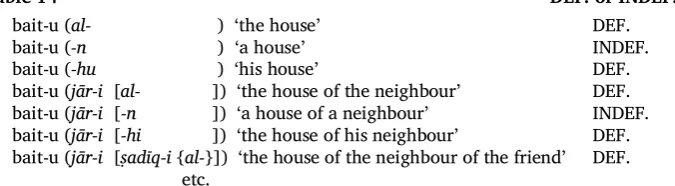
[image:12.595.140.478.320.413.2]5. Al-, -n, pronoun suffixes, and genitives: lexotactic vs. delotactic structuring Nouns/noun-phrases in Standard Arabic are either definite or indefinite, and where they involve an annexion (genitive) structure (with either a pronoun or noun/noun-phrase annex) every noun in the phrase has the same degree of defi-niteness: either definite or indefinite. I have proposed a structural (syntactic) anal-ysis for nouns/noun-phrases involving al-, -n, pronoun suffixes, and genitives as in Table 12 (Section 3.1), reproduced immediately below as Table 14, with addition-al information on the definiteness or indefiniteness of the noun(s)/noun-phrase(s).
Table 14 DEF. or INDEF.?
bait-u (al- ) ‘the house’ DEF.
bait-u (-n ) ‘a house’ INDEF.
bait-u (-hu ) ‘his house’ DEF.
bait-u (j r-i [al- ]) ‘the house of the neighbour’ DEF.
bait-u (j r-i [-n ]) ‘a house of a neighbour’ INDEF.
bait-u (j r-i [-hi ]) ‘the house of his neighbour’ DEF. bait-u (j r-i [ad q-i {al-}]) ‘the house of the neighbourof the friend’ DEF.
etc.
What the syntactic analysis given in Table 14 does is to show how words (here defined informally) and morphemes (here defined informally as elements constitut-ing words) commute with one another. This syntax of words (and morphemes) – i.e. entities which have both form (expression) and meaning (content) – is known in extended axiomatic functionalism as lexotactics. Table 14 thus provides a lexo-tactic analysis. It is however also possible to strip away the words themselves and simply look at meaningful entities and how these combine. Syntax of this kind – dealing with meaning abstracted from all consideration of form/expression – is known in extended axiomatic functionalism as delotactics. Table 15 (below) pro-vides an initial delotactic analysis of the structures discussed in this article. I use a
backslash to indicate an ‘abstract meaning’ (devoid of form/expression). Thus,
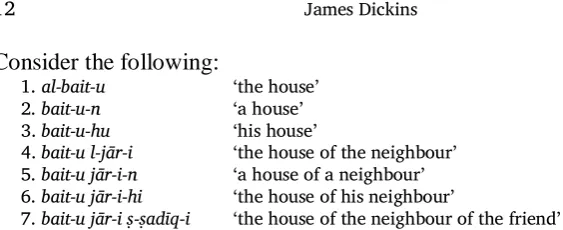
Consider the following:
1. al-bait-u ‘the house’ 2. bait-u-n ‘a house’ 3. bait-u-hu ‘his house’
4. bait-u l-j r-i ‘the house of the neighbour’ 5. bait-u j r-i-n ‘a house of a neighbour’ 6. bait-u j r-i-hi ‘the house of his neighbour’
7. bait-u j r-i -ad q-i ‘the house of the neighbour of the friend’
[image:13.595.113.395.74.189.2]We can present the lexotactic analysis (already discussed; cf. Section 3.1), and proposed delotactic analysis of these as in Table 15.
Table 15
Lexotactic analysis Delotactic analysis
1. bait-u (al- ) ‘the house’ \DEF.\+\bait\ 2. bait-u (-n ) ‘a house’ \INDEF.\+\bait\ 3. bait-u (-hu ) ‘his house’ (\DEF.\+\bait\) \-hu\ 4. bait-u (j r-i [al-] ) ‘the house of the neighbour’(\DEF.\+\bait\) (\DEF.\+\j r\) 5. bait-u (j r-i [-n] ) ‘a house of a neighbour’ (\INDEF.\+\bait\) (\INDEF.\+\j r\) 6. bait-u (j r-i [-hi] ) ‘the house of his neighbour’ (\DEF.\+\bait\) ((\DEF.\+\j r \) \-hu\))
7. bait-u (j r-i [ad q-i {al-}]) ‘the house of the neighbour’(\DEF.\+\bait\) ((\DEF.\+\j r\) (\DEF.\+\adq\))) etc. of the friend’
Taking each of these in turn:
1. al-bait-u ‘the house’ can be analysed delotactically as \DEF.\+\bait\. The
‘plus’ symbol + is to be read as meaning a simple combination of two elements,
i.e. \DEF.\ ‘definiteness’ (relayed lexically by al-) and \bait\.
2. bait-u-n ‘a house’ can be analysed delotactically as \INDEF.\+ \bait\, i.e. \INDEF.\ ‘indefiniteness’ (relayed lexically by -n) and \bait\.
3. bait-u-hu ‘his house’ can be analysed delotactically as (\DEF.\+\bait\) \-hu\.
The arrow symbol is to be read as a combination of two elements, the one to
which the arrow points being the head (in this case (\DEF.\+\bait\)) and the one away from which the arrow points being the modifier (in this case \-hu\). Thus bait-u-hu ‘his house’ is analysed delotactically as \DEF.\+\bait\ (= ‘the house’)
‘of his’ (to use English glosses).5 For justification of why the genitive ‘of his’ el e-ment should be regarded as the modifier, see the discussion of example 7. bait-u j r-i -ad q-i ‘the house of the neighbour of the friend’ below.6
5 Arguably the -hu ‘of his’ element in bait-u-hu ‘the house of his’ should itself be further an a-lysed as containing a \DEF.\. I have not, however, pursued this in this article.
6 In Standard Arabic nouns with pronoun suffixes, such as bait-u‘[the] house’ in bait-u-hu ‘his house’ are always definite. In some Arabic dialects, by contrast, nouns with pronoun suffixes may be indefinite when they modify a previous noun. An example from Sudanese Arabic is
r jil j r-na ‘a man who is our neighbour’ (more literally, ‘a man our-neighbour’). Taking it that a definite noun has to have an indefinite modifier (noun or adjective) and that the head noun r jilis here indefinite, we have to conclude (correctly, I believe) that j r-na ‘our neig
h-bour’ is also indefinite. In various languages it is possible to combine an indefinite article d
i-rectly with a possessive pronoun, e.g. Turkish bir arkada ım ‘a friend of mine’, where bir
4. bait-u l-j r-i ‘the house of the neighbour’ can be analysed delotactically as (\DEF.\+\bait\) (\DEF.\+\j r\), i.e. a definite head ‘the house’ plus a definite
modifier ‘the neighbour’ (using English glosses).
5. bait-u j r-i-n ‘a house of a neighbour’ can be analysed delotactically as (\INDEF.\+\bait\) (\INDEF.\+\j r\), i.e. an indefinite head ‘the house’ plus an
indefinite modifier ‘the neighbour’ (using English glosses).
6. bait-u j r-i-hi ‘the house of his neighbour’ can be analysed, in the first i n-stance, as (\DEF.\+\bait\) ((\DEF.\+\j r\) \-hu\), i.e. as a head-modifier
combination of two definite elements, the head of which is ‘the house’, while the modifier is ‘the neighbour of his’ (using English glosses). The second of these def i-nite elements (\DEF.\+\j r\) \-hu\ can then itself be further analysed as a head-modifier combination of two elements, the head being (\DEF.\+\ j r\), while the modifier is \-hu\ ‘of his’.
7. bait-u j r-i -ad q-i ‘the house of the neighbour of the friend’ can be analysed as, in the first instance, as (\DEF.\+\bait\) ((\DEF.\+\j r\) \ -ad q-i\), i.e. as a head-modifier combination of two definite elements, the head of which is ‘the house’, while the modifier is ‘the neighbour of the friend (using English glosses). The second of these definite elements (\DEF.\+\j r\) \ -ad q-i\ can then itself be further analysed as a head-modifier combination of two elements, the head being (\DEF.\+\j r\), while the modifier is (\DEF.\+\-ad q-i\) ‘the friend’.
Example 7. shows why the relationship between the annexion-head (i.e. the first phrase in the genitive) and the annex (the subsequent noun/noun-phrase, perhaps itself complex, as in example 7) is a head-modifier relationship, rather than one of parity between the two elements (i.e. rather than a simple +
relationship). The thing described by ‘the house of a neighbour’ is both ‘a house’ and ‘a neighbour’s [house]’ (i.e. it belongs to a neighbour, or similar). It is not,
however, (necessarily) also ‘a friend’s [house]’. Thus, the further one moves away
from the annexion-head in terms of annexes, the less direct the connection be-tween the referent of the relevant noun and the referent of the annex. Such ‘refe
r-ential distancing’ can be taken to be a signal of modifier status (peripherality to a
head) (cf. ZWICKY 1993; also CORBETT,FRASER and MCGLASHAN 1993: 1). This es-tablishes the general principle that an annex is peripheral to (i.e. it modifies) an annexion-head, and thus that the relationship between annexion-heads and annex-es throughout (as applying to examplannex-es 3–7 above) is a head-modifier relationship. 6. Conclusion
lexo-tactic vs. delolexo-tactic. I have shown that a delolexo-tactic analysis of the features covered in this paper yields significantly different results from a lexotactic analysis.7
References
BADAWI, EL-SAID, CARTER, M. and GULLY, ADRIAN. 2004. Modern written Arabic: a comprehen-sive grammar. London and New York: Routledge.
CORBETT,GREVILLE B.,FRASER,N.M. and MCGLASHAN,S. 1993. Heads in grammatical theory. Cambridge: Cambridge University Press.
CRYSTAL,DAVID. 1985. A dictionary of linguistics and phonetics (6th edn.). Oxford: Blackwell. DICKINS, JAMES. 1998. Extended axiomatic linguistics. Berlin and New York: Mouton de
Gruy-ter.
DICKINS, JAMES. 2009. ‘Extendedaxiomatic functionalism: postulates’. In Linguistica Online: http://www.phil.muni.cz/linguistica/art/DICKINS/dic-001.pdf
DICKINS,JAMES. 2011. ‘Fac*l forms in Sudanese Arabic: the reassertion of morphology’. In
Zeitschrift fuer Arabische Linguistik, 53: 36-67.
HESELWOOD, BARRY. 2008. ‘Simultaneous phonemes in English’. In Linguistica Online:
http://www.phil.muni.cz/linguistica/art/heselwood/hes-001.pdf
HOLES,CLIVE. 1995. Modern Arabic: structures, functions and varieties. London: Longman. LIPI SKI,EDWARD. 1997. Semitic languages: outline of a comparative grammar. Leuven: Peters.
LYONS,CHRISTOPHER. 1999. Definiteness. Cambridge: Cambridge University Press.
RETSÖ,JAN. 1984–1986. ‘State, determination and definiteness in Arabic: a reconsideration’. In Orientalia Suecana XXXIII-XXXV (1984–1986). Pp. 341–346.
RETSÖ, JAN. 2010. ‘Status – eine vernachlässigte Kategorie der arabischen Grammatik?’. In Arabische Welt: Grammatik, Dichtung und Dialekte. SHABO TALAY and HARTMUT BOBZIN (eds.). Wiesbaden: Reichert Verlag. Pp. 65–71.
WATSON, JANET. 1993. A Syntax of an n Arabic. Wiesbaden: Harrassowitz.
Zwicky, ARNOLD. 1993 ‘Heads, bases and functors’. In G.B. Corbett, N.M. Fraser and S. McGlashan (eds.), Heads in grammatical theory. Cambridge: Cambridge University Press. Pp. 292–315.
7 One significant issue which this article glosses over is the fact that in Standard Arabic
nuna-tion (tanw n), like case endings, is not normally written (except in the case of dual and mascu-line sound plural nouns). Nunation is similarly not always pronounced. According to the traditional, formal rules for speaking Standard Arabic, nunation is pronounced in liaison (wa l) contexts, but not where there is pause after the relevant word (waqf). In more informal styles of speaking Standard Arabic, highly complex, probabilistic principles apply, such that it cannot typically be predicted with certainty where nunation will and will not be pronounced – although certain words in Modern Standard Arabic are always pronounced with case-endings and nunation, particularly accusative adverbs such as abcan ‘of course, naturally’.