This is a repository copy of The Deduction Theorem for Strong Propositional Proof
Systems.
White Rose Research Online URL for this paper:
http://eprints.whiterose.ac.uk/74443/
Article:
Beyersdorff, O (2010) The Deduction Theorem for Strong Propositional Proof Systems.
Theory of Computing Systems, 47 (1). 162 - 178 . ISSN 1432-4350
https://doi.org/10.1007/s00224-008-9146-6
[email protected] Reuse
See Attached
Takedown
If you consider content in White Rose Research Online to be in breach of UK law, please notify us by
The Deduction Theorem for
Strong Propositional Proof Systems
⋆Olaf Beyersdorff
Institut f¨ur Theoretische Informatik, Leibniz Universit¨at Hannover, Germany [email protected]
Abstract. This paper focuses on the deduction theorem for
proposi-tional logic. We define and investigate different deduction properties and show that the presence of these deduction properties for strong proof systems is powerful enough to characterize the existence of optimal and even polynomially bounded proof systems. We also exhibit a similar, but apparently weaker condition that implies the existence of complete disjointNP-pairs. In particular, this yields a sufficient condition for the completeness of the canonical pair of Frege systems and provides a gen-eral framework for the search for completeNP-pairs.
1
Introduction
The classical deduction theorem for propositional logic explains how a proof of a formulaψfrom an extra hypothesisϕis transformed to a proof ofϕ→ψ. While this property has been analysed in detail and is known to hold for Frege systems [5, 6], the situation is more intricate for stronger systems such as extensions of Frege systems. On the one hand, formulating extended Frege systems EF as Frege systems where the size of the proof is measured by the number of steps in the proof, the deduction theorem again holds for extended Frege systems (as the number of steps in Frege systems is polynomially related to the proof size inEF). On the other hand, in the usual formulation, neitherEF nor substitution Frege systemsSF satisfy the classical deduction theorem, as neither the extension nor the substitution rule is sound (in the sense that every satisfying assignment for the premises also satisfies the conclusion of these rules). Thus, another approach for the deduction theorem in EF or SF is to limit the use of the extension or substitution rule in the systems. Yet, as a third alternative, we can take the full systemsEF andSF, but consider weakened versions of the deduction property. In this paper we aim to clarify the relations between these different ap-proaches. In particular, we concentrate on the third alternative and show that even restricted notions of deduction are very powerful for strong systems, as they have unlikely consequences. More concretely, we relax the condition from
the classical deduction theorem by requiring the extra hypothesisϕto be tauto-logical. In this way we arrive at two weaker versions of the deduction property, for which we ask whether they are valid for strong proof systems with natural properties. It turns out that even these weaker versions of deduction are very powerful properties for strong proof systems as they allow the characterization of the existence of optimal and even polynomially bounded proof systems.
These characterizations are interesting as they relate two important concepts from different areas. The problem of the existence of polynomially bounded proof systems is known to be equivalent to the NP versus coNP question [9], while
the question of the existence of optimal proof systems, asking for a strongest propositional proof system, is a famous and well-studied problem in proof com-plexity, posed by Kraj´ıˇcek and Pudl´ak [19], and with implications for a number of promise complexity classes (cf. [17, 22]). In particular, Sadowski [22] obtained different characterizations for the existence of optimal proof systems in terms of optimal acceptors and enumerability conditions for easy subsets of TAUT. Ear-lier, Kraj´ıˇcek and Pudl´ak [19] establishedNE=coNEas a sufficient condition for
the existence of optimal proof systems, while K¨obler, Messner, and Tor´an [17] showed that optimal proof systems imply complete sets for a number of other complexity classes likeNP∩coNPandBPP.
On the other hand, we show that weak deduction combined with suitable closure properties of the underlying proof system implies the existence of com-plete disjointNP-pairs. Although disjointNP-pairs were already introduced into
complexity theory in the 80’s by Grollmann and Selman [15], it was only during recent years that disjointNP-pairs have fully come into the focus of
complexity-theoretic research [20, 11–14, 1, 4]. This interest mainly stems from the appli-cation of disjoint NP-pairs to such different areas as cryptography [15, 16] and
propositional proof complexity [21, 20, 1].
Similarly as for other promise classes it is not known whether the class of all disjoint NP-pairs contains pairs that are complete under the appropriate
reductions. This question, posed by Razborov [21], is one of the most prominent open problems in the field. On the positive side, it is known that the existence of optimal proof systems suffices to guarantee the existence of complete pairs [21]. More towards the negative, a body of sophisticated relativization results underlines the difficulty of the problem. Glaßer, Selman, Sengupta, and Zhang [12] provided an oracle under which complete disjointNP-pairs do not exist. On
the other hand, in [12] they also constructed an oracle relative to which there exist complete pairs, while optimal proof systems do not exist.
Further information on the problem is provided by a number of different characterizations. Glaßer, Selman, and Sengupta [11] obtained a condition in terms of uniform enumerations of machines and also proved that the question of the existence of complete pairs receives the same answer under reductions of different strength. Additionally, in [4] the problem was characterized by prov-ability conditions in propositional proof systems. Namely, there exist complete
NP-pairs if and only if there exists a propositional proof system which proves the
their components. It was also shown in [4] that increasing the number of com-ponents from two to arbitrary constants does not change the difficulty of the problem, i.e., complete disjoint NP-pairs exist if and only if complete disjoint
k-tuples ofNP-sets exist for everyk≥2.
In this paper we exhibit several sufficient conditions for the existence of complete disjoint NP-pairs which involve properties of concrete proof systems
such as Frege systems and their extensions. These results fall under a general paradigm for the search for completeNP-pairs, that asks for the existence of proof
systems satisfying a weak version of the deduction theorem and moderate closure conditions. In particular, we provide two conditions that imply the completeness of the canonical pair of Frege systems and demonstrate that the existence of completeNP-pairs is tightly connected with the question whether EF is indeed
more powerful than ordinary Frege systems.
The paper is organized as follows. In Sect. 2 we provide some background information on propositional proof systems and disjointNP-pairs. In Sect. 3 we
discuss various extensions of Frege systems which we will investigate in Sect. 4 with respect to different versions of the deduction property. Section 5 contains the results connecting the deduction property for strong systems with the ex-istence of complete NP-pairs. Finally, in Sect. 6 we conclude with some open
problems.
2
Preliminaries
Propositional Proof Systems. Propositional proof systems were defined in a very general way by Cook and Reckhow [9] as polynomial-time computable functionsP which have as their range the set of all tautologies. A stringπwith
P(π) = ϕ is called a P-proof of the tautology ϕ. The size of a proof π is the number of symbols |π| in the proof. By P ⊢≤m ϕ we indicate that there is a
P-proof ofϕof size ≤m. We writeP ⊢∗ ϕn ifϕn is a sequence of tautologies
with polynomial-size P-proofs. A propositional proof system P ispolynomially boundedif all tautologies have polynomial sizeP-proofs.
Proof systems are compared according to their strength by simulations as introduced in [9] and [19]. A proof systemSsimulatesa proof systemP (denoted byP ≤S) if there exists a polynomialpsuch that for all tautologies ϕandP -proofs πof ϕthere is an S-proof π′ of ϕwith |π′| ≤p(|π|). If such a proof π′
can even be computed from πin polynomial time we say thatS p-simulatesP
and denote this by P≤pS. If the systems P and S mutually (p-)simulate each
other, they are called (p-)equivalent, denoted by P ≡(p) S. A proof system is
calledoptimalif it simulates all proof systems.
In the following sections, simple closure properties of propositional proof systems will play an important role. We say that a proof system P is closed under modus ponens if there exists a polynomialpsuch that for all numbers k
and all propositional formulasϕ1, . . . , ϕk+1 the following holds. IfP ⊢≤nϕi for
i= 1, . . . , kandP ⊢≤n ϕ1→ϕ2→ · · · →ϕk+1, then we getP ⊢≤p(n)ϕk+1. This
the proof size, but in fact a polynomial number of times (cf. [3] for a discussion of this and the following closure properties).
Similarly, we say thatPisclosed under substitutions of variables with respect to the polynomial q if P ⊢≤m ϕ(¯x) implies P ⊢≤q(m) ϕ(¯y) for all formulas ϕ(¯x) and propositional variables ¯y that are distinct from ¯x. Not specifying the polynomial explicitly, we say that P is closed under substitutions of variables
if there exists a polynomial q with this property. Likewise, P is closed under substitutions by constantsif there exists a polynomialqsuch thatP⊢≤mϕ(¯x,y¯)
impliesP ⊢≤q(m)ϕ(¯a,y¯) for all formulasϕ(¯x,y¯) and constants ¯a∈ {0,1}|x¯|.
DisjointNP-Pairs. A pair (A, B) is called adisjointNP-pairifA, B∈NPand
A∩B =∅. Grollmann and Selman [15] first defined the notion of a many-one reduction between disjointNP-pairs, which can be equivalently stated as follows
(cf. [20]): a disjointNP-pair (A, B) many-one reduces to a pair (C, D), denoted
(A, B)≤p(C, D), if there exists a polynomial-time computable functionf such
that f(A)⊆C and f(B)⊆D. A disjointNP-pair is complete if every disjoint NP-pair reduces to it.
The connection between disjoint NP-pairs and propositional proof systems
was established by Razborov [21], who associated a canonical disjoint NP-pair
(Ref(P),SAT∗) with a proof system P, where the first component Ref(P) =
{(ϕ,1m)|P ⊢
≤m ϕ} contains information about proof lengths in P and the
second component SAT∗ ={(ϕ,1m)| ¬ϕ∈ SAT} is a padded version of SAT.
This canonical pair is linked to the automatizability and the reflection property of the proof system [20]. More information on the connection between disjoint
NP-pairs and propositional proof systems can be found in [20, 1, 13].
3
Extensions of Frege Systems
A prominent example of a class of proof systems is provided by Frege systems
which are usual textbook proof systems based on axioms and rules. In the context of propositional proof complexity these systems were first studied by Cook and Reckhow [9] and it was proven there that all Frege systems, i.e., systems using different axiomatizations and rules, are p-equivalent.
In addition to Frege systems the extended Frege proof system EF can ab-breviate complex formulas by propositional variables by the followingextension rule: ifqis a new propositional variable, neither occurring in the previous proof steps nor in the proven formula, then q ≡ ϕ is an admissible proof step for arbitrary formulas ϕnot containing q. The variable q is anextension variable, which from now on abbreviates the formula ϕ. Note that q ≡ϕ is in general not tautological, and therefore q must not appear in the proven formula. This extension rule might further reduce the proof size, but it is not known whether
Another way to enhance the power of Frege systems is to allow substitutions not only for axioms but also for all formulas that have been derived in Frege proofs. Augmenting Frege systems by this substitution rule leads to the substitu-tion Frege system SF. The extensionsEF andSF were introduced by Cook and Reckhow [9]. While it was already proven there thatEF is simulated bySF, the converse simulation is considerably more involved and was shown independently by Dowd [10] and Kraj´ıˇcek and Pudl´ak [19]. For more detailed information on Frege systems and their extensions we refer to the monograph [18].
Under the notion ofHilbert-style proof systemswe subsume all proof systems that have as proofs sequences of formulas, and formulas in such a sequence are derived from earlier formulas in the sequence by the rules available in the proof system. In particular, Frege systems and its extensions are Hilbert-style systems. Hilbert-style proof systemsP can be enhanced by additional axioms in two different ways. Namely, we can form a proof systemP+ΦaugmentingP by a polynomial-time computable setΦof tautologies as new axiom schemes. This means that formulas from Φas well as substitution instances of these formulas can be freely introduced as new lines inP+Φ-proofs. In contrast to this we use the notationP∪Φfor the proof system that extendsP only by formulas fromΦ
but not by their substitution instances as new axioms. In our applications the set
Φwill mostly be printable, meaning thatΦcan both be decided and generated in polynomial time.
ForEF there are two canonical ways how to define the extensionsEF∪Φand
EF +Φ, where these two possibilities differ in the use of the extension axioms. In principle, this yields four possible types of extensions ofEF. Although some of these systems are not very natural, we will briefly discuss all of them, as the actual usage of the extension variables will turn out to be crucial for the deduction properties of EF. In the first method we will allow the introduction of extension axioms p ≡ ϕ only for extension variables p not occurring in Φ, whereas in the second method we can freely use extension axioms that also involve variables from Φ. For the first weaker notion we will use the notation
EF−∪Φ and EF−+Φ, whereas the stronger second way is indicated by the usual notation EF∪Φ and EF+Φ. When investigating deduction properties, we will frequently extend EF by different sets of tautologies Φ which are not always made explicit. Therefore, we will also use the notationEF−for the base systemEF. HenceEF andEF−are the same system, but the different notation indicates, how the system is augmented by further axioms. We will use the same notation (EF+Ψ)− when we use an extensionEF+Ψ as the base system and
augment this with further axiomsΦto systems (EF +Ψ)−∪Φ.
As already mentioned, we obtain four possible types of extensions ofEF, but it is easily seen that the distinction between EF and EF− becomes irrelevant when we augment these systems by axiom schemesΦ:
Proposition 1. Let Φ be a polynomial-time decidable set of tautologies. Then the proof systems EF +Φand EF−+Φ are p-equivalent.
generality, we assume that there is an infinite set of propositional variables which neither appear in the proof πnor inΦ. In order to convertπinto anEF−+Φ -proof we only have to check, whether π contains extension axiomsp≡ θ with extension variablespthat occur in the axiom setΦ. If this is not the case, then
πis already an EF−+Φ-proof. Otherwise, we just rename every occurrence of
pin πto a new variableq, which neither appears inπnor inΦ. Performing this step for every extension atom in π, we already arrive at an EF−+Φ-proof of
ϕ. This is correct, because the proven formulaϕmay not contain any extension variables, and renaming variables in axioms from Φin the proof still results in valid substitution instances of Φ, which we are permitted to use inEF−+Φ
-proofs. ⊓⊔
By Proposition 1, there is only one canonical way how to define extensions of
EF that use all substitution instances of the extra axioms. These extensions are particularly important as every proof systemP is p-simulated by a proof system of the form EF+Φwhere the axioms Φprovide a propositional description of the reflection principle of P, expressing a strong form of the consistency of P
(cf. [18] for details).
In addition, also the systemsEF ∪Φ and EF +Φ appear to be very close to each other, as also EF∪Φcan use substitution instances of Φ in its proofs. Namely, if ϕ(p1, . . . , pn) is a formula from Φ and θ1(¯q), . . . , θn(¯q) are
propo-sitional formulas in the variables ¯q that are disjoint from ¯p, then we can de-duce ϕ(θ1, . . . , θn) in EF ∪Φ as follows: we start with the extension axioms
p1 ≡ θ1(¯q), . . . , pn ≡ θn(¯q) and use these formulas to show the equivalence
ϕ(p1, . . . , pn)≡ϕ(θ1, . . . , θn) by induction on the formulaϕ. Using the original
axiom ϕ(p1, . . . , pn) from Φ we arrive with modus ponens at the substitution
instanceϕ(θ1, . . . , θn). We leave it open, whether this idea can be extended to a
full simulation ofEF+ΦbyEF∪Φ, but the argument shows that also the system
EF∪Φis quite natural, as it is equivalent to the proof systemP =EF+Φwhere formulas from Φ use pairwise distinct variables and eachP-proof may contain at most one substitution instance of each formula fromΦ.
For SF the situation becomes even simpler, as there is only one sensible way to define extensions ofSF. Namely, becauseSF can immediately generate substitution instances, we haveSF∪Φ≡pSF+Φ. In total, the following picture
of possible extension of Frege systems emerges:
Proof system Extensions by polynomial-time decidable axiomsΦ
F F∪Φ ≤p F+Φ
EF EF−∪Φ ≤p EF∪Φ ≤p EF−+Φ ≡p EF+Φ
SF SF ∪Φ ≡p SF+Φ
Probably not all these extensions lead to natural systems.1 As the table
indi-cates, onlyF∪Φ,F+Φ,EF−∪Φ,EF∪Φ, andEF+Φremain as possible (and
presumably different) systems. From this list, the systems F ∪Φ, F +Φ, and
EF+Φseem natural. ForEF−∪ΦandEF∪Φthe situation is probably not so clear. One criticism againstEF∪Φis that, as in the ”∪” setting, the variables in
Φcannot be arbitrarily substituted, it might not be natural to then define them by extension axioms. On the other hand, the systemsEF∪Φnaturally appear in the investigation of deduction properties, and, after all, lead to interesting consequences (Theorems 8 and 9). Finally, it is even possible that the systems
EF∪ΦandEF+Φare in fact equivalent (cf. the second paragraph after Propo-sition 1), and thence, EF∪Φwould just be a reformulation of a natural proof system.
In the above table all shown simulation relations are probably strict in each line (except forEF ∪Φ≤p EF +Φas mentioned above), because the converse
simulations (even for ≤) have unlikely consequences, as we will show in the sequel of this paper, or easily follows from known results. The next table gives an overview of these consequences, ranging in strength from the existence of complete disjointNP-pairs to the existence of optimal proof systems.
Assumption Consequence
F≡F∪Φ *) EF is optimal (Theorem 2)
F∪Φ≡F+Φ *) Complete disjointNP-pairs exist (Corollary 15) EF ≡EF−∪Φ *) EF is optimal (Theorem 2)
EF−∪Φ≡EF∪Φ *) EF is optimal (Theorem 8)
SF ≡SF∪Φ *) SF is optimal (Theorem 2) *) for all polynomial-time decidable sets of tautologiesΦ
The implications in lines 2 and 4 follow from Corollary 15 and Theorem 8 below. All other implications can be derived from the following result:
Theorem 2 (Kraj´ıˇcek, Pudl´ak [19]). Let P ≥EF be a proof system that is closed under substitutions and modus ponens. Then P is optimal if and only if
P ⊢∗ϕn for all printable sequences ϕn of tautologies.
To derive the first line from the above table, assume that F ≡ F ∪Φ for all polynomial-time decidable sets of tautologies Φ. In particular, this means
F ⊢∗ ϕn for all printable sequences ϕn, and hence also EF ⊢∗ ϕn. As EF
has the necessary closure properties, the optimality ofEF follows by the above theorem. Lines 3 and 5 are deduced analogously.
In contrast to these conditional separations, we do not seem to have such indication for separating the systems in the vertical columns of the first table, as even the relation betweenF and EF ≡pSF is not settled.
4
Deduction Properties for Frege Systems
Because proof complexity is focusing on the length of proofs it is interesting to analyse how the proof length is changing in the deduction theorem. AnF-proof of ϕ → ψ together with the axiom ϕ immediately yields the formula ψ with one application of modus ponens. Therefore it is only interesting to ask for the increase in proof length when constructing a proof ofϕ→ψfrom anF-proof of
ψwith the extra axiomϕ. This was analysed in detail in [5, 6].
The main application of the deduction property is to simplify proofs of com-plex formulas. Namely, to prove an implicationϕ→ψit suffices to construct a proof of ψfrom ϕ. In particular, ϕcan be any formula and is not necessarily a tautology. It is clear that such a deduction property is doomed to fail for strong systems likeEF orSF that can immediately produce substitution instances from
ϕ. For instance, by one application of the substitution rule we getSF∪ {p} ⊢q, whereas p→ q is not even a tautology. Similarly, we get EF ∪ {p} ⊢ q by in-troducing the extension axiomp≡q with extension variable pas the first line of the proof, and then derive qby modus ponens. This example, however, does not work forEF− as we have used the variablepfrom the extra assumption as an extension variable. In fact, such an example cannot be found as the classical deduction theorem is valid forEF− (Theorem 4).
Aiming in particular at strong proof systems likeEF we therefore restrictϕ
to tautologies and make the following general definition.
Definition 3 (Efficient/classical deduction property).A Hilbert-style proof system P allows efficient deductionif there exists a polynomialp such that for all finite sets Φof tautologies,
P∪Φ⊢≤mψ implies P ⊢≤p(m+m′)( ^
ϕ∈Φ
ϕ)→ψ
wherem′ =|Vϕ∈Φϕ|.
If this even holds for all finite setsΦof propositional formulas, then we say that P has theclassical deduction property.
This classical deduction property is known to hold for Frege systems (cf. [5, 6]), but actually almost the same proof also holds for the presumably stronger systemEF−.
Theorem 4 (Deduction theorem for Frege systems).LetΨ be a polynomial-time decidable set of tautologies. Then every Frege system F+Ψ and every ex-tension Frege system of the form(EF+Ψ)− has the classical deduction property.
Proof. For everyF-rule
Ri =
ψ1 . . . ψr
ψ
we fix anF-proofπi of the tautology
((q→ψ1)∧ · · · ∧(q→ψr))→(q→ψ)
Let ϕ1, . . . , ϕn be arbitrary propositional formulas and let (θ1, . . . , θk) be
a proof of ψ of size m in the system P ∪ {ϕ1, . . . , ϕn}, where P is F+Ψ or
(EF+Ψ)−. Letm′=Pn
i=1|ϕi|. By induction onj we constructP-proofs of the
implications
(
n
^
i=1
ϕi)→θj .
We distinguish three cases on how the formulaθj was derived.
Ifθj is one of the formulas from{ϕ1, . . . , ϕn}or a substitution instance from
Ψ, then we get (Vni=1ϕi)→θj in a proof of sizeO(m′+|θj|).
Ifθj was inferred fromθj1, . . . , θjr by theF-ruleRi, then we can get fromπi
anF-proof of sizeO(m′+|θj|+Prl=1|θjl|) of the tautology
((
n
^
i=1
ϕi)→θj1)∧ · · · ∧((
n
^
i=1
ϕi)→θjr)→(( n
^
i=1
ϕi)→θj).
Combining all the earlier proved implications (Vni=1ϕi) →θjl, l = 1, . . . , r by
conjunctions and using modus ponens, we get the desired implication (Vni=1ϕi)→
θj. Hence the already existingP-proofs of (Vni=1ϕi)→θkfork < jare prolonged
by aP-proof of sizeO(m+m′).
If in the case of (EF+Ψ)− the formulaθ
j was derived by the extension rule,
i.e.,
θj= (q≡θ)
with a new variableq, then we can also use the extension rule to getq≡θ and derive
(
n
_
i=1
¬ϕi)∨(q≡θ) = ( n
^
i=1
ϕi)→(q≡θ)
in a proof of size O(m′ +|θ|). Here it is important that by the definition of (EF+Ψ)−the extension variableqdoes not occur in the formulasϕ
i, as otherwise
we would not be able to use qas an extension variable in an (EF +Ψ)−-proof
of (Vni=1ϕi)→θk. ⊓⊔
A still weaker form of the deduction property is given in the next definition.
Definition 5 (Weak deduction property). A Hilbert-style proof system P
allows weak deduction if the following condition holds. For all printable sets
Φ ⊆TAUT there exists a polynomial psuch that for all finite subsets Φ0 ⊆Φ
we can infer from P ∪Φ0 ⊢≤m ψ that P ⊢≤p(m+m′) (Vϕ∈Φ0ϕ) → ψ where
m′ =|Vϕ∈Φ0ϕ|.
In Definition 3 we allowed a fixed polynomial increase for the proof size in the transformation of a proof fromψto the implication (Vϕ∈Φ0ϕ)→ψ, whereas
Proposition 6. Optimal Hilbert-style proof systems have the weak deduction property. Similarly, polynomially bounded Hilbert-style proof systems have the efficient deduction property.
Proof. LetP be an optimal Hilbert-style proof system and letΦbe a printable set of tautologies. Then P ∪Φ is a well defined proof system which by the optimality of P is simulated by P. Hence we have polynomial-size P-proofs of all formulas from Φ. Given a finite setΦ0and a P∪Φ0-proofπof a formula ψ
we can therefore first derive all formulas from Φ0 in polynomial-size P-proofs and concatenate this withπ. This results in a polynomial-sizeP-proof ofψfrom which we easily obtain a polynomial-size P-proof of (Vϕ∈Φ0ϕ)→ψ.
IfP is polynomially bounded, then all tautologies have polynomial-sizeP -proofs. Hence in particular, there is a polynomial bound on the proof size of the formulas (Vϕ∈Φ0ϕ)→ψwhich is independent ofΦ. ⊓⊔
The following theorem provides a form of a converse to the last proposition. This shows that the efficient and even the weak deduction property are very strong assumptions for proof systems satisfying basic closure properties.
Theorem 7. LetP ≥EF be a Hilbert-style proof system that fulfills the follow-ing two conditions:
1. P is closed under modus ponens and substitutions by constants.
2. For all printable sets of tautologiesΦthe proof systemP∪Φis closed under substitutions of variables.
Then the following implications hold. IfP has the weak deduction property, then
P is an optimal proof system. If P even has the efficient deduction property and item 2 holds for some fixed polynomial p, not depending onΦ, then P is a polynomially bounded proof system.
Proof. Let us argue for the first implication. To obtain the optimality of a proof systemP≥EF that is closed under modus ponens, it suffices to showP ⊢∗ϕn
for all printable sequences of tautologiesϕnby Theorem 2. Letϕn(¯p) be a
print-able sequence in the variprint-ables ¯p, and let ¯qbe a sequence of propositional variables that is disjoint from ¯p. We consider the proof systemP′ =P∪ {ϕ
n(¯q)|n≥0},
where the variables ¯p from ϕn(¯p) are substituted by ¯q. By assumption, P′
is closed under substitutions of variables and hence we have P′ ⊢
∗ ϕn(¯p).
By the weak deduction property for P we get P ⊢∗ Vi∈Iϕi(¯q) → ϕn(¯p) for
some finite set I. Using closure under substitutions by constants we derive
P ⊢∗ Vi∈Iϕi(1, . . . ,1) → ϕn(¯p), where we have substituted all variables ¯q in
ϕi(¯q) by constants 1. Because allϕiare tautologies, the formulasϕi(1, . . . ,1) are
true formulas without variables and therefore admit polynomial-size P-proofs, asP ≥EF. Using modus ponens forP we arrive at polynomial-sizeP-proofs of
ϕn(¯p), as desired.
sequences of tautologiesϕn and a fixed polynomialp. In the definition of the
effi-cient deduction property and the other closure properties we have also bounded the increase in the proof length by fixed polynomials. Hence an easy modification of the above argument yields the second implication. ⊓⊔
Theorem 7 tells us that, for a non-optimal Hilbert-style proof system P
satisfying the natural closure properties from item 1, either P does not have weak deduction orP∪Φis not closed under substitutions of variables for some choice ofΦ. Examining the situation for extensions ofEFwe obtain the following result.
Theorem 8. Let Ψ be a polynomial-time decidable set of tautologies. Then the following conditions are equivalent:
1. EF+Ψ has the weak deduction property. 2. EF+Ψ is an optimal proof system.
3. For all polynomial-time decidable setsΦ⊂T AU T the systems(EF+Ψ)−∪Φ
and(EF +Ψ)∪Φare equivalent.
4. For all polynomial-time decidable sets Φ⊂T AU T the proof system (EF+
Ψ)−∪Φis closed under substitutions of variables.
Proof. We will prove the implications 1⇔2, 2⇒3, 3⇒4, and 4⇒2. To prove item 2 from item 1, let us assume that EF +Ψ has the weak deduction property. By definition, the system EF +Ψ is closed under modus ponens and under substitutions by constants. In order to conclude the optimality of the proof system by Theorem 7, it remains to verify the closure of (EF+Ψ)∪Φ
under substitutions of variables for arbitrary printable sets Φ of tautologies. Going back to the proof of Theorem 7, we observe that instead of proving closure under substitutions of variables, it actually suffices to derive formulasϕ(¯q) from
Φin arbitrary variables ¯q. For this assume thatΦcontains the formulaϕ(¯p), and we want to derive the formulaϕ(¯q). This can be done as follows: we introduce the extension axiomsp1≡q1, . . . , pk ≡qk for all variablespi in ¯p. By induction on
the formula ϕwe then prove the equivalenceϕ(¯p)≡ϕ(¯q) with polynomial-size
EF-proofs and finally use modus ponens to conclude withϕ(¯q). The implication 2⇒1 was proven in Proposition 6.
Clearly, item 2 implies item 3.
Now we prove the implication 3⇒4. Let us denote the system (EF+Ψ)−∪Φ
byP− and the system (EF+Ψ)∪ΦbyP. Assuming the equivalence ofP− and
P, it suffices to prove closure under substitutions of variables for the system
P, as this property is preserved inside the degree of a proof system. Let π be a P-proof of the formula ϕ(¯p), and let ¯q be a set of variables distinct from ¯
p. By the equivalence of P and P− we have a P−-proof π− of ϕ(¯p) that is
only polynomially longer thanπ. From π− we will devise aP-proof ofϕ(¯q) as
follows: If there is an extension axiom q ≡ θ in π− with extension variable q
from ¯q, then we renameqin the entire proofπ−to a new variable which neither
π′. Now we construct the proof π of ϕ(¯q): π starts with the extension axioms
p1≡q1, . . . pk≡qk, introducing the original variables ¯pas extension atoms. This
is followed by the proof π′. By induction on the formula ϕ we then prove the
equivalenceϕ(¯p)≡ϕ(¯q) with polynomial-sizeEF-proofs and finally use modus ponens to conclude withϕ(¯q).
The final implication 4⇒2 follows from Theorem 7 as the systems (EF+Ψ)− even have the classical deduction property by Theorem 4. ⊓⊔
In particular, the last theorem yields two seemingly unrelated characteriza-tions for the optimality of EF, namely weak deduction for EF and closure of
EF−∪Φunder substitutions of variables for arbitrary tautologiesΦ.
Similarly, we obtain the following characterizations for the efficient deduction property of extensions ofEF.
Theorem 9. Let Ψ be a polynomial-time decidable set of tautologies. Then the following conditions are equivalent:
1. EF+Ψ has the efficient deduction property. 2. EF+Ψ is polynomially bounded.
3. There exists a polynomialpsuch that for all polynomial-time decidable sets
Φ⊂ T AU T the proof system (EF +Ψ)−∪Φ is closed under substitutions
with respect top.
While one might have objections on extending the systemsEF+Ψto systems (EF+Ψ)∪Φfor the deduction properties (cf. the discussion after Footnote 1), the same results are also valid for substitution Frege systems. In particular, as
SF fulfills the conditions required in Theorem 7, we immediately obtain from Proposition 6 and Theorem 7 the following characterizations.
Corollary 10. Let Ψ be a polynomial-time decidable set of tautologies. Then the proof system SF+Ψ is optimal if and only if SF+Ψ has the weak deduction property. Further, the system SF +Ψ is polynomially bounded if and only if SF +Ψ has the efficient deduction property.
As we know that every proof system P is simulated by a proof system of the form EF +Ψ with printable Ψ ⊂ TAUT (for instance we can take Ψ as translations of the reflection principle of P), we can deduce the following char-acterization of the existence of optimal proof systems.
Corollary 11. There exists an optimal proof system if and only if there exists a polynomial-time decidable set Ψ ⊂ TAUT such that EF +Ψ has the weak deduction property.
Similarly, we can characterize the existence of polynomially bounded proof systems by the efficient deduction property.
5
Deduction Properties and Complete
NP
-Pairs
In this section we link the deduction property to the problem of the existence of complete disjoint NP-pairs. In this analysis properties of proof systems are
transferred to properties of the corresponding canonical pairs of the systems. Augmenting Hilbert-style proof systemsP by additional axiomsΦwill usu-ally enhance the power of the proof system. The following lemma shows, however, that ifP has the weak deduction property, then the canonical pair ofP∪Φwill not be more difficult than the canonical P-pair. In particular, combined with Theorem 4 the next lemma shows that the canonical pairs of F and its exten-sionsF∪Φare equivalent for printable setsΦ⊆TAUT.
Lemma 13. LetΦ be a printable set of tautologies and letP be a proof system with the weak deduction property. Then (Ref(P∪Φ),SAT∗)≤p(Ref(P),SAT∗).
Proof. LetΦbe printable and letpbe the polynomial from the weak deduction property forP andΦ. Because Φ is printable there exists a polynomialq such that for each number m the setΦ contains at most q(m) tautologies of length
≤m. LetΦm=Φ∩Σ≤mbe the set of these tautologies.
Then (Ref(P∪Φ),SAT∗) reduces to (Ref(P),SAT∗) via the function
(ψ,1m) 7→ ( ( ^ ϕ∈Φm
ϕ)→ψ,1p(mq(m)+m)) .
To verify the claim assume that (ψ,1m)∈Ref(P∪Φ). Letπbe a P∪Φ-proof
of ψof length ≤m. This proof πcan use only formulas of length ≤m from Φ
of which there are only≤q(m) many. Hence the tautologies used in the proofπ
are contained inVϕ∈Φmϕ. Therefore we know thatπis also a proof forψin the
proof systemP∪Φm. Using the weak deduction property ofP we get aP-proof
of size≤p(mq(m) +m) of (Vϕ∈Φmϕ)→ψ.
Now assume (ψ,1m)∈SAT∗. Then¬
ψis satisfiable and therefore
¬(( ^
ϕ∈Φm
ϕ)→ψ) = ( ^
ϕ∈Φm
ϕ)∧ ¬ψ
is also satisfiable because (Vϕ∈Φmϕ) is a tautology. ⊓⊔
In the next theorem we formulate a sufficient condition for the existence of complete NP-pairs. The hypotheses in this theorem are very similar to the
hypotheses in Theorem 7, which gave a sufficient condition for the existence of optimal proof systems. The decisive difference between the two theorems is that in Theorem 7 we needed closure ofP∪Φunder substitutions of variables, whereas in the following theorem closure under substitutions by constants suffices.
Theorem 14. Let P be a Hilbert-style proof system that simulates the truth-table system and fulfills the following three conditions:
2. For all printable sets of tautologiesΦthe proof systemP∪Φis closed under substitutions by constants.
3. P has the weak deduction property.
Then the canonical pair of P is a complete disjointNP-pair.
Proof. Let (A, B) be a disjoint NP-pair. Similarly as in Cook’s proof of the NP-completeness of SAT [8], we can construct in polynomial time propositional
formulasψn(¯x,y¯) such thatψn(¯a,y¯) is satisfiable if and only if ¯a∈A. Similarly,
we build such propositional formulasθn(¯x,z¯) forB. We choose the variables of
ψn(¯x,y¯) andθn(¯x,¯z) in such a way that the input variables ¯xare the common
variables ofψnandθn, and the auxiliary variables ¯yand ¯zare distinct. We define
the sequenceϕn as
ϕn=ψn(¯x,y¯)→ ¬θn(¯x,z¯) .
Let P′ denote the system P ∪ {ϕn|n ≥0}. We first claim that the reduction
from (A, B) to the canonical pair ofP′ is given by
a 7→ (¬θ|a|(¯a,z¯),1p(|a|))
for some suitable polynomial p. To see the correctness of the reduction let first
abe an element fromAof lengthn. Asψn representsAthere exists a witness ¯b
such thatψn(¯a,¯b) is a tautological formula. TheP′-proof of¬θn(¯a,z¯) proceeds as
follows. First we use the axiomψn(¯x,y¯)→ ¬θn(¯x,z¯) and substitute the variables
¯
xand ¯y by ¯aand ¯b, respectively, obtaining
ψn(¯a,¯b)→ ¬θn(¯a,¯z) .
As ψn(¯a,¯b) is a true propositional formula without variables we can provide a
polynomial-sizeP-proof for it. This is possible as by assumptionP simulates the truth-table system. An application of modus ponens gives aP-proof of¬θn(¯a,z¯),
as desired.
Assume now a ∈ B. Then ¬¬θ|a|(¯a,z¯) = θ|a|(¯a,z¯) is satisfiable and hence
(¬θ|a|(¯a,z¯),1p(|a|))∈SAT∗.
By Lemma 13 the canonical pair ofP′ reduces to the canonical pair of P, hence (A, B) is≤p-reducible to (Ref(P),SAT∗). ⊓⊔
The decisive hypotheses in Theorem 14 are assumptions 2 and 3. For Frege systems property 3 of Theorem 14 is fulfilled, but property 2 is not clear. For
EF andSF, however, we have property 2, but whether property 3 holds is open. To find out whether some strong proof system fulfills both conditions 2 and 3 remains as a challenging task.
Instantiating Theorem 14 for Frege systems leads to the following corollary which asks, in principle, whether the systemsF∪ΦandF+Φare equivalent.
Corollary 15. Assume that for all printable sets of tautologies Φ the system
By Theorem 4 and Lemma 13 the same corollary also holds for the proof systemEF−.
Our last result shows that the existence of completeNP-pairs is tightly
con-nected with the question whetherF andEF are indeed proof systems of different strength.
Corollary 16. Assume that for all printable sequencesΦof tautologies the proof systemsF∪Φand EF∪Φare equivalent. Then the canonical pair of the Frege proof system is complete for the class of all disjoint NP-pairs.
Proof. To apply Theorem 14 we need to show thatF ∪Φ is closed under sub-stitutions by constants for all printable sets of tautologies Φ. By assumption
F ∪Φ is equivalent to EF ∪Φ, hence it suffices to show this closure prop-erty for EF ∪Φ. Given a formulaϕ(¯p,q¯) and an EF ∪Φ-proof for it, we con-struct anEF ∪Φ-proof of an instance ϕ(¯p,a¯) with constants a1, . . . , ak
substi-tuted for the variables q1, . . . , qk as follows: First we use the extension axioms
q1 ≡a1, . . . , qk ≡ak, then we repeat the proof of ϕ(¯p,q¯), and finally we show
the equivalence ϕ(¯p,q¯)≡ϕ(¯p,¯a) by induction on the formula ϕand using the formulasqi≡ai. This yields theEF ∪Φ-proof ofϕ(¯p,¯a). ⊓⊔
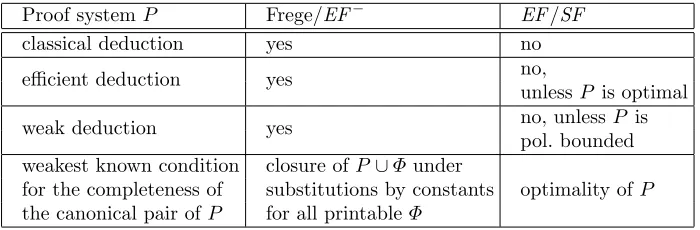
In Table 1 we have summarized the different deduction properties and their implications for the existence of complete NP-pairs for Frege systems and their
extensions.
Proof system P Frege/EF− EF/SF
classical deduction yes no
no, efficient deduction yes
unlessP is optimal no, unlessP is
weak deduction yes
pol. bounded weakest known condition closure ofP∪Φunder
for the completeness of substitutions by constants optimality of P
[image:16.595.134.484.399.514.2]the canonical pair ofP for all printable Φ
Table 1.Deduction properties for different types of proof systems
6
Conclusion
with a moderate amount of closure properties yields complete disjointNP-pairs.
It therefore seems to be interesting to investigate the following problem:
Problem 17. Are there natural strong proof systems besides Frege systems that satisfy the weak deduction property?
Given the implications above, we expect, however, that neither proving nor disproving this question will be an easy task.
It would also be interesting to know whether the condition in Corollary 15 also characterizes the completeness of the canonical Frege pair, similarly as in Corollaries 11 and 12. A more general program is to determine which conse-quences of the completeness of the canonical pair of some proof systemP are to expect for the system P itself.
Acknowledgements. I am indebted to Emil Jeˇr´abek, Johannes K¨obler, and Pavel Pudl´ak for helpful suggestions on this work. I also wish to thank Sebas-tian M¨uller and the anonymous referees for very helpful suggestions on how to improve this paper.
References
1. O. Beyersdorff. Classes of representable disjoint NP-pairs. Theoretical Computer Science, 377:93–109, 2007.
2. O. Beyersdorff. The deduction theorem for strong propositional proof systems. InProc. 27th Conference on Foundations of Software Technology and Theoretical Computer Science, volume 4855 ofLecture Notes in Computer Science, pages 241– 252. Springer-Verlag, Berlin Heidelberg, 2007.
3. O. Beyersdorff. Logical closure properties of propositional proof systems. InProc. 5th Conference on Theory and Applications of Models of Computation, volume 4978 ofLecture Notes in Computer Science, pages 318–329. Springer-Verlag, Berlin Heidelberg, 2008.
4. O. Beyersdorff. Tuples of disjoint NP-sets. Theory of Computing Systems, 43(2):118–135, 2008.
5. M. L. Bonet. Number of symbols in Frege proofs with and without the deduction rule. In P. Clote and J. Kraj´ıˇcek, editors,Arithmetic, Proof Theory and Compu-tational Complexity, pages 61–95. Oxford University Press, Oxford, 1993.
6. M. L. Bonet and S. R. Buss. The deduction rule and linear and near-linear proof simulations. The Journal of Symbolic Logic, 58(2):688–709, 1993.
7. M. L. Bonet, S. R. Buss, and T. Pitassi. Are there hard examples for Frege systems? In P. Clote and J. Remmel, editors,Feasible Mathematics II, pages 30– 56. Birkh¨auser, 1995.
8. S. A. Cook. The complexity of theorem proving procedures. InProc. 3rd Annual ACM Symposium on Theory of Computing, pages 151–158, 1971.
9. S. A. Cook and R. A. Reckhow. The relative efficiency of propositional proof systems. The Journal of Symbolic Logic, 44:36–50, 1979.
10. M. Dowd. Model-theoretic aspects of P6=NP. Unpublished manuscript, 1985. 11. C. Glaßer, A. L. Selman, and S. Sengupta. Reductions between disjoint NP-pairs.
12. C. Glaßer, A. L. Selman, S. Sengupta, and L. Zhang. Disjoint NP-pairs. SIAM Journal on Computing, 33(6):1369–1416, 2004.
13. C. Glaßer, A. L. Selman, and L. Zhang. Survey of disjoint NP-pairs and relations to propositional proof systems. In O. Goldreich, A. L. Rosenberg, and A. L. Selman, editors,Essays in Theoretical Computer Science in Memory of Shimon Even, pages 241–253. Springer-Verlag, Berlin Heidelberg, 2006.
14. C. Glaßer, A. L. Selman, and L. Zhang. Canonical disjoint NP-pairs of proposi-tional proof systems. Theoretical Computer Science, 370:60–73, 2007.
15. J. Grollmann and A. L. Selman. Complexity measures for public-key cryptosys-tems. SIAM Journal on Computing, 17(2):309–335, 1988.
16. S. Homer and A. L. Selman. Oracles for structural properties: The isomorphism problem and public-key cryptography. Journal of Computer and System Sciences, 44(2):287–301, 1992.
17. J. K¨obler, J. Messner, and J. Tor´an. Optimal proof systems imply complete sets for promise classes. Information and Computation, 184:71–92, 2003.
18. J. Kraj´ıˇcek. Bounded Arithmetic, Propositional Logic, and Complexity Theory, volume 60 ofEncyclopedia of Mathematics and Its Applications. Cambridge Uni-versity Press, Cambridge, 1995.
19. J. Kraj´ıˇcek and P. Pudl´ak. Propositional proof systems, the consistency of first order theories and the complexity of computations.The Journal of Symbolic Logic, 54:1063–1079, 1989.
20. P. Pudl´ak. On reducibility and symmetry of disjoint NP-pairs. Theoretical Com-puter Science, 295:323–339, 2003.
21. A. A. Razborov. On provably disjoint NP-pairs. Technical Report TR94-006, Electronic Colloquium on Computational Complexity, 1994.