ResearchOnline@JCU
This is the author-created version of the following work:
Drovandi, Aaron D., Teague, Peta-Ann, Glass, Beverley D., and Malau-Aduli,
Bunmi (2018) A randomised controlled trial evaluating the effectiveness and
tolerability of step-up and step-down varenicline therapy for smoking cessation:
study protocol. Journal of Smoking Cessation, 13 (3) pp. 179-185.
Access to this file is available from:
https://researchonline.jcu.edu.au/50107/
© The Author(s)
Please refer to the original source for the final version of this work:
A randomised controlled trial evaluating the effectiveness and tolerability
of step-up and step-down varenicline therapy for smoking cessation: Study
protocol
Drovandi A, Teague P, Glass B and Malau-Aduli B
ABSTRACT
Background: Varenicline remains the most effective medication for smoking cessation, however
discontinuation as a result of adverse events negatively impacts medication adherence, and the
likelihood of a quit attempt being successful. Post treatment cravings and withdrawal symptoms
may also occur, increasing the likelihood of treatment failure, due to lapse and relapse after
achieving initial abstinence. This protocol details a trial investigating changes in the effectiveness
and tolerability of varenicline, when an extended step-up and step-down regimen are used.
Methods: A phase 4, randomised, double-blinded, placebo-controlled single-centre study with a
treatment period of 16 weeks, and follow-up period of 12 weeks will be conducted. Up to 201
participants will be enrolled and allocated in a 1:1:1 ratio to a placebo-matching control group,
step-up, or step-down intervention group, all receiving behavioural counselling and quitting advice.
Participants will be contacted weekly during treatment and fortnightly during follow-up. Eligible
participants are smokers over 18 years old, willing to quit smoking, are able to attend clinic visits,
and have no uncontrolled or serious medical issues. Primary outcome measures are comparisons
of biochemically confirmed continuous abstinence rates, 7-day point prevalence abstinence rates
and the frequency, severity and duration of adverse events, cravings and withdrawal symptoms.
Secondary outcome measures are participant adherence to the study medication throughout
treatment, and comparisons of changes in smoking satisfaction and reward. Effects of each regimen
on smoking cessation will be assessed by logistic regression, with survival analyses used for a more
precise estimate of when cessation occurs. Primary endpoints will then be compared using a
INTRODUCTION
Tobacco use continues to be a major contributor to preventable morbidity and mortality, being
strongly linked to a growing list of health conditions, including several forms of cancer, and
cardiovascular and respiratory diseases (Fiore et al., 2008). Unfortunately, successful smoking
cessation continues to be challenging, despite the availability of smoking cessation medications and
behavioural counselling techniques (Cahill et al., 2013). Medications such as varenicline (Champix®
/ Chantix®), the most effective agent available for smoking cessation (Cahill et al., 2016), have
several clinical issues impacting on their effectiveness such as causing intolerable adverse effects
leading to premature therapy discontinuation, poor adherence, and a resurgence of cravings and
withdrawal symptoms after therapy has been completed (Drovandi et al., 2016; Balmford et al.,
2011; Catz et al., 2011; Liberman et al., 2013; Rigotti et al., 2010).
Modifications to the varenicline regimen through changes in daily dosing may address these
problems as suggested by a recent systematic review (Drovandi et al., 2017). Modifications trialled
and warranting further study include the use of an extended duration of pre-quit varenicline
therapy (Hajek et al., 2011; Hawk et al., 2012), and an extended duration of varenicline therapy
(Tonstad et al., 2006; Williams et al., 2007). These modifications were theorised to reduce the
frequency and severity of adverse events at the beginning of therapy and the long-term risk of
relapse at the end of treatment. A modification yet to be tested is a step-down period at the end
of varenicline therapy, potentially reducing the short-term risk of relapse at the end of treatment,
which has been encountered in some clinical trials (Tonstad et al., 2006; Rigotti et al., 2010).
This protocol was developed to evaluate changes in the effectiveness and tolerability of varenicline,
when it is introduced more slowly over a period of 4 weeks and ceased over a period of 2 weeks. It
is proposed that the use of extended ‘step-up’ therapy will reduce the frequency and severity of
adverse effects, which are usually more prominent at the beginning of therapy (Tonstad et al., 2016;
cravings and withdrawal symptoms due to a sudden drop in dopamine levels from the removal of
varenicline (Coe et al., 2005).
METHODS
This protocol has been registered with the Australian New Zealand Clinical Trials Registry
(ACTRN12616000802404p), and was developed to comply with the Helsinki Declaration of 1975
(revised in 2008) and Australian Guidelines on the development of ethical research. Ethical approval
was given by the James Cook University’s Human Research Ethics Committee (approval number
H6748). This article for the study protocol follows the Standard Protocol Items: Recommendations
for Interventional Trials (SPIRIT) checklist (Chan et al., 2013).
Study Design
A randomised, double-blinded, placebo-controlled trial will consist of three treatment groups with
different dosing schedules: two intervention groups (step-up and step-down varenicline therapies)
and a placebo-matched control group. This community-based single-site trial will require
participants to adhere to a treatment duration of 16-weeks and a follow-up duration of 12-weeks,
and attend scheduled clinic visits at James Cook University’s Health Clinic in Townsville, Australia.
Participant Eligibility and Recruitment
Eligible participants are required to be at least 18 years old and motivated to quit smoking, have a
Fagerström Test for Nicotine Dependence (FTND) score of at least 5.0, indicate their intention to
comply with scheduled clinic visits, have no history of major or uncontrolled depressive or other
psychiatric disorders, and use appropriate hormonal contraception if a woman of childbearing age.
Participants are ineligible if they have a history of a suicide attempt or any suicidal behaviours in
the previous 2 years, have a severe or uncontrolled major depressive, psychiatric, or cardiovascular
disorder, have a current psychosis, have concomitant substance abuse disorders, have used
varenicline within the previous 6 months, or do not agree to abstain from non-cigarette tobacco
Participants will be recruited from pharmacies, general practitioner clinics and newspaper
advertisements in Townsville, Australia. Potential participants may view, self-assess and complete
an expression of interest flyer at these locations, which include preliminary eligibility questions, and
the contact details of the principal investigator to facilitate a baseline visit with the potential
participant. Final eligibility and further information and consent documents will be provided during
the baseline visit to ensure the eligibility and safety of participants.
Treatment Groups and Interventions
The dose regimens for all the treatment groups are detailed in Table 1. Intervention group 1
(step-up) will be assigned to take 0.5mg once daily for 7 days, 0.5mg twice daily for 7 days, 0.5mg once
daily plus 1.0mg once daily for 7 days, 1.0mg twice daily for 11 weeks, then 2 weeks of placebo
tablets matched to the step-down intervention group. Intervention group 2 (step-down) will be
assigned to take 2 weeks of placebo tablets matched to the step-up intervention group, followed
by 0.5mg once daily for 3 days, 0.5mg twice daily for 4 days, 1.0mg twice daily for 11 weeks, then
0.5mg twice daily for 7 days, then 0.5mg once daily for 7 days. The control group will be assigned
to take 2 weeks of placebo tablets matched to the step-up intervention group, followed by 0.5mg
once daily for 3 days, 0.5mg twice daily for 4 days, 1.0mg twice daily for 11 weeks, then 2 weeks of
placebo tablets matched to the step-down intervention group. The medication provided will be
supplied in a dose administration aid (DAA) to avoid dosing confusion, maintain treatment blinding,
and to serve as a mechanism for monitoring participant adherence (Haywood and Glass, 2016).
Eligible participants will be randomly assigned a participant identifier number (PIN), each of which
is linked through a computer-generated randomisation sequence to a treatment group. Treatment
allocations will be sealed in individual envelopes, and a research associate who is not involved in
the study will be responsible for affixing PINs to each DAA to ensure continued double-blinding.
However, a participant’s allocated treatment can be revealed prior to completion of the study, if
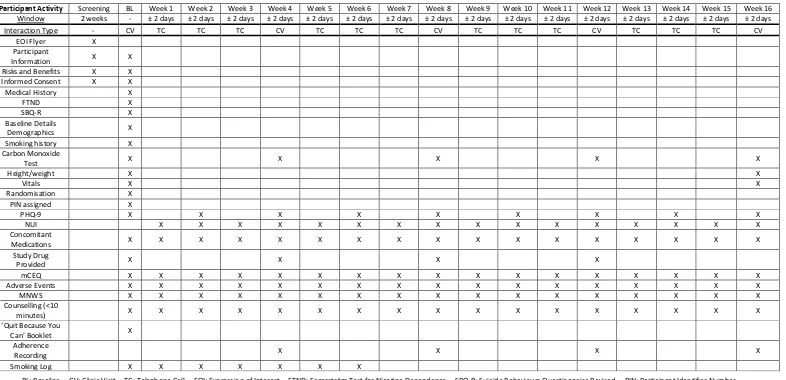
Interventions for eligible participants for the duration of the trial, including data collection tools are
detailed in Tables 2 and 3 for the treatment and follow-up periods respectively. Participants will be
contacted weekly during the treatment phase, and fortnightly during the follow-up phase through
a combination of telephone calls and face to face clinic visits. These scheduled interactions will
gather data on participant health indicators (both physical and mental), concomitant medication
load, adverse events, cravings and withdrawal symptoms experienced, and recent smoking habits.
Participants will receive a booklet on smoking cessation during the baseline visit, and up to 10
minutes of individualised counselling on techniques for smoking cessation during each intervention,
and be recommended to set a quit date between weeks 4 and 6 of treatment.
Study Outcomes
Primary outcomes to be assessed during this trial are comparisons of biochemically confirmed
continuous abstinence rates, 7-day point prevalence abstinence rates and the frequency, severity,
and duration of adverse effects, cravings, and withdrawal symptoms. These primary outcomes will
determine if step-up or step-down varenicline dosing has positive effects as measured by improved
smoking cessation rates and reduced adverse events, cravings, or withdrawal symptoms during
cessation attempts. Secondary outcome measures include adherence to the study medication
throughout treatment and changes in smoking satisfaction and reward.
Data Collection and Management
During the interventional and follow-up periods, as detailed in Table 2 and Table 3 respectively,
data for the primary and secondary outcomes will be initially collected from participants on a
weekly basis, with monthly face to face clinic visits being interspersed by telephone calls. Adverse
events. Continuous and 7-day point prevalence abstinence rates will be assessed by multiple
methods, including the Nicotine Use Inventory (NUI), a personal smoking log, and biochemically
confirmed using a Micro+ Smokerlyzer device. The NUI will be administered during scheduled
telephone and clinic visits by the principal investigator, querying the participants’ use of cigarettes
or any other nicotine-containing products. The smoking log will be used daily by participants to
abstinence to be confirmed during clinic visits using a Micro+ Smokerlyzer device, with a cut-off
reading of <10ppm considered as being abstinent. All adverse events, including serious and
non-serious, will be recorded on case report forms on a per-participant basis, to be reported to the
principal investigator, and causality determined during the scheduled telephone and face to face
clinic visits. Participants will be encouraged to log adverse events daily as they occur, ensuring to
note changes in severity or apparent cause if they persist over several days, will be coded using
MedDRA, and followed-up until cessation of the event. Concerning or unusual adverse events will
be reported immediately to the principal investigator, with events considered to be serious or
unexpected to also be reported to Pfizer Inc., the approving ethics committee, and the Adverse
Drug Reaction unit of the Therapeutic Goods Administration. Physical health will be assessed at the
commencement and cessation of treatment, and at the completion of the follow-up period, and
include recording of participant height, weight, and vital signs (blood pressure, respiratory rate, and
heart rate). Mental health will be assessed initially using the Suicide Behaviours Questionnaire
Revised (SBQ-R) (Osman et al., 2001), and monitored fortnightly using the Patient Health
Questionnaire-9 (PHQ-9) (Kroenke et al., 2001). The 9-item version of the Minnesota Nicotine
Withdrawal Scale (MNWS) (Hughes and Hatsukami, 1986) will be used to assess weekly changes in
cravings and withdrawal symptoms, using a 5-point Likert scale ranging from 0 (not at all) to 5
(extreme). The MNWS will be self-administered by participants on a daily basis, and reported to the
principal investigator during phone calls and clinic visits.
Medication adherence checks will be done by the principal investigator during the treatment period
clinic visits, by counting remaining tablets in returned DAAs. Changes in smoking satisfaction and
reward will be assessed by the principal investigator using the Modified Cigarette Evaluation
Questionnaire (mCEQ) (Cappelleri et al., 2007), a 12-item questionnaire rating on a 7-point scale
from 1 (Not at all) to 7 (Extremely) the common experiences normally received by smoking. All data
collection will be performed by the principal investigator only, who will personally enter all data
into a master excel spreadsheet, which will be stored on a passwordprotected computer in the
Sample Size and Statistical Analyses
Using GPOWER v3.1, it was determined that to detect a moderate effect size with 80% power, a
total of 119 completers are required for statistical power for the primary endpoints of the study,
being the biochemically confirmed continuous abstinence rate for participants in each treatment
group. To ensure statistical power is achieved, up to 201 participants will be enrolled to
accommodate up to 40% participant withdrawal from treatment and loss to follow-up as
demonstrated by similarly designed smoking cessation trials (Hajek et al., 2011; Rigotti et al., 2010;
Hawk et al., 2012). Intention to treat analysis will include univariate and multivariate analysis of the
factors associated with abstinence post-quit date. Analysis will occur after the final participant has
completed their end-of-study clinic visit.
Data analysis will include assessing biochemically confirmed continuous abstinence rates and the
presence of, and numerical scale of severity of adverse events, cravings and withdrawal symptoms,
for smokers or non-smokers. Quantitative data will be subjected to multivariate analysis in SPSS
(v23) to establish relationship between categorical and continuous variables. Logistic regression will
be used to assess the effect of the treatment regimens on smoking cessation. Odds ratio (OR) will
be used to compare the relative odds of occurrence of smoking cessation, between the active and
control groups. The 95% confidence intervals (CI) will be used to estimate the precision of the OR.
Survival analysis (via cox regression) will be used to measure more precise and absolute estimates
of when smoking cessation occurs. A survival probability estimate will also be calculated using the
Kaplan-Meier method. Survival curves and a non-parametric statistical log rank test will be used to
determine significant differences between the groups. The severity of adverse events, cravings and
withdrawal symptoms will be compared between the three groups, using a General Linear Model
(GLM) in SPSS (v23). Significance levels were set at 0.05 and a medium effect size as reported by
Cohen (1988) will be calculated to determine the magnitude of statistically significant relationships.
Study Monitoring
Adverse event-recording documents will be provided both electronically and as hard-copies during
clinic visits, and when additionally requested. Participants who experience intolerable adverse
events or worsening of concomitant medical conditions may have their dose temporarily reduced
or withdrawn, with recommencing of the standard dose at the discretion of the participant,
principal investigator, and medical advisor. Participants may also have treatment permanently
withdrawn if their participation places them at an excessive risk of harm (including changes in
behaviour or mood), or demonstrate an inability to comply with the study protocol. Participants
will be encouraged to log adverse events daily, which will be regularly monitored by the principal
investigator, to track event progression and ensure the resolution of events.
ETHICS AND DISSEMINATION
This research has been approved by the James Cook University Human Research Ethics Committee
(approval number H6748), with amendments to the protocol submitted to the committee and to
Pfizer Inc. as they occur. The principal investigator will be responsible for gaining informed consent
from participants and will maintain patient confidentiality during clinic visits and phone calls.
Advisors to the principal investigator will only have access to de-identified data from participants.
Results for this research will largely be disseminated through publication in peer-reviewed journals.
The approving ethics committee, Pfizer Inc., and the supplier of the dose administration aids
(Webstercare) will be provided with detailed reports on the outcomes of the research, and
REFERENCES
Balmford, J., Borland, R., Hammond, D., and Cummings, K. M. (2011). Adherence to and reasons
for premature discontinuation from stop-smoking medications: data from the ITC Four-Country
Survey. Nicotine and Tobacco Research, 13(2), 94-102
Cahill, K., Stevens, S., Perera, R., and Lancaster, T. (2013). Pharmacological interventions for
smoking cessation: an overview and network meta-analysis. Cochrane Database of Systematic
Reviews, 5:CD009329
Cahill, K., Lindson-Hawley, N., Thomas, K. H., Fanshawe, T. R., Lancaster, T. (2016). Nicotine
receptor partial agonists for smoking cessation. Cochrane Database of Systematic Reviews,
5:CD006103
Cappelleri, J. C., Bushmakin, A. G., Baker, C. L., Merikle, E., Olufade, A. O., and Gilbert, D. G.
(2007). Confirmatory factor analyses and reliability of the modified cigarette evaluation
questionnaire. Addictive behaviors, 32(5):912-923
Catz, S. L., Jack, L. M., McClure, J. B., Javitz, H. S., Deprey, M., Zbikowski, S. M., et al. (2011).
Adherence to varenicline in the COMPASS smoking cessation intervention trial. Nicotine and
Tobacco Research, 13(5), 361-368
Chan, AW., Tetzlaff, J. W., Altman, D. G., Laupacis, A., Gøtzsche, P. C., Krleža-Jerić, K., et al. (2013).
SPIRIT 2013 statement: defining standard protocol items for clinical trials. Annals of internal
medicine, 158(3), 200-207
Coe, J. W., Brooks, P. R., Vetelino, M. G., Wirtz, M. C., Arnold, E. P., Huang, J. et al. (2005).
Varenicline: an α4β2 Nicotinic Receptor Partial Agonist for Smoking Cessation. Journal of
Medicinal Chemistry 48(10), 3474-3477
Cohen, J. (1988). Statistical power analysis for the behavioural sciences. Lawrence Earlbaum
Associates. Hillsdale, NJ, 20-26.
Drovandi, A. D., Chen, C. C., and Glass, B. D. (2016). Adverse Effects Cause Varenicline
Discontinuation: A Meta-Analysis. Current Drug Safety, 11, 78-85
Drovandi, A. D., Teague, P. A., Glass, B. D., and Malau-Aduli, B. (2017). A Systematic Review
Investigating the Impact of Modified Varenicline Regimens on Smoking Cessation. Journal of
Fiore, M. C., Jaen, C. R., Baker, T., Bailey, W. C., Benowitz, N. L., Curry, S. J. et al., (2008). Treating
tobacco use and dependence: 2008 update. Rockville, MD: US Department of Health and Human
Services
Hajek, P., McRobbie, H. J., Myers, K. E., Stapleton, J., and Dhangi, A. (2011). Use of Varenicline for
4 Weeks Before Quitting Smoking: decrease in ad lib smoking and increase in smoking cessation
rates. Archives of Internal Medicine, 171(8), 770-777
Hawk, L. W., Ashare, R. L., Lohnes, S. F., Schlienz, M. A., Rhodes, J. D., Tiffany, S. T., et al. (2012).
The Effects of Extended Pre-Quit Varenicline Treatment on Smoking Behaviour and Short-Term
Abstinence: A Randomized Clinical Trial. Clinical Pharmacology and Therapeutics, 91(2), 172-180
Haywood, A. and Glass, B. D. (2016). Evidence of Stability of Medicines Repackaged in Compliance
Aids: A Review. Current Drug Safety, 11(1), 69-77
Hughes, J. R., and Hatsukami, D. (1986). Signs and symptoms of tobacco withdrawal. Archives of
general psychiatry, 43(3):289-294
Kroenke, K., Spitzer, R. L., and Williams, J. B. (2001). The PHQ-9: validity of a brief depression
severity measure. Journal of General Internal Medicine, 16(9):606-613
Liberman, J. N., Lichtenfeld, M. J., Galaznik, A., Mastey, V., Harnett, J., Zou, K. H. et al. (2013).
Adherence to Varenicline and Associated Smoking Cessation in a Community-Based Patient
Setting. Journal of Managed Care Pharmacy, 19(2), 125-131
Osman, A., Bagge, C. L., Guitierrez, P. M., Konick, L. C., Kooper, B. A., and Barrios, F. X. (2001). The
Suicidal Behaviours Questionnaire-Revised (SBQ-R): Validation with clinical and nonclinical
samples. Assessment, 8(4), 443-454
Rigotti, N. A., Pipe, A. L., Benowitz, N. L., Arteaga, C., Garza, D., and Tonstad, S. (2010). Efficacy
and Safety of Varenicline for Smoking Cessation in Patients with Cardiovascular Disease.
Circulation 121, 221-229
Tonstad, S., Tǿnnesen, P., Hajek, P., Williams, K. E., Billing, C. B., and Reeves, K. R. (2006). Effect of
maintenance therapy with varenicline on smoking cessation: A randomized controlled trial.
Journal of the American Medical Association, 296(1): 64-71
Williams, K. E., Reeves, K. R., Billing, C. B. Jr., Pennington, A. M., and Gong, J. (2007). A
double-blind study evaluating the long-term safety of varenicline for smoking cessation. Current Medical
Table 1. Varenicline dosing schedules for the three treatment regimens.
Treatment Group
Week 1 Week 2 Week 3 Weeks
4-14
Week 15
Week 16 Weeks
17-28 Intervention Group 1 0.5mg once daily (morning) 0.5mg twice daily 1.0mg morning, 0.5mg night 1.0mg twice daily Placebo twice daily Placebo once daily (morning) Follow-up phase Intervention Group 2 Placebo* once daily (morning) Placebo twice daily 0.5mg morning for 3 days, 0.5mg twice daily for 4 days
1.0mg twice daily 0.5mg twice daily 0.5mg once daily (morning) Follow-up phase Control Group Placebo once daily (morning) Placebo twice daily 0.5mg morning for 3 days, 0.5mg twice daily for 4 days
1.0mg twice daily Placebo twice daily Placebo once daily (morning) Follow-up phase
Table 2. Schedule of procedures between the principal investigator and study participants during the treatment period.
BL: Baseline CV: Clinic Visit TC: Telephone Call EOI: Expression of Interest FTND: Fagerström Test for Nicotine Dependence SBQ-R: Suicide Behaviours Questionnaire Revised PIN: Participant Identifier Number PHQ-9: Patient Health Questionnaire-9 NUI: Nicotine Use Inventory mCEQ: Modified cigarette evaluation questionnaire MNWS: Minnesota Nicotine Withdrawal Scale
Participant Activity Screening BL Week 1 Week 2 Week 3 Week 4 Week 5 Week 6 Week 7 Week 8 Week 9 Week 10 Week 11 Week 12 Week 13 Week 14 Week 15 Week 16
Window 2 weeks - ± 2 days ± 2 days ± 2 days ± 2 days ± 2 days ± 2 days ± 2 days ± 2 days ± 2 days ± 2 days ± 2 days ± 2 days ± 2 days ± 2 days ± 2 days ± 2 days
Interaction Type - CV TC TC TC CV TC TC TC CV TC TC TC CV TC TC TC CV
EOI Flyer X
Participant
Information X X
Risks and Benefits X X
Informed Consent X X
Medical History X
FTND X
SBQ-R X
Baseline Details
Demographics X
Smoking history X
Carbon Monoxide
Test X X X X X
Height/weight X X
Vitals X X
Randomisation X
PIN assigned X
PHQ-9 X X X X X X X X X
NUI X X X X X X X X X X X X X X X X
Concomitant
Medications X X X X X X X X X X X X X X X X X
Study Drug
Provided X X X X
mCEQ X X X X X X X X X X X X X X X X X
Adverse Events X X X X X X X X X X X X X X X X X
MNWS X X X X X X X X X X X X X X X X X
Counselling (<10
minutes) X X X X X X X X X X X X X X X X X
‘Quit Because You
Can’ Booklet X
Adherence
Recording X X X X
Table 3. Schedule of procedures between the principal investigator and participants during the follow-up period
Participant Activity Week 17 Week 18 Week 19 Week 20 Week 21 Week 22 Week 23 Week 24 Week 25 Week 26 Week 27 Week 28
Window ± 2 days ± 2 days ± 2 days ± 2 days ± 2 days ± 2 days ± 2 days ± 2 days ± 2 days ± 2 days ± 2 days ± 2 days
Interaction Type N/A TC N/A TC N/A CV N/A TC N/A TC N/A CV
Carbon
Monoxide Test X X
Height/weight X
Vitals X
PHQ-9 X X X X X X
NUI X X X X X X
Concomitant
Medications X X X X X X
mCEQ X X X X X X
Adverse Events X X
MNWS X X X X X X
Counselling
(<10 minutes) X X X X X X