Int. J. Electrochem. Sci., 6 (2011) 2798 - 2807
International Journal of
ELECTROCHEMICAL
SCIENCE
www.electrochemsci.org
Development of Electrochemical Sensor for Detection of
Mercury by Exploiting His-Phe-His-Ala-His-Phe-Ala-Phe
Modified Electrode
Nurulhaidah Daud, Nor Azah Yusof*, Tan Wee Tee
Chemistry Department, Faculty of Science, Universiti Putra Malaysia, 43400, Serdang, Selangor, Malaysia.
*
E-mail: [email protected]
Received: 23 March 2011 / Accepted: 30 May 2011 / Published: 1 July 2011
A sensitive voltammetric method for detection of mercury ions is described which is made by modifying a gold electrode with 3-mercaptopropionic acid followed by covalent attachment of the octapeptide His-Phe-His-Ala-His-Phe-Ala-Phe to the self-assembled monolayer using carbodiimide coupling. A linear working range for concentration of mercury between 0.25 to 0.81 with LOD 9.5×10⁻⁹ M was obtained which is below the WHO guidelines for drinking water. The reproducibility of the analytical signal is 4.5% in indicating a reproducible and reliable detection system. The developed method was applied for the detection of Hg(II) in spiked wastewater and validated against ICPMS. Good agreement was obtained between the developed method and ICPMS. Insignificant interference was observed by As3+, Cr3+, Cu2+, Ni2+, Pb2+and Zn2+ in detection of Hg(II) thus making the developed system highly potential for electrochemical sensor in Hg(II) detection.
Keywords: Hg(II) detection, peptide modified electrode, cyclic voltammetry
1. INTRODUCTION
Several techniques for the determination of the total mercury content have been reported, including cold vapor atomic fluorescence spectrometry [4], cold vapor atomic absorption spectrometry [5], inductively coupled plasma atomic emission spectrometry [6], and inductively coupled plasma mass spectrometry [7].
The high toxicity of mercury has prompted the development of various analytical methods for its determination towards the creation of a sufficiently stable detection system which is simple to operate, inexpensive and does not require mechanical or chemical treatment before analysis or for regeneration. Electrochemical sensors with recognition elements of biological origin have received particular attention due to which include a very broad range of electrode materials and measurement methodologies that can be selected. It also offers high sensitivity and selectivity, and impressive cost effectiveness and miniaturization [8].
A group of researchers have been investigating the development of electrochemical biosensors based on peptides for detecting heavy metals [9-14]. Some of them identify a peptide which is capable of binding cadmium ions specifically for the measurement of low concentrations with minimal interference from other metal ions.
Amino acid in peptide can be arranged in any particular order or length and present an almost infinite number of ligands for binding metal [15]. The polar side chains of peptide might act as ligands for metal ions based on the theory of hard and soft acids and bases [16]. Amino acid bearing N donor ligands in their side chains (his, lys, arg) and S donor ligand (cys) have strong binding preferences for class B metals (Ag+, Hg2+, Cd2+, and Au+) [15].
In this work, we focus on determination of trace mercury in solution using self-assembled monolayer (SAM) of peptide (HFHAHFAF) with 3-mercaptopropionic acid (MPA) using cyclic voltammetry. Similar approaches have been used by Frey and Corn [17] where poly(L-lysine) was attach to mercaptoundecanoic acid and Yang et al. [18] where the tripeptide Gly–Gly–His modified electrode was prepared by first self-assembling MPA onto the gold electrode followed by covalent attachment for the detection of copper in water samples.
2. EXPERIMENTAL
2.1. Materials
His-Phe-His-Ala-His-Phe-Ala-Phe (HFHAHFAF) was synthesized using Aapptec (apogee) Machine (USA). N-hydroxysuccinimide (NHS) and 3- Mercaptopropionic acid (MPA) and Hg(II) nitrate were purchased from Aldrich (USA, Germany). 1-ethyl-3-(3-dimethylaminopropyl) carbodiimide hydrochloride (EDC) was from Fluka (USA) and 2-(N-morpholino) ethanesulfonic acid (MES) was from Sigma (USA). Ethanol absolute was obtained from HmbG Chemicals (Germany), Na2SO4.10H2O from Fisher (United Kingdom) and CH3COONa.3H2O from Merck (Germany).
2.2. Instrumentation
All electrochemical measurements were performed with µAutolab (Type III) (Microchemie) interfaced to a PC using GPES (version 4.9) software for windows. The experiments were carried out in a three-electrode cell at room temperature (25°C). The counter electrode was a platinum wire and Ag/AgCl, 3 M KCl electrode was used as the reference; the modified gold (Au) electrode was used as working electrode. Prior to any measurements, the solutions were deoxygenated by bubbling N2 gas through the solution for 15 min and N2 gas was allowed to flow freely over the surface of the solution during measurements. The signal of the modified and unmodified Pt electrode were measured using cyclic voltammetry (CV) by scanning using potential from -0.25 V to 1.5 V with a scan rate of 100 mV s-1 unless otherwise stated. The metal ion concentration of a solution was determined using ICP-MS(ELAN DRC-e) PerkinElmer SCIEX.
2.3. Preparation of peptide modified Au electrode (Au-MPA- HFHAHFAF)
The gold electrode (0.07 cm2) is polished with 0.3 and 0.05 µm alumina slurry on polishing cloth, rinsed and ultrasonically agitated in order to remove adsorbed particles. The electrode was incubated in a 10 mM solution of MPA in 75% ethanol, 25% water for overnight and rinsing with absolute ethanol. Then, the electrode was incubated in 20 mM EDC and 4 mM NHS with 100 mM MES (pH 5.5) for 2 hours followed by rinsing with 25 mM MES buffer solution. The gold modified electrode was reacted overnight with 20 mg/ml of the synthesized peptide[18].
3. RESULT AND DISCUSSIONS
3.1. Electrochemical characterization of Hg(II) at Au-MPA-HFHAHFAF peptide modified electrode
The sensing interface is fabricated as in Scheme 1. The first step involved in the fabrication is preparing the gold surface, assembling MPA onto the surface, activating the MPA and finally attaching the peptide. The success or failure of any of these steps is only evaluated once the peptide is attached and the electrode is exposed to the metal ion. The effect of the nature and preparation of the gold surface on the amount of MPA attached have been investigated previously [18-20]. The success of attachment of the peptide to the gold electrode can be inferred from electrochemical study of the modified electrode (Fig. 1). Gold electrode was modified with self-assembled monolayer of MPA and activation of the carbonyl group with EDC/NHS. Covalent bond of the N-terminus of the peptide results in the formation of peptide-modified electrode (Au-MPA- HFHAHFAF).
electrolyte respectively. Line (b) suggested that the peptide is associated with the interface and Au-MPA-HFHAHFAF modified electrode can have more sensitive response due to the enhanced partitioning of Hg(II) in the modified electrode. If the peptide is absent, such that the electrode is only modified with MPA, the response is low compared to modified electrode.
Au
Au
Au
MPAAu
Au
S O OHi) EDC / NHS ii) HFHAHFAF HN NH O HN O NH O N HN HN O NH O N HN HN O NH O N HN S O
Au
O OHAu
Au
Scheme 1. Fabrication of the HFHAHFAF peptide modified electrode.
Figure 1. The cyclic voltammetry pattern of a) Au-MPA modified electrode and b) Au-MPA-HFHAHFAF modified electrode in 50 µM Hg(II) and 0.1 M Na2SO4 as supporting electrolyte (pH 7) with potential scanning commenced in negative direction over the range -0.25-1.5 V vs Ag/AgCl at a scan rate 100 mV s-1 .
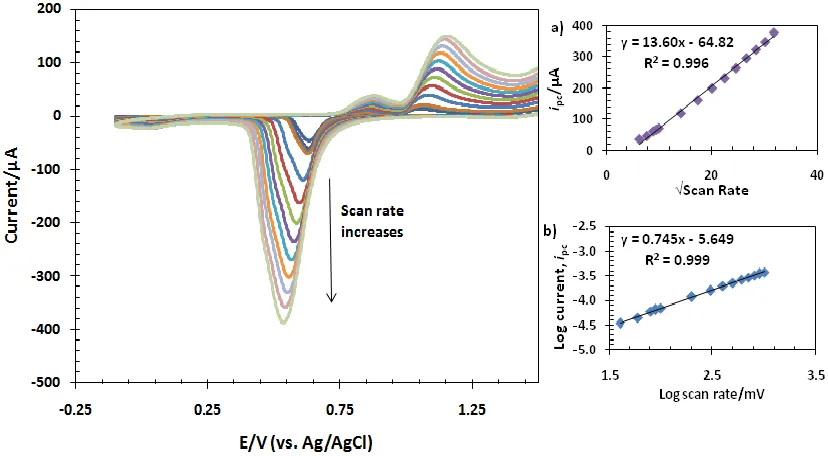
[image:5.596.157.442.74.274.2]Faster scan rates causes the same amount of charge passed in a shorter period of time and the current increases slowly at higher scan rate indicating that species on the surface are involved in the reaction (surface-confined process).
[image:5.596.91.505.457.685.2]
The wide potential range (the peak broaden) of the electrochemical transformation suggests that they have a broad energy distribution [24]. Peak current is proportional to the square root of scan rate as indicated in Fig 2awhich is based on Ranles-Sevcik equation. The slope value of 0.75 from the plotted graph shown in Figure 2b demonstrates this electrochemical electrode process undergoes adsorption-diffusion process [25, 26].
3.2. pH effect
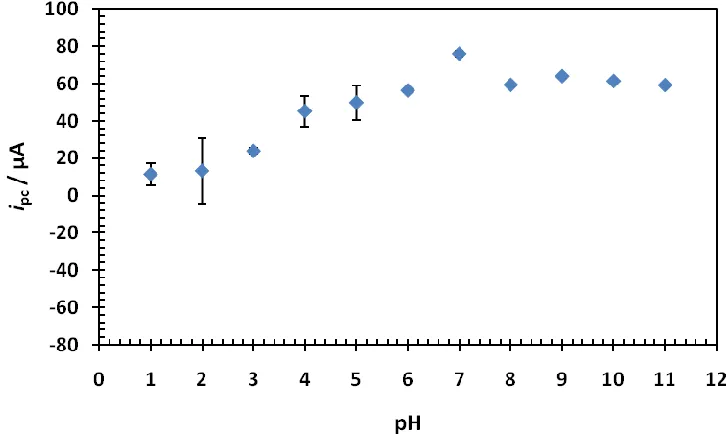
[image:6.596.117.480.399.616.2]In order to obtain optimal electrochemical behaviours of Hg(II), the influence of 0.1 M Na2SO4 supporting electrolyte pH on electrochemical behaviours of Hg(II) at Au-MPA-HFHAHFAF modified electrode were varied from pH 1 to pH 11. Fig. 3 shows that higher current was observed in neutral conditions. The current increased with increasing pH value and reached the highest at pH 7. The current started to decrease beyond that. Deprotonation involved in the reduction process that is facilitated at higher pH values and provide more stable electrocatalytic activity for Hg(II) reduction [24]. An increase in pH will reduce the concentration of hydrogen ion, thus allowing greater complex formation between Hg(II) and peptide. To achieve maximum selectivity of Hg(II) uptake, pH 7 was selected for further experimental procedure.
Figure 3. Reduction peak current at 25 °C for 50 nM Hg(II) in 0.1 M Na2SO4 as supporting electrolyte as a function of pH using the Au-MPA-HFHAHFAF modified electrode with potential scanning in negative direction from -0.25-1.5 V vs Ag/AgCl at a scan rate 100 mV
This suggests that the electrode is stable and could be used for a week without loss of performance whereupon the current response began to decline attributed to degradation of the alkenethiols. Short chain alkanethiols are known to be oxidised in the presence of oxygen and light where the thiolate is converted to either a sulfinate or a sulfonate. [27-30]. In both cases the oxidised thiol is not as strongly adsorbed on the electrode surface as the thiol [27]. During the repeated use of the electrode, the alkenethiols maybe oxidised whereupon it is detach from the electrode surface.
3.3 Calibration curve
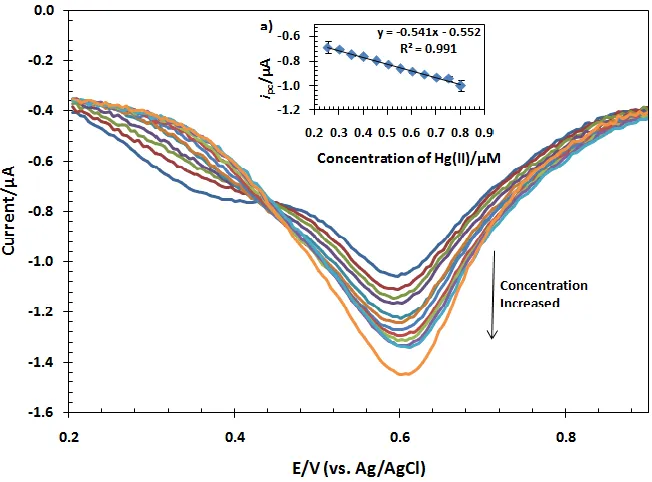
In Fig. 4, a well defined peaks with peak currents proportional to the concentrations Hg(II) metal ions were observed in potential range of 0.2-0.9 V. Insets of Fig. 4a represent the calibration curves of current intensity versus concentration of Hg(II) concentration in the range of 0.25-0.81 µM in a mixture of 0.1 M Na2SO4 solution with preconcentration time of 60s. The sensitivity, expressed as the slope of the linear region of the calibration curve is 5×10⁻⁷ AµM-1. The value of LOD obtained was 9.5×10⁻⁹ M (1.9 ppb) which is well below the WHO guidelines for drinking water of 2 µg/litre [3, 31]. Other papers [30,31] have reported lower detection limits than this, by using anodic stripping voltammetry (ASV) at a solid gold electrode, however the deposition times are generally very long. Even though such low detection limits were not achieved in this research, the result obtained demonstrated that the developed Au-MPA-HFHAHFAF modified electrode are capable in detection of and Hg(II) at low concentration level as documented by WHO for drinking water.
[image:7.596.136.462.445.686.2]
3.4 Interference
Study on possible interference were carried out using 1:1 ratio of each metal ions possibly coexist with Hg2+. Insignificant interference was observed when As3+, Cr3+, Cu2+, Ni2+, Pb2+and Zn2+ coexist in the sample, indicating that these species did not really affect the determination of mercury. However significant interference was observed from Cd2+, Cu2+, Fe2+. Khustenko et al. [32] reported that iron and copper has the strongest effect on the determination of mercury by stripping voltammetry in the potential range from +0.4 to +0.6 V, which makes the measurement of the stripping current of mercury difficult. To eliminate the effect of iron, Khustenko used NH4F which forms stable electrochemically inert complexes of the composition, mainly FeF52-. Copper was reported to have interference with electrochemical sensor based on conformational change mediated by Hg2+ coordination [32-34]. This peptide also contains histidine and from the literature, cysteine and histidine-rich peptide can bind to cadmium [35, 36].
3.5. Analytical Application
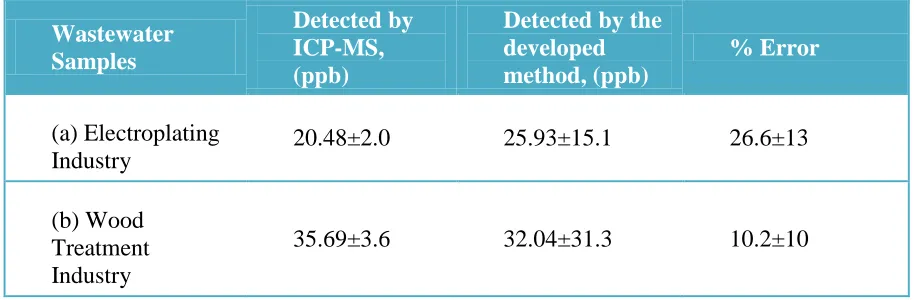
The developed method was applied for detection of Hg(II) in wastewater samples in order to evaluate the applicability of an Au-MPA-HFHAHFAF modified electrode in real sample application. Waste water was analyzed using the developed method. The samples were also analysed using inductively coupled plasma mass spectrophotometer (ICP-MS). The results were summarized in Table 1 and good recovery agreement was achieved between the two methods.
Table 1. Determination of Hg(II) solution in wastewater samples from (a) Electroplating and (b) Wood Treatment Industry.
Wastewater Samples
Detected by ICP-MS, (ppb)
Detected by the developed method, (ppb)
% Error
(a) Electroplating Industry
20.48±2.0 25.93±15.1 26.6±13
(b) Wood Treatment Industry
35.69±3.6 32.04±31.3 10.2±10
4. CONCLUSION
[image:8.596.70.527.495.645.2]
value of 4.5%. The sensitivity obtained was 5×10⁻⁷ A µM-1 and the limit of detection (LOD) was calculated as 9.5×10⁻⁹ M which is well below the WHO guidelines for drinking water of 2 µg/litre. Low detection limits coupled with good selectivity for Hg(II) satisfy the performance criteria for a single metal ion sensor. Insignificant interference by As3+, Cr2+, Cu2+, Ni2+, Pb2+and Zn2+ was observed. The Au-MPA-HFHAHFAF modified electrode exhibit long life time and generate precise measurements over a period of 7 days.
ACKNOWLEDGEMENTS
The author would like to thank The Ministry of Science, Technology and Innovation of Malaysia for funding this research through the Science Fund research grant (Project no.: 03-01-04-SF0134)
References
1. K.V. Gopal, Neurotoxicol. Teratol., 25 (2003).
2. P.B. Tchounwou, W.K. Ayensu, N. Ninashvili and D. Sutton, Environ. Toxicol., 18 (2003) 149. 3. WHO, Mercury in drinking-water. Background document for preparation of WHO Guidelines for
drinking-water quality, (2004).
4. J.R.D. Guimaraes, M. Roulet, M. Lucotte and D. Mergler, Sci. Total Environ., 261 (2000) 91. 5. S.C. Hight, J. Cheng, Food Chem., 91 (2005) 557.
6. G.R. Boaventura, A.C. Barbosa and G.A. East, Biol. Trace Elem. Res., 60 (1997) 153. 7. P. Ugo, S. Zampieri, L.M. Moretto and D. Paolucci, Anal. Chim. Acta, 434 (2001) 291.
8. X.-C. Fu, X. Chen, Z. Guo, L.-T. Kong, J. Wang, J.-H. Liu and X.-J. Huang, Electrochimica Acta, 56 (2010) 463-469.
9. W. Yang, E. Chow, G.D. Willett, D.B. Hibbert and J.J. Gooding, Analyst, 128 (2003) 712.
10. W. Yang, D. Jaramillo, J.J. Gooding, D.B. Hibbert, R. Zhang, G.D. Willett and K.J. Fisher, Chem. Commun., 19 (2001) 1982.
11. W. Yang, J.J. Gooding and D.B. Hibbert, Analyst, 126 (2001) 1573.
12. W. Yang, J.J. Gooding and D.B. Hibbert, J. Electroanal. Chem., 516 (2001) 10. 13. Ebru Gökmeş, Int. J. Electrochem. Sci., 6 (2011) 103 - 112.
14. O. Zitka, D. Huska, V. Adam, A. Horna, M. Beklova, Z. Svobodova and R. Kize, Int. J. Electrochem. Sci., 5 (2010) 1082 - 1089.
15. E. Chow and J.J. Gooding, Electroanalysis, 18 (2006) 1437-1448.
16. P. Kotrba, L. Doleckova, M. Pavlik and T. Ruml, Biothechnology Techniques, 10 (1996) 773-778. 17. B.L. Frey and R. M. Corn, Anal. Chem., 68 (1996) 3187-3193.
18. W. Yang, E. Chow, G.D. Willett, D.B. Hibbert and J.J. Gooding, Analyst, 128 (2003) 712-718. 19. D. Losic, J. J. Gooding and J. G. Shapter, Langmuir, 17 (2001) 3307-3316.
20. D. Losic, J. J. Gooding, J. G. Shapter, D. B. Hibbert and K. Short, Electroanalysis, 13 (2001) 1385-1393.
21. M. Hepel, J. Dallas and M.D. Noble, Journal of Electroanalytical Chemistry, 622 (2008) 173-183. 22. W. Yang, D. Jaramillo, J.J. Gooding, D.B. Hibbert, R. Zhang, G.D. Willett and K.J. Fishe, Chem.
Commun., (2001) 1982-1983.
23. W. T. Tan, E.B. Lim and J. K. Goh, , J. Solid State Electrochem, 9 (2005) 30-42.
24. A.Szucs, A. Loix, AJ. B. Nagy and L. Lamberts, J. Electroanal. Chem., 402 (1996) 137.
25. R.G. Compton and C.E. Banks (Eds.), Cyclic Voltammetry at Macroelectrodes in Understanding Voltammetry, World Scientific Publishing Co Pte Ltd, Singapore, 2007.
27. R. B. Garrell, J. E. Chadwick, D. L. Severance, N. A. McDonald and D. C. Myles, J. Am. Chem. Soc., 117 (1995) 11563.
28. D. A. Hutt and G. J. Leggett, J. Phys. Chem. B, 100 (1996) 6657. 29. E. Cooper and G. J. Leggett, Langmuir, 14 (1998) 4795.
30. Y. Cao, Y.-S. Li, J.-L. Tseng and D. M. Desidero, Spectrochim. Acta, 57 (2001) 27. 31. U.S. Envionmental Protection Agency.Ground Water and Drinking Water, Envionmental
Protection Agency
32. L. A. Khustenko, L.N. Larins and B.F. Nazarov, Journal of Analytical Chemistry, 58 (2003) 262-267.
33. D. Wu, Q. Zhang, X. Chu, H. Wang, G. Shen and R. Yu, Biosensors and Bioelectronics, 25 (2010) 1025-1031.
34. R. W. Frei and O. Hutzinger (Eds.), Analytical aspects of mercury and other heavy metals in the environment, Gordon and Breach Science Publishers, Inc. , US, 1975.
35. I.A. Banerjee, L. Yu and H. Matsui, PNAS, 100 (2003) 14678–14682.
36. E. Chow, D.B. Hibbert and J.J. Gooding, Electrochemistry Communications, 7 (2005) 101-106.