In silico
design of context-responsive mammalian
promoters with user-defined functionality
Adam J. Brown
1,*, Suzanne J. Gibson
2, Diane Hatton
2and David C. James
1,*1Department of Chemical and Biological Engineering, University of Sheffield, Mappin St., Sheffield S1 3JD, UK and
2Biopharmaceutical Development, MedImmune, Cambridge CB21 6GH, UK
Received May 23, 2017; Revised July 25, 2017; Editorial Decision August 20, 2017; Accepted August 22, 2017
ABSTRACT
Comprehensive de novo-design of complex mam-malian promoters is restricted by unpredictable combinatorial interactions between constituent tran-scription factor regulatory elements (TFREs). In this study, we show that modular binding sites that do not function cooperatively can be identified by analyz-ing host cell transcription factor expression profiles, and subsequently testing cognate TFRE activities in varying homotypic and heterotypic promoter archi-tectures. TFREs that displayed position-insensitive, additive function within a specific expression con-text could be rationally combined together in silico
to create promoters with highly predictable activi-ties. As TFRE order and spacing did not affect the performance of these TFRE-combinations, compo-sitions could be specifically arranged to preclude the formation of undesirable sequence features. This facilitated simple in silico-design of promoters with context-required, user-defined functionalities. To demonstrate this, we de novo-created promot-ers for biopharmaceutical production in CHO cells that exhibited precisely designed activity dynam-ics and long-term expression-stability, without caus-ing observable retroactive effects on cellular perfor-mance. The design process described can be utilized for applications requiring context-responsive, cus-tomizable promoter function, particularly where co-expression of synthetic TFs is not suitable. Although the synthetic promoter structure utilized does not closely resemble native mammalian architectures, our findings also provide additional support for a flexible billboard model of promoter regulation.
INTRODUCTION
Context-specific promoter-performance is a function of promoter activity dynamics, long-term gene expression
cas-sette behavior (e.g. propensity for silencing, compatibil-ity with other genetic components (1)), and promoter– cell interactions (e.g. off-target effects on cellular processes (2,3)). Given the inherent limitations of naturally-evolved sequences, for example undesirable sizes and unpredictable expression dynamics, synthetic promoters are typically pre-ferred for most applications. The most common method of synthetic promoter construction is design of entirely syn-thetic systems, comprising synsyn-thetic transcription factors (TFs; i.e. zinc finger (4), transcription activator-like effec-tor (5), chimeric (6) and CRISPR-TFs (7)) that transacti-vate elements containing their cognate binding sites (tran-scription factor regulatory elements (TFREs)). Utilization of synthetic and non-mammalian DNA-binding domains facilitates construction of promoters that impose minimal host cell interactions, and enables transcriptional outputs that are beyond the natural limitations of mammalian TF– TFRE pairs (e.g. fine-tuned, trigger-inducible transcrip-tional control (6,8,9)). Moreover, as these orthogonal sys-tems are not designed to function in specific cell types or expression conditions, a single device can be used in diverse contexts. However, the associated metabolic burden and in-troduction of other exogenous recombinant protein(s) may limit the attractiveness of these systems in some applica-tions, such as gene therapy and biopharmaceutical produc-tion.
When co-expression of synthetic TFs is not suitable, ar-tificial promoters can be designed to interact with a host cell’s existing repertoire of TFs. As different mammalian cell-types express unique and varying complements of TFs, the use of such promoters is typically limited to specific cell-types and/or conditions (10,11). Further, as these promot-ers harness cellular TFs, they impose synthetic promoter-endogenous TF-promoter-endogenous promoter interactomes that can negatively affect the activity dynamics of both syn-thetic and endogenous promoters (2,12,13). For example, exogenous promoters harbouring copies of native-TFREs have been shown to compete for available TFs and titrate them away from endogenous genes, inducing changes in the host cell transcriptome (2). Elements causing such retroac-tivity effects (14) are incompatible with gene therapy and
*To whom correspondence should be addressed. Tel: +44 114 222 7505; Email: [email protected]
Correspondence may also be addressed to Adam J. Brown. Tel: +44 114 222 7594; Email: [email protected]
C
The Author(s) 2017. Published by Oxford University Press on behalf of Nucleic Acids Research.
biopharmaceutical production processes, where promoter function must be coordinated with other desirable cellu-lar functionalities (e.g. proliferation and cell survival). Pro-moters intended for these applications must also display long-term expression stability, which can be compromised by the presence of sequence features such as CpG mo-tifs (methylation-mediated silencing (15,16)) and repeat ele-ments (homologous recombination-mediated silencing (17– 19)). However, using currently available promoter construc-tion techniques, it is difficult to optimize promoter, expres-sion cassette and host-cell performance simultaneously. In-deed,de novo-creation of mammalian promoters exhibiting precisely-designed activities invitro/vivohas not previously been demonstrated.
Ideally, promoters could be designed to exhibit any user-defined set of functionalities by simply selecting and arrang-ing an appropriate composition of TFREs, regardless of whether they interact with endogenous or synthetic TFs. Such comprehensivein silicodesign is apparently limited by the complex rules that govern promoter activity, including the orientation, spatial positioning, and order of compos-ite TFREs, and the function, expression level, and activity of their cognate TFs (20,21). However, Smithet al.recently systematically tested the rules of TFRE organization in thousands of artificial sequences, and found that promoter activities were predominantly simply a function of relative TFRE copy numbers (22). These sequences therefore pri-marily functioned according to the billboard model of pro-moter regulation, where TFREs act as independent blocks with flexible positioning (23,24). When conforming to this regulatory model, constituent TFREs can be re-arranged in any configuration without affecting promoter activity dy-namics, in the same way that symbols on a billboard can be arranged in any order without altering the total sum of information present. Alternatively, promoters can adhere to an enhancesome model of regulation, whereby TFREs must be strictly and specifically positioned in order to enable for-mation of protein interfaces (25–27). In reality, many pro-moters contain a mixture of position-flexible additive/ sub-tractive TFREs and position-sensitive cooperative TFREs (28). Indeed, in the promoters constructed by Smith et al. activitieswereimpacted by combinatorial interactions be-tween various TFRE-pairs (22). If composite TFREs are capable of synergistic interactions the complexity ofin sil-ico promoter design is substantially increased. However, studies have shown that combinatorial interactions between TFs are relatively uncommon (29). Moreover, Smithet al. only identified eight (out of a possible sixty six) combinato-rial TFRE interactions among the twelve TFREs that were used for promoter construction (22). Therefore, it should be possible to specifically select combinations of modular TFREs that do not function cooperatively, and utilize them to build promotersin silicoaccording to relatively simple design rules.
Given that TF concentration levels correlate well with cognate binding site activities (30,31), we hypothesized that de novo-design of context-specific, customizable promoters could be achieved by (i) profiling TF expression in the host cell, (ii) identifying TFREs that do not function coopera-tively, and iii) determining the relative transcriptional activ-ity of TF–TFRE interactions within heterotypic elements
(i.e. the contribution to overall promoter activity provided by a single copy of each TFRE). Following this measure-model-manipulate paradigm we identified a pool of TFREs that displayed intra-promoter position-independent func-tion within CHO cells, the preferred producfunc-tion host for therapeutic proteins. Accordingly, we were able to, for the first time, specifically select and arrange heterotypic TFRE-combinations in silico in order to create promoters with context-required, user-defined functionalities. To demon-strate this, we havede novo-designed promoters for use in the context of biopharmaceutical production that are pro-tected from silencing, exhibit precisely designed activity dy-namics, and impose no off-target effects on cell growth or viability. By showing that customizable ‘billboard elements’ can be designed to interact with host-cell machinery with-out causing retroactive effects, this study facilitatesde novo-creation of context-responsive, optimized promoters for ap-plications where the use of completely orthogonal synthetic TF–TFRE pairs is not suitable.
MATERIALS AND METHODS
Analysis of host cell TF expression dynamics
Total RNA was extracted from three CHO-K1-derived cell lines (parental host cell line, and host expressing ei-ther glutamine synthetase (GS) or GS and an IgG anti-body) during exponential and stationary phases of growth using RNAeasy mini kits (Qiagen, Crawley, UK). RNA purity and integrity were confirmed using a NanoDrop spectrophotometer (Thermo Fisher Scientific, Paisley, UK) and 2100 Bioanalyzer (Agilent Technologies, Wokingham, UK). RNA-seq libraries were prepared using the TruSeq RNA library preparation kit (Illumina, Essex, UK) and se-quenced using an Illumina HiSeq 2000 system (Illumina). Sequence reads were mapped to the CHO-K1 reference genome using Tophat (32,33), and the relative abundance of each transcript was calculated using Cufflinks (34). A cu-rated database of experimentally validated mouse TFs was obtained from TFcheckpoint (35,36). The mean transcript abundance of each TF gene across all six experimental con-ditions was determined, and genes with expression levels above the 70th percentile were selected for further analy-sis. Gene expression stability was measured by calculating the maximum fold change (MFC) in transcript abundance across all transcriptomes. Cognate binding sites of stably ex-pressed TFs (MFC<1.5) were obtained from previously published studies and online databases ((37); see supple-mentary information, Table S1).
Due to confidentiality restrictions, RNA-seq data from proprietary CHO cell lines cannot be deposited in public databases. However, the datasets can be obtained from the authors for non-commercial research purposes upon accep-tance of a material transfer agreement.
In vitro-construction of homotypic and heterotypic promoters
TFRE-reporters, synthetic oligonucleotides containing six repeat copies of a specific TFRE in series (see supplementary in-formation, Table S1) were inserted upstream of the CMV core promoter. To create libraries of heterotypic promot-ers, TFRE building blocks containing a single copy of a discrete TF binding sequence were constructed as previ-ously described (39), and ligated together in varying com-binations with T4 DNA ligase (Thermo Fisher Scientific). A ‘cloning-block’ containing KpnI and XhoI restriction en-donuclease sites was included in ligation mixes at a 1:20 mo-lar ratio to TFRE blocks. Random TFRE block-assemblies were digested with KpnI and XhoI (Promega, Southamp-ton, UK), gel extracted (Qiaquick gel extraction kit, Qia-gen), and inserted upstream of the CMV core promoter in SEAP-reporter vectors. Plasmids were sequenced to deter-mine the TFRE-composition of eachin vitro-constructed synthetic promoter.
Modeling of heterotypic promoter activities
In vitro-constructed heterotypic promoter activities were modeled as a function of constituent TF binding site copy numbers. A comparison of different modeling approaches (linear regression, generalized linear, generalized additive, Gaussian process) determined that all models had equiva-lent predictive power. Accordingly, to minimize complex-ity, we used a multiple linear regression model ˆY= β0+
β1x1+β2x2 +. . . β12x12 where ˆYrepresents promoter
ac-tivity, and x1–x12 are the copy numbers of 12 discrete
TFRE blocks. Regression coefficients (β1–β12; calculated
using least-squares estimation, ˆβ = (XTX)−1XTy) were an-alyzed to determine the relative transcriptional activity of a single copy of each TFRE block within heterotypic pro-moter architectures. The predictive ability of the model, the possibility of overfitting, and model robustness were as-sessed using leave-one-out and five-fold cross-validations. Overfitting was further investigated by calculating the co-efficient of variation for each regression weight across all cross-validation models. Multicollinearity between predic-tor variables was assessed by determining variance inflation factors.
In silicodesign of heterotypic promoters
Every possible 1–14 block combination of twelve discrete TF binding sites (n=9 657 699) was generated using the ‘combinations’ function in R. The relative transcriptional activity of each TFRE-combination was determined us-ing our model ofin vitro-constructed heterotypic promoter activities. TFRE-combinations with desired design crite-ria were selected from the library by applying successive filtration steps (as described in Results and Discussion). Constituent TFREs were arranged to minimize the occur-rence of CpG dinucleotides, repeat sequences, and restric-tion endonuclease sites. To aid this process, binding sites were separated with specifically designed 6 bp spacer se-quences. Designed promoter sequences were analysed for the presence of repeat sequences and endonuclease sites us-ing FAIR (http://bioserver1.physics.iisc.ernet.in/fair/) and Webcutter (http://rna.lundberg.gu.se/cutter2/) (40). To con-firm that unintended, additional TF binding sites had not
been created at TFRE-spacer junctions, promoters were analyzed using MatInspector (https://www.genomatix.de/ matinspector.html) and Transcription Affinity Prediction tool (TRAP:http://trap.molgen.mpg.de/cgi-bin/trap form. cgi) (41,42). Designed sequences were synthesized (Gen-eArt, Regensburg, Germany) and cloned upstream of the minimal CMV core promoter in SEAP-reporter vectors.
CHO cell culture and transfection
Chinese hamster ovary (CHO) cells (CHO-K1-derived) were routinely cultured in CD-CHO medium (Thermo Fisher Scientific) at 37◦C in 5% (v/v) CO2 in vented
Er-lenmeyer flasks (Corning, UK), shaking at 140 rpm, and subcultured every 3–4 days at a seeding density of 2 × 10⁵ cells/ml. Cell concentration and viability were
deter-mined by an automated Trypan Blue exclusion assay us-ing a Vi-Cell cell viability analyser (Beckman-Coulter, High Wycombe, UK). Exponential and stationary phases of cul-ture were determined by measuring viable cell concentra-tions every 24 h and calculating specific cell growth rates (d−1). Two hours prior to transient transfections, 2×10⁵
cells from a mid-exponential phase culture were seeded into individual wells of a 24-well plate (Nunc, Stafford, UK). Cells were transfected with DNA-lipid complexes comprising DNA and Lipofectamine (Thermo Fisher Sci-entific), prepared according to the manufacturer’s instruc-tions. Internal controls (hCMV-IE1-SEAP, SV40-SEAP, NFkB-RE-SEAP) were included in each plate to confirm reproducible transfection performance and normalize syn-thetic promoter activities. Transfected cells were incubated for 24 h prior to quantification of SEAP protein expres-sion using the Sensolyte pNPP SEAP colorimetric reporter gene assay kit (Cambridge Biosciences, Cambridge, UK). To confirm that SEAP activities in cell culture supernatants were correlated with SEAP mRNA levels, total RNA was extracted from selected transfected cells and analysed by qPCR.
To construct stable pools, synthetic promoter-SEAP re-porter plasmids (5g) coexpressing a glutamine synthetase selection marker gene were transfected into CHO cells (1
×107; triplicate transfections) by electroporation using the
Amaxa Nucleofector system (Lonza, Slough, UK; program U024). Stable transfectants were selected in 50M methio-nine sulfoximine (Sigma). For batch-production processes, 6 × 10⁶ cells from a mid-exponential phase culture were inoculated into 30 ml CD-CHO medium in vented Erlen-meyer flasks. Cell concentration, culture viability and SEAP expression (at mRNA and protein levels) were measured during exponential (day 4) and stationary (day 7) growth phases. To validate long-term expression stability, 7-day batch-production processes were repeated after high and low producer stable pools had been subcultured in MSX-containing medium for 8 weeks (60 cell generations).
RNA extraction, reverse transcription and qPCR analysis
ng of extracted RNA was reverse transcribed using the Quantitect reverse transcription kit (Qiagen), according to manufacturer’s instructions (genomic DNA was eliminated during this procedure). cDNA was diluted 1:10 in nuclease free water prior to qPCR analysis using a 7500 fast real-time PCR system (Applied Biosystems, Cheshire, UK). Re-action mixtures containing 12.5l QuantiFast SYBR green PCR master mix (Qiagen), 2l cDNA, 2.5l primer mix (fi-nal concentration of 200 nM per primer), and 8l nuclease free water were prepared in MicroAmp fast optical 96-well plates (Applied Biosystems). Amplification conditions were as follows: 95◦C for 5 min, followed by 40 cycles at 95◦C for 15 s and 60◦C for 60 s. Melting curve analysis was performed from 60 to 95◦C. Reaction mixtures containing no template, or products from reverse transcription reactions performed in the absence of reverse transcriptase, were used as nega-tive controls. All samples were run in triplicate and mean Ct (cycle threshold) values were used for further analysis. Rel-ative SEAP mRNA levels were calculated using the 2−Ct method (43), where Gnb1 and Fkbp1a were utilized as in-ternal control reference genes as they exhibit highly stable levels of expression across the experimental conditions used in this study (data not shown). Primer amplification efficien-cies were determined from standard curves (10-fold serial dilutions of pooled cDNA samples) using the equation E
=10 (–1/slope). All primers had amplification efficiencies between 98% and 100% (r2 >0.998; primer sequences are
listed in Supplementary Table S2).
RESULTS AND DISCUSSION
Analysis of host-cell TF expression dynamics facilitates iden-tification of binding sites with context-specific functionalities
To demonstrate our process of custom promoter design we created sequences for use in CHO cells, the predomi-nant host for the production of biopharmaceuticals. While transcriptional control has previously been demonstrated in CHO cells,in vitroconstruction methods have not enabled customizable specification of sequence features in order to prevent promoter silencing and minimize off-target effects on key cellular processes that underpin protein production (39,44). To profile the TF repertoire of CHO cells, we ana-lyzed TF expression levels in six different experimental con-ditions, comprising three discrete CHO cell lines (CHO-K1 derived parental host cell line, and host expressing either glutamine synthetase (GS), or GS and an IgG antibody), sampled at exponential and stationary phases of culture. Given the inherent genetic instability of transformed mam-malian cell lines, CHO cells that are subjected to cloning, selection and adaptation procedures typically display signif-icant genetic/functional divergence (45–47). This was true for our transgenic derivatives, where in both cell lines over 1000 genes were differentially expressed (fold change>1.5) compared to the parental host during exponential phase growth (data not shown). Given the difficulty of directly measuring effective TF concentrations (i.e. TFs that are appropriately modified and localized in the nucleus), we determined TF expression at the mRNA level. While this does not allow precise quantification of active TF levels, it does provide information on general TF expression patterns
(e.g. no/low/high/differential expression), enabling identi-fication of cognate TFREs with corresponding activity dy-namics (30,31,48). Moreover, this method is easily applica-ble to promoter design for most mammalian cell types, for which transcriptomic datasets are typically available (49).
While it is estimated that mammalian genomes contain
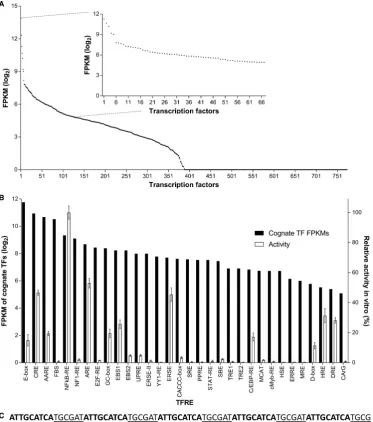
∼2000 TF-encoding genes, only a fraction of these have been experimentally-verified as DNA-binding TFs (11,50). Accordingly, we restricted our analysis to the 774 TFs that have been shown to both exhibit sequence-specific DNA binding and regulate RNA polymerase II-dependent tran-scription (35). The mean expression level of each TF across six experimental conditions was determined. As shown in Figure1, 388/774 TFs are expressed in CHO cells, where expression levels span over three orders of magnitude. De-pending on required functionalities, synthetic promoters can be designed to interact with any combination of avail-able host-cell TF-parts. For example, cell type-specificity could be achieved by designing promoters to bind TFs that are preferentially upregulated in the intended host cell, and specifically downregulated in cell types where off-target ac-tivity is undesirable. In this example, we aimed to create pro-moters that would have minimal impact on the CHO cell processes that underpin protein production, such as prolif-eration and cell survival. Therefore, we targeted TFs that are relatively highly expressed in CHO cells (ranked in the top 30% of TF mRNA expression levels), rationalizing that heterologous promoters can interact with these abundant cellular components without affecting the host cell tran-scriptome (i.e. these TFs are unlikely to become limiting if the nuclear copies of their cognate binding sites are mod-erately increased) (2,51). Further, we wanted designed pro-moters to exhibit stable activities in the context of different CHO cell lines and growth phases. We therefore focused our search on TFs that displayed high expression stability across all six CHO cell transcriptomes, measured as a maximum fold change (ratio between the highest and lowest expres-sion level) of<1.5. Finally, to minimize the risk of silenc-ing, we did not want promoters to interact with TFs that primarily function as repressors (52,53). Accordingly, we discounted TFs that have only been experimentally shown to negatively regulate transcription from RNA polymerase II promoters ((50); TFs shown to function as both transre-pressors and transactivators were not discarded). Applica-tion of these selecApplica-tion criteria identified 67 CHO cell TFs with requisite expression profiles and functionalities (Fig-ure1A).
mam-Figure 1. Identification of transcriptionally active transcription factor regulatory elements (TFREs) that bind relatively abundant host-cell components. (A) RNA-seq analysis of CHO cell transcriptomes determined the relative expression level of host-cell transcription factors (TFs). Points represent the average expression level of each TF in three discrete CHO cell lines, sampled at exponential and stationary phases of culture (n=6). Inset graph shows the expression level of 67 TFs that exhibit high (ranked in the top 30% of TF mRNA expression levels) and stable expression across different CHO cell lines and growth phases (maximum fold change<1.5). FPKM=fragments per kilobase of transcript per million fragments mapped. (B) Cognate binding sites of TFs with appropriate expression dynamics were identified and cloned in series (6×copies) upstream of a minimal CMV core promoter in secreted alkaline phosphatase (SEAP)-reporter vectors. CHO cells were transiently transfected with each homotypic TFRE-reporter and SEAP activity was measured 24 h post-transfection. Data are expressed as a percentage of the production exhibited by the strongest homotypic promoter. Bars represent the mean±SD of three independent experiments (n=3, each performed in triplicate). (C) An example homotypic promoter nucleotide sequence is shown. AARE sites are in bold, 6 bp spacer sequences are underlined, and the CMV core promoter is italicized.
malian core promoter (hCMV-IE1 core containing a TATA box and an initiator element; hCMV-IE1 core promoter and TFRE consensus sequences are shown in supplemen-tary information, Figure S1 and Table S1, respectively). Measurement of SEAP reporter production after transient transfection of CHO cells with each homotypic TFRE-reporter plasmid showed that 12/32 TFREs could inde-pendently mediate activation of recombinant gene tran-scription (E-box, CRE, AARE, NFkB-RE, ARE, GC-box,
EBS1, ERSE, C/EBP-RE, D-box, HRE, DRE). As
[image:5.612.127.501.68.491.2]TFRE-partners in order to drive transcription. TFRE activities may also be affected by the specific promoter structure uti-lized. For example, it has been shown that the transcrip-tional activity of a discrete TFRE in homotypic elements can vary between inactive, active, and highly-active, depend-ing on the regulatory elements present in the downstream core promoter (54). We therefore concluded that the activity of individual TFREs in homotypic promoter architectures is highly context-specific and cannot be precisely predicted in silicofrom the mRNA abundance of cognate TFs. How-ever, profiling cellular TFs at the mRNA level does facilitate identification of TF–TFRE pairs that have user-required functionalities within a specific expression-context.
TFREs that are active in homotypic architectures display position-insensitive function in heterotypic promoters
To test the hypothesis that TFREs that are transcriptionally active in homotypic promoters are likely to display position-insensitive function when combined together in the con-text of heterotypic architectures, we constructed promot-ers with varying TFRE-compositions. For each of the 12 TFREs identified as active in homotypic promoters, we syn-thesized oligonucleotide building blocks containing a single copy of the TF binding sequence. TFRE blocks were ligated to assemble random strings of TF binding sites, which were inserted upstream of the minimal CMV core promoter in SEAP reporter plasmids (see Methods, ‘in-vitro construc-tion of heterotypic promoters’). Composite-TFREs within each promoter were separated by the same 6 bp spacer se-quence that was used in homotypic promoter construction (see Figure1C). As shown in Figure2A, seven distinct pro-moter libraries were constructed by mixing varying com-binations of TFRE blocks. Library TFRE-compositions were designed to assess whether the function of individual TFREs was additive (i.e. adding additional copies of a dis-crete TFRE to a heterotypic element will increase overall promoter strength by a predictable, fixed amount), and un-affected by either relative spatial positioning (i.e. distance to the transcriptional start site) or the identify of neigh-bouring TFREs (i.e. cooperative interactions). Accordingly, to guarantee that each TFRE would occur in diverse con-texts and copy numbers, individual TFREs were included in multiple libraries with varying accompanying elements. While we did not expect relative differences in TFRE activ-ities to be maintained between homotypic and heterotypic architectures, we assumed that TFREs with higher activity in the former may be likely to drive stronger transactiva-tion in the latter. Accordingly, in an attempt to test TFRE function over a wide range of transcriptional outputs, we used relative TFRE activities in homotypic elements to de-sign library compositions such that each TFRE would oc-cur within the context of variable-strength promoters. Un-like massively parallel reporter assays, this multi-library ap-proach does not enable an exhaustive, systematic evaluation of TFRE functionality (55–57). However, it is an efficient method for this specific application, where we aimed to rig-orously assess the position-sensitivity of TFRE function us-ing a minimal number of test-promoters.
Measurement of SEAP production after transfection of CHO cells with 140 discrete synthetic promoter-reporter
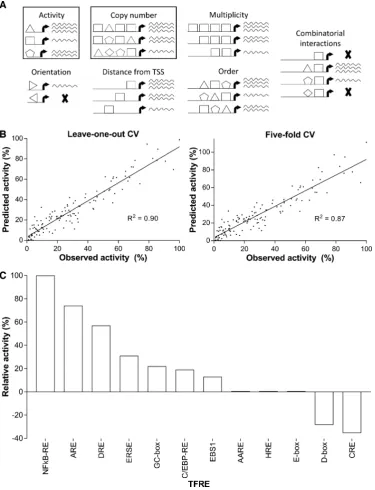
plasmids is shown in Figure2B. These data show that pro-moter activities spanned two orders of magnitude, where the most active promoter exhibited a 2.3-fold increase in SEAP production over that deriving from a control vector containing the potent human cytomegalovirus immediate early 1 promoter (hCMV-IE1; GenBank accession number M60321.1, nucleotides 517–1193). With the exception of li-brary 5, promoter activities within each lili-brary varied by at least an order of magnitude, where the mean activity of each library ranged from 5.2 to 61.5 relative promoter units (RPU). To check that SEAP enzymatic activity was an ac-curate proxy for transcriptional activity, SEAP mRNA lev-els in transfected cells were measured by qPCR. This anal-ysis confirmed that within our transient expression system the SEAP production from each plasmid was directly pro-portional to relative promoter activities (supplementary in-formation, Figure S2). Accordingly, to increase promoter screening throughput, we did not routinely perform qPCR analysis for experiments that utilized this expression system. Given that TFREs were specifically selected for their pu-tative position-insensitive function in heterotypic architec-tures, we hypothesized that promoter activities would sim-ply be a function of the relative transcriptional activity con-tributed by each TF binding site, independent of TFRE spacing or order. To test this assumption, and determine the activity of each TFRE in heterotypic architectures, we sequenced promoters to reveal their TFRE-compositions, and modeled promoter activities as a function of TFRE copy numbers (promoters varied in length between 4 and 18 TF binding sites, mean=9, and therefore discrete TFREs could occur in multiple copies per promoter)). The resulting linear regression model had high predictive power, where observed and predicted values for promoter activity were highly correlated (leave-one-out cross-validationr2=0.90).
To evaluate the robustness of the model, and assess the pos-sibility of overfitting, we analyzed the model using five-fold cross-validation. The correlation between observed and ex-pected promoter activities was similarly high (r2 = 0.87;
com-Figure 2.Heterotypic assemblies of modular transcription factor regulatory element (TFRE)-blocks exhibit transcriptional activities spanning over two orders of magnitude. (A) TFREs that were transcriptionally active in homotypic architectures (see Figure1) were combined together in varying combina-tions to construct libraries of heterotypic promoters. Multiple constructs were created within each library, where the order, orientation, spatial positioning and copy number of composite-TFREs was varied (the total number of discrete promoters created within each library is shown). (B) Heterotypic elements were inserted upstream of a minimal CMV core promoter in secreted alkaline phosphatase (SEAP)-reporter vectors and transiently transfected into CHO cells. SEAP expression was quantified 24 h post-transfection. Data are expressed as a percentage of the production exhibited by the strongest heterotypic promoter. SEAP production from the control hCMV-IE1-SEAP reporter is shown as the black line. Each bar represents the mean of two transfections; for each promoter,<10% variation in SEAP production was observed. qPCR analysis of SEAP transcript abundance confirmed that relative protein activities in cell culture supernatants were linearly correlated with SEAP mRNA levels (see Supplementary Figure S2).
prise TFREs that do not function cooperatively within a specific cellular environment.
As the only predictor variables in our model are the number of copies of each TF binding site, the model co-efficients represent the contribution a single copy of each TFRE makes to overall promoter activities. Analysis of model coefficients identified that within the context of het-erotypic promoters only 7/12 TFREs were transcriptionally
active (NFkB-RE, ARE, DRE, ERSE, GC-box, C/
EBP-RE, EBS1;P≤0.01), where the remaining five were either transcriptionally inactive (AARE, HRE, E-box), or tran-scriptionally repressive (D-box, CRE;P≤0.01). As shown in Figure3C, TFRE transcriptional activities in heterotypic architectures ranged from –35 to 100 relative TFRE-activity units (normalized TFRE activity values=regression coef-ficients ×8.9). Accordingly, activity in the context of ho-motypic promoters was not predictive of TFRE activity in heterotypic promoters. It is well known that TFREs can ex-hibit differential function dependent on the quantity of con-catenated binding sites (20,22,61,62). Indeed, we did not use data from our homotypic promoter experiments to train the
model of heterotypic promoter activities as we assumed that TFRE function may vary between the two organizational structures used (i.e. discrete binding sites occurred in 6× concatenated copies vs. predominantly single copies neigh-boured by differing TFREs). There are multiple potential mechanisms that may explain why AARE, HRE and D-box were active in homotypic clusters but inactive as individual copies within heterotypic elements. For example, cognate TFs for these TFREs may require multiple adjacent sites to facilitate stable binding via protein–protein interactions (62–64). Alternatively, TFRE clustering may increase local-ized cognate TF concentrations and alter their binding/ un-binding dynamics (63,65).
[image:7.612.125.498.66.396.2]bend-Figure 3. The function of modular transcription factor regulatory element (TFRE)-blocks in heterotypic promoter architectures is independent of binding site order and spacing. (A) The function of discrete TFREs within heterotypic elements can be influenced by multiple ‘rules’. We modelled heterotypic promoter activities (see Figure2) using TFRE copy numbers as the only predictor variable. (B) The linear regression model’s predictive power was analyzed using leave-one-out and five-fold cross validations (CV). (C) The relative transcriptional activity of a single copy of each modular TFRE-block within heterotypic promoters was determined by analyzing the model coefficients. TFRE regression coefficients were multiplied by 8.9 to obtain normalized TFRE activities.
ing, stretching, supercoiling) (66,67). Although given then their function was largely position-independent according to our model, where a single copy of each TFRE con-tributed a fixed amount of transrepression to overall pro-moter activity, it may be more likely that TFs bound at these sites functioned via active, rather than passive, mech-anisms (e.g. by interacting with components of the general transcriptional machinery (67)). While further experimental work (e.g. TFRE mutation studies) may have clarified the
mechanisms by which neutral and repressive TFREs func-tioned, this was not required forin silicopromoter design. Indeed, as the function of repressive TFREs was predom-inantly position-insensitive, albeit subtractive, they could still theoretically be utilized as modular building blocks in synthetic promoter construction.
[image:8.612.113.489.68.559.2]TFREs forde novopromoter creation, to confirm that we had rigorously tested possible position-dependent deter-minants of their function, we analyzed heterotypic pro-moter sequences to determine (i) the frequency at which each TFRE occurred in varying promoter positions (i.e. first TFRE upstream of the core promoter=position one), and (ii) the number of times each possible heterotypic TFRE-TFRE pair appeared. This analysis showed that all TFRE-TFREs were represented in positions 1–9 at least five times (mean
=11; supporting information Table S3) and all TFRE pairs occurred on at least four occasions (mean=11; supporting information Table S4). Due to the limitations of the pro-moter construction method used (i.e. randomly assembled TFRE strings, as opposed to specifically designed composi-tions (22)), positional features were not equally represented across the libraries. For example, the TFRE pairs DRE-EBS and DRE-EBS-C/EBP-RE were present in 35 and 4 copies respectively. Accordingly, the potential impact of under-represented features may have been hidden. However, as all features were tested in multiple varying contexts, and the model explaining heterotypic element activities had high predictive ability, we concluded that testing additional pro-moter variants was unnecessary.
In conclusion, our data indicate that while TFREs that were active in homotypic cluster promoters did display position-insensitive behavior in heterotypic elements, their function could be either additive, neutral or subtractive. For future studies it may therefore be preferable to initially assess TFRE activities in single site-copy homotypic pro-moters. However, the transcriptional output from a single TF binding site is rarely sufficient to drive detectable lev-els of recombinant gene expression (20,22). Accordingly, for identification of modular, additive TFREs that are tran-scriptionally active in single-copy repeats, we recommend the two-step screening method developed here, whereby, (i) multisite-copy homotypic promoters are created to identify TFREs that are unlikely to interact combinatorially, and (ii) multi TFRE-synthetic elements are constructed to de-termine the relative activity and function of each TFRE in heterotypic promoters.
In silicodesign of promoters with context-specific functional-ities
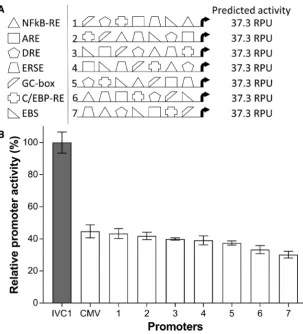
Given that our model of promoter activities had both high predictive power and simple explanatory variables (i.e. TFRE copy numbers), we hypothesized that we could, for the first time, demonstrate the in silico design of mam-malian promoters that exhibit predictable activitiesin vitro. To test this, we designed seven promoters containing a single copy of each TFRE that was transcriptionally ac-tive in heterotypic architectures (NFkB-RE, ARE, DRE, ERSE, GC-box, C/EBP-RE, EBS1), where constituent TF binding sites were arranged in completely different or-ders within each construct (Figure 4A). Previous stud-ies have shown that promoters containing the same com-bination of TFREs can exhibit significantly different ac-tivities depending on the relative organisation of con-stituent binding sites (22,25,68). However, according to our model the function of our specifically selected TFREs is position-independent, and therefore promoters with
iden-tical TFRE-compositions should display the same level of activity (model-predicted activity of our seven ‘test promot-ers’=37.3 RPU). To confirm this, synthetic promoters were chemically synthesized and inserted upstream of the mini-mal CMV core promoter in SEAP reporter vectors. Mea-surement of SEAP production after transient transfection of CHO cells with each reporter plasmid showed that pro-moter activities ranged from 30.2 to 43.3 RPU (coefficient of variation=9.8%). Therefore, thein vitroactivity of all designed promoters was within 7 RPU of the predicted ac-tivity, corresponding to an error range of±18%, where there was only a 1.4-fold difference in expression between the strongest and weakest promoter. These data therefore con-firmed that TFRE order and spacing had minimal effect on promoter activities. Accordingly, we concluded that pro-moters with precisely-defined activities could be createdin silicoby simply selecting appropriate TFRE combinations and organizing them in any configuration.
Figure 4.Synthetically designed promoters exhibit predictable activitiesin vitro. (A) Promoters with identical transcription factor regulatory element (TFRE)-compositions, but varying TFRE-orders, were designedin silico. Thein vitroactivity of each synthetic element was predicted using our model of heterotypic promoter activities (see Figure3). (B) Synthetic promoters were chemically synthesized, inserted upstream of a minimal CMV core element in secreted alkaline phosphatase (SEAP)-reporter vectors, and transiently transfected into CHO cells. SEAP expression was quantified 24 h post-transfection. Data are expressed as a percentage of the production exhibited by the strongestin vitro-constructed heterotypic promoter, IVC1 (equivalent to 100 relative promoter units (RPU); see Figure2). Values represent the mean±SD of three independent experiments (n=3, each performed in triplicate).
folding and assembly rates, we selected multiple discrete TFRE-combinations in order to enable a wide range of dif-ferent transcriptional outputs (5, 10, 20, 40, 60, 80, and 100 RPU). As an example, a promoter with the
TFRE-composition 2xARE: 1xC/EBP-RE: 1xGC-box: 1xEBS1:
1xDRE: 1xNFkB-RE was selected as it met all requisite de-sign criteria and had a predicted activity of 40.2 RPU.
When TFRE organization has minimal effect on pro-moter activity, constituent TF binding sites can be opti-mally arranged to minimize the occurrence of undesirable sequence features. Accordingly, to maximise recombinant gene expression stability, we organized TFREs in configu-rations which prevented the formation of features associ-ated with promoter silencing. Firstly, given that promoter methylation-mediated epigenetic silencing has been shown to cause production instability in CHO cells, we minimized the number of CpG dinucleotides within each construct (15,16). Further, as gene silencing can also be caused by deletion of DNA segments via homologous recombination (17,72), we specifically prevented the occurrence of repeat sequences. Given that eukaryotic machinery can recombine identical sequences longer than 40 bp, we reasoned that preventing intra-promoter repeats larger than 20 bp, and
occurrence of restriction endonuclease sites (263/308 ana-lyzed restriction sites do not occur in any promoter). Lastly, to prevent improper regulation of promoter activity, all se-quences were designed to ensure that additional, ‘accidental TF binding sites’ were not created at TFRE-spacer junc-tions.
Custom-designed sequences exhibit predictable functionali-tiesin vitro
For each desired promoter activity level we designed two synthetic sequences with different TFRE-compositions (supplementary information, Table S5). Synthetic promot-ers were chemically synthesized and inserted upstream of the minimal CMV core promoter in SEAP reporter vectors. Measurement of SEAP production after transient transfec-tion of CHO cells with each reporter plasmid showed that designed and observed activities were highly correlated (r2 =0.92; Figure5B). At very low–high levels of transcription (5–60 RPU), thein vitroactivity of all promoters was within 5 RPU of predicted activities. However, when transcrip-tional output was very high (80–100 RPU), the difference between observed and predicted activities varied by 10–22 RPU (11–22%). It has previously been shown that tran-scriptional noise increases concomitantly with both pro-moter activity and TF binding site copy number (75,76). This may explain why the four strongest promoters (with the largest TFRE copy numbers) exhibited the greatest de-viation between observed and predicted activities. However, as all promoters with designed activities≥80 exhibited ac-tivities≥78in vitro, we concluded that very strong promot-ers canbe routinely created in silico, but that at this level of expression very precise control of transcription may be intractable.
To test the function of our designed sequences in an in-tragenomic context, we stably transfected CHO cells with synthetic promoter-reporter plasmids coexpressing a glu-tamine synthetase selection marker gene (77). In order to analyze the full range of transcriptional control, we eval-uated promoters with activities of 5, 10, 20, 80 and 100 RPU. To ensure that gene expression variability was di-rectly linked to differences in promoter activity, rather than site-specific integration effects, we employed a stable pool system where recombinant vectors randomly integrate into varying chromosomal locations to create heterogeneous cell populations (each pool was generated using a single syn-thetic promoter-reporter plasmid). Stably transfected CHO cell pools were selected in medium containing methion-ine sulphoximmethion-ine and re-adapted to suspension culture. To evaluate promoter performance in an industrially-relevant bioproduction context, promoter activities were measured during a 7-day batch-production process. As shown in Fig-ure5C, the promoter activities observed in transient expres-sion systems were maintained in chromosomal contexts. qPCR analysis of SEAP mRNA abundance revealed that the ratio of relative promoter strengths in stable expression systems (100:72:28:16:8) was highly similar to our origi-nal designed ratio of promoter activities (100:80:20:10:5). Moreover, relative promoter activities were maintained be-tween exponential (day 4) and stationary (day 7) phases of growth. These data confirm our assumption that promoter
activity dynamics can be specifically tailored by designing sequences to bind TFs with synchronous expression pro-files. Further, no synthetic promoter had a significant effect on cell growth or viability (viable cell concentration and cul-ture viability varied by<20% between all cell pools at days 4 and 7; data not shown), validating our selection of TFRE-combinations that were specifically designed to minimize off-target effects on cellular performance. Finally, to assess gene expression stability, high and low producer stable pools were subcultured in MSX-containing medium for sixty gen-erations. As shown in Figure5D SEAP production was not significantly reduced following long-term culture, confirm-ing that synthetic sequences had been successfully designed to prevent promoter silencing.
CONCLUSION
In conclusion, we have, for the first time, demonstrated in silico construction of mammalian promoters that ex-hibit precisely designed activitiesin vitro. By analysing both host cell TF levels and cognate TFRE activities, we were able to build promoters using TF–TFRE pairs that exhib-ited desired activity dynamics without imposing retroac-tive effects on cellular performance. Over-activity of these TFs/TFREs is generally associated with cancerous pheno-types, and we therefore assume that their high levels of ac-tivity in CHO cells are required to maintain uncontrolled proliferation and suppression of apoptosis (78–83). While we did not experimentally verify which TFs interacted with each binding site, given that synthetic elements functioned as designed, we assume that unpredicted TF–TFRE inter-actions were either uncommon or did not negatively impact expected TFRE/cell functions. By identifying TFREs that function via positon-independent mechanisms within a spe-cific expression-context, we were able to select and organize TFRE-compositionsin silicoin order to simultaneously op-timize promoter, expression cassette and host cell perfor-mance.
Figure 5. In silicodesigned sequences exhibit custom-defined functionalitiesin vitro.(A) Millions of transcription factor regulatory element (TFRE)-combinations were constructed and testedin silicousing our model of heterotypic element activities (see Figure3). Selection criteria were applied to identify combinations optimal for the context of biopharmaceutical production in CHO cells. Constituent TFREs within each promoter were then specifically arranged to prevent occurrences of sequence features that can contribute to promoter silencing. (B) Synthetic promoters with varying designed activities were chemically synthesized, inserted upstream of a minimal CMV core element in secreted alkaline phosphatase (SEAP)-reporter vectors, and transiently transfected into CHO cells. SEAP expression was quantified 24 h post-transfection. Data are expressed as a percentage of the production exhibited by the strongest promoter. (C) CHO cells were stably transfected with synthetic promoter-reporter plasmids coexpressing a glutamine synthetase selection marker gene. Three distinct stable pools were created for each reporter-plasmid, where recombinant vectors randomly integrate into varying chromosomal locations to create heterogeneous cell populations. Following selection in medium containing methionine sulfoximine, promoter activities were measured during a 7-day batch-production process. SEAP titer and mRNA abundance were determined in mid-exponential and stationary phases of growth. Data are expressed as a percentage of the expression exhibited by the strongest promoter. (D) Stable pools were subcultured in selective medium for sixty generations. SEAP expression was quantified at the end of a 7-day batch-production process. Data are expressed as a percentage of the production exhibited by each pool at generation fifteen. Values represent the mean±SD of three independent experiments (n=3, each performed in triplicate).
of modular-regulatory element identification and assembly may also aid the construction of genetic circuits that utilize multiple completely synthetic TF–TFRE pairs.
DATA AVAILABILITY
The sequences ofin silicodesigned synthetic promoters have been deposited with the DNA Data Bank of Japan (acces-sion numbers LC270626–LC270639).
SUPPLEMENTARY DATA
Supplementary Data are available at NAR Online.
ACKNOWLEDGEMENTS
The authors thank Dr Tarik Senussi for construction of re-combinant cell lines, Dr Darren Geoghegan for construc-tion of RNA-seq libraries, and Yash Patel for assistance with generation of stable pools.
FUNDING
Funding for open access charge: MedImmune.
REFERENCES
1. Mutalik,V.K., Guimaraes,J.C., Cambray,G., Lam,C.,
Christoffersen,M.J., Mai,Q.-A., Tran,A.B., Paull,M., Keasling,J.D. and Arkin,A.P. (2013) Precise and reliable gene expression via standard transcription and translation initiation elements.Nat. Methods,10, 354–360.
2. Brewster,R.C., Weinert,F.M., Garcia,H.G., Song,D., Rydenfelt,M. and Phillips,R. (2014) The transcription factor titration effect dictates level of gene expression.Cell,156, 1312–1323.
3. Karreth,F.A., Tay,Y. and Pandolfi,P.P. (2014) Target competition: transcription factors enter the limelight.Genome Biol.,15, 114. 4. Gaj,T., Gersbach,C.A. and Barbas,C.F. (2013) ZFN, TALEN, and
CRISPR/Cas-based methods for genome engineering.Trends Biotechnol.,31, 397–405.
5. Perez-Pinera,P., Ousterout,D.G., Brunger,J.M., Farin,A.M., Glass,K.A., Guilak,F., Crawford,G.E., Hartemink,A.J. and Gersbach,C.A. (2013) Synergistic and tunable human gene activation by combinations of synthetic transcription factors.Nat. Methods,10, 239–242.
6. R ¨ossger,K., Charpin-El-Hamri,G. and Fussenegger,M. (2014) Bile acid-controlled transgene expression in mammalian cells and mice.
Metab. Eng.,21, 81–90.
7. Chavez,A., Scheiman,J., Vora,S., Pruitt,B.W., Tuttle,M., Iyer,E.P., Lin,S., Kiani,S., Guzman,C.D. and Wiegand,D.J. (2015) Highly efficient Cas9-mediated transcriptional programming.Nat. Methods,
12, 326–328.
8. Gitzinger,M., Kemmer,C., Fluri,D.A., El-Baba,M.D., Weber,W. and Fussenegger,M. (2011) The food additive vanillic acid controls transgene expression in mammalian cells and mice.Nucleic Acids Res.,40, e37.
9. M ¨uller,K., Engesser,R., Schulz,S., Steinberg,T., Tomakidi,P., Weber,C.C., Ulm,R., Timmer,J., Zurbriggen,M.D. and Weber,W. (2013) Multi-chromatic control of mammalian gene expression and signaling.Nucleic Acids Res.,41, e124–e124.
10. Schlabach,M.R., Hu,J.K., Li,M. and Elledge,S.J. (2010) Synthetic design of strong promoters.Proc. Natl. Acad. Sci. U.S.A.,107, 2538–2543.
11. Vaquerizas,J.M., Kummerfeld,S.K., Teichmann,S.A. and Luscombe,N.M. (2009) A census of human transcription factors: function, expression and evolution.Nat. Rev. Genet.,10, 252–263. 12. Hansen,A.S. and O’Shea,E.K. (2013) Promoter decoding of
transcription factor dynamics involves a trade-off between noise and control of gene expression.Mol. Syst. Biol.,9, 704.
13. Borkowski,O., Ceroni,F., Stan,G.-B. and Ellis,T. (2016) Overloaded and stressed: whole-cell considerations for bacterial synthetic biology.
Curr. Opin. Microbiol.,33, 123–130.
14. Del Vecchio,D., Ninfa,A.J. and Sontag,E.D. (2008) Modular cell biology: retroactivity and insulation.Mol. Syst. Biol.,4, 161. 15. Kim,M., O’Callaghan,P.M., Droms,K.A. and James,D.C. (2011) A
mechanistic understanding of production instability in CHO cell lines expressing recombinant monoclonal antibodies.Biotechnol. Bioeng.,
108, 2434–2446.
16. Yang,Y., Chusainow,J. and Yap,M.G. (2010) DNA methylation contributes to loss in productivity of monoclonal antibody-producing CHO cell lines.J. Biotechnol.,147, 180–185.
17. Jasin,M. and Rothstein,R. (2013) Repair of strand breaks by homologous recombination.Cold Spring Harb. Perspect. Biol.,5, a012740.
18. Baudin,A., Ozier-Kalogeropoulos,O., Denouel,A., Lacroute,F. and Cullin,C. (1993) A simple and efficient method for direct gene deletion in Saccharomyces cerevisiae.Nucleic Acids Res.,21, 3329–3330. 19. Sleight,S.C., Bartley,B.A., Lieviant,J.A. and Sauro,H.M. (2010) Designing and engineering evolutionary robust genetic circuits.J. Biol. Eng.,4, 12.
20. Sharon,E., Kalma,Y., Sharp,A., Raveh-Sadka,T., Levo,M., Zeevi,D., Keren,L., Yakhini,Z., Weinberger,A. and Segal,E. (2012) Inferring gene regulatory logic from high-throughput measurements of thousands of systematically designed promoters.Nat. Biotechnol.,30, 521–530.
21. Weingarten-Gabbay,S. and Segal,E. (2014) The grammar of transcriptional regulation.Hum. Genet.,133, 701–711. 22. Smith,R.P., Taher,L., Patwardhan,R.P., Kim,M.J., Inoue,F.,
Shendure,J., Ovcharenko,I. and Ahituv,N. (2013) Massively parallel
decoding of mammalian regulatory sequences supports a flexible organizational model.Nat. Genet.,45, 1021–1028.
23. Kulkarni,M.M. and Arnosti,D.N. (2003) Information display by transcriptional enhancers.Development,130, 6569–6575.
24. Arnosti,D.N. and Kulkarni,M.M. (2005) Transcriptional enhancers: Intelligent enhanceosomes or flexible billboards?J. Cell. Biochem.,
94, 890–898.
25. Swanson,C.I., Evans,N.C. and Barolo,S. (2010) Structural rules and complex regulatory circuitry constrain expression of a Notch-and EGFR-regulated eye enhancer.Dev. Cell,18, 359–370.
26. Thanos,D. and Maniatis,T. (1995) Virus induction of human IFN gene expression requires the assembly of an enhanceosome.Cell,83, 1091–1100.
27. Merika,M. and Thanos,D. (2001) Enhanceosomes.Curr. Opin. Genet. Dev.,11, 205–208.
28. Spitz,F. and Furlong,E.E. (2012) Transcription factors: from enhancer binding to developmental control.Nat. Rev. Genet.,13, 613–626.
29. Ravasi,T., Suzuki,H., Cannistraci,C.V., Katayama,S., Bajic,V.B., Tan,K., Akalin,A., Schmeier,S., Kanamori-Katayama,M. and Bertin,N. (2010) An atlas of combinatorial transcriptional regulation in mouse and man.Cell,140, 744–752.
30. Gertz,J. and Cohen,B.A. (2009) Environment-specific combinatorial cis-regulation in synthetic promoters.Mol. Syst. Biol.,5, 244. 31. Segal,E., Raveh-Sadka,T., Schroeder,M., Unnerstall,U. and Gaul,U.
(2008) Predicting expression patterns from regulatory sequence in Drosophila segmentation.Nature,451, 535–540.
32. Trapnell,C., Pachter,L. and Salzberg,S.L. (2009) TopHat: discovering splice junctions with RNA-Seq.Bioinformatics,25, 1105–1111. 33. Xu,X., Nagarajan,H., Lewis,N.E., Pan,S., Cai,Z., Liu,X., Chen,W.,
Xie,M., Wang,W. and Hammond,S. (2011) The genomic sequence of the Chinese hamster ovary (CHO)-K1 cell line.Nat. Biotechnol.,29, 735–741.
34. Trapnell,C., Williams,B.A., Pertea,G., Mortazavi,A., Kwan,G., Van Baren,M.J., Salzberg,S.L., Wold,B.J. and Pachter,L. (2010) Transcript assembly and quantification by RNA-Seq reveals unannotated transcripts and isoform switching during cell differentiation.Nat. Biotechnol.,28, 511–515.
35. Chawla,K., Tripathi,S., Thommesen,L., Lægreid,A. and Kuiper,M. (2013) TFcheckpoint: a curated compendium of specific
DNA-binding RNA polymerase II transcription factors.
Bioinformatics,29, 2519–2520.
36. Tripathi,S., Vercruysse,S., Chawla,K., Christie,K.R., Blake,J.A., Huntley,R.P., Orchard,S., Hermjakob,H., Thommesen,L. and Lægreid,A. (2016) Gene regulation knowledge commons: community action takes care of DNA binding transcription factors.Database,
2016, baw088.
37. Mathelier,A., Zhao,X., Zhang,A.W., Parcy,F., Worsley-Hunt,R., Arenillas,D.J., Buchman,S., Chen,C.-y., Chou,A. and Ienasescu,H. (2013) JASPAR 2014: an extensively expanded and updated open-access database of transcription factor binding profiles.Nucleic Acids Res.,42, D142–D147.
38. Brown,A.J., Mainwaring,D.O., Sweeney,B. and James,D.C. (2013) Block decoys: transcription-factor decoys designed for in vitro gene regulation studies.Anal. Biochem.,443, 205–210.
39. Brown,A.J., Sweeney,B., Mainwaring,D.O. and James,D.C. (2014) Synthetic promoters for CHO cell engineering.Biotechnol. Bioeng.,
111, 1638–1647.
40. Senthilkumar,R., Sabarinathan,R., Hameed,B.S., Banerjee,N., Chidambarathanu,N., Karthik,R. and Sekar,K. (2010) FAIR: A server for internal sequence repeats.Bioinformation,4, 271. 41. Manke,T., Roider,H.G. and Vingron,M. (2008) Statistical modeling
of transcription factor binding affinities predicts regulatory interactions.PLoS Comput. Biol.,4, e1000039.
42. Cartharius,K., Frech,K., Grote,K., Klocke,B., Haltmeier,M., Klingenhoff,A., Frisch,M., Bayerlein,M. and Werner,T. (2005) MatInspector and beyond: promoter analysis based on transcription factor binding sites.Bioinformatics,21, 2933–2942.
43. Livak,K.J. and Schmittgen,T.D. (2001) Analysis of relative gene expression data using real-time quantitative PCR and the 2−CT method.Methods,25, 402–408.
sequences spacing transcription factor binding sites.Gene,297, 21–32.
45. Davies,S.L., Lovelady,C.S., Grainger,R.K., Racher,A.J., Young,R.J. and James,D.C. (2013) Functional heterogeneity and heritability in CHO cell populations.Biotechnol. Bioeng.,110, 260–274. 46. Korke,R., Rink,A., Seow,T.K., Chung,M.C., Beattie,C.W. and
Hu,W.-S. (2002) Genomic and proteomic perspectives in cell culture engineering.J. Biotechnol.,94, 73–92.
47. Derouazi,M., Martinet,D., Schmutz,N.B., Flaction,R., Wicht,M., Bertschinger,M., Hacker,D., Beckmann,J. and Wurm,F. (2006) Genetic characterization of CHO production host DG44 and derivative recombinant cell lines.Biochem. Biophys. Res. Commun.,
340, 1069–1077.
48. Gertz,J., Siggia,E.D. and Cohen,B.A. (2009) Analysis of combinatorial cis-regulation in synthetic and genomic promoters.
Nature,457, 215–218.
49. Sheng,X., Wu,J., Sun,Q., Li,X., Xian,F., Sun,M., Fang,W., Chen,M., Yu,J. and Xiao,J. (2016) MTD: a mammalian transcriptomic database to explore gene expression and regulation.Brief. Bioinform.,
18, 28–36.
50. Tripathi,S., Christie,K.R., Balakrishnan,R., Huntley,R., Hill,D.P., Thommesen,L., Blake,J.A., Kuiper,M. and Lægreid,A. (2013) Gene Ontology annotation of sequence-specific DNA binding transcription factors: setting the stage for a large-scale curation effort.Database,
2013, bat062.
51. van Dijk,D., Sharon,E., Lotan-Pompan,M., Weinberger,A., Segal,E. and Carey,L.B. (2017) Large-scale mapping of gene regulatory logic reveals context-dependent repression by transcriptional activators.
Genome Res.,27, 87–94.
52. Wajapeyee,N., Malonia,S.K., Palakurthy,R.K. and Green,M.R. (2013) Oncogenic RAS directs silencing of tumor suppressor genes through ordered recruitment of transcriptional repressors.Genes Dev.,27, 2221–2226.
53. Smith,Z.D. and Meissner,A. (2013) DNA methylation: roles in mammalian development.Nat. Rev. Genet.,14, 204–220. 54. Juven-Gershon,T. and Kadonaga,J.T. (2010) Regulation of gene
expression via the core promoter and the basal transcriptional machinery.Dev. Biol.,339, 225–229.
55. Kheradpour,P., Ernst,J., Melnikov,A., Rogov,P., Wang,L., Zhang,X., Alston,J., Mikkelsen,T.S. and Kellis,M. (2013) Systematic dissection of regulatory motifs in 2000 predicted human enhancers using a massively parallel reporter assay.Genome Res.,23, 800–811. 56. Melnikov,A., Murugan,A., Zhang,X., Tesileanu,T., Wang,L.,
Rogov,P., Feizi,S., Gnirke,A., Callan,C.G. Jr and Kinney,J.B. (2012) Systematic dissection and optimization of inducible enhancers in human cells using a massively parallel reporter assay.Nat. Biotechnol.,30, 271–277.
57. Mogno,I., Kwasnieski,J.C. and Cohen,B.A. (2013) Massively parallel synthetic promoter assays reveal the in vivo effects of binding site variants.Genome Res.,23, 1908–1915.
58. Hair,J.F., Black,W.C., Babin,B.J., Anderson,R.E. and Tatham,R.L. (1998)Multivariate Data Analysis. Prentice Hall, New Jersey. 59. Rastegar,S., Hess,I., Dickmeis,T., Nicod,J.C., Ertzer,R., Hadzhiev,Y.,
Thies,W.-G., Scherer,G. and Str¨ahle,U. (2008) The words of the regulatory code are arranged in a variable manner in highly conserved enhancers.Dev. Biol.,318, 366–377.
60. Harrell,F. (2015)Regression Modeling Strategies: with Applications to Linear Models, Logistic and Ordinal Regression, and Survival Analysis. Springer, NY.
61. Grskovic,M., Chaivorapol,C., Gaspar-Maia,A., Li,H. and
Ramalho-Santos,M. (2007) Systematic identification of cis-regulatory sequences active in mouse and human embryonic stem cells.PLoS Genet.,3, e145.
62. Giniger,E. and Ptashne,M. (1988) Cooperative DNA binding of the yeast transcriptional activator GAL4.Proc. Natl. Acad. Sci. U.S.A.,
85, 382–386.
63. Ezer,D., Zabet,N.R. and Adryan,B. (2014) Homotypic clusters of transcription factor binding sites: A model system for understanding
the physical mechanics of gene expression.Comput. Struct. Biotechnol. J.,10, 63–69.
64. Chu,D., Zabet,N.R. and Mitavskiy,B. (2009) Models of transcription factor binding: sensitivity of activation functions to model
assumptions.J. Theor. Biol.,257, 419–429.
65. Ezer,D., Zabet,N.R. and Adryan,B. (2014) Physical constraints determine the logic of bacterial promoter architectures.Nucleic Acids Res.,42, 4196–4207.
66. Struhl,K. (1989) Molecular mechanisms of transcriptional regulation in yeast.Annu. Rev. Biochem.,58, 1051–1077.
67. Gaston,K. and Jayaraman,P.-S. (2003) Transcriptional repression in eukaryotes: repressors and repression mechanisms.Cell. Mol. Life Sci.,60, 721–741.
68. Senger,K., Armstrong,G.W., Rowell,W.J., Kwan,J.M., Markstein,M. and Levine,M. (2004) Immunity regulatory DNAs share common organizational features in Drosophila.Mol. Cell,13, 19–32. 69. Hussain,H., Maldonado-Agurto,R. and Dickson,A.J. (2014) The
endoplasmic reticulum and unfolded protein response in the control of mammalian recombinant protein production.Biotechnol. Lett.,36, 1581–1593.
70. Gorman,A.M., Healy,S.J., J¨ager,R. and Samali,A. (2012) Stress management at the ER: regulators of ER stress-induced apoptosis.
Pharmacol. Ther.,134, 306–316.
71. Sano,R. and Reed,J.C. (2013) ER stress-induced cell death mechanisms.BBA-Mol. Cell Res.,1833, 3460–3470. 72. Moynahan,M.E. and Jasin,M. (2010) Mitotic homologous
recombination maintains genomic stability and suppresses tumorigenesis.Nat. Rev. Mol. Cell Biol.,11, 196–207. 73. Lambert,S., Saintigny,Y., Delacote,F., Amiot,F., Chaput,B.,
Lecomte,M., Huck,S., Bertrand,P. and Lopez,B. (1999) Analysis of intrachromosomal homologous recombination in mammalian cell, using tandem repeat sequences.Mutat. Res., DNA Repair,433, 159–168.
74. Read,L.R., Raynard,S.J., Ruk´s´c,A. and Baker,M.D. (2004) Gene repeat expansion and contraction by spontaneous intrachromosomal homologous recombination in mammalian cells.Nucleic Acids Res.,
32, 1184–1196.
75. Sharon,E., van Dijk,D., Kalma,Y., Keren,L., Manor,O., Yakhini,Z. and Segal,E. (2014) Probing the effect of promoters on noise in gene expression using thousands of designed sequences.Genome Res.,24, 1698–1706.
76. Murphy,K.F., Bal´azsi,G. and Collins,J.J. (2007) Combinatorial promoter design for engineering noisy gene expression.Proc. Natl. Acad. Sci. U.S.A.,104, 12726–12731.
77. Cockett,M., Bebbington,C. and Yarranton,G. (1990) High level expression of tissue inhibitor of metalloproteinases in Chinese hamster ovary cells using glutamine synthetase gene amplification.
Nat. Biotechnol.,8, 662–667.
78. Beishline,K. and Azizkhan-Clifford,J. (2015) Sp1 and the ‘hallmarks of cancer’.FEBS J.,282, 224–258.
79. Dolcet,X., Llobet,D., Pallares,J. and Matias-Guiu,X. (2005) NF-kB in development and progression of human cancer.Virchows Arch.,
446, 475–482.
80. Kansanen,E., Kuosmanen,S.M., Leinonen,H. and Levonen,A.-L. (2013) The Keap1-Nrf2 pathway: mechanisms of activation and dysregulation in cancer.Redox Biol.,1, 45–49.
81. Romero-Ramirez,L., Cao,H., Nelson,D., Hammond,E., Lee,A.-H., Yoshida,H., Mori,K., Glimcher,L.H., Denko,N.C. and Giaccia,A.J. (2004) XBP1 is essential for survival under hypoxic conditions and is required for tumor growth.Cancer Res.,64, 5943–5947.
82. Kar,A. and Gutierrez-Hartmann,A. (2013) Molecular mechanisms of ETS transcription factor-mediated tumorigenesis.Crit. Rev. Biochem. Mol. Biol.,48, 522–543.