Chemistry
PAPER
Cite this:Polym. Chem., 2017,8, 4811
Received 12th July 2017, Accepted 17th July 2017
DOI: 10.1039/c7py01161j
rsc.li/polymers
Phenyl acrylate is a versatile monomer for the
synthesis of acrylic diblock copolymer
nano-objects
via
polymerization-induced self-assembly
†
S. L. Canning,
V. J. Cunningham, L. P. D. Ratcli
ff
e and S. P. Armes
*
Over the last decade or so, polymerization-induced self-assembly (PISA) has become widely recognized as a versatile technique for the rational synthesis of diblock copolymer nano-objects in the form of con-centrated dispersions. However, there are relatively few examples of acrylic-based PISA formulations in the literature, partly because such copolymers typically possess relatively low glass transition temperatures (Tg) that preclude morphological characterization by transmission electron microscopy. To address this
problem, we have selected phenyl acrylate (PhA) as a model monomer to generate the solvophobic block in three PISA formulations using reversible addition–fragmentation chain transfer (RAFT) polymerization. Thus, a poly(dimethyl acrylamide)-based chain transfer agent (CTA) is chain-extended using PhAviaRAFT aqueous emulsion polymerization to produce a series of well-defined sterically-stabilized spheres whose mean diameter can be readily adjusted from 38 nm to 188 nm by varying the target degree of polymeri-zation (DP). In contrast, RAFT alcoholic dispersion polymeripolymeri-zation of PhA using a poly(acrylic acid) CTA leads to an evolution of copolymer morphology from spheres to worms to lamellae andfinally vesicles as the target DP of the structure-directing PPhA block is increased. Similarly, RAFT dispersion polymerization of PhA inn-heptane also produces spheres, worms or vesicles depending on the target DP of the PPhA block.1H NMR studies indicate that >98% PhA conversion is achieved in all cases, while GPC analysis indicates high blocking efficiencies. However, relatively broad molecular weight distributions are observed (Mw/Mn= 1.37 to 2.48), which suggests extensive chain transfer to polymer in such PISA syntheses,
par-ticularly in the case of the RAFT aqueous emulsion polymerization formulation. Nevertheless, the relatively highTgof PPhA (50 °C) enables characterization of the various copolymer morphologies using
conven-tional TEM.
Introduction
AB diblock copolymers are well-known to self-assemble into well-defined micelles in a solvent that is selective for one of the two blocks.1–9In principle, a wide range of morphologies can be obtained depending on the relative volume fractions of each block.10,11Traditionally, this self-assembly involves some form of post-polymerization processing (e.g. a pH switch, a solvent switch or thin film rehydration) that is conducted at high dilution and typically at rather low final copolymer con-centrations (<1% w/w). With the advent of controlled radical polymerization (CRP) techniques such as nitroxide-mediated
polymerization (NMP),12atom transfer radical polymerization (ATRP)13,14and reversible addition–fragmentation chain trans-fer (RAFT) polymerization,15 polymerization-induced self-assembly (PISA) has recently become established as a versatile platform technology for the rational synthesis of diblock co-polymer nano-objects at high solids, which eliminates the requirement for further processing steps.16–19
In practice, most of the PISA formulations reported in the literature are based on RAFT polymerization.16–22Robust RAFT dispersion polymerization formulations have been developed for water,16,19,20,23–32 lower alcohols17,33–40 and non-polar solvents17,41–45while RAFT aqueous emulsion polymerization has also been thoroughly explored.46–52 However, the vast majority of PISA syntheses reported in the literature involve polymerization of methacrylic or styrenic monomers rather than acrylic monomers, despite the commercial importance of the latter monomer class. Acrylic polymers typically exhibit glass transition temperatures (Tg) well below ambient
tempera-ture, which makes them very useful for paints and coatings53 †Electronic supplementary information (ESI) available: Assigned 1H NMR
spectra of the macro-CTA and diblock copolymer in each of the three solvent systems. See DOI: 10.1039/c7py01161j
Department of Chemistry, University of Sheffield, Dainton Building, Brook Hill, Sheffield, South Yorkshire S3 7HF, UK. E-mail: s.p.armes@sheffield.ac.uk
Open Access Article. Published on 25 July 2017. Downloaded on 16/11/2017 14:18:10.
This article is licensed under a
Creative Commons Attribution 3.0 Unported Licence.
View Article Online
and also adhesion applications.54 Unfortunately, this makes the examination of copolymer morphology via conventional transmission electron microscopy (TEM) rather problematic, and such characterization is usually an important component of most PISA studies. In principle, cryo-TEM can be utilized instead, but in practice this technique is not widely available and relatively expensive; moreover, appropriate sample prepa-ration protocols are not well-developed for imaging non-aqueous formulations.
Chain transfer to polymer is well known for the polymeri-zation of acrylic monomers.55–57 This side reaction leads to branching and hence significant broadening of the molecular weight distribution (MWD), although this can be mitigated to some extent by using CRP techniques.58,59 This problem may explain why relatively few acrylic-based PISA formulations have been reported in the literature.45,60–67 These include syntheses conducted in either water,60,61,64,65 n-alkanes45,63,66 or ethanol/water mixtures.62,67 For example, Ratcliffe et al.
recently chain-extended a poly(lauryl acrylate) (PLA) macro-molecular chain transfer agent (macro-CTA) using benzyl acrylate (BzA) to produce PLA-PBzA diblock copolymer nano-objects in eithern-heptane, n-dodecane or iso-hexadecane.66 By varying the target DP of the PBzA core-forming block, pure phases of spheres, worms and vesicles could be produced. However, relatively broad molecular weight distributions were observed, withMw/Mnvalues ranging from 1.53 to 1.67 when
targeting PBzA DPs of 55–90 at 25% w/w solids. Moreover, the relatively low Tg of PBzA (6 °C) prevented characterization
of the nano-object morphology by conventional TEM, so cryo-TEM was utilized instead.66
In principle, one solution to this imaging problem is to simply select an acrylic polymer with a relatively high Tg. In
practice, very few acrylic monomers are suitable in this regard. Nevertheless, this approach was recently reported by Tanet al., who polymerized isobornyl acrylate (IBOA; Tg of PIBOA =
94 °C) using a poly(ethylene glycol)-based macro-CTA.67This PISA synthesis was conducted in an 85/15 ethanol/water mixture at 40 °C using visible light to initiate the polymeri-zation. High conversions (>95%) were obtained within 30 min and relatively narrow molecular weight distributions were reported (e.g. Mw/Mn = 1.26 when targeting a PIBOA DP of
150). However, diblock copolymers were typically contami-nated with approximately 10–20% unreacted macro-CTA. Nevertheless, either spheres, worms or vesicles could be pro-duced depending on the PISA synthesis conditions, as judged by conventional TEM studies.
In the present work, we have chosen to study phenyl acryl-ate (PhA) as a model acrylic monomer in the context of three PISA formulations. Poly( phenyl acrylate) (PPhA) has a relatively highTgof 50 °C,68which should be sufficient to enable
copoly-mer morphology studies using conventional TEM. To evaluate the versatility of this new monomer, we studied its use in RAFT aqueous emulsion polymerization, RAFT alcoholic dis-persion polymerization and RAFT disdis-persion polymerization inn-alkanes using suitable macro-CTAs as the steric stabilizer block.
Experimental section
MaterialsLauryl acrylate (LA, 98%) was purchased from Tokyo Chemical Industry UK Ltd. Phenyl acrylate (PhA, 97%) was purchased from Alfa Aesar (UK). Both monomers were used as received. 2-(Dodecylthiocarbonothioylthio)-2-methylpropionic acid (DDMAT, 98%), dimethyl acrylamide (DMAC, 99%), acrylic acid (AA, 99%), potassium persulfate (KPS, 99%), L-ascorbic acid (AscAc, 99%) and azoisobutyronitrile (AIBN, 98%) were pur-chased from Sigma Aldrich (UK) and were used as received.
tert-Butyl peroxy-2-ethylhexanoate (T21S) was purchased from AkzoNobel (The Netherlands). Dimethyl sulfoxide-d6, CDCl3
and DMF-d7were purchased from Goss Scientific Instruments
Ltd (Cheshire, UK). All other solvents were purchased from Fisher Scientific (Loughborough, UK) and were used as received. Deionized water was used for all aqueous PISA formulations.
Synthesis of PDMAC53macro-CTA by RAFT solution polymerization
A typical protocol for the synthesis of a PDMAC53macro-CTA
was as follows. DMAC monomer (0.141 mol, 14.021 g), DDMAT RAFT agent (2.57 mmol, 0.9376 g) and dioxane (0.397 mol, 35.00 g, corresponding to a 30% w/w solution) were added to a round-bottomed flask in order to target a mean DP of 55. AIBN initiator (0.257 mmol, 0.0422 g, CTA/AIBN molar ratio = 10.0) was added to this mixture, and the resulting yellow solution was cooled by immersion in an ice bath while sparging with N2gas for 30 min, before the sealed flask was placed in an oil
bath set at 70 °C. After 35 min, the polymerization was quenched by immersion of the reaction flask in ice, followed by exposure to air. The final DMAC conversion was determined to be 92% by1H NMR spectroscopy. The crude PDMAC macro-CTA was then precipitated twice into a ten-fold excess of diethyl ether to remove unreacted DMAC and other residual reagents before being dried in a vacuum oven overnight at 20 °C. 1H NMR analysis indicated a mean DP of 53 for the final purified PDMAC macro-CTA, which suggests a CTA efficiency of 95%. THF GPC analysis of PDMAC53macro-CTA
indicated Mn and Mw/Mn values of 5400 g mol−1 and 1.08,
respectively.
Synthesis of PDMAC53-PPhAxdiblock copolymer nano-objects by RAFT aqueous emulsion polymerization
A typical protocol for the synthesis of PDMAC53-PPhA100
diblock copolymer was as follows: PDMAC53 macro-CTA
(0.200 g, 0.0356 mmol), KPS (1.90 mg, 0.007 mmol; CTA/ initiator molar ratio = 5.0) and water (2.192 g, corresponding to a 25% w/w aqueous solution) were weighed into a 25 mL round-bottom flask and purged with nitrogen for 30 min. Ascorbic acid (2.0 mg, 16μmol, CTA/initiator molar ratio = 5.0; prepared as a 10% w/w aqueous solution) was degassed separ-ately with nitrogen for 30 min prior to addition to the aqueous solution in the reaction flask. Phenyl acrylate (0.527 g, 3.56 mmol) was also degassed separately with nitrogen for
Open Access Article. Published on 25 July 2017. Downloaded on 16/11/2017 14:18:10.
This article is licensed under a
30 min and added last to the reaction flask, which was then sealed and immersed in an oil bath set at 30 °C. The reaction mixture was stirred for 4.5 h to ensure high monomer conver-sion (>99% by1H NMR analysis) and subsequently quenched by cooling to 20 °C, followed by exposure to air. DMF GPC ana-lysis of PDMAC53-PPhA100indicatedMn andMw/Mn values of
18 400 g mol−1and 2.10, respectively.
Synthesis of PAA26macro-CTA
A typical protocol for the synthesis of a PAA26macro-CTA was
as follows. AA monomer (0.080 mol, 6.000 g), DDMAT RAFT agent (2.78 mmol, 1.011 g), and ethanol (0.081 mol, 7.102 g, corresponding to a 50% w/w solution) were added to a round-bottomed flask in order to target a mean DP of 30. AIBN initiator (0.56 mmol, 0.091 g, CTA/AIBN molar ratio = 5.0) was added to this mixture, and the resulting yellow solution was cooled in an ice bath while sparging with N2gas for 30 min,
before the sealed flask was immersed in an oil bath set at 60 °C. After 150 min, the polymerization was quenched by immersion of the reaction flask in an ice bath, followed by exposure to air.1H NMR spectroscopy indicated a final AA con-version of 85%. The crude polymer was then precipitated twice into a ten-fold excess of diethyl ether before being dried in a vacuum oven at 20 °C.1H NMR analysis indicated a mean DP of 26 for this PAA macro-CTA, which suggests a CTA efficiency of 98%. THF GPC analysis of this PAA26macro-CTA indicated MnandMw/Mnvalues of 3400 g mol−1and 1.07, respectively.
Synthesis of PAA26-PPhAxdiblock copolymers by RAFT alco-holic dispersion polymerization
A typical protocol for the synthesis of PAA26-PPhA50 diblock
copolymer nano-objects was as follows: PAA26 macro-CTA
(0.080 g, 0.035 mmol) was added to a glass vial, followed by PhA monomer (0.265 g, 1.787 mmol) and ethanol (1.038 g, corresponding to a 25% w/w solution). AIBN initiator was then added (1.20 mg, 7.15 µmol, CTA/AIBN molar ratio = 5.0). This flask was cooled using an ice bath, and the solution was sparged with N2gas for 25 min. The flask was then sealed and immersed
in an oil bath set at 70 °C. The reaction mixture was stirred for 16 h to ensure high monomer conversion (>99% by1H NMR analysis) and subsequently quenched by cooling followed by exposure to air. THF GPC analysis of PAA26-PPhA50indicatedMn
andMw/Mnvalues of 8100 g mol−1and 1.68, respectively.
Synthesis of PLA14macro-CTA
A typical protocol for the synthesis of a PLA14macro-CTA was
as follows. LA monomer (0.32 mol, 76.92 g), DDMAT RAFT agent (12.8 mmol, 4.67 g), and acetone (1.41 mol, 82.0 g) were added to a round-bottomed flask in order to target a mean DP of 25. AIBN initiator (2.56 mmol, 0.420 g, CTA/AIBN molar ratio = 5.0) was added to this mixture, and the resulting yellow solution was cooled in an ice bath while sparging with N2gas
for 30 min, before the sealed flask was immersed in an oil bath set at 70 °C. After 125 min, the polymerization was quenched by immersion of the reaction flask in ice, followed by exposure to air. A final LA conversion of 55% was
deter-mined by1H NMR spectroscopy. This crude polymer solution was then precipitated twice into a ten-fold excess of cold methanol and washed in further methanol before being dried under vacuum for 72 h at 20 °C.1H NMR analysis indicated a mean DP of 14 for this PLA macro-CTA, which suggests a CTA efficiency of 98%. THF GPC analysis indicatedMnandMw/Mn
values of 3700 g mol−1and 1.12, respectively.
Synthesis of PLA14-PPhAxdiblock copolymers by RAFT dis-persion polymerization inn-alkanes
A typical protocol for the synthesis of PLA14-PPhA80 diblock
copolymer nano-objects was as follows: PLA14 macro-CTA
(0.180 g, 0.05 mmol) was added to a 14 mL glass vial, followed by PhA monomer (0.572 g, 3.86 mmol) andn-heptane (2.05 g). T21S initiator was then added (2.08 mg, 0.01 mmol; CTA/T21S molar ratio = 5.0), as a 1.0% solution inn-heptane to make up a 25% w/w solution. This flask was cooled using an ice bath, and the solution was sparged with N2gas for 20 min. The flask
was then sealed and immersed in an oil bath set at 80 °C. The reaction mixture was stirred for 16 h to ensure high monomer conversion (99% according to 1H NMR analysis) and sub-sequently quenched by cooling to 20 °C, followed by exposure to air. THF GPC analysis of PLA14-PPhA80 indicated Mn and Mw/Mnvalues of 13 800 g mol−1and 1.44, respectively.
Copolymer characterization 1H NMR spectroscopy
All 1H NMR spectra were recorded on a 400 MHz Bruker Avance-400 spectrometer using DMF-d7 (PDMAC53-PPhAx),
dimethyl sulfoxide-d6(PAA26-PPhAx) and CDCl3(PLA14-PPhAx)
as deuterated solvents.
Gel permeation chromatography (GPC)
Molecular weight distributions of the PAA26-PPhAxand PLA14
-PPhAx diblock copolymers were assessed by GPC using THF
eluent. For the former series of copolymers, such analysis required exhaustive methylation of the carboxylic acid groups in the PAA block with excess trimethylsilyldiazomethane to prevent column adsorption. The GPC set-up consisted of two 5 µm Mixed C columns (30 cm) and a WellChrom K-2301 refractive index detector operating at 950 ± 30 nm. The mobile phase contained 2.0% v/v triethylamine and 0.05% w/v butyl-hydroxytoluene (BHT) with a toluene flow rate marker and the flow rate was fixed at 1.0 mL min−1. Copolymer solutions (1.0% w/v) were prepared in THF. A series of ten near-monodis-perse poly(methyl methacrylate) standards (Mpvalues ranging
from 1280 to 330 000 g mol−1) were used for calibration. Data were analyzed using Agilent GPC/SEC software (version 1.2). The molecular weights and dispersities of the PDMAC53-PPhAx
diblock copolymers were determined by GPC using DMF eluent at 60 °C. The GPC set-up consisted of two Polymer Laboratories PL gel 5μm Mixed C columns connected in series to an Agilent 1260 Infinity GPC/SEC system with refractive index and variable wavelength detectors and autosampler. The mobile phase was HPLC-grade DMF containing 10 mM LiBr with a flow rate of 1.0 mL min−1. Copolymer solutions
Open Access Article. Published on 25 July 2017. Downloaded on 16/11/2017 14:18:10.
This article is licensed under a
(1.0% w/v) were prepared in DMF. Ten near-monodisperse PMMA standards (Mn= 625 to 618 000 g mol−1) were used for
calibration. Data were analyzed using Agilent GPC/SEC software (version 1.2).
Dynamic light scattering (DLS)
The intensity-average hydrodynamic diameter of each batch of diblock copolymer nanoparticles was determined from the Stokes–Einstein equation using a Malvern Instruments Zetasizer NanoZS instrument. Dilute (0.20% w/w) copolymer dispersions were analyzed and data were averaged over three consecutive runs. Measurements were made at 25 °C and the scattered light was detected at an angle of 173°.
Transmission electron microscopy (TEM)
Copper/palladium TEM grids (Agar Scientific, UK) were coated in-house to yield a thin film of amorphous carbon. For the PDMAC53-PPhAx and PAA26-PPhAx samples, the grids were
then subjected to a glow discharge for 30 s to create a hydro-philic surface. Individual samples (0.20% w/w dispersion, 10.0μL) were placed on the freshly-treated grids for 1 min and then blotted with filter paper to remove excess solution. To stain the colloidal aggregates, uranyl formate (9.0 μL of a 0.75% w/w solution) was absorbed onto the sample-loaded grid for 20 s and then carefully blotted to remove excess stain. The grids were then dried using a vacuum hose. For the PLA14
-PPhAxsamples, each dispersion (0.20% w/w, 11μL) was placed
on a grid for 1 min and then blotted with filter paper to remove excess solution. To stain the deposited nanoparticles, each grid was exposed to ruthenium(IV) oxide vapor for 7 min at 20 °C prior to analysis.41This heavy metal compound acted as a positive stain to improve electron contrast. The ruthenium (IV) oxide was prepared as follows: ruthenium(II) oxide (0.30 g) was added to water (50 g) to form a black slurry; addition of sodium periodate (2.0 g) with stirring produced a yellow solu-tion of ruthenium(IV) oxide within 1 min. Imaging of all grids was performed using a Philips CM100 instrument operating at 100 kV equipped with a Gatan 1 k CCD camera.
Results and discussion
One major obstacle to the more widespread use of acrylates in PISA formulations are the relatively lowTgvalues exhibited by
such polymers. In contrast, PPhA has aTgof 50 °C, which is
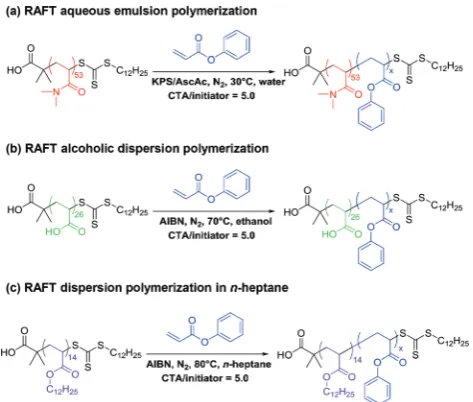
comparable to that of poly(2-hydroxypropyl methacrylate) or poly(benzyl methacrylate).69 Many high-quality TEM images have been reported for PISA formulations based on such methacrylic core-forming blocks,33,34,46,70so it was considered likely that similar results could be obtained for PPhA. To exem-plify the versatility offered by the use of phenyl acrylate, we devised three new acrylic-based RAFT-mediated PISA formu-lations based on this monomer (see Fig. 1). Thus RAFT aqueous emulsion polymerization of PhA utilized a PDMAC53
macro-CTA, while RAFT dispersion polymerization of PhA in ethanol used PAA26 as a stabilizer block. Finally, RAFT
dis-persion polymerizations conducted in n-heptane were con-ducted using a PLA14macro-CTA. Each of these three PISA
for-mulations is discussed in turn below.
RAFT aqueous emulsion polymerization of phenyl acrylate using PDMAC53stabilizer
The PDMAC53 macro-CTA was synthesized by RAFT solution
polymerization in dioxane using 2-(dodecylthiocarbono-thioylthio)-2-methylpropionic acid (DDMAT) as the RAFT agent, as this CTA is well-suited for the controlled polymer-ization of both acrylic and acrylamide-based monomers.30,66A low-temperature synthesis protocol was selected for the syn-thesis of PDMAC53-PPhAxdiblock copolymer nanoparticlesvia
RAFT aqueous emulsion polymerization in an attempt to mini-mize chain transfer to polymer, which is well-known for the polymerization of acrylic monomers.55–59 This problem leads to broadening of the molecular weight distributionvia long-chain branching. Thus a redox initiator system comprising KPS and ascorbic acid was selected to enable polymerizations to be conducted at 30 °C.65
A series of PDMAC53-PPhAxcopolymers was prepared with a
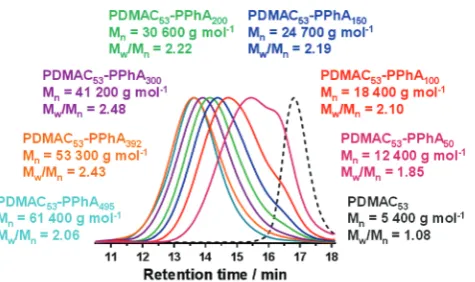
target PPhA DP (x) ranging from 50 to 500, see Table 1. High conversions were obtained in all cases (>98% forx= 50–500; entries 1–7). DMF GPC analysis indicated relatively high block-ing efficiencies, with the copolymer molecular weight increas-ing monotonically with target core-formincreas-ing block DP, as expected. However, Mw/Mn values ranged from 1.85 to 2.48
with no apparent trend between DP and dispersity (Fig. 2). This is perhaps surprising given the relatively low reaction temperature selected for these PISA syntheses, and this point will be considered later.
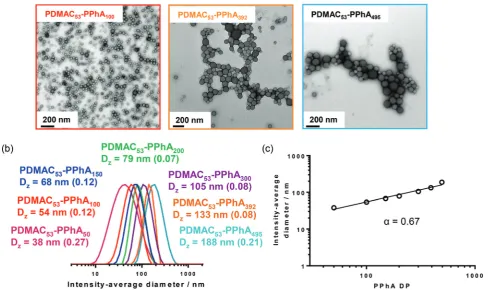
Spherical nanoparticles were produced in all cases, as con-firmed by both DLS analysis and TEM (Fig. 3). This kinetically-Fig. 1 Polymerization of phenyl acrylateviathree different PISA formu-lations: (a) RAFT aqueous emulsion polymerization at 30 °C, (b) RAFT alcoholic dispersion polymerization in ethanol at 70 °C and (c) RAFT dis-persion polymerization inn-heptane at 80 °C.
Open Access Article. Published on 25 July 2017. Downloaded on 16/11/2017 14:18:10.
This article is licensed under a
[image:4.595.309.546.48.249.2]trapped morphology has been reported for many RAFT aqueous emulsion polymerization syntheses,46,48,61,71–76 but
this phenomenon is not properly understood. However, it is perhaps noteworthy that the relatively few such PISA formu-lations yielding non-spherical nano-objects employed either (i) statistical copolymer macro-CTAs comprising a 1 : 1 molar ratio of (meth)acrylic acid and oligo(ethylene glycol) (meth) acrylate,51,52,77,78(ii) copolymer macro-CTAs comprising a poly
(N-acryloylmorpholine) (PNAM) block with a few poly(ethylene glycol) acrylate (PEGA) units with varying position within the polymer chain or (iii) a monomer exhibiting a relatively high aqueous solubility (e.g. 4-hydroxybutyl methacrylate).47
Nevertheless, in the present study the PISA mechanism provided good control over the particle size, with a monotonic increase in the intensity-average particle diameter being observed when targeting core-forming DPs ranging from 50 to 500 (see Fig. 3).
RAFT dispersion polymerization of phenyl acrylate in ethanol
It is now well-established that RAFT alcoholic dispersion polymerization normally enables access to worms or vesicles when targeting longer solvophobic blocks, provided that the
steric stabilizer block is sufficiently short to allow efficient sphere-sphere fusion to occur on the time scale of the PISA synthesis.16–18,20,23,25,28,79–81 Accordingly, for the RAFT dis-persion polymerization of PhA in ethanol, a PAA macro-CTA with a mean DP of 26 was synthesized via RAFT solution polymerization in ethanol using DDMAT as the RAFT agent. Following exhaustive methylation with excess trimethyl-silyldiazomethane, THF GPC analysis indicated anMw/Mn of
1.07, suggesting good RAFT control. This PAA26 macro-CTA
was then used for the polymerization of PhA in ethanol at 70 °C using AIBN initiator. For such PISA formulations, higher copolymer concentrations (e.g.25% w/w solids, as used herein) favor the production of pure (rather than mixed) phases.
Table 2 summarizes the target PAA26-PPhAxcompositions,
withxranging from 30 to 300. Analysis by1H NMR indicated that the final monomer conversion was high (>98%) in all cases. Following exhaustive methylation of the carboxylic acid residues in the PAA block, THF GPC analysis indicated margin-ally narrower molecular weight distributions compared to those obtained for the series of PDMAC53-PPhAx diblock
co-polymers prepared by RAFT aqueous emulsion polymerization (compare Tables 1 and 2). Although relatively high blocking efficiencies were obtained, the molecular weight distributions were again rather broad compared to those typically obtained
for PISA syntheses based on methacrylic diblock
copolymers.16–22 For this second series of all-acrylic copoly-mers, increasing the target DP of the core-forming block led to a gradual increase in dispersity (see Fig. 4). The weak high molecular weight shoulder is similar to that previously reported by Ratcliffe and co-workers66for PLA14-PBzAx
synth-eses conducted viaPISA in non-polar solvents; this feature is postulated to be either the result of chain transfer to polymer or possibly owing to termination by combination.
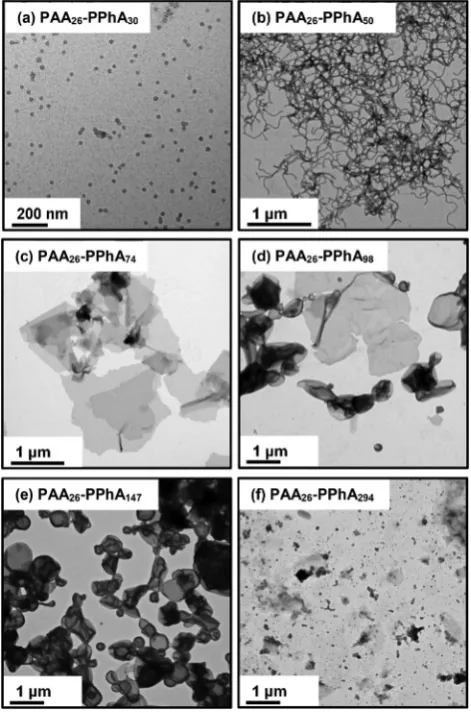
[image:5.595.41.555.74.181.2]An evolution in copolymer morphology occurs when target-ing higher PPhA DPs for this PISA system. Thus a relatively transparent dispersion is obtained at a PPhA DP of 30, with DLS and TEM studies indicating the presence of relatively small spheres with an intensity-average diameter of 24 nm. As the PPhA DP is increased to 50, a pure worm phase is obtained Table 1 Summary of monomer conversions, GPC molecular weight data, DLS particle diameters and TEM morphologies obtained for a series of PDMAC53-PPhAxdiblock copolymers preparedviaRAFT aqueous emulsion polymerization at 30 °Ca
Entry no. Target diblock composition Conversionb/%
DMF GPCc
DLS diameterd/nm TEM morphology
Mn Mw/Mn
1 PDMAC53-PPhA50 >99 12 400 1.85 38 (0.27) Spheres
2 PDMAC53-PPhA100 >99 18 400 2.10 54 (0.12) Spheres
3 PDMAC53-PPhA150 >99 24 700 2.19 68 (0.12) Spheres
4 PDMAC53-PPhA200 >99 30 600 2.22 79 (0.07) Spheres
5 PDMAC53-PPhA300 >99 41 200 2.48 105 (0.08) Spheres
6 PDMAC53-PPhA400 98 53 300 2.43 133 (0.08) Spheres
7 PDMAC53-PPhA500 99 61 400 2.06 188 (0.21) Spheres
aConditions: [macro-CTA] : [initiator] molar ratio = 5.0; copolymer concentration = 25% w/w.bMonomer conversion determined by1H NMR
spec-troscopy in DMF-d7.cRefractive index detector, calibrated with a series of near-monodisperse poly(methyl methacrylate) standards.dDLS:
inten-sity-average diameters were calculated using cumulants analysis software provided by the manufacturer (Malvern Instruments, UK). The numbers in brackets denote the polydispersity in the particle diameter.
Fig. 2 DMF GPC curves for PDMAC53-PPhAxdiblock copolymers pre-pared at 25% w/w solidsviaRAFT aqueous emulsion polymerization of PhA at 30 °C.Mnvalues are expressed relative to a series of near-mono-disperse poly(methyl methacrylate) calibration standards.
Open Access Article. Published on 25 July 2017. Downloaded on 16/11/2017 14:18:10.
This article is licensed under a
[image:5.595.50.288.251.392.2]in the form of a transparent soft gel. At a PPhA DP of 74, a transparent brittle gel was produced with DLS studies indicating a large sphere-equivalent diameter (>2 µm) and relatively high polydispersity (0.88). TEM studies suggest that this is actually a lamellar phase, with large stacked‘sheets’. Similar lamellae have been reported by Yanget al.,26,82who also utilized a RAFT dis-persion polymerization formulation comprising ethanol plus a co-solvent (either dioxane or methyl ethyl ketone). In these two
earlier studies the formation of such a lamellar morphology was rationalized in terms of the relatively highTg(219 °C) of the poly
(styrene-alt-N-phenylmaleimide) core-forming block impeding vesicle formation. However, the present study suggests that other as-yet-unidentified factors may be responsible for the formation of such lamellar morphologies.
Increasing the PPhA DP up to 98 produced a mixed phase comprising lamellae and vesicles, suggesting that the lamellar Fig. 3 A series of PDMAC53-PPhAxdiblock copolymers prepared at 25% w/w solidsviaRAFT aqueous emulsion polymerization of PhA conducted at
[image:6.595.55.545.62.352.2]30 °C using a PDMAC53macro-CTA. (a) Selected TEM images showing well-defined spherical nanoparticles; (b) corresponding DLS intensity-average size distributions and (c) the relationship between the DP of the core-forming PPhA block and the intensity-average DLS diameter, whereαis the scaling factor.
Table 2 Summary of monomer conversions, GPC molecular weight data, DLS particle diameters, and copolymer morphologies obtained for a series of PAA26-PPhAxdiblock copolymers synthesizedviaRAFT dispersion polymerization of phenyl acrylate in ethanol at 70 °Ca
Entry no. Target diblock composition Monomer conversionb/%
GPC datac
DLS diameterd/nm TEM morphology Mn Mw/Mn
1 PAA26-PPhA30 98 7200 1.45 24 (0.22) Spheres
2 PAA26-PPhA50 >99 8100 1.68 231 (0.38) Worms
3 PAA26-PPhA75 99 14 500 1.50 2800 (0.88) Lamellae
4 PAA26-PPhA100 98 12 300 1.77 1300 (0.28) Lamellae + vesicles
5 PAA26-PPhA150 98 12 200 2.13 970 (0.09) Vesicles
6 PAA26-PPhA300 98 41 200 2.48 3400 (0.95) Precipitate
aConditions: [macro-CTA] : [initiator] molar ratio = 5.0; copolymer concentration = 25% w/w.bMonomer conversion determined by1H NMR
spec-troscopy in DMSO-d6.cDetermined by THF GPC (refractive index detector, calibrated using a series of poly(methyl methacrylate) standards).
dIntensity-average diameters were calculated using cumulants analysis software provided by the manufacturer (Malvern Instruments, UK). The
numbers in brackets denote the polydispersity in the particle diameter.
Open Access Article. Published on 25 July 2017. Downloaded on 16/11/2017 14:18:10.
This article is licensed under a
[image:6.595.49.553.455.552.2]sheets are sufficiently deformable to enable vesicle formation to occurvia‘wrap up’. The visual appearance of PAA26-PPhA147
(entry 6 in Table 2) was a turbid free-flowing dispersion, which is characteristic of vesicles in the PISA literature.66,81,83,84TEM studies confirmed this morphology, with some evidence for the presence of oligolamellar vesicles (see Fig. 5). Finally, a precipitate phase comprising polydisperse particles of approxi-mately 6 µm was observed when targeting PAA26-PPhA300(see
entry 6 in Table 2 and Fig. 5). Given the highly asymmetric nature of these latter diblock copolymer chains, it seems likely that‘vesicle death’has occurred in this case. As reported by Warren et al.,27 the overall vesicle diameter is conserved during PISA. Thus, as the membrane thickens, the volume of the vesicle lumen must shrink. This leads to sterically con-gested stabilizer chains within the inner leaflet, which ulti-mately leads to vesicle destabilization. Strong evidence to support this upper limit constraint on vesicle growth was recently confirmed by Derry et al.85 via in situ synchrotron SAXS studies. Given that‘vesicle death’has been observed for PISA syntheses conducted in both water and mineral oil, this suggests agenericmechanism that is hence also likely to apply to the current RAFT alcoholic dispersion polymerization formulation.
RAFT dispersion polymerization of phenyl acrylate in n-heptane
A wide range of copolymer morphologies could also be accessed via RAFT dispersion polymerization of PhA in
n-heptane at 80 °C. These syntheses were conducted using a PLA14macro-CTA at 25% w/w solids to enable direct comparison
with the other two PISA formulations. Again, a series of PLA14
-PPhAx diblock copolymers were produced by systematically
varying the PPhA target DP (see Table 3). According to1H NMR studies, high conversions (>98%) were obtained in each case.
As expected, the apparent GPCMnfor this series of diblock
copolymers increased with increasing PPhA DP. Moreover, THF GPC analysis suggested high blocking efficiencies, with
this formulation providing significantly better control over the molecular weight distribution;Mw/Mn values range from 1.37
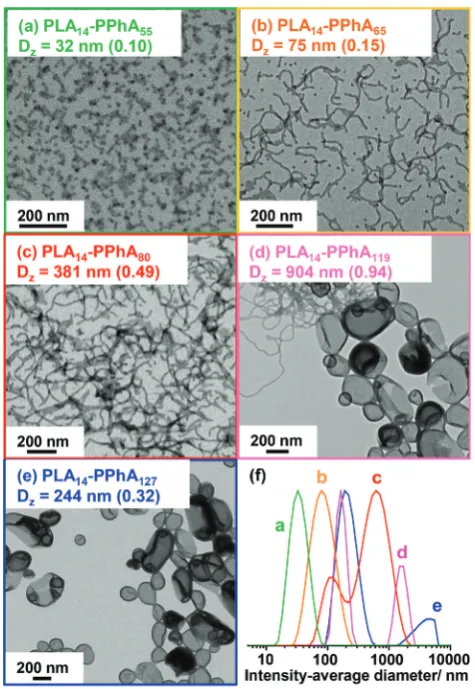
to 1.53 in all cases. Nevertheless, the GPC curve for each copo-lymer contained a high molecular weight shoulder (see Fig. 6). DLS and TEM studies confirmed that the expected evolution in copolymer morphology occurred on varying the target DP for the structure-directing PPhA block. Thus, the PLA14-PPhA55
dispersion was a transparent free-flowing fluid. This is consist-ent with the formation of spheres, which were found to be approximately 32 nm and relatively uniform in size, as judged by DLS and TEM studies respectively (see Fig. 7a).
An increase in PPhA DP of only ten units produced a turbid free-flowing liquid comprising a mixed phase of spheres and worms (see Fig. 7b). A free-standing transparent gel comprising a pure worm phase was obtained when targeting a PPhA DP of 80 (see Fig. 7c). Further increasing the core-forming block DP produced a mixed phase of worms and vesicles for PLA14
-PPhA119(see Fig. 7d), while TEM studies confirmed the
exist-ence of a pure vesicle phase for a PPhA DP of 127 (see Fig. 7e). Fig. 4 THF GPC curves obtained for PAA26-PPhAxdiblock copolymers
prepared at 25% w/w solidsviaRAFT alcoholic dispersion polymerization of PhA at 70 °C. Molecular weight data are expressed relative to a series of near-monodisperse poly(methyl methacrylate) calibration standards.
Fig. 5 PAA26-PPhAxdiblock copolymers prepared at 25% w/w solids by
RAFT alcoholic dispersion polymerization of PhA at 70 °C: selected TEM images showing the evolution in copolymer morphology to form (a) spheres, (b) worms, (c) lamellae, (d) a mixed phase of lamellae and vesi-cles, (e) vesicles or (f ) precipitate on increasing the PPhA target DP.
Open Access Article. Published on 25 July 2017. Downloaded on 16/11/2017 14:18:10.
This article is licensed under a
[image:7.595.50.288.48.198.2] [image:7.595.309.545.51.408.2]Comparing these three PhA-based PISA formulations (see Tables 1–3), significantly higher dispersities are obtained for RAFT aqueous emulsion polymerization at 30 °C compared to the two RAFT dispersion polymerizations conducted at 70 or 80 °C. Similarly broad molecular weight distributions have been reported by other workers for all-acrylic RAFT aqueous emulsion formulation.60,61In contrast, significantly lower dis-persities (Mw/Mn < 1.30) have been achieved for certain
[image:8.595.43.553.75.163.2]low-temperature RAFTdispersionpolymerization formulations con-ducted in either water65or ethanol/water mixtures.67We postu-late that the relatively high dispersities associated with RAFT aqueous emulsion polymerization may be related to stronger partitioning of unreacted monomer within the growing steri-cally-stabilized nanoparticles. This higher local monomer con-centration is consistent with the significantly faster rate of polymerization observed for such PISA formulations relative to RAFT dispersion polymerizations. According to Lovell and co-workers, such a rate enhancement is likely to favor a higher degree of branching via chain transfer to polymer.58
Table 3 Summary of monomer conversions, GPC molecular weight data, DLS particle diameters, and copolymer morphologies obtained for a series of PLA14-PPhAxdiblock copolymers synthesizedviaRAFT dispersion polymerization inn-heptane at 80 °Ca
Entry no. Target diblock composition Monomer conversionb/%
GPC datac
DLS diameterd/nm TEM morphology
Mn Mw/Mn
1 PLA14-PPhA55 >99 11 300 1.42 32 (0.10) Spheres
2 PLA14-PPhA65 >99 13 000 1.40 75 (0.15) Spheres + worms
3 PLA14-PPhA80 >99 14 600 1.37 381 (0.49) Worms
4 PLA14-PPhA120 99 18 300 1.40 904 (0.94) Worms + vesicles
5 PLA14-PPhA130 98 20 800 1.53 244 (0.32) Vesicles
aConditions: [macro-CTA] : [initiator] molar ratio = 5.0; copolymer concentration = 25% w/w.bMonomer conversion determined by1H NMR
spec-troscopy in CDCl3.cDetermined by THF GPC (refractive index detector, calibrated with poly(methyl methacrylate) standards).dIntensity-average
diameters were calculated using cumulants analysis software provided by the manufacturer (Malvern Instruments, UK). The numbers in brackets denote the polydispersity in the particle diameter.
Fig. 6 THF GPC curves obtained for a series of PLA14-PPhAxdiblock copolymers prepared at 25% w/w solidsviaRAFT dispersion polymer-ization of PhA inn-heptane at 80 °C (see Table 3). Molecular weight data are expressed relative to a series of near-monodisperse poly(methyl methacrylate) calibration standards.
Fig. 7 TEM images and corresponding DLS intensity-average diameters ( polydispersity index shown in parentheses) obtained for a series of PLA14-PPhAxdiblock copolymers prepared at 25% w/w solidsviaRAFT
dispersion polymerization of phenyl acrylate in n-heptane at 80 °C. Increasing the target DP of the structure-directing PPhA block leads to a gradual evolution in copolymer morphology from (a) pure spheres, (b) spheres and worms, (c) worms, (d) worms and vesicles and (e) pure vesicles. (f ) The corresponding DLS intensity-average size distributions obtained for these copolymer dispersions.
Open Access Article. Published on 25 July 2017. Downloaded on 16/11/2017 14:18:10.
This article is licensed under a
[image:8.595.51.286.227.403.2] [image:8.595.308.546.277.622.2]To examine this hypothesis, the following control experiments were performed. The PDMAC53 macro-CTA was used to
poly-merize phenyl acrylate via RAFT solution polymerization in DMF at 30 °C (see ESI†for the precise synthetic protocol and associated characterization data). Three different DPs were tar-geted for the PPhA core-forming block: 50, 100 and 150. Thus these diblock compositions correspond to entries 1–3 in Table 1. In each case, high PhA conversions (>96%) were achieved after approximately 16 h at 30 °C. DMF GPC analyses indicated high blocking efficiencies and significantly narrower MWDs (Mw/Mn≤1.26) for all three diblock copolymers. These
additional experiments confirm that the PDMAC53macro-CTA
has a relatively high end-group fidelity and hence indicate that the problem of high dispersity is instead intimately related to the heterogeneous nature of these PISA formulations. This is consistent with our hypothesis that chain transfer to polymer becomes much more likely within monomer-swollen particles.
Conclusions
Phenyl acrylate is a useful model monomer for conducting fundamental studies focused on acrylic-based PISA formu-lations. Unlike the vast majority of acrylic polymers, theTgof
poly( phenyl acrylate) is sufficiently high (50 °C) to allow mor-phological studies to be conducted using conventional TEM, rather than cryo-TEM. Accordingly, phenyl acrylate has been employed to generate the structure-directing solvophobic block in RAFT aqueous emulsion polymerization, RAFT alco-holic dispersion polymerization and RAFTn-alkane dispersion polymerization. In the former case, only kinetically-trapped sterically-stabilized spheres could be obtained; this morpho-logical limitation is often reported in the literature and remains poorly understood. In contrast, RAFT dispersion polymerization in either ethanol or n-heptane yielded the expected range of copolymer morphologies, depending on the relative volume fractions of the soluble and insoluble blocks. In each case high-quality images could be obtained by TEM. Final monomer conversions were invariably high (>98%) for these PISA syntheses, but GPC analyses indicated relatively broad molecular weight distributions, particularly for RAFT aqueous emulsion polymerization. This is believed to be the result of chain transfer to polymer, which is a well-known side reaction for the polymerization of acrylic monomers when employing either conventional free radical polymerization or pseudo-living radical polymerization techniques such as RAFT. Nevertheless, such branching is no barrier to the convenient formation of well-defined sterically-stabilized diblock copolymer nanoparticles at high solids. In summary, phenyl acrylate is a versatile monomer in the context of fundamental PISA research, which has been hitherto mainly focused on methacrylic monomers or styrene.
Con
fl
ict of interest
The authors declare no competing financial interest.
Acknowledgements
EPSRC is thanked for a Platform grant (EP/J007846) and the European Research Council is acknowledged for a five-year Advanced Investigator grant (PISA 320372).
Notes and references
1 B. M. Discher, Y. Won, D. S. Ege, J. C.-M. Lee, F. S. Bates, D. E. Discher and D. A. Hammer,Science, 1999,284, 1143– 1146.
2 D. E. Discher and A. Eisenberg,Science, 2002,297, 967–973. 3 L. Zhang and A. Eisenberg,Science, 1995,268, 1728–1731. 4 L. Zhang and A. Eisenberg, J. Am. Chem. Soc., 1996, 118,
3168–3181.
5 Y. Mai and A. Eisenberg,Chem. Soc. Rev., 2012,41, 5969. 6 S. Jain and F. S. Bates, Macromolecules, 2004, 37, 1511–
1523.
7 R. Xu, M. A. Winnik, F. R. Hallett, G. Riess and M. D. Croucher,Macromolecules, 1991,24, 87–93.
8 Y. Won,Science, 1999,283, 960–963.
9 C. Booth and D. Attwood,Macromol. Rapid Commun., 2000,
21, 501–527.
10 J. N. Israelachvili, D. J. Mitchell and B. W. Ninham,
J. Chem. Soc., Faraday Trans. 2, 1976,72, 1525–1568. 11 A. Blanazs, S. P. Armes and A. J. Ryan, Macromol. Rapid
Commun., 2009,30, 267–277.
12 C. J. Hawker, A. W. Bosman and E. Harth, Chem. Rev., 2001,101, 3661–3688.
13 M. Kato, M. Kamigaito, M. Sawamoto and T. Higashimura,
Macromolecules, 1996,28, 1721–1723.
14 J. S. Wang and K. Matyjaszewski, J. Am. Chem. Soc., 1995,
117, 5614–5615.
15 J. Chiefari, Y. K. B. Chong, F. Ercole, J. Krstina, J. Jeffery, T. P. T. Le, R. T. A. Mayadunne, G. F. Meijs, C. L. Moad, G. Moad, E. Rizzardo and S. H. Thang, Macromolecules, 1998,31, 5559–5562.
16 N. J. Warren and S. P. Armes,J. Am. Chem. Soc., 2014,136, 10174–10185.
17 M. J. Derry, L. A. Fielding and S. P. Armes,Prog. Polym. Sci., 2016,52, 1–18.
18 S. L. Canning, G. N. Smith and S. P. Armes,
Macromolecules, 2016,49, 1985–2001.
19 B. Charleux, G. Delaittre, J. Rieger and F. D’Agosto,
Macromolecules, 2012,45, 6753–6765.
20 J. Rieger,Macromol. Rapid Commun., 2015,36, 1458–1471. 21 J.-T. Sun, C.-Y. Hong and C.-Y. Pan,Polym. Chem., 2013,4,
873–881.
22 J.-T. Sun, C.-Y. Hong and C.-Y. Pan, Soft Matter, 2012,8, 7753–7767.
23 N. J. Warren, O. O. Mykhaylyk, D. Mahmood, A. J. Ryan and S. P. Armes,J. Am. Chem. Soc., 2014,136, 1023–1033. 24 S. Sugihara, A. Blanazs, S. P. Armes, A. J. Ryan and
A. L. Lewis,J. Am. Chem. Soc., 2011,133, 15707–15713.
Open Access Article. Published on 25 July 2017. Downloaded on 16/11/2017 14:18:10.
This article is licensed under a
25 A. Blanazs, A. J. Ryan and S. P. Armes, Macromolecules, 2012,45, 5099–5107.
26 P. Yang, L. P. D. Ratcliffe and S. P. Armes,Macromolecules, 2013,46, 8545–8556.
27 N. J. Warren, O. O. Mykhaylyk, A. J. Ryan, M. Williams, T. Doussineau, P. Dugourd, R. Antoine, G. Portale and S. P. Armes,J. Am. Chem. Soc., 2015,137, 1929–1937.
28 L. P. D. Ratcliffe, A. J. Ryan and S. P. Armes,
Macromolecules, 2013,46, 769–777.
29 M. Williams, N. J. W. Penfold, J. R. Lovett, N. J. Warren, C. W. I. Douglas, N. Doroshenko, P. Verstraete, J. Smets and S. P. Armes,Polym. Chem., 2016,7, 3864–3873.
30 S. J. Byard, M. Williams, B. E. Mckenzie, A. Blanazs and S. P. Armes,Macromolecules, 2017,50, 1482–1493.
31 W. Zhou, Q. Qu, Y. Xu and Z. An,ACS Macro Lett., 2015,4, 495–499.
32 J. Tan, H. Sun, M. Yu, B. S. Sumerlin and L. Zhang,ACS Macro Lett., 2015,4, 1249–1253.
33 M. Semsarilar, E. R. Jones, A. Blanazs and S. P. Armes,Adv. Mater., 2012,24, 3378–3382.
34 E. R. Jones, M. Semsarilar, A. Blanazs and S. P. Armes,
Macromolecules, 2012,45, 5091–5098.
35 M. Semsarilar, V. Ladmiral, A. Blanazs and S. P. Armes,
Polym. Chem., 2014,5, 3466–3475.
36 M. Semsarilar, N. J. W. Penfold, E. R. Jones and S. P. Armes,Polym. Chem., 2015,6, 1751–1757.
37 W. Zhao, G. Gody, S. Dong, P. B. Zetterlund and S. Perrier,
Polym. Chem., 2014,5, 6990–7003.
38 X. Zhang, J. Rieger and B. Charleux,Polym. Chem., 2012,3, 1502–1509.
39 W. M. Wan and C. Y. Pan,Macromolecules, 2010,43, 2672– 2675.
40 W. M. Wan, X. L. Sun and C. Y. Pan, Macromol. Rapid Commun., 2010,31, 399–404.
41 L. A. Fielding, M. J. Derry, V. Ladmiral, J. Rosselgong, A. M. Rodrigues, L. P. D. Ratcliffe, S. Sugihara and S. P. Armes,Chem. Sci., 2013,4, 2081–2087.
42 M. J. Derry, L. A. Fielding and S. P. Armes,Polym. Chem., 2015,6, 3054–3062.
43 A. P. Lopez-Oliva, N. J. Warren, A. Rajkumar,
O. O. Mykhaylyk, M. J. Derry, K. E. B. Doncom, M. J. Rymaruk and S. P. Armes,Macromolecules, 2015,48, 3547–3555.
44 L. A. Fielding, J. A. Lane, M. J. Derry, O. O. Mykhaylyk and S. P. Armes,J. Am. Chem. Soc., 2014,136, 5790–5798. 45 L. Houillot, C. Bui, M. Save, B. Charleux, C. Farcet,
C. Moire, J.-A. Raust and I. Rodriguez, Macromolecules, 2007,40, 6500–6509.
46 V. J. Cunningham, A. M. Alswieleh, K. L. Thompson, M. Williams, G. J. Leggett, S. P. Armes and O. M. Musa,
Macromolecules, 2014,47, 5613–5623.
47 A. A. Cockram, T. J. Neal, M. J. Derry, O. O. Mykhaylyk, N. S. J. Williams, M. W. Murray, S. N. Emmett and S. P. Armes,Macromolecules, 2017,50, 796–802.
48 J. Rieger, W. Zhang, F. Stoffelbach and B. Charleux,
Macromolecules, 2010,43, 6302–6310.
49 W. Zhang, F. D’Agosto, O. Boyron, J. Rieger and
B. Charleux,Macromolecules, 2011,44, 7584–7593.
50 S. Boissé, J. Rieger, G. Pembouong, P. Beaunier and B. Charleux,J. Polym. Sci., Part A: Polym. Chem., 2011,49, 3346–3354.
51 W. Zhang, F. D’Agosto, O. Boyron, J. Rieger and
B. Charleux,Macromolecules, 2012,45, 4075–4084.
52 W. Zhang, F. D’Agosto, P. Y. Dugas, J. Rieger and B. Charleux,Polym., 2013,54, 2011–2019.
53 P. A. Steward, J. Hearn and M. C. Wilkinson,Adv. Colloid Interface Sci., 2000,86, 195–267.
54 Z. Czech,Polym. Int., 2003,52, 347–357.
55 N. M. Ahmad, D. J. Britton, F. Heatley and P. A. Lovell,
Macromol. Symp., 1999,143, 231–241.
56 F. Heatley, P. A. Lovell and T. Yamashita,Macromolecules, 1998,31, 2828–2837.
57 C. Plessis, G. Arzamendi, J. M. Alberdi, M. Agnely, J. R. Leiza and J. M. Asua,Macromolecules, 2001,34, 6138– 6143.
58 N. M. Ahmad, B. Charleux, C. Farcet, C. J. Ferguson, S. G. Gaynor, B. S. Hawkett, F. Heatley, B. Klumperman, D. Konkolewicz, P. A. Lovell, K. Matyjaszewski and R. Venkatesh,Macromol. Rapid Commun., 2009, 30, 2002– 2021.
59 Y. Reyes and J. M. Asua,Macromol. Rapid Commun., 2011,
32, 63–67.
60 M. Chenal, L. Bouteiller and J. Rieger,Polym. Chem., 2013,
4, 752–762.
61 C. J. Ferguson, R. J. Hughes, D. Nguyen, B. T. T. Pham, R. G. Gilbert, A. K. Serelis, C. H. Such and B. S. Hawkett,
Macromolecules, 2005,38, 2191–2204.
62 X. Zhang, S. Boissé, C. Bui, P.-A. Albouy, A. Brûlet, M.-H. Li, J. Rieger and B. Charleux, Soft Matter, 2012,8, 1130–1141.
63 L. Houillot, C. Bui, C. Farcet, C. Moire, J. A. Raust, H. Pasch, M. Save and B. Charleux, ACS Appl. Mater. Interfaces, 2010,2, 434–442.
64 J. Zhou, R. He and J. Ma,Polymers, 2016,8, 207.
65 G. Liu, Q. Qiu, W. Shen and Z. An,Macromolecules, 2011,
44, 5237–5245.
66 L. P. D. Ratcliffe, B. E. McKenzie, G. M. D. Le Bouëdec,
C. N. Williams, S. L. Brown and S. P. Armes,
Macromolecules, 2015,48, 8594–8607.
67 J. Tan, C. Huang, D. Liu, X. Zhang, Y. Bai and L. Zhang,
ACS Macro Lett., 2016,5, 894–899.
68 R. Diaz-Calleja, E. Riande and J. San Román,
Macromolecules, 1991,24, 1854–1858.
69 Polymer Handbook, ed. J. Brandrup and E. H. Immergut, Wiley & Sons, 1975.
70 A. Blanazs, J. Madsen, G. Battaglia, A. J. Ryan and S. P. Armes,J. Am. Chem. Soc., 2011,133, 16581–16587. 71 C. J. Ferguson, R. J. Hughes, B. T. T. Pham, B. S. Hawkett,
R. G. Gilbert, A. K. Serelis and C. H. Such,Macromolecules, 2002,35, 9243–9245.
72 N. P. Truong, M. V. Dussert, M. R. Whittaker, J. F. Quinn and T. P. Davis,Polym. Chem., 2015,6, 3865–3874.
Open Access Article. Published on 25 July 2017. Downloaded on 16/11/2017 14:18:10.
This article is licensed under a
73 L. Carlsson, A. Fall, I. Chaduc, L. Wagberg, B. Charleux, E. Malmstrom, F. D’Agosto, M. Lansalot and A. Carlmark,
Polym. Chem., 2014,5, 6076–6086.
74 Y. Ning, L. A. Fielding, T. S. Andrews, D. Growney and S. P. Armes,Nanoscale, 2015,7, 6691–6702.
75 L. Guo, Y. Jiang, T. Qiu, Y. Meng and X. Li,Polym., 2014,
55, 4601–4610.
76 J. Rieger, G. Osterwinter, C. Bui, F. Stoffelbach and B. Charleux,Macromolecules, 2009,42, 5518–5525.
77 X. Zhang, S. Boissé, W. Zhang, P. Beaunier, F. D’Agosto, J. Rieger and B. Charleux,Macromolecules, 2011,44, 4149– 4158.
78 S. Boissé, J. Rieger, K. Belal, A. Di-Cicco, P. Beaunier, M.-H. Li and B. Charleux,Chem. Commun., 2010,46, 1950– 1952.
79 M. Semsarilar, V. Ladmiral, A. Blanazs and S. P. Armes,
Langmuir, 2013,29, 7416–7424.
80 M. Semsarilar, V. Ladmiral, A. Blanazs and S. P. Armes,
Langmuir, 2012,28, 914–922.
81 K. E. B. Doncom, N. J. Warren and S. P. Armes, Polym. Chem., 2015,6, 7264–7273.
82 P. Yang, O. O. Mykhaylyk, E. R. Jones and S. P. Armes,
Macromolecules, 2016,49, 6731–6742.
83 W. Cai, W. Wan, C. Hong, C. Huang and C. Pan, Soft Matter, 2010,6, 5554–5561.
84 J. R. Lovett, N. J. Warren, L. P. D. Ratcliffe, M. K. Kocik and S. P. Armes,Angew. Chem., 2015,127, 1295–1299.
85 M. J. Derry, L. A. Fielding, N. J. Warren, C. J. Mable, A. J. Smith, O. O. Mykhaylyk and S. P. Armes,Chem. Sci., 2016,7, 5078–5090.
Open Access Article. Published on 25 July 2017. Downloaded on 16/11/2017 14:18:10.
This article is licensed under a