EQ-5D-5L
.
White Rose Research Online URL for this paper:
http://eprints.whiterose.ac.uk/124872/
Version: Published Version
Article:
Hernandez, M. orcid.org/0000-0003-4474-5883 and Pudney, S. (2018) EQ5DMAP: a
command for mapping between EQ-5D-3L and EQ-5D-5L. The Stata journal, 18 (2). pp.
395-415. ISSN 1536-867X
Notwithstanding the Stata Journal copyright notice, StataCorp and the Stata Journal
hereby agree that an electronic copy (PDF) of the following article can be made available
by open access: Hernandez-Alava, M., and S. Pudney. 2018 "eq5dmap: A command for
mapping between EQ-5D-3L and EQ-5D-5L". Stata Journal 18: 395-415. The Stata
Journal website: https://www.stata-journal.com
[email protected] https://eprints.whiterose.ac.uk/ Reuse
See Attached
Takedown
If you consider content in White Rose Research Online to be in breach of UK law, please notify us by
Editors
H. Joseph Newton
Department of Statistics Texas A&M University College Station, Texas [email protected]
Nicholas J. Cox
Department of Geography Durham University Durham, UK
Associate Editors
Christopher F. Baum, Boston College
Nathaniel Beck, New York University
Rino Bellocco, Karolinska Institutet, Sweden, and University of Milano-Bicocca, Italy
Maarten L. Buis, University of Konstanz, Germany
A. Colin Cameron, University of California–Davis
Mario A. Cleves, University of Arkansas for Medical Sciences
Michael Crowther, University of Leicester, UK
William D. Dupont, Vanderbilt University
Philip Ender, University of California–Los Angeles
James Hardin, University of South Carolina
Ben Jann, University of Bern, Switzerland
Stephen Jenkins, London School of Economics and Political Science
Ulrich Kohler, University of Potsdam, Germany
Frauke Kreuter, Univ. of Maryland–College Park
Peter A. Lachenbruch, Oregon State University
Stanley Lemeshow, Ohio State University
J. Scott Long, Indiana University
Roger Newson, Imperial College, London
Austin Nichols, Abt Associates, Washington, DC
Marcello Pagano, Harvard School of Public Health
Sophia Rabe-Hesketh, Univ. of California–Berkeley
J. Patrick Royston, MRC CTU at UCL, London, UK
Mark E. Schaffer, Heriot-Watt Univ., Edinburgh
Philippe Van Kerm, LISER, Luxembourg
Vincenzo Verardi, Universit´e Libre de Bruxelles, Belgium
Ian White, MRC CTU at UCL, London, UK
Richard A. Williams, University of Notre Dame
Jeffrey Wooldridge, Michigan State University
Stata Press Editorial Manager
Lisa Gilmore
Stata Press Copy Editors
Adam Crawley,David Culwell, andDeirdre Skaggs
TheStata Journalpublishes reviewed papers together with shorter notes or comments, regular columns, book reviews, and other material of interest to Stata users. Examples of the types of papers include 1) expository papers that link the use of Stata commands or programs to associated principles, such as those that will serve as tutorials for users first encountering a new field of statistics or a major new technique; 2) papers that go “beyond the Stata manual” in explaining key features or uses of Stata that are of interest to intermediate or advanced users of Stata; 3) papers that discuss new commands or Stata programs of interest either to a wide spectrum of users (e.g., in data management or graphics) or to some large segment of Stata users (e.g., in survey statistics, survival analysis, panel analysis, or limited dependent variable modeling); 4) papers analyzing the statistical properties of new or existing estimators and tests in Stata; 5) papers that could be of interest or usefulness to researchers, especially in fields that are of practical importance but are not often included in texts or other journals, such as the use of Stata in managing datasets, especially large datasets, with advice from hard-won experience; and 6) papers of interest to those who teach, including Stata with topics such as extended examples of techniques and interpretation of results, simulations of statistical concepts, and overviews of subject areas.
TheStata Journalis indexed and abstracted byCompuMath Citation Index,Current Contents/Social and Behav-ioral Sciences,RePEc: Research Papers in Economics,Science Citation Index Expanded(also known asSciSearch),
Scopus, andSocial Sciences Citation Index.
For more information on theStata Journal, including information for authors, see the webpage
http://www.stata.com/bookstore/sj.html
Subscription rateslisted below include both a printed and an electronic copy unless otherwise mentioned.
U.S. and Canada Elsewhere
Printed & electronic Printed & electronic
1-year subscription $124 1-year subscription $154 2-year subscription $224 2-year subscription $284 3-year subscription $310 3-year subscription $400
1-year student subscription $ 89 1-year student subscription $119
1-year institutional subscription $375 1-year institutional subscription $405 2-year institutional subscription $679 2-year institutional subscription $739 3-year institutional subscription $935 3-year institutional subscription $1,025
Electronic only Electronic only
1-year subscription $ 89 1-year subscription $ 89 2-year subscription $162 2-year subscription $162 3-year subscription $229 3-year subscription $229
1-year student subscription $ 62 1-year student subscription $ 62
Back issues of theStata Journalmay be ordered online at
http://www.stata.com/bookstore/sjj.html
Individual articles three or more years old may be accessed online without charge. More recent articles may be ordered online.
http://www.stata-journal.com/archives.html
TheStata Journalis published quarterly by the Stata Press, College Station, Texas, USA.
Address changes should be sent to the Stata Journal, StataCorp, 4905 Lakeway Drive, College Station, TX 77845, USA, or emailed to [email protected].
® ®
Copyright c2018 by StataCorp LLC
Copyright Statement: TheStata Journaland the contents of the supporting files (programs, datasets, and help files) are copyright cby StataCorp LLC. The contents of the supporting files (programs, datasets, and help files) may be copied or reproduced by any means whatsoever, in whole or in part, as long as any copy or reproduction includes attribution to both (1) the author and (2) theStata Journal.
The articles appearing in theStata Journalmay be copied or reproduced as printed copies, in whole or in part, as long as any copy or reproduction includes attribution to both (1) the author and (2) theStata Journal. Written permission must be obtained from StataCorp if you wish to make electronic copies of the insertions. This precludes placing electronic copies of theStata Journal, in whole or in part, on publicly accessible websites, fileservers, or other locations where the copy may be accessed by anyone other than the subscriber. Users of any of the software, ideas, data, or other materials published in theStata Journalor the supporting files understand that such use is made without warranty of any kind, by either theStata Journal, the author, or StataCorp. In particular, there is no warranty of fitness of purpose or merchantability, nor for special, incidental, or consequential damages such as loss of profits. The purpose of theStata Journalis to promote free communication among Stata users.
eq5dmap: A command for mapping between
EQ-5D-3L and EQ-5D-5L
M´onica Hern´andez-Alava School of Health and Related Research Health Economics and Decision Science
University of Sheffield
Sheffield,UK
Stephen Pudney
School of Health and Related Research Health Economics and Decision Science
University of Sheffield
Sheffield,UK
Abstract. In this article, we describe a new command,eq5dmap, for conditional prediction of the utility values of EQ-5D-5L (EQ-5D-3L) from observed or speci-fied values of EQ-5D-3L (EQ-5D-5L) conditional on age and gender. Predictions can be made either from the five-item health descriptions or from the (exact or approximate) utility score. The prediction process is based on a joint statistical model of the two variants of EQ-5D that have been fit to alternative reference datasets (the National Data Bank for Rheumatic Diseases and a EuroQol Group coordinated data-collection study). The underlying model is a system of ordinal regressions with a flexible residual distribution specified as Gaussian or as a copula mixture. Use of the command is illustrated with an application that includes an investigation of the sensitivity of the mapping outcomes to the choice of reference dataset.
Keywords: st0528, eq5dmap,EQ-5D,EQ-5D-3L,EQ-5D-5L, mapping, conditional prediction, copula, mixture model
1
Introduction
The quality-adjusted life year (QALY) is one of the most widely used health benefit
mea-sures in economic evaluations of interventions, services, or programs designed to improve
health. TheQALYallows healthcare decision makers to use a consistent approach across
a broad range of disease areas, treatments, and patients. It is the preferred outcome measure for the National Institute for Health and Care Excellence in its appraisals of
health interventions in England (NICE 2014). Preference-based measures such as the
EQ-5D-3L underpin the calculation ofQALYs.
EQ-5Ddescribes health states in terms of five dimensions: mobility, self-care, usual
activities, pain or discomfort, and anxiety or depression. The original EQ-5D, now
called EQ-5D-3L, measures each dimension on a three-level scale (no problems, some
or moderate problems, extreme problems). EQ-5D-3L can describe 243 different health
states in this way. For example, the health state 11223 corresponds to no problems in the mobility and self-care dimensions, some problems in the usual activities and pain or discomfort dimensions, and extreme problems in the anxiety or depression dimension. Valuation studies in different countries assigned an index or utility score to each of the
c
health states described in this way. Dolan (1997) published the firstUKvalue set using general public preferences. Other countries have developed their own value sets, but in all countries, the health state 11111 (full health) is assigned a utility score of 1, and death is assigned a value of 0. States with utility scores between 0 and 1 reflect some degree of impairment, and states with negative valuations are considered worse than death.
A new version of the health description system, theEQ-5D-5L, has been developed to
try to address concerns about the lack of sensitivity and floor or ceiling distortions of the
EQ-5D-3L. The number of dimensions has remained unchanged, but the new EQ-5D-5L
extends the number of levels per dimension from three to five (no problems, slight prob-lems, moderate probprob-lems, severe probprob-lems, extreme problems). To improve consistency
across dimensions and aid understanding, there have also been some wording changes.1
The number of discrete health states described by the new version is 3,125. Utility
value sets for EQ-5D-5L have been released for England (Devlin et al. 2018),2 Japan
(Shiroiwa et al. 2016), Canada (Xie et al. 2016), Uruguay (Augustovski et al. 2016), Netherlands (Versteegh et al. 2016), Korea (Kim et al. 2016), China (Luo et al. 2017), and Indonesia (Purba et al. 2017), and similar work is underway in other countries.
Many studies now includeEQ-5D-5Linstead of the originalEQ-5D-3L. We have shown
in previous articles (Hern´andez-Alava and Pudney 2017; Hern´andez-Alava et al. 2018)
that in the UK, EQ-5D-3L and EQ-5D-5L lead to different utility scores for the same
underlying level of health; this has profound implications for economic evaluations. It is, therefore, inappropriate to mix the evidence collected using both instruments without adjusting for these differences. Because all studies, new and those previously completed, will form part of the available evidence in future economic evaluations, it is important to have a consistent way of translating health benefits measured using one of the two
versions of EQ-5D into the other. Hern´andez-Alava and Pudney (2017) developed a
flexible model that allows analysis of the joint responses to EQ-5D-3L and EQ-5D-5L.
The underlying model is a system of ordinal regressions with a flexible copula-mixture residual distribution. This model has been refit using two different datasets and results reported elsewhere (Hern´andez-Alava et al. 2018). In this article, we describe a new
command, eq5dmap, for conditional prediction of theEQ-5D-5L (EQ-5D-3L) utility from
observedEQ-5D-3L (EQ-5D-5L) responses or specified utility values and age and gender.
The command predictions are based on the models in Hern´andez-Alava et al. (2018).
This command is the only available method of translating evidence from EQ-5D-3L to
EQ-5D-5Land vice versa using the individual health states, an individual utility value, or an approximate utility score. Section 2 describes the two types of predictions that can be computed with the command. Section 3 explains briefly the underlying statistical model. The command syntax is fully described in section 4. Section 5 presents an illustrative example of the use of the command. Section 6 concludes.
1. See the EuroQol website https://euroqol.org/eq-5d-instruments/ for examples of the question word-ing used in EQ-5D-3L and EQ-5D-5L.
2
The mapping method
Theeq5dmapcommand allows mapping both from the older to the newer format (3L→
5L) and the reverse (5L→3L). We explain the mapping methodology for the case of
3L→5L, but the procedure is essentially the same for 5L→3L.
Let Y3d ∈ {1,2,3} and Y5d ∈ {1,2,3,4,5} represent outcomes for the dth
do-main (d= 1, . . . ,5) of EQ-5D-3L and EQ-5D-5L, respectively. Define the vectors Y3 =
(Y31, . . . , Y35) and Y5 = (Y51, . . . , Y55) , and write the corresponding utility scoring
scalesυ3(.) and υ5(.). Our aim is to calculate the expectation of υ5(Y5) conditional
on the values of a vector of covariatesX and also on available information aboutY3.
Depending on the form of that information, two types of mapping can be done.
2.1
A specified value for
Y
3LetS5={1, . . . ,5}5 be the set of possible values that can be taken by the vector Y5.
If we know the conditioning value ofY3, the expectation ofυ5 can be computed as
E(υ5|Y3=y3,X) =
X
y5∈S5
υ5(y5)p(y5|y3,X)
wherep(y5|y3,X) is the form of conditional probability implied by the specified
under-lying statistical model for the joint distributionY3|X andY5|X.
2.2
A specified (approximate) value for
υ
3(
Y
3)
In some cases, the user may know only the value of υ3(Y3), rather than Y3 itself.
Because the mapping Y3 → υ3 is not (quite) one to one, this case involves weaker
conditioning information. Another possibility is that the user has only a predicted
valueυb3, and the prediction may not correspond precisely to any validEQ-5D-3Lutility
score. We handle both problems by distance-weighted averaging within a neighborhood
of the specified value,υb3.
LetCbe a user-specified bandwidth. Define a set of vectors
S(υ) ={Y3 : |υ3(Y3)−υ| ≤C}
and a weight function of Epanechnikov form:
ω(υ3−υ) =
(
1− {(υ3−υ)/C}2
for|(υ3−υ)|< C
0 otherwise
The estimate of the expected value ofυ5is
P
y3∈S(bυ3)
ω{υ3(y3)−bυ3} P
y5
υ5(y5)p(y5|y3,X)
P
y3∈S(υb3)
where the summation overy5covers all 3,125 possible outcome vectors for theEQ-5D-5L
descriptive system.
3
The underlying statistical model
The predictive distribution Pr(Y5|Y3,X) is derived from a model of the joint
distri-bution ofY3|X and Y5|X developed by Hern´andez-Alava and Pudney (2017). That
model is a system of 10 latent regressions, arranged in 5 groups, following the natural
pairing of the dimensions in the 2 versions of EQ-5D, with domain d containing the
equations forY3d andY5d,
Y∗
3d = Xβ3d+U3d Y∗
5d = Xβ5d+U5d
)
d= 1, . . . ,5
wherei indexes individual cases and we assume random sampling so that all sampled
variables are independent across individuals. X is a row vector of covariates, andβ3d
and β5d are column vectors of coefficients conformable withX. We assume that the
covariate vectorX is the same for both the three-level and the five-level version of the
rth domain but may differ between domains. U3d and U5d are unobserved residuals,
which may be stochastically dependent and nonnormal. The latent dependent variables
Y∗
3d and Y5∗d are not observed directly, but they have observable ordinal counterparts,
Y3d andY5d, that are generated by the threshold-crossing conditions
Ykd=q iff Γkqd≤Ykd∗ <Γk(q+1)d, q= 1, . . . , Qk, and k= 3,5
where Qk = 3 or 5 is the number of categories of Ykd and the Γkqd are threshold
pa-rameters, with Γk1d=−∞and Γk(Qk+1)d= +∞.
To allow for background correlation between the five dimensions of EQ-5D, we
de-compose the residualUkid into a single between-group factor Vi, which represents the
individual’s general tendency to give more or less positive responses and a specific
resid-ualεkid correlated within but not between dimensions,
Ukid=ψkdVi+εkid k= 3,5 and d= 1, . . . ,5
where theψkd are a set of 10 parameters.
The model can be fit under various alternative assumptions about the joint
distribu-tion of the residualsε3id andε5id within each dimension dand the distributional form
of the common factorVi. The eq5dmap command offers two specifications: the
Gaus-sian, where the pairsε3id andε5idhave bivariate normal distributions andVi∼N(0,1);
and the copula specification, where the distribution of each pairε3id andε5id is
spec-ified in copula form with normal mixture marginals and Vi as a normal mixture (see
Hern´andez-Alava and Pudney [2017] for details).
of study. We present a concise summary of both datasets below. A more detailed discussion of the similarities and differences between the two datasets can be found
in Pennington et al. (Forthcoming). Users of eq5dmapshould consider carefully which
reference dataset is better suited for their study.
The first dataset comes from the National Data Bank for Rheumatic Diseases (NDB),
which is a register of patients with rheumatic disease, mainly referred by U.S. and Canadian rheumatologists (Wolfe and Michaud 2011). In 2011, there was a switch from
the three-level to the five-level version of EQ-5D, and both versions were collected in
parallel during the January 2011 wave, which we used to fit the reference model. The second dataset comes from a data-collection study coordinated and partly funded by
the EuroQuol Group (EQG) between August 2009 and September 2010, in six countries:
Denmark, England, Italy, the Netherlands, Poland, and Scotland. It covered eight broad patient groups (cardiovascular disease, respiratory disease, depression, diabetes, liver disease, personality disorders, arthritis, and stroke) and a student cohort (healthy
population). ThisEQGdataset was intended to cover many responses across all the
EQ-5Ddimensions in a range of diseases (Janssen et al. 2013; van Hout et al. 2012). The
EQGsample is younger than theNDBsample, with an average age of 51 versus 63, and
it covers a wider age range. There is a big difference in gender composition: theEQG
sample is 53% female, compared with 81% for NDB, in line with what is expected in
a rheumatoid arthritis specific sample. Using the UK value sets, the EQG sample has
lower health-related quality of life, with average UK utility values of 0.628 and 0.7033
for EQ-5D-3L and EQ-5D-5L, respectively, versus 0.681 and 0.7664 in the NDB dataset.
Fitted reference models for these datasets are described in Hern´andez-Alava and Pudney
(2017) and Hern´andez-Alava et al. (2018).
4
The eq5dmap command
4.1
Syntax
eq5dmap outputvarname if in weight, covariates(varlist)
{items(varlist)|score(varname)} model(modelname)
direction(mappingdirection) values3(3Lvaluesetname)
values5(5Lvaluesetname) bwidth(#)
4.2
Description
eq5dmap is a community-contributed command that allows outcomes measured using
EQ-5D-3L to be converted into (expected) utility values measured using the newer EQ-5D-5Lor vice versa.
The predictions are constructed from an underlying statistical model as described
in section 3. The model is not fit by the eq5dmap command; instead, estimation
re-sults are selected from a collection of existing estimates derived from alternative model specifications and alternative reference datasets.
4.3
Output
eq5dmapreturns the calculated conditional expectation of the required three- or
five-level EQ-5D utility score in the variable outputvarname. It also uses the summarize
command to give a (weighted) summary of the predicted scores within the subset of
observations defined by anyifandinqualifiers that are specified.
4.4
Options
covariates(varlist) specifies the variables used as covariates. Mapping is age and
gender specific, so there are two covariates. They must be specified as a varlist
with the items ordered as age in years in the interval [16,100] and gender (coded as
female =0, male =1). covariates()is required.
If the predictor is the five-dimensional EQ-5Dhealth description:
items(varlist) specifies the variables that contain observed values for the five EQ-5D
domain items to map from. They must be specified as a varlist containing five
variables ordered as mobility, self-care, usual activities, pain or discomfort, and
anxiety or depression. For 3L→5L mapping, the variables should all be coded on
a scale 1, 2, 3, where 1 = no problems, . . . , 3 = extreme problems; for 5L → 3L
mapping, the coding must be1= no problems, . . . ,5= extreme problems. Either
items()orscore()is required, but not both.
If the predictor is a utility score rather than the health description:
score(varname)specifies a variable that contains the value of the utility score. Either
items()orscore()is required, but not both.
model(modelname) specifies the model to be used for the mapping. The available
options for modelname are NDBgauss, NDBcopula, EQGcopula, or EQGgauss. The
default ismodel(EQGcopula).
direction(mappingdirection)specifies the direction of mapping: direction(3L->5L)
specifies mapping fromEQ-5D-3L to the newerEQ-5D-5L, whiledirection(5L->3L)
specifies the reverse. The default isdirection(3->5).
values3(3Lvaluesetname)specifies one of the alternative EQ-5D-3L value sets offered.
Currently, the only one offered isUK, which specifies the value set described by Dolan
(1997). The default isvalues3(UK). This option is used only whenEQ-5D-3L is the
values5(5Lvaluesetname)specifies one of the alternative EQ-5D-5L value sets offered.
Currently, the only one offered is UK, which specifies the value set described by
Devlin et al. (2018). The default is values5(UK). This option is used only when
EQ-5D-5Lis the target outcome or when mapping from an EQ-5D-5Lutility score.
bwidth(#)is the bandwidth that controls the matching of the specified utility score to
neighboring values. The default isbwidth(0), which enforces exact matching to a
point on the chosen value set; if there is a multiplicity of points that match exactly,
then their average is returned as the value foroutputvarname. If there is no exact
match within the neighborhood defined by the bandwidth, then outputvarname is
returned with a missing value, and a warning is written to the log file.
5
Examples
In sections 5.1 and 5.2, we give examples of the basic use of eq5dmap for Y3 → υ5
mapping and (exact) υ3 → υ5 mapping. Section 5.3 gives recommendations on the
choice of bandwidth for approximate υ3 →υ5 mapping, and section 5.4 considers the
potential sensitivity of results to the choice of reference dataset and model specification.
5.1
Mapping from EQ-5D-3L items to a EQ-5D-5L utility score
eq5dmap is provided with a dataset that lists all possible EQ-5D-3L health states by
gender and all ages from 16 to 100 (it thus containsN = 243×2×85 = 41310 records).
The dataset includes a set of five ordinal variables Y3 1 to Y3 5 corresponding to the
five EQ-5D-3Ldimensions.5 The data are summarized below.
. // Load and examine the input dataset . use eq5dmap_data
. summarize
Variable Obs Mean Std. Dev. Min Max
Y3_1 41,310 2 .8165065 1 3
Y3_2 41,310 2 .8165065 1 3
Y3_3 41,310 2 .8165065 1 3
Y3_4 41,310 2 .8165065 1 3
Y3_5 41,310 2 .8165065 1 3
male 41,310 .5 .5000061 0 1
age 41,310 58 24.53599 16 100
fwEQG 41,310 .0856693 .626692 0 37
fwNDB 41,310 .1259985 1.05797 0 34
u3 41,310 .1367572 .3105279 -.594 1
u3hat 41,310 .1372946 .3011919 -.5935036 .781076
Our example uses theUKvalue sets reported in Devlin et al. (2018) and Dolan (1997)
for theEQ-5D-5LandEQ-5D-3Lvalue sets, respectively. We use theNDBreference dataset
and the copula specification and predict the five-level utility score from the vector of
EQ-5D-3L descriptive items, that is, aY3 →υ5 mapping. Note that it is not necessary
to include the utility5 option in the command, because the Devlin et al. (2018)UK
score is the default (and currently only) choice.
. eq5dmap v5_y3, covariates(age male) model(NDBcopula) > items(Y3_1 Y3_2 Y3_3 Y3_4 Y3_5)
No direction specified: default is 3->5 No 5L value set specified: default is UK Summary of inputs to eq5dmap:
The 5-level value set is: UK
The age covariate is contained in input variable: age The gender covariate is contained in input variable: male Mapping from Y3 to v5
The 3-level descriptive items are contained in input variables: Y3_1 Y3_2 Y3_3 > Y3_4 Y3_5
Unweighted mean of predicted 5L score within selected sample
Variable Obs Mean Std. Dev. Min Max
v5_y3 41,310 .4755077 .262427 -.2247076 .9600279
The striking feature of the predicted utility scores is that they do not cover the full
range [−0.285,1.000] of the Devlin et al. (2018) value set. Instead, they vary between
−0.225 and 0.960. This loss of dispersion is an inevitable feature of any minimum
mean-squared error prediction based on the conditional expectation because the purely
random component of υ5(Y5) is inherently unpredictable. But note that the lower
dispersion of predicted scores relative to directly observed scores is not a problem if the scores are to be used in an economic evaluation based on aggregate net benefit, because
the conditional mean ofQALYs is not affected by the loss of dispersion.6 However, loss
of dispersion does become a problem when confidence intervals are to be computed or the distribution, rather than the mean or aggregate, of net benefit is required. See Hern´andez-Alava and Pudney (2017) for details of the full predictive distribution that can be used to handle such cases.
5.2
Mapping from an exact EQ-5D-3L score to an EQ-5D-5L score
The second type of mapping generates the predicted five-level utility score from a
spec-ified utility value (aυ3 →υ5 mapping). In this example, we choose the precise utility
scoreu3corresponding to the actual health state description in the dataset and a
band-width of 0.001, which gives exact mapping of utility scores.
. eq5dmap v5_u3, covariates(age male) model(NDBcopula) score(u3) bwidth(0.001) No direction specified: default is 3->5
No 5L value set specified: default is UK No 3L value set specified: default is UK Summary of inputs to eq5dmap:
The 5-level value set is: UK
The age covariate is contained in input variable: age The gender covariate is contained in input variable: male Mapping from v3 to v5
The 3-level value set is: UK
The 3-level score is contained in input variable: u3 The bandwidth is: .001
Unweighted mean of predicted 5L score within selected sample
Variable Obs Mean Std. Dev. Min Max
v5_u3 41,310 .4755077 .2607798 -.2247076 .9600279
The means of the two mapped variables,v5 y3 andv5 u3, are the same up to the
seventh decimal place, but not their standard deviations (SDs). This is due to the
weaker conditioning information contained in the utility score. For the majority of
the UK utility values in EQ-5D-3L, there is a one-to-one correspondence between the
health state and its assigned value. For example, the worst health state described by
Y3 = (3,3,3,3,3) is the only one that has a value of −0.594. However, for a small
number of utility values, there is not a one-to-one relationship, because the same utility value corresponds to two different health states. For example, the two distinct health
states described byY3= (1,2,2,1,1) andY3= (2,1,1,1,2) have the same utility value
of 0.779. Thus, the calculation of the expectedEQ-5D-5Lneeds to take into account that
anEQ-5D-3Lvalue of 0.779 can result from either of those two health states. Averaging
across these equal-valued states reduces theSDslightly.
5.3
Mapping from an approximate utility score: choice of bandwidth
One can use eq5dmap to carry out a bυ3 → υ5 mapping in situations where bυ3 is not
a valid point in the EQ-5D-3L value set, but rather an inexact average or predicted
utility score. Mapping is done using distance-weighted averaging of scale points within a
neighborhood ofbυ3. The bandwidth parameter simultaneously defines the neighborhood
over which averaging is to be done and the rate at which the weight declines with increasing distance.
There are potential pitfalls in this type of mapping, and it is important to consider two issues: What is the local character of the distribution of utilities that (implicitly)
underlies the specified value υb3? And does the mapping function bυ3 → υ5 have the
desirable property of monotonicity?
Given the coarse structure of the EQ-5D-3L and the nature of the UK value set
re-ported in Dolan (1997), the EQ-5D-3L utility distributions in most trial datasets are
very irregular, with large intervals of zero or nonzero probability and multiple modes. Consequently, the local averaging procedure may work well in some regions and not in others, and results can be very sensitive to the choice of bandwidth; indeed, with a
points near enough to average. Because we do not know the shape of the distribution
implicitly underlyingυb3, we cannot implement an adaptive bandwidth procedure as is
commonly used in nonparametric density estimation.
To illustrate this, we now repeat the mapping using the variableu3hat, which
con-tains approximate utility values that do not exactly match any values found in the
“official” UK EQ-5D-3Lvalue set.7 We illustrate the effect of making alternative choices
for the bandwidth using the mixed copula model and the NDB reference dataset. The
following code is used:
. // Predicted UK utility scores:
. // loop over different bandwidths: 0.01, 0.03, 0.05, 0.1, and 0.2 . foreach c of numlist 1 3 5 10 20 {
2. local bw = `c´/100
3. display "Bandwidth = `bw´, Specification = copula, Data = NDB" 4. display "Predicted UK scores..."
5. eq5dmap v5_u3_`c´ , covariates(age male) > model(NDBcopula) score(u3hat) bwidth(`bw´)
6. // Correlations with mapped actual score: . correlate v5_u3_`c´ v5_u3
7. }
The output from the first two passes of the loop is reproduced below; the full results are summarized in the first column of table 1, which also gives results for other model choices.
Bandwidth = .01, Specification = copula, Data = NDB Predicted UK scores...
No direction specified: default is 3->5 No 5L value set specified: default is UK No 3L value set specified: default is UK Summary of inputs to eq5dmap:
The 5-level value set is: UK
The age covariate is contained in input variable: age The gender covariate is contained in input variable: male Mapping from v3 to v5
The 3-level value set is: UK
The 3-level score is contained in input variable: u3hat The bandwidth is: .01
Unweighted mean of predicted 5L score within selected sample
Variable Obs Mean Std. Dev. Min Max
v5_u3_1 38,590 .4973598 .2307445 -.2247076 .8946413
Warning: It was not possible to find a valid point using the current bandwidth. Missing values generated.
(obs=38,590)
v5_u3_1 v5_u3
v5_u3_1 1.0000
v5_u3 0.8458 1.0000
Bandwidth = .03, Specification = copula, Data = NDB Predicted UK scores...
No direction specified: default is 3->5 No 5L value set specified: default is UK No 3L value set specified: default is UK Summary of inputs to eq5dmap:
The 5-level value set is: UK
The age covariate is contained in input variable: age The gender covariate is contained in input variable: male Mapping from v3 to v5
The 3-level value set is: UK
The 3-level score is contained in input variable: u3hat The bandwidth is: .03
Unweighted mean of predicted 5L score within selected sample
Variable Obs Mean Std. Dev. Min Max
v5_u3_3 41,310 .4819085 .2487869 -.2247076 .8379605
(obs=41,310)
v5_u3_3 v5_u3
v5_u3_3 1.0000
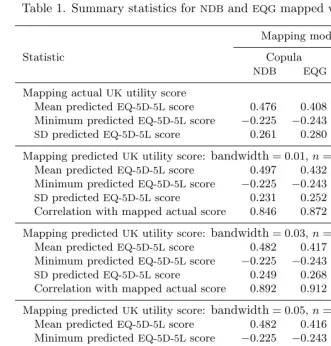
Table 1. Summary statistics for NDBandEQGmapped values for EQ-5D-5L
Mapping model based on . . .
Statistic Copula Gauss
NDB EQG NDB EQG
Mapping actualUKutility score
Mean predictedEQ-5D-5Lscore 0.476 0.408 0.461 0.400 Minimum predictedEQ-5D-5Lscore −0.225 −0.243 −0.218 −0.239
SDpredictedEQ-5D-5Lscore 0.261 0.280 0.257 0.265
Mapping predictedUKutility score: bandwidth= 0.01,n= 38590
Mean predictedEQ-5D-5Lscore 0.497 0.432 0.482 0.422 Minimum predictedEQ-5D-5Lscore −0.225 −0.243 −0.218 −0.239
SDpredictedEQ-5D-5Lscore 0.231 0.252 0.228 0.239 Correlation with mapped actual score 0.846 0.872 0.858 0.895
Mapping predictedUKutility score: bandwidth= 0.03,n= 41310
Mean predictedEQ-5D-5Lscore 0.482 0.417 0.468 0.407 Minimum predictedEQ-5D-5Lscore −0.225 −0.243 −0.218 −0.239
SDpredictedEQ-5D-5Lscore 0.249 0.268 0.246 0.257 Correlation with mapped actual score 0.892 0.912 0.902 0.928
Mapping predictedUKutility score: bandwidth= 0.05,n= 41310
Mean predictedEQ-5D-5Lscore 0.482 0.416 0.467 0.407 Minimum predictedEQ-5D-5Lscore −0.225 −0.243 −0.218 −0.239
SDpredictedEQ-5D-5Lscore 0.247 0.266 0.245 0.255 Correlation with mapped actual score 0.899 0.917 0.908 0.933
Mapping predictedUKutility score: bandwidth= 0.10,n= 41310
Mean predictedEQ-5D-5Lscore 0.482 0.416 0.467 0.407 Minimum predictedEQ-5D-5Lscore −0.189 −0.223 −0.187 −0.211
SDpredictedEQ-5D-5Lscore 0.243 0.261 0.240 0.251 Correlation with mapped actual score 0.904 0.923 0.913 0.939
Using the smallest bandwidth, 0.01,eq5dmapgives a warning. For 7% of the
obser-vations, matches could not be found within the bandwidth, generating missing mapped
values. These observations tend to be at the extremes of the EQ-5D-3L distribution,
where the gaps between consecutive utility values are substantial.8 Even this small
number of missing values is enough to distort the mean because missingness is not sym-metric across the upper and lower tails of the utility distribution. For that reason, it is usually unwise to use a very small bandwidth when utility values are approximate. In this case, a slightly larger bandwidth of 0.03 resolved the existence issue, and in our artificial example, larger bandwidths generated a result more highly correlated with the result of an exact mapping of actual scores: compare the rows of table 1 for bandwidths
0.03, 0.05, and 0.1. The mean of the predicted scores is fairly stable for different
band-widths, and, as expected, theSDdecreases as the bandwidth increases. Note that, for
any bandwidth, the mean of the mapped approximate utility is systematically above the mean of the mapping from the actual utility score. This happens to be due to the arbitrary method we used to generate hypothetical utility values; it is not inherent
in the mapping approach.9 Specific guidance on the bandwidth choice when mapping
a single overall mean utility from EQ-5D-3L to EQ-5D-5L is given in Pennington et al.
(Forthcoming). Based on the two available reference datasets, it is shown that small bandwidths, no larger than 0.1 but large enough to cover the full health value of 1,
work well when the overall mean utilityE(υ3) in the trial is in the interval (1,0.7] (this
guarantees that a full health response inEQ-5D-3Lis included in the distance-weighted
average in an area where there is a large gap in theEQ-5D-3Ldistribution). If the mean
utility is in the interval (0.7,0.6], a larger bandwidth of 0.2 is preferred; for mean
utili-ties below 0.6, an even larger bandwidth of about 0.4 is preferable. Figure 1 compares
the kernel densities of the mapped values using exact matching of the EQ-5D-3L
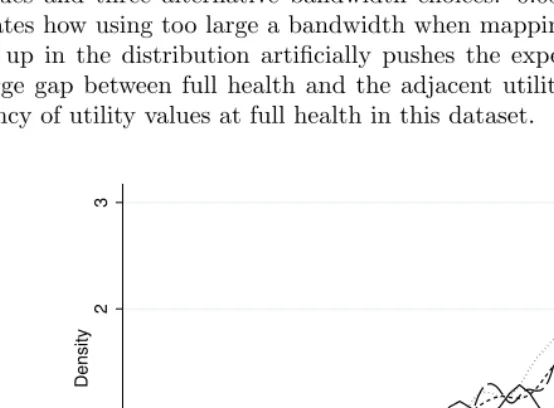
util-ity values and three alternative bandwidth choices: 0.03, 0.10, and 0.20. The figure illustrates how using too large a bandwidth when mapping from utility scores that are higher up in the distribution artificially pushes the expected values down because of the large gap between full health and the adjacent utility value and the relative high frequency of utility values at full health in this dataset.
0
1
2
3
Density
−.5 0 .5 1
bwidth=0.001 bwidth=0.03
bwidth=0.10 bwidth=0.20
kernel = epanechnikov, bandwidth = 0.0280
Figure 1. Kernel densities of mapped values for EQ-5D-5L using the copula mixture
model and the NDB reference dataset; exact matching of individual EQ-5D-3L utility
values versus approximate utility values for alternative bandwidths
[image:16.612.105.382.310.514.2]The second important issue that should be considered in choosing a bandwidth
for mapping from an approximate utility score υb3 is monotonicity. If a trial
estab-lishes that procedure 1 gives a better expected EQ-5D-3L outcome than procedure 2,
there will be serious difficulty in implementing cost-effectiveness analysis if the mapped
EQ-5D-5L measure reverses that ranking, purely because of the choice of bandwidth.10
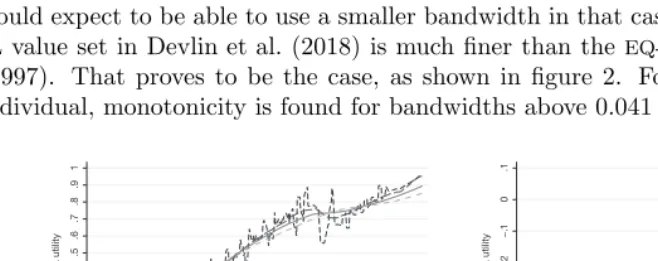
Perverse outcomes of this type can be avoided if the mapping functionυb5(υb3)
gener-ated by eq5dmap is monotonically increasing. The relationship between monotonicity
and bandwidth choice can be illustrated by applying eq5dmap over a grid of values
b
υ3 =−0.594, . . . ,1.0 for alternative bandwidths; figure 2 plots the 3L →5L mapping
function for alternative bandwidths, using theNDB copula-mixture model applied to a
hypothetical 40-year-old male. In this case, the function is monotonic only for
band-widths of 0.207 or larger; if we switch to the same model based on the EQG reference
dataset, monotonicity applies for bandwidths above 0.190.
The same procedure can be used to examine monotonicity of 5L→3L mapping. We
would expect to be able to use a smaller bandwidth in that case because theUK
EQ-5D-5Lvalue set in Devlin et al. (2018) is much finer than theEQ-5D-3L value set in Dolan
(1997). That proves to be the case, as shown in figure 2. For the same hypothetical
individual, monotonicity is found for bandwidths above 0.041 (NDB) or 0.060 (EQG).
[image:17.612.79.408.292.422.2](a) 3L→5L (b) 5L→3L
Figure 2. The effect of bandwidth choice on monotonicity of mapping functions
(copula-mixture model;NDBreference data; 40-year-old male)
Although users of eq5dmap will want to investigate the sensitivity of results to
al-ternative choices of bandwidth, we would strongly advise caution with mapping from an approximate utility score—it should be avoided in favor of exact individual-level mapping if at all possible; and, where unavoidable, it should not be done using
band-widths substantially less than 0.2 for 3L→5L mapping or 0.05 for 5L→3L mapping if
monotonicity is required. As discussed above, exceptions to this rule of thumb should be made if the trial subjects are believed to be concentrated at either extreme of the health distribution. We recommend that sensitivity analysis always be carried out and reported.
10. Nonmonotonicity is also a possibility in exactY3→υ5mapping, and the possibility is inherent in
5.4
Sensitivity of mapping outcomes to the choice of reference
data-set
A reference dataset is one that contains simultaneous observations on the two versions of
EQ-5D. From that dataset, our estimate of the joint distribution ofEQ-5D-3Land
EQ-5D-5Lresponses is derived, which in turn is used to form a conditional predictor ofEQ-5D-5L.
Different reference datasets will yield different mapping results, and it is important to know how great those differences might be to give some indication of robustness. We
compare results based on theNDBdataset, which covers North American patients with
rheumatoid arthritis, with results based on EQG, which is an assemblage of ad hoc
samples collected in several European countries. Do these very different samples give a similar picture of the relationship between responses to the three-level and five-level
versions ofEQ-5D? We also investigate the effects of model choice by comparing mapping
results from the copula-mixture and Gaussian specifications.
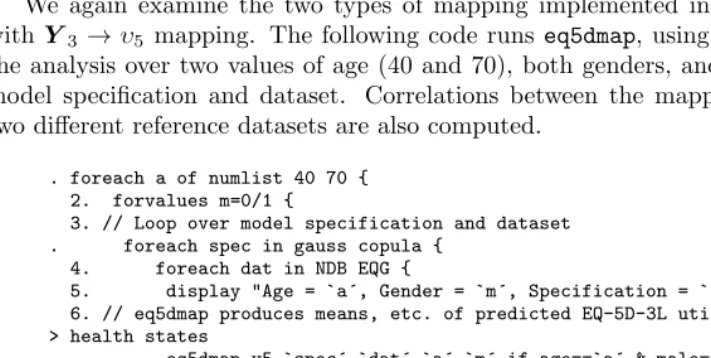
We again examine the two types of mapping implemented in eq5dmap, beginning
withY3 →υ5 mapping. The following code runseq5dmap, using four loops to repeat
the analysis over two values of age (40 and 70), both genders, and the two choices for model specification and dataset. Correlations between the mapped results using the two different reference datasets are also computed.
. foreach a of numlist 40 70 { 2. forvalues m=0/1 {
3. // Loop over model specification and dataset . foreach spec in gauss copula {
4. foreach dat in NDB EQG {
5. display "Age = `a´, Gender = `m´, Specification = `spec´, Data = `dat´" 6. // eq5dmap produces means, etc. of predicted EQ-5D-3L utility scores across > health states
. eq5dmap v5_`spec´_`dat´_`a´_`m´ if age==`a´ & male==`m´, > covariates(age male) model(`dat´`spec´)
> items(Y3_1 Y3_2 Y3_3 Y3_4 Y3_5)
7. }
8. }
9. // Compute correlations between results for different reference datasets . correlate v5_gauss_NDB_`a´_`m´ v5_gauss_EQG_`a´_`m´ if age==`a´ & male==`m´
10. correlate v5_copula_NDB_`a´_`m´ v5_copula_EQG_`a´_`m´ if age==`a´ & male==`m´ 11. }
12. }
[image:18.612.75.431.296.475.2](output omitted)
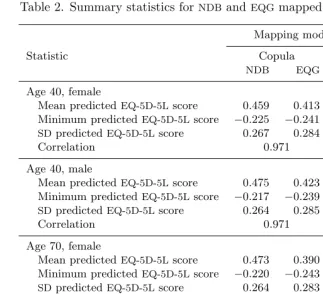
Table 2 summarizes the results in terms of the mean score, minimum score, andSD
across EQ-5D-5L health states, together with the correlations between predictions
pro-duced by each model specification on the two reference datasets. The mean prediction is
always larger using the NDBrather than theEQGdataset and the mixed copula rather
Table 2. Summary statistics for NDBandEQGmapped values for EQ-5D-5L
Mapping model based on . . .
Statistic Copula Gauss
NDB EQG NDB EQG
Age 40, female
Mean predictedEQ-5D-5Lscore 0.459 0.413 0.450 0.407 Minimum predictedEQ-5D-5Lscore −0.225 −0.241 −0.218 −0.238
SDpredictedEQ-5D-5Lscore 0.267 0.284 0.261 0.269
Correlation 0.971 0.980
Age 40, male
Mean predictedEQ-5D-5Lscore 0.475 0.423 0.466 0.413 Minimum predictedEQ-5D-5Lscore −0.217 −0.239 −0.208 −0.235
SDpredictedEQ-5D-5Lscore 0.264 0.285 0.259 0.269
Correlation 0.971 0.979
Age 70, female
Mean predictedEQ-5D-5Lscore 0.473 0.390 0.455 0.390 Minimum predictedEQ-5D-5Lscore −0.220 −0.243 −0.215 −0.237
SDpredictedEQ-5D-5Lscore 0.264 0.283 0.260 0.269
Correlation 0.958 0.970
Age 70, male
Mean predictedEQ-5D-5Lscore 0.489 0.402 0.471 0.396 Minimum predictedEQ-5D-5Lscore −0.208 −0.240 −0.203 −0.234
SDpredictedEQ-5D-5Lscore 0.260 0.284 0.257 0.269
Correlation 0.958 0.968
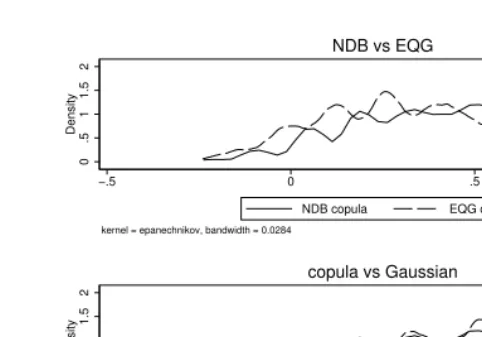
Figure 3 plots the empirical distributions (kernel densities) of the mappedEQ-5D-5L
values for a 70-year-old male. For a given choice of model (the copula-mixture model is illustrated), there are noticeable differences between the results for the two reference
datasets. For a given reference dataset (theNDB is illustrated), the difference between
0
.5
1
1.5
2
Density
−.5 0 .5 1
NDB copula EQG copula
kernel = epanechnikov, bandwidth = 0.0284
NDB vs EQG
0
.5
1
1.5
2
Density
−.5 0 .5 1
NDB copula NDB gauss
kernel = epanechnikov, bandwidth = 0.0284
[image:20.612.124.365.66.234.2]copula vs Gaussian
Figure 3. Comparison of kernel densities of mapped values forEQ-5D-5Lfor a 70-year-old
male
Next, we repeat the exercise for aυ3→υ5 mapping using the entire dataset. First,
we use u3, the variable containing the actual UK utility scores corresponding to the
health states described by the variables Y3 1 to Y3 5. The following code produces
results that are summarized in the first section of table 1.
. // Actual UK 3-level utility scores:
. // loop over model specification and dataset . foreach spec in gauss copula {
2. foreach dat in NDB EQG {
3. display "Specification = `spec´, Data = `dat´" 4. display "Actual UK scores..."
5. eq5dmap v5_`spec´_`dat´_actual,
> covariates(age male) model(`dat´`spec´) > score(u3) bwidth(0.001)
6. } 7. }
(output omitted)
As before, all mappings using theNDBdataset produce higher-average mapped values
than those using theEQG dataset (see table 1). The smaller the bandwidth, the lower
the correlations with the values mapped from the actual utility scores and also the
smaller the SDs of the mapped values.
5.5
Mapping using weights
Our dataset contains a row for every possibleEQ-5D-3Lhealth state by age and gender.
proportion of health states in the three-level descriptive system with associated utility scores around and below 0 (equivalent to death). Even disease-specific samples in very severely affected subpopulations usually have much larger average three-level utility
scores: for example, the mean three-level utility values in the EQG and NDB samples
are 0.628 and 0.681, respectively, and the proportion of individuals with a negative utility value is only 8% and 4%. This contrasts with the almost 35% health states with negative utility values in the whole 3L descriptive system.
In this section, we demonstrate the use of the weighting option to calculate the
mean mapped five-level utility for the populations in the EQG and the NDB samples.
The variablesfwEQGandfwNDBin the dataset contain frequency weights describing the
demographic composition of the EQG and NDB data, respectively. The following code
continues with the choice of theNDBmixed copula mapping model to map theEQ-5D-3L
descriptive items into a predicted five-level utility score, but it uses theEQG frequency
weights to calculate the weighted mean of the mapped utility score.
. eq5dmap v5_y3EQG [fw = fwEQG], covariates(age male) model(NDBcopula) > items(Y3_1 Y3_2 Y3_3 Y3_4 Y3_5)
No direction specified: default is 3->5 No 5L value set specified: default is UK Summary of inputs to eq5dmap:
The 5-level value set is: UK
The age covariate is contained in input variable: age The gender covariate is contained in input variable: male Mapping from Y3 to v5
The 3-level descriptive items are contained in input variables: Y3_1 Y3_2 Y3_3 > Y3_4 Y3_5
Weighted mean of predicted 5L score within selected sample
Variable Obs Mean Std. Dev. Min Max
v5_y3EQG 3,539 .7088379 .2298323 -.2170747 .9587727
Now, we carry out the same mapping but using theNDBfrequency weights instead.
. eq5dmap v5_y3NDB [fw = fwNDB], covariates(age male) model(NDBcopula) > items(Y3_1 Y3_2 Y3_3 Y3_4 Y3_5)
No direction specified: default is 3->5 No 5L value set specified: default is UK Summary of inputs to eq5dmap:
The 5-level value set is: UK
The age covariate is contained in input variable: age The gender covariate is contained in input variable: male Mapping from Y3 to v5
The 3-level descriptive items are contained in input variables: Y3_1 Y3_2 Y3_3 > Y3_4 Y3_5
Weighted mean of predicted 5L score within selected sample
Variable Obs Mean Std. Dev. Min Max
v5_y3NDB 5,205 .7640676 .1689144 -.2246118 .9584147
The mean difference between three-level and five-level utility scores calculated for
theEQG andNDBsample compositions are fairly small—0.081 and 0.083, respectively.
In comparison, the average three-level or five-level difference is 0.339 when calculated
age-gender groups. This is consistent with the findings in Hern´andez-Alava and Pudney (2017) and Hern´andez-Alava et al. (2018) of minor differences between three-level and
five-levelEQ-5Dat the top of their range but much larger differences at the bottom.
We now investigate the effect of using alternative weights on the correlations between the mappings based on different reference datasets. The following code calculates the
correlations between the υ3→υ5 mapped values in section 5.4 using the mixed copula
model.
. // calculate correlations - unweighted
. correlate v5_copula_NDB_actual v5_copula_EQG_actual (obs=41,310)
v5_cop.. v5_cop..
v5_copula_.. 1.0000
v5_copula_.. 0.9549 1.0000
. // calculate correlations - weighted
. correlate v5_copula_NDB_actual v5_copula_EQG_actual [fw = fwNDB] (obs=5,205)
v5_cop.. v5_cop..
v5_copula_.. 1.0000
v5_copula_.. 0.9967 1.0000
. correlate v5_copula_NDB_actual v5_copula_EQG_actual [fw = fwEQG] (obs=3,539)
v5_cop.. v5_cop..
v5_copula_.. 1.0000
v5_copula_.. 0.9959 1.0000
The unweighted correlation between the mapped values using different reference
datasets is high (0.9549) when calculated unweighted across all possible EQ-5D-3L
out-comes, and it increases to a value close to 1 when the sample is weighted to either
the NDBor the EQG composition. This serves to demonstrate that inconsistencies
be-tween EQ-5D-3L and EQ-5D-5L utility scores are moderate in samples with a realistic
composition and that their main feature is difference in the mean rather than lack of correlation.
6
Conclusion
In this article, we presented a new command, eq5dmap, that calculates the
predic-tion of EQ-5D-3L utility scores from observed or specified values of EQ-5D-5L
(indi-vidual items or utility score), age and gender, and vice versa. The predictive
dis-tribution was derived from a joint model of the two versions of EQ-5D developed in
7
Acknowledgments
This work was supported by the National Institute for Health and Care Excellence with its Decision Support Unit and the Medical Research Council (grant MR/L022575/1).
Pudney acknowledges furtherESRCfunding through the Centre for Micro-Social Change
(grant RES-518-28-5001). The views expressed in this article, and any errors or omis-sions, are those of the authors only.
We thank Kaleb Michaud (University of Nebraska Medical Center and National Data Bank for Rheumatic Diseases), Frederick Wolfe (National Data Bank for Rheumatic Diseases), and the EuroQol Group for providing the data used in the calculation of the weighting variables in section 5.
8
References
Augustovski, F., L. Rey-Ares, V. Irazola, O. U. Garay, O. Gianneo, G. Fern´andez,
M. Morales, L. Gibbons, and J. M. Ramos-Go˜ni. 2016. AnEQ-5D-5L value set based
on Uruguayan population preferences. Quality of Life Research25: 323–333.
Devlin, N., K. Shah, Y. Feng, B. Mulhern, and B. van Hout. 2016. Valuing
health-related quality of life: AnEQ-5D-5Lvalue set for England. Office of Health Economics,
London, UK.
Devlin, N. J., K. K. Shah, Y. Feng, B. Mulhern, and B. van Hout. 2018. Valuing
health-related quality of life: An EQ-5D-5L value set for England. Health Economics
27: 7–22.
Dolan, P. 1997. Modeling valuations for EuroQol health states. Medical Care35: 1095–
1108.
Hern´andez-Alava, M., and S. Pudney. 2017. Econometric modelling of multiple
self-reports of health states: The switch from EQ-5D-3L to EQ-5D-5L in evaluating drug
therapies for rheumatoid arthritis. Journal of Health Economics 55: 139–152.
Hern´andez-Alava, M., A. Wailoo, S. Grimm, S. Pudney, M. Gomes, Z. Sadique,
D. Meads, J. O’Dwyer, G. Barton, and L. Irvine. 2018. EQ-5D-5L versus EQ-5D-3L:
The impact on cost effectiveness in the United Kingdom. Value in Health21: 49–56.
Hern´andez Alava, M., A. J. Wailoo, and R. Ara. 2012. Tails from the peak district:
Adjusted limited dependent variable mixture models of EQ-5D questionnaire health
state utility values. Value in Health15: 550–561.
van Hout, B., M. F. Janssen, Y.-S. Feng, T. Kohlmann, J. Busschbach, D. Golicki, A. Lloyd, L. Scalone, P. Kind, and A. S. Pickard. 2012. Interim scoring for the
EQ-5D-5L: Mapping theEQ-5D-5LtoEQ-5D-3Lvalue sets.Value in Health15: 708–715.
Janssen, M. F., A. S. Pickard, D. Golicki, C. Gudex, M. Niewada, L. Scalone, P.
to the EQ-5D-3L across eight patient groups: A multi-country study. Quality of Life Research22: 1717–1727.
Kim, S.-H., J. Ahn, M. Ock, S. Shin, J. Park, N. Luo, and M.-W. Jo. 2016. TheEQ-5D-5L
valuation study in Korea. Quality of Life Research25: 1845–1852.
Luo, N., G. Liu, M. Li, H. Guan, X. Jin, and K. Rand-Hendriksen. 2017. Estimating anEQ-5D-5Lvalue set for China. Value in Health 20: 662–669.
NICE. 2014. DevelopingNICEguidelines: The manual. National Institute for Health and
Care Excellence. https: // www.nice.org.uk / process / pmg20 / chapter / introduction-and-overview#updating-this-manual.
Pennington, B., M. Hern´andez-Alava, S. Pudney, and A. J. Wailoo. Forthcoming.
Com-paring theEQ-5D-3Land5Lversions. What are the implications for model-based cost
effectiveness estimates? Decision Support Unit report.
Purba, F. D., J. A. M. Hunfeld, A. Iskandarsyah, T. S. Fitriana, S. S. Sadarjoen, J. M.
Ramos-Go˜ni, J. Passchier, and J. J. V. Busschbach. 2017. The IndonesianEQ-5D-5L
value set. PharmacoEconomics 35: 1153–1165.
Shiroiwa, T., S. Ikeda, S. Noto, A. Igarashi, T. Fukuda, S. Saito, and K. Shimozuma.
2016. Comparison of value set based onDCEand/orTTOdata: Scoring forEQ-5D-5L
health states in Japan. Value in Health 19: 648–654.
Versteegh, M. M., K. M. Vermeulen, S. M. A. A. Evers, G. Ardine de Wit, R. Prenger,
and E. A. Stolk. 2016. Dutch tariff for the five-level version ofEQ-5D.Value in Health
19: 343–352.
Wolfe, F., and K. Michaud. 2011. The National Data Bank for rheumatic diseases: A
multi-registry rheumatic disease data bank. Rheumatology 50: 16–24.
Xie, F., E. Pullenayegum, K. Gaebel, N. Bansback, S. Bryan, A. Ohinmaa, L. Poissant,
and J. A. Johnson. 2016. A time trade-off-derived value set of the EQ-5D-5L for
Canada. Medical Care 54: 98–105.
About the authors
M´onica Hern´andez-Alava is an applied microeconometrician in the Health Economics and De-cision Science section in ScHARR, University of Sheffield,UK.