Bradley, A., Chang, W-S. orcid.org/0000-0002-2218-001X and Harris, R. (2015) The effect
of drying on timber frame connections post flooding. Proceedings of the Institution of Civil
Engineers - Construction Materials, 168 (3). pp. 144-157. ISSN 1747-650X
https://doi.org/10.1680/coma.14.00042
[email protected]
https://eprints.whiterose.ac.uk/
Reuse
Unless indicated otherwise, fulltext items are protected by copyright with all rights reserved. The copyright
exception in section 29 of the Copyright, Designs and Patents Act 1988 allows the making of a single copy
solely for the purpose of non-commercial research or private study within the limits of fair dealing. The
publisher or other rights-holder may allow further reproduction and re-use of this version - refer to the White
Rose Research Online record for this item. Where records identify the publisher as the copyright holder,
users can verify any specific terms of use on the publisher’s website.
Takedown
If you consider content in White Rose Research Online to be in breach of UK law, please notify us by
The effect of drying on timber frame
connections post flooding
&1 Alistair BradleyMEng
PhD Researcher, Department of Architecture and Civil Engineering, University of Bath, Bath, UK
&2 Wen-Shao ChangMS Arch, PhD, FHEA
Lecturer in Timber Engineering, Department of Architecture and Civil Engineering, University of Bath, Bath, UK
&3 Richard HarrisBSc, CEng, FICE, FIStructE, FIMMM Professor of Timber Engineering, BRE Centre for Innovative Construction Materials, Department of Architecture and Civil Engineering, University of Bath, Bath, UK
1 2 3
Timber structures face a unique risk from flooding. Elevations in moisture content due to prolonged wetting will lead to a reduction in the mechanical properties of the building. Despite recent growth of timber construction in the UK and a known increased risk from flooding, little research has been conducted into its effects on light frame timber construction and the most efficacious drying method. This paper presents the results of experiments to determine the optimum drying conditions for light timber frame construction with oriented strand board sheathing after simulated flooding. A series of specimens were wetted for 5 d to simulate flooding before exposure to different environments. The specimens were load tested and values of ultimate strength, yield strength and stiffness were compared to those of un-wetted control specimens. It was found that the optimum drying condition for recovery of the maximum pre-wetting mechanical properties was an environment of 38
˚
C and 40% relative humidity. Although this is an optimal setting there is still a permanent reduction in the mechanical properties of approximately 40% for strengths and 20% for stiffness. Stiffness is dependent on grain orientation; however, strength was found to be independent of grain orientation, as it is governed by the oriented strand board failure.Notation
Fu ultimate strength, defined as maximum load on specimen during deformation
Fy yield strength, intersection of straight line extensions of initial and plastic sections of load–slip curve for a well-defined bi-linear load–slip curve. See also BSI 12512 (BSI, 2001)
kt,kp initial stiffness values for tangential and parallel specimens respectively. Stiffness is defined as the secant stiffness between 0?1 and 0?4Fu
MC0 moisture content prior to testing MC5 moisture content after 5 d of soaking MCtest moisture content at testing after exposure
to a drying environment; always less than 20%
T temperature
1. Introduction
Timber structures, owing to their hygroscopic nature, face a unique threat from flooding. The relationship between moisture content (MC) and timber strength is well documented (Dinwoodie, 2000). Increases in MC lead to a reduction in the mechanical properties of timber (Rammer and Winistorfer, 2001) as well as a loss of strength in oriented strand board (OSB) (Wu and Piao, 1999; Wu and Suchsland, 1997). It is thus reasonable to assume that exposure to flooding may lead to temporary or permanent reductions in the mechanical proper-ties of timber structures. With respect to PTF specifically, increases in MC will affect the mechanical properties of the nailed shear connections between the OSB sheathing and the softwood timber frame.
Following flooding it is important to dry any structure sufficiently; however, it is especially important with timber as elevated moisture levels will cause decay in the material (Blass, 1995; Forest Products Laboratory (US), 1999; Rammer and Winistorfer, 2001). The majority of drying guidance suggests that a MC of less than 20% is sufficiently dry to prevent such decay. Below 20% the timber is generally considered to be at reduced risk from rot (BRE, 1974, 1997; BSI, 2013; Garvin
et al., 2005).
The methods of drying structures following a flood can be grouped into three main categories: naturally ventilated drying, convection drying and artificial dehumidification (BSI, 2013; Garvin et al., 2005). The manner in which each of these conditions is achieved varies in practice, but common to them all is the control and alteration of temperature and relative humidity. The UK document, Publicly Available Specification 64 (PAS 64) (BSI, 2013), is designed as a single reference source when dealing with flooding. PAS 64 discusses how the aforementioned drying methods can be implemented, as well as floor restoration practicalities such as the removal of plasterboard and insulation to facilitate drying; however, it offers no guidance as to which is the most appropriate method for a particular structure or situation. Lamondet al.(2013) have performed an in-depth study of available flood guidance. The study concluded that new guidance would be welcomed and that for drying, ‘mapping building type to optimum method’ is needed (Lamondet al., 2013). The current scenario in the UK is one in which there is a known increased risk of flooding combined with a growth in use of platform timber frame, a construction type with a unique susceptibility to wetting. Exposure of timber frame to water results in weakening of timber and its products in a way that does not happen with other structural materials. Furthermore, there is a lack of research into the effects of flooding on timber frame despite the increase in risk of exposure to flood.
As mentioned earlier, there is very little previous work into the relationship between drying methodology and recovery of
mechanical properties. Escarameia et al. (2007) studied a number of different wall constructions and investigated the leakage and subsequent drying rates. Only naturally ventilated drying was explored and no strength tests were conducted. Their work focused on absorption rate and performance of different constructions and renders exposed to flooding. It did not assess drying methods for efficacy and, owing to the variety of structural types investigated, has limited data with respect to timber construction. Additionally the study did not investigate the mechanical properties of any of the test specimens.
Leichtiet al.(2002) studied the effect of flooding and drying on the load capacity of full-size shear walls. Their study tested walls after air drying only and concluded that the wetting/ drying cycle had little effect on the walls’ lateral load resistance or energy absorption capacity, with only a loss of stiffness evident (Leichti et al., 2002). The study did not, however, investigate the effect of different drying methods on the capacity of the structure following flooding, but rather focused only on natural, unassisted drying.
Both of the aforementioned studies assume that the tested structures are sufficiently dry after either a set time span or a non-direct measurement of MC. In practice, a structure is only declared dry after it has been measured to be,20% MC (BSI, 2013; Garvinet al., 2005). Experience from drying fresh felled lumber suggests that incorrect drying can result in undesirable effects such as warping, cracking or case hardening (Forest Products Laboratory (US), 1999). It is therefore important to understand the influence that artificial dehumidification and convection heating have on the mechanical properties. Removal of moisture by some artificially accelerated means may result in changes to the timber and sheathing that affect their ability to carry design loads safely.
2. Experimental programme
Previous work by the present authors (Bradley et al., 2014) showed that the drying environment does affect the recovery of mechanical properties and that a balanced environment of low humidity and slightly elevated temperature produces the greatest return to original, pre-flood properties. Excessively high temperatures produced the worst recovery of mechanical properties. In all cases a permanent loss of strength and stiffness was observed.
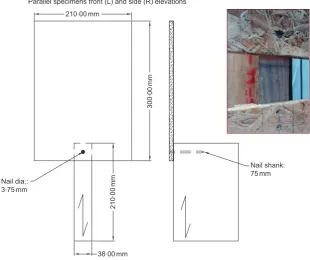
The area of interest in a flooded structure is the section below the flood water line. It is this wetted area that will suffer the majority of the detrimental effects to mechanical properties as a result of flooding. It was therefore decided to test connection details rather than full-size walls. As the critical component in a shear wall assembly is often the connection between the timber frame and sheathing, this approach allows rapid characterisation of the impact of drying on the typical failure point. The test specimens are single nailed connections between a section of the timber frame and the OSB sheathing, as detailed in Figures 1(a) and 1(b).
2.1 Specimen design
The test specimens were constructed with quarter sawn Douglas fir sourced from a local saw mill with 9 mm OSB/3 sheathing nailed to the timber using 3?75 mm dia. smooth shank nails as prescribed by Eurocode 5 (BSI, 2003). Two different grain orientations were considered, parallel to grain and tangential to grain (Figures 1(a) and 1(b)).
The specimens were fully immersed in water for 5 d, then dried according to one of the environments given in Table 1. Three specimens of each orientation were tested in each drying condition.
2.2 Experimental design
The work of Bradleyet al.(2014) investigated a broad range of drying climates, some of which were outside the scope of normal drying procedures. The current work focuses instead on a more realistic range of environments around the conditions found to be most optimal by Bradleyet al.(2014). To maximise experimental returns, design of experiments (DoE) techniques were implemen-ted, specifically Taguchi methods (Belavendram, 1995).
In an experiment using Taguchi methods, various ‘control factors’ are chosen. Control factors influence the outcome of the process that is being studied, for example, temperature or speed. Factors are the experimental variables. For each factor, ‘levels’ are assigned. These levels are the different values that each factor will take during the experiment. The Taguchi method then assigns each of these factors and levels to an orthogonal array. The construction of the array produces a set of experiments which minimises the number of tests that must be performed while still capturing the effects of each factor level contribution. Each experiment in an array is unique and allows the isolation of one factor and its subsequent effect on output. This method allows the study of the influence and relative significance of multiple variables at the same time. By grouping outputs according to each factor level it is possible to isolate the effect of a factor on the output being studied. Optimum levels are then identified through the use of response charts. Response charts are a method by which the influence of each factor on an
experiment can be represented visually, see Figures 6 and 7 later (in Sections 3.4 and 3.5). Further information on the Taguchi method can be found in Belavendram (1995) and Taguchi (1986).
In the current study two control factors were selected: temperature (T) and relative humidity (RH). These factors were assigned three levels each, as given in Table 1. They were then arranged in an orthogonal array (Table 1). Each experiment number in the array represents a unique combina-tion of T and RH levels. The effect of grain orientation is studied by repeating the set of experiments with the second grain orientation. Factors and levels are referred to by their shortened format, with the level indicated by the appropriate number; T3 is temperature at level three for example.
Each experiment has three repeat specimens, loaded mono-tonically, that is, pulled in a single direction until failure, not loaded cyclically. There are also three control specimens of each orientation giving a total for both grain orientations of 60 specimens. The control specimens are used as references for all other values and are assumed to represent the pre-wetting, original values of the connections.
2.3 Experimental equipment
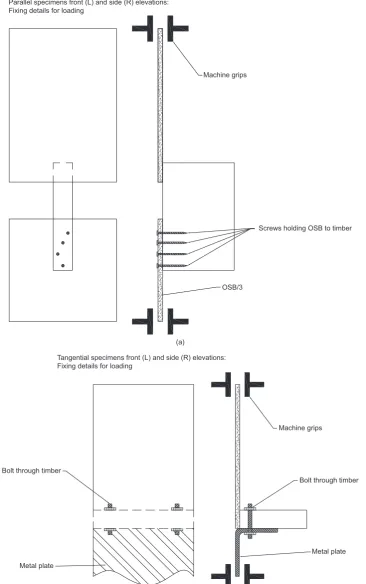
In order to achieve the desired drying environments an environmental chamber capable of maintaining environmental conditions within the ranges given in Table 1 was used. The chamber produces turbulent air flow of 0?2 m/s and is capable of four air changes per hour. The specimens were loaded monotonically under displacement control at 2 mm/min in a universal testing frame. The experimental set-up is as illustrated in Figures 2(a) and 2(b).
2.4 Moisture measurement
Moisture content is measured using a two pin capacitance type moisture meter. Uninsulated pins were inserted 4 mm into the sheathing and timber of each specimen. MC was taken as a surface reading on the OSB sheathing and timber. This method is the least invasive type of measurement and allows MC to be determined without unduly affecting the strength of the specimen through removal of material.
Moisture content was measured before wetting (MC0), after wetting for 5 d (MC5) and prior to load testing after being dried (MCtest). The MC meter is capable of reading 6–43% MC. Any MCs measured beyond this scale are recorded as
+44%.
degradation. Where it was not possible to load test specimens immediately upon them reaching the 20% MC limit, the specimens were stored in their drying environment until such time as it was possible to test them. This resulted in some variation in values of MCtest.
3. Results and discussion
3.1 Observations and failure modes
After the soaking process many specimens showed thickness swelling of the OSB board as well as unrecovered thickness (a)
(b) 210.00 mm
Parallel specimens front (L) and side (R) elevations
Tangential specimens front (L) and side (R) elevations 38.00 mm
Nail shank: 75 mm Nail dia.:
3.75 mm
300
. 00
mm
210
. 00
mm
38
. 00
mm
Nail shank: 75 mm
Nail dia.: 3.75 mm
300
. 00
mm
[image:5.595.144.455.151.411.2]210.00 mm
Machine grips Parallel specimens front (L) and side (R) elevations:
Fixing details for loading
Screws holding OSB to timber
OSB/3
(a)
(b)
Tangential specimens front (L) and side (R) elevations: Fixing details for loading
Machine grips
Bolt through timber Bolt through timber
Metal plate
[image:6.595.122.489.139.724.2]Metal plate
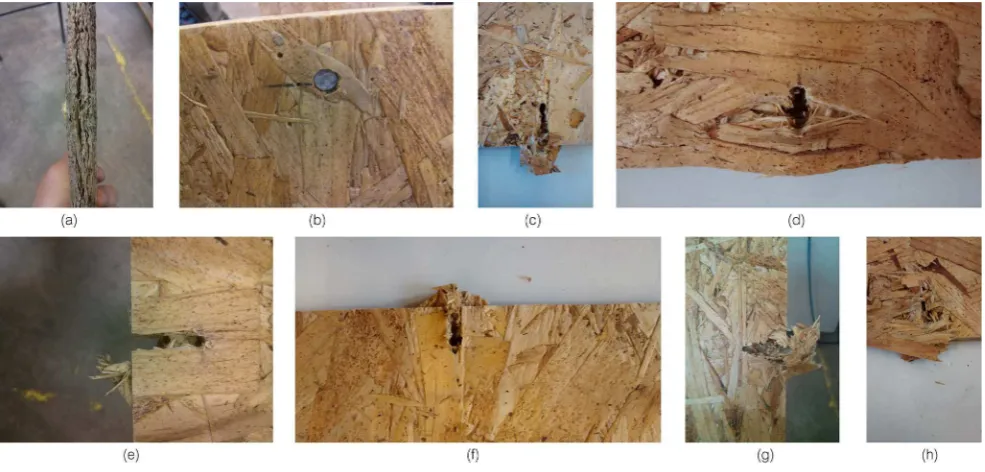
swelling after drying. The measured swelling was consistently between 11 and 12 mm. This swelling resulted in splitting of the board between laminate layers and the apparent
punching of the nail head through the board (Figures 3(a) and 3(b)).
The severity of rupture between OSB layers that was visible after drying varied. Some specimens showed large gaps between OSB flakes, others very little. At the interface between the nail head and the OSB the swelling resulted in either a punching shear through the OSB, a slight dishing or, in some cases, no damage at all. This shows that the swelling forces were not sufficient to cause nail withdrawal.
The failure modes of specimens were consistent across all tests. There were only two similar failure modes observed: nail pull through and nail rip out. Pull through refers to the nail head pulling out of the back of the OSB board. Rip out refers to the nail ripping through the base of the board. Ripping out of the board base is far more common than failure by pull through the OSB back (Figures 3(c) and 3(d)).
The rip out varies depending on the drying environment to which the specimens were exposed. In some cases a ‘clean’ rip is observed. The OSB fibres break and a single groove is cut through the board by the nail. In other cases the whole fibre length appears to be pulled through the base, resulting Experiment no. Factor 1a Factor 2b
1 1 1
2 1 2
3 1 3
4 2 1
5 2 2
6 2 3
7 3 1
8 3 2
9 3 3
aFactor 1 represents temperature: levels 1, 2, and 3 of factor 1
are, respectively, 18
˚
C, 30˚
C and 38˚
C.bFactor 2 stands for relative humidity: levels 1, 2 and 3 of factor
[image:7.595.44.285.147.287.2]2 are respectively 20, 40 and 80%.
Table 1.The L9(34) unsaturated Taguchi array used to optimise the
experimental design. Grain orientation is investigated by repeating the experiments with a second orientation. The factor levels are given below the main table
Figure 3.(a) OSB swelling resulting in laminate layers of OSB to open due to adhesive rupture; (b) punching shear around the nail head caused by board expansion; (c) example of nail rip out base of board; (d) example of nail pull through back of board; (e), (f) examples of clean rips through base of board with little
[image:7.595.47.540.465.701.2]in far more displaced material. Figures 3(e)–3(h) show this difference.
The similarity in failure mechanisms suggests two conclusions. First, it is the OSB that is the critical factor in the specimen failure. Failure due to any other component of the connection was never observed. Second, the differences in the expelled material from specimens are attributable to the different conditions of drying to which each specimen was exposed. This is evidence to suggest that each drying environment affected the material properties of the specimens differently.
3.1.1 Observed wet patches of dry specimens
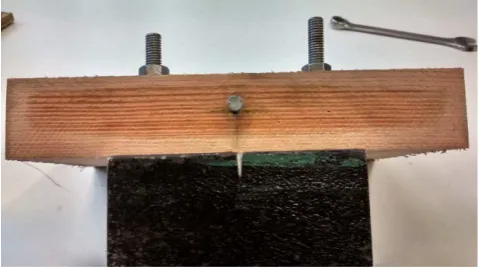
In a small number of specimens (five of the 60 tested), it was found that after testing the contact surface between the OSB and timber connection was in fact still visibly wet, despite the MC readings for the rest of the specimen being less than 20% (see Figure 4). Given the area that was still wet is inaccessible without disassembly it is likely that a similar phenomenon could occur in a real structure subject to flooding. The criterion of a surface MC of , 20% may therefore not always be sufficient to ensure the structure is dry throughout.
All these hidden areas of elevated MC were observed in experiment 3 specimens; 38
˚
C and 80% RH. Therefore, it is suggested that this environment should not be employed for drying, in order to reduce the risk of this occurrence. Although this concealed area of elevated MC only occurred in a few specimens, it is an important phenomenon to be aware of and something that should be considered by those drying PTF structures after flooding.3.2 Moisture contents
Moisture content values at different stages of the experiment are given in Table 2. Measurements were taken before wetting, after 5 d of wetting and as the specimens were load tested (MC0, MC5and MCtest).
The OSB MC5 was checked against a number of individual OSB samples soaked for the same length of time. The MCs of these specimens were found to have an average of approxi-mately 80% using the oven drying method and, in some cases, MC well over 100% was observed.
3.3 Mechanical properties
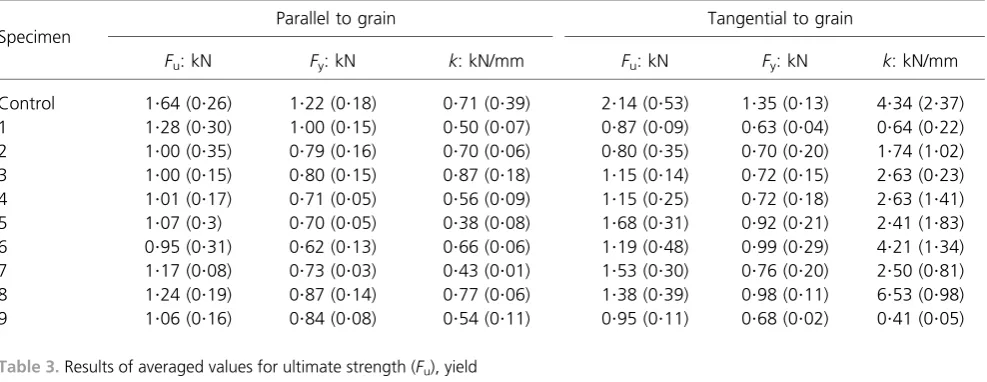
The testing programme recorded applied displacement and resulting force in each specimen. From these results, average values of ultimate strength, Fu(kN), yield strength, Fy(kN) and stiffness, k (kN/mm) are obtained for each drying condition. These are calculated according to BS EN 12512 (BSI, 2001). The averaged results for each condition for both grain orientations, including the control specimens, are presented in Table 3. There is notably greater variation in the stiffness in the tangential to the grain specimens, although this is likely due to the natural variability of timber.
3.4 Strength comparisons
For ultimate and yield strength, a Welch t-test ata´50?05 shows no significant difference between parallel and tangential speci-mens exposed to the same drying environment. In other words, grain direction does not exhibit a major influence over the ultimate strength or yield strength of connections dried under the same conditions. As such, the data for parallel and tangential tests were grouped in order to analyse the effect each drying condition has on the strength properties of the connection.
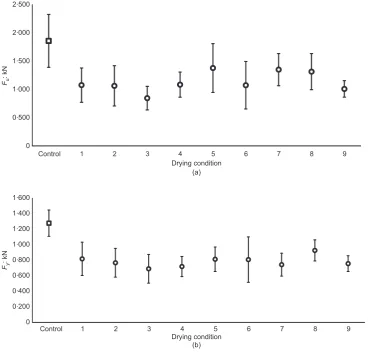
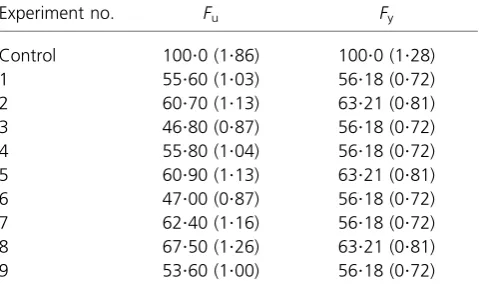
Figure 5 shows that there is a clear reduction in strengths compared to the control specimens. To draw a more useful conclusion, a response chart was used, as shown in Figure 6. This approach allows the influence of each factor and level to be isolated and analysed (Belavendram, 1995). Figure 6 presents the data as percentages of the control specimen strengths to allow for simpler comparison. For both Fu and Fy, a decrease of approximately 40% from the value of the control specimens is visible for all factor levels. Considering temperature, it can be seen that the recovered strength ranges between 54 and 62%, or 8% of the pre-wetting strength (control specimens). Similarly, for RH there is a range of recovered strengths of 53–67% or 14%. This indicates that the RH at which a specimen is dried has greater influence overFuthan the temperature.
[image:8.595.56.296.146.280.2]In order to optimise for ultimate strength, factors three and two should be selected for temperature and RH, respectively: 38
˚
C and 40% RH (T3, RH2). This optimisation will produce a predicted return to strength of approximately 68% of the Figure 4.A concealed wet patch is visible in this tangentialcontrol specimen value; see Belavendram (1995) for further details on determining the predicted values.
The effect of factor levels is somewhat more limited with respect toFy. For temperature the response varies from 58 to 59%, just by 1%, and RH produces a variation of 58–64% (6%) when compared to the control strength.
When considering optimisation of yield strength, the only factor that appears to influence strength recovery is the RH. Setting different temperature levels produces a flat response graph. This indicates that, within the ranges studied, the temperature has little influence on the yield strength.
In this case the optimal factor setting for ensuring the greatest return to pre-flood yield strength requires setting RH to level
two: 40% (RH2). This is the same level as required for Fu optimisation, see Table 4. Given the lack of response produced by temperature changes, the level setting is not as important. As such the obvious approach is to choose the same level as was chosen for optimisation of Fu, level three. This factor setting of 38
˚
C, 40% RH (T3, RH2) gives a predicted yield strength of 62% of the average control value. Based on Figures 6(a) and 6(b) the optimised environment will result in the greatest percentage return of control specimen strengths, nearly 70% forFuand 64% forFy.These results indicate that there is a loss of approximately 30% ultimate capacity and 36% yield capacity, even at the optimised factor levels. This is, however, an improvement over the least optimal condition which would result in predicted ultimate and 0
0.500 1.000 1.500 2.000 2.500
Control 1 2 3 4 5 6 7 8 9
Fu
: kN
Drying condition (a)
(b) 0
0.200 0.400 0.600 0.800 1.000 1.200 1.400 1.600
Control 1 2 3 4 5 6 7 8 9
Fy
: kN
[image:9.595.109.487.150.514.2]Drying condition
yield strengths of only 47% and 56%, respectively. The percentage returns to strength for all environments tested are given in Table 5.
3.5 Initial stiffness comparison
Comparing stiffness values between grain orientations for each drying condition shows a significant difference between tangen-tial and parallel specimens. Generally the tangentangen-tial specimens have stiffness an order of magnitude greater than the equivalent parallel specimen under a given drying condition (see Table 3). Since there is a significant difference between results for different grain orientations, analysis of stiffness was conducted separately
for each orientation. The average stiffness for parallel specimens was 0?6 kN/mm, whereas the average for the tangential speci-mens was 2?57 kN/mm, and the control stiffness values were 0?71 kN/mm and 4?72 kN/mm, respectively.
Figures 7(a) and 7(b) show the response charts (expressed as percentage of control specimen) for the parallel and tangential specimens. It is clear to see that there is a large difference between factor levels for both temperature and RH.
For the parallel specimens (kp), the optimal condition for maximising stiffness is temperature at level one and RH at level 0
10 20 30 40 50 60 70 80 90 100
T1 T2 T3 RH1 RH2 RH3
Percentage of control specimen strength: %
Factor level
(a)
(b)
Temperature Relative humidity Average strength
0 10 20 30 40 50 60 70 80 90 100
T1 T2 T3 RH1 RH2 RH3
Percentage of control specimen strength: %
Factor level
[image:10.595.146.467.141.556.2]Temperature Relative humidity Average strength
three, 18
˚
C and 80% RH (T1, RH3). The mean stiffness for parallel specimens is approximately 84% of the control specimen values. The tangential specimens (kt) have a meanstiffness of 60% of the control and the optimal condition is temperature at level three and RH at level two; 38
˚
C and 40% RH (T3, RH2).0 10 20 30 40 50 60 70 80 90 100
T1 T2 T3 RH1 RH2 RH3
Percentage of control specimen strength: %
Factor level
(a)
(b)
Temperature Relative humidity Average strength
0 10 20 30 40 50 60 70 80 90 100
T1 T2 T3 RH1 RH2 RH3
Percentage of control specimen strength: %
Factor level
[image:11.595.71.522.126.682.2]Temperature Relative humidity Average strength
The two optimal conditions result in a predicted value of stiffness of 95 and 97% for parallel and tangential specimens, respectively. These results are presented in Table 6.
This is in contrast to the least optimal solution, which would result in stiffness of 60% and 56% forkpandkt, respectively. There is a permanent loss of stiffness due to flooding and drying but this can be mitigated by appropriate drying methods.
3.6 Overall optimisation
With regards to overall optimisation of the drying regime,Fu,
Fyand kt all require the same conditions to achieve optimal drying performance. This is not, however, the optimal drying condition forkp.
One approach to rationalising the difference is to investigate the effect of applying the optimal condition forkt,FuandFyto
kp. Consulting Figure 7(a) again, it can be seen that there is little difference between the effect of temperature at T1 and T3. Changing from level one to level three is equivalent to a loss of just 1% stiffness. A change in RH from RH3 to RH2 represents a loss of 10% stiffness. The data suggest that at this setting the specimen should have a predicted stiffness equivalent to 84% of the parallel control value, a loss of under 10% compared to the optimum.
Given that setting temperature to 38
˚
C and RH to 40% is optimum for almost all criteria considered, and that it reduces the value ofkpby less than 10%, it is suggested that this be used as the global optimised drying environment. In reality there is a mix of timber orientation in a frame and the environmental condition cannot be tailored to individual elements. It is therefore important to ensure that the best overall drying outcome is achieved using only one environment, hence the need for a global optimisation.3.7 Mechanical property loss and failure mechanisms
The results presented suggest that the drying method for OSB sheathed, light timber structures can be optimised to maximise their return to pre-flooding load-carrying capacity. The per-manent loss of mechanical properties is mostly attributable to the OSB used in the connection. The reduction in the mechanical properties of the OSB is to be expected.
It is well established that an increase of MC can cause significant permanent reduction in the mechanical properties of OSB (Wu and Piao, 1999; Wu and Suchsland, 1997). For Moisture content: %
OSB-MC0 10?7 (1?2)
OSB-MC5 44+(N/A)
OSB-MCtest 14?6 (3?4)
Timber-MC0 15?3 (0?8)
Timber-MC5 36?3 (1?7)
Timber-MCtest 12?7 (3?5)
Table 2.Averaged MC data for all specimens. The initial values, MC0show little variation. Values for OSB-MC5were consistently
beyond the scale of the MC meter. Parenthetical values are standard deviations
Specimen
Parallel to grain Tangential to grain
Fu: kN Fy: kN k: kN/mm Fu: kN Fy: kN k: kN/mm
[image:12.595.57.551.535.726.2]Control 1?64 (0?26) 1?22 (0?18) 0?71 (0?39) 2?14 (0?53) 1?35 (0?13) 4?34 (2?37) 1 1?28 (0?30) 1?00 (0?15) 0?50 (0?07) 0?87 (0?09) 0?63 (0?04) 0?64 (0?22) 2 1?00 (0?35) 0?79 (0?16) 0?70 (0?06) 0?80 (0?35) 0?70 (0?20) 1?74 (1?02) 3 1?00 (0?15) 0?80 (0?15) 0?87 (0?18) 1?15 (0?14) 0?72 (0?15) 2?63 (0?23) 4 1?01 (0?17) 0?71 (0?05) 0?56 (0?09) 1?15 (0?25) 0?72 (0?18) 2?63 (1?41) 5 1?07 (0?3) 0?70 (0?05) 0?38 (0?08) 1?68 (0?31) 0?92 (0?21) 2?41 (1?83) 6 0?95 (0?31) 0?62 (0?13) 0?66 (0?06) 1?19 (0?48) 0?99 (0?29) 4?21 (1?34) 7 1?17 (0?08) 0?73 (0?03) 0?43 (0?01) 1?53 (0?30) 0?76 (0?20) 2?50 (0?81) 8 1?24 (0?19) 0?87 (0?14) 0?77 (0?06) 1?38 (0?39) 0?98 (0?11) 6?53 (0?98) 9 1?06 (0?16) 0?84 (0?08) 0?54 (0?11) 0?95 (0?11) 0?68 (0?02) 0?41 (0?05)
example, Wu and Suchsland report that, in bending tests, for a MC increase from 4 to 24% there is a modulus of elasticity loss of 72% in the parallel direction and 83% in the perpendicular direction. Similarly, there is an average modulus of rupture loss of 58% and 67%. This loss of capacity is a result of adhesive rupture due to thickness swelling.
As shown in Table 2, there was an average increase in the OSB MC of more than 33%. It is therefore reasonable to expect a reduction in the board strength of the tested specimens. The specimens in these experiments were not tested in bending, rather, in effect, bearing. Clearly the loss of capacity will therefore not be identical to that reported by Wu and Suchsland (1997), but should be of a similar order and a result of the same mechanism.
The experimental results have also shown that the strength of the connection specimens is independent of the grain; only initial stiffness is affected by grain orientation.
3.8 Grain dependency
Visual observations of connection failures showed that it is always the OSB that ultimately fails, either as nail pull through or rip out. The consistency of the failure mode, combined with
the lack of influence of grain orientation with respect to Fu or Fy, demonstrates that it is the OSB that is ultimately responsible for the strength of the connection and that this capacity is independent of the grain orientation of the timber. The initial stiffness is, however, dependent on the orientation, with kt generally an order of magnitude greater than kp (Table 2). This indicates that at some point the connection behaviour must switch from one governed by the timber to one governed by the OSB.
The connection is loaded so that the OSB moves relative to the timber. It is suggested that the initial displacement causes the nail to crush the timber at the edge of the upper side of the nail hole. At this stage the nail bearing pressure on the OSB is less than the crushing resistance of the OSB. The displacement at this stage pulls the nail upwards, bending it and resulting in the crushing of the timber. Increased deflection causes an increase in nail bending. This increase in the nail bend causes more of the length of the nail to actively bear into the timber, resulting in a greater timber contact surface. When this surface is sufficiently large, the bearing pressure of the nail and the bearing resistance of the timber reach equilibrium, resulting in no more nail bending. There is, however, still displacement being applied to the specimen and so one of two things must happen. Either the nail can withdraw from the timber or the OSB can begin to rip as it moves relative to the nail. The withdrawal capacity of the nail in the timber is always greater than the axial force exerted by the loading and as such the OSB must rip. This has been observed in all tested specimens. The withdrawal capacity of the nail is a result of the friction between the nail and the timber into which it is embedded. This utilisation of the withdrawal resistance of the nail at large angles of connection deflection is commonly referred to as the ‘rope effect’.
During this ripping of the OSB board, the nail is not cutting and removing fibres as a saw would, but rather displacing them within the sheet, leading to compression in the board around the nail bearing surface and push out of fibres (Figures 3(c), 3(e), 3(f) and 3(g)).
This proposed mechanism accounts for the influence of grain orientation on connection stiffness and its lack of influence Strength consideration Temperature level Relative humidity level Predicted strength Optimised strength
Ultimate (Fu) 3 (38
˚
C) 2 (40% RH) 68% 1?32 kN [image:13.595.48.543.146.198.2]Yield (Fy) 3 (38
˚
C) 2 (40% RH) 62% 0?80 kNTable 4.Optimised factor setting for ultimate and yield strength. Note that given its apparent lack of influence the factor level for temperature forFyis chosen to be identical to the optimum setting forFu
Experiment no. Fu Fy
Control 100?0 (1?86) 100?0 (1?28) 1 55?60 (1?03) 56?18 (0?72) 2 60?70 (1?13) 63?21 (0?81) 3 46?80 (0?87) 56?18 (0?72) 4 55?80 (1?04) 56?18 (0?72) 5 60?90 (1?13) 63?21 (0?81) 6 47?00 (0?87) 56?18 (0?72) 7 62?40 (1?16) 56?18 (0?72) 8 67?50 (1?26) 63?21 (0?81) 9 53?60 (1?00) 56?18 (0?72)
[image:13.595.46.286.572.714.2]over strength. The behaviour is initially governed by the timber properties until those of the OSB become critical. This behaviour is observed in all specimens tested, including the control specimens.
4. Conclusion
A series of drying environments have been studied and it has been found that to optimise overall recovery of mechanical properties of a nailed timber to OSB connection after wetting, heating to 38
˚
C and lowering RH to 40% results in the greatest recovery of mechanical properties in the tested specimens. Strength (bothFuandFy) was observed to be independent of the grain orientation of the timber as it is governed by the OSB sheathing of the specimen. Values ofkpandktwere influenced by grain orientation. Using the optimised drying environment, recovery of 68% of the ultimate strength, 62% of the yield strength and 84% of the stiffness can be expected.Observations indicate that ultimately it is the OSB that is of concern in the connection as it is most susceptible to flood damage; the connection failure is always attributable to the OSB. The loss in connection strength indicates that shear walls will lose strength as their capacity is governed by the nailed connection. How this loss of connection capacity affects overall racking strength needs to be studied.
It was also noted that there is a small risk of trapped moisture in otherwise dry specimens. It is possible for wet patches to exist between the sheathing and frame despite the measured value indicating the connection is dry. It is important for flood remediation specialists to be aware of this possibility when drying timber structures. A handheld MC meter was used in these tests to prevent damage to the test specimens before testing; however, for situations where a structure is at risk of trapped moisture, an alternative (possibly more invasive) measurement technique should be considered.
Comparison of the effect of temperature and RH on recovery of mechanical properties after flooding indicates that RH is more important than the temperature in influencing maximum recovery. Thus if only one can reasonably be controlled it should be the RH, as it has the most influence on the drying outcome.
The results of the experiments presented here suggest that following flooding, the drying methodology will affect the mechanical properties of a light frame timber structure. Although the return to original strength can be maximised, there is still an unrecoverable loss of mechanical properties as a result of flooding and drying.
Acknowledgements
The authors would like to thank the University of Bath for funding the PhD project that allowed this research to be conducted, the technical staff in the Architecture and Civil Engineering department at Bath without whose expertise this project would not have been possible and finally Mr Ewan Basterfield from the Faculty of Science at the University of Bath for kindly allowing use of the plant growth rooms for such an extended period of time.
REFERENCES
Belavendram N(1995)Quality by Design: Taguchi Techniques for Industrial Experimentation. Prentice Hall, London, UK.
Blass HJ(1995)STEP 1: Timber Engineering, Basis of Design, Material Properties, Structural Components and Joints. Centrum Hout, Almere, The Netherlands.
Bradley A, Chang WS and Harris R(2014) The effect of drying conditions on post flooding mechanical properties of timber shear walls. InProceedings of the World Conference of Timber Engineers 2014, Quebec(Salenikovich A (ed.)). Available at http://schd.ws/hosted_files/wcte14/8b/ ABS701_Bradley_web.pdf (accessed 09/12/14).
BRE(1974)Drying Out Buildings. Building Research Establishment, Watford, UK, BRE Digest 163.
BRE(1997)Good Repair Guide 11, Part 3. Building Research Establishment, Watford, UK, p. 4.
BSI(2001) BSI EN 12512:2001: Timber Structures – Test methods – Cyclic testing of joints made with mechanical fasteners. BSI, London, UK.
BSI(2003) BS EN 1995:1-1 Eurocode 5 – Design of timber structures – Part 1-1: General rules and rules for buildings. BSI, London, UK.
BSI(2012) PD 6693-1:2012: Recommendations for the design of timber structures to Eurocode 5: Design of timber structures – General. Common rules and rules for buildings. BSI, London, UK, p. 68.
Stiffness orientation Temperature level Relative humidity level Predicted strength
Parallel 1 (18
˚
C) 3 (80% RH) 95% [image:14.595.56.546.148.198.2]Tangential 3 (38
˚
C) 2 (40% RH) 97%BSI(2013) PAS 64:2013: Mitigation and recovery of water damaged buildings. Code of practice. BSI, London, UK.
Dinwoodie JM(2000)Timber: Its Nature and Behaviour. BRE, Spon, London, UK.
Escarameia M, Karanxha A and Tagg A(2007) Quantifying the flood resilience properties of walls in typical UK dwellings.
Building Services Engineering Research and Technology
28(3): 249–263. See http://bse.sagepub.com/content/28/3/ 249.abstract (accessed 02/12/2014).
Forest Products Laboratory (US)(1999)Wood Handbook: Wood
as an Engineering Material. United States Department of Agriculture Forest Service, Madison, WI, USA.
Garvin S, Reid J and Scott M(2005)Standards for the Repair of Buildings Following Flooding. Ciria, London, UK, C623.
Huntingford C, Marsh T, Scaife AAet al. (2014) Potential influences on the United Kingdom’s floods of winter 2013/ 14.Nature Climate Change4(9): 769–777. See http://dx.doi. org/10.1038/nclimate2314 (accessed 12/10/2014).
IPCC (Intergovernmental Panel on Climate Change)(2013)
Climate Change 2013: The Physical Science Basis. Contribution of Working Group I to the Fifth Assessment Report of the Intergovernmental Panel on Climate Change
(Stocker, TF, Plattner GK, Tignor M, Allen SK, Boschung J, Nauels A, Xia Y, Bex V and Midgley PM. (eds.)), Cambridge University Press, Cambridge, UK.
Lamond J, Proverbs D, Escarameia M and Tagg A(2013) Towards improved guidelines for drying flood-damaged buildings.
Journal of Flood Risk Management7(3): 195–204. See http://doi.wiley.com/10.1111/jfr3.12040 (accessed 16/10/ 2014).
Leichti J, Staehle R and Rosowsky DR(2002) A performance
assessment of flood-damaged shearwalls.Proceedings of the 9th International Conference on Durability of Materials and Components, Vancouver, Canada.
Menendez JM, Leitch K and Hairstans R(2014) Sole plate fixing details for modern methods of timber construction. In
Materials and Joints in Timber Structures Recent
Developments of Technology(Aicher S, Reinhardt HW and Garrecht H (eds)). RILEM Book Series, Springer, The Netherlands, pp. 109–118, see http://dx.doi.org/10.1007/ 978-94-007-7811-5_10 (accessed 31/08/2014).
Otto FEL, Rosier SM, Allen MRet al. (2014) Attribution analysis of high precipitation events in summer in England and Wales over the last decade.Climatic Change. See http:// link.springer.com/10.1007/s10584-014-1095-2 (accessed 16/ 10/2014).
Rammer DR and Winistorfer SG(2001) Effect of moisture content on dowel-bearing strength.Wood and Fiber Science
33(1): 126–139.
Taguchi G(1986)Introduction to Quality Engineering: Designing Quality into Products and Processes. Asian Productivity Organization, Tokyo, Japan.
United Kingdom Forestry Commission(2013)UK Timber Market
Statement – December 2013. See http://www.forestry.gov.uk/ pdf/UKTimberMarketStatement2013.pdf/$FILE/
UKTimberMarketStatement2013.pdf (accessed 01/10/2014).
Wu Q and Piao C(1999) Thickness swelling and its relationship to internal bond strength loss of commercial oriented strandboard.Forest Products Journal49(7/8): 50–55.
Wu Q and Suchsland O(1997) Effect of moisture on the flexural properties of commercial oriented strandboards.Wood and Fiber Science29(1): 47–57.
WHAT DO YOU THINK?
To discuss this paper, please email up to 500 words to the editor at [email protected]. Your contribution will be forwarded to the author(s) for a reply and, if considered appropriate by the editorial panel, will be published as discussion in a future issue of the journal.