Received 10 Jun 2015|Accepted 14 Sep 2015|Published 21 Oct 2015
Zeolite-like liquid crystals
Silvio Poppe
1, Anne Lehmann
1, Alexander Scholte
1, Marko Prehm
1, Xiangbing Zeng
2, Goran Ungar
2,3& Carsten Tschierske
1Zeolites represent inorganic solid-state materials with porous structures of fascinating complexity. Recently, significant progress was made by reticular synthesis of related organic solid-state materials, such as metal-organic or covalent organic frameworks. Herein we go a step further and report the first example of a fluid honeycomb mimicking a zeolitic framework. In this unique self-assembled liquid crystalline structure, transverse-lying p-conjugated rod-like molecules form pentagonal channels, encircling larger octagonal channels, a structural motif also found in some zeolites. Additional bundles of coaxial molecules penetrate the centres of the larger channels, unreachable by chains attached to the honeycomb framework. This creates a unique fluid hybrid structure combining positive and negative anisotropies, providing the potential for tuning the directionality of anisotropic optical, electrical and magnetic properties. This work also demonstrates a new approach to complex soft-matter self-assembly, by using frustration between space filling and the entropic penalty of chain extension.
DOI: 10.1038/ncomms9637 OPEN
1Institute of Chemistry, Organic Chemistry, Martin Luther University Halle-Wittenberg, Kurt-Mothes Strasse 2, D-06120 Halle/Saale, Germany. 2Department of Materials Science and Engineering, University of Sheffield, Mappin Street, Sheffield S1 3JD, UK.3Department of Physics, Zhejiang
Z
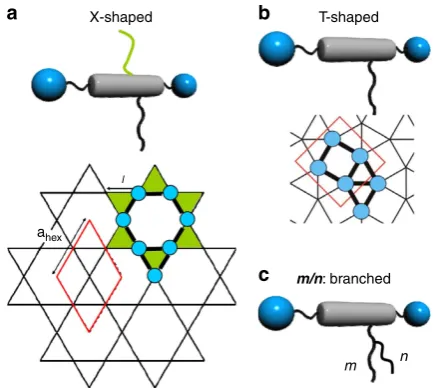
eolites are well-known inorganic solid-state materials with well-defined porous framework structures, used for gas storage, separation and catalytic applications1,2. For control of micro porosity, metal-organic frameworks (MOFs)3 and covalent organic frameworks (COFs) were developed in the previous decade4,5. In addition, COFs and MOFs recently received significant attention for optoelectronic and photovoltaic applications5–7and as ferroelectrics8, in these cases not necessarily requiring open pores. For the latter applications, the framework structures provide the facility to tailor the spatial organization of p-conjugated aromatic groups in a desired pattern. Related soft structures, representing liquid crystal (LC) honeycombs, have previously been developed for T-shaped and X-shaped polyphilic molecules (see Fig. 1a,b)9–11. In these self-assembled soft structures, rigid aromatic rod-like cores of the molecules forming the honeycomb walls are connected by dynamic intermolecular hydrogen bonding between their glycerol end groups. The honeycomb channels are filled with flexible chains laterally attached to the aromatic rods. As shown in previous work, the volume of the flexible chains relative to the rod length determines the size and shape of the channel cross-section, which range from triangular to hexagonal and beyond9–11. The cross-sectional shape of the channels is mainly determined by geometric rules, whereas the hydrogen bonding, the segregation of polar from apolar units and rigid from flexible segments, as well as anisotropic interactions between the rod-like cores, contribute to the stabilization of the periodic honeycomb structures. Putting it crudely, although the periodic tiling in the xy plane ensures low energy, the disorder along z axis secures relatively high entropy. This leads to thermodynamically stable bulk structures with sufficient mobility to allow efficient self-healing of local defects. They are also sufficiently robust to be independent of most molecular or atomistic features of the substrate surface, in contrast to related two-dimensional (2D) assemblies of molecules12,13, nanoparticles or colloidal particles on solid or LC surfaces14,15.Formation of periodic structures combining channels of different shapes was previously observed for related polyphilic X-shaped molecules (Fig. 1a) with two different and strongly incompatible side chains, such as perfluoroalkyls and carbosi-lanes, attached to opposite sides of the rod-like core16–18. As these chains cannot mix, superstructures combining channels with different size and content were obtained by combining incompatible chains with widely disparate volumes. For T-shaped molecules (Fig. 1b) with only one chain or X-shaped molecules with two identical chains, mainly congruent honeycombs, consisting of identical channels, were obtained. The only periodic mixed-cell honeycombs observed in these compounds were triangle–square combinations (Fig. 1b) in cases where the chains were too large for triangular, but too small for square channels19.
Here we present a new approach of deliberately introducing packing frustration by keeping the volume but shortening the length of the flexible chains. Not only do we get soft honeycombs with largely disparate cells (pentagonal and octagonal), but the imposed frustration also results in an unprecedented type of LC where mesogens orient both perpendicular and parallel to the director axis. This opens the possibilities for a range of fascinating and surprising new complex structures through self-assembly of T-shaped molecules with only a single branched chain (structure
cin Fig. 1). One of them represents the first example of a zeolite-like nanostructured LC that forms by self-assembly of polyphilic molecules involving p-conjugated rod-like cores and combining pentagonal with octagonal channels. Another novel structure is also reported, combining pentagonal and hexagonal channels. These complex superstructures are the result of a newly adopted strategy by introducing entropy controlled packing frustration to the previously developed concept of LC honeycombs.
Results
Molecular structures and LC phases. Five compounds with structurec, designated by the length of the two branches in their lateral chains asm/n(see Fig. 2 and Table 1), were synthesized as described in the Methods and the Supplementary Methods; the differential scanning calorimetry (DSC) traces are shown in Supplementary Fig. 1. All compounds are isomers with mþn¼20 but differing in the length of the two branches (m,n); they range from compound20/0having a linearn-alkyl chain to compound 10/10 having two equal branches. As shown in Table 1, all compounds form enantiotropic (thermodynamically stable) liquid crystalline phases, in most cases over relatively wide temperature ranges between the crystalline (Cr) and the isotropic liquid state. Regarding X-ray diffraction, these ordered fluids, as expected, show only diffuse wide-angle scattering with a max-imum atd¼0.45–0.46 nm. This corresponds to the mean lateral distance between the molecules and indicates that the molecules have no fixed position. The presence of sharp Bragg reflections in the small angle range however confirm the presence of long-range 2D mesoscopic order. The plane group assignments of the LC phases of compoundsm/nare shown in Table 1.
X-shaped T-shaped
ahex
l
m/n: branched
m n
a b
[image:2.595.58.276.434.628.2]c
Figure 1 | Honeycomb-type LC phases combining channels with different
shape.(a) Kagome combining honeycomb cells with hexagonal and
triangular cross-section as formed by X-shaped molecules having different and incompatible lateral chains at opposite sides of the rod-like core unit9,11,16. (b) Archimedean 32.4.3.4 tiling by triangular and square cylinders with ratio 2:1 as found for T-shaped molecules with only one linear chain with certain length10. These periodic structures are shown as tiling patterns representing cuts perpendicular to the channels; blue dots represent polar glycerol groups. (c) Molecules under consideration herein, having a single branched alkyl chain.
O O
OH OH HO
HO
O
H2m+1Cm CnH2n+1
Figure 2 | Molecular structure of compoundsm/n.All compounds have
the same number of carbon atoms in the branched lateral chain with
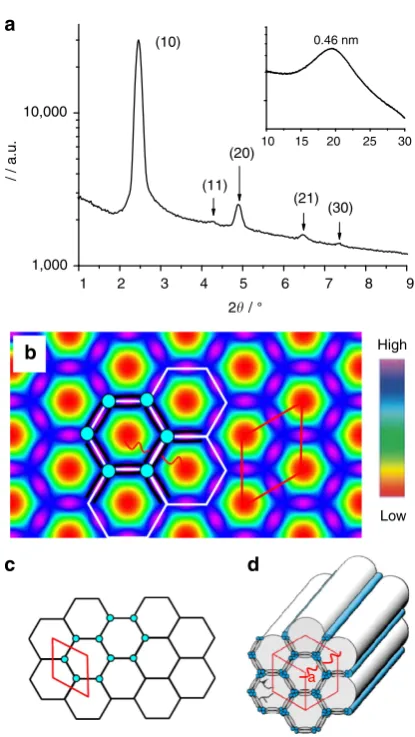
[image:2.595.336.521.639.703.2]Hexagonal honeycombs. For compounds 20/0 with a linear chain and 16/4 having the branching point closest to one end of the alkyl chain, the 1/d values of the small angle Bragg reflections are in the ratio 1:pffiffiffi3:2:pffiffiffi7:3, in line with a hexagonal lattice with ahex¼4.2 nm (Fig. 3a). In both cases, these correspond to ahex¼pffiffiffi3Lmol, with Lmol being the length of the rod-like core unit between the ends of the glycerol groups in the most extended conformation (Lmol¼2.45 nm). This d/Lmol ratio is indicative of a regular hexagonal honeycomb involving
six molecules in the circumference of each hexagonal
channel (Colhex1, Fig. 3c,d)9,10. The reconstructed electron density map (Fig. 3b) confirms this structure and shows a
high electron density net (purple) representing the
hexagonally arranged aromatic-glycerol walls surrounding the low-electron-density cells (red/yellow) containing the lateral alkyl chains. The fact that the molecules are aligned transverse to the channels is confirmed by the negative birefringence (see Supplementary Fig. 2a). As typical for LC honeycombs of molecules with only one lateral group, the walls are formed by back-to-back organized pairs of molecules (Fig. 3b,d, see also Supplementary Table 6 and Supplementary Note 4).
Hexagonal superlattice of compound14/6. For compound14/6, with a reduced difference between branches mand n, the small angle reflections between B130 and 145°C can be indexed as (11), (21), (30), (22), (31), (32), (50), (33) and (51) of a hexagonal lattice. Interestingly, the (10) and (20) reflections are very weak or completely missing (Fig. 4a), which indicates a structure sig-nificantly different from that of Colhex1. Here, the hexagonal lattice parameter ahex¼9.72 nm corresponds to about 4Lmol; therefore, a simple hexagonal honeycomb as in20/0and16/4can be excluded. The electron density map (Fig. 4b) of this Colhex2 structure indicates the presence of a more complex superlattice. There are small regular hexagons with low-density alkyl centres (red), each surrounded by six giant hexagons with threefold symmetry and alternating side lengths, corresponding toLmoland 2Lmol, respectively (Fig. 4b–d). These latter hexagons, containing nine molecules in their circumference (9-hexagons, indicated by solid white lines in Fig. 4b), are further divided into triplets of pentagons (dotted lines). However, the pentagonal cells within the 9-hexagons appear to be poorly ordered, as the electron-density difference between their walls and their cell interior is reduced (green/blue). This suggests some structural disorder, which is likely to result from the extended (1.17-fold) length of those inner walls compared with the outer walls of the 9-hexagon (see Supplementary Note 3). This mismatch and the overcrowding of the pentagonal channels by the alkyl chains may be responsible for the disorder inside the 9-hexagons, which could provide an entropic advantage for this structure (see Fig. 4b,d).
Zeolite-like LC with c2mm-lattice. The soft, self-assembled superstructure formed by compounds10/10and12/8having two branches with equal or similar length is very different from those
Table 1 | Transition temperatures (T/°C), corresponding enthalpy values (DH/kJ mol1) and lattice parameters (a,b/nm) of compoundsm/n*.
Compouds m n Phase transitions a,b Channel cross-sections
20/0 20 0 Cr 35 [35.1] Colhex1/p6mm185 [6.7] Iso ahex¼4.2 nm Hexagons
16/4 16 4 Cr 43 [6.7] Colhex1/p6mm144 [4.5] Iso ahex¼4.2 nm Hexagons
14/6 14 6 Cr 53 [7.3] M1B130 [o0.01] Colhex2/p6mm145 [4.0] Iso ahex¼9.7 nm Pentagonsþhexagons
12/8 12 8 Cr172 [7.1] Cr294 [6.9] Colrec/c2mm146 [4.2] Iso a¼6.2 nmb¼15.5 nm Pentagonsþoctagons
10/10 10 10 Cr 75 [7.1] Colrec/c2mm147 [4.5] Iso a¼6.4 nmb¼16.1 nm Pentagonsþoctagons
Cr, crystalline solid; Iso, isotropic liquid; M1, unknown liquid crystal; Colhex1, Colhex2, Colrec, columnar liquid crystal with hexagonal and rectangular two-dimensional lattice, respectively.
For differential scanning calorimetry traces, see Supplementary Fig. 1; for tables with X-ray diffraction data, see Supplementary Tables 1–5. *First heating at 10 K min1, peak temperatures were used; transition enthalpies in square brackets.
10,000
1,000
1 2 3 4 5 6 7 8 9
/ / a.u.
(10)
(20)
(21) (30) (11)
10 15 20 25 30 0.46 nm
2 /°
High
Low
a a
b
[image:3.595.323.531.201.570.2]c d
Figure 3 | Hexagonal honeycomb.(a) 2yscan of the small-angle X-ray
of all other compounds. The small-angle X-ray scattering (SAXS) patterns show numerous Bragg reflections, which can be indexed on a rectangular c2mm lattice (conditions hk: hþk¼2n: h0: h¼2nandk0:k¼2n, see Fig. 5a and Supplementary Figs. 6 and 7). The 2D electron density map of10/10(Fig. 5b) shows high-density dots (purple/blue) located in the centre and at the corners of the unit cell. Each is enclosed between two low-density cres-cents (red/yellow). Within the medium density continuum (green) there are additional low-density dots (red) arranged along wavy lines. These are partly surrounded by lines of highest density (blue), assigned to the glycerol groups and terphenyl cores. Superimposed on the map in Fig. 5b is the proposed arrangements of honeycomb walls (white), as are a few schematic molecules (black lines and blue dots). Accordingly, antiparallel pentagonal channels fuse to form layers. Each pentagonal channel is filled with low-density alkyl chains. The space between these layers is divided by additional walls into octagonal cells. With planar alignment (channels parallel to the substrate), two orien-tations are observed in the grazing incidence SAXS (GISAXS) patterns, having either the {100} or the {110} planes horizontal
1,600 1,400 1,200 1,000
800
600
400
200
1 2 3 4 5 6 7
2 /°
/ / a.u.
0.46 nm
High
Low (11)
(21)
(22) (30)
(31)
(32) (33) (50)
(51)
10 15 20 25 30
ahex = 4Lmol
a
b
[image:4.595.325.528.49.514.2]c d
Figure 4 | Hexagonal superlattice.(a) 2yScan of the X-ray diffraction
(XRD) pattern of the Colhex2structure of14/6atT¼135°C, (b) the corresponding electron density map, (c) the net-representation and (d) a three-dimensional model showing the molecular organization in the hexagonal superlattice formed by hexagonal and distorted pentagonal channels; see Supplementary Table 4 for tabular XRD data; Supplementary Fig. 9 shows alternative electron density maps based on other phase combinations and the phase choice is explained in Supplementary Note 1; Supplementary Table 6 gives the estimation of the number of molecules in the unit cell and honeycomb walls, which are explained in more detail in the Supplementary Notes 3 and 4.
(12 0)
(10 0)
(80)
(91) (82)
(93)
(53)
(33) (62)
(42)
(22)
(02) (71)
(51)
(31)
(11) (60)
(40)
(20)
High
Low
Colhex1 Colhex2 c2mm
a
b
a
b
c d
e f
g
h
[image:4.595.71.261.50.390.2]O
Figure 5 | Zeolite-like organization of compounds 12/8 and 10/10 with
c2mmlattice.(a) GISAXS pattern of10/10atT¼90°C with indices;
(b) electron density map of10/10with colour scale, tiling pattern (white lines) and molecular arrangement (black lines and blue dots) are superimposed; (c) contact region between the low-birefringencec2mm
phase of12/8(left) and the high-birefringence Colhex1phase of compound
16/4(right) with induced Colhex2phase between them atT¼136°C (see also Supplementary Fig. 3); (d) texture as observed for12/8at 140°C between crossed polarizers withl-retarder plate; the indicatrix orientation is shown in the inset (see also Supplementary Fig. 2c,d and explanations in the corresponding caption); (e) molecular model showing eight molecules of
10/10forming the walls of the octagonal cells; (f) the empty space being
(see Fig. 6). This allows maximum contact between the polar groups and the horizontal polar substrate, with minimum lattice distortion20, thus further supporting the proposed nanostructure. The high electron density in the centres of the octagonal cells indicates that the space in these giant channels contains additional molecules with the aromatic cores and glycerol units in the centre. In principle, there are two possible alignments of the additional molecules, either perpendicular or parallel to the channels (Fig. 5g, h). In the first case, quasi-infinite ribbons of transverse-oriented pairs of molecules arranged side-by-side run along the channels (Fig. 5g). In the second case, bundles of axially oriented molecules, about 7–11 in cross-section, stack end-to-end along the columns (see Fig. 5h, Supplementary Table 6 and explanations in Supplementary Note 4).
To distinguish these two cases, optical investigations were performed between crossed polarizers. All honeycombs show birefringent fan-like ‘developable domains’ as typical for fluid superstructures with a 2D lattice21. In the fans, the channels are parallel or nearly parallel to the substrate and circle around the central defect. Figure 5c shows the textures of all three LC structures in a sample with constant thickness, the hexagonal honeycomb of 16/4(Colhex1) on the left and the zeolitic c2mm structure of12/8on the right. In the contact region in the middle, where both compounds mix, the pentagon/hexagon tiling of the intermediate Colhex2phase develops, the same phase as observed in compound 14/6. The film thickness is such that in all areas first-order birefringence colours are seen. There is a distinct shift in colour of the fans from red/orange to yellow as one moves from the Colhex1and Colhex2to thec2mm. This implies reduced retardation, hence reduced birefringence of the zeolite-likec2mm structure, meaning that the positive contribution of the terphenyls in the centre of the octagonal channels is partially cancelling the negative contribution from the terphenyls in the honeycomb walls. Had all terphenyls been perpendicular to the channel axis, the absolute value of birefringence would not have been reduced.
Using an additional l-retarder plate the direction of the intramolecular p-conjugation pathway with respect to the cylinder axis can be identified. As shown in Fig. 5d and Supplementary Fig. 2 the orientation of the blue-shifted fans is south-west to north-east, where the columns, being normal to the
fans, lie southeast to northwest. The blue colour means that the slow axis is oriented south-west to north-east for all compounds m/n, that is, it is perpendicular to the axis of the cylinders. Hence, the birefringence is negative, with the average orientation of the terphenyl cores perpendicular to the channels, in line with the proposed honeycomb structures. For some rays in the fans of thec2mmphase, the birefringence is virtually zero (red), even at 45°orientation to the polarizers (Fig. 5d), indicating that in this projection the contributions to birefringence of the transverse and axial molecules cancel almost exactly (see also Supplementary Fig. 2 and caption for more details).
Discussion
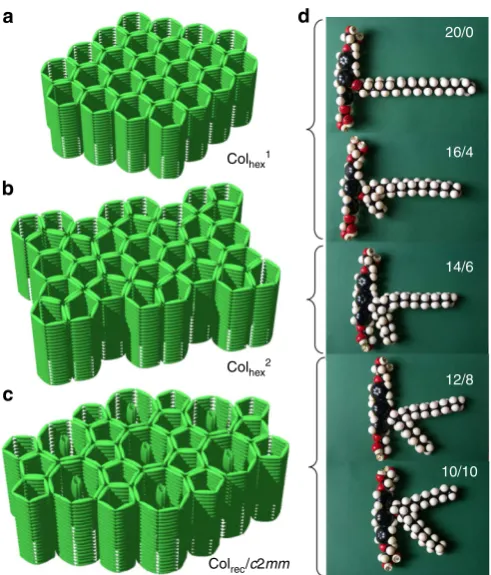
Overall, the complex self-assembly achieved in this series of isomeric compounds arises from the decreasing effective chain length at constant chain volume (Fig. 7). The simple hexagonal honeycomb (Fig. 7a), observed for 20/0 and 16/4 is the intrinsically preferred structure based on the ratio of side-chain volume to rod length. Although for all compoundsm/nthe length of the side chains is sufficient to reach the centre of the hexagonal channel, increasing chain stretching required for the shorter chains becomes entropically unfavoured. Replacing hexagonal by the smaller pentagonal channels allows the chains to retain high disorder (see Supplementary Note 3), but at the expense of stretching two sides of the pentagons and thus breaking some hydrogen bonds at the apices (Fig. 4d). The remaining hexagons in the complex Colhex2 structure of14/6are believed to serve to partially relieve the frustration of pentagonal packing of a Euclidean plane (Figs 4b and 7b). In the same manner, insertion of hexagons is required in a pentagonally tiled spherical surface as the sphere radius increases (as, for example, in the case of
[image:5.595.305.551.392.680.2] [image:5.595.47.282.491.682.2](11) (10)
Figure 6 | Different orientations of thec2mmlatitice of 10/10.GISAXS
pattern of the Colrec/c2mmphase of10/10atT¼90°C, showing the two orientations (10) and (11) together with electron density maps oriented to lie on a {100} and {110} plane, respectively; the thick black lines show the contact plane.
Colhex1
Colhex2
Colrec/c2mm
20/0
14/6 16/4
12/8
10/10
a d
b
c
Figure 7 | Development of supramolecular organization depending on
chain branching.(a–c) Models showing the organization of the aromatic
fullerenes). It is worth noting that interesting tiling patterns, including quasiperiodic, have been observed with molecules13,22 and colloidal particles14,15,23of a pentagonal symmetry.
Unlike compounds20/0,16/4and14/6, the two compounds10/ 10 and 12/8 with shortest chains cannot form the hexagonal channels any more and only layers of fused pentagonal channels remain, thus allowing more chains to be expelled from the tight pentagonal cylinders24,25. These layers fuse with the formation of octagonal channels. The unreachable void in the centre of the octagonal channel (Fig. 5e) is filled with an additional column consisting of concatenated bundles of rods aligned along the cylinder axis (Fig. 5f,h). The resulting tiling patterns of the LC honeycomb resembles that of inorganic zeolites with the framework-type BIK26 in projection viewed along [001] and known, for example, in the alumosilicatebikitaite27. Furthermore, it represents a unique combination of a honeycomb forming the framework10,11and its inverse, the columnar rod-bundle phase28, filling the centre of the cells. As the orientations of the molecules in the framework and in the bundles are orthogonal, an unprecedented soft-matter structure is obtained, where for the first time identicalp-conjugated rods are aligned parallel as well as perpendicular to the director. This new principle may allow tuning of optical anisotropy and other anisotropic properties29–31. It is conceivable, for example, that such structures could be used in sensors or chemical actuators, where a small lattice expansion
induced by selected guest species could trigger a transition such as Colhex22Colrec/c2mm, thereby significantly changing properties such as electric permittivity or magnetic permeability.
This work demonstrates that rational design of polyphilic
p-conjugated molecules can lead to the emergence of
well-ordered nanostructured fluids with reduced symmetry and unparalleled complexity. In comparison, dynamic equilibrium states also determine the type of evolving solid-state structures during solvothermal synthesis of MOFs, COFs and zeolitic materials, often aided by structure-directing agents32,33. Thus, the knowledge of the basic principles of dynamic self-assembly into complex superstructures gained here should also be beneficial for the rational design of these solid-state materials.
Methods
Syntheses.All compounds were synthesized in-house according to the synthetic
procedure shown in Fig. 8. Details of the experimental procedures and the analytical data of compoundsm/nare given in the accompanying Supplementary Methods34.
Optical and calorimetric investigations.Phase transitions were determined by
polarizing microscopy (Leica DMR XP) in conjunction with a heating stage (FP 82 HT, Mettler) and controller (FP 90, Mettler), and by DSC (DSC-7, Perkin Elmer) at heating/cooling rates of 10 K min1(peak temperatures). Optical investigation was carried out under equilibrium conditions between glass slides, which were used without further treatment; sample thickness wasB15mm. A full-wavelength retardation plate was used to determine the sign of birefringence.
X-ray diffraction.X-ray investigations were carried out using Ni-filtered CuKa
radiation (15–30 min exposure time). Aligned samples were obtained on a glass plate. Alignment was achieved on slow cooling (rate: 1–0.01 K min1) of a small droplet of the sample. Alignment is effected at the sample–glass or at the sample–air interface, with domains fibre-like disordered around an axis perpen-dicular to the interface. The aligned samples were held on a temperature-controlled heating stage and the diffraction patterns were recorded with a 2D detector (Vantec 500, Bruker). High-resolution small-angle powder diffraction experiments were done at beamline I22 at Diamond Light Source. Samples in 1 mm thin-walled borosilicate glass capillaries were held in a modified Linkam hot stage with a cylindrical hole drilled through the silver heating block, the sample area being closed by mica windows at the front and back. A MarCCD 165 detector was used and the sample-to-detector distance was 1.3 m. Samples for GISAX were prepared by melt casting thin films on silicon substrate surface. The films were heated to isotropic liquid in vacuum oven and then slowly cooled. GISAXS measurements were done at Station I16 at Diamond Light Source (U.K.).
Electron density reconstruction.Fourier reconstruction of the electron density
was carried out using the general formula for 2D periodic systems:
rð Þ ¼xy X
hk
FðhkÞexp 2½ pi hxð þkyÞ ¼X
hk
ffiffiffiffiffiffiffiffiffiffiffi
IðhkÞ p
exp 2½ pi hxð þkyÞ þifð Þhk
Here,f(hkl) is the phase of the (hkl) reflection andIthe corrected intensity. For centrosymmetric structures considered in this work, the phase anglefcan only take up the values of 0 orp. The choice of phase combination was made on the merit of each reconstructed electron density map obtained using the reflections of strong or medium intensity, as indicated in the Supplementary Tables 3–5. Additional knowledge of the molecules (molecular shape, length, volume of each part and the distribution of electron density among the different moieties) was used in the choice of phase, as explained in the Supplementary Notes 1 and 2, see also Supplementary Figs 8–10.
References
1. Davis, M. E. Ordered porous materials for emerging applications.Nature417, 813–821 (2002).
2. Wang, Z., Yu, J. & Xu, R. Needs and trends in rational synthesis of zeolitic materials.Chem. Soc. Rev.41,1729–1741 (2012).
3. Yaghi, O. M. Reticular synthesis and the design of new materials.Nature423, 705–714 (2003).
4. Cote, A. P.et al.Porous, crystalline, covalent organic frameworks.Science310, 1166–1170 (2005).
5. Feng, X., Ding, X. & Jiang, D. Covalent organic frameworks.Chem. Soc. Rev.
41,6010–6022 (2012).
6. Dogru, M. & Bein, T. On the road towards electroactive covalent organic frameworks.Chem. Commun.50,5531–5546 (2014).
O O
OH
O O OH
OH OH
HO O
O O
O
O O
O O
O O
O Br
CnH2n+1
CnH2n+1
CnH2n+1 H2n+1Cn
H2m+1Cm
H2m+1Cm 2a–e
1
Am/n
O m/n
iii
iv
Br Br
OAc O
O O (HO)2B
i,ii
2 equ.
m= 20, n= 0: 2a, 20/0
m= 16, n= 4: 2b, 16/4
m= 14, n= 6: 2c, 14/6
m= 12, n= 8: 2d, 12/8
[image:6.595.51.285.49.385.2]m= 10, n= 10: 2e, 10/10
Figure 8 | Synthesis of compoundsm/n.Reagents and conditions: (i)
7. Xiang, Z., Cao, D. & Dai, L. Well-defined two dimensional covalent organic polymers: rational design, controlled synthesises and potential applications.
Polym. Chem.6,1896–1911 (2015).
8. Tayi, A. S., Kaeser, A., Matsumotzo, M., Aida, T. & Stupp, S. Supramolecular ferroelectrics.Nat. Chem.7,281–294 (2015).
9. Tschierske, C. Development of structural complexity by liquid crystal self-assembly.Angew. Chem. Int. Ed.52,8828–8878 (2013).
10. Tschierske, C. Liquid crystal engineering—New complex mesophase structures and their relations to polymer morphologies, nanoscale patterning and crystal engineering.Chem. Soc. Rev.36,1930–1970 (2007).
11. Tschierske, C.et al.Complex tiling patterns in liquid crystals.Interface Focus2, 669–680 (2012).
12. Elemans, J. A., Lei, S. & De Feyter, S. Molecular and supramolecular networks on surfaces: from two-dimensional crystal engineering to reactivity.Angew. Chem. Int. Ed.48,7298–7332 (2009).
13. Ecija, D.et al.Five-vertex Archimedean surface tessellation by lanthanide-directed molecular self-assembly.Proc. Natl Acad. Sci. USA110,6678–6681 (2013). 14. Lapointe, C. P., Mason, T. G. & Smalyukh, I. I. Shape-controlled colloidal
interactions in nematic liquid crystals.Science326,1083–1086 (2009). 15. Dontabhaktuni, J., Ravnik, M. & Zˇumer, S. Quasicrystalline tilings with nematic
colloidal platelets.Proc. Natl Acad. Sci. USA111,2464–2469 (2014). 16. Glettner, B.et al.Liquid crystalline kagome.Angew. Chem. Int. Ed.47,
9063–9066 (2008).
17. Zeng, X. B.et al.Complex tilings and critical phenomena in tetraphilic liquid crystals.Science331,1302–1306 (2011).
18. Liu, F.et al.Arrays of giant octagonal and square cylinders by liquid crystalline self-assembly of X-shaped polyphilic molecules.Nat. Commun.3,1104 (2012). 19. Chen, B., Zeng, X. B., Baumeister, U., Ungar, G. & Tschierske, C. Liquid crystals composed of pentagonal, square and triangular columns.Science307,96–99 (2005).
20. Ungar, G.et al.GISAXS in the study of supramolecular and hybrid liquid crystals.J. Phys. Conf. Ser.247,012032 (2010).
21. Kleman, M. Developable domains in hexagonal liquid crystals.J. Phys. France
41,737–745 (1980).
22. Wasio, N. A.et al.Self-assembly of hydrogen-bonded two-dimensional quasicrystals.Nature507,86–89 (2014).
23. Senyuk, B., Liu, Q., Bililign, E., Nystrom, P. D. & Smalyukh, I. I. Geometry-guided colloidal interactions and self-tiling of elastic dipoles formed by truncated pyramid particles in liquid crystals.Phys. Rev. E91,040501(R) (2015). 24. Ren, C. F.et al.Crystallographic realization of the mathematically predicted
densest all-pentagon packing lattice by C5 symmetric ‘sticky’ fluoropentamers.
Angew. Chem. Int Ed.50,10612 (2011).
25. Liu, J.et al.Structural transformation of two-dimensional metal-organic coordination networks driven by intrinsic in-plane compression.J. Am. Chem. Soc.133,18760–18766 (2011).
26. Baerlocher, Ch., McCusker, L. B. & Olson, D. H. inAtlas of Zeolite Framework Types 6th edn. (Elsevier, Amsterdam, 2007).
27. Kooman, V., Gait, R. I. & Rucklidge, J. The crystal structure of Bikitaite, Li[AlSi2O6]. H2O.Am. Mineral.59,71–78 (1974).
28. Prehm, M., Liu, F., Zeng, X., Ungar, G. & Tschierske, C. Axial-bundle phases – new modes of 2D, 3D, and helical columnar self-assembly in liquid crystalline phases of bolaamphiphiles with swallow tail lateral substituents.J. Am. Chem. Soc.133,4906–4916 (2011).
29. Kato, T. Self-assembly of phase-segregated liquid crystal structures.Science295, 2414–2418 (2002).
30. Lagerwall, J. P. F. & Scalia, G. A new era for liquid crystal research: applications of liquid crystals in soft matter nano-, bio- and microtechnology.Curr. Appl. Phys.12,1387–1412 (2012).
31. Fleischmann, E. K. & Zentel, R. Liquid-crystalline ordering as a concept in materials science: From semiconductors to stimuli-responsive devices.Angew. Chem. Int. Ed.52,8810–8827 (2013).
32. Wang, Z., Yu, J. & Xu, R. Neds and trends in rational synthesis of zeolitic materials.Chem. Soc. Rev.41,1729–1741 (2012).
33. Moliner, M., Rey, F. & Corma, A. Towards the rational design of efficient organic structure directing agents for zeolite synthesis.Angew. Chem. Int. Ed.
52,13880–13889 (2013).
34. Ko¨lbel, M., Beyersdorff, T., Tschierske, C., Diele, S. & Kain, J. Thermotropic and lyotropic liquid crystalline phases of rigid aromatic amphiphiles.Chem. Eur. J.6,3821–3837 (2000).
Acknowledgements
Financial support is acknowledged from the DFG (FOR 1145, Grand Ts 39/21-2), the government of Saxonia-Anhalt through the Cluster of Excellence ‘Nanostructured Materials’, the joint NSF-EPSRC PIRE project ‘RENEW’ (EPSRC EP_K034308), the Leverhulme Foundation (RPG-2012-804) and, for GU, the ‘1000 Talents’ programme of the Government of China. For help with X-ray synchrotron experiments we thank Dr G. Nisbet and Professor S. Collins of I16 and Professor N. Terrill of I22 at Diamond Light Source.
Author contributions
S.P., A.L. and A.S. synthesized and purified the materials, and performed optical and DSC investigations. M.P. and X.Z. performed X-ray diffraction and electron density calculations, and interpreted the results. G.U. and C.T. supervised the work and have written the manuscript. All authors discussed the results and commented on the manuscript.
Additional information
Supplementary Informationaccompanies this paper at http://www.nature.com/ naturecommunications
Competing financial interests:The authors declare no competing financial interests.
Reprints and permissioninformation is available online at http://npg.nature.com/ reprintsandpermissions/
How to cite this article:Poppe, S.et al.Zeolite-like liquid crystals.Nat. Commun.6:8637 doi: 10.1038/ncomms9637 (2015).