DOCUMENT
THE TOURISM SECTOR IN THE
COMMUNITY
A study of concentration, competition and
competitiveness
This document has been prepared for use within the Commission. It does not necessarily represent the Commission's official position.
Cataloguing data can be found at the end of this publication
Luxembourg: Office for Official Publications of the European Communities, 1S85
ISBN: 92-825-5276-4
Commission of the European Communities
THE TOURISM SECTOR IN THE COMMUNITY
A Study of Concentration Competition and Competitiveness
Research Group : TEPRO Prof. S. Casini Prof. R. Varaldo
Dr. P. Masetti . Dr. G. DaLl'Ara
P R E F A C E
The present voluæe is part of s series of sectoral studies on the evolution of concentration in the seaber states of the European Community.
These reports were compiled by the different national Institutes and experts, engaged by the Cosaission to effect the study programme in question.
Regarding the specific and general interest of these reports and the repcsibility taken by the Commission with respect to the European Parliament, they are published wholly in the original version.
The Commission refrains fro» consenting, only stating that the çesponsibility for the data and opinions appearing in the reports, rests solely with the Institute or the espert who is the author.
INDEX
page
Chapter One: ANALYSIS OF THE BASIC CHARACTERISTICS OF THE TOURISM INDUSTRY
1.1. Economic Significance of Tourism in the EEC in Single Countries, and by Type of
Tourism — International and Domestic . . . .
1.2. The Impact of Tourism on Balance of Payments . . . . 17
1.3. Characteristics and Effects ,
of Tourism on Labour Market 24
Chapter Two: CHARACTERISTICS OF STRUCTURES
AND SUPPLIERS OF TOURISM 27
2.1. Concentration of Supply and of Hospitality Structures in the EEC
and in Individual Countries 31
2.2. Concentration of Principal Suppliers
and Types of Hospitality 48
2.3. Geographic Concentration 58
Chapter Three: COMPETITION 79
3.1. The Influence of Suppliers and
Hospitality Industry on Competition 79
Chapter Four: COMPETITIVENESS 107
4.1. Principal Trends and Evolution of Hospitality . . . . 107
4.2. Competitiveness Through the Price
of Holidays and Some Goods 144
4.3. Evolution of the Market 146
SUMMARY 153
C h a s t e r One
ANALYSIS OF THE BASIC CHARACTERISTICS OF THE TOURIST INDUSTRY
1.1. Economic Significance of Tourism in the EEC, in Single Countries, and by Type of Tourism — International and Domestic
Table 1
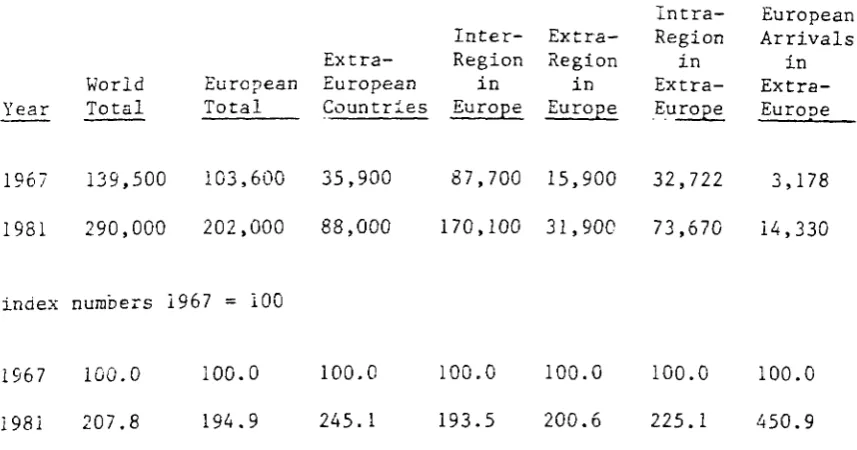
International Tourism - Arrivals
(000)
Intra- European Inter- Extra- Region Arrivals Extra- Region Region in in World European European in in Extra-Year Total Total Countries Europe Europe Europe Europe
1967 139,500 103,600 35,900 87,700 15,900 32,722 3,178
1981 290,000 202,000 88,000 170,100 31,900 73,670 14,330
index numbers 1967 = 100
1967 100.0 100.0 100.0 100.0 100.0 100.0 100.0
1981 207.8 194.9 245.1 193.5 200.6 225.1 450.9
(our elaboration of WTO data)
intra-regional tourism: tourist flow between the various countries of the same continent
In the last fifteen y e a r s the volume of travel for tourism has all but t r i p l e d , while the international component has doubled: the access to tourism of those social classes with lower incomes and spending power concerns n e a r e r destinations, just a s , from 1974 o n w a r d s , the notable increase in t r a n s p o r t costs has negatively influenced long distance t r a v e l .
The data show t h a t :
It is possible to speak of a 'boom' in national tourism, even if in some European countries (especially Great Britain
(GB), the N e t h e r l a n d s , the Federal Republic of Germany (FRG), Switzerland e t c . ) the tendency to travel abroad in the last ten y e a r s has overtaken that of spending holidays in the r e s p e c t i v e home c o u n t r i e s . The p r e f e r r e d areas are the Mediterranean, the American continent, Africa, Eastern Asia and the Pacific.
While the European continent - - already mature from a tourist angle — has seen a new increase and doubled international tourist a r r i v a l s , the remaining countries in the world also appear on the s c e n e , r e c o r d i n g more consistent i n c r e a s e s of 2 . 5 . (See Table 1)
Again concerning the 1967-81 period in Europe the increase in foreign a r r i v a l s r e g i s t e r e d in all the continental countries indicates a 'parallelism' between the i n t r a - r e g i o n a l compo-nent and that of e x t r a - E u r o p e a n o r i g i n s , both increasing by about 100%. (See Table 1)
a) More ihan half of the population takes a period of holidays and leisure every year and Europe alone r e p r e s e n t s 50 p e r c e n t of world tourist arrivals and d e p a r t u r e s .
b) European incomes are h i g h e r than the incomes of many countries of the world, t h e r e is a generalised system of paid leave, flexible frontier controls, protection of t o u r i s t s and a tendency ίο develop tourism by many g o v e r n m e n t s . c) There is a large quantity of employment in the tourist field
and hospitality i n d u s t r y .
d) Natural and historical r e s o u r c e s .
The world total (again national -*- international tourism) has been estimated by the OMT, for 1981, at about 2.323 million a r r i v a l s .
That European tourism is a phenomenon that can be p u t down almost entirely to the mobility of the Europeans can be shown by the following data:
1) The incidence of national tourism in this area is v e r y high — about 85% of the entire traffic;
2) International a r r i v a l s , coming from within the region ( i . e . from other European States) r e p r e s e n t in Europe 83% of the total.
"Arrivals of International Tourism" means the number of people who have visited or spent their holidays in a country other than the one in which they live. In g e n e r a l , the statistics of the various c o u n t r i e s , u n d e r this h e a d i n g , do not include people on day t r i p s , that i s : those who do not book and whose stay is less than 24 h o u r s . While they do include, together with normal a r r i v a l s , those who may be staying for one night only before going on to the country in which they intend to spend their holidays (take for example countries like Ireland and Greece which, in this context, can be considered as 'final destinations' and therefore in the total number of arrivals r e g i s t e r e d , those 'in t r a n s i t ' r e p r e s e n t a smaller p e r c e n t a g e ) .
If, to these f a c t o r s , we add the diversity in the ways of p r e s e n t i n g 'information' and the difficulty in g a t h e r i n g together e v e r y -thing concerning tourism, it is clearly advisable to treat with caution the available data and use it as an indication r a t h e r than a t r u e mea-s u r e of the actual mea-situation.
In the p r e s e n t work, the majority of the comparative statistics have been set against data relating to 1967. A comparison with more r e c e n t y e a r s would not have indicated the major developments in the international tourist movement of these last five y e a r s , the great transformation in the way holidays are t a k e n , and the strategic role of the tour o p e r a t o r s which had developed by 1967.
costs, beginning in 1974 with the petrol c r i s i s . Worldwide the growth has been u n i n t e r r u p t e d :
From a world total of 76 million international tourist arrivals in 1961, the figure increased to 290 million in 1981, with an annual average rise of about 7.5% (based on WTO estimate). This is the case even if the highest p e r c e n t a g e increase took place between 1960 and 1970 (+ 14,2 and + 16.1 respectively in 1963 and 1964, and + 13.2 and + 1 0 . 3 , compared to the p r e v i -ous y e a r s , in 1966 and 1969).
The desire for holidays, r e c o r d s a continual increase among the Euro-pean populations and is documented not only by official data on tourist traffic, but also by the 'national investigations into home country citizens' holidays, carried out in most European countries from the beginning of the 1960s.
These sample investigations have shed light on a n o t h e r consis-tent phenomenon, which developed in the 1970s — the taking of "more than one" holiday a y e a r , by millions of people. This is due to an increase in the practice of tourism (in general) and the splitting up of holidays into more than one season.
But the great and in many ways explosive rise in national and international tourism has not p r e v e n t e d critical situations in the hotel s e c t o r s of some EEC countries in some cases the number of b u s i -n e s s e s has d r o p p e d , as has the -number of b e d s .
Three great changes have contributed to these negative a s p e c t s in the hotel sector of some European areas and have been p a r t i c -ularly influential in the last twenty y e a r s :
— for some y e a r s now — have been offering more and more space to a p a r t m e n t s , to r e n t e d h o u s e s , to villas, to r e s i -dences and to h o u s e / h o t e l s .
b) The development of new tourist a r e a s , outside the EEC, with lower price levels than the EEC a v e r a g e , and less tourist s a t u r a t i o n .
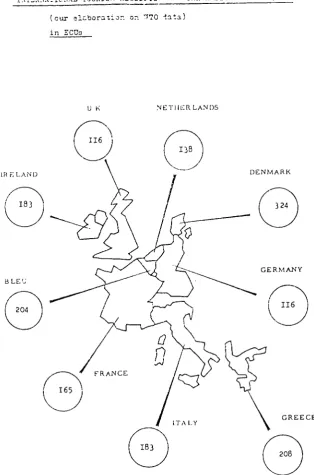
Figure 1
I N T E R N A T I O N A L î c i r a i s r « R E C E I P T S r r a Η Λ 3 Ι ? Α Γ : Τ : ; Ε Ο 1 9 6 2 ( c u r e l a b o r a i i o r . on '.ïTO l a t a )
i n ECDa
NETHERLANDS
IR ELAND DENMARK
GREECE
The desire to spend holidays abroad is highest among the Dutch population, followed by the Germans and Danes. Among the non EEC countries the Swiss data is i n t e r e s t i n g : nearly 70% foreign s t a y s for every 100 i n h a b i t a n t s . In s h o r t , within the main countries that g e n e r -ate international tourism the demand for holidays abroad has grown at a higher r a t e than home tourism, even if Belgium and above all F r a n c e ' s r a t e of increase of national tourism is higher than the i n t e r -national i n c r e a s e , which nonetheless is still positive.
There i s , in any case, a correlation between "family income" and travelling a b r o a d . An estimation r e p o r t e d by Prof. B u r k a r t on "The Management of Tourism" s a y s : "every one p e r c e n t increase of income, t r i g g e r s a 2.2 p e r c e n t increase in the number of t r i p s . More income means more foreign t r i p s " .
The Centrality of Europe and the 'Retreat' of the EEC
The flow of tourism abroad g e n e r a t e d by European countries as a whole continues to favour European destinations even if t h e r e has been a net increase in e x t r a continental t r a v e l . However these countries still only r e p r e s e n t a minority of the total of foreign travel done by E u r o p e a n s :
3.4% of the total flow in 1967 (equal to 3,178 million a r r i v a l s ) 9.4% of the total flow in 1981 (equal to 14,330 million a r r i v a l s )
However these figures do allow us to note a tendency for the future — a fundamental role, as far as European demand is concerned, in the extra European holiday market.
But the centrality of Europe, concerning international tourism, has p e r s i s t e d t h r o u g h the y e a r s . Within Europe t h e r e is in p r o g r e s s a redistribution of tourist demand that has favoured areas outside the EEC, with the exception of Great Britain and Greece, and that on the whole sees the EEC r e c o r d i n c r e a s e s below those of the remaining European c o u n t r i e s .
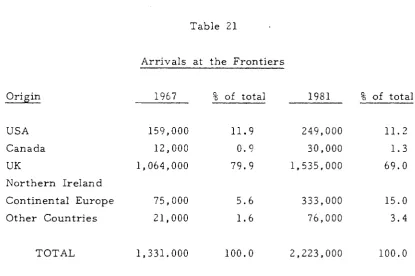
An assessment of the t r e n d s of international tourism within the EEC is based on such diversity of data from the various countries that its value can only be indicative. Nevertheless the great increase in the amount of international tourism r e g i s t e r e d by Greece and Great Britain should be considered as highly significant, an increase r e s p e c -tively of 500% and 167.8% in the period between 1967 and 1981. For Greece and Britain the information is based on statistics r e g i s t e r e d at the frontier; however the criteria have been slightly modified.
On the other hand the countries which p r e s e n t the lowest r a t e of development, in the period 1967-1981, are Belgium, Luxembourg and Denmark. For Belgium and Denmark a comparison can only be made using data relative to the bookings r e g i s t e r e d by the receiving o r -ganisation: + 9.6% for Belgium and + 22.7% for Denmark. For Luxem-bourg the p e r c e n t a g e increase is 19.2 based on total a r r i v a l s in hotel accommodation in 1981 as compared with 1967.,
countries like F r a n c e , Ireland and the Low Countries r e p r e s e n t similar v a l u e s .
Under countries showing a increase of 40% we find the German Federal Republic and Italy with 42.7% and 46.1% r e s p e c t i v e l y . In these countries the most reliable information concerns the n u m b e r s of a r -rivals r e g i s t e r e d by the receiving o r g a n i s a t i o n s .
1.2 The Impact of Tourism on Balance of Payments
The Effect of Tourism on the Community's and the Individual EEC Countries'
Balance of Payments
An analysis of the economic effects caused by tourism is made difficult by the serious lack of statistical evidence. Because of this the depth of our e n q u i r y into this sector is necessarily limited. However the tendencies which have emerged are still i n t e r e s t i n g . It is clear, above all, that the EEC would stand to gain a great deal (in terms of its Balance of Payments) if Spain joined the Community. In fact, the tourist deficit is mostly caused by tourist traffic towards Spain.
The total e x p e n d i t u r e of EEC r e s i d e n t s (1981 figures — EEC estimate) for tourism amounted to 100 billion ECUs a y e a r . This figure r e p r e s e n t s about 7% of the citizens' total e x p e n d i t u r e for 'private consumption'; it is to be expected t h a t this figure will be valid for future y e a r s .
On the other h a n d , EEC income from tourism amounts to 90 billion ECUs and so the deficit is about 10 billion ECUs. Community income from tourism is t h u s divided:
30 billion ECUs from intra-community and extra-community (international t o u r i s m ) ;
60 billion ECUs from domestic tourist traffic.
As far as development t r e n d s are c o n c e r n e d , for income it has been estimated that between 1972 and 1982 the real income and real e x p e n d i t u r e for tourism rose 1.5 times. In p a r t i c u l a r the quotas of tourist income from extra-community countries (quote of international tourism) rose in the same period by 25%.
The EEC quota of international tourism is not influenced solely by US tourism; it seems, in fact, that the g r e a t e s t income is from non-American tourist s o u r c e s . Recently substantial tendencies have emerged indicating a growth in tourism from Japan and Asia. If these tendencies were to be confirmed for the EEC, t h e r e would follow v e r y positive effects. Europe's historical, cultural and commercial attraction for the East could positively influence the development of international tourism in the next decade.
Tourist traffic within the EEC has marked effects on the Balance of Payments of the individual EEC countries and the benefits could increase if the Member States promoted travel within the Commu-n i t y , aCommu-nd harmoCommu-nizatioCommu-n of s t r u c t u r e s , s e r v i c e s , holiday p e r i o d s , s t a g g e r i n g of holidays e t c . As well as creating wealth and occupation, the development of intra-Community tourism would reduce the economic gap which exists between the EEC c o u n t r i e s . F u r t h e r m o r e this kind of policy would see a decrease of the deficit in tourism in the EEC, a deficit which doubled from 1972 to 1982.
The major deficit is found in the FRG, while Italy gains most benefit — it takes in six times more than it s p e n d s for tourism. The French and Greek Balance of Payments are positive, while all the other countries are in a deficit situation.
Experience teaches though that often the tourist development
of Regions with mainly rural economies does not bring many economical
benefits to those Regions. In fact, even though high growth in p r e s
-ences is recorded often, infrastructures and some services are
fi-nanced by public funds and this costs more than the income received.
It is more beneficial, in our opinion, to concentrate financial
effort on those areas that have a tourist \
rocation, services, and work
force which are available and easily utilized.
Table 2
Gross Value Added Hotels and
Catering at Producer Prices
(percentage of total value added for each country)
Country Hotels / Restaurants
Germany Denmark France Ireland Italy Netherlands
Source: U.N. Yea rh 1. 1. 2. 1. 2, 1. ook .4 .1 . i .7 .4 .0 1980/1981
Total Value Added
(millions of national currency)
1,393,940 278,679 2,439,404 6,471. 120,702,640 247,670 (1979) (1977) (1979) (1978) (1979) (1977)
1.3. Characteristics and Effects of Tourism on Labour Market
The employment created by tourism does not only concern those in-volved in the production of the goods and services which are directly consumed by the t o u r i s t . Those who operate indirectly in the setting up of s t r u c t u r e s or in the production of goods and services which are in some way involved in tourist activity are also to be considered. For example t h e r e is a vast area of commerce which works essentially for the tourist market b u t only partly for the resident population. Again the small local i n d u s t r i e s , v e r y active in the developed tourist a r e a s , provide major sources of employment and family collaboration.
The most important p e r c e n t a g e of tourist employment in the EEC is that which involves the seasonal-summer holiday model, where a services-offer s t r u c t u r e p r e v a i l s , tied to a high degree of dispersion both of the b u s i n e s s e s involved and the work force. This h a p p e n s with reference both to the hotel sector and the wider g r o u p of 'public' concerns — b a r s , r e s t a u r a n t s , snack b a r s — as well as to the travel a g e n c i e s . The summer tourist sector has therefore an anomalous combination of official and non-official work (both economically and with r e g a r d s to union r e p r e s e n t a t i o n ) which seems hard to eliminate, considering the difficulties involved in operating a check on employees. Therefore the available data on employment volumes is h a r d l y reliable and even the t r a d e union and employers' estimates are v e r y a p p r o x i -mate.
the headings which can be grouped together u n d e r general e x p e n s e s are v e r y r i g i d , so the only source of possible economies, especially in the smaller tourist c o n c e r n s , is that of cutbacks in the work force.
The use of non-official labour helps towards lowering costs and the s p r e a d of this p r a c t i c e , in the seasonal tourist sector, is v e r y consistent. The situation is v e r y different for the large hotel chains which form the most 'industrial' element of tourism. Here the use of full time qualified staff prevails and health and social benefits are almost always, if not always, g u a r a n t e e d . The tour o p e r a t o r s sector too is organized along the lines of the above mentioned operative model, even if, in some cases in the high season p e r i o d s , temporary staff are taken on.
An estimate of the employment effects of tourism i s , t h e r e f o r e , an a r d u o u s t a s k . We must remember too that the seasonal n a t u r e of the tourist offer has a determining influence on the organization of work, not only in seaside and mountain tourism but also in s p a , con-g r e s s and b u s i n e s s tourism.
Italy s e r v e s as a model for an estimation of the problem: out of 1.5 million people who are officially employed with a national work contract, 800,000 are seasonal and the remaining 700,000 work full time in tourism — hotels, r e s t a u r a n t s , camp s i t e s , travel a g e n t s , b a r s , etc.
Tourist employment is tied, to a certain d e g r e e , to tourist spending in the sense that the more the tourist s p e n d s , the more people go into direct or indirect employment.
influence the labour market. The labeur market, on the whole, p r e -sents high levels of mobility and elasticity. Above all, the holiday tourism area (concerning n o n - s t a n d a r d hotels) may draw on a huge army of r e s e r v e labour. It is t h o u g h , an unqualified labour force which is used more for its quantity than for its degree of special-ization.
In the tourist sector in the Community, and also world wide, female employment is v e r y h i g h . In the seasonal tourism areas women r e p r e s e n t 60% of the total in employment and in the permanent tourism areas (big cities, commercial c e n t r e s ) female employment is about 40% of the total. Tourism helps employment as it has a stimulating and balancing function — in the weak EEC areas it helps local employment, above all 'female'.
The developed EEC areas with a high degree of i n d u s t r i a l i -zation use labour from non-Community countries for the least qualified j o b s . In the European economic s t r u c t u r e , the a v e r a g e investment n e c e s s a r y to create a job is about 30,000 ECUs, while in the manufac-t u r i n g i n d u s manufac-t r y imanufac-t rises manufac-to 70/75 manufac-thousand ECUs. As for manufac-tourism manufac-the estimates supplied by p r e v i o u s EEC studies indicate that to create a job, 11,000 ECUs in Italy and 15,000 in Britain are n e e d e d . More r e c e n t s t u d i e s carried out in Italy by P. Costa at the University of Venice (1983) s u p p l y estimates according to which, for e v e r y 750,000 ECUs s p e n t in tourist consumption an added value of 350.000 ECUs is generated and work is created for 45 people a year in 'direct' employ-ment and for 75 people in overall employemploy-ment (including n o n - d i r e c t l a b o u r ) .
The conclusion reached by the above mentioned study s u b s t a n -tially modifies the data estimations available up until now, in that by adding the ' d i r e c t ' , indirect and induced effects together we find that for every million s p e n t , 1.4 million ECUs are g e n e r a t e d at least income derived from work and fixed capital consumption. By p r u d e n t use of the total income of tourism in the EEC (estimation 1982) that is 92 billion ECUs, the general figures of tourism's effect on the labour market would show over 16 million occupied w o r k e r s between direct, indirect and induced employment.
P e r h a p s the effect of tourism in this s t u d y is h i g h l i g h t e d , but labour in the sector is v e r y differentiated and often with ' p a r t - t i m e ' c h a r a c t e r i s t i c s . The tourist phenomenon at the employment level concerns not only the direct, official labour market (here defined as labour / employment) but also a whole series of independent activities — family a s s i s t a n c e , employers, craftsmen - - who, when t h e r e is tourist activity p r e s e n t , work to p r o d u c e income.
Table 3
Empi oyment
to Tourism in the in Sectors
Connected : EEC
Workers in Commerce / Restaurants / Hotels
Country Belgium Denmark Germany Greece France Eire Italy Luxemburg Netherlands Great Britain
Total (Eur 10)
1979 426,000 250,000 2,742,000 166,000 2,525,000 140,000 1,687,000 50,000 632,000 3,739,000 12,357,000 1981 420,000 239,000 2,784,000
data not available 2,575,000
data not available 1,729,000
data not available 671,000
3,506,000
Figures for other sectors:
Transport and travel - 5.4 million
Employers, family assistance, freelance workers - 8.5 million Entertainment and show business - data not available
Source: Eurostat.
In our opinion, the labour market will not be s e n s i t i v e to evolution in the s h o r t term and t h a t is going t h r o u g h a period of s t a s i s in the i n v e s t m e n t in t h e s e c t o r , especially with r e g a r d s to t h e seasonal hospitality s t r u c t u r e s (seaside and winter h o l i d a y s ) . The situation is slightly b e t t e r in t h e l a r g e u r b a n and commercial a r e a s .
present in almost all EEC countries. After short periods of work in
hotels and restaurants young people tend to change jobs.
The tendency is more marked in the non-standard hotel sector
where there is high seasonal employment and discontinuous work
rhythms. The hotel chains are more attentive and do not 'waste' their
labour force — they train and form their staff and invest capital in
them. Furthermore by using shifts and industrial working hours they
offer greater and more standard levels of job satisfaction for their
employees.
Chapter Two
CHARACTERISTICS OF STRUCTURES
AND SUPPLIERS OF TOURISM
An accurate analysis of the sector shows that the major part of the
tourist supply-side industry is composed of thousands of small family
enterprises whose characteristics do not allow us to single out
signifi-cant economic standards for the study of concentration.
Within the receiving sector only the International Corporations
and the Hotel Chains (approximately 4% of total hotel capacity in the
EEC) show elements of concentration that require a specific analysis,
also because they may affect the evolution of their competition.
TO is a second tourist sector that requires analysis because it is
an enterprise that produces, organizes, promotes, and sells
hospitality-including transportation and assistance: therefore true suppliers of
tourism.
There is v e r y low economic concentration, and scarcity of data for the largest p a r t of the hospitality s u p p l y , but all over the EEC a s t r o n g concentration of small e n t e r p r i s e s geographically situated in holiday areas (spontaneous a g g r e g a t i o n ) . Economically s p e a k i n g , we should say that small e n t e r p r i s e s have low potential of absorbing changes in tourist demand and movements of consumer n e e d s . Our s t u d y takes out the importance of the 'real' supply of accommodation p r e s e n t i n g a 'profile' of hospitality in the EEC c o u n t r i e s .
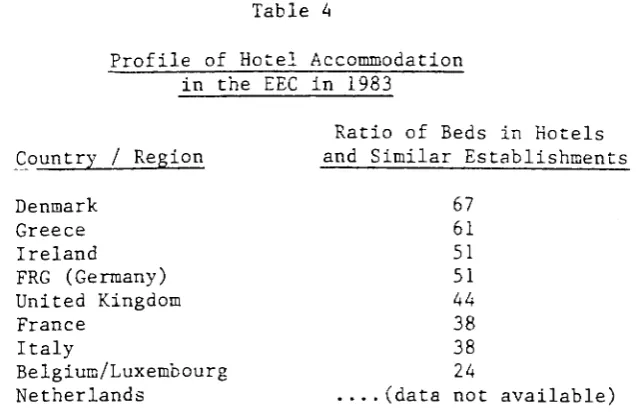
Table 4
Profile of Hotel Accommodation in the EEC in 1983
Ratio of Beds in Hotels Country / Region and Similar Establishments
Denmark 67 Greece 61 Ireland 51 FRG (Germany) 51
United Kingdom 44
France 38 Italy 38 Belgium/Luxembourg 24
Netherlands ....(data not available)
Source: Our elaboration of Worldwide Lodging Industry/OECD/Istat/WTO.
small suppliers of hospitality who could not commercialize themselves otherwise.
Obviously the association and grouping of hoteliers is b r i n g i n g the sector increasing economic benefits. A d v e r t i s i n g , promotion and marketing policies are becoming more p o p u l a r , and our r e p o r t examines these a t t i t u d e s which seem to be the only spontaneous answer to the negative forecasts that e x p e r t s project for small 'family' hotels.
We assume, during the s t u d y , that general t r e n d s indicate con-sumer p r e f e r e n c e for 'high r a t e d ' hotels ( i . e . 3-4 s t a r h o t e l s ) . The high r a t i n g applies, in the EEC c o u n t r i e s , to those hotels where the management is not a family management, and signifies a standardization of the hospitality. Industrial management seem to be strongly connect-ed with the future development of tourism and with the economic success of the hospitality i n d u s t r y .
We have found however that the "Star Rating System", so popular t h r o u g h o u t the world is not adequate for the EEC in providing infor-mation for t o u r i s t s and consumers. We have given great importance to hotel chains and to leading international companies not so much for their direct capacity (number of b e d s ) b u t for the potential that they h a v e . Hotel chains have qualified management, use vocational training of p e r s o n n e l who are aware and advanced in the marketing field. T h r o u g h their s t r a t e g i e s it is possible to u n d e r s t a n d some general t r e n d s , as they are most sensitive to market c h a n g e s , evolutions, and f o r e c a s t s . Dominating hotel chains contain more service flexibility and price elasticity than many small family-operated hotels.
their 'catchment areas'. In fact, their economic weight may seem small
but their strategical potential is able to change the market and to
affect competition.
The Tour Operators also represent a very important side of the
'supply' and their influence is reported as 'fundamental' for competition
and to determine preferences in the world of tourism. Although
individual holidays are exceeding 70 percent of all travel, there is a
marked preference for organised tours when the destination is non
domestic (i.e. holidays abroad).
Cone
H O S D EEC
e n t r itali'
a n d
•aíion tv S tr
in In
of 'UC
S U P D Ï V t u r e s dividual
in Ci
a n d t h e
r^untì
of
■ics
The Tour Operators: Characteristics
■I?
e.:
Services Offered
md involution
As many researchers into tourism have noted the functions cf the
Travel Agency / Business have hardly changed since the beginning of
tourism.
These functions are:
organizing journeys, setting up as
intermediary between supply and demand, and supplying
collateral
services — from information tc assistance — and to the organising of
excursions during the s t a y s .
In order to understand the modern agency system, a crucial
difference must be made between the travel business that concerns
itself with tour operating and the travel business that concerns itself
with the retailing of travel.
Tcur operating is 'the creation of journeys and stays and the
reJative publicity and putting on the market of the product'.
The
activity of a Tour Operator (TO) is therefore a business activity
organized on a large scale.
The Pacific Area Travel Association
(PATA) defines the TO as "specialised concern in the planning and
realization of journeys / holida^/s which are p r e p r e p a r e d and prepaid.
They are sold to the public through Travel Agents".
PATA also
suggests a difference between TO and Tour Organizer.
The Tour
Organizer is the organizer of a preformed group.
Although exact,
Tourist Operators or that of legislation even if it is true that many
Coach Operators (bus operators) are Tour Organizers.
A TO usually supplies three types of service:
organization of the transport;
accommodation;
services in the proper sense of the word.
The services offered may be:
after-sales services, supplied to the client during the journey
or at the destination (transfers, assistance during the stay);
pre-sales service, connected to the operations in the sale of
the holiday (reservations, information, publicity).
The TO, as a producer of standardized holidays, appeared on the
scene in the 1960s as a result of the evolution in transport and in
particular the growing charter services.
The main characteristics of the TO's product are its 'all-included
conditions' (even though there are various solutions during the stay or
in the means of transport) and the competitive price. The TO then
assembles the various components of the tourist product (travel /
stay / assistance) and resells it at a 'market' price. The maintaining
of this objective during the years of the energy crisis has greatly
increased the risk run by the TOs in the definition of their
pro-grammes. Many large TOs have started basing their targets on high
percentages of occupation of transport means and limiting themselves to
very modest profits.
**
The USA is an exception in that there are more Tour Organizers
than tour operators.
For relationship between TO and Air Line companies, see section
"Ownership of the Tour Operators".
In this way, since the beginning of the 1970s, there have been
many cases of bankruptcy in the TO sector. Some, like Clarksons
Holidays (1974) — probably the biggest — were clamorous cases. The
number of highly industrialized TOs is very low, as is the market
quota that they directly control. Their importance grows as we go
further North where the tourist tradition is more consolidated and
reference to a professional organization is more habitual in the people
who go on holiday.
The conditioning power of the TOs is very strong all over
Eu-rope. This is explained by:
The promotional and publicity effort made- by the TOs is very
effective. Its impact is achieved through brochures (often
more than 500,000 copies are printed), billboard advertising,
TV advertising and magazine and newspaper advertising.
The TOs, thanks to their organizing capabilities, are able to
move great numbers of tourists and so to transform some
destinations into favoured tourist spots. Where the holiday is
seen as a status symbol, destinations are presented as
fashion-able and 'chic'. In other words, the presence of a tourist
area in a TO brochure and the tourists that an operator sends
there have an induced effect: they increase the degree of
attraction that the area has for the single tourist market.
As concerns distribution, the TO may be compared to a wholesaler
who uses a distributive network made of retailers (the travel
agen-cies). These travel agencies may however be specialized in either
incoming or outgoing activities.
Recently, there are indications that TOs are becoming less
l!Most TOs have their own sales points, or they control them. In
some countries the TO eliminates the agency network by sending
brochures directly to clients so that the system of distribution takes
four directions:
Producer(s) - TO - Travel Agency - Consumer
Producer(s) - TO - Consumer
Producer(s) - Travel Agency - Consumer
Producer(s) - Consumer
The TOs' functions and their activities in the distribution sector have
conditioned the position in the market of the travel agencies. In fact
in some countries (like Italy) the TOs main rival is the travel agency
(organizing its own holidays), while in others most travel agents
distribute the TO's brochures (simply 'reselling' them). In other
situations the retailing travel agent is an operator who can construct
made-to-measure holidays for a regular clientele who do not want
pre-packaged 'mass' holidays.
The present situation, as we shall see, shows a substantial parity
in TO prices for similar products. There has been some attempt made
therefore to characterize the product — based, in some cases, on the
identifying of a target group and in others on the construction of an
'ad hoc' product. This specializing policy is evident in small and
middle size TOs who tend to reserve for themselves a market quota
and present themselves as being the 'specialists'.
Many banks have found themselves acting like partners to the
TOs without and prior planning, forced to become creditors for travel
agencies, air lines and tour operators, who found themselves in
diffi-culties and as a consequence became involved in the transfer of stocks
and shares, which is a continuous feature of a very active market.
.'ι· :.<>"Η' Lank.' , i'ti t r a n e r ' ;, ' ( ι t o u r i s m has o c c u r r e d , ir: t h e first • ,;..nr··. ,is a r e s u l t of r e q u e s t s for f o r e i g n c u r r e n c y l o r t o u r i s t s "ravelling o v e r s e a s , t h e n as a p u b l i c r e l a t i o n s e x e r c i s e . Today many o a n k s offer v a r i o u s s e r v i c e s to t o u r i s t s , a n d o r g a n i z e t r i p s for t h e i r own staff and c l i e n t s . An example of t h i s is 'la B a n q u e de B r u x e l l e s ' which o p e r a t e s not only as a c r e d i t i n s t i t u t i o n b u t also as a t r a v e l a g e n c y .
In a d i f f e r e n t way b a n k s s u c h as t h e Midland, who own T h o m as Cook c a r r y out t h i s function b y i s s u i n g t r a v e l l e r s c h e q u e s (valid all o v e r t h e w o r l d ) .
R e c e n t l y many b a n k s h a v e e n t e r e d t h e c r e d i t c a r d m a r k e t , a n d also h a v e a v e r y definite i n f l u e n c e on t o u r i s m b y offering a v a r i e t y of s e r v i c e s to t o u r i s t s , p u b l i s h i n g m a g a z i n e s a n d e n c o u r a g i n g v i s i t s to d i f f e r e n t t o w n s and c o u n t r i e s u s i n g t h e c r e d i t c a r d .
On t h e b a s i s of t h e s e f a c t o r s we h a v e u n d e r t a k e n a s u r v e y among t h e EEC c o u n t r i e s which h a s confirmed o u r h y p o t h e s i s a s well as r e v e a l i n g a g r e a t deal of new i n f o r m a t i o n . To c a r r y out t h e s e s u r v e y s we h a v e c o n d u c t e d i n d e p t h i n t e r v i e w s with t h e main TOs a n d h a v e e x p l o i t e d t h e k n o w l e d g e of e x p e r t s b o t h in t h e p r i v a t e a n d t h e p u b l i c s e c t o r s .
Main T o u r O p e r a t o r s in t h e EEC
t h i s r e a s o n it is i m p o r t a n t to r e v i e w t h e p r i n c i p a l TO c o m p a n i e s in t h e main EEC c o u n t r i e s .
An i n i t i a l e v a l u a t i o n of t h e l e v e l of c o n c e n t r a t i o n e x i s t i n g in t h e TO s e c t o r c a n b e f o r m u l a t e d b y c a l c u l a t i n g t h e r o l e of t h e p r i n c i p a l f o u r T O s in t h e EEC , t a k i n g t h e r e s p e c t i v e n u m b e r of c l i e n t s e s t i m a t e d for 1982.
TUI (FGR) w i t h NUR (FGR)
Thompson (UIC) ITS (FGR)
T o t a l
If we c o m p a r e t h i s t o t a l w i t h t h e f i g u r e s for p e o p l e t r a v e l l i n g a b r o a d in t h e E E C , w h i c h c a n b e e v a l u a t e d a s a r o u n d 60 m i l l i o n , w e c a n c a l c u l a t e t h a t t h e s h a r e of t h e m a r k e t c o n t r o l l e d b y t h e p r i n c i p a l f o u r T O s , in t h e E E C , i s 8%.
2,231,000 1,040,000 1,020,000 506,000
4,797,000
clients
II II II
GREAT BRITAIN
The British market is emblematic for an u n d e r s t a n d i n g of how the TOs have developed. It is due both to historical r e a s o n s — the b i r t h of organized tourism and that of the first TO to take place in Great Britain — and cultural r e a s o n s . F u r t h e r m o r e in Great Britain we can examine, more than elsewhere, the figure of the TO in its p u r e s t s t a t e , examine it evolution and hypothesize a possible f u t u r e . In GB the TO's functions are v e r y specialized i n d e e d . The following classi-fication compares the top ten British TOs from 1971 to 1981:
Company
1. Clarksons 2. Thomson H. 3. Goodwill (a) 4. Sunair/Lunn P. 5. Castle
6. Cosmos 7. Global 8. Blue Cars
(b)
1971 - Clients
600,000 290,000 270,000 230,000 190,000 170,000 150,000 130,000 Company
1. Thomson H. 2. Intasun 3. Cosmos 4. Horizon (c) 5. SWSA (d) 6. Laker (e) 7. Wings/OSL 8. Global 1981 1 - Clients ,020,000 470,000 420,000 390,000 350,000 320,000 280,000 250,000
N.B.: All f i g u r e s are approximate. a
b -c d
-Goodwill purchased by Court Line in early 1974 : liquidation in 1974
Purchased by Thomson Holidays in 1972 Formerly Horizon Midland
Including Sovereign and Enterprise H. : owned by British Airways
Including Laker Air Holidays and Arrowsmith, both sold off after Laker collapse in 1982
(Clarksons - purchased by Court Line in 1973 : liquidation 1974)
In the 1970s t h e r e were many cases of financial difficulties in the organized tourism world in Great Britain. Even small and middle size Operators went out of b u s i n e s s . We should underline however that on the whole t h e r e has been development in organized tourism for all the ' s u r v i v i n g ' TOs on the list. The r e a s o n s for this success are to be found in the fact that the TO, by acquiring as a wholesaler and s t a n d a r d i s i n g the holidays, can then offer them at prices which are far more competitive than a n y t h i n g the single tourist can do. The TO's operative ' s e c r e t ' is that they offer a price which is lower than the sum total of the services contained in the p a c k a g e . The TOs also achieve significant cost economies in the organization of the tourist offer b e c a u s e :
The means of t r a n s p o r t are usually used intensively (they avoid long s t a y s of c h a r t e r planes in the a i r p o r t s ) .
They allow the use of tourist s t r u c t u r e s t h r o u g h o u t the season (in this way TOs and hoteliers have exactly the same i n t e r e s t s in that the latter want to extend their opening p e r i o d ) .
In the case of Great Britain it is v e r y important to look at the kind of distribution existing or, in other w o r d s , the kind of relation-ship t h e r e is between TOs and the d i s t r i b u t i n g travel a g e n c i e s . In Great Britain t h e r e are about 7,000 retailing travel a g e n t s ; for Italy the figure is 2,800; and in FRG (Germany) it is 7,800. Almost 5,000 are members of the Association of British Travel Agents (ABTA). About 90% of the p a c k a g e s offered by TOs is sold t h r o u g h the d i s -tribution network of the t r a v e l a g e n t s .
It is the TO who r u n s the r i s k s in the formation of the tourist p r o d u c t b e c a u s e the agent does not b u y the package from the TO, to then r e s e l l it to the client (as h a p p e n s in other s e c t o r s ) , b u t r e -s e r v e -s the p a c k a g e only after the client ha-s decided to b u y .
In 1978 Tjaereborg, one of the biggest Scandinavian TOs, opened an office in London and began selling directly to the p u b l i c , t h u s eliminating the intervention of the travel agency - - as h a p p e n s normal-ly in Scandinavia. This was not the first case of direct sales in Great Britain, but it was a case that could b r e a k p r e - e x i s t i n g and consoli-dated positions and certainly contributed to an acceleration in the evolution of Great Britain's tourist market. From 1978 on direct sales have significantly increased and now r e p r e s e n t almost 20% of the whole market. This innovation has forced even giants like Thomson to diversify, in o r d e r to b e t t e r attack the market and r e s i s t competition. Thomson is now owner of Portland Holidays, which practices direct sales and offers a p r o d u c t v e r y similar tc that of Thomson's b u t with more competitive p r i c e s .
In fact, direct sales save on the commission paid tc the r e t a i l e r , but the publicity e x p e n s e s needed in o r d e r to r e a c h the client are enormous. Even in the case of direct sales it is indispensable to have a high market quota in o r d e r to cover r u n n i n g c o s t s .
The foremost concern of a TO who has gained a market space is that of not losing his clients. The TO wants to make s u r e that they do not contact the hotel d i r e c t l y , make the r e s e r v a t i o n , and organize other s e r v i c e s without using the TO as a. mediator. Another concern is that the clients come back dissatisfied with the services sold — this is one reason why the TO n e e d s s t a n d a r d i s e d , easy to sell p r o d u c t s and s e r v i c e s . TOs then p r e f e r to programme destinations which are not too near the home c o u n t r y because the t o u r i s t could then go r o u n d the TO, without too much difficulty. However an analysis of the main TO catalogues shows t h a t the overwhelming majority of destinations proposed is within two h o u r s ' flight time.
successful and perhaps has been discovered by individual tourism —
this is the case of the Greek island 'Kos' which was programmed by a
large TO after market research showed it was a favourite destination
of that TO's potential clientele.
FRANCE
A classification of the main TOs in F r a n c e , based on the volume of b u s i n e s s recorded in 1982 (in b r a c k e t s the number of 1981 forfaits -or package) follows:
1. Club Mediterranee (see Appendix B) 2. Sotair (183,192)
3. Nouvelles F r o n t i e r e s ( n . a . ) 4. Fram (160,752)
Club Mediterrannee also develops hospitality in hotels and villages. It employs 180,000 people (mostly p a r t t i m e ) in its 166 h o s p i -tality s t r u c t u r e s . However it operates in the tourist market both as a TO and as a 'Hotel Chain'.
On the whole the figure relative to 1982 b u s i n e s s is much h i g h e r than it was in 1981, and the top five TOs take up 41% of total b u s i -n e s s . Accordi-ng to a s u r v e y co-nducted by a specialized magazi-ne, the 1982 number of clients i n c r e a s e d by 10% when compared to 1981, b u t the number of people employed grew by only 0.3% — the s u r v e y was carried out using data supplied by 124 TOs who sell about 2,900,000 forfaits. According to our own estimates the number of full-time staff employed by the TOs is over 5,000. It is h a r d e r to calculate the number of seasonal staff b u t using INSEE data we can say t h a t it is probably t h r e e times the figure we have just q u o t e d .
ITALY
A SEAT s u r v e y calculated that in 1982, 1,590,493 forfaits were sold by Italian a g e n c i e s . The main Italian TOs a r e :
Alpitour
Visitando il Mondo Moteltur
UTÅT
Other important tour and t r a v e l companies a r e : Grandi Viaggi, T u r -i s a n d a , Vacanze and Ventana.
If we exclude Alpitour, the number of holidays sold by the major TOs goes from 20,000 to 60,000. One of the r e a s o n s for this chronic weakness of Italian TOs is t h a t about 75% of the travel agencies does not only resell p r o d u c t s , b u t also creates programmes. A second reason is t h a t in Italy for some time now t h e r e have been no c h a r t e r companies.
FRG (Germany)
According to the FVW magazine, 1982 closed with this TO classifica-tion :
1. TUI - 2,231,200 Clients 2. NUR - 1.040,353 " 3. ITS - 506,481 " 4. DER - 276,000 "
Other important tour and travel companies a r e : Tjareborg (237,000), ADAC (225,000).. Ameropa (208,000), Hetzel (186,000), Wolters
(158,000), Jet Reisen (143,000).
TUI was formed in 1968 when the four major FRG TOs (Touropa, Scharnow, Hummel, Tigges) merged to face the 'new' rival, Necker-mann, which was t h r e a t e n i n g to take over the no. 1 spot on the FRG market, Neckermann was formed in 1963 by a postal sales and large store company. Now TUI (Turistik Union International) is the major European TO and comprises A i r - T o u r , T r a n s e u r o p a , T w e n t o u r s , Hit and Area, while NUR (Neckermann u n d Reisen) comprises the following TOs: GuT Reisen, Club Reisen, Terramar and Club Aldiana.
In all the EEC countries t h e r e have been 'merger' phenomena of different k i n d s — therefore TOs have been born which, like TUI or SUNAIR in Belgium, or Holland I n t e r n a t i o n a l , are the sum of p r e v i o u s -ly existing TOs. In 1973 the six TOs which then formed TUI (Air-t o u r s , Hummel, Scharnow, T i g g e s , Touropa and T r a n s e u r o p a ) had 1,874,000 clients. In 1983 the same TOs had 1,828,700 clients — 2.4% l e s s . TUI, in 1973, r e p r e s e n t e d 58% of the tourist traffic of the twelve top FRG TOs which controlled 65% of the organized market
(source : FVW); today TUI, although it is formed b y nine TOs, r e p r e -s e n t -s only 38.5% of that 65% of the organized FRG market.
OTHER COUNTRIES
Greece
Denmark
Netherlands
Eire
Luxemburg Belgium
The importance of TOs who concern themselves with outgoing traffic is only r e l a t i v e . The official list of H ATTA members has only 18 names: Manos T r a v e l , Ginis Vacances, Travel Plan, Pan Holidays, Arion S . A . , Atlas, Doukas T o u r s , Hellas Beach T o u r s , Heronia Travel are some of the TOs.
Apart from the two huge companies (Tjaereborg and Spies) which are the same size as the o p e r a t o r s on Great Britain's market and which control the b i g g e s t section of the TO market, t h e r e are the following o p e r a t o r s : DSB, DCU, F r i t i d s r e j s e r , World Tourist Rejsebureau, FDM, Novasol, T h i n g g a r d Plus Rejser. Apart from the huge Holland International — formed by the merger of many TOs — t h e r e are Arke Rei-zen, Hotelplan, Neckermann, NRV, N b b s , De Jong In t r a t o u r s , Vrij Uit, De Snelle Vliet, Oad Reizen, the most s t r i k i n g characteristic in the Netherlands is the close ties at a distribution level between TOs and b a n k s .
The major TOs are Abbey T r a v e l , Irish Group T r a v -el, Blueskies, Carouse], Club T r a v e l , Global T o u r s , S u n b o u n d , Cara Holidays. The top Eire TO i s , t h o u g h Joe Walsh T o u r s which s e n d s about 100,000 clients abroad and is by far the b i g g e s t .
The main TOs are Luxair and T r a n s e u r o p e .
Ownership of the Tour Operators
The ownership structure of TOs is very varied. We can identify as
TO-owning bodies:
Large Stores
Air Lines
State Railways
Banks - Credit Agricol owns Voyages Conseil in
France; in Great Britain the Midland
Bank owns Thomas Cook; Banque de
Bruxelles operates her own travel
compa-ny.
General Stores owns Global in Great
Britain; Kaufhof owns ITS in Germany.
As we have already seen, Airlines own
many TOs, especially in Great Britain.
CIT is owned by the Italian Railways; in
Belgium Railtour is owned by the Belgian
Railways.
Financial Groups - This is the case of Thomas Cook and
Thomson.
Private Ownership - UTAT in Italy; Vantage in Great Britain;
Cosmovel and Voyages Fram in France
are owned privately.
The stocks of various TO companies are quoted on the Stock
Exchange in their country of origin. Often the shares are distributed
among hundreds of small savers.
As has been stated before, the ownership of a TO on the part of
the banks has not had a significant effect on the competition. Often
the banks have absorbed the shares of the TO, and their creditors,
without attempting a merger. The greatest economic interest in fact
lies in the travellers cheque market.
The major share of travellers cheques issued belong to:
American Express
Thomas Cook & Son (Midland Bank - Euro Traveller Cheque)
- First National City Bank
- Bank America
In recent years the use of Eurocheques in the EEC has spread and
consolidated and constitutes a very important market for the European
banking system, which has not yet been fully utilized by the tourists.
Other financial reasons put in a close relationship air lines and TOs.
We can distinguish two cases:
Air Lines Which Own TOs: Air Lines Owned by TOs:
KLM - Holland International Britannia Airways - Thomson
Air France - Sotair Air Europe - Intasun
LTU - Jahn Reisen, Munich Monarch - Cosmos
British Airways - Sovereign, Orion - Horizon
Enterprise, Martin Rooks, Flair
British Caledonian - Blue Sky Sterling - Tjaereborg
Luxair - Luxair Vacances
Sabena - owns part of the
Airtour shares
This situation of close contact between TOs and Air Lines is not
without consequences. In fact when an Air Line owns a TO, its
programme and policy may be conditioned by the Air Line's interests
Concentration of Principal Suppliers
££i
and T y p e s of HospitalityAnalysis of the S t r u c t u r e and of 1
the Principal Hotel Groups
The hotel offer in the EEC- c o u n t r i e s is v e r y h e t e r o g e n e o u s both as r e g a r d s the size and s t r u c t u r a l c h a r a c t e r i s t i c s of the h o t e l s , and the r a n g e and quality of s e r v i c e s as well as the ways of r u n n i n g and organizing the u n i t s . It is t h u s difficult firstly to evaluate the r e l a -t i o n s h i p s be-tween s -t r u c -t u r e and compe-ti-tive b e h a v i o u r of -the ho-tels and secondly to examine the effects t h a t t h e v have on competition in the t o u r i s t m a r k e t .
It is c e r t a i n , t h o u g h , t h a t a p r o c e s s of s t r u c t u r a l c h a n g e is in p r o g r e s s . This c h a n g e in the hotel offer is b a s e d above all on g r e a t e r concentration ( m e r g e r s , one g r o u p a b s o r b i n g a n o t h e r , associate r e l a t i o n s h i p s , hotel g r o u p i n g b r a n d s , e t c . ) , and on a g r e a t e r s t a n d a r d i s a -tion of s t r u c t u r e s and s e r v i c e s . In the f u t u r e this will lead to a s t r u c t u r e of the hotel offer which will be v e r y different from the p r e s e n t o n e , and also to more s o p h i s t i c a t e d models of competition.
In this p a r t of the s t u d y a t t e n t i o n h a s b e e n paid to the two fundamental a s p e c t s of the organization of the offer:
The k i n d s of o p e r a t i v e u n i t s and b u s i n e s s e s which work in t h e hospitality m a r k e t ; and
The Main Types of Company and Associated Company in Hospitality S t r u c t u r e s
In o r d e r to estimate, at a European level, the phenomenon of hotel g r o u p s and chains, several data and publications from the hotel sector have been examined. A classification h y p o t h e s i s of the s t r u c t u r e s by associate company and co-operative models has been elaborated. Even if the p r e s e n t economic importance of the various t y p e s of ' g r o u p i n g ' in the EEC is not v e r y g r e a t , t h e y may be important in reaching a Community policy which aims at the elimination of the tourism deficit and g a p s . After an i n - d e p t h examination of the different t y p e s of ' g r o u p i n g ' we have identified a classification which i n c l u d e s :
a. Hotel and Hotelier Associations b . Hotel Preservation C e n t r e s c. Hotel Groups
d. Hoteliers' Co-operatives e. Hotel Chains or Companies
a. Hotel and Hoteliers Associations
They have mainly ' t r a d e - u n i o n ' objectives and r a r e l y concern them-selves with selling hospitality. They s u p p l y consultancy work and assistance to members in the fiscal, administrative and work s e c t o r s . They have an important function in the EEC in that they are the official interlocutors of g o v e r n m e n t s , tourism ministries and the bodies responsible for tourist promotion. Even Regional and Local authorities
opinions on tourism development. Their power comes from a grouping t o g e t h e r of up to t h o u s a n d s of associates — although they do not r e p r e s e n t them commercially or economically.
b . Hotel Reservation C e n t r e s
These are the c e n t r e s for s h a r e d services that single hoteliers or g r o u p s organize and finance in o r d e r to rationalize and speed up r e s e r v a t i o n s t h r o u g h centralizing communications. The r e s e r v a t i o n centre g u a r a n t e e s the payment of the commission to those who make r e s e r v a t i o n s and carries out an i n t e r e s t i n g function for travel a g e n -cies. These c e n t r e s are v e r y numerous in Europe and generally group t o g e t h e r hotels that offer ' n o n s t a n d a r d hospitality'. They are n e v -e r t h -e l -e s s som-etim-es giv-en a ' b r a n d nam-e'.
They c a r r y out publicity for the hotels in the group and usually publish the list of associates in exchange for a participation fee which varies according to the n a t u r e of the c e n t r e and the type of service it p r o v i d e s .
Recently there has been an increase in sales promotion and
ad-vertising by these reservation centres and the 'free toll' telephone
system will be the basis of their future development. Meanwhile airline
companies often carry out a basic operational 'reservation service'.
Our investigations indicate that the most active Hotel Reservation
Centres in Europe are:
Hotel Reservation Centre No. of Hotels Represented Worldwide
UTELL INTERNATIONAL - UK over 2000
SUPRANATIONAL - USA " 400
HRI (Leading Hotels...) - USA " 200
Golden Tulip - NL " 300
But many hotels are represented by two or more reservation centres.
We have traced about 50 operating in the EEC alone.
c. Hotel Groups
This is a relatively recent phenomenon. These groups have an overall
operative philosophy in that they gather hotels which are similar in
structure, price and services. The 'grouping' is made with
'non-competing units' into a common market scheme.
Participating units belong to different i n v e s t o r s and v e r y often cannot be considered homogeneous for type of hospitality. Hotel grouping at the moment is oriented towards c a p t u r i n g the attention of ' b u s i n e s s t r a v e l l e r s ' , but increasing efforts in the hotel t r a d e show great effervescency and often the b i r t h of new hotel g r o u p s , also in holiday r e s o r t s .
Franchising p r a c t i c e will p u s h forward common group marketing experiences in the EEC and the benefits for the market of tourism and for the t o u r i s t s are coming to fruition.
No. of in the 479
87 30 25
Units
EEC H< sad . Office
USA FRG UK UK Hotel Group
BEST WESTERN
STEINBERGER HOTELS PRESTIGE HOTELS COMFORT HOTELS INT.
The influence of the Spanish hotel g r o u p s , whose b r a n d names ' A g r u -pados' and 'Sol' have flooded into o p e r a t o r s ' catalogues, h a s a domi-nant effect on the competition for the holiday market in the EEC.
The attraction and services supplied b y t h e s e g r o u p s ( e n t e r t a i n ment, s h o w s , folklore, homogeneous management, and a unique m a r k e t -ing scheme) lead to an u n d o u b t e d a d v a n t a g e for the Spanish market.
At p r e s e n t France seems to be the more efficient in the EEC u n d e r the Hotel Grouping profile. A large concentration of hotels is r e p o r t e d by several s o u r c e s . Evidence of some b r a n d names is 'Cam-panile' and 'Mapotel', b u t the market concentration is v e r y lively and p r o s p e r o u s .
d. Hoteliers' Co-operatives
These are bodies to which hotels are associated and carry out
promo-tion, collective purchases and sometimes have travel agency or tour
operator functions. It is as yet not a very common phenomenon but,
with regards to competition in the EEC tourist sector, they may have
an important role in the future. The role of the co-operatives, lies in
the fact that 'non-standard' hotel structures in Europe suffer from the
competition of organized groups which aim at an 'international
stan-dard' in hospitality. Co-operatives could have the function of
econom-ically and 'culturally' grouping hoteliers and EEC structures —
acti-vating their training and improving their competitiveness in the
inter-national standard hotel market. The route that this study sees as
most practicable seems to be that which in the USA is called 'Budget
Hotels'. According to this model even small hotels would find a space
on a market where 'grouping brands' are developing a very strong
self-assertive marketing activity.
e. Hotel Chains or Companies
From an economic point of view and as regards competition, hotel
chains and companies have an important place. A UN study showed
that in 1978, 2.1% of the total rooms available in developed countries
was either controlled by or the property of 81 hotel chains. Since
1982, Role des Sociétés transnationales dans le Tourisme.
Re-search carried out for the UN on transnational companies, 1982.
then the chains have further developed and control a greater share of
the hotel market, above all in the middle / high bracket and in the
standardized services sector. It is difficult to calculate accurately the
influence of hotel chains on the EEC market because much ' economic
data are unavailable (they have their headquarters mainly in the USA
or Canada). It is only possible to supply a classification of the most
influential chains on the market in the ten EEC countries. However
this classification owes more to experience than supplied company data.
(See Table 5)
'Table 5
Naie of Chain / Group Head Office Quits In the World Unit« in tin EEC Operations and Information
M 46 - first hotel opened 1952; first European unit In 1568
800 over 400 - owns Travelodge USA ¡franchising coi η·β· over 40 - (our estin,) ovns Intercontinental
(80 units, formerly PAS AH) and Fortim Hotels) TRUSTHOUSE FORTE
M U T A I
SHERATON
HYATT Φ ETAP/PLH
U) CREST USA France France 450 250
m
over- Including Raiiaia Renaissance Brand - soae units under management contract only
(ITT group - USA)
- Ì60 franchlsed hotels in the world Accor Croup (35 units franchlsed or under »anageient contract)
Opening no« 2 new units in the EEC developing new units for 1985 Wagons Lits Croup (5 more opening 1985) also operates as EbSo Motor Hotels; owed by Bass Charrington Brewers
SOFITEL MERCURE MERIDIEN THISTLE HOTELS JOLLY LOHW'S CANADIAN PACIFIC
RANK HOTELS CICA HOTELS CONCORDE France France France HE Italy USA Canada UK Italy Fran:e 51 49 43 40 30 22 21 20 20 20 29 49 9 40 29 3 2 20 20 19
Accor Croup ¡5 franchlsed units In Europe) Accor Croup (9 franchlsed units in Europe)
owned by Scottish and Newcastle Irewerles mainly operating in Italy
only direct management presently increasing units in the EEC «arket
mainly operating in Italy see Appendix Β
Notes on Table 5
The hotel chains work to b u d g e t s and consolidated plans frequently decided outside E u r o p e . Obtaining data on balance s h e e t s and forecasts for European countries is not e a s y .
Even if the volume of b e d s at the disposition of the hotel chains is still limited, n e v e r t h e l e s s the level of expansion is such that it should be considered as a major protagonist in European competition.
The European chains are recovering lost g r o u n d in comparison with the US c h a i n s , which have been situated in the EEC market since the '60s.
T r u s t Houses and Forte Group merged in 1970.
Grand Metropolitan, after a series of m e r g e r s and t a k e - o v e r s now control the "Intercontinental" chain which used to belong to Pan American plus Forum Hotels.
In 1983 the Accor Group was formed in France which o p e r a t e s with four principal b r a n d names: Novotel, Mercure, Sofitel and J a c q u e s Borei (1983), Overall the Group works with 406 u n i t s , many of which have less than 100 rooms. The Accor company is quoted on the Stock E x c h a n g e .
The Méridien chain belongs to Air France and was founded in 1972. By 1987 it plans to open 16 new hotels t h r o u g h o u t the world, predominantly of 'International S t a n d a r d ' .
In the EEC t a k e - o v e r s and m e r g e r s are limited to two coun-t r i e s : France and Bricoun-tain. Ocoun-therwise icoun-t does nocoun-t show any concentration of chains or shifts in the major hotel g r o u p s . T h e r e is a general 'inertia' in the traditional hotels and ' n o n - s t a n d a r d ' hospitality.
The US hotel chains supply some data:
Hotel
Holiday Inn Sheraton Ramada Inn Hilton
Total Hotels 1750
450 600 250
of which a r e : Franchised 1300
300
350
150
It is obvious from this data that the system of franchising h a s a major influence on the development of the chains and therefore on the E u r o -pean hospitality m a r k e t . (See Appendix C)
2.3 Geographie Concentration
The concept of geographic concentration has a notable relevance in tourism, in contrast to that which occurs in the manufacturing i n d u s t r y where the r a t e s of concentration take into account the sales t u r n -over and the number of employees of the various companies and not the importance of the geographic location.
Tourist practice and the relative demand, which in economic planning is t r e a t e d as ' t r a n s f e r ' of overall consumption from the place of normal r e s i d e n c e to the tourist locality, is concerned with a ' p r o d -uct' that i n c l u d e s , in addition to the receiving s e r v i c e s , many other r e s o u r c e s , n a t u r a l and otherwise, p r e s e n t in the t e r r i t o r y .
The t o u r i s t offer is therefore composed of a series of a t t r a c t i o n s (the c o u n t r y s i d e organization, cultural . . . ) singled out, on the whole, by the t o u r i s t in a p a r t i c u l a r area or locality. It is between these geographic components ( r e g i o n s , areas or localities) that the primary level of competition e x i s t s , whilst within these areas the number of tourist e n t e r p r i s e s — usually v e r y high — g u a r a n t e e s a s u s t a i n e d level of competition.
However even among the various tourist a r e a s , within the EEC t e r r i t o r y , we are unable to single out any which could have a mono-polistic effect. The following a n a l y s e s , c o u n t r y by c o u n t r y , show that if t h e r e are zones with a high potential for international tourism, t h e r e are o t h e r s which are particularly a d v a n t a g e d in domestic tourism.
In the last fifteen y e a r s a relatively static situation has marked the hotel sector — the only exception being Greece where hotel capaci-ty has t r i p l e d . The territorial division of hotel supply has been 'blocked' since the end of the 1960s with the 'mature' hotel areas intent on maintaining the earning power of t h e i r concerns and financ-ing r e s t r u c t u r i n g p r o c e s s e s .
This phenomenon is linked to the less than 'brilliant' growth of international tourism in the majority of EEC c o u n t r i e s , if we consider that foreign tourism has always p r e s e n t e d a g r e a t e r use of hotel s u p p l y . This has h a p p e n e d while national tourism has been more and more i n t e r e s t e d in the many forms of e x t r a - h o t e l holidays. In this sector t h e r e has been a great dynamism as opposed to the hotel s e c -tor, and has s p r e a d all t h r o u g h the t e r r i t o r y , r e c o r d i n g continual g r o w t h .
Analysis of the Concentration, by Type,
in the Various Geographic Areas
ITALY
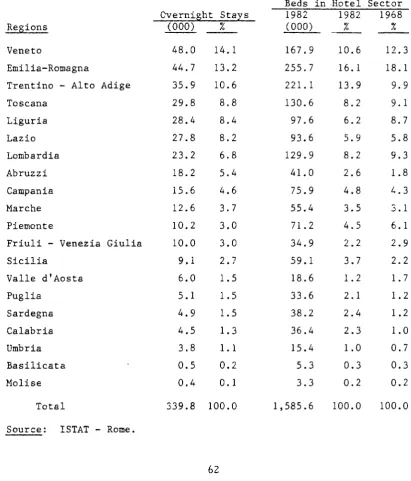
The analysis of the market quota shows firstly the extreme diffusion of Italian tourist activity and the absence therefore of a marked geo-graphic concentration of Italian tourist s u p p l y . The quotas for each of the twenty regions