A Regularization Corrected Score
Method for Nonlinear Regression
Models with Covariate Error
The Harvard community has made this
article openly available.
Please share
how
this access benefits you. Your story matters
Citation
Zucker, David M., Malka Gorfine, Yi Li, Mahlet G. Tadesse, and Donna
Spiegelman. 2013. “A Regularization Corrected Score Method for
Nonlinear Regression Models with Covariate Error.” Biometrics 69
(1): 80–90. https://doi.org/10.1111/j.1541-0420.2012.01833.x.
Citable link
http://nrs.harvard.edu/urn-3:HUL.InstRepos:41384747
Terms of Use
This article was downloaded from Harvard University’s DASH
A Regularization Corrected Score Method for Nonlinear
Regression Models with Covariate Error
David M. Zucker1,*, Malka Gorfine2, Yi Li3, Mahlet Tadesse4, and Donna Spiegelman5
1Department of Statistics, Hebrew University, Mount Scopus, Jerusalem, Israel
2Faculty of Industrial Engineering and Management, Technion - Israel Institute of Technology,
Haifa, Israel
3Department of Biostatistics, University of Michigan, Ann Arbor MI, USA
4Department of Mathematics and Statistics, Georgetown University, Washington DC, USA
5Departments of Epidemiology and Biostatistics, Harvard School of Public Health, Boston MA,
USA
Summary
Many regression analyses involve explanatory variables that are measured with error, and failing to account for this error is well known to lead to biased point and interval estimates of the regression coefficients. We present here a new general method for adjusting for covariate error. Our method consists of an approximate version of the Stefanski-Nakamura corrected score approach, using the method of regularization to obtain an approximate solution of the relevant integral equation. We develop the theory in the setting of classical likelihood models; this setting covers, for example, linear regression, nonlinear regression, logistic regression, and Poisson regression. The method is extremely general in terms of the types of measurement error models covered, and is a functional method in the sense of not involving assumptions on the distribution of the true covariate. We discuss the theoretical properties of the method and present simulation results in the logistic regression setting (univariate and multivariate). For illustration, we apply the method to data from the Harvard Nurses’ Health Study concerning the relationship between physical activity and breast cancer mortality in the period following a diagnosis of breast cancer.
Keywords
Errors in variables; nonlinear models; logistic regression; integral equations
1. Introduction
Many regression analyses involve explanatory variables that are measured with error. Failing to account for the covariate error leads to biased estimates of the regression coefficients, and hence a large literature has developed on the problem of correcting for covariate measurement error. Fuller (1987) provides an authoritative account for linear models, while Carroll et al. (2006) summarizes the literature on nonlinear models. The nonlinear case remains an active research area, bearing on such common statistical models as nonlinear regression with a continuous response, logistic regression for binary responses,
NIH Public Access
Author Manuscript
Biometrics
. Author manuscript; available in PMC 2013 April 10.Published in final edited form as:
Biometrics. 2013 March ; 69(1): 80–90. doi:10.1111/j.1541-0420.2012.01833.x.
NIH-PA Author Manuscript
NIH-PA Author Manuscript
Poisson regression for count data, and Cox regression for survival data. This paper presents a flexible new method for nonlinear regression problems with covariate error, built on earlier work.
Three basic study designs are of interest: (1) the replicate measures design, where repeat covariate measurements are available (either for all individuals or for a subsample), (2) the internal validation design, where the true covariate values are available on a sample of individuals in the main study, and (3) the external validation design, where the key parameters of the measurement error distribution are estimated (assuming reasonable transportability) from an external study, independent of the main study, with paired
measurements of the true and surrogate covariate. Also, two types of methods are of interest: structural methods, which involve model assumptions on the distribution of the true
covariates, and functional methods, which do not require such assumptions.
Various approaches have been proposed. We focus on the SIMEX and corrected score approaches, which are functional modeling approaches. These are general approaches that can handle both internal and external validation designs as well as, with slight adaptation, the replicate measures design. Our proposed method is based on the corrected score approach.
The SIMEX method of Cook and Stefanski (1994) involves simulating new covariate values with various levels of artificially added measurement error, carrying out a naive model fit for each of the resulting new data sets, and then back-extrapolating to zero measurement error. While some success has been achieved with this approach, obviously the back-extrapolation process is uncertain. Moreover, SIMEX can be hard to apply in certain non-classical settings. One challenging setting is when the measurement error variance depends on the true covariate value. A version of SIMEX that can handle this setting under the replicate measures design was developed by Devanarayan and Stefanski (2002), but it does not appear that SIMEX can handle this setting under internal or external validation study designs.
The corrected score approach, advanced by Stefanski (1989) and Nakamura (1990, 1992), involves replacing the likelihood score in the conventional likelihood-based analysis with a function of the surrogate covariates that serves as an unbiased substitute. In Section 2, we present the exact definition. For the independent additive error model, Nakamura (1990) showed that this approach yields consistent estimators in the case of normal linear regression, Poisson regression, Gamma regression, and inverse Gaussian regression. Nakamura (1992) presented an approximate corrected score method for the Cox regression model, which Kong and Gu (1999) later showed to yield consistent estimates. Novick and Stefanski (2002) presented a corrected score method that is aimed at the independent additive error model with normal errors, and is valid when the likelihood score function is an entire function in the complex plane (such as, for example, Poisson regression with an exponential link). Stefanski, Novick, and Devanarayan (2005) elaborate on this approach. When the error-prone covariate is discrete, a corrected score can be formulated easily; the relevant theory was developed for generalized linear models by Akazawa, Kinukawa, and Nakamura (1998), and extended to the Cox regression model by Zucker and Spiegelman (2008).
On the other hand, for logistic regression with additive normal error, Stefanski (1989) showed that an exact corrected score method does not exist. Huang and Wang (2001) presented an exact modified corrected score method for logistic regression, with clever reweighting of the terms in the original score function so that an exact corrected score can be found. This reweighting leads to some loss in efficiency. Moreover, the method of Huang
NIH-PA Author Manuscript
NIH-PA Author Manuscript
and Wang is designed only for the case of independent additive measurement error. Buzas (2009) presents an approximate corrected score method for the logistic regression model with high efficiency when the covariate effect is moderate, but this method is designed only for the case of independent additive normal error.
The basic problem with the corrected score approach in the logistic regression model and other cases with a continuous error-prone covariate X is that obtaining the corrected score requires solving a challenging integral equation. The equation involved is a Fredholm integral equation of the first kind, discussed by Delves and Mohamed (1985, Ch. 12) and Kress (1989, Ch. 16). Such equations do not always have an exact solution; the logistic regression problem is one case of this. Moreover, even when an exact solution exists, the problem can be ill-conditioned. We tried to tackle the case of a continuous covariate by discretizing the covariate to various degrees of fineness and applying the methodology for the discrete case, but with only limited success. The classification matrix tended to be ill-conditioned even with a modest degree of fineness, such as six categories.
In this paper, we develop a new approach. The idea is to handle the integral equation using the method of regularization (Delves and Mohamed, 1985, Sec. 12.3; Kress, 1989, Ch. 16), which involves minimizing a penalized distance function to obtain an approximate solution. In contrast with the original integral equation problem, the regularized problem always has a solution, and is reasonably well conditioned provided that the weight α on the penalty term is not too small. As α tends to infinity, the estimation procedure tends to a naive analysis in which we ignore the covariate error, and simply substitute the surrogate covariate value for the true value. Conversely, under suitable conditions, as α tends to zero the procedure approaches an exact corrected score procedure. The idea is to push α as close as possible to zero to get good estimates of the model parameters. We call our approach the regularized corrected score (RECS) approach.
The advantage of RECS is that it is extremely flexible. Its formulation is very general, and it is a functional method with no modeling of the distribution of the true covariate, but only of the conditional density of the surrogate covariate given the true covariate. The method can handle both internal and external validation designs. It can handle the replicate measures design as well, with the overall surrogate measurement defined as the sample mean (or other summary measure) of the available measurements on the individual. Moreover, the method can handle arbitrary measurement error structures, not just independent additive
measurement error. Differential measurement error, where the measurement error depends on the response, is also covered. The goal of this paper is to develop the RECS method in detail for the classical likelihood setting. Section 2 lays out the setting and background. Section 3 presents the proposed procedure and its theoretical properties. Section 4 presents simulation results under the logistic regression model. Section 5 presents a real-data illustration of the method in the logistic regression setting. Section 6 presents a brief discussion.
2. Setting and Background
We assume a typical setup with n independent units whose response values Yi, i = 1, … n,
follow a regression model involving several covariates. We assume for now that only one of the covariates is subject to error; later we will generalize to the case of multiple error-prone covariates. We denote by Xi the true value of the error-prone covariate, and by Wi the
measured value. We let Zi denote the vector of error-free covariates, which may include an
arbitrary number of discrete and continuous components. We denote the conditional density or mass function of Yi given (Xi, Zi) by f (y|Xi, Zi, θ), where θ is a p-vector of unknown
parameters, including regression coefficients and auxiliary parameters such as error
NIH-PA Author Manuscript
NIH-PA Author Manuscript
variances. In contrast with the SIMEX method, the Huang and Wang (2001) method, and most other methods in the literature, we provide the option of allowing measurement error to depend on Xi, Zi, and the outcome Yi (differential error). We denote by ai(x, w) the
conditional density of Wi given Xi = x, with the subscript i signifying possible dependence
on Zi and Yi. To ease the presentation of the theoretical results, we assume that (Xi, Zi) are
i.i.d. random vectors. We stress, however, that our method does not involve any modeling (either parametric or nonparametric) of the distribution of (Xi, Zi). The theory can, in
principle, be extended to the case where (Xi, Zi) are non-random values satisfying suitable
ergodicity conditions.
The classical normalized likelihood score function when there is no covariate error is given by U(θ) = n−1Σi ui(Xi, θ), where ui(x, θ) = u(Yi, x, Zi, θ) with u(y, x, z, θ) = [∂/∂θ] log f(y|
x, z, θ). The maximum likelihood estimate (MLE) is obtained by solving the equation U(θ) = 0. The idea of the Stefanski-Nakamura corrected score approach is to find a function ū (y, w, z, θ) such that
(1)
We define ūi(w, θ) = ū (Yi, w, Zi, θ), and then use the modified likelihood score function Ū
(θ) = n−1Σi ūi(Wi, θ) in place of U(θ) as the basis for estimation. The estimation equation
thus becomes Ū (θ) = 0.
In the present setting, equation (1) for the corrected score function takes the form
(2)
where uij(x) and ūij(w), respectively, denote the j-th component of ui(x, θ) and ūi(w, θ)
(suppressing the argument θ in the definitions), and the integral is over the entire range of W. As indicated in the introduction, we do not seek an exact solution to (2), but instead use the method of regularization to find an approximate solution.
Define the integral operator Aig(x) = ∫ ai(x, w)g(w)dw. Write Δij(x) = uij(x) − Aiuij(x) and
Δ̄ij(x) = ūij(x) − uij(x). We can then write (2) as AiΔ̄ij = Δij. We seek the Δ̄ij(·, θ, α) that
minimizes the penalized loss function
(3)
where ||g||2 denotes the weighted squared L2 norm ||g||2 = ∫ c(v)g(v)2dv and α > 0 is a penalty factor. The penalty is introduced in order to avoid ill-conditioning and ensure existence of a solution. After obtaining Δ̄ij(·, θ, α), we use ūij(x, θ, α) = uij(x)+ Δ̄ij(x, θ, α)
as a corrected score term.
For the weight function c(v), we propose as a generic choice the standard normal density, p i.e., c(v) = ϕ(v) with , after standardizing W to mean 0 and variance 1. The weight function is designed to put emphasis on the region of the covariate space where the bulk of the data lie. One could consider tailoring the choice of the weight function to the pattern of the observed distribution of W, but we do not discuss this here.
We formulate the minimization problem in terms of Δ̄ij(·, θ, α) rather than ūij(·, θ, α) in
order to anchor the procedure at uij(w), which corresponds to the naive analysis where we
NIH-PA Author Manuscript
NIH-PA Author Manuscript
ignore the covariate error and substitute Wi for Xi. See Hansen (1994, Sec. 2, second
paragraph) for the idea of centering the regularization process around an initial estimate of the desired solution to the integral equation. As α→∞, the loss function (Δ̄ij) puts
increasingly heavy weight on ||Δ̄ij||2, causing the minimizer Δ̄ij to tend to 0 and thus leading
to the naive estimates based on uij(w). At the other extreme, as α→ 0, the problem of
minimizing (Δ̄ij) approaches the problem of solving AΔ̄ij = Δij. We first describe the
procedure for a fixed α, and then discuss the selection of the value of α.
By using the L2 norm, we ensure that the problem of minimizing the loss function always
has a unique solution, and the solution has a convenient form. Delves and Mohamed (1985, Sec. 12.3) and Kress (1989, Theorem 16.1) present the relevant theory. Let
denote the operator adjoint of Ai. Then, for any L2 function δ, the
minimizer of (Ū; Ai, δ, α) = ||AiŪ − δ|| + α ||Ū||2 is given by , where
is the identity operator. The next section describes a numerical scheme for finding the solution that leads to a simple linear system of equations. We thus obtain an easily implemented procedure.
3. The Procedure
3.1 The Procedure for a Given α
To numerically determine the minimizer of (Δ̄ij), we use a Galerkin-type basis expansion
approach, in the spirit of (though not identical to) Delves and Mohamed (1985, Sec. 12.4). Specifically, we represent the solution Δ̄ij(·, θ, α) in a basis expansion
(4)
where the ψm are specified basis functions. In our numerical work, we use the “probabilists”
Hermite polynomials, which are orthonormal with respect to the weight function ϕ. One has to choose the number M of basis functions to include. We found that M = 6 yields good performance; the results with M = 4 are inferior to those with M = 6, while the results with M = 10 are similar to those with M = 6 but with more outliers.
Denote φim(x) = Aiψm(x) and dij = [dij1 … dijM ]T (suppressing the argument α in dijm for
the time being). We then can express the objective function (Δ̄ij) as
where because of the orthonormality of the ψm functions. We now
approximate the L2 norm in the first term on the right side via the quadrature approximation
(5)
where xk and qk are the classical Gauss-Hermite quadrature points and weights (modified p
slightly to account for our use of the weight function as opposed to the
NIH-PA Author Manuscript
NIH-PA Author Manuscript
standard Hermite weight function exp(−v2)). Given the approximation (5), we can express
the objective function as
where and . Next, define the matrix Φ̃i by Φ̃ikm =
φ̃im(xk) and the vector Δ̃ij = [δ̃ij(x1) … Δ̃ij(xK)]. We obtain
. We then find, by standard least squares theory, that the vector dij(α) that minimizes the above quantity is given by dij(α) = C(α) Δ̃ij, where
C(α) = (Φ̃TΦ̃ + αI)−1. Note that C(α) does not depend on θ. Finally, we define ūij(w, θ, α)
= uij(w, θ) + Δ̄ij(w, θ, α), where Δ̄ij(w, θ, α) is given by (4) with dijm(α) as just described.
Then, as indicated in the preceding section, we put Ū (θ, α) = n−1Σ
i ūi(Wi, θ, α) and define
the estimator θ̂(α) to be the solution to Ū (θ, α) = 0.
In the course of the foregoing procedure, we have to evaluate integrals of the form
(6)
Integrals of this type appear in φim(x) = Aiψm(x) and in Δij(x) = uij(x) − Aiuij(x). These
integrals can be evaluated by K′-point numerical quadrature for suitable K′. Web Appendix A.1 presents the details. In regard to the choice of K and K′, in our numerical work we generally used K = K′ = 20; we reran selected simulations with K = K′ = 30 and obtained similar results. In a data analysis, the analyst can try a succession of increasing values of K and K′, and stop when there is no further change in the results.
In practice, ai(x, w) has to be estimated, using data from an internal or external validation study (or a replicate measures study). We assume that ai(x, w) follows a known parametric model depending on parameters ξ (distinct from θ) which are estimated from the relevant data. We thus write ai(x, w, ξ). The parametric model is allowed to be of any specified form.
Thus, in addition to the classical independent additive error model, we allow models with dependence between the error and the true covariate value, and models with differential error. We have examined the effect of misspecifying the parametric form. In practice, the parametric model would be chosen based on analysis of the validation data. Regression methods can be used to model E[WjX]. Heterogeneity of variance can be assessed and modeled by applying regression methods to the squares of the residuals, as in Davidian and Carroll (1987). These models can be checked using standard tools. The distributional form for the error can be selected by examining the standardized residuals from the regression of W on X.
3.2 Theoretical Properties
In general, θ̂(α) will not converge to the true value θ
0 of θ, but rather to a limit θ̃(α) that is
close to θ0 when α is small. We cannot make α arbitrarily small, but we can try to make it
small enough to obtain estimates with small bias, and the numerical studies in the next section indicate that this goal can be achieved. Thus, our method does not produce an exactly consistent estimator, but it does produce an approximately consistent estimator.
NIH-PA Author Manuscript
NIH-PA Author Manuscript
Moreover, under standard regularity conditions, is asymptotically normal. These properties are formalized in the following theorem, proved in Web Appendix A.2.
Theorem—Define ūE(θ, α) = E[ūi(Wi, θ, α)]. Let D̄(α)(θ) be the Jacobian of −Ū (θ, α).
Then, under the regularity conditions in Web Appendix A.2, the following results hold.
a. We have E[ūij(Wi, θ, α)|Xi, Zi, Yi] = uij(Xi, θ)+ rij(Xi, θ, α) with rij(·, θ, α)
converging uniformly in θ to zero as α→ 0.
b. Similarly, with uijs(x, θ) = [∂/∂θs]uij(x, θ) and ūijs(w, θ, α) = [∂/∂θs] ūijs(w, θ, α),
we have E[ūijs(Wi, θ, α)|Xi, Zi, Yi] = uijs(Xi, θ) + rijs(Xi, θ, α) with rijs(·, θ, α)
converging uniformly in θ to zero as α→ 0.
c. For all α sufficiently small, the equation ūE(θ, α) = 0 has a unique solution, which
we denote by θ̃(α). For fixed α, we have θ̂(α)→θ̃(α) almost surely as n →∞. d. We have θ̃(α)→θ0 as α→ 0.
e. If a
i(x, w) is known, is asymptotically mean-zero normal with
covariance matrix that can be estimated using the sandwich estimator
with . Under a parametric model for ai(x, w) with
estimated parameters ξ, a similar result holds, with a suitable adjustment to the estimated covariance matrix to account for the estimation of ξ, as described in Web Appendix A.3.
Remark—Assumptions A1–A3 are typical assumptions made in asymptotic theory; see, for example, van der Vaart (1998, p. 46, bottom). Assumption A4 is a modest assumption that holds in many cases of interest. For example, suppose (X, W) follows the independent additive error model W = X + σε, where ε is a random variable with density fε, independent of X. We then have a(x, w) = σ−1 fε ((w − x)/σ) = σ−1 f̃ε ((x − w)/σ), with f̃ε (u) = fε (−u).
The assumption thus will be satisfied provided that the location-scale family of densities f(x, w, σ) = σ−1f̃θε ((x−w)/σ) is a complete family of densities with respect to the parameters (w, σ). This condition certainly holds if fε is a density of exponential family form; see Lehmann (1986, p. 142). Next, consider the extended model W = X + σ(X, γ) ε, which we examine in our numerical studies, where γ is a vector of parameters. Assumption A4 will hold in this setting if the family of densities
is a complete family of densities with respect to the parameters (w, γ). Again, this condition will hold if fε is a density of exponential family form.
3.3 Choice of the Penalty Parameter Function α
The issue of how to choose the penalty parameter in a regularization problem has been investigated in previous literature. Hansen (1994, 2007) describes three leading criteria: the
NIH-PA Author Manuscript
NIH-PA Author Manuscript
L-curve criterion, the GCV criterion, and the quasi-optimality criterion. We tried all three, and found the GCV criterion to be the most satisfactory. The GCV criterion is
and α is chosen to minimize this quantity. In our setting, with a separate value GCVij(α) for
each i and j, we use the summary criterion . In implementing this rule, we evaluate Δ̃ij at the naive estimate of θ, and then keep α fixed at
the resulting value for the remainder of the estimation process.
3.4 Multiple Error-Prone Covariates
The method can be extended to the case of two error-prone covariates X1 and X2. For the basis functions, we use the tensor product of the univariate basis functions. The integrals in quantities of the form Aig(x) become double integrals, which are evaluated by bivariate
quadrature. In the L2 norm appearing in the objective function, we take the weight function
to be c(w1, w2) = ϕ (w1) ϕ (w2), and evaluate the integral using the bivariate version of (5).
In the case of three or more error-prone covariates, the situation becomes more complicated. Taking the basis function set to be the tensor product of the univariate basis functions will typically produce too large a basis function set, so some reduction will be necessary. One option is to take the basis function set to include all the univariate basis functions for the individual covariates plus the cross-products of the linear terms. In the evaluation of the integrals Aig(x) = E[g(Wi)|Xi = x], a Monte-Carlo method will probably be more workable
than a classical quadrature method. The L2 norms can be computed using a multivariate version of (5), but the computational load may be demanding.
The simulation work presented in the next section includes results for the case of two error-prone covariates. On a practical level, it appears challenging to apply our method with three or more prone covariates. However, many applications involve only one or two error-prone covariates, and thus can be handled by our method in a reasonable way. An arbitrary number of error-free covariates can be handled without difficulty.
4. The Logistic Regression Model: Simulation Studies
4.1 Simulation Study Designs
To investigate the finite sample performance of our method, we conducted a series of simulation studies. This subsection describes the simulation study designs; the next subsection describes the results. The studies were conducted in the setting of the logistic regression model. The response variable Yi equals either 0 or 1. Defining Ti = (Xi, Zi) and
Ti0≡ 1, the model is logit and the score function u(y, x, z, θ)
is
NIH-PA Author Manuscript
NIH-PA Author Manuscript
We examined the following methods: (1) naive analysis ignoring measurement error, (2) RECS, (3) the Novick and Stefanski (2001) complex variable corrected score method (N&S), (4) SIMEX, (5) the Huang and Wang (2001) nonparametric corrected score method (H&W), (6) a Bayesian MCMC-type method (at the suggestion of a referee), patterned after Richard-son et al. (2002). The SIMEX method was applied with linear (SIMEX-L), quadratic (SIMEX-Q), and nonlinear extrapolation (SIMEX-NL). We show the results for SIMEX-Q in the tables, and the results for the other versions in the web appendix. For the Huang and Wang method, which requires replicate measurements of W, we took two replicates per individual and doubled the error variance for comparability with the other methods. Note that H&W is designed to provide accurate estimates only for the slope, not for the intercept. All simulation results for Methods 1–5 are based on 1,000 simulation replications. The MCMC method is very time-consuming, so for this method we ran only 100 replications.
The SIMEX method is designed for independent additive normal measurement error. The N&S method is designed for the case where the measurement error is independent additive normal and the likelihood score function is an entire function in the complex plane. The latter condition does not hold for logistic regression, and thus the N&S method is not designed to handle any of the simulation scenarios we have studied. The H&W nonparametric method is designed for independent additive measurement error with an arbitrary distribution, which is not modeled in any way. The RECS method is designed for parametric measurement error models of arbitrary form, including non-normal,
heteroscedastic, and differential error.
The details of the Bayesian MCMC method are presented in Web Appendix B. The MCMC algorithm was run for 100,000 iterations, with the last 40,000 iterations used for inference. Our adaptation of the Richardson et al. method involves an input parameter η that regulates the variance of the prior distributions on β0 and β1. Specifically, the prior on βj was taken to
be normal with mean equal to the naive estimate and variance equal to η times the estimated variance of the naive estimate. We present results for η = 100. Results for η = 10 are provided in the web appendix. It was necessary for the prior on β0 and β1 to be moderately
informative to ensure convergence of the MCMC sampler. This is an inherent difficulty with the Bayesian approach in the context of the main study/external validation study design that we consider, with no individuals for which the outcome Y and the true covariate X are both observed. The setting η = 100 corresponds to the maximum degree of noninformativeness under which convergence of the MCMC sampler is maintained across all scenarios studied.
For each estimator, we summarize the bias in terms of the mean and median of the difference between the estimated and true parameter values, and the dispersion in terms of the empirical standard deviation and standardized interquartile range (dividing the raw interquartile range by 1.349, which is the ratio between the interquartile range and the standard deviation for a normal distribution). The median and the interquartile distance are more robust to outliers, and thus provide further insight in addition to that provided by the mean and the standard deviation. In addition, we present the coverage rates of the 95% Wald confidence interval based on asymptotic normal theory. For the naive method, variance estimates were computed using the standard asymptotic variance formula. For the RECS and N&S methods, an explicit sandwich-type formula was used. For SIMEX, we used the jackknife estimator in the R package simex, while for H&W we used a bootstrap variance estimator. For the Bayesian MCMC method, interval estimation was based on 95% highest posterior density (HPD) intervals (Box and Tiao, 1973, Section 2.8).
In Simulation Sets A and B, we considered the case of a single continuous error-prone covariate Xi and no other covariates. In these two simulation sets, we worked in the setting
NIH-PA Author Manuscript
NIH-PA Author Manuscript
of a main study/external validation study design, involving a main study sample with data on W and Y and an external validation sample with data on W and X. The main study sample size was 200 and the external validation sample size was 70. The measurement error parameters were estimated by maximum likelihood. The RECS method was implemented with M = 6 basis functions and K = K′ = 20 quadrature points. The true values of the regression parameters were set at β0 = β1 = 1.
Simulation Set A involved measurement error models of the form Wi = Xi + εi, where εi is
normally distributed, but with error variance possibly depending on Xi and Yi. We examined
three simulation scenarios, as follows:
Scenario A1 Xi ~ N (0, 1), εi|(Xi, Yi) ~ N (0, γ)
Scenario A2 Xi ~ N (0, 1), εij(Xi, Yi) ~ N (0, γ1 + γ2|Xi|)
Scenario A3 Xi ~ N (0, 1), εi|(Xi, Yi) ~ N (0, γ1 + γ2|Xi| + γ3|Yi|)
For each of the above scenarios, we examined two sets of measurement error parameters. In Scenario A1, we took γ = 0.5 or 1. In Scenarios A2 and A3, the two sets of measurement error parameters were chosen to make the unconditional variance of εi equal to about 0.5 or
1, respectively. Scenario A1 is the classical additive error model, which is theoretically covered by RECS, SIMEX, and H&W (for N&S, the measurement error model assumption is satisfied but the entire function condition is not). Scenarios A2 and A3 involve
heteroscedastic error models that are theoretically covered by RECS but not by N&S, SIMEX, or H&W.
Simulation Set B involved measurement error models of the form Wi = Xi + εi, with
non-normal εi. We considered two distributions for εi, the double-exponential distribution
(DBLEXP(γ), with γ denoting the variance) and a modified chi-square distribution MOD-CHI which Huang and Wang (2001) used in their simulation work. Specifically, the MODCHI(γ) is defined to be the distribution of a variate truncated at the value 5, recentered to mean zero, and then rescaled to a variance of γ. In Scenario B3, we also take X to have a MODCHI distribution. The DBLEXP distribution is similar to the normal, but with heavier tails. The MODCHI distribution is highly skewed. The specific scenarios examined were as follows:
Scenario B1 Xi ~ N (0, 1), εi|(Xi, Yi) ~ DBLEXP(γ)
Scenario B2 Xi ~ N (0, 1), εi|(Xi, Yi) ~ MODCHI(γ)
Scenario B3 Xi ~ MODCHI(1), εi|(Xi, Yi) ~ MODCHI(γ)
These scenarios are theoretically covered by RECS and H&W, but not by SIMEX or N&S.
For each of these scenarios, we ran simulations for γ = 0.5 and γ = 1. For the MODCHI distribution, integrals of the form Aig(x) were evaluated as described at the end of Web
Appendix A.1. Note that the MODCHI(γ) is a non-regular distributional family: it has support that depends on γ. Hence, classical asymptotic theory for MLE’s does not apply to the MLE of γ. However, due to the restricted range of γ values that are compatible with a given dataset due to the definition of the support, with an external validation sample of 70 the value of γ is estimated with virtually no error.
Simulation Set C considered the case of two error-prone covariates X1, X2 and one
error-free covariate Z. For this simulation set, the sample size was 500, and the measurement error parameters were taken as known. For the RECS method, the basis function set was taken to be the tensor product of the univariate basis functions sets with M = 6, and in the quadrature
NIH-PA Author Manuscript
NIH-PA Author Manuscript
calculations we took K′ = 20 and K = 10. The true regression coefficients were β0 = β1 = β2
= β3 = 1. The scenarios examined were as follows.
Scenario C1 X1, X2, Z i.i.d. N (0, 1); ε1, ε2 i.i.d. N (0, γ), independent of X1, X2, Z
Scenario C2 X1, X2, Z i.i.d. N (0, 1); ε1, ε2 conditionally independent given X1, X2, Z
and distributed as N(0, γ1 + γ2(|X1| + |X2| + |Z|))
Scenario C3 X1, X2 ~ MODCHI(1); Z ~ N(0, 1); ε1, ε2 ~ MODCHI(γ), all random
variables independent of each other
In Scenarios C1 and C3, we took γ = 1, while in Scenario D2 we took γ1 = 0.4 and γ2 =
0.25, so that the unconditional variance of ε1 and ε2 was about 1. Scenario C1 is the
classical additive error model, which is theoretically covered by RECS, SIMEX, and H&W (for N&S, the measurement error model assumption is satisfied but the entire function condition is not satisfied). Scenario C2 involves a heteroscedastic error model that is theoretically covered by RECS, but not by N&S, SIMEX, or H&W. Scenario C3 involves a non-normal error model that is theoretically covered by RECS and H&W, but not by SIMEX or N&S.
Finally, in Scenario D, we examined the effect of misspecifying the error distribution, in the setting of a single error-prone covariate. The details are described in Web Appendix C.2. The R code for the simulations can be found with the supplemental web materials or on the first author’s website (http://pluto.huji.ac.il/~mszucker).
4.2 Simulation Results
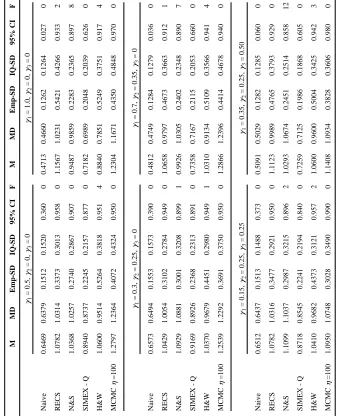
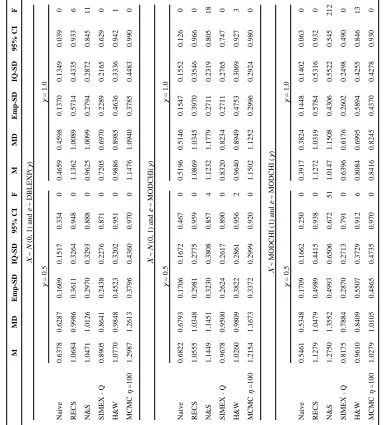
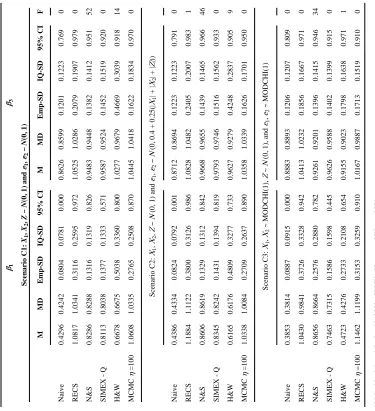
Tables 1 and 2 present, respectively, the results of Simulation Studies A and B, while Table 3 presents the results of Simulation Study C. In Tables 1 and 2 we present the results only for the slope parameter β1, which is the parameter of main interest. Results for the intercept
parameter are given in the web appendix. In Table 3 we present results only for β1 and β3,
the slope parameters for X1 and Z, respectively. The web appendix provides the results for
β0 and β2. The results for β2 are similar to those for β1. The results of Simulation Scenario
D are in the web appendix. Here we discuss the findings, focusing on estimation of the slope parameter. Overall, the RECS method performs very well in terms of bias and confidence interval coverage. Below we discuss how RECS compares with the competing methods.
We begin with the Simulation Study A, the setting of normal measurement error with possible heteroscedasticity. RECS showed low bias throughout, especially when we look at the median of the estimates. N&S also generally showed low bias, although the bias was greater than that of RECS in a number of cases. SIMEX-NL also showed low bias in most cases (the last panel of Table 1 being a notable exception), but the estimation procedure was unsuccessful 6–10% of the time due to failure of the extrapolation process. SIMEX-L, SIMEX-Q, H&W, and MCMC performed markedly less well in terms of bias. The variability of the RECS estimates was comparable to that of the SIMEX-NL estimates and generally higher than that of the other methods.
We turn now to Simulation Study B, with non-normal measurement error. Again, RECS showed low bias throughout. N&S had low bias with double exponential error, and showed the best performance among the various methods in this case. With MODCHI error, RECS had low bias, while all the other methods had substantial bias.
We turn next to Simulation Study C, with two error-prone covariates and one error-free covariate. SIMEX and H&W performed poorly in estimating the slope parameters of the two error-prone covariates. The SIMEX-NL method performed especially poorly, producing estimates way off in the wrong direction. The RECS method performed well. In Scenarios
NIH-PA Author Manuscript
NIH-PA Author Manuscript
D1 (normal homoscedastic error) and D3 (MODCHI error), RECS performed markedly better than N&S in terms of producing estimates with low bias, while in Scenario D3 (normal heteroscedastic), the performance was similar, with RECS overestimating and N&S underestimating. With MCMC method, the estimates with η = 10 were seriously biased, while the estimates with η = 100 had low to moderate bias.
In all three of the above scenarios, RECS generally yielded substantially better confidence interval coverage rates than the competing methods. Often the difference was substantial. We note that the SIMEX-NL method failed to admit a confidence interval in a considerable number of cases because the estimated variances were negative.
Finally, we turn to Simulation Study D, concerning the performance of RECS when the error model is misspecified (assumed normal but actually skewed normal or MODCHI). Aside from the case with both X and ε distributed MODCHI, the mean bias was in the range of 15–35% and the median bias was in the range 10–20%. Thus, in terms of median bias, RECS performed reasonably – certainly much better than the naive analysis with no measurement error correction. When both X and ε were distributed MODCHI, RECS performed poorly. However, this result is not too disturbing – because of the great difference between the MODCHI and normal distributions, it is unlikely that an analyst would
mistakenly fit a normal model to MODCHI measurement errors. In principle, added robustness can be gained by using a flexible distributional form for the error model, such as the “semi-nonparametric normal” model of Gallant and Nychka (1987).
The degree of penalization in the RECS method tended to be very low throughout. The mean α value was less than 0.01 in all simulation scenarios studied.
5. Practical Illustration
We illustrate the method on data from the Nurses’ Health Study (NHS). The NHS began in 1976 when 121,700 female nurses aged 30–55 returned a questionnaire about their lifestyle and their health. Here, we analyze the relationship between physical activity and mortality among women diagnosed with breast cancer during the NHS follow-up. This relationship was previously examined by Holmes et al. (2005). The present analysis involves a subset of the nurses included in the analysis of Holmes et al. Specifically, we consider the group of 1660 nurses who were diagnosed with breast cancer at least 10 years before the
administrative end of the study, June 2002. This is the main study. The endpoint is the binary variable defined as breast cancer death within 10 years following diagnosis. The total number of such deaths was 188. In NHS, physical activity was assessed by a questionnaire in which women were asked how much time they spent on average during the past year on each of the most common forms of leisure time physical activity. The questionnaire results were then converted into metabolic equivalent task hours per week (METS). Validation data were available from 149 women from the NHS II study (Wolf et al., 1994), a study begun in 1989 which involved a cohort of U.S. female nurses similar to that of the NHS, and in which the same physical activity questions were asked. In our analysis, these data are regarded as arising from an external validation study. In the validation study, METS was assessed using both the questionnaire and a detailed activity diary, with the diary regarded as the gold standard. We denote the METS value based on diary data by X and the METS value based on questionnaire data by W. The degree of measurement error is considerable, with the correlation between X and W in the validation study being 0.47. Since the distribution of METS was skewed, we developed the measurement error model from the validation data using a transformed version of METS defined by X* = log(1+X). We considered two measurement error models, denoted MEM1 and MEM2. Both models were of the form
. In MEM1, εi was taken to have the N(0, σ2) distribution, independent of
NIH-PA Author Manuscript
NIH-PA Author Manuscript
. MEM2 incorporated dependence between εi and , with the conditional distribution of
εi given taken to be , with . The parameters ω0, ω1 were
estimated by simple linear regression in both models (weighted regression based on the MEM2 model for εi produced virtually identical estimates of ω0 and ω1). For MEM1, σ2
was estimated by the regression MSE in the standard manner. For MEM2, γ1 and γ2 were
estimated via regression analysis of the squares of the residuals obtained from MEM1; in this regression analysis, the t-test on γ2 was borderline significant (p=0.0614), suggesting
some evidence of heteroscedasticity. The estimates obtained were ω̂0 = 1.2271, ω̂1 = 0.5653,
σ̂2 = 0.8181, γ̂
1 = 0.5883, and γ̂2 = 0.3497. Graphical inspection of the normalized residuals
based on the MEM2 model for εi showed reasonable conformity to a normal distribution. A
preliminary analysis of the main study data indicated that the log odds of breast cancer could be reasonably expressed as a linear function of X*, so we proceeded on this basis.
We ran RECS with 6 basis functions and K = K′ = 20 quadrature points in the quadrature calculations. The relevant R code can be found with the supplemental web materials or on the first author’s website. We also applied the SIMEX and N&S methods to the data. The H&W method is not relevant, since we have an external validation design rather than a replicate measures design. Standard errors for the RECS and N&S methods were computed using a sandwich-type estimator, while standard errors for SIMEX were computed using the jackknife method in the R package simex.
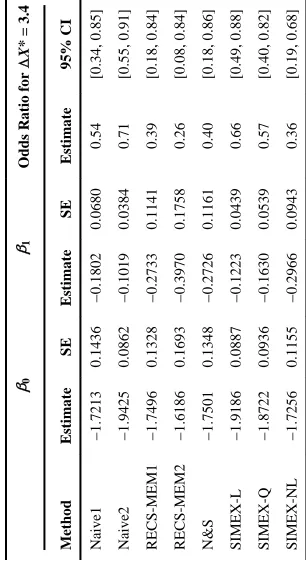
Table 7 presents the results for the various methods. The naive method was applied in two forms: (1) using as is (Naive1) and (2) using , thus correcting for location-scale bias but not for measurement error (Naive2). The table includes estimates of
β0 and β1 and corresponding standard errors. The table also includes an estimate and a 95%
confidence interval for the odds ratio associated with a change in X* of 3.4, which corresponds approximately to the difference between the extreme lower and upper METS categories defined in Holmes et al. (2005) (walking less than 1 hour per week vs. walking 8 or more hours per week). SIMEX-L yielded a slope estimate similar to that yielded by Naive2, while Q gave a slightly larger estimate. RECS-MEM1, N&S, and SIMEX-NL yielded slope estimates differing markedly from the Naive2 estimate, and the estimates yielded by these three methods were comparable. RECS-MEM2 yielded a slope estimate differing substantially from RECS-MEM1, showing the impact of a more refined error model.
6. Discussion
We have presented a new “regularized corrected score” (RECS) approach to adjusting for covariate error in nonlinear regression problems. The approach builds on the corrected score method developed by Stefanski, Nakamura, and others. With a continuous error-prone covariate, the corrected score approach involves solving an integral equation. In many problems, an exact solution to this integral equation does not exist or cannot be practically obtained, and so we have proposed using an approximate solution obtained using the method of regularization. For logistic regression, a series of simulation studies showed that the method performs well in general, and offers some advantages over existing methods.
The RECS method yielded estimates with substantially less bias than competing estimators in the case of a single error-prone covariate with MODCHI error and in the case of two error-prone and one error-free covariates under two of the error models studied. The RECS estimator does tend to have higher variance than the other estimators, particularly the N&S estimator. We were unable to pinpoint the exact cause for the higher variance with the RECS method, but it is common for estimators that rely on weaker assumptions to be somewhat more variable than estimators that rely on stronger assumptions. The RECS
NIH-PA Author Manuscript
NIH-PA Author Manuscript
method had better confidence interval coverage rates than the competing methods in all scenarios studied.
We have developed the theory in the general setting of classical likelihood models, which covers, in particular, generalized linear models such as nonlinear regression, logistic regression, and Poisson regression. It is possible to extend the development to other settings. In particular, it is of interest to extend the method to Cox survival regression, using the work of Zucker and Spiegelman (2008) on corrected score analysis for the Cox model with a discrete error-prone covariate as a starting point. We plan to develop this extension in future work.
The computational complexity and load of the method is modest. For example, the data analysis described in the preceding section finished in about 1 minute of real time, when run in R in batch mode on a VMware virtual machine configured with one AMD 2700 MHz processor and 1GB memory, installed on a physical machine SUN FIRE X4240.
The method presented here is a functional method in the sense of not requiring information on the distribution of the true covariate. This is in contrast to many other measurement error methods, such as regression calibration and likelihood-based methods. We do rely on a parametric model for the conditional distribution of the surrogate variable given the true variable, but our simulations suggest that the performance of the estimates is robust to misspecification of parametric model unless the misspecification is extreme. Also, it is possible in principle to use a flexible parametric model such as Gallant and Nychka’s (1987) “semi-nonparametric” model, which makes the reliance on parametric modeling less restrictive. The method is extremely general in terms of the types of measurement error models covered. It allows the measurement error to depend on the true covariate value and on other covariates. It also allows differential error, where the measurement error depends on the outcome. This flexibility is a distinct advantage relative to other methods.
Supplementary Material
Refer to Web version on PubMed Central for supplementary material.
Acknowledgments
This work has been supported by U.S. National Cancer Institute Grant 2R01CA050597. We thank Yijian (Eugene) Huang for providing code for the Huang and Wang (2001) method.
References
Akazawa K, Kinukawa N, Nakamura T. A note on the corrected score function corrected for misclassification. Journal of the Japan Statistical Society. 1998; 28:115–123.
Box, GEP.; Tiao, GC. Bayesian Inference in Statistical Analysis. Wiley; New York: 1973. (reissued in paperback, 1992)
Buzas J. A note on corrected scores for logistic regression. Statistics and Probability Letters. 2009; 79:2351–2358.
Carroll, RJ.; Ruppert, D.; Stefanski, LA.; Crainiceanu, CM. Measurement Error in Nonlinear Models: A Modern Perspective. 2. Chapman and Hall/CRC; Boca Raton: 2006.
Cook JR, Stefanski LA. Simulation-extrapolation estimation in parametric measurement error models. Journal of the American Statistical Association. 1994; 89:1314–1328.
Davidian M, Carroll RJ. Variance function estimation. Journal of the American Statistical Association. 1987; 82:1079–1091.
Delves, LM.; Mohamed, JL. Computational Methods for Integral Equations. Cambridge University Press; Cambridge: 1985.
NIH-PA Author Manuscript
NIH-PA Author Manuscript
Devanarayan V, Stefanski LA. Empirical simulation extrapolation for measurement error models with replicate measurements. Statistics and Probability Letters. 2002; 59:219–225.
Fuller, WA. Measurement Error Models. Wiley; New York: 1987.
Hansen PC. Regularization tools: a Matlab package for analysis and solution of discrete ill-posed problems. Numerical Algorithms. 1994; 6:1–35.
Hansen PC. Regularization Tools Version 4.0 for Matlab 7.3. Numerical Algorithms. 2007; 46:189– 194.
Holmes MD, Chen WY, Feskanich D, Kroenke CH, Colditz GA. Physical activity and survival after breast cancer diagnosis. Journal of the American Medical Association. 2005; 293:2479–2486. [PubMed: 15914748]
Huang Y, Wang CY. Consistent function methods for logistic regression with errors in covariates. Journal of the American Statistical Association. 2001; 95:1209–1219.
Gallant AR, Nychka DW. Seminonparametric maximum likelihood estimation. Econometrica. 1987; 55:363–390.
Kress, R. Linear Integral Equations. Springer; Berlin: 1989.
Kong FH, Gu M. Consistent estimation in Cox proportional hazards model with covariate measurement errors. Statistica Sinica. 1999; 9:953–969.
Lehmann, EL. Testing Statistical Hypotheses. 2. Wadsworth and Brooks/Cole; Pacific Grove, CA: 1986.
Nakamura T. Corrected score function of errors-in-variables models: methodology and application to generalized linear models. Biometrika. 1990; 77:127–137.
Nakamura T. Proportional hazards model with covariates subject to measurement error. Biometrics. 1992; 48:829–838. [PubMed: 1420844]
Novick SJ, Stefanski LA. Corrected score estimation via complex variable simulation extrapolation. Journal of the American Statistical Association. 2002; 97:472–481.
Richardson S, Leblond L, Jaussent I, Green PJ. Mmixture models in measurement error problems, with reference to epidemiological studies. Journal of the Royal Statistical Society, Series A. 2002; 165:549–566.
Stefanski L. Unbiased estimation of a nonlinear function of a normal mean with application to measurement-error models. Communications in Statistics, Theory and Methods. 1989; 18:4335– 4358.
Stefanski LA, Novick SJ, Devanarayan V. Estimating a nonlinear function of a normal mean. Biometrika. 2005; 92:732–736.
Wolf AM, Hunter DJ, Colditz GA, Manson JE, Stampfer MJ, Corsano KA, Rosner B, Krlska A, Willett WC. Reproducibility and validity of a self-administered physical activity questionnaire. International Journal of Epidemiology. 1994; 23:991–999. [PubMed: 7860180]
Zucker DM, Spiegelman D. Corrected score estimation in the proportional hazards model with misclassified discrete covariates. Statistics in Medicine. 2008; 27:1911–1933. [PubMed: 18219700]
NIH-PA Author Manuscript
NIH-PA Author Manuscript
NIH-PA Author Manuscript
NIH-PA Author Manuscript
[image:17.612.91.429.262.679.2]NIH-PA Author Manuscript
Table 1
Simulation Study A
X
~
N
(0, 1) and
ε ~ N (0, γ1 + γ2 |X | + γ3 Y
) Results for Slope Parameter
β1
– Sample Size
n
=200, Validation Sample Size
m =70 M MD Emp-SD IQ-SD 95% CI F M MD Emp-SD IQ-SD 95% CI F γ1 = 0.5, γ2 = 0, γ3 = 0 γ1 = 1.0, γ2 = 0, γ3 = 0 Naive 0.6469 0.6379 0.1512 0.1520 0.360 0 0.4713 0.4660 0.1262 0.1264 0.027 0 RECS 1.0782 1.0314 0.3373 0.3013 0.958 0 1.1567 1.0231 0.5421 0.4266 0.933 2 N&S 1.0368 1.0257 0.2740 0.2867 0.907 0 0.9487 0.9859 0.2283 0.2365 0.897 8
SIMEX - Q
0.8940 0.8737 0.2245 0.2157 0.877 0 0.7182 0.6989 0.2048 0.2039 0.626 0 H&W 1.0600 0.9514 0.5264 0.3818 0.951 4 0.8840 0.7851 0.5249 0.3751 0.917 4 MCMC η =100 1.2797 1.2364 0.4072 0.4324 0.950 0 1.2304 1.1671 0.4350 0.4848 0.970 0 γ1 = 0.3, γ2 = 0.25, γ3 = 0 γ1 = 0.7, γ2 = 0.35, γ3 = 0 Naive 0.6573 0.6494 0.1553 0.1573 0.390 0 0.4812 0.4749 0.1284 0.1279 0.036 0 RECS 1.0429 1.0054 0.3102 0.2784 0.949 0 1.0658 0.9797 0.4673 0.3663 0.912 1 N&S 1.0929 1.0881 0.3001 0.3208 0.899 1 0.9926 1.0305 0.2402 0.2348 0.890 7
SIMEX - Q
0.9169 0.8926 0.2368 0.2313 0.891 0 0.7358 0.7167 0.2115 0.2053 0.660 0 H&W 1.0370 0.9679 0.4451 0.2980 0.949 1 1.0310 0.9134 0.5109 0.3566 0.941 4 MCMC η =100 1.2539 1.2292 0.3691 0.3750 0.950 0 1.2866 1.2396 0.4414 0.4678 0.940 0 γ1 = 0.15, γ2 = 0.25, γ3 = 0.25 γ1 = 0.35, γ2 = 0.25, γ3 = 0.50 Naive 0.6512 0.6437 0.1513 0.1488 0.373 0 0.5091 0.5029 0.1282 0.1285 0.060 0 RECS 1.0782 1.0316 0.3477 0.2921 0.950 0 1.1123 0.9989 0.4765 0.3793 0.929 0 N&S 1.1099 1.1037 0.2987 0.3215 0.896 2 1.0293 1.0674 0.2451 0.2514 0.858 12
SIMEX - Q
0.8718 0.8545 0.2241 0.2194 0.840 0 0.7259 0.7125 0.1986 0.1868 0.605 0 H&W 1.0410 0.9682 0.4373 0.3121 0.957 2 1.0600 0.9600 0.5004 0.3425 0.942 3 MCMC η =100 1.0950 1.0748 0.3028 0.3490 0.990 0 1.1408 1.0934 0.3828 0.3606 0.980 0
N&S - Novick and Stefanski (2002); H&W - Huang and Wang (2001) SIMEX results are based on
B
= 100,
λ
= (0.5, 0.7, 0.9, 1.1, 1.3, 1.5, 1.7, 1.9) and the simex R library
NIH-PA Author Manuscript
NIH-PA Author Manuscript
[image:18.612.101.484.253.678.2]NIH-PA Author Manuscript
Table 2
Simulation Study B Non-Normal Measurement Error with Normal or Non-Normal True Covariate Results for Slope Parameter
β1
– Sample Size
n
=200,
Validation Sample Size
m =70 M MD Emp-SD IQ-SD 95% CI F M MD Emp-SD IQ-SD 95% CI F X ~ N
(0, 1) and
ε ~ DBLEXP( γ ) γ = 0.5 γ = 1.0 Naive 0.6378 0.6287 0.1609 0.1517 0.334 0 0.4659 0.4598 0.1370 0.1349 0.039 0 RECS 1.0684 0.9986 0.3611 0.3264 0.948 0 1.1362 1.0089 0.5714 0.4335 0.933 6 N&S 1.0471 1.0126 0.2970 0.3293 0.888 0 0.9625 1.0099 0.2794 0.2872 0.845 11
SIMEX - Q
0.8905 0.8641 0.2438 0.2276 0.871 0 0.7205 0.6970 0.2289 0.2165 0.629 0 H&W 1.0770 0.9848 0.4523 0.3202 0.951 0 0.9886 0.8985 0.4636 0.3336 0.942 1 MCMC η =100 1.2987 1.2613 0.3796 0.4360 0.970 0 1.1476 1.0940 0.3785 0.4483 0.990 0 X ~ N
(0, 1) and
ε ~ MODCHI( γ ) γ = 0.5 γ = 1.0 Naive 0.6822 0.6793 0.1706 0.1672 0.467 0 0.5196 0.5146 0.1547 0.1552 0.126 0 RECS 1.0555 1.0348 0.2981 0.2775 0.959 0 1.0869 1.0345 0.3970 0.3546 0.966 0 N&S 1.1449 1.1451 0.3230 0.3808 0.857 4 1.1232 1.1779 0.2711 0.2319 0.805 18
SIMEX - Q
0.9678 0.9500 0.2624 0.2617 0.890 0 0.8320 0.8234 0.2711 0.2765 0.747 0 H&W 1.0260 0.9809 0.3822 0.2861 0.956 2 0.9640 0.8949 0.4753 0.3069 0.927 3 MCMC η =100 1.2154 1.1673 0.3372 0.2999 0.920 0 1.1502 1.1252 0.2996 0.2924 0.980 0 X
~ MODCHI (1) and
ε
~ MODCHI (
γ ) γ = 0.5 γ = 1.0 Naive 0.5461 0.5348 0.1709 0.1662 0.250 0 0.3917 0.3824 0.1448 0.1402 0.063 0 RECS 1.1279 1.0479 0.4989 0.4415 0.938 0 1.1272 1.0319 0.5784 0.5316 0.932 0 N&S 1.2750 1.3552 0.4993 0.6506 0.672 51 1.0147 1.1508 0.4306 0.5522 0.545 212
SIMEX - Q
0.8175 0.7884 0.2870 0.2713 0.791 0 0.6396 0.6176 0.2602 0.2498 0.490 0 H&W 0.9610 0.8409 0.5507 0.3729 0.912 6 0.8084 0.6995 0.5894 0.4255 0.846 13 MCMC η =100 1.0279 1.0105 0.4865 0.4735 0.970 0 0.8416 0.8245 0.4370 0.4278 0.930 0
N&S - Novick and Stefanski (2002); H&W - Huang and Wang (2001) SIMEX results are based on
B
= 100,
λ
NIH-PA Author Manuscript
NIH-PA Author Manuscript
NIH-PA Author Manuscript
NIH-PA Author Manuscript
NIH-PA Author Manuscript
[image:20.612.93.468.271.682.2]NIH-PA Author Manuscript
Table 3
Simulation Study C Two Error-Prone Covariates and One Error-Free Covariate Sample Size
n =500 β1 β3 Scenario C1: X1 , X2 , Z ~ N
(0, 1) and
ε1 , ε2 ~ N (0, 1) M MD Emp-SD IQ-SD 95% CI M MD Emp-SD IQ-SD 95% CI F Naive 0.4296 0.4242 0.0804 0.0781 0.000 0.8626 0.8599 0.1201 0.1223 0.769 0 RECS 1.0817 1.0341 0.3116 0.2595 0.972 1.0525 1.0286 0.2079 0.1907 0.979 0 N&S 0.8286 0.8288 0.1316 0.1319 0.826 0.9483 0.9448 0.1382 0.1412 0.951 52
SIMEX - Q
0.8113 0.8038 0.1377 0.1333 0.571 0.9587 0.9524 0.1452 0.1519 0.920 0 H&W 0.6678 0.6675 0.5038 0.3360 0.800 1.0277 0.9679 0.4669 0.3039 0.918 14 MCMC η =100 1.0608 1.0335 0.2765 0.2508 0.870 1.0445 1.0418 0.1622 0.1834 0.970 0 Scenario C2: X1 , X2 , Z ~ N
(0, 1) and
ε1
,
ε2
~
N
(0, 0.4 + 0.25(|
X1 | + | X2 | + | Z| )) Naive 0.4386 0.4334 0.0824 0.0792 0.001 0.8712 0.8694 0.1223 0.1223 0.791 0 RECS 1.1884 1.1122 0.3800 0.3126 0.986 1.0828 1.0482 0.2405 0.2007 0.983 1 N&S 0.8606 0.8619 0.1329 0.1312 0.842 0.9668 0.9655 0.1439 0.1465 0.966 46
SIMEX - Q
0.8345 0.8242 0.1431 0.1394 0.819 0.9793 0.9746 0.1516 0.1562 0.933 0 H&W 0.6165 0.6176 0.4809 0.3277 0.733 0.9627 0.9279 0.4248 0.2837 0.905 9 MCMC η =100 1.0338 1.0084 0.2709 0.2637 0.890 1.0358 1.0339 0.1626 0.1701 0.950 0 Scenario C3: X1 , X2 ~ MODCHI(1), Z ~ N
(0, 1), and
ε1 , ε2 ~ MODCHI(1) Naive 0.3853 0.3814 0.0887 0.0915 0.000 0.8883 0.8893 0.1206 0.1207 0.809 0 RECS 1.0430 0.9841 0.3726 0.3328 0.942 1.0413 1.0232 0.1856 0.1667 0.971 0 N&S 0.8656 0.8664 0.2576 0.2880 0.782 0.9261 0.9201 0.1396 0.1415 0.946 34
SIMEX - Q
0.7463 0.7315 0.1586 0.1598 0.445 0.9626 0.9588 0.1402 0.1399 0.915 0 H&W 0.4723 0.4276 0.2733 0.2108 0.654 0.9155 0.9023 0.1798 0.1638 0.971 1 MCMC η =100 1.1462 1.1199 0.3153 0.3259 0.910 1.0167 0.9887 0.1713 0.1519 0.910 0
N&S - Novick and Stefanski (2002); H&W - Huang and Wang (2001) SIMEX results are based on
B
= 100,
λ
= (0.5, 0.7, 0.9, 1.1, 1.3, 1.5, 1.7, 1.9) and the simex R library
NIH-PA Author Manuscript
NIH-PA Author Manuscript
NIH-PA Author Manuscript
NIH-PA Author Manuscript
NIH-PA Author Manuscript
[image:22.612.91.244.398.679.2]NIH-PA Author Manuscript
Table 4
NHS Results
β0
β1
Odds Ratio for
Δ
X*
= 3.4
Method
Estimate
SE
Estimate
SE
Estimate
95% CI
Naive1
−1.7213
0.1436
−0.1802
0.0680
0.54
[0.34, 0.85]
Naive2
−1.9425
0.0862
−0.1019
0.0384
0.71
[0.55, 0.91]
RECS-MEM1
−1.7496
0.1328
−0.2733
0.1141
0.39
[0.18, 0.84]
RECS-MEM2
−1.6186
0.1693
−0.3970
0.1758
0.26
[0.08, 0.84]
N&S
−1.7501
0.1348
−0.2726
0.1161
0.40
[0.18, 0.86]
SIMEX-L
−1.9186
0.0887
−0.1223
0.0439
0.66
[0.49, 0.88]
SIMEX-Q
−1.8722
0.0936
−0.1630
0.0539
0.57
[0.40, 0.82]
SIMEX-NL
−1.7256
0.1155
−0.2966
0.0943
0.36