White Rose Research Online URL for this paper: http://eprints.whiterose.ac.uk/86124/
Version: Accepted Version
Article:
Lefstein, A, Snell, J and Israeli, M (2015) From moves to sequences: Expanding the unit of analysis in the study of classroom discourse. British Educational Research Journal, 41 (5). 866 - 885. ISSN 0141-1926
https://doi.org/10.1002/berj.3164
[email protected] https://eprints.whiterose.ac.uk/ Reuse
Unless indicated otherwise, fulltext items are protected by copyright with all rights reserved. The copyright exception in section 29 of the Copyright, Designs and Patents Act 1988 allows the making of a single copy solely for the purpose of non-commercial research or private study within the limits of fair dealing. The publisher or other rights-holder may allow further reproduction and re-use of this version - refer to the White Rose Research Online record for this item. Where records identify the publisher as the copyright holder, users can verify any specific terms of use on the publisher’s website.
Takedown
If you consider content in White Rose Research Online to be in breach of UK law, please notify us by
From Moves to Sequences: Expanding the Unit of Analysis in the Study of Classroom Discourse
Adam Lefstein
Ben-Gurion University of the Negev
Julia Snell
University of Leeds
Mirit Israeli
Ben-Gurion University of the Negev
Note: The authors gratefully acknowledge support from the UK Economic and Social Research
Council (Towards Dialogue: A Linguistic Ethnographic Study of Classroom Interaction and
Abstract
What is the appropriate unit of analysis for the study of classroom discourse? One
common analytic strategy employs individual discourse moves, which are coded, counted and
used as indicators of the quality of classroom talk. In this article we question this practice,
arguing that discourse moves are positioned within sequences that critically shape their meaning
and effect. We illustrate this theoretical claim through exploration of a corpus of over 7000
discourse moves in primary literacy lessons. First, we use conventional measures such as the
proportion of open and closed questions, and show how these indicators can be misleading when
abstracted from the sequences in which they are embedded. We propose a complementary
method, lag sequential analysis, which examines how discourse is sequentially structured – i.e. which discourse moves are followed by which other moves, and which chains of moves are more
or less significant. We illustrate this method through re-analysis of our corpus of literacy
lessons, examining differences between the sequential patterns found to be significant in the
different classrooms observed. While lag sequential analysis does not resolve all problems
inherent in systematic observation of classroom discourse, it does shed light on critical patterns
From Moves to Sequences: Expanding the Unit of Analysis in the Study of Classroom Discourse
Relating educational policies, classroom processes and pupil outcomes requires a reliable
and valid means of measuring classroom discourse and interaction. A popular and expedient
strategy involves systematic observation of discourse moves according to a predetermined
coding scheme (typically focusing on actor and function) and statistical analyses of the resulting
frequencies and correlations. Through such methods researchers have advanced understanding
about relationships between the relative dialogicality of lessons and pupil achievement (Nystrand
et al., 1997), about the extent to which new instructional policies have modified classroom
interactional patterns (Galton et al., 1999; Smith et al., 2004), about the relationships between
classroom interaction and social class (Harris & Williams, 2012), about shifts in classroom
discourse following an extended collaborative action research project (Wells & Arauz, 2006),
and about which instructional practices are associated with student explanations (Webb et al.,
2009). In our own work, we have used such a strategy to identify from within a large corpus
relatively dialogic episodes and to explore processes of continuity and change in classroom
interactional patterns (Snell & Lefstein, 2011).
Systematic observation and coding of discourse moves poses, however, a number of
problems. Mercer (2010), in a discussion contrasting different methods for analysing classroom
discourse, raises three sets of issues. First are challenges with regard to coding reliability:
meaning is inherently ambiguous, and is furthermore situated temporally (e.g. the same utterance
will serve different functions at the beginning and at the end of a lesson). Second, validity
straightforward as coding schemes might suggest (see also Gee, 2011, pp. 63-65; and Bloome et
al., 2005, p. 32). Third, are “difficulties in determining the appropriate size of the unit of
analysis to be coded... [f]or example, is the most meaningful unit a question or
question-and-answer?” (p. 4).
This article addresses Mercer’s question about the size of the unit of analysis. We propose that, for many purposes it is necessary to expand the unit of analysis beyond the
individual discourse move in order to investigate how discreet moves are sequentially structured.
In developing this argument, we first review the unit of analysis problem and its implications for
the study of classroom discourse. Second, we discuss problems with the popular analytic
strategy of employing the individual discourse move as unit of analysis, as illustrated in our
analysis of 30 video-recorded literacy lessons in one London primary school. Third, we
re-analyse the same data-set using lag sequential analysis (Bakeman & Gottman, 1997) to uncover
sequential patterns within the corpus, and discuss advantages and limitations of this method.
Concerns with the Unit of Analysis
The current methodological concern with units of analysis has its roots in Gestalt
psychology and, specifically, the way their ideas were developed and promoted by Vygotsky
(Matusov, 2007). Briefly, Vygotsky argued against the traditional psychological method of
decomposing complex mental processes into component elements that no longer captured the
key characteristics of the whole. In a famous passage Vygotsky (1987) compared such a strategy
to studying water through analyses of hydrogen and oxygen in isolation:
When one approaches the problem of thinking and speech by decomposing it into its
water into hydrogen and oxygen in his search for a scientific explanation of the
characteristics of water, its capacity to extinguish fire or its conformity to Archimedes law
for example. This man will discover, to his chagrin, that hydrogen burns and oxygen
sustains combustion. He will never succeed in explaining the characteristics of the whole
by analyzing the characteristics of its elements. (quoted in Matusov, 2007, p. 308)
Likewise, we will not be able to capture the distributed nature of cognition through study
of individuals’ thinking, isolated from the people and artifacts that mediate cognitive processes.
Or, as we argue below, the co-constructed nature of discourse cannot be captured through study
of individual discourse moves, isolated from the sequences of utterances in which they are
embedded.
Instead of decomposing the object of inquiry into elements, Vygotsky suggests that
researchers should “partition” the whole into units that preserve “all the basic characteristics of
the whole”. In this approach, the molecule is the smallest unit of analysis for studying H2O, and
word meaning (Vygotsky, 1987), mediated action (Wertsch, 1998) or activity systems
(Engeström et al., 1999) are appropriate units of analysis for socio-cultural psychological
research.
Matusov (2007), to whom this section is heavily indebted, discusses a range of
methodological problems with overly reductive units of analysis. The most problematic is what
he terms “horizontal reductionism”, which “involves treating a part of a system as if it is the self
-contained and isolated whole” (p. 315). For an example of horizontal reductionism consider an
analysis of disability that treats the phenomenon as entirely a matter of individual capacity,
without consideration of the social and material context against which differences in individual
example from the area of classroom discourse consider an analysis of the functions of teacher
questions that ignores the ways in which students respond to those questions. In both cases, an
element of the system (individual capacity, a teacher question) is treated as if it operated
independently of the system in which it is actually embedded.
The context-dependent nature of discourse is a well-developed theme in conversation
analysis and linguistic anthropology (e.g. Duranti & Goodwin, 1992). The meanings and
significance of utterances are shaped by a variety of contexts, including, for example, the cultural
setting and social sphere; the activity in which interlocuters are engaged (Levinson, 1979); and
even the actions of the audience while a speaker fashions their utterance (Schegloff, 2001).
Conversation analysis emphasizes, in particular, the critical role of sequential context:
No empirically occurring utterance ever occurs outside, or external to, some specific
sequence. Whatever is said will be said in some sequential context, and its illocutionary
force will be determined by reference to what it accomplishes in relation to some
sequentially prior utterance or set of utterances. (Heritage & Atkinson, 1984, p. 6)
In light of this principle, conversation analysts attend closely to the sequential unfolding
of discourse, to how each turn addresses that which preceded it, and to the range of possible
responses it projects for the next speaker. Hence, for conversation analysts, the key unit of
analysis (though they don’t explicitly discuss methodology in such terms) is the exchange, and the minimal unit is an adjacency pair, i.e. two turns that conventionally come together, with the
first turn setting up the expectation of the second, such as question and answer, apology and
minimization, or invitation and acceptance.1
1Note that conversation analysts tend to use the term “unit” differently than I am employing it here. Hence, for
Sociocultural researchers seek to replace reductive units of analysis with more holistic
ones. However, holistic units are not without their pitfalls, chief among which are issues of
manageability. Moreover, it seems that no unit of analysis can ever be big enough, as all social
practices are embedded in larger social, economic and cultural systems. “Each new candidate for
the unit of analysis,” remarks Matusov, “...sooner or later becomes recognized by sociocultural scholars as ‘too small’. A unit that preserves the whole of the phenomenon, as Vygotsky and
Gestalt psychologists insisted, seems to resist having its boundary and limit” (p. 373). Discourse
analysis similarly resists boundaries, and often analysts find that interpretation of an utterance
requires consideration of not only the social situation and activity, but also the entire history of
the discourses spoken. As Bakhtin (1891) wrote, “each word tastes of the context and contexts
in which it has lived its socially charged life” (p. 783); all of these contexts are potentially
relevant to understanding the use of that word.
In attempting to strike a balance between reductionism and holism, we will argue below
that interactional structures of three or more turns is a methodologically expedient and
theoretically sound unit for the analysis of classroom discourse (at least for many common
purposes and contexts).
Matusov notes that researchers often choose their unit of analysis in part because of
institutional constraints or momentum, i.e. “because the research method for which this unit of analysis will be used is well developed and not because it is the best fit for the study of the
conceptualized construct of the phenomenon” (p. 314). In such a way, for example, we adopted
methods for systematic observation, coding and counting frequencies of discourse moves for our
study of continuity and change in classroom discourse. While these methods were in retrospect
not the best fit for our purposes (to be discussed below), we should note that it makes a lot of
sense for researchers to use existing and accepted methods, in order to benefit from others’
investments in developing, trialling and refining them, and in order to afford between-study
comparisons. We turn to our own research in the next section.
Discourse Move as Unit of Analysis in the Towards Dialogue Project
The impetus for our work on this topic comes from our experiences with systematic
observation of classroom discourse data in the Towards Dialogue: A Linguistic Ethnographic
Study of Classroom Interaction and Change project.2 This study examined processes of
continuity and change in classroom interactional patterns through quantitative interrogation of
systematic observation data (the focus of this article) and linguistic ethnographic micro-analysis
of select segments. Details about this project are elaborated elsewhere (Lefstein & Snell, 2011a,
2011b, 2011c, 2013, 2014; Snell & Lefstein, 2011); here we briefly describe details particularly
relevant to the current article.
We observed and video-recorded naturally occurring classroom discourse and interaction
in 73 literacy lessons in seven upper primary classrooms at Abbeyford Primary School3, a
relatively large community primary school in an East London borough with a long-standing
interest in dialogic pedagogy and a history of developing and implementing pedagogical
innovations. A senior local authority advisor recommended Abbeyford Primary on account of its
highly regarded, stable and experienced teaching staff and leadership team. We also conducted a
bi-weekly professional development workshop for participating teachers, in which we assisted in
2 We gratefully acknowledge support received from the UK Economic and Social Research Council (ESRC), award
no. RES-061-25-0363.
lesson planning, guided reflection on video-recorded classroom episodes and discussed teachers’ concerns in the enactment of dialogic pedagogy.
In order to investigate continuity and change in classroom interactional patterns we
subjected a sub-set of 30 lessons to computer-assisted systematic classroom observation,
sampled from lessons taught by three teachers, who had between 10 and 11 years of teaching
experience and who had also been involved in a previous dialogic teaching programme.
Analyses of this coded corpus were used to situate the sample (by comparing it to previous
studies), to examine processes of change over time, to investigate correlations between relative
dialogicality and other key variables (especially teacher and pedagogic activity), and to select
episodes for micro-analysis.
Systematic observation of these lessons focused only on the whole-class teaching
segments (defined as a whole class activity lasting longer than 2 minutes). This accounted for
approximately 50 percent of the total duration of the lessons (i.e. 24 minutes of an average 48
minute lesson). For each whole-class segment we coded discourse moves using the systematic
observation software, The Observer XT4 (Noldus 2008), using a coding system adapted from that
developed by Hardman and colleagues (Hardman et al. 2003; Smith & Hardman 2004). This
system codes discourse moves, defined as a single utterance or a string of uninterrupted
utterances with a common function (e.g. to explain, direct, question, respond, give feedback).
Questions were further subdivided according to type (e.g. ‘open’, ‘closed’, ‘probe’). We also
distinguished between ‘simple’ feedback (repetition of a pupil answer or very brief response
such as ‘Okay’) and ‘elaborated’ feedback (an extended response). We further coded for activity
type (e.g. ‘Recap’, ‘Review of group work’, ‘Introduce new task’). In the way we set up the
system, the software “stopped” one move once another move was coded. Noticeable pauses
between moves were coded as “silence”. Because the start of every code is time-stamped,
durations as well as frequencies of coded behaviours were recorded.5
Analysis of this corpus yielded a number of interesting yet tentative findings related to (a)
similarities and differences between teachers, and between the classroom practice observed and a
national sample of literacy lessons; (b) changes over time in classroom interactional patterns; and
(c) the conditions under which teaching and learning was more or less dialogic. We also used the
analysis to locate particularly dialogic episodes – i.e. episodes with a large proportion of open,
probe or uptake questions, elaborated feedback, and high rates of pupil participation – which we then subjected to further, micro-analytic scrutiny.
We briefly outline and illustrate some key findings, and then discuss their limitations,
especially with regard to the unit of analysis. In the interests of brevity we focus in particular on
teacher question types. The use of teacher questions as a key indicator of discourse quality is
relatively common in such research, with a high proportion of closed, factual, or exam questions
interpreted as evidence of low cognitive demand, and conversely, a relatively high proportion of
open, uptake or probe questions interpreted as a sign of productive dialogue (e.g. Galton et al.,
1980, 1999; Goodlad, 1984; Myhill & Dunkin, 2005; Nystrand et al., 1997; but see also Dillon,
1982, for a dissenting view).6
Contrasting Classroom Discourse: Between Teachers and with a National Sample
5 Further details on the coding system, including definitions for all the codes, can be found in Snell & Lefstein
(2011).
6 We used the following operational definitions for the central question types:
Open question: a question for which the teacher does not appear to have a prespecified answer in mind. Closed question: a question for which there are a limited range of prespecified acceptable answers. Probe question: a follow-up question designed to extend an individual pupil’s response.
Table 1 details average rates and durations of discourse moves in each of the classrooms,
and contrasts these data with findings from a national study of literacy lessons collected by
researchers at the University of Newcastle in 2001 (Hardman et al. 2003). The numbers in the
top half of the table show the ‘rate’ (i.e. number per hour) for teacher and pupil discourse moves.
Rate is calculated as frequency per hour to make this data comparable to other studies. If, for
example, a teacher used 5 open questions in 20 minutes of whole-class teaching, this would be
reported as a rate per hour of 15. Rate is recorded for each individual teacher and for the school
as a whole (i.e. the average for all 3 teachers), and this is compared with the averages reported by
Hardman and colleagues for the 35 literacy lessons included in their national sample (Hardman
et al. 2003; Smith et al. 2004).7
---
Insert Table 1 approximately here
---
The table shows that teachers at Abbeyford Primary asker fewer closed questions than the
teachers in the national sample, and instead adopted a more dialogic stance, using more open
questions (i.e. questions for which there is no single, predefined correct answer) and probes
(where the teacher stays with the same pupil to extend their initial response). The percentages to
the left of ‘rate’ show each question type as a percentage of total questions posed. While 50% of
7
questions in the national sample were closed, only 34% of questions at Abbeyford Primary were
of this type.8
Likewise, the analysis suggests that alongside the differences between the school and the
national sample there are also meaningful differences between teachers and classrooms within
the school. In particular, Ms Leigh’s classroom stands out as exhibiting much higher rates of elaborated feedback, and both she and (to a lesser extent) Mr Robbins posed a greater proportion
of open and probe questions than Ms James.
Changes over Time in Classroom Interactional Patterns
Systematic observation of discourse also allows us to measure the extent to which
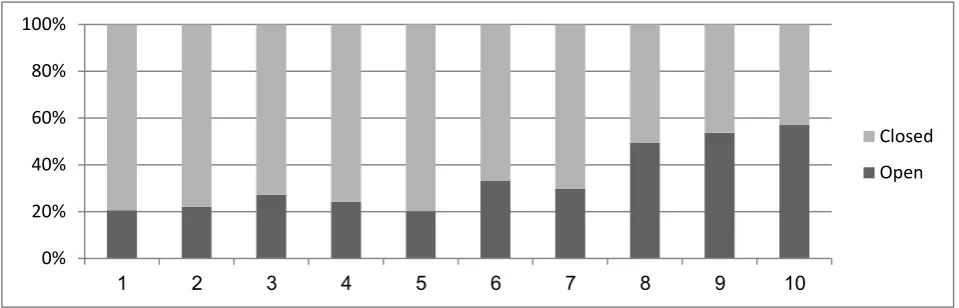
classroom discourse has changed over time. For example, Figure 1 tracks the ratio of open to
closed questions in the thirty observed lessons (aggregated for all three teachers by order of
observations), showing that over the course of the study, the teachers began to ask more open
questions and fewer closed questions.
---
Insert Figure 1 approximately here
---
This movement towards more frequent use of open questions and away from closed
questions suggests a change in teaching practice towards more dialogic pedagogy. However, this
was the only appreciable change over time, which raises the concern that this development was
merely a ‘bolt-on’ to familiar practice (Galton et al., 1999: 52) rather than an indicator of more
penetrating and/or durable changes in teaching and learning.
8 The proportion of open questions in both sets of data represents a considerable increase on the findings of the
Conditions under which Teaching and Learning Was More or Less Dialogic
We looked at a number of different factors shaping fluctuations in the frequency of
moves that are perceived to be indicative of relatively dialogic discourse; here we focus on the
distribution of discourse moves between pedagogic activities. Discourse features indicative of
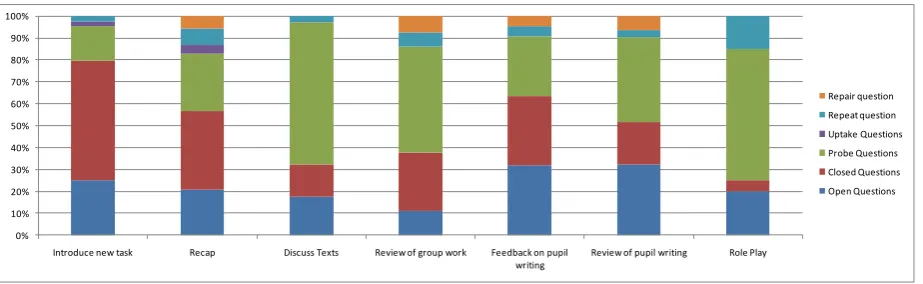
relatively dialogic teaching clustered around certain pedagogic activities, such as review of
group work, text-based discussions and feedback on pupil writing, and this phenomenon was
particularly pronounced in one of the classrooms (see figure 2). When the teacher, Ms. Leigh,
introduced a new task she posed more closed than open or probe questions (55% closed vs. 41%
open and probe questions), but this ratio was inverted when discussing texts (15% closed vs.
83% open and probe questions), reviewing pupil writing (19% closed vs. 71% open and probe
questions) or engaging in role play activities (5% closed vs. 80% open and probe questions).9
---
Insert Figure 2 approximately here
---
Uneasiness with the Move as Unit of Analysis
The above interpretations of our findings are based on the assumption that teacher
questions are a good indicator of the dialogic quality of the discourse overall. Though this
assumption is generally accepted, or at least implicit in most relevant studies, we were uneasy
with the reductionism involved in such an extrapolation from discourse move (teacher question)
to interactional category (dialogic pedagogy). First, the category of dialogic pedagogy includes
multiple dimensions of discourse and activity, among them participation norms, interpersonal
9 Detailed analysis of these patterns, including break-down of frequencies of all discourse features by activity type
relations, substantive content and epistemological stance (see Lefstein, 2010; Lefstein & Snell,
2011, 2014). The ratio of open to closed questions is only relevant to the final dimension: closed
questions are assumed to be suggestive of an authoritarian epistemological stance, and
vice-versa. But, this assumption is also problematic: the educative qualities of dialogic interaction do
not derive in and of themselves from teacher questions, but rather from the subsequent student
participation and teacher follow-up that are assumed to be stimulated by such questions (see e.g.
Cullen, 2002; Nassaji & Wells, 2000). However, the common idea that open questions will lead
to and be associated with other (roughly, dialogic) discourse features is undermined by the
finding (noted above) that no other aspects of discourse changed alongside the change in the
ratio of open to closed questions. The fact that only question types changed should make us
suspicious of the idea that that shift reflects a change in the quality of interaction.10 Finally,
when we looked more closely at 18 episodes that boasted a high density of “dialogic” discourse
moves (open, uptake and probe questions; elaborated feedback; pupil response to pupil; and
relative pupil participation), seven of them came up as “false positives”, i.e. episodes that did not
meaningfully differ from the rest of the corpus with regard to the substantive issues that
interested us, such as the interplay of teacher and student voices, reciprocal discourse norms, and
a critical, exploratory approach to knowledge.
To illustrate the importance of expanding the unit of analysis from discourse move to
sequence, consider the following extract, which took place at the beginning of a Year 6 lesson on
waste and recycling. The teacher, Ms. James, projected a powerpoint slide that posed an
apparently open question: “What do we do with our rubbish?”
Extract 1. “All that rubbish”11 1 2 3 4 5 6 7 8
Ms James: right
well what do we do with our rubbish (1.5) what does happen to our rubbish
have a think
about what happens to your rubbish that you get rid of at home
do you actually think about what happens to your rubbish 9 pupils: [no:
10 11 12 13 14 15
Ms James: [do you just
use something and then just put it in the bin and just (xxxxx xxxx)
it’s in the bin
nothing to do with me anymore 16 pupils: xxx xxxx ((a few shake heads)) 17
18 19
Ms James: where does it actually go what do we actually do with it Bethany
20 Bethany: it goes to landfill 21 22 23 24 25 26
Ms James: right landfill
we mentioned this the other day what is landfill
what is landfill any ideas
Nigel what’s landfill
27 Nigel: (putting) the rubbish in the ground 28
29
Ms James: yeah
it’s the rubbish that goes in the ground
A quick tally of discourse moves shows that this 30 second segment features a high ratio
of teacher open to closed questions. Ms James poses a series of three open questions (lines 2,
21-22, and 24-29) and only one closed question (line 23). However, though she explicitly
instructs the pupils to “have a think”, the open questions do not develop into a particularly
thoughtful or productive exchange. Instead, after posing and repeating her first question (what
11
Transcription notations:
(text)- Transcription uncertainty xxxx - indecipherable speech (1.5) - A 1.5 second pause
(( ))- Description of non-verbal activity [ - Overlapping talk or action [
happens to our rubbish?), Ms. James poses a second question (do you even think about this
question?), reformulates it in more concrete terms (do you just put it in the bin… nothing to do
with me anymore?) and then returns to a slightly different version of her first question (where
does it actually go?). At this point she receives and acknowledges a pupil response (line 20),
which she then uses as the basis for a classic closed elicitation sequence (Mehan, 1979) on lines
22-29. Clearly, counting the frequencies of open and closed questions – without attending to the ensuing interaction – paints a rather misleading picture of the academic quality of the talk in the
segment. In the next section we discuss alternative methods of analysing classroom discourse
that attempt to account for its sequential development.
Expanding the Unit of Analysis: Sequential Analysis
Current attempts to account for the sequential nature of classroom interaction can be
divided into top-down and bottom-up methods.
Top-down methods seek to code units larger than the discourse move, such as genre,
activity or exchange. Sinclair & Coulthard (1976), for example, in their seminal study of the
structure of classroom discourse, developed a hierarchical coding scheme in which lessons are
composed of transactions, which contain teaching exchanges, which comprise acts (discourse
moves). Their analysis highlighted the prevalent Initiation-Response-Follow-up (IRF) structure,
which has formed the basis for much classroom discourse analysis since, including the coding
system we have adapted here. Building on Sinclair and Coulthard’s scheme, Wells and
colleagues (Wells, 1999; Wells & Arauz, 2006) coded episode activity orientations and types of
exchanges, in addition to discourse moves. Because of the limited size of the corpus, and the
moves within the episodes, rather than on the episodes themselves. For example, they
investigated frequencies of negotiatory and known information questions within the various
episodes (and learning domains), the lengths of student responses, and the extent to which
responses to the different types of questions were followed up with evaluative or other forms of
teacher feedback.
Another example of coding discourse units larger than the discourse move is Mercer and
colleagues’ (Mercer, 1886; Mercer & Littleton, 2007) distinction between exploratory,
disputational and cumulative forms of talk. These categories have been productively used to
guide practice, and trained observers have been able to use them to differentiate between
experimental and control groups, but, as Mercer (1996) explains, they “are not meant to be descriptive categories into which all observed speech can be neatly and separately coded (as
might be done in systematic observation research)” (p. 368). Rather, when Mercer and
colleagues use quantitative measures of discourse in their research they turn to frequencies of
key phrases such as “I think” and lengths of utterances (Mercer & Littleton, 7002; Mercer,
Wegerif & Dawes, 1999).
Likewise, in most of our own work, we have used micro-analytic methods to examine
closely episodes lasting several minutes or longer (e.g. Lefstein & Snell, 2011c, 2014). Such
methods involve working slowly through the fine-grain details of talk and interaction, moving
between the specific event and the broader social structures, institutions, discourses and histories
that shape it, and of course consulting with the participants themselves. This strategy, however,
is extremely time-consuming and, while analysing episodes or genres makes good sense
theoretically, these categories tend to be relatively loose, with fuzzy boundaries, and as such are
An alternative approach is to work bottom-up from discourse moves to examination of
interactional sequences through lag sequential analysis (Bakeman & Gottman, 1997; see also
Chiu & Khoo, 2005, for a discussion that contrasts lag sequential with competing techniques).
This statistical method facilitates interrogation of the sequential organization of a series of events
(for example, discourse moves), including the conditional probabilities that some events will be
followed by certain others, the strength of these associations, and the significance of the
sequential patterns observed (i.e. that the relationships are not the result of the random
distribution of independent events).
Two recent studies employ lag sequential analysis to study classroom discourse patterns.
Jadallah and her colleagues (2011) coded small group discourse for different types of teacher
scaffolding moves and pupil responses in a corpus of 30 Collaborative Reasoning discussions
(including 5,300 turns at talk). They then analysed the probabilities of relevant pupil moves
following teacher prompts (e.g. pupil clarification following teacher request for clarification),
demonstrating both the immediate and delayed effects of teacher scaffolding moves on pupil
responses, and of pupil responses on other pupils’ utterances. Similarly, Molinari and colleagues (2012) used lag sequential analytic methods to investigate naturally occurring whole class
teaching in three Italian primary schools. The coded teacher questions, pupil responses and
teacher follow-up moves in a corpus of 828 triads identified in close to 10 hours of recordings,
and examined conditional probabilities between teacher initiations (e.g. authentic vs. focused
questions), pupil responses (e.g. correct vs. erroneous answers) and teacher follow-up moves.
They found a variety of significant triadic chains, including for example teacher authentic
question-correct pupil answer-teacher simple follow-up and teacher focused question-incorrect
Lag Sequential Analysis of the Toward Dialogue Corpus
We translated our corpus into the Sequential Data Interchange Standard (SDIS) and
analysed it by means of the Generalized Sequential Querier (GSEQ) 5.1 and ILOG 4 computer
programmes (Bakeman & Quera, 2011; Bakeman & Robinson, 1994). The resulting data-base
includes 7,228 discourse moves (hereafter, events) divided into 142 discrete observations (a
topically focused pedagogic activity in the whole class teaching segment in one of twenty-nine
lessons taught by three teachers). The original corpus was coded using 25 discreet categories.
However, performing lag sequential analysis on this number of codes would require many more
events than we recorded (the formula for computing the necessary number of events is 5 x Kl+1
where K is the number of codes and l is the number of lags examined (lag +1 are two move
chains, lag +2 yield three move chains, etc.); therefore, analysing 25 codes at lag +2 would
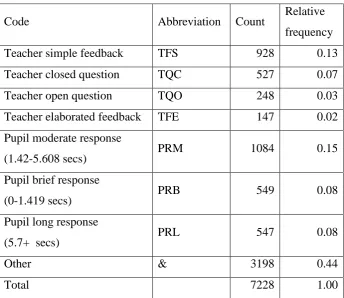
require 78,125 events). For this reason, we selected the seven codes that most interest us
theoretically – teacher open and closed questions, pupil brief, moderate and lengthy responses,
and teacher simple and elaborate feedback – lumping all the other codes into an Other category.12 Performing lag sequential analysis at lag +2 with eight codes necessitates 2,560 events, a
requirement we satisfy for one of the teachers (Ms James) and of course for all of the teachers
pooled together, but not for the different types of pedagogic activity; performing this analysis at
lag +1 requires 320 events, a requirement we satisfy for all teachers and most of the activities.
Counts and relative frequencies of the eight codes are provided in Table 2:
---
12
Insert Table 2 approximately here
---
We posed five questions for lag sequential analysis of this data – the first two refer to general sequential tendencies within the corpus, the latter three to the specific issues explored
above through examination of frequencies of individual discourse moves:
1) Is the observed discourse sequentially structured? Put another way, what is the
likelihood that the structures observed are random, the result of the independent distribution of
discourse over time?
2) Do certain kinds of pupil response follow certain kinds of teacher questions? And are
these question-response pairs followed by certain types of follow-up? Specifically, we
hypothesize (a) that Teacher Closed Questions are likely to be followed by Pupil Brief
Responses, which in turn are likely to give rise to Teacher Simple Feedback (i.e. the chain
TQC-PRB-TFS is hypothesized to recur significantly more often than if discourse moves were
independent of one another), and (b) that Teacher Open Questions are likely to be followed by
Pupil Long Responses, which in turn are likely to give rise to Teacher Elaborate Feedback (i.e.
the chain TQO-PRL-TFE is hypothesized to recur significantly more often than if discourse
moves were independent of one another).
3) Are there significant differences between the teachers with regard to how discourse in
their classrooms is sequentially structured? For example, in the comparison of frequencies of
key discourse moves Ms Leigh’s class appeared to be more dialogic than Ms James’ class – are
these differences manifest also in sequential patterns?
4) Did the sequential patterns observed in the three classrooms change over time? For
discourse chains as they deepened their understandings of classroom discourse through
collaboration with one another and with us in video-based reflective workshops?
5) Did the sequential patterns observed vary between different pedagogical activities?
For example, certain activities, such as discuss texts and feedback on pupil writing, boasted
higher frequencies of dialogic discourse moves – are there similar differences in sequential patterns?
We begin with the latter three questions, since we must first establish how stable the
sequential dependencies are in order to decide how to cut up the data-set in order to investigate
the first two questions. In the accepted terms of lag sequential analysis we need to test for
heterogeneity –the stability of the sequential relationships across the three different teachers’ classrooms, and stationarity – the stability of the sequential relationships over time (in our case, across pedagogic activities and over the course of the school year). To do so, we compared the
sequential dependencies in sub-sets of the corpus (e.g. each of the classrooms) to the corpus as a
whole and computed likelihood ratio chi square statistics to test for the significance of the
differences between them (see, e.g., Jadallah et al., 2011). We based these tests on 2 X 4
contingency tables that include as the given event the two categories of teacher questions that
most interest us (TQO and TQC), with the three types of pupil responses (PRB, PRM and PRL)
as the target events. The results of these and the other tests are displayed in Table 3.
---
Insert Table 3 approximately here
The results of the heterogeneity tests are significant, indicating that the differences
between the classrooms are greater than might be expected by chance.13 For this reason, we do
not pool the data across classrooms for the rest of the tests, instead analysing each classroom
corpus separately.
We conducted two stationarity tests: one for changes over time, for which each classroom
corpus was divided into three segments, and the other for differences between pedagogic activity
(observations were pooled for each of eight pedagogic activities; one activity, Explain, was
removed since it occurred only once in the corpus and contained only 62 events). Like the tests
of heterogeneity, the stationarity tests are based on the sequential dependencies between closed
and open teacher questions and brief, medium and long pupil responses.
Readers will note that degrees of freedom vary among the stationarity tests. These
differences are due to the absence of the relevant sequential chains in some of the activities and
stages. In such cases we either removed the relevant code (PRB or PRL) and/or activities,
depending on which omission maximized the number of events in the test. The tests examine
non-stationarity, i.e. the assumption that differences between the segments or activities are
significant. Hence, a non-significant result shows that differences between the segments and
activities are no greater than might be reasonably expected by chance, and we should therefore
reject the hypothesis that the relevant discourse patterns changed over time or between
pedagogic activities. The results of these tests are mixed: seven indicating stationarity and five
demonstrating significant differences between activities or over time. The significant results of
the three tests for stationarity between activities can be explained in each case by one particularly
13
deviant pedagogic activity: review group work vis-à-vis TQC-initiated dyads in Mr Robbins’ classroom, discuss texts vis-à-vis TQO-initiated dyads in Ms Leigh’ classroom, and role play
vis-à-vis TQO-initiated dyads in Mr Robbins’ classroom. In all three cases, the results are insignificant if this one anomalous activity is removed. The significant results for the tests of
change over time are due to a sharp reduction in TQC-PRM and TQC-PRL dyads in the final
segment in Mr Robbins’ classroom (conditional probabilities of 0.13 and 0.02 respectively, compared to 0.4 and 0.16 overall), and to a relative decrease in TQO-PRB and TQO-PRM dyads
in the middle segment in Ms James classroom (conditional probabilities of 0.14 and 0.14
respectively, compared to 0.29 and 0.33 overall), likely due to intensive preparations for the
standardized tests that took place in May of the academic year (see Snell & Lefstein, 2011, p.
13). On account of these significant results we focus our analyses primarily on Ms James’ and
Ms Leigh’s classrooms, which exhibited fewer stationarity problems.
We now turn to examine the nature of the sequential patterns within each of the
classrooms. First, we conducted tests of independence, i.e. the hypothesis that the discourse
moves are independent of one another, and any relationships detected are the result of their
random distribution. These tests are all significant at the 0.001 level, indicating that the
sequential dependencies are highly unlikely to have occurred by chance. Next we explored
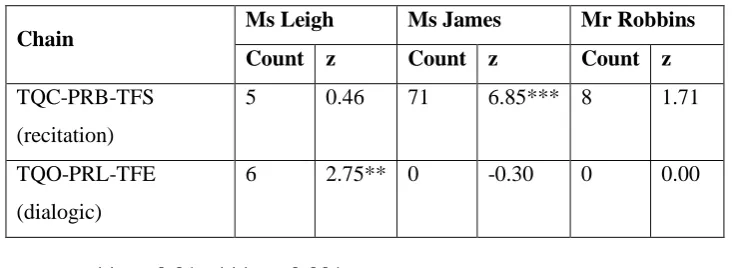
specific chains of discourse moves that interested us: TQC-PRB-TFS and TQO-PRL-TFE. The
first chain is typical of recitation teaching: the teacher poses a closed question, which is met by a
brief (under 1.5 second) response, which is then followed up by simple feedback
(acknowledgement or rejection of the answer without further explanation or elaboration). The
second chain is indicative of more dialogic teaching: the teacher poses an open question, which
teacher feedback. Table 4 displays the distribution of these two chains within each classroom,
along with z scores, which are used to calculate the significance of the chain given the baseline
frequencies of each of the events within the relevant corpus.
---
Insert Table 4 approximately here
---
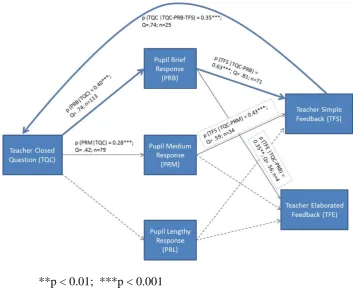
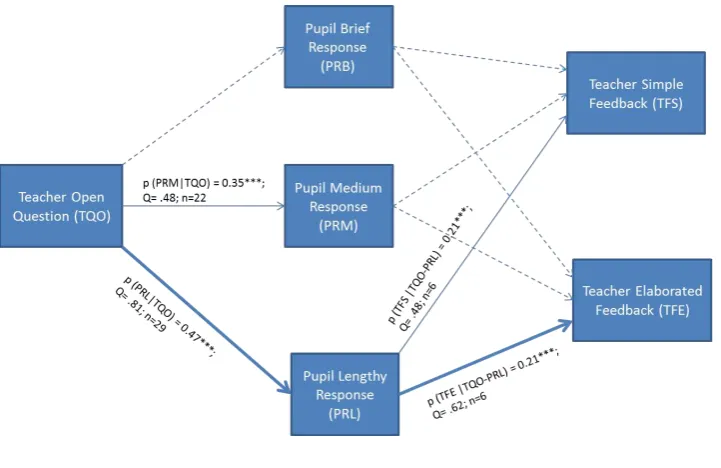
Another way of examining these relationships is by displaying graphically the
associations between each of the phases. Figures 3 and 4 show the two most significant chains
observed: TQC-PRB-TFS in Ms James classroom and TQO-PRL-TFE in Ms Leigh’s classroom,
juxtaposed alongside the sequential dependencies for other pupil responses and teacher feedback
moves for the given teacher initiations. Note that these figures are not conventional state
transition diagrammes, in which conditional probabilities are given for the relationships between
contiguous events; rather, the diagrammes are cumulative: for lag +2 (i.e. two moves after the
teacher initiation) we show the probabilities of the target follow-up move given the teacher
question-pupil response dyad, and at lag +3 we show the probability of cycling back to TQC
following the entire TQC-PRB-TFS chain (in figure 3). For each significant relationship we
display conditional probabilities (written “p (I | J)”, i.e. the conditional probability of I given J),
Yule’s Q (a value that ranges from 0 to 1, with 0 signifying no association, and 0.2, 0.43 and 0.6 conventionally interpreted as weak, moderate and large associations respectively; see Yoder &
Symons, 2010, p. 126) and joint frequencies. Dotted arrows show non-significant relationships,
while heavy lines show strong associations.
---
---
So as not to overwhelm, we have spared readers detailed information about the sequential
dependencies of TQC and TQO chains in the other two classrooms, in which the associations are
not nearly as strong or clear-cut. By way of illustration, the conditional probability of PRB
following TQC in Ms Leigh’s classroom is 0.19 (Yule’s Q = 0.56), and the conditional
probability of PRL following TQO in Ms James’ classroom is 0.08 (Yule’s Q = 0.38). The
sequential analysis shows that the discourse norms that bind teacher closed questions, brief pupil
responses and teacher simple feedback are particularly strong in Ms James’ classroom, while the open question, extended pupil response and elaborate feedback pattern is most pronounced in Ms
Leigh’s classroom.
Conclusion: the Potential and Limitations of Sequential Classroom Discourse Analysis
This article has explored the problem of the unit of analysis in studies of classroom
discourse. We noted that most attempts to quantitatively study classroom discourse use the
individual discourse move as their unit of analysis. We questioned this practice, arguing that
discourse moves are positioned within sequences that critically shape their meaning and effect.
We illustrated this theoretical point through exploration of discourse data from a study of
primary literacy classrooms, showing that accepted indicators such as open and closed questions
can be very problematic if abstracted from the sequences in which they are embedded. We then
proposed that lag sequential analysis may help overcome some of the shortcomings associated
with conventional calculations of frequencies and rates of individual moves, and demonstrated
this method in a re-analysis of the same data set. To what extent has the sequential analysis
The lag sequential analysis findings coincide to a certain extent with the comparison of
rates of open and closed questions in Table 1. Ms James posed a greater proportion of closed to
open questions than did Ms Leigh, and offered less elaborate feedback. Likewise, pupils in the
former classroom speak for less time than in the latter classroom. However, the sequential
analysis shows how these different discourse moves interact. After all, Ms James also posed
open questions, and Ms Leigh closed questions. Significantly, the closed questions in Ms James’ class tended to give rise to brief pupil responses, which in turn tended to receive simple teacher
feedback followed by a further closed question: a statistically significant 71 occurrences of this
chain in Ms James’ classroom in comparison to a non-significant 5 instances in Ms Leigh’s
classroom (see table 4). Likewise, almost half of Ms Leigh’s open questions led to lengthy pupil responses, which were strongly associated with elaborate feedback (a significant 6 occurrences
of this chain in Ms Leigh’s classroom compared to its non-signficant non-occurrence in Ms
James’ classroom). Consequently, we would argue that the meaning of open and closed
questions in the two classrooms is qualitatively different, and that counts of frequencies of
individual discourse moves do not tell the whole story.
Similarly, the sequential analysis offers some insight into the issues of change over time
and differences among the pedagogic activities. Many of the differences that we observed in the
distribution of frequencies (figures 1 and 2) are not accompanied by similar differences in
sequential structures. While some of the non-stationarity tests for differences between pedagogic
activities were significant, these effects were not nearly as pronounced as in the comparison of
individual discourse move frequencies, and disappeared when one anomalous activity was
omitted. Finally, only one of the two significant non-stationarity tests for changes over time –
became more dialogic over the course of the year. Moreover, this finding is not supported by the
stationarity test for TQO-initiated sequences in that classroom, or for the tests of stability over
time in the other two classrooms.
In closing, we note some key limitations of this exercise. First, we did not have sufficient
data to perform some of the tests we would have liked to have undertaken, for example,
comparing lag +2 sequential patterns in the different pedagogic activities. Second, our original
coding system was not devised for this sequential analysis, and as a result included too many
codes and, critically, insufficiently sensitive categories to differentiate pupil responses. In future
research we intend to use coding schemes that differentiate more clearly between types of pupil
discourse moves, investigating, for example, the accuracy of pupil answers, the use of
argumentation, and speaking with or without explicitly receiving the floor. Third, and most
importantly, lag sequential analysis cannot overcome the inherent limitations of a coding system
that focuses on form rather than meaning or relationships, and is incapable of coming to terms
with ambiguity.
These limitations notwithstanding, we believe that this exercise has demonstrated the
potential power of sequential analysis to address some of the shortcomings of conventional
methods for counting relative frequencies and distributions of individual discourse moves. Units
of analysis of course need to be appropriate to research purposes, but they also need to be
well-suited to the intrinsic qualities of the object of inquiry. Lag sequential analysis offers a
promising way forward in accounting for the sequentially structured nature of classroom
References cited
Bakeman, R., & Gottman, J. M. (1997). Observing interaction: an introduction to sequential analysis (2nd ed.). Cambridge: Cambridge University Press.
Bakeman, R., & Quera, V. (2011). Sequential Analysis and Observational Methods for the Behavioral Sciences. Cambridge: Cambridge University Press.
Bakeman, R., & Robinson, B. F. (1994). Understanding log-linear analysis with ILOG: An interactive approach. Hillsdale, NJ: Erlbaum.
Bakhtin, M. M., Holquist, M., & Emerson, C. (1981). The dialogic imagination: four essays. Austin: University of Texas Press.
Bloome, D., Carter, S. P., Christian, B. M., Otto, S., & Shuart-Faris, N. (2005). Discourse analysis & the study of classroom language & literacy events: a microethnographic perspective. Mahwah, N.J.: L. Erlbaum Associates.
Chiu, M.M., & Khoo, L. (2005). A new method for analyzing sequential processes dynamic multilevel analysis. Small Group Research, 36(5), 600-631.
Cullen, R. (2002). Supportive teacher talk: The importance of the F move. ELT Journal, 56(2), 117-127.
Dillon, J. T. (1982). The Effect of Questions in Education and Other Enterprises. Journal of Curriculum Studies, 14(2), 127-152.
Duranti, A., & Goodwin, C. (1992). Rethinking context: language as an interactive phenomenon. Cambridge: Cambridge University Press.
Engeström, Y., Miettinen, R., & Punamäki, R.L. (1999). Perspectives on activity theory. Cambridge, UK: Cambridge University Press.
Galton, M. J., Croll, P., & Simon, B. (1980). Inside the primary classroom. London ; Boston: Routledge & Kegan Paul.
Galton, M., Hargreaves, L., Comber, C., Wall, D., & Pell, T. (1999). Changes in Patterns of Teacher Interaction in Primary Classrooms: 1976-96. British Educational Research Journal, 25(1), 23-37.
Gee, J. P. (2011). An introduction to discourse analysis: theory and method (3rd ed.). Milton Park, Abingdon: Routledge.
Goodlad, J. I. (1984). A place called school: prospects for the future. New York: McGraw-Hill Book Co.
Hardman, F., Smith, F., & Wall, K. (2003). 'Interactive whole class teaching' in the national literacy strategy. Cambridge Journal of Education, 33(2), 197.
Harris, D., & Williams, J. (2012). The association of classroom interactions, year group and social class. British Educational Research Journal, 38(3), 373-397.
Jadallah, M., Anderson, R. C., Nguyen-Jahiel, K., Miller, B. W., Kim, I., Kuo, L., Dong, T., & Wu, X. (2011). Influence of a teacher’s scaffolding moves during child-led small-group discussions, American Educational Research Journal, 48(1), pp. 194-230.
Lefstein, A., & Snell, J. (2011a). Classroom discourse: the Promise and Complexity of Dialogic Practice. In S. Ellis, E. McCartney & J. Bourne (Eds.), Insight and Impact: Applied Linguistics and the Primary School. Cambridge: Cambridge University Press. Lefstein, A., & Snell, J. (2011b). Professional vision and the politics of teacher learning.
Teaching and Teacher Education, 27(3), 505-514. doi: 10.1016/j.tate.2010.10.004 Lefstein, A., & Snell, J. (2011c). Promises and Problems of Teaching With Popular Culture: A
Linguistic Ethnographic Analysis of Discourse Genre Mixing in a Literacy Lesson. Reading Research Quarterly, 46(1), 40-69.
Lefstein, A., & Snell, J. (2013). Beyond a unitary conception of pedagogic pace: quantitative measurement and ethnographic experience. British Educational Research Journal, 39(1), 73-106.
Lefstein, A., & Snell, J. (2014). Better Than Best Practice: Developing Teaching and Learning Through Dialogue. Abingdon: Routledge.
Levinson, S. C. (1979). Activity types and language. Linguistics, 17(5/6), 356-399.
Matusov, E. (2007). In Search of the Appropriate Unit of Analysis for Sociocultural Research. Culture & Psychology, 13(3), 307-333.
Mehan, H. (1979). Learning lessons: Social organization in the classroom. Cambridge, Mass: Harvard University Press.
Mercer, N. (1996). The quality of talk in children's collaborative activity in the classroom. Learning and Instruction, 6(4), 359-377.
Mercer, N. (2004). Sociocultural discourse analysis: Analysing classroom talk as a social mode of thinking. Journal of Applied Linguistics, 1(2), 137-168.
Mercer, N. (2010). The analysis of classroom talk: Methods and methodologies. British Journal of Educational Psychology, 80(1), 1-14.
Mercer, N., & Littleton, K. (2007). Dialogue and the development of children's thinking: A sociocultural approach. London: Routledge.
Mercer, N., Wegerif, R., & Dawes, L. (1999). Children's talk and the development of reasoning in the classroom. British Educational Research Journal, 25(1), 95-111.
Molinari, L., Mameli, C., & Gnisci, A. (2012). A sequential analysis of classroom discourse in Italian primary schools: The many faces of the IRF pattern. British Journal of
Educational Psychology, 83(3), 414-430.
Myhill, D., & Dunkin, F. (2005). Questioning Learning? Language and Education, 19(5), 415-427.
Nystrand, M., Gamoran, A., Kachur, R., & Prendergast, C. (1997). Opening dialogue:
understanding the dynamics of language and learning in the English classroom. New York: Teachers College Press.
Schegloff, E. A. (2001). Discourse as an Interactional Achievement III: The Omnirelevance of Action. In D. Schiffren, D. Tannen & H. E. Hamilton (Eds.), The handbook of discourse analysis (pp. 229-249). Malden, MA: Blackwell.
Selting, M. (2000). The Construction of Units in Conversational Talk. Language in Society, 29(4), 477-517.
Sinclair, J.M., & Coulthard, M. (1976). Towards an analysis of discourse: The English used by teachers and pupils. Oxford University Press: London.
Smith, F., Hardman, F., Wall, K., & Mroz, M. (2004). Interactive whole class teaching in the National Literacy and Numeracy Strategies. British Educational Research Journal, 30(3), 395-411.
Snell, J. (2011). Interrogating video data: systematic quantitative analysis versus micro
ethnographic analysis. International Journal of Social Research Methodology, 14(3), 253-258.
Snell, J. & A. Lefstein (2011) Computer-assisted systematic observation of classroom discourse & interaction: Technical report on the systematic discourse analysis component of the Towards Dialogue study. Working papers in Urban Language & Literacies, #77.
London: King’s College London. <http://www.kcl.ac.uk/depsta/education/wpull.html>. Varenne, H., & McDermott, R. (1998). Successful failure: The school America builds. Boulder,
CO: Westview Press.
Vygotsky, L.S. (1987). The collected works of L.S. Vygotsky: Vol. 1: Thinking and speech (R.W. Rieber & A.S. Carton, Eds.). New York: Plenum.
Webb, N. M., Franke, M. L., De, T., Chan, A. G., Freund, D., Shein, P., et al. (7008). ‘Explain to your partner’: teachers' instructional practices and students' dialogue in small groups. Cambridge Journal of Education, 39(1), 49-70.
Wells, G. (1999). Dialogic inquiry: Towards a sociocultural practice and theory of education. Cambridge, U.K.: Cambridge University Press.
Wells, G., & Arauz, R. M. (2006). Dialogue in the classroom. Journal of the Learning Sciences, 15(3), 379-428.
Wertsch, J.V. (1998). Mind as action. Oxford: Oxford University Press.
Figure 1. Change over time: open vs. closed questions 0%
20% 40% 60% 80% 100%
1 2 3 4 5 6 7 8 9 10
Closed
Figure 2. Discourse variation as a function of pedagogic activity in Ms Leigh’s lessons 0%
10% 20% 30% 40% 50% 60% 70%
Introduce new task Recap Discuss Texts Review of group work Feedback on pupil writing
Review of pupil writing Role Play
**p < 0.01; ***p < 0.001
**p < 0.01; ***p < 0.001
Ms Leigh Ms James Mr Robbins
School Average
National Sample Lessons sampled 10 10 10 30 35 Total whole-class teaching sampled
(mins) 224 262 244 729
Mean lesson duration (mins) 49 50 46 48 53 Mean whole-class teaching duration
(mins) 22 26 24 24 32
Mean percentage whole-class teaching 45% 52% 52% 50% 60%
RATE PER HOUR
Teacher
Explain 35 61 33 44 52
Direct 49 32 46 42 43
Open Questions 20% 16 14% 29 18% 19 16% 22 13% 15 Closed Questions 30% 24 35% 71 36% 37 34% 46 50% 58
Probe Questions 38% 31 17% 34 26% 27 23% 31 17% 19 Uptake Questions 1% 1 4% 9 3% 3 3% 5 7% 8
Repeat or repair question 11% 9 30% 62 16% 17 23% 30 13% 15
Total Questions 81 205 103 134 115
Elaborated Feedback 42% 26 6% 8 6% 5 13% 13 Simple Feedback 58% 36 94% 116 94% 90 87% 83
Total Feedback 62 124 95 95 65
PUPIL
Spontaneous Contribution 21 19 49 30 10 Read aloud/pupil presentation 12 11 14 13 11
Response to Teacher 145 200 158 169 120 Choral response 19 52 15 24 9
Average duration pupil response to
teacher (seconds) 6 3 6 5 5
Percentage contribution (duration) 32% 23% 41% 32% 25%
Table 1. Cross-classroom Comparison of Frequencies and Rates of Discourse Moves
Code Abbreviation Count Relative frequency
Teacher simple feedback TFS 928 0.13
Teacher closed question TQC 527 0.07
Teacher open question TQO 248 0.03
Teacher elaborated feedback TFE 147 0.02
Pupil moderate response
(1.42-5.608 secs) PRM 1084 0.15
Pupil brief response
(0-1.419 secs) PRB 549 0.08
Pupil long response
(5.7+ secs) PRL 547 0.08
Other & 3198 0.44
[image:37.595.86.431.96.394.2]Total 7228 1.00
Independence
between activities over time Heterogeneity
Initi-ation Class LR
2
df p LR 2 df p LR 2 df p LR 2 df p
TQC
Ms James 253.28 3 0.001 24.79 48 0.998 32.85 24 0.107
264.83 24 0.0001 Ms Leigh 76.08 3 0.001 25.77 24 0.365 24.86 24 0.413
Mr Robbins 108.34 3 0.001 91.90 60 0.005 44.85 24 0.006
TQO
Ms James 74.50 3 0.001 23.77 24 0.475 67.99 24 0.001
292.16 24 0.0001 Ms Leigh 82.79 3 0.001 40.18 18 0.002 46.66 12 0.366
[image:38.595.48.533.76.256.2]Mr Robbins 53.54 3 0.001 75.76 30 0.001 11.05 12 0.524
Chain Ms Leigh Ms James Mr Robbins
Count z Count z Count z
TQC-PRB-TFS
(recitation)
5 0.46 71 6.85*** 8 1.71
TQO-PRL-TFE
(dialogic)
6 2.75** 0 -0.30 0 0.00
[image:39.595.115.482.97.231.2]**p < 0.01; ***p < 0.001