MICROSPHERES OF PERINDOPRIL ERBUMINE
Dissertation submitted to
THE TAMIL NADU DR.M.G.R. MEDICAL UNIVERSITY,
CHENNAI.
In partial fulfillment for the award of the degree of
MASTER OF PHARMACY IN PHARMACEUTICS
Submitted by
(Reg. No: 26108602)
DEPARTMENT OF PHARMACEUTICS
COLLEGE OF PHARMACY
MADURAI MEDICAL COLLEGE
MADURAI – 625 020.
Dr. AJITHADAS ARUNA, M.Pharm., Ph. D., Principal,
College of Pharmacy, Madurai Medical College, Madurai-625 020.
CERTIFICATE
This is to certify that the dissertation entitled “FORMULATION AND CHARACTERIZATION OF FLOATING MICROSPHERES OF PERINDOPRIL
ERBUMINE”submitted by Mr. S. KATHIRAVAN in partial fulfillment of the requirement for the Degree of Master of Pharmacy in Pharmaceutics is a bonafide work carried out by him, under the guidance and supervision of Mr.A.Abdul Hasan Sathali, M.Pharm.,(Ph.D) Professor and Head, in the Department of Pharmaceutics, Madurai Medical College, Madurai-20, during the academic year 2011 – 2012. This dissertation is forwarded to the Controller of Examination, The Tamil nadu Dr. M.G.R. Medical University, Chennai.
Prof. Mr. A.Abdul Hasan Sathali, M.Pharm., (Ph.D)., Professor & Head,
Department of Pharmaceutics, College of Pharmacy,
Madurai Medical College, Madurai-625020
CERTIFICATE
This is to certify that the dissertation entitled “FORMULATION AND CHARACTERIZATION OF FLOATING MICROSPHERES OF PERINDOPRIL
ERBUMINE”submitted by Mr. S. KATHIRAVAN in partial fulfillment of the requirement for the Degree of Master of Pharmacy in Pharmaceutics is a bonafide work carried out by him, under my guidance and supervision during the academic year 2011 – 2012 in the Department of Pharmaceutics, Madurai Medical College, Madurai-20.
I wish him success in all his endeavors.
It is my pleasure to express my respectful regards and thanks to Mr.Dr.A.Edwin Joe M.D., F.M., B.L., Dean, Madurai Medical College, Madurai for providing all kinds of supportive facilities required to carry out my project work.
It is my privilege to extend my gratitude to Dr. Ajithadas Aruna, M.Pharm., Ph.D., Principal, College of pharmacy, Madurai Medical College, Madurai for her support to carry out my project work.
It is my immense pleasure and honour to express my deep sense of gratitude and heartfelt thanks to Prof.Mr. A. Abdul Hasan Sathali, M.Pharm.,(Ph.D)., Head and Professor, Department of Pharmaceutics for his excellence in guidance, contribution and encouragement which helped me in the successful completion of each and every stage of my project work.
I thank Mr. C. Pandian, M.Pharm., Mrs. D. Uma Maheswari, M.Pharm., and Mr. R. Senthil prabhu, M.Pharm. Dept. of Pharmaceutics for his support and valuable
suggestions throuhtout my work.
I also extend my thanks to our department staffs Mrs. Mumtaj, Mrs. Geetha and Mrs.Chitravalli for their contribution throughout my project work.
college of Pharmacy, Ooty. For her helping to carry out DSC studies in accordance with my dissertation work.
My sincere thanks to Mr.S. Manivannan, Dept. of Physics, NIT, Trichy for their help in the powder X-ray determination.
I wish to acknowledge Mr. A.Raja, Dept. of Nanotech, Karunya Uniiversity, Coimbatore for his help in SEM Studies in accordance with my Dissertation work for carrying out size and topography analysis of my formulations.
I am very much thankful to Mrs.Lavanya Anbu, Pharma Information Centre, Chennai, for her help in reference collections regarding my project.
I extend my thanks to Dr.Jonat M.V.S.C Veterinary Assistant Surgeon, Central Animal House, Madurai Medical College, Madurai for his valuable assistance during invivo studies.
I wish to thank M/s.Madurai Digital X-Rays, for their timely help to carry out my X-Ray studies.
I express my heartiest thanks to United Scientifics and universal drug & chemical suppliers for providing chemicals to carry out my project work.
Mrs.R.Kavitha, Ms.K.Priyanka, Ms.P.Shanmugapriya and Ms.T.Sangeetha for their moral support.
I would like to give my sincere thanks to my friends Mr.S.Ganesan, Mr.V.Palanivel, Mr.T.Prakash, Mr.D.RajivGandhi, Mr.V.Selvaraj, Ms.R.Revathi, Ms.T.Suganya, Mr.J.Varun, Ms.B.Yuganya for their timely help and co-operation.
I would like to give my sincere thanks to my juniors Ms. C. Deepa., Ms. M. Gomathi., Mr. M. Gopinath., Mrs. J. Jayalakshmi., Mr. L. Magesh kumar., Mr. P.Mainkandan., Mr. I. Samdurai., Ms N.Surya devi., Ms. V.Susila devi., & Ms. N. Nisha for their timely help and co-operation.
I also extend my thanks to all the staff members and P.G. Students of Department of Pharmaceutical Chemistry and Pharmacognosy for their Co-operation.
I honestly acknowledge the love, care and moral support rendered by my family members & friends whose part cannot be expressed in holophrastic.
CHAPTER
NO TITLE
PAGE NO
I INTRODUCTION 1
II GASTRORETENTIVE DRUG DELIVERY SYSTEM –A
REVIEW 15
III LITERATURE REVIEW 46
IV AIM OF THE WORK 56
V PLAN OF WORK 58
VI MATERIALS AND EQUIPMENTS 60
VII DRUG PROFILE 62
VIII POLYMERS AND EXCIPIENTS PROFILE 68
IX EXPERIMENTAL DETAILS 81
X RESULTS AND DISCUSSION
TABLES & FIGURES 89
XI
SUMMARY AND CONCLUSION
135
Madurai Medical College Page 1 CHAPTER-I
INTRODUCTION
ORAL CONTROLLED DRUG DELIVERY SYSTEMS
Oral ingestion has long been the most convenient and commonly employed
route of drug delivery. Indeed, for controlled release systems the oral route of
administration has received attention with respect to research on physiological and drug
constraints as well as design and testing of product. This is because there is more
flexibility in dosage form design for oral route than that of parenteral route. Drug
delivery technologies are the formulation technologies that modify drug release profile,
absorption, distribution and elimination for the benefit of improving product efficacy
and safety, as well as patient convenience and compliance (Brahmankar.D.M.,
Jaiswal.S.B., 2007).
Routes of administration
1. Enteral.
2. Topical.
3. Parenteral.
1. Enteral drug delivery:
It includes peroral i.e.
Gastro-intestinal
Sub-lingual
Rectal
2. Topical drug delivery:
Madurai Medical College Page 2 Intranasal
Inhalational
Intravaginal
Transdermal
3. Parenteral drug delivery:
It includes all routes of administration through or under one or more layers of skin.
Intramuscular
Subcutaneous
Intravenous
The most preferred route of drug administration for systemic delivery of drugs is
orally (Chien, Y.W., 1982). More than 50% of drug delivery systems available in the
market are oral drug delivery systems. These systems have the obvious advantages of
case of administration and patient acceptance. Several oral drug delivery technologies
have come and gone, and new systems still emerge even today.
One would always like to have ideal drug delivery systems that will possess
two main properties (Lingaraj, et al, 2010),
1. It will be a single dose for the whole duration of treatment,
2. It will deliver the active drug directly at the site of action.
The Challenge:
Most of the marketed products currently available are immediate release
products. To achieve and maintain the concentration of an administered drug within
Madurai Medical College Page 3 Brahmankar.D.M., Jaiswal.S.B., 2007) it is often necessary to take drug dosage several
times and this result in a fluctuating drug level in plasma.
The Controlled Release:
Controlled drug delivery is one which delivers the drug at a predetermined rate,
for locally or systemically, for a specified period of time.
Continuous oral delivery of drugs at predictable & reproducible kinetics for
predetermined period throughout the course of GIT.
There are many benefits offered by controlled drug delivery systems (Chien,
Y.W., 1982). For example, sustained release technologies allow prolonged delivery of a
therapeutic dose, thus reducing the number of times that a patient needs to take their
medication while maintaining a steady state of drug in the bloodstream, and
time-delayed release introduces a lag time before dose release, providing pulsatile delivery of
drug to specific sites, such as the colon, or at a specific time. Temporal control of drug
release has particular advantages in the treatment of disorders that demonstrate a
circadian pattern, such as cardiovascular disorders, asthma, anxiety and
hypercholesterolemia. In such cases, the development of controlled-release
formulations that deliver the payload at an optimal time can greatly enhance the
therapeutic effects of the drug and reduce the dose required.
Potential methods that can be used to retard drug release are:
1. Capsules of polymeric material filled with a solid or liquid drug or with a
suspension of drug, in which drug release is controlled by diffusion through the
Madurai Medical College Page 4 2. A heterogeneous dispersion of drug particles in a solid matrix which can be either
biodegradable or non-biodegradable, and drug release is controlled by diffusion
through or erosion of the matrix, or both.
3. A laminate of agent and polymeric material made by coating a film of
biodegradable material with solid drug and then by forming the filminto a sealed
"Sandwich" or "Jelly roll" in which drug release is controlled by diffusion,
erosion, or both(Robinson J.R. and Lee V.H.L., 1987.).
4. Liquid-liquid encapsulation of the drug in a viscous solution of polymer, in which
drug release is controlled by slow diffusion through dilution of the media (Zhao
W.Q., Pu B.Y. and Hartland S., 1993).
5. Pumps that either mechanically or chemically (osmotic pressure) provide drug in a
controlled manner (Prabakaran D., et al., 2004,Li X., Pan W., Nie S. and Wu L., 2004.Verma R.K. and Garg S., 2004).
6. Microparticles that have an apparent density lower than that of gastric juice. Thus,
the final product float on gastric juice for an extended period while slowly
releasing the drug (Streubel A., et al., 2002, EL-Kamel A.H., 2001).
7. Drug-containing bio adhesive polymer that adheres to the mucin coating of the
Madurai Medical College Page 5 transit time of the drug. Drug is released at a constant rate from the bio adhesive
polymer for subsequent absorption (Kriwet B et al., 1998)
8. Chemical bonding of drug to a polymer backbone by pendent amide or ester
linkage, in which drug release is controlled by hydrolysis (Hoste K., et al 2004)
ORAL CONTROLLED RELEASE FORMULATIONS:
Oral route has been the commonly selected and most convenient for the drug
delivery. (Vyas.S.P., Khar R K., 2002) Oral route of administration has more attention
in the pharmaceutical field because of the more flexibility in the designing of dosage
form than routes drug delivery.
Most of the oral controlled drug delivery systems rely on diffusion, dissolution
or combination of both mechanisms, to release the drug in a controlled manner to the
Gastrointestinal Tract (GIT).
Novel oral drug delivery systems are broadly classified in to two categories as
they may controlled release dosage forms as well as targeting dosage forms. General
controlled manner in the GIT for systemic uptake and no particular area of GIT
specified. In contrast, targeted preparations are releasing the drug in a specified area or
tissue of the GIT (e.g. colon specific drug delivery systems).
Targeting systems are either releasing drug in controlled manner or in one burst
at the specific area (Vyas, S.P., Khar, and R.K). The goal of a targeted oral drug
delivery system (TODDS) is to achieve better therapeutics success compared to
conventional dosage form. This can be achieved by improving the pharmacokinetic
profile, patient convenience and compliance in therapy, some of the advantages of
Madurai Medical College Page 6 Reduced dosing frequency
Better patient convenience and compliance
Reduced GI side effects and other toxic effects.
Less fluctuating plasma drug level
More uniform drug effect
Less total dose
Better stability of the drug.
On the other hand TODDS suffer from a number of potential disadvantages:
o Higher cost
o Relatively poor in vitro-in vivo correlation o Possible dose dumping
o Reduced potential for dose change or withdrawal in the event of toxicity
Targeting of drugs through oral route involves control of time of release or
location of release. On the basis of environmental, anatomical and physiological factors
these drug delivery system can be classified with respect to target site as follows:
Systems targeted to stomach/duodenum
Systems targeted to small intestine
Systems targeted to large intestine/colon
Systems targeted to lymphatic.
Oral Diffusion-Controlled Systems:
The basic concepts of oral controlled release dosage forms can be defined based
on release-profile characteristic or the underlying release- controlling mechanism
(Xiaoling Li, Bhaskara R. Jasti., 2005). Two distinct drug release profiles, extended and
Madurai Medical College Page 7 provide thedesired release rate. Three delivery systems dominate today’s market oforal
CR products:
Matrix systems.
reservoir systems and
osmotic systems.
Release mechanisms from these dosage forms, diffusion plays a key role in
both matrix and reservoir systems, whereas osmotic pressure is the predominant
mechanism of drug release from osmotic systems and could also play a role in a
reservoir system.
Matrix systems
A matrix system consists of active and inactive ingredients that are
homogeneously mixed in the dosage form. Matrix systems divide into two categories,
based on rate-controlling materials.
Hydrophobic matrix systems Hydrophilic matrix systems
Hydrophobic matrix systems:
This is the only system where use of a polymer is not essential to provide
controlled drug release, although insoluble polymers have been used. As the term
suggests, the primary rate-controlling components of a hydrophobic matrix are water
insoluble in nature. These ingredients include waxes, glycerides, fatty acids, and
polymeric materials such as ethyl cellulose and methacrylate copolymers. To modulate
drug release, it is necessary to incorporate soluble ingredients such as lactose into the
Madurai Medical College Page 8 The presence of insoluble ingredients in the formulations helps to maintain the
physical dimension of a hydrophobic matrix during drug release. Diffusion of the active
form from the system is the release mechanism. Very often, pores form within a
hydrophobic matrix as a result of the release of the active ingredient. Hydrophobic
matrix systems generally are not suitable for insoluble drugs because the concentration
gradient is too low to render drug release.
Hydrophilic matrix systems
The primary rate-controlling ingredients of a hydrophilic matrix are polymers
that would swell on contact with the aqueous solution and form a gel layer on the
surface of the system.
Drugs release from hydrophilic matrices is by polymer dissolution (erosion) and
diffusion of drug molecules across the gel layer have been identified as the
rate-controlling mechanisms.
The model semi empirical “exponent equation” has been used widely to
differentiate the contributions of both mechanisms:
Qt =ktn
Where Qt is amount Q in time t, n is a diffusion exponent, and k is a kinetic constant. If diffusion dominates polymer erosion, the value of n would approach 0.5. On the other hand, for erosion-controlled formulations, n would approach the value of unity. Under an “anomalous” condition, the value of n falls in between 0.5 and 1 when both diffusion and erosion play roles.
For very soluble compounds, diffusion of drug molecules is the dominant
mechanism of release, and the role of polymer erosion is limited in modulating drug
Madurai Medical College Page 9 prolonged release (e.g., >12 h) can be challenging. On the other hand, release of less
soluble drugs from hydrophilic matrices is expected to be slow because both polymer
dissolution and drug diffusion play key roles (Xiaoling Li, Bhaskara R. Jasti., 2005):.
Classification of oral controlled drug delivery system
1. Continuous release system
1. Dissolution controlled release system
2. Diffusion controlled release system
3. Diffusion and dissolution controlled release system.
4. ion exchange resin drug complexes
5. slow dissolving salt and complexes
6. pH independent formulations.
7. Osmotic pressure controlled systems
8. Hydrodynamic pressure controlled systems.
2. Delayed transit and continuous release systems
1. Altered density system.
2. Mucoadhesive system.
3. Size based systems.
3. Delayed Release system
1. Intestinal release system.
Madurai Medical College Page 10
Factors influencing the design and performance of controlled drug delivery system
(Vyas.S.P.,Khar R K, 2002. Vyas, S.P., Khar, R.K., Xiaoling Li, Bhaskara R. Jasti.,
2005).
a) Biopharmaceutic characteristic of the drug
1. Molecular weight of the drug
2. Aqueous solubility of the drug
3. Apparent partition coefficient
4. Drug Pka and ionization physiological pH
5. Drug stability
6. Mechanism and site of absorption
7. Route of administration.
b) Pharmacokinetic characteristic of the drug
1. Absorption rate
2. Elimination half life
3. Rate of metabolism
4. Dosage form index
c) Pharmacodynamic characteristic of the drug
1. Therapeutic range
2. Therapeutic index
3. Plasma–concentration–response relationship
Advantages of controlled drug delivery systems:
• Improved patient convenience and compliance
Madurai Medical College Page 11 • Increased safety margin of high potency drugs.
• Reduction in dose.
• Reduction in health care cost. • Total dose is low.
• Reduced GI side effects.
• Reduced dosing frequency.
• Better patient acceptance and compliance. • Less fluctuation at plasma drug levels.
• More uniform drug effect
• Improved efficacy/safety ratio. • Dose dumping.
• Reduced potential for accurate dose adjustment. • Need of additional patient education.
Disadvantages of controlled drug delivery systems
Decreased systemic availability.
Poor invitro-invivo correlations.
Chances of dose dumping.
Dose withdrawal is not possible.
Higher cost of formulation.
Microencapsulation Techniques
Madurai Medical College Page 12 It is the earliest process used to make an encapsulated product. This process
utilized the interaction of two oppositely charged polyelectrolyte in water to form a
polymer–rich coating solution called a coacervate (Leon Lachman, Lieberman H A,
Kanig J L). Both water soluble and insoluble drugs can be microencapsulated.
Interfacial Polymerization:
It involves dispersing the organic phase containing drug particles into the
aqueous phase containing monomers, whereby monomers react at liquid / liquid
interface to form a capsule wall (Ji J., Childs R.F. and Mehta M., 2001). Drugs best
encapsulated with this method are low-melting solid or poorly soluble organic liquids.
Electrostatic Method:
It is useful when the coating material and drug to be encapsulated are both
aerosols and oppositely charged (Zaho Y.,et al 2005). The drug and coating material are
atomized resulting in the formation of microcapsules, which are then cooled and
collected by an appropriate aerosol collecting system.
Precipitation Process:
It covers many techniques. For examples, gelation of calcium alginate with
calcium salt solution, and precipitate of a polymer around the drug being encapsulated
by adding antisolvent (Tu L.S., Dehghani F. and Foster N.R., 2002).
Hot Melt Techniques:
It involves mechanical drop formation at an elevated temperature followed by a
Madurai Medical College Page 13 reasonable operating Temperature and can be readily sprayed. Drugs to be encapsulated
by this method must be thermally stable (Souto E.B et al., 2005).
Salting Out Method:
It involves the addition of salt to an aqueousPolymer solution thereby separating
the polymer from solution. One concern with this method is the possibility to
incorporate a relatively high concentration of salt into the capsule wall (Konan Y.N.,
Gurny R. and Allémann E., 2002).
Solvent Evaporation Techniques:
In this method drug and polymer are dissolved in a water immiscible volatile
organic solvent and then dispersed into an aqueous solution to form an emulsion, the
organic solvent is evaporated and solid microcapsule is formed (Freitas S., Merkle H.P.
and Grander B., 2005).
Air Suspension Method:
In this method, the solid-particular core materials are dispersed in a supporting
air stream and spray coating the suspended particles with a polymer solution (Rodriguez
L.et al 2004).
Multiorifice – Centrifuge:
This process is mechanical in nature and use centrifugal forces to core material
particles through polymer films formed across a hole in a spinning centrifuge(54), thus
Madurai Medical College Page 14 microcapsules are hardened by collection in air or in a solution of a hardening agent
(Leon Lachman, Lieberman H A, Kanig J L,).
Pan–Coating Techniques:
The micronized drug material is deposited onto various spherical substrates and
coated with multiple layers of film-forming polymers in a coating pan (Pearnchob N
and Bodmeier R., 2003).
Spray Drying:
In this method the core material is dispersed into a coating solution or polymer
melt and atomized the mixture into an air stream, which is usually heated, the solvent is
Madurai Medical College Page 15 CHAPTER-II
GASTRO RETENTIVE DRUG DELIVERY SYSTEM
Gastro retentive Drug Delivery System
Gastroretentive dosage forms are drug delivery systems which remain in the
stomach for an extended period of time and allow both spatial and temporal control of drug liberation. Basically gastroretentive systems swells following ingestion and is
retained in the stomach for a number of hours, while it continuously releases the incorporated drug at a controlled rate to preferred absorption sites in the upper intestinal tract (Stanley Davies., 2005). Their application can be advantageous in the
case of drugs absorbed mainly from the upper part of GIT or are unstable in the medium of distal intestine.
Gastrointestinal Tract
Anatomy of the gastrointestinal tract:
The gastrointestinal tract is divided into three main regions namely:
Stomach.
Madurai Medical College Page 16 Figure 1
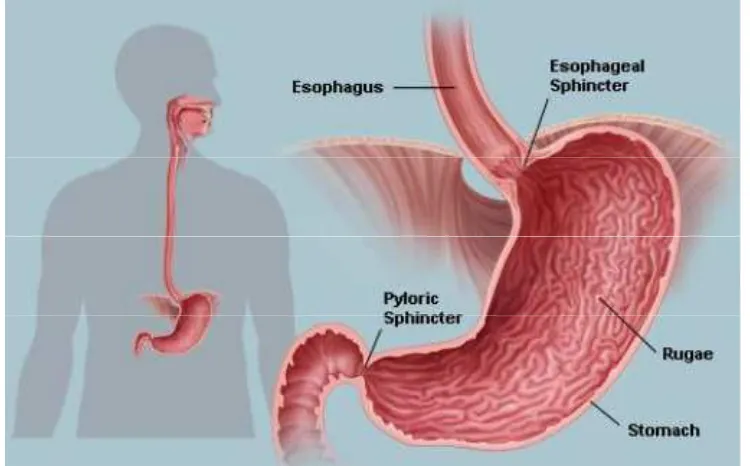
The GIT is a muscular tube, from the mouth to the anus, which functions to take in nutrients and eliminate waste by secretion, motility, digestion, absorption and
excretion, which are known as physiological processes. The stomach is a J-shaped enlargement of the GIT which is divided into 4 anatomical regions:
cardia fundus
body antrum.
The main function of the stomach is to store and mix food with gastric secretions before emptying its load (chyme) through the pyloric sphincter and into the
small intestine at a controlled rate suitable for digestion and absorption. During empty state, the stomach occupies a volume of about 50 ml, but this may increase to as much
Madurai Medical College Page 17 same basic arrangement of tissues, the different layers, from outside to inside, comprising serosa, intermuscular plane, longitudinal muscle, submucosa, circular muscle, lamina propria, muscularis mucosae, and epithelium. In addition to longitudinal
and circular muscle, the stomach has a third muscle layer known as the "oblique muscle layer", which is situated in the proximal stomach, branching over the fundus and higher regions of the gastric body. The different smooth muscle layers are responsible for
performing the motor functions of the GIT, i.e. gastric emptying and intestinal transit.
Basic gastrointestinal tract physiology
The stomach is divided into 3 regions anatomically: fundus, body, and antrum pylorus. The proximal part is the fundus and the body acts as a reservoir for undigested material, whereas the antrum is the mainsite for mixing motions and acts as
a pump for gastric emptying by propelling actions. Gastric emptying occurs during fasting as well as fed states but the pattern of motility is distinct in the 2 states. During
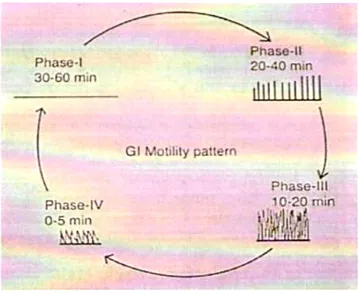
the fasting state an interdigestive series of electrical events take place, which cycle through both stomach and intestine every 2 to 3 hours. This is called the interdigestive myloelectric cycle or migrating myloelectric cycle (MMC), which is divided into
following 4 phasesare:
Phase I: This period lasts about 30 to 60 minutes with no contractions.
Phase II: This period consists of intermittent contractions that increase gradually in intensity as the phase progresses, and it lasts about 20 to 40
minutes. Gastric discharge of fluid and very small particles begins later in this phase.
Madurai Medical College contractions, also down the small Int
Phase IV: This contractions dissip
Salient features
Section Length (m)
Stomach 0.2
Small intestine
6-10
lege
, also known as ‘‘house-keeper wave,’’ sweep all Intestine.
This is a short transitory period of about 0 to 5 m
[image:27.595.148.507.186.480.2]s dissipate between the last part of phase III and qui
Fig 2 Gastro intestinal motility attterm
tures of upper gastrointestinal tract (R. Talukder
2004)
Transit time (h)
pH Microbial count
Absorbing surface area (m2)
Variable 1-4 <103 0.1
3 ± 1 5-7.5
103-1010 120-200
Page 18 sweep gastric contents
to 5 minutes, and the
nd quiescence of phase
lukder and R. Fassihi.,
Apsorption pathways
P,C,A
Madurai Medical College Page 19 P, Passive diffusion; C, Convective or aqueous channel transport; A, Active transport; F, Facilitated transport; I, Ion-pair transport; E, Entero-or pinocytocis; CM, Caveolin Mediated transport.
Need for gastroretention
• Drugs that are absorbed from the proximal part of the gastrointestinal tract (GIT).
• Drugs that are less soluble or that degrade at the alkaline pH. • Drugs that are absorbed due to variable gastric emptying time.
• Local or sustained drug delivery to the stomach and proximal small intestine to treat certain conditions (Brahmankar.D.M., Jaiswal.S.B.,).
• Treatment of peptic ulcers caused by H.Pylori infections (Mona Semalty et al., 2010).
Formulation considerations for GRDDS
It must be effective retention in the stomach to suit for the clinical demand. It must be convenient for intake to facilitate patient compliance.
It must have sufficient drug loading capacity and control drug release profile. It must have full degradation and evacuation of the system once the drug release
is over.
It should not have effect on gastric motility including emptying pattern.
It should not have other local adverse effects (Vyas, S.P., Khar, R.K.,Targeted and controlled drug deliver,).
Madurai Medical College Page 20 Drugs with a narrow absorption window.
Drugs acting locally in the stomach.
Drugs those are primarily absorbed in the stomach. Drugs those are poorly soluble at an alkaline pH. Drugs absorbed rapidly from the GI tract.
Drugs those degrade in the colon (Xiaoling Li, Bhaskara R. Jasti., 2005).
Drugs those are unsuitable for gastro retentive drug delivery systems
Drugs that have very limited acid solubility e.g. Phenytoin etc.
Drugs that suffer instability in the gastric environment e.g. Erythromycin etc. Drugs intended for selective release in the colon e.g. 5- amino salicylic acid and
corticosteroids etc. (European Pharmacopoeia 2009).
Factors affecting gastric retention
Various factors that affect the bioavailability of dosage form and efficacy of the gastro retentive system (Xiaoling Li, Bhaskara R. Jasti., 2005) are:
Density: Gastric retention time (GRT) is a function of buoyancy of dosage form that is dependent on the density.
Size: Dosage form units with a diameter of more than 7.5 mm are reported to have an increased GRT compared with those with a diameter of 9.9 mm.
Shape: Tetrahedron and ring shaped devices with a flexural modulus of 48 and 22.5 kilo pounds per square inch (KSI) are reported to have better GRT 90% to 100% retention at 24 hours compared with other shapes.
Madurai Medical College Page 21 failure of units, allow co-administration of units with different release profiles or containing incompatible substances and permit a larger margin of safety against dosage form failure compared with single unit dosage forms.
Fed or unfed state: Under fasting conditions, the GI motility is characterized by periods of strong motor activity or the migrating myoelectric complex (MMC) that occurs every 1.5 to 2hrs. The MMC sweeps undigested material
from the stomach and, if the timing of administration of the formulation coincides with that of the MMC, the GRT of the unit can be expected to be very
short. However, in the fed state, MMC is delayed and GRT is considerably longer.
Nature of meal: Feeding of indigestible polymers or fatty acid salts can change the motility pattern of the stomach to a fed state, thus decreasing the gastric emptying rate and prolonging drug release.
Caloric content: GRT can be increased by 4 to 10 hours with a meal that is high in proteins and fats.
Frequency of feed: The GRT can increase by over 400 minutes when successive meals are given compared with a single meal due to the low frequency of MMC.
Gender: Mean ambulatory GRT in males (3.4±0.6 hours) is less compared with their age and race matched female counterparts (4.6±1.2 hours), regardless of the weight, height and body surface).
Age: Elderly people, especially those over 70, have a significantly longer GRT. Posture: GRT can vary between supine and upright ambulatory states of the
Madurai Medical College Page 22 Concomitant drug administration: Anticholinergics like atropine, propantheline, opiates like codeine and prokinetic agents like Metoclopramide and Cisapride, can affect floating time.
Biological factors: Diabetes and Crohn’s disease etc.
Approaches to Gastric retention
Various approaches for gastro retentive drug delivery systems are:
(A)Floating drug delivery (B)Bio/Muco-adhesive systems (C)Raft-forming systems
(D)Swelling and expanding systems (E)Superporous Hydrogels
(F)High density systems
(A)Floating drug delivery
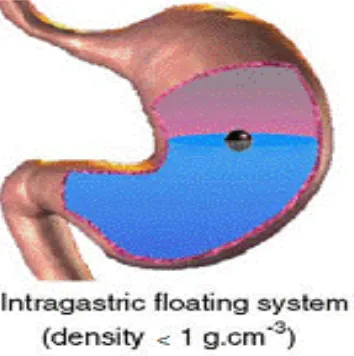
Floating Drug Delivery Systems(FDDS) have a bulk density lower than gastric fluids and thus remain buoyant in the stomach (Bardonnet P.L et al., 2006), (Fig.3), for
a prolonged period of time, without affecting the gastric emptying rate and the drug is released slowly at a desired rate from the system, results in an increase in the gastric
Madurai Medical College Page 23 Fig: 3 Graphic of the buoyant tablet which is less dense than the stomach fluid and
therefore remains in the fundus.
(B)Bio/Muco-adhesive systems
Bio/muco-adhesive systems, bind to the gastric epithelial cell surface or mucin, which extends the GRT of drug delivery system in the stomachThe surface epithelial
adhesive properties of mucin have been well recognized and applied to the development of GRDDS based on bio/muco-adhesive polymers (Fig 4). The ability to provide
adhesion of a drug delivery system to the gastrointestinal wall provides longer residence time in a particular organ site, thereby producing an improved effect in terms of local action or systemic effect. Binding of polymers to the mucin/epithelial surface
Madurai Medical College Page 24 Fig: 4 Bioadhesive systems
(C) Raft-forming systems:
These systems (Bardonnet P.L et al., 2006), contain gel-forming solution (e.g. sodium alginate solution containing carbonates or bicarbonates), which on contact with
the gastric contents, swells and forms a viscous cohesive gel containing entrapped CO2 bubbles, releases drug slowly in stomach by forming the raft layer on the top of gastric fluid (Fig.5). These formulations contain antacids such as calcium carbonate or
Madurai Medical College Page 25 Fig: 5 Barrier formed by a raft-forming system
(D)Swelling and expanding systems:
A dosage form in the stomach will withstand gastric transit if it is bigger than the pyloric sphincter, also the dosage form must be small enough to be swallowed, and
must not cause gastric obstruction either singly or by accumulation (Bardonnet P.L et al., 2006). Thus, their configurations are required to develop an expandable system in
order to prolong the gastric retention time (GRT),
1) A small configuration for oral intake. 2) An expanded gastroretentive form.
3) A final small form enabling evacuation following drug release from the
device. Swellable systems, (Fig.6), are also retained in the gastro intestinal tract (GIT) due to their mechanical properties. The swelling is usually results from osmotic
absorption of water and the dosage form is small enough to be swallowed by the gastric fluid.
• Expandable systems have some drawbacks like problematical storage of much easily hydrolysable, biodegradable polymers relatively short-lived mechanical shape memory for the unfolding system most difficult to industrialize and not
Madurai Medical College Page 26 Fig: 6 Drug release from swellable systems
Thus, gastro retentivity is improved by the combination of substantial dimension with high rigidity of dosage form to withstand peristalsis and mechanical contractility of the
stomach. Unfoldable and swellable systems have been investigated and recently tried to develop an effective gastro retentive drug delivery.
Unfoldable and swellable systems have been investigated and recently tried to
develop an effective gastro retentive drug delivery.
Unfoldable systems are made of biodegradable polymers. They are available in
different geometric forms, like tetrahedron, ring or planner membrane (4 - label disc or 4 - limbed cross form) of bioerodible polymer compressed within a capsule which extends in the stomach.
(E) Superporous Hydrogels:
Conventional hydrogels, with pore size ranging between 10 nm and 10 µm has very slow process of water absorption and require several hours to reach an equilibrium
Madurai Medical College Page 27 (>100 µm), swell to equilibrium size within a minute, due to rapid water uptake by capillary wetting through numerous interconnected open pores. Moreover they swell to a large size (swelling ratio 100 or more) and are intended to have sufficient mechanical
[image:36.595.146.482.259.503.2]strength to withstand pressure by gastric contractions. This is achieved by a co- formulation of a hydrophilic particulate material, Ac-Di-Sol (Croscarmellose sodium).
Fig:7 On the left, Superporous Hydrogels in its dry (a) and water-swollen (b) state.
On the right, schematic illustration of the transit of Superporous Hydrogel.
(F)Magnetic systems:
This approach is based on the simple principle that the dosage form contains a small internal magnet, and a magnet placed on the abdomen over the position of the stomach to enhance the gastric retention time (GRT) (Bardonnet P.L et al., 2006),. The
Madurai Medical College Page 28
(G)Self-unfolding systems:
The self-unfolding systems are capable of mechanically increasing in size relative to the initial dimensions. This increase prevents the system from passing
through the pylorus and retains for a prolonged period of time in the stomach. A drug can be either contained in a polymeric composition of the gastro retentive system or included as a separate component. Several methods, were suggested to provide for the
self-unfolding effect
• The use of hydrogels swelling in contact with the gastric juice.
• Osmotic systems, comprising an osmotic medium in a semi-permeable membrane
• Systems based on low-boiling liquids converting into a gas at the body temperature
(H)High density systems:
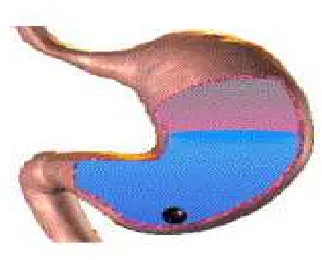
These systems with a density of about 3 g/cm3 are retained in the rugae of the stomach and are capable of withstanding its peristaltic movements. A density of 2.6-2.8
g/cm3 acts as a threshold value after which such systems can be retained in the lower part of the stomach. High density formulations include coated pellets. Coating is done by heavy inert material such as barium sulphate, zinc oxide, titanium dioxide, iron
Madurai Medical College Page 29 Fig: 8 Graphic of heavy tablet which is denser than the stomach fluid and
therefore sinks to the antrum
Floating drug delivery systems:
A floating dosage form is useful for drugs acting locally in the proximal
gastrointestinal tract. These systems are also useful for drugs that are poorly soluble (or)
unstable in intestinal fluids. The floating properties of these systems help to retain in the
stomach for a long time. Various attempts have been made to develop floating systems,
which float on the gastric contents and release drug molecules for the desired time
period. After the release of a drug, the remnants of the system are emptied from the
stomach.
Based on the mechanism of buoyancy, two different technologies have been
used in development of floating drug delivery systems. These include:
a) Effervescent system.
Madurai Medical College Page 30 a) Effervescent Systems
Effervescent systems, include use of gas generating agents, carbonates (e.g.
Sodium bicarbonate) and other organic acid (e.g. citric acid and tartaric acid) present in the formulation to produce carbon dioxide (CO2) gas, thus reducing the density of the system and making it float on the gastric fluid. An alternative is the
incorporation of matrix containing portion of liquid, which produce gas that evaporate at body temperature
.
Fig: 9Gas generating systems
These effervescent systems further classified into two types:
1) Gas generating systems.
2) Volatile liquid or vacuum containing systems.
1) Gas generating systems
A) Tablets:
1. Intragastric single layer floating tablets or Hydrodynamically Balanced
Madurai Medical College Page 31 These formulations have bulk density lower than gastric fluids and thus float in the stomach that increases the gastric emptying rate for a prolonged period, (Fig.10). These are formulated by intimately mixing the gas (CO2) generating agents and the
drug within the matrix tablet. The drug is released slowly at a desired rate from the floating system and the residual system is emptied from the stomach after the complete release of the drug. This leads to an increase in the gastric residence time (GRT) and a
[image:40.595.219.405.300.419.2]better control over fluctuations in plasma drug concentration.
Fig 10 Intragastric single layer floating tablet
2. Intragastric bilayer floating tablets
These are also compressed tablets, containing two layers (Fig.11):
Madurai Medical College Page 32 Fig 11: Intragastric bilayer floating tablet
B) Floating capsules
These floating capsules are formulated by filling with a mixture of sodium alginate and sodium bicarbonate. The systems float as a result of the generation of CO2 that was trapped in the hydrating gel network on exposure to an acidic environment.
C) Multiple unit type floating pills
These multiple unit type floating pills are sustained release pills, known as ‘seeds’, which are surrounded by two layers. The outer layer is of swellable membrane layer while the inner layer consists of effervescent agents. This system sinks at once
and then it forms swollen pills like balloons which float as they have lower density, when it is immersed in the dissolution medium at body temperature. The lower density
is due to generation and entrapment of CO2 within the system.
D) Floating system with Ion-Exchange resins
Floating system using bicarbonate loaded ion exchange resin was made by mixing the beads with 1M sodium bicarbonate solution, and then the semi-permeable
Madurai Medical College Page 33 results in generation of CO2 that carries beads towards the top of gastric contents and producing a floating layer of resin beads.
2)Volatile liquid or vacuum containing systems
(a) Intragastric floating gastrointestinal drug delivery system
This system floats in the stomach because of floatation chamber, which is
vacuum or filled with a harmless gas or air, while the drug reservoir is encapsulated by a microporous compartment.
(b) Inflatable gastrointestinal delivery systems
These systems are incorporated with an inflatable chamber, which contains liquid ether that gasifies at body temperature to inflate the chamber in the stomach.
These systems are fabricated by loading the inflatable chamber with a drug reservoir, which can be a drug, impregnated polymeric matrix, then encapsulated in a gelatine
capsule. After oral administration, the capsule dissolves to release the drug reservoir together with the inflatable chamber. The inflatable chamber automatically inflates and retains the drug reservoir compartment in the stomach. The drug is released
continuously from the reservoir into gastric fluid.
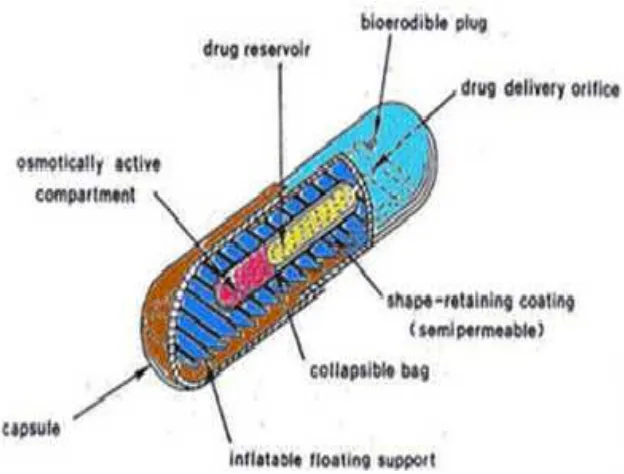
c) Intragastric osmotically controlled drug delivery system
This system is comprised of an osmotic pressure controlled drug delivery device and an inflatable floating support in a biodegradable capsule, On contact with the
Madurai Medical College Page 34 to inflate the bag and it is deformable. The osmotic pressure controlled drug delivery device consists of two components, osmotically active compartment and a drug reservoir compartment. The drug reservoir compartment is enclosed by a pressure
responsive collapsible bag, which is impermeable to liquid and vapour and has a drug delivery orifice. The osmotically active compartment contains an osmotically active salt and is enclosed within a semi-permeable housing. In the stomach, the osmotically active
salt present in the osmotically active compartment is dissolved by absorbing the water continuously present in the GI fluid through the semi-permeable membrane. An osmotic
pressure is thus created which acts on the collapsible bag and in turn forces the drug reservoir compartment to reduce its volume and activate the drug reservoir compartment to reduce its volume and activate the drug release of a drug solution
formulation through the delivery orifice. The floating support is also made to contain a bioerodible plug that erodes after a predetermined time to deflate the support. The
[image:43.595.158.470.482.719.2]deflated drug delivery system is then emptied from the stomach.
Madurai Medical College Page 35 b) Non-Effervescent systems
The Non-Effervescent floating drug delivery systems are based on mechanism of swelling of polymer or bioadhesion to mucosal layer in GI tract. The various types of
this system are:
1) Single layer floating tablets:
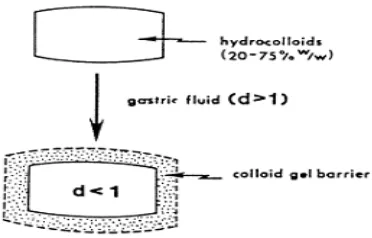
These are formulated by intimate mixing of drug with a gel forming hydrocolloid, that
swells on contact with gastric fluid and maintain bulk density of less than unity. The air trapped by the swollen polymer confers buoyancy to these dosage forms.
2) Bilayer floating tablets
A bilayer tablet contain two layer one immediate release layer which release initial dose from system while the another sustained release layer absorbs gastric
fluid, forming an impermeable colloidal gel barrier on its surface, and maintain a bulk density of less than unity and thereby it remains buoyant in the stomach.
3) Alginate beads
Multi unit floating dosage forms were developed from freeze dried calcium
alginate. Spherical beads of approximately 2.5 mm diameter can be prepared by dropping a sodium alginate solution into aqueous solution of CaCl2, causing
precipitation of calcium alginate leading to formation of porous system, which can maintain a floating force for over 12 hours. When compared with solid beads, which gave a short residence, time of 1 hr, and these floating beads gave a prolonged
residence time of more than 5.5 hours.
4)Hollow microspheres
Madurai Medical College Page 36 Bhaskara R. Jasti, 2005) (Fig.13). The ethanol: dichloromethane solution of the drug and an enteric acrylic polymer was poured into an agitated aqueous solution of PVA that was thermally controlled at 400C. The gas phase generated in dispersed polymer
droplet by evaporation of dichloromethane formed an internal cavity in microsphere of polymer with drug. The microballons floated continuously over the surface of acidic dissolution media containing surfactant for more than 12 hours in vitro (Alexander
Streubel et al., 2006).
Fig: 13 Formulation of floating hollow microsphere or microballoon
EVALUATION OF FLOATING DOSAGE FORMS
1. For Single Unit Dosage Forms (ex: tablets). (Baumgartner S et al.,2000 & Rosa M. et al.,1994)
(i) Floating lag time: It is the time taken by the tablet to emerge onto the surface of
dissolution medium and is expressed in seconds or minutes.
(ii) Invitro drug release and duration of floating: This is determined by using USP II
apparatus (paddle) stirring at a speed of 50 or 100 rpm at 37 ± 0.2 °c in simulated
Madurai Medical College Page 37
analysed for the drug content. The time (hrs) for which the tablets remain buoyant on
the surface of the dissolution medium is the duration of floating and is visually
observed.
(iii) In vivo evaluation for gastro-retention: This is carried out by means of X-ray or
Gammascintigraphic monitoring of the dosage form transition in the GIT. The tablets
are also evaluated for hardness, weight variation, etc.
2. For Multiple Unit Dosage Forms (ex: microspheres) Apart from the In vitro
release, duration of floating and in vivo gastro-retention tests, the multiple unit dosage
forms are also evaluated for
(i) Morphological and dimensional analysis with the aid of scanning electron
microscopy (SEM). The size can also be measured using an optical microscope.
(ii) % yield of microspheres: This is calculated from Weight of microspheres obtained ×100 / total weight of drug
and polymer
(iii) Entrapment efficiency: The drug is extracted by a suitable method, analysed and is
calculated from
Practical amount of drug present ×100 / Theoretical drug content
(iv) In vitro floating ability (Buoyancy %): A known quantity of microspheres are
spread over the surface of a USP (Type II) dissolution apparatus filled with 900 ml of
0.1 N HCl containing 0.002% v/v Tween 80 and agitated at 100 rpm for 12 hours. After
12 hours, the floating and settled layers are seperated, dried in a dessicator and
Madurai Medical College Page 38
The buoyancy is calculated from the following formula.
Buoyancy (%) = Wf / ( Wf + Ws) * 100
Where, Wf and Ws are the weights of floating and settled microspheres respectively.
(v) Drug-excipient (DE) interactions: This is done using FTIR. Appearance of a new peak, and/or disappearance of original drug or excipient peak indicate the DE
interaction. Apart from the above mentioned evaluation parameters, granules (ex:
Gelucire 43/01) are also evaluated for the effect of ageing with the help of Differential
Scanning Calorimeter or Hot stage polarizing microscopy.
CHARACTERIZATION PARAMETERS:
1. Size and shape evaluation:
The particle size and shape plays a major role in determining solubility rate of the drugs
and thus potentially its bioavailability. The particle size of the formulation was
determined using Sieve analysis, Air elutriation analysis, Photo analysis, Optical
microscope ,Electro résistance counting methods (Coulter counter), Sedimentation
techniques, Laser diffraction methods, ultrasound attenuation spectroscopy, Air
Pollution Emissions Measurements etc.
2. Floating Properties:
Effect of formulation variables on the floating properties of gastric floating drug
delivery system was determined by using continuous floating monitoring system and
statistical experimental design.
Madurai Medical College Page 39
The surface topography and structures were determined using scanning electron
microscope (SEM, JEOL JSM – 6701 F, Japan) operated with an acceleration voltage
of 10k.v, Contact angle meter, Atomic force microscopy (AFM), Contact profiliometer.
4. Swelling Studies:
Swelling studies were performed to calculate molecular parameters of swollen
polymers. Swelling studies was determined by using Dissolution apparatus, optical
microscopy and other sophisticated techniques which include H1NMRimaging,
Confocal laser scanning microscopy (CLSM), Cryogenic scanning electron microscopy
(Cryo-SEM), Light scattering imaging (LSI) etc. The swelling studies by using
Dissolution apparatus (USP dissolution apparatus (usp-24) labindia disso 2000) was
calculated as per the following formula. (Ferdous Khan et al., 2008)
Swelling ratio = Weight of wet formulation / Weight offormulations
5. Determination of the Drug Content:
Percentage drug content provides how much amount of the drug that was present in the
formulation. It should not exceed. the limits acquired by the standard monographs.
Drug content was determined by using HPLC, HPTLC methods, near infrared
spectroscopy (NIRS), Microtitrimetric methods, Inductively Coupled Plasma Atomic
Emission Spectrometer (ICPAES) and also by using spectroscopy techniques.
6. Percentage Entrapment Efficiency:
Percentage entrapment efficiency was reliable for quantifying the phase distribution of
drug in the prepared formulations. Entrapment efficiency was determined by using three
methods such as Micro dialysis method, Ultra centrifugation, and pressure Ultra
Madurai Medical College Page 40 7. In-vitro Release Studies:
In vitro release studies (USP dissolution apparatus (USP- 24) lab India disso 2000)
were performed to provide the amount of the drug that is released at a definite time
period. Release studies were performed by using Franz diffusion cell system and
synthetic membrane as well as different types of dissolution apparatus.
8. Powder X-ray Diffraction:
X-ray powder diffraction (Philips analytical, modelpw1710) is the predominant tool for
the study of poly-crystalline materials and is eminently suited for the routine
characterization of pharmaceutical solids. Samples were irradiated with α radiation and
analyzed between 2 ºC and 60 ºC .The voltage and current used were 30KV and 30mA
respectively.
9. Fourier Transform Infrared Analysis:
Fourier transform infrared spectroscopy (FT-IR, Shimadzu, Model-RT-IR-8300) is a
technique mostly used to identify organic, polymeric, and some inorganic materials as
well as for functional group determination. Fourier Transform Infrared Analysis
(FT-IR) measurements of pure drug, polymer and drug loaded polymer formulations were
obtained on FTIR. The pellets were prepared on KBr-press under hydraulic pressure of
150kg/cm2; the spectra were scanned over the wave number range of 3600 to 400 cm-1
at the ambient temperature.
10.Differential Scanning Calorimetric (DSC):
DSC (Shimadzu, Model-DSC-60/DSC-50/ Metler Toldeo) are used to characterize
water of hydration of pharmaceuticals .Thermo grams of formulated preparations were
Madurai Medical College Page 41
were used to calibrate the DSC temperature and enthalpy scale. The sample
preparations were hermitically sealed in an aluminium pan and heated at a constant rate
of 10°C/min; over a temperature range of 25° C – 65°C. Inert atmosphere was
maintained by purging nitrogen gas at the flow rate of 50ml/min.
III) IN-VIVO EVALUATION
a) Radiology
X-ray is widely used for examination of internal body systems. Barium Sulphate is
widely
used Radio Opaque Marker. So, BaSO4 is incorporated inside dosage form and X-ray
images are taken at various intervals to view the dosage form.
b) Scintigraphy
Similar to X-ray, emitting materials are incorporated into dosage form and then images
are
taken by scintigraphy. Widely used emitting material is 99Tc.
c) Gastroscopy
Gastroscopy is peroral endoscopy used with fibre optics or video systems. Gastroscopy
is used to inspect visually the effect of prolongation in stomach. It can also give the
detailed evaluation of GRDDS.
d) Magnetic Marker Monitoring
In this technique, dosage form is magnetically marked with incorporating iron powder
inside, and images can be taken by very sensitive bio-magnetic measurement
equipment. Advantage of this method is that it is radiation less and so not hazardous.
e) Ultrasonography
Madurai Medical College Page 42 Advantages of floating drug delivery system
• The principle of Hydrodynamically Balanced System (HBS) can be used for any particular medicament or class of medicament. The HBS formulations are not restricted to medicaments, which are principally absorbed from the stomach, since it has been found that these are equally efficacious with medicaments
which are absorbed from the intestine. E.g. Chlorpheniramine maleate.
• The HBS are advantageous for drugs absorbed through the stomach e.g. ferrous salts and for drugs meant for local action in the stomach and treatment of peptic ulcer disease e.g. antacids.
• The efficacy of the medicaments administered utilizing the sustained release principle of HBS has been found to be independent of the site of absorption of the particular medicaments.
• Administration of a prolonged release floating dosage form tablet or capsule will result in dissolution of the drug in gastric fluid. After emptying of the stomach contents, the dissolved drug is available for absorption in the small
intestine, therefore it is expected that a drug will be fully absorbed from the floating dosage form if it remains in solution form even at alkaline pH of the
intestine.
• Many drugs categorized as once-a-day delivery have been demonstrated to have suboptimal absorption due to dependence on the transit time of the dosage
Madurai Medical College Page 43 a system designed for longer gastric retention will extend the time within which drug absorption can occur in the small intestine.
• When there is vigorous intestinal movement and a short transit time as might occur in certain type of diarrhoea, poor absorption is expected under such circumstances it may be advantageous to keep the drug in floating condition in stomach to get a relatively better response.
• Gastric retention will provide advantages such as the delivery of drugs with narrow absorption windows in the small intestinal region.
Limitations of floating drug delivery system
• The floating system requires, sufficiently high level of fluid in the stomach for the system to float, this can be overcome by administering dosage form with a
glass full of water (200-250 ml) or coating the dosage form with bioadhesive polymer which adhere to gastric mucosa.
• Aspirin and non-steroidal anti-inflammatory drugs are known to cause gastric lesions, and slow release of such drugs in the stomach is unwanted.
• Drugs, such as Isosorbide dinitrate, that are absorbed equally throughout the GI tract, drugs undergoing first pass metabolism will not benefit from incorporation into a gastric retention system.
• Floating dosage form should not be given to the patients just before going to the bed as gastric emptying occurs rapidly when the subject remains in supine posture.
Madurai Medical College Page 44 • Drugs that have multiple absorption sites or which undergo first pass
metabolism were not desirable.
• The single unit floating dosage form is associated with “all or none concept”. This problem can be overcome by formulating multiple unit system like floating microballoons or microspheres.
Applications of floating drug delivery system
Sustained drug delivery:
Hydrodynamically Balanced System (HBS) type are dosage forms which have bulk density less than one, relatively large in size and did not easily pass through
pylorus, releases the drug over a prolonged period of time by retaining in the stomach for several hours and by increasing the gastric residence time (Manoj Goyal et al., 2011).
Site specific drug delivery:
Floating drug delivery systems are particularly useful for drugs having specific
absorption from stomach or proximal part of the small intestine e.g. riboflavin, furosemide etc. The absorption of captopril has been found to be site specific, stomach being the major site followed by duodenum (Manoj Goyal et al., 2011)..
Absorption enhancement:
Drugs that have poor bioavailability, because of their
absorption is restricted to upper GIT are potential candidates to be formulated as floating drug delivery systems, thereby improving their absolute bioavailability (Manoj Goyal et al., 2011)..
Madurai Medical College Page 45 Retention of the drug at the stomach (HBS system), minimizes the amount of drug that reaches the colon, that prevents the undesirable activities of the drug in colon (Manoj Goyal et al., 2011). This Pharmacodynamic aspect provides the rationale
for GRDF formulation for betalactam antibiotics that are absorbed only from the small intestine, and whose presence in the colon leads to the development of microorganism’s resistance.
Reduction in plasma fluctuations:
Patients with advanced Parkinson’s disease, experienced pronounced
fluctuations in symptoms while treatment with standard L-dopa. A HBS dosage form provided a better control of motor fluctuations although its bioavailability was reduced by 50-60% of the standard formulation (Manoj Goyal et al., 2011).
Peptic ulcer treatment:
H. Pylori, causative bacterium for peptic ulcers and chronic gastritis. Patients
require high concentration of drug, to be maintained at the site of infection that is within the gastric mucosa. The floating dosage form due to its floating ability was retained in stomach and maintained high concentration of drug in the stomach. A sustained liquid
preparation of Ampicillin, using sodium alginate was developed that spreads out and adheres to gastricmucosal surfaces and releases the drug continuously.
Suitable for poorly absorbed drugs.
Floating drug delivery systems are particularly useful for drugs which are poorly soluble or unstable in intestinal fluids and acid stable drugs and for those which
undergo abrupt changes in their pH-dependent solubility due to pathophysiological conditions of GIT, food and age, e.g. floating system for furosemide lead to
Madurai Medical College Page 46 CHAPTER-III
LITERATURE REVIEW
Anand Gadad et al., 2011, developed and evaluated floating microspheres of
captopril to prolong its gastric residence time in stomach. Floating microspheres
was formulated using bio compatible polymers like Eudragit S100 and Ethyl
cellulose in different proportion by solvent evaporation technique. The microsphere
with Ethlcellulose showed higher buoyancy when compared with Eudragit S100
polymer.
Gangadharappa H. V et al., 2011, developed and evaluated Hollow Microspheres
of Rosiglitazone Maleate, Microspheres were prepared by modified Quasi-emulsion
diffusion technique using ethyl cellulose, eudragit S100, polyethylene oxide and
Hydroxyproply methyl cellulose (HPMC K15M) as polymers. The formulations
were evaluated for micromeritic properties, in vitro, in vivo buoyancy, % yield,
entrapment efficiency, in vitro and in vivo release studies. SEM photographs
showed the outer surface of microspheres was smooth and dense whereas internal
surface was porous which helped to prolong floating to increase residence time in
stomach. All the formulations floated for more than 8 h. In vitro drug release studies
showed controlled release of rosiglitazone maleate for over 12 h. The release
behaviour best fitted mostly in peppas and zero order equations. In vivo evaluation
of blood glucose levels in albino rats showed that floating microspheres of
Madurai Medical College Page 47 Mallikarjuna Rao K et al., 2011, prepared and evaluated floating microspheres
with Amoxycillin trihydrate as a model drug for prolongation of gastric residence
time. The microspheres were prepared by the Non-aqueous solvent diffusion
method using polymers HPMC and Ethyl cellulose. By the observation of all
formulation results concluded that D: Polymer (1:2), polymer Ec:HPMC
(1.5gm:0.5gm) containing formulation showed the better drug release.
Kumar Darapu B N et al., 2011, formulated and evaluated Gastroretensive
Floating Microspheres of Ranitidine Hydrochloride by using HPMC K 100,
Xanthan gum and Eudragit S‐100 and in various ratios of 1: 1, 1: 2, and 1: 3. The
formulations were evaluated for FTIR, drug loading, % entrapment, particle size,
SEM, buoyancy, dissolution study and the drug release kinetics. Comparison of
three polymers revealed HPMC to be a suitable candidate for sustained release.
M.Saravanan, B.Anupama., 2011, developed and evaluated Ethyl cellulose and
PEG blend floating microspheres loaded with ranitidine hydrochloride by novel
solvent evaporation matrix erosion method. PEG employed as pore forming agent to
induce buoyancy. The drug loaded microsphere could float for 10 hrs and sustain
the drug release over 4 to 6 hrs.
Yuanfen Liu et al., 2011