0022-538X/94/$04.00+()
Copyright © 1994,American Society for Microbiology
Varicella-Zoster Virus
Open
Reading
Frame 4
Protein Is
Functionally Distinct
from
and Does Not Complement Its
Herpes
Simplex Virus
Type
1 Homolog,
ICP27t
HIROYUKI MORIUCHI, MASAKO MORIUCHI, HOLLY A. SMITH, ANDJEFFREY I. COHEN*
Medical VirologySection, Laboratory of ClinicalInvestigation, Nationlal Institilte of Allergy
andInfectiousDiseases, Bethesda, Maiyland 20892 Received 11 August 1993/Accepted 24 November 1993
Varicella-zostervirus (VZV) open reading frame 4 (ORF4) encodes a putative immediate-early protein which is homologous to herpes simplex virus type 1 (HSV-1) ICP27 on the basis of gene location and similarity in amino acid sequence. In transient expression assays, however, ORF4 and ICP27 exhibit different properties. ICP27 alone has little activity on target plasmids, but it acts as a transactivator or a transrepressor in the presence of other HSV-1 transactivators. In contrast, ORF4 directly transactivates plasmids containing homologous or heterologous promoters and has no apparent transrepressing activity. To further illuminate the functional similarities and differences between ORF4 and ICP27, Vero cell lines which express ORF4 under the inducible metallothionein promoter were constructed. Cell lines expressing functionally active ORF4 protein
upregulated the expression of transfected VZV target plasmids but were unable to efficiently complement HSV-1 ICP27 mutants. These results indicate that, despite structural similarities, VZV ORF4 and HSV-1 ICP27 behave differently in transient expression assays and may play different roles in virus replication.
Varicella-zoster virus (VZV), the etiologicagentof chicken
poxand shingles, isamember of thealphaherpesvirus family.
VZVhasphysiochemicalproperties and genomic organization
(3) similar to those of herpes simplex virus type 1 (HSV-1),
another memberofthealphaherpesvirusfamily. Thefunctions ofmanyVZV gene products remain undefined but have been predicted by analogy to those of their HSV-1 counterparts,
which are better characterized.
VZVexpresses fourgenes, open reading frame4 (ORF4), ORF61, ORF62,andORF63, each of whichishomologousto anHSV-1 immediate-early (IE) gene on thebasis ofgenomic location and similarity in predicted amino acid sequence.
Previous studies revealedthat all four VZVputative IEgene
productspossess transregulatory activity.
VZVORF62 transactivates allthreeputative kineticclasses of VZV gene promoters intransient expressionassays(10, 11, 18,24) and autorepresses or autostimulatesits ownpromoter,
depending on the experimental conditions (5, 25). The
pre-dicted amino acidsequenceof ORF62ishighly homologousto
that of HSV-1 ICP4, and cell lines stably
expressing
VZVORF62complement HSV-1 ICP4 mutants (7), indicatingthat VZV ORF62 and HSV-1 ICP4are functional homologs.
VZVORF61 protein also transactivatesVZVpromoters in
theabsence of otherviral transactivators(21)but represses the
ORF62- orORF4-mediated transactivation in Vero cells (21, 22). Amino acid homology between ORF61 protein and its
HSV-1 counterpart, ICPO, is restricted tothe amino-terminal cysteine-rich region; nevertheless, cell lines stably expressing ORF61 complement an HSV-1 ICPO mutant
(19),
indicatingthat VZV ORF61 and HSV-1 ICPOare functional homologs.
VZV ORF63 represses the ORF62 promoter in transient
expression assays (12). At present, it is uncertain whether
*Corresponding author. Mailingaddress:MedicalVirologySection,
Laboratory of Clinical Investigation, NIAID, Bldg. 10, Rm. IIN214, National Institutes of Health, Bethesda, MD 20892. Phone: (301) 496-5221. Fax: (301)496-7383.
t This paper is dedicated to the memory of
Holly
A. Smith.ORF63 is the functional equivalent of HSV-lICP22, with which it shares genomic location and limited amino acid
sequence homology.
VZV ORF4 encodes a protein which shares considerable
amino acidsequence homology with HSV-1 ICP27. Although ICP27 is essential for HSV-1replication (27), the role of ORF4
in viral replication is not well understood. ICP27 and ORF4 manifest distinct properties in transient expression assays. ICP27 has little or notransregulatoryeffect on targetplasmids by itself (6, 29); however,incombinationwith ICP4 and
ICPO,
ICP27 acts as a transactivatoror a transrepressor, depending
onthe target construct. In contrast, ORF4 alone transactivates
plasmidscontaining VZV orother viral promoters (4, 11,22),
and no transrepressing activityhas been reported.
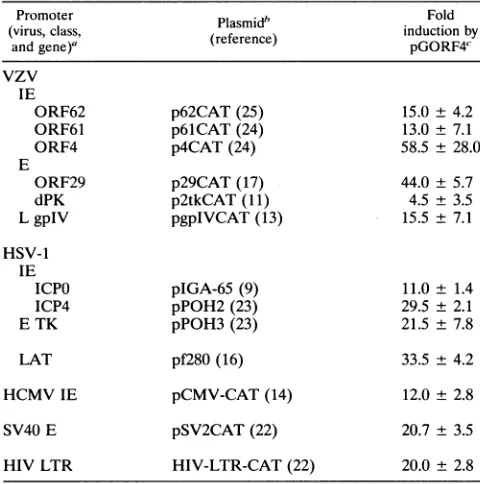
To further evaluate the regulatory capacity of the VZV ORF4 protein, we cotransfected Vero cells with a plasmid expressingthe VZV ORF4 gene along withplasmids
contain-ing promoters from VZV, HSV-1, or otherviruses linked to the chloramphenicol
acetyltransferase
(CAT) gene (Table1).
In these experiments, plasmid pGORF4 (ORF4 driven byits ownpromoter[10]) transactivatedeach of the target constructs
tested, with an increase in CAT activity from 5- to 59-fold. Thus, ORF4 transactivatestarget constructscontainingdiverse promoters.
Recently, Sandri-Goldin and Mendoza(28) showed that the
regulatory activity of HSV-1 ICP27 is independent of the target gene promoter sequencesbut
depends
onthe presence of different mRNAprocessing
signals. Activation by ICP27 correlated with differentpolyadenylation
sites in the target gene, whilerepression by ICP27 correlated with the presence ofan intron either 5' or3' to the target gene. To determinewhether VZVORF4 andHSV-1 ICP27havesimilarfunctions
in transient expression assays, we cotransfected cells with
plasmids expressing VZV ORF4orHSV-1 ICP27
along
withHSV-1
targetplasmids. pTK-CAT SV40AcontainstheHSV-1 thymidine kinase gene promoter followedby
the CAT gene, the simian virus 40(SV40)
small-t-antigen
intron,
and the SV40 earlypolyadenylation region (28).
pMC150
(which
ex-1987
on November 9, 2019 by guest
http://jvi.asm.org/
TABLE 1. Transactivation of target plasmids containing promoters from VZV, HSV-1,and unrelated viruses by VZV ORF4
Promoter
PlsibFold
(virus,class, (reference) inductionby
andgene)' rfrne pGORF4'
vzv IE
ORF62 p62CAT(25) 15.0 ±4.2
ORF61 p61CAT (24) 13.0 ±7.1
ORF4 p4CAT(24) 58.5 ± 28.0
E
ORF29 p29CAT(17) 44.0 ±5.7
dPK p2tkCAT(11) 4.5 ± 3.5
LgpIV pgpIVCAT (13) 15.5 ± 7.1
HSV-1 IE
ICPO pIGA-65 (9) 11.0± 1.4
ICP4 pPOH2(23) 29.5 ± 2.1
E TK pPOH3(23) 21.5 ± 7.8
LAT pf280 (16) 33.5 ± 4.2
HCMV IE pCMV-CAT(14) 12.0± 2.8
SV40 E pSV2CAT(22) 20.7 ± 3.5
HIV LTR HIV-LTR-CAT(22) 20.0 ± 2.8
aE, early; L, late; dPK,deoxypyrimidine kinase; TK, thymidine kinase;LAT, latency-associated transcript; HCMV, human cytomegalovirus; HIV, human
immunodeficiency virus;LTR,longterminal repeat.
bThe amount oftransfected targetplasmidwaschosen so that the basal level ofCAT activitywas less than5%. The total amount of plasmid DNA was
adjustedto 10pLgby adding pGEM2.
cFivemicrogramsofpGORF4wascotransfected with targetplasmids.Each transfection was done at least twice, and the fold inductions are means ±
standard deviations.
pressesICP27from its own promoter[2]) alone had littleor no
effect onpTK-CAT SV40A(Fig. 1A) but repressed the ICPO-and ICP4-mediated transactivation of pTK-CAT SV40 A in accord with earlierfindings (28).Incontrast, pGORF4
trans-activated pTK-CAT SV40Aby itself and did not repress the ICPO- and ICP4-mediated transactivation of pTK-CAT SV40
A. pTK-CAT SYN A contains the HSV-1 thymidine kinase gene promoter followed by the CAT gene and a synthetic oligonucleotide linker 3' to the CAT-coding sequences
(28).
Thisoligonucleotide contains the highly conserved polyadenyl-ation recognition signal AATAAA; however, asecondsignal, termed the
G/U
box, is not present. Both pMC150 and pGORF4 had littleor noeffectonpTK-CAT SYNA(Fig.
1B)
butenhanced theICPO- and ICP4-mediated transactivation of pTK-CAT SYN A. Thus, VZV ORF4 and HSV-1 ICP27 behavedifferently in transient expression assays.
To further compare the roles of VZV ORF4 and HSV-1 ICP27 in the regulation of herpesvirus gene expression, we constructed
plasmids
whichinducibly
express VZV ORF4 (Fig. 2). Plasmids expressing ORF4 were constructed bydi-gesting recombinant VZV DNAwithHgiAI and NcoI
(which
cut atnucleotides 2267 and 4141, respectively [3]), producing blunt ends with T4 DNA polymerase, ligating a double-stranded
KpnI
linkeroligonucleotide (19), digesting
withKpnI,andinserting theDNAinto theKpnI site of pMTP-3H
(which
contains the human metallothionein promoter
[19]).
Each of theresulting plasmids, pMTPORF4R and pMTPORF4I,con-tains the VZV ORF4 gene with theconsensus sequence for initiation of translation at -1 to -4 bases upstream of the ATG codon, in the right and inverted orientations, respec-tively, under the control of the human metallothionein
pro-moter which is inducible by cadmium chloride
(CdCl2).
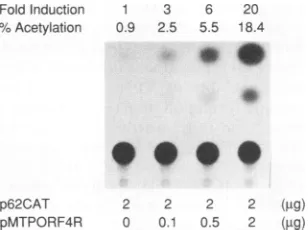
Co-transfection ofpMTPORF4R with p62CAT(containing
the VZV ORF62 promoter followed by the CAT gene[25])
A.
40
0 c 0
-0c 'a
0
30
20
10
0
c 0
7C)
LL
'I
30 I
20
-10
1
_r-
I
am 1r
IpTK-CAT SV40A 2pg 2jg pTK-CATSYNA 24g 2tg
pKl-2(ICP4) - 1gg pK1-2(ICP4) - 1gg
pMC151(ICPO) - 1 g pMC151(ICPO) - lpg
FIG. 1. Comparison of VZV ORF4 and HSV-1 ICP27 in transient expression assays. Vero cells were cotransfected with 2 ,ug of pTK-CAT SV40 A(CAT under the control of the HSV-1 thymidine kinase gene promoter followed by theSV40 small-t-antigen intron and SV40early polyadenylation region) (A)orwith 2 ,ug ofpTK-CAT SYN A(CATunder the control of the HSV-1 thymidine kinase gene promoter followed by a synthetic oligonucleotide containing the conserved AATAAA sequence but not the G/U box) (B). Each plasmid was used alone and in combination with1jigofpMC151(expressing HSV-1ICPO)and 1jigofpKl-2(expressing HSV-1 ICP4), along with 5 ,ug of pGEM2 (open bars), 5
jig
ofpMC150 (expressing HSV-1 ICP27 [closed bars]), or 5 ,ug of pGORF4 (expressing VZV ORF4 [shaded bars]). Plasmids used for the experimentsareindicated below the figure.Fold induction of CAT is the CAT activity relative to that obtained for plasmid pTK-CATSV40 A orpTK-CATSYNAalone. The values are the averages of duplicate transfections, and standard deviations are shown.Fi
on November 9, 2019 by guest
http://jvi.asm.org/
[image:2.612.57.297.91.333.2]-El-CO
vzv l~-,
II I
+1874:1 ORF4 '- -1
HgiI Ncol
ORF4 correctorientation
SV40
polyA
pMTPORF4I
ORF4 inverse orientation
FIG. 2. Construction ofVZVORF4expressionvectors.pMTP-3H contains the human metallothionein promoter (MTP) followed by a
KpnI restriction endonuclease site and an SV40 polyadenylation
(polyA) sequence.The 1.9-kb NcoI-HgiAI fragment from the VZV
genome contains the protein-coding sequence of ORF4 but no
up-stream transcriptional regulatory sequences. pMTPORF4R contains the VZVORF4geneinserted into theKpnI site of pMTP-3H inthe right orientation drivenby the MTP with an SV40 polyA sequence
downstream, while pMTPORF4I contains ORF4 in the inverted orientation.
resulted inupregulation of CAT expression in a
dose-depen-dent manner in Vero cells (Fig. 3). Similar results were
obtained withpGORF4 (ORF4 driven by its own promoter)
(Table 1).
Togeneratecell lines which induciblyexpress VZVORF4, Vero cells were cotransfected with pSV2neo (containing the G418 resistancegene asaselectionmarker[30])anda20-fold molar excess of pMTPORF4R or pMTPORF4I, and
G418-resistant colonieswere selected and subcloned(19). Cell lines stably transformed with ORF4 were maintained in medium containing dialyzed fetal bovineserumbefore the experiments to reduce the level of expression from the metallothionein
Fold Induction 1 3 %Acetylation 0.9 2.5
:*
6 20
5.5 18.4
_0
_9..
p62CAT 2 2 2 2 (ig)
pMTPORF4R 0 0.1 0.5 2 (gg)
FIG. 3. Transactivation of the VZV ORF62promoter by ORF4
expressed from transfected plasmids. Vero cellswere cotransfected with 2,ugofp62CAT (CATunder the control of the VZV ORF62 promoter)aloneorin combination with 0.1to 2,ugofpMTPORF4R (ORF4 driven bythe human metallothionein promoter). CdCl, (10 FM)wasaddedimmediatelyaftertransfection,cellswereharvested 2
days later, and cell lysates were assayed for CAT activity. Fold induction of CAT (shown above the autoradiogram) is the CAT activity relative to that obtained for plasmid p62CAT alone. The
experimentswereperformedthreetimes,andarepresentativeresultis
shown.
promoter. CdCl2was addedto a final concentration of5 FM
(for
viral infectionexperiments)
or 10 p.M(for
other experi-ments) immediately after transfection to induce expressionfrom the metallothioneinpromoter.
Twenty colonies obtained from transfection with
pMTPORF4R and ten colonies from transfection with
pMTPORF4Iwereanalyzed byNorthern(RNA)
blotting (19).
Two cell lines obtained from transfection with each plasmid expressed VZV ORF4 RNA after induction by CdCl2
(Fig.
4A).
The V4R-5 and V4R-13cell lines(which
expressORF4)
and the V41-8and V41-10cell lines
(which
express antisenseORF4)were furthercharacterized.
Southern
blotting
ofcellular DNAs from the four cell lines indicated that each cell line containedORF4 DNA(Fig.
4B).The V4R-5 and V4R-13 cell lineswere further examined for
expression
ofVZVORF4protein by
Westernblotting
(immu-noblotting). To induce
expression
from the metallothioneinpromoter, CdCl2
(10
F.M)
wasadded tothe medium theday
before cells were harvested. Cell extracts from V4R-5 and V4R-13 cells were fractionated
by
sodiumdodecyl
sulfate-polyacrylamide gel
electrophoresis,
transferredto anitrocellu-lose
membrane,
andincubated with rabbit anti-ORF4antibody
directed
against
apeptide corresponding
to thecarboxy-terminal 14 amino acids
(amino
acids 439 to452)
of VZV ORF4. Afterbeing washed,
the membranewasincubatedwith goatanti-rabbitantibody conjugated
withalkalinephosphatase
and was then
developed
with buffercontaining
5-bromo-4-chloro-3-indolylphosphate
and nitroblue tetrazolium(Im-muno-Blot assay
kit; Bio-Rad, Richmond,
Calif.).
In theabsenceof
CdCl2,
the celllinescontainednodetectable ORF4protein
(18).
However,theaddition ofCdCl2
ledtoexpression
ofORF4
protein
whichwasdetected withanti-ORF4antibody
(Fig.
4C).
Each of the cell lines described above was examined in
transient
expression
assays. Toverify
that theinducibleexpres-sion of ORF4 inthesecell lines
upregulates
theVZVORF62promoter, transfectionswere
performed
withp62CAT
in thepresence or absence of
CdCl2
(10
jiM).
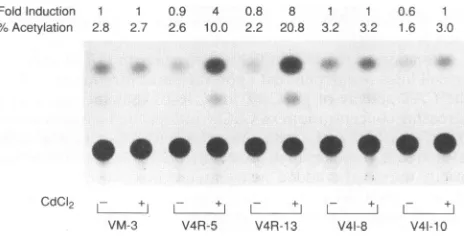
Induction of ORF4expression by CdCl2
in V4R-13 cells(which
express VZVORF4
[Fig. 4C])
increased CATactivity
(eightfold) (Fig. 5).
Lessactivation
(fourfold)
ofp62CAT
was seenafter transfec-tion of V4R-5 cells(which
express less ORF4protein
than V4R-13 cells[Fig.
4C]). In the absence ofCdCl2,
littleor noactivation of
p62CAT
was observed after transfection ofV4R-5and V4R-13 cells
(Fig. 5).
Noactivation ofp62CAT
wasobserved in thepresence of
CdCl2
in VM-3 cells(which
weretransformed withvector
plasmid pMTP-3H
andpSV2neo
[19])
or in V41-8 and V41-10 cells
(which
express antisense ORF4RNA
[Fig. 4A]).
Activation ofthe VZVORF62 promoterin
ORF4-express-ing
celllineswasdependent
uponthe concentrationofCdCl2.
The CAT
activity
ofp62CAT
in V4R-13 cells increased withincreasing
concentrations ofCdCl2
andreachedamaximumat10 to 40
puM
CdCl2
(18).
Above 10puM
CdCl2,
the cellsdeveloped
agranular
appearanceafter2to 3days, suggesting
toxicity
due to the addedheavy
metal. In contrast, the CATactivity
ofp62CAT
in VM-3 cellswas notenhanced butslightlyreduced with addition of
CdCl2, probably
because of thetoxicity
of theheavy
metal. Since concentrations of 10pFM
ormore
CdCl2
were toxic tocells,
5p.M
CdCl, was added toinduce
expression
from the metallothionein promoter in theviral infection
experiments
describedbelow.Studies with HSV-1 ICP27
temperature-sensitive
anddele-tion mutants demonstrated that
ICP27
isindispensable
forHSV-1
growth
in vitro(15,
27).
HSV-1 ICP27 temperature-sensitive mutants growonly
at thepermissive
temperature,on November 9, 2019 by guest
http://jvi.asm.org/
[image:3.612.59.297.76.250.2] [image:3.612.102.256.507.622.2]A
E
CD co
.c
V-tt
4.4kb- l
.:; v
2.4kb- 0g
1.4kb
-B
u<ZzL0 c:'I-,0 Go000
,t F v
;*
St 2 -0 0 0 0 01.3kb-
"' 44FIG. 4. (A) Northern blot analysis of ORF4 transcripts intransformed Vero cell lines. Each lane contains 15vLgof cellular RNA. The blotwas
hybridized with the 32P-labelled 1.8-kb KpnI ORF4 DNA fragment of pMTPORF4R. The leftmost lane contains RNA from VZV-infected human fibroblast(WHF) cells. Markers indicate sizes in kilobases. A 2.1-kb transcriptwasdetected in VZV-infected WHF andORF4-transformed cells, and a 4-kb transcript was noted in VZV-infected WHF cells (as described previously [26]). An additional 2.4-kb transcript detected in
ORF4-transformed cells maybe duetothe additional(SV40)polyadenylation signal in theORF4-expressingvector(Fig.2). (B) Southern blot analysis of ORF4-specific sequences in transformed Vero cell lines. Electrophoretically separatedKpnI digests (10 p.g) of cellular DNAswere
transferredtoanylon membrane and probed with the probe used for the Northern blot. The leftmost lane contains 50pgof thesamefragment used for theprobe. Marker indicates size in kilobase pairs. (C) Western blot analysis of ORF4 proteins in transformed Vero cell lines. Each lane containslysatefrom5 x 105 cells.Cellularproteinsweretransferredtoanitrocellulose membrane, incubated with rabbit anti-ORF4serum,and then incubated with alkaline phosphatase-conjugatedanti-rabbitserum. ORF4protein ispresentasa55-kDaprotein. Markers indicate sizes in
kilodaltons.
while ICP27 deletion mutantsgrow onlyin ICP27-expressing cells. To determine whether VZV ORF4 can functionally
substitute for HSV-1 ICP27,we infected cell linesexpressing
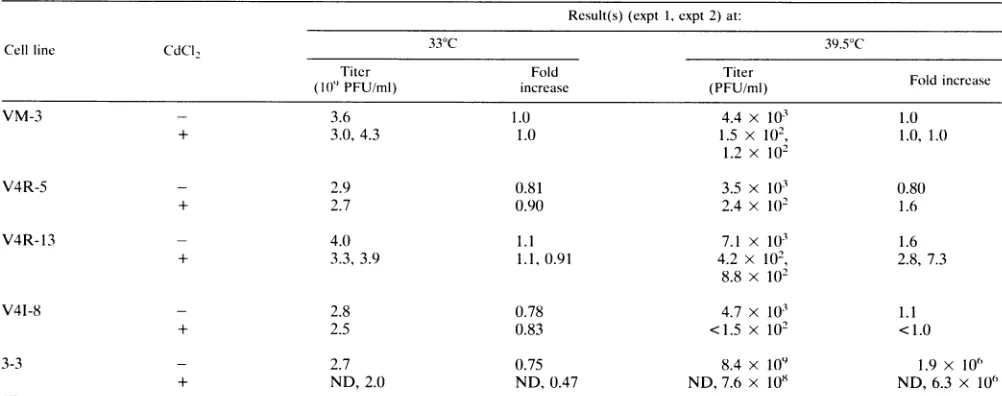
VZV ORF4 with HSV-1 ICP27 mutants. Single-step growth experiments with HSV-1 KOS (wild type), tsE6 (an HSV-1 ICP27 temperature-sensitive mutant [27]), and 5d1l.2 (an HSV-1 ICP27 deletionmutant [27])wereperformedto deter-mine theyields of virus 24 h after infection. WhileHSV-1 KOS (18) and tsE6at33°C(Table 2)grewtosimilar titersonall cell
lines tested, tsE6 at 39.5°C (Table 2) grew to 106-fold-higher levels in 3-3(ICP27-expressing [15]) cells than in control cells. tsE6 at39.5°Cgrew topeak titers of only three- orsevenfold more inV4R-13 (VZV ORF4-expressing) cells than in VM-3 (control) cells after induction by CdCl2 (Table 2). tsE6 at 39.5°Cgrewtosimilar titers inV4R-5 cells(whichexpressless
ORF4 protein than V4R-13 cells) and in VM-3 cells. SdIl.2
grew well only in 3-3 (ICP27-expressing) cells and grew to similar titers in V4R-13, V4R-5, and VM-3 cells(18).
Tofurtherdetermine whether VZV ORF4cancomplement
FoldInduction 1 1
%Acetylation 2.8 2.7
0.9 4 0.8 8 1 1
2.6 10.0 2.2 20.8 3.2 3.2
0.6 1
1.6 3.0
* o -E
*
0 4w _.iX
CdCV21- + 1-+V 1- +
VM-3 V4R-5 V4R-1 3
+ I- +
V41-8 V41-1 0
FIG. 5. Transactivation of the VZV ORF62promoter by ORF4 expressed from stably transformed cell lines. Cell lines were
trans-fectedwithp62CAT and maintained in either the absence (-)orthe presence(+) of CdCI2 (10 ,uM). Fold induction of CAT (shown above
the autoradiogram) is the CAT activity relative tothat obtained for VM-3 cells in either the absence or the presence of CdCI2. The experimentswereperformed three times, andarepresentativeresult is
shown.
the growth of HSV-1 ICP27 mutants, the plaque formation efficiencies of the mutants were tested in various cell lines.
HSV-1 tsE6 (at 39.5°C) and 5d11.2 yielded fewornoplaques in
ORF4-expressing cellsorincontrol cells, while thesemutants produced numbers of plaques similartothatof wild-type virus (KOS) in 3-3 cells (18). Likewise, cell lines expressing other VZV regulatory proteins (FI-14 [ORF62-expressing] [7], V61R-21 [ORF61-expressing] [19], and VIOR-18
[ORF10-expressing] [20] cells)wereunabletocomplement the HSV-1 ICP27 mutants (18), suggesting that none of these VZV
regulatoryproteinswasabletoefficiently substitute for HSV-1 ICP27.
In the single-step growth study (Table 2), there was a
suggestion that ORF4 assisted replication of tsE6; however, the plaque titration assays did not confirm this finding. Fur-thermore, ORF4 never assisted replication of another ICP27
mutant, Sd/I.2. To help assesswhether ORF4 could
comple-ment anotherHSV-1 transactivator, we studied the influence
ofORF4onthegrowth ofan HSV-1 VP16mutant,in1814(a mutant defective in the transactivating function of VP16 [1]). Transactivationof HSV-1 IEgenesby VP16 isnotessential for viralgrowth, but viral replication is inefficient in the absence of the transactivating ability of VP16, as shown by the lower
efficiencyofplaque formation of in 1814 than that of wild-type virus. The impairment in transactivation by the HSV-1 VP16 mutant in1814 is complemented in cells expressing ORFIO (VZV homolog of VP16 [20]), HSV-1 ICPO (1), or ORF61 (VZV homolog of ICPO [19]), each of which is able to transactivate HSV-1 IE promoters. In three separate experi-ments,in 1814produced fourfold(4.2 ± 0.6 [mean ± standard
deviation])more plaquesonV4R-13 cells thanoncontrol cells
when inducedbyCdCl, while in 1814produced sevenfold (7.4
± 1.5) more plaques on 16-8 (HSV-1 VP16-expressing [31])
cells than on control cells (18). Since VZV ORF4
transacti-vates HSV-1 IE promoters in transient expression assays
(Table 1), the increase of HSV-1 in 1814growth by ORF4was
probably dueto theoverallupregulation of HSV-1 IEgenesby
ORF4. Thus, V4R-13 cells produce ORF4 protein that is functionally active inthe contextofherpesvirus infection and slightly activates thegrowth ofan HSV-1 mutant.
C
LLI
Cv)
.C IV lt
i 2 2
N 0 0
66kd
-45kd
on November 9, 2019 by guest
http://jvi.asm.org/
[image:4.612.148.468.73.196.2] [image:4.612.64.297.529.647.2]TABLE 2. Single-stepgrowthstudyofan HSV-1ICP27 temperature-sensitive mutant(tsE6) onVerocell linesexpressingVZV ORF4or HSV-1ICP27"
Result(s) (expt 1, expt 2) at:
Cellline CdCI2 33°C 39.5°C
Titer Fold Titer
(10"PFU/ml) increase (PFU/ml) Fold Increase
VM-3 - 3.6 1.0 4.4 x 10³ 1.0
+ 3.0, 4.3 1.0 1.5 x 10², 1.0, 1.0
1.2 x 10²
V4R-5 - 2.9 0.81 3.5 x 10³ 0.80
+ 2.7 0.90 2.4 x 10' 1.6
V4R-13 - 4.0 1.1 7.1 X 10³ 1.6
+ 3.3,3.9 1.1,0.91 4.2 x 10², 2.8, 7.3
8.8 x 10²
V41-8 - 2.8 0.78 4.7 x 10³ 1.1
+ 2.5 0.83 <1.5 x 10² <1.0
3-3 - 2.7 0.75 8.4 x 10⁹ 1.9 x O1"
+ ND,2.0 ND, 0.47 ND, 7.6 x 10⁸ ND, 6.3 x 10⁶
Monolayers ofindicated cell lines were infected at a multiplicity of infection of 2 PFU per cell and incubated at 33 or 39.5°C for 24 h in either the absence (-)
orthe presence (+) of 5 ,uMCdCl2.Cell-free and cell-associated virus was pooled, and titers were determined by plaque assays on Vero cells at 33°C. ND, not done.
Although VZV ORF4 and HSV-1 ICP27 have similar predicted amino acid sequences, ourdata indicate that VZV ORF4 is not a functional homolog ofHSV-1 ICP27.Transient expressionassaysshowedthatthetwoproteinsexert somewhat
different regulatory functions. Moreover, cell lines expressing
functionally active ORF4 protein were unable to efficiently complement HSV-1 ICP27 mutants.
VZVORF4andHSV-1ICP27exhibit different properties in
transientexpressionassays.ICP27appears toimpairsplicingof pre-mRNA (28). HSV-1 encodes several IE proteins (ICPO, ICP22, and ICP47) whose mRNAs are known to be spliced. Therefore, downregulation of these genes by ICP27 may be
criticalforthe transition from the IEphasetothe early phase of infection. In contrast, ORF4 has no known repression activity and only one VZVgene, ORF42/45 (presumably not an IE gene), is thought to be spliced (3). Thus, the different properties ofORF4 and ICP27 in transient expression assays may reflect evolutionary differences in VZV and HSV-1 IE genes.
VZV ORF4-expressing cells produced ORF4 protein that wasfunctionally activeintransientexpression assays(asshown
by upregulation of transfected p62CAT [Fig. 5]) and in the contextofherpesvirus infection (as shownbyenhancement of
plaque formation ofan HSV-1 VP16 mutantin1814 [18]). By usingcell linesstablyexpressing specificgenes, ourlaboratory showed thatVZV ORF62 (7), ORF61 (19), and
ORFIO
(20)are functional homologs of their HSV-1 counterparts, ICP4,
ICPO,
and VP16, respectively. In contrast, cell lines stablyexpressing VZV ORF4 were unable to complement HSV-1 ICP27 mutantsefficiently (onlythree- to sevenfold [Table 2]). Moreover,cell linesexpressingother VZVregulatory proteins (ORF62, ORF61,or
ORFIO)
werealso unable tocomplement HSV-1 ICP27mutants(18). Felser et al. (8) found thatVZVcoinfectioncouldcomplementtsE6 (anHSV-1ICP27 temper-ature-sensitive mutant) only3-fold but thattsB21 (an HSV-1
ICP4 temperature-sensitive mutant)wascomplemented up to
83-fold. These results, taken together, indicate that neither
ORF4 nor the complete repertoire of VZV proteins can
efficiently substitute for HSV-1 ICP27.
In conclusion, VZV ORF4 behaves differently fromHSV-1 ICP27 intransient expressionassaysand is unable to efficiently
complement HSV-1 ICP27 mutants, indicating that ORF4 is not a functional homologofICP27.Thus,despite the similar-ities in their amino acid sequences, VZV ORF4 and HSV-1 ICP27 may have different roles inherpesvirusgeneregulation. Wethank R. M.Sandri-Goldin for plasmids pTK-CAT SV40Aand pTK-CAT SYN A, S. Nagpal andJ.M.Ostrove forrabbit anti-ORF4 antibody, and P. A. Schaffer for HSV-1 tsE6 and5d1I.2 and for 3-3 cells.
REFERENCES
1. Ace,C. I.,T. A. McKee, J. M.Ryan, J. M.Cameron, andC.M. Preston. 1989. Construction and characterization of a herpes simplexvirus typeI mutantunabletotransinduceimmediate-early geneexpression.J. Virol. 63:2260-2269.
2. Croen, K. D., J.M. Ostrove, L.J. Dragovic, J.E. Smialek, and S. E. Straus. 1987. Latentherpes simplexvirus inhuman trigem-inal ganglia. Detection ofan immediate early gene "anti-sense" transcript byin situhybridization.N.Engl. J.Med. 317:1427-1432. 3. Davison,A.J.,andJ. E. Scott. 1986. ThecompleteDNAsequence
ofvaricella-zoster virus. J. Gen. Virol. 67:1759-1816.
4. Defechereux, P.,L. Melen,L.Baudoux,M.-P. Merville-Louis, B. Rentier, and J. Piette. 1993. Characterization of the regulatory functions of varicella-zoster virus open reading frame 4 gene product.J.Virol. 67:4379-4385.
5. Disney,G. H., T.A. McKee, C. M. Preston, and R. D. Everett. 1990.Theproduct of varicella-zoster virus gene 62 autoregulates itsown promoter. J.Gen. Virol. 71:2999-3003.
6. Everett,R. D. 1986. The productsofherpes simplexvirus type 1 (HSV-1) immediate early genes 1, 2, and 3 can activate HSV-1 geneexpression in trans.J. Gen. Virol. 67:2507-2513.
7. Felser,J. M.,P. R.Kinchington,G.Inchauspe,S. E.Straus,and J. M. Ostrove. 1988. Cell lines containing varicella-zoster virus open reading frame 62 and expressing the "IE" 175 protein
complement ICP4mutantsofherpessimplexvirustype1.J.Virol. 62:2076-2082.
8. Felser, J. M., S. E. Straus, andJ. M. Ostrove. 1987. Varicella-zosterviruscomplementsherpessimplexvirus type1 temperature-sensitivemutants.J.Virol.61:225-228.
9. Gelman,I.H.,andS. Silverstein. 1985. Identification of
on November 9, 2019 by guest
http://jvi.asm.org/
[image:5.612.58.559.96.294.2]ateearly genes from herpes simplex virus that transactivate the virus thymidine kinasegene.Proc. Natl.Acad. Sci. USA 82:5265-5269.
10. Inchauspe, G., S. Nagpal, and J. M. Ostrove. 1989. Mapping of twovaricella-zoster virus-encodedgenesthat activate the expres-sion ofviral early and lategenes.Virology 173:700-709. 11. Inchauspe, G., and J. M. Ostrove. 1989.Differentialregulationby
varicella-zoster virus (VZV) and herpes simplex virus-I trans-activatorgenes.Virology 173:710-714.
12. Jackers, P., P.Defechereux,L.Baudoux, C. Lambert, M. Massaer, M.-P. Merville-Louis,B. Rentier, and J. Piette. 1992. Character-ization of regulatory functions of the varicella-zoster virus gene 63-encoded protein.J. Virol. 66:3899-3903.
13. Ling,P., P. R.Kinchington,M.Sadeghi-Zadeh,W. T.Ruyechan, andJ. Hay.1992.Transcription from varicella-zoster virusgene67 (glycoprotein IV). J. Virol. 66:3690-3698.
14. Maldarelli,F., M. A.Martin, and K.Strebel. 1991. Identification of posttranscriptionally active inhibitory sequences in human immunodeficiency virus type 1 RNA: novel level ofgene regula-tion. J. Virol. 65:5732-5743.
15. McCarthy,A. M., L. McMahan,andP. A.Schaffer. 1989.Herpes simplex virus type 1 ICP27 deletion mutants exhibit altered patternsoftranscription andare DNAdeficient.J. Virol. 63:18-27.
16. Meier, J. L.Unpublished data.
17. Meier, J. L., and S.E. Straus. 1993. Varicella-zostervirus DNA polymerase andmajor DNA-binding proteingeneshave overlap-pingdivergentpromoters. J.Virol. 67:7573-7581.
18. Moriuchi, H., and M. Moriuchi.Unpublisheddata.
19. Moriuchi, H., M. Moriuchi, H. A. Smith, S. E.Straus, andJ. I. Cohen. 1992.Varicella-zostervirusopenreadingframe 61protein isfunctionally homologoustoherpessimplexvirustype1 ICPO.J. Virol. 66:7303-7308.
20. Moriuchi, H.,M.Moriuchi, S. E. Straus,andJ. I. Cohen. 1993. Varicella-zoster virusopen readingframe 10protein,theherpes simplexvirus VP16 homolog, transactivates herpesvirus immedi-ate-earlygene promoters.J.Virol. 67:2739-2746.
21. Moriuchi, H.,M. Moriuchi, S. E.Straus, and J.I. Cohen. 1993. Varicella-zoster virus (VZV) open reading frame 61 protein transactivates VZVgene promoters and enhances theinfectivity of VZVDNA. J. Virol. 67:4290-4295.
22. Nagpal,S.,andJ.M. Ostrove. 1991.Characterizationof apotent varicella-zoster virus-encodedtrans-repressor. J. Virol. 65:5289-5296.
23. O'Hare, P., J. D. Mosca, and G. S. Hayward. 1986. Multiple transactivating proteinsofherpes simplexvirusthat have different target specificitiesand exhibit bothpositiveand negative regula-toryfunctions. Cancer Cells 4:175-188.
24. Perera, L. P., J. D. Mosca,W. T. Ruyechan, and J. Hay. 1992. Regulation ofvaricella-zoster virusgeneexpression in human T lymphocytes.J. Virol. 66:5298-5304.
25. Perera, L. P., J. D. Mosca, M. Sadeghi-Zadeh, W. T.Ruyechan, and J. Hay. 1992. The varicella-zoster virus immediate-early protein, IE62,canpositively regulate itscognatepromoter. Virol-ogy191:346-354.
26. Reinhold,W.C., S. E. Straus, and J. M. Ostrove. 1988. Direction-ality and further mapping ofvaricella-zoster virus transcripts. VirusRes. 9:249-261.
27. Sacks, W. R., C. C. Greene, D. P. Aschman, and P. A. Schaffer. 1985.Herpes simplex virustype1 ICP27 isanessential regulatory protein.J.Virol. 55:796-805.
28. Sandri-Goldin, R. M.,andG. E. Mendoza. 1992. A herpesvirus regulatory proteinappears to actpost-transcriptionally by affecting mRNAprocessing. Genes Dev. 6:848-863.
29. Sekulovich,R.E., K. Leary, and R. M.Sandri-Goldin. 1988.The herpes simplex virus type I ot protein ICP27 can act as a
trans-repressor or atrans-activator in combination with ICP4 and ICPO.J. Virol.62:4510-4522.
30. Southern,P.J., and P.Berg. 1982.Transformation of mammalian cellstoantibiotic resistance withabacterialgeneunder control of theSV40early regionpromoter.J.Mol.Appl. Genet. 1:327-341. 31. Weinheimer, S.P., B.A.Boyd, S.K.Durham,J.L.Resnick,and D.R.O'Boyle II. 1992.Deletion of the VP16openreading frame ofherpes simplex virustype 1. J. Virol. 66:258-269.