R E S E A R C H A R T I C L E
Open Access
Implementation study of an
interprofessional medication adherence
program for HIV patients in Switzerland:
quantitative and qualitative
implementation results
Mélanie Lelubre
1,2,3, Olivier Clerc
4, Marielle Grosjean
4, Karim Amighi
3, Carine De Vriese
3, Olivier Bugnon
1,2and Marie-Paule Schneider
1,2*Abstract
Background:An interprofessional medication adherence program (IMAP) for chronic patients was developed and successfully implemented in the community pharmacy of the Department of ambulatory care and community medicine (Lausanne, Switzerland). This study assesses the capacity of a physician and a nurse at the infectious diseases service of a public hospital and of community pharmacists in the Neuchâtel area (Switzerland) to implement the IMAP in their practice.
Methods: Mixed method, prospective, observational study. Quantitative and qualitative analyses of the implementation process were conducted following the RE-AIM model (reach, effectiveness, adoption, implementation and maintenance). Results:Implementation started in November 2014. One physician, one nurse, and five pharmacists agreed to participate. Healthcare professionals perceived the benefits of the program and were motivated to implement it in their practice (adoption). Seventeen patients were included in the program; 13 refused to participate. The inclusion of naïve HIV patients was easier than the inclusion of experienced patients with difficult psychosocial issues (reach).
Pharmacists were engaged in reinforcing patient medication adherence in 25% of interviews (effectiveness). Key facilitators expressed by healthcare professionals were patient inclusion by the physician and the nurse instead of the pharmacist and the organisation of regular meetings between all stakeholders. In contrast, the encountered barriers were the lack of time and resources, the lack of team uptake, and the lack of adoption by senior managers (implementation). Interviewed patients were all satisfied with this new program, encouraging healthcare professionals to scale it up. Structural changes allowed the hospital and one pharmacy to enter the maintenance stage (maintenance). Conclusion:The research team and collaboration between all professionals involved played an important role in this implementation. However, the dissemination of such a program to a larger scale and for the long term requires financial and structural resources as well as transitional external support.
Keywords:Implementation, Implementation outcomes, Re-AIM, Medication adherence, IMAP, Community pharmacy service, Interprofessional collaboration
* Correspondence:[email protected] 1
Community pharmacy, School of Pharmaceutical Sciences, University of Geneva, University of Lausanne, Geneva, Switzerland
2Community pharmacy, Department of ambulatory care and community
medicine, University of Lausanne, Lausanne, Switzerland Full list of author information is available at the end of the article
Background
Pharmacists are currently developing their role as a pro-vider of professional pharmacy services through a num-ber of various initiatives around the world [1]. In Switzerland, pharmacist interventions such as the poly-medication check and poly-medication adherence monitoring are remunerated by the healthcare system. However, even if a remuneration system exists, only a minority of pharmacists provide these interventions in practice and initiatives are often not implemented at scale across the population [2].
This trend is not confined to Switzerland; implementa-tion of such services in practice remains difficult world-wide [3]. Recently, new studies adapted the consolidated framework for implementation research (CFIR) to list all potential factors that can influence the implementation of new services in community pharmacies [4, 5]. The most frequent barriers cited by pharmacists are lack of time, lack of resources/staff, lack of support/technical assistance, and inadequate infrastructure in the phar-macy [2,3,6–10]. The lack of motivation and the lack of benefits perceived by healthcare professionals are bar-riers that limit the adoption of these new services [2,8,
11]. Moreover, external factors such as the patients’ needs and acceptance/perception, the lack of collabor-ation, and the opinion of other healthcare professionals also influence the implementation of new services [8,10,
12,13].
However, examples in the literature show that the im-plementation of community pharmacy services in practice is feasible [7,14]. For example, the Community Pharmacy Center of the Department of Ambulatory Care & Com-munity Medicine (PMU) of Lausanne (Switzerland) devel-oped and successfully implemented an interprofessional medication adherence program (IMAP) for chronic pa-tients [15]. The positive impact of this program has already been demonstrated for HIV patients. However, the capacity to implement it for HIV patients in other com-munity pharmacies and medical settings has never been assessed [16]. To answer this question, an implementation evaluation study was conducted in 2014 during the imple-mentation of IMAP in a public hospital“Hôpital neuchâ-telois, Pourtalès” and community pharmacies in the Neuchâtel area (Switzerland). The main aim of this re-search was to evaluate the implementation outcomes of this project. The second aim was to collect patient clinical data, in particular medication adherence, viral load (VL), and CD4 cell count. A full description of the implementa-tion stages and strategies is given elsewhere [17].
Method
Study design and framework
To evaluate the implementation outcomes at the same time as the collection of patient clinical data in this
prospective observational study, we used the RE-AIM model with a mixed method approach [18]. This model was used to evaluate the transfer of the IMAP into the current health system and its effectiveness for the target population through five dimensions: reach, effectiveness, adoption, implementation (fidelity), and maintenance. Qualitative and quantitative results are presented by dimension and themes; results from the qualitative ana-lysis are underlined with dotted lines. The mixed method approach, particularly the qualitative analysis, allowed us to describe the factors influencing the dimen-sions of interest. Considering the definition given by Curran et al., the study design is characterized as an hy-brid type 3 design as the implementation outcomes were the first interest and clinical outcomes were collected for informative purposes [19].
Description of the intervention and target patients The IMAP combines motivational interviewing with feed-back to the patient based on the medication adherence electronic measure (MEMS™, WestRock, Switzerland). The core content of the interview between the pharmacist and the patient is reported to the physician and the nurse. The development of the program is fully described else-where [15].
In this project, the target population are HIV patients whose medication adherence is not ritualized and/or patients who go through periods of suboptimal adher-ence. The physician and the nurse follow their patients to improve and/or stabilize clinical outcomes and medi-cation adherence to prevent virological failure. Consider-ing this aim, patient selection criteria for enterConsider-ing the IMAP were defined by the participating physician and nurse as either naïve HIV patients, patients with an anti-retroviral switch or patients with psychosocial issues.
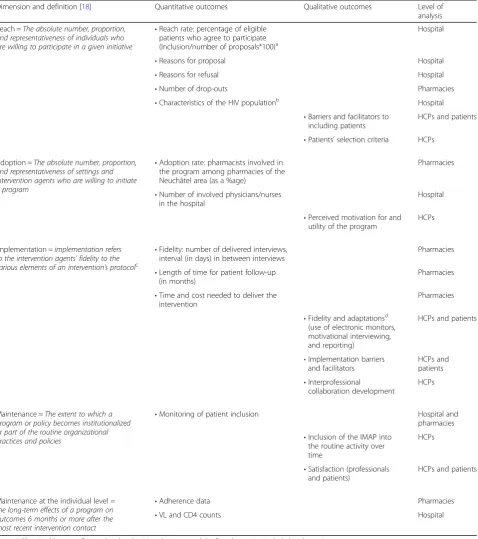
Measured outcomes
The collected outcomes are described in Table 1. The clinical outcomes, e.g. VL, CD4 counts, and adherence data, were observed and described at the individual level as part of the maintenance dimension.
Data collection
because of the positive atmosphere in the study groups and the willingness of healthcare professionals to in-crease their exchange of experience. If one pharmacist
[image:3.595.61.540.99.639.2]was absent during a focus group, an investigator (ML or MPS) visited this pharmacist for an individual interview and used the same interview grid as the one used during Table 1Collected quantitative and qualitative outcomes
Dimension and definition [18] Quantitative outcomes Qualitative outcomes Level of
analysis
Reach =The absolute number, proportion, and representativeness of individuals who are willing to participate in a given initiative
•Reach rate: percentage of eligible patients who agree to participate (Inclusion/number of proposals*100)a
Hospital
•Reasons for proposal Hospital
•Reasons for refusal Hospital
•Number of drop-outs Pharmacies
•Characteristics of the HIV populationb Hospital
•Barriers and facilitators to including patients
HCPs and patients
•Patients’selection criteria HCPs
Adoption =The absolute number, proportion, and representativeness of settings and intervention agents who are willing to initiate a program
•Adoption rate: pharmacists involved in the program among pharmacies of the Neuchâtel area (as a %age)
Pharmacies
•Number of involved physicians/nurses in the hospital
Hospital
•Perceived motivation for and utility of the program
HCPs
Implementation =implementation refers to the intervention agents’fidelity to the various elements of an intervention’s protocolc
•Fidelity: number of delivered interviews, interval (in days) in between interviews
Pharmacies
•Length of time for patient follow-up (in months)
Pharmacies
•Time and cost needed to deliver the intervention
Pharmacies
•Fidelity and adaptationsd
(use of electronic monitors, motivational interviewing, and reporting)
HCPs and patients
•Implementation barriers and facilitators
HCPs and patients
•Interprofessional
collaboration development
HCPs
Maintenance =The extent to which a program or policy becomes institutionalized or part of the routine organizational practices and policies
•Monitoring of patient inclusion Hospital and
pharmacies
•Inclusion of the IMAP into the routine activity over time
HCPs
•Satisfaction (professionals and patients)
HCPs and patients
Maintenance at the individual level = the long-term effects of a program on outcomes 6 months or more after the most recent intervention contact
•Adherence data Pharmacies
•VL and CD4 counts Hospital
Notes: HCPs = Healthcare professionals = the physician, the nurse, and the five pharmacists included in the project
a
Eligible patients were determined by the physician and the nurse and therefore considered as the number of proposals in this project
b
Gender, age, ethnicity, education degree, source of HIV infection, antiretrovirals (ART) description at inclusion, ART line, VL, and CD4 count at inclusion
c
In addition, implementation research has been expanded to include factors influencing the implementation process
d
the focus group. Patients’perceptions were also collected by an investigator during individual, semi-structured, taped phone interviews. Patient interviews were stopped after data saturation was reached.
Quantitative variables were collected from October 2014 to December 2016 in patient health records (hos-pital and pharmacy) and through the Swiss HIV Cohort Study (SHCS) database, an ongoing multicentre pro-spective observational study for interdisciplinary HIV-related research, which includes 69% of all HIV pa-tients in Switzerland [20]. Variables were also collected prospectively during medical and adherence assessments at the hospital and at the pharmacies (SISPha™Software) (see Table1). To answer the question of the representa-tiveness of included patients, we collected sociodemo-graphic characteristics, VL, and CD4 counts for all HIV patients followed by the SHCS at the“Hôpital neuchâte-lois, Pourtalès”. This data covered 1) included patients, 2) patients who refused the program, and 3) patients to whom the adherence program was not proposed because the program was not perceived as necessary by the phys-ician and the nurse.
Qualitative analysis
Individual and focus groups were transcribed verbatim identifying healthcare professionals and patients with numbers to ensure anonymity. Transcriptions were in-ductively coded by two independent investigators sep-arately (ML and MPS), who then pooled the codes and discussed the discrepancies. Lastly, the codes were grouped into themes. To validate our data, the sug-gested themes were presented to all stakeholders.
Statistical analysis
Descriptive data were represented as proportions for discrete variables and by the median and the interquartile range (IQR) for continuous variables, using Excel and STATA (StataCorp. 2013. Stata Statistical Software: Release 13. College Station, TX: StataCorp LP). Adherence data for the entire combined antiretroviral treatment (cART) were represented as the implementation dimension of adherence. Implementation of the dosing regimen is defined as the ex-tent to which a patient’s actual dosing corresponds to the prescribed dosing regimen [21]. Patients were considered as adherent if this percentage was≥90% [22].
Results
The collaboration between the physician, the nurse, and the five pharmacists started in November 2014. All in-volved healthcare professionals were interviewed four times during the two-year study period. Eight patients (out of 17 included, 5 women – 3 men, median age 36 years [35–40]) were interviewed once. At least one patient per pharmacy was interviewed, which meant that
all pharmacists were represented. All themes and related transcribed sentences are presented in Additional file3. Reach
In 2 years, the program was proposed to 30 patients considered as eligible by the physician and the nurse; 17 agreed to participate, which represents a reach rate of 56.7%. The main reasons for proposal were a patient’s difficult psychosocial context that may affect medication adherence (n= 15), and the introduction of a new treat-ment, either a first or subsequent line (n= 9) (see Table 2). All 9 naïve HIV patients were included in the program with an acceptance rate of 100%, whereas pa-tients with psychosocial issues tended to refuse the pro-gram more often (n= 10/15) (Table2).
The number of included patients per pharmacy was low (2 to 3 patients), except for the pharmacist located near the hospital, who followed 9 patients. The included pa-tients were mostly men (n= 10; 58.8%) and younger than patients who refused (median age 36 [31–43]). No drop out was recorded in the study. Characteristics of the entire HIV population of the hospital are presented in Table2. Facilitators for reaching patients
Facilitators for reaching patients were their inclusion by the physician and the nurse and specifically the inclusion of naïve HIV patients, to whom the program was pre-sented as a package linked to the new treatment. Quan-titative data confirmed this statement, as 100% of naïve HIV patients agreed to participate (see Table2). Accord-ing to interviewed patients, the physician and the nurse described the program appropriately and information re-ceived by patients was reassuring.
Refusals and barriers to reaching patients
The main reported reason for refusal was the patient’s reluctance to change pharmacy, especially because of an existing trust relationship with the pharmacist (n= 11/ 13). However, the physician and the nurse explained that reasons were sometimes unclear, a possible escape for some complex patients who did not want to talk about their medication adherence. These patients are difficult to reach; they also tend to avoid talking with the nurse trained in therapeutic education at the hospital.
Different barriers have been encountered by healthcare professionals to reach patients. These can be HIV-related difficulties (psychosocial issues with stigmatisation, denial and need for a high confidentiality level) and the limited number of trained pharmacies, reducing the choice for pa-tients. The small population base of HIV patients also ex-plained the small number of included patients.
Table 2Characteristics of the HIV population of the“Hôpital neuchâtelois-Pourtalès”between November 2014 and December 2016 (based on the patients’medical records for included patients and the data of the Swiss HIV Cohort Study, SHCS, for patients who refused or were not proposed participation)
Inclusion Refusal Not proposed
Number of patients 17 13 25
Gender (n, %)
Male 10 (58.8%) 5 (38.5%) 15 (60.0%)
Female 6 (35.3%) 5 (38.5%) 10 (40.0%)
Transsexual 1 (5.9%) 0 0
Missing data 0 3 (23.1%) 0
Age (year) (median, IQR) 36 (31–42) 52 (39–56) 49 (41–54)
Ethnicity
White 12 (70.6%) 9 (69.2%) 16 (64.0%)
Black 3 (17.6%) 1 (7.7%) 5 (20.0%)
Other ethnicity 2 (11.8%) 0 4 (16.0%)
Missing data 0 3 (23.1%) 0
Highest attained educational degree (n, %)
Basica
1 (5.9%) 1 (7.7%) 5 (20.0%)
Medium/highb 12 (70.6%) 9 (69.2%) 20 (80.0%)
Unknown/Missing data 4 (23.5%) 3 (23.1%) 0
Most likely source of HIV infection
Sexual contact 13 (76.4%) 8 (61.5%) 22 (88.0%)
I.V. drug use/sexual contact (unclear which one) 2 (11.8%) 1 (7.7%) 3 (12.0%)
Other sources 2 (11.8%) 1 (7.7%) 0
Missing data 0 3 (23.1%) 0
ART description at inclusionc
NRTI + NNRTI 7 (41.2%) 9 (69.2%) 15 (60.0%)
NRTI + INSTI 6 (35.3%) 0 2 (8.0%)
Other 3 (17.6%) 1 (7.7%) 5 (20.0%)
No treatment 0 0 3 (12.0%)
Missing data 1 (5.9%) 3 (23.1%) 0
Switch of treatment during the study (n, %) 7 (41.2%) 4 (30.8%) 6 (24.0%)
Treatment stop 0 1 (7.7%) 1 (4.0%)
Missing data 0 3 (23.1%) 0
ART line
Naive patientsd
9 (53.0%) 0 0
Experienced patients 8 (47.0%) 10 (76.9%) 24 (96.0%)
Missing data 0 3 (23.1%) 1 (4.0%)
VL at inclusion
Patients with < 50 copies/mL (n, %) 7 (41.2%) 10 (76.9%) 24 (96.0%)
Patients with≥50 copies/mL (n, %) 10 (58.8%) 0 1 (4.0%)
Missing data (n, %) 0 3 (23.1%) 0
CD4 at inclusion (median, IQR)
the counter, which could breach the confidentiality needed by many HIV patients. Moreover, they had diffi-culties in acknowledging the added value and benefits of the program and were afraid to propose a“paid service” to patients, even if the program is supported by the Swiss national health insurance system.
Adoption
Motivations of healthcare professionals
At the hospital, the initiating event for adopting the IMAP was a local experience with a non-adherent patient, whose need for medical and nursing time was disproportionate compared to the other patients. The physician and the nurse became aware of the need for additional support, which spurred them to contact the Lausanne community pharmacy to implement the IMAP in their practice. The hierarchy of the infectious disease service was informed of the program and its development.
In the Neuchâtel area, five community pharmacies were trained and ready to deliver the program, which represented 9% of Neuchâtel pharmacies (n= 5/56). Par-ticipating pharmacists were convinced that such a ser-vice is part of the future of the profession and perceived it as an opportunity to prove their added value. The IMAP, in collaboration with the hospital, was seen as a springboard and an opportunity to include patients and get more experience in medication adherence. For all healthcare professionals, motivations to integrate the IMAP in their practice were to support complex patients and to develop interprofessional collaborations.
Perceived utility of the program by healthcare professionals All healthcare professionals agreed that the program was useful for patients. Firstly, they observed improvements in clinical results. Secondly, patients developed a rela-tionship of trust with the pharmacist, who became a ref-erence person for the patient at the pharmacy. The physician also noted that the pharmacist was a contact point for keeping patients in care and avoiding losing patients for follow-up. Thirdly, the use of electronic pill-boxes seemed to reassure patients, allowing them to visualize their medication intake.
Implementation Time and cost
[image:6.595.56.539.121.275.2]The total time needed at the hospital to deliver the pro-gram was 30 to 40 min per patient (proposal: 5–10 min, contact with the pharmacist: 15 min, discussion with the patients about medication adherence results during follow-up visit: 10–15 min). No specific costs were required at the hospital to implement the program. For the physician and the nurse, this new program took more time at the beginning of the implementation process, but is now integrated into a routine and does not require substantial additional time. For pharmacists, the program delivery took approximately 45 min for a first interview and 20 to 45 min per patient for a follow-up interview (interview preparation: 5 min, inter-view: 5–30 min, report (writing and sending): 10 min). The regular meetings, organised every 6 months be-tween stakeholders, took approximately two hours. The
Table 2Characteristics of the HIV population of the“Hôpital neuchâtelois-Pourtalès”between November 2014 and December 2016 (based on the patients’medical records for included patients and the data of the Swiss HIV Cohort Study, SHCS, for patients who refused or were not proposed participation)(Continued)
Inclusion Refusal Not proposed
Reasons for proposal (n, %)e –
Difficult psychosocial context 5 10
Introduction of a new ART 8 1
Difficulties described by the patient 2 1
Suspected non-adherence by health professionals 3 0
Other 1 1
Reasons for patient refusal (n, %)e – –
Refused to change pharmacy 11
Doesn’t feel the need for such support 2
Fears about confidentiality 2
Notes:
a
Did not complete school or professional education, mandatory school
b
Finished apprenticeship, bachelor’s degree, higher professional education, higher technical or commercial school, university or other equivalent educational degree
c
NRTI = nucleoside reverse-transcriptase inhibitors, NNRTI = non-nucleoside reverse-transcriptase inhibitors, INSTI = integrase inhibitors
d
First ART started < 1 month ago
e
rent of the meeting room was zero as the meetings took place in the hospital.
To implement the program in practice, pharmacists had to pay 4500 CHF per year for the web platform, which includes 5 days of training available for the pharmacist and one day for the pharmacy technician.
Intervention fidelity and adaptations
The intervention consisted of patient-pharmacist moti-vational interviews based on the medication adherence re-sults of the electronic monitors, followed by a medication adherence report sent to the physician and the nurse. In total, 63 medication adherence interviews were encoded on the web platform by the pharmacists. The median interval in between interviews was 48 days [30–73] and the median follow-up time since inclusion was 1.7 years [0.6–1.9]. Two pharmacists (2/5) had a high fidelity to the program. They fully integrated the communication skills of motivational interviewing, they used the electronic monitors, and emailed reports on each interview to the physician and the nurse. The other three pharmacists bal-anced between a paternalistic and a shared responsibility attitude with patients. However, with time, most of them developed active-listening skills, progressed at the patient’s rhythm, looked for solutions in collaboration with pa-tients, and valued patients’ self-management achieve-ments. They connected fluctuations in medication adherence over time to living conditions, e.g. a drop in cART adherence during an overwhelming postpartum period. During the first year, pharmacists expressed fears about tackling some adherence issues with patients and thought that patients would perceive the intervention as a
‘policing’one. This feeling decreased over time and phar-macists became more at ease with patients.
Only one pharmacist, who followed two patients, did not use the electronic monitors because neither the patients nor the pharmacist were at ease with the monitoring and perceived it as a form of control instead of a support.
Finally, we observed that pharmacists did not system-atically send the adherence report to the physician and the nurse. Some pharmacists had concerns about the relevance of the transmitted information. Moreover, pharmacists had concerns about disturbing the physician with too many reports and increasing his workload. However, all pharmacists contacted the physician or the nurse in case of medication adherence problems. Even so, the physician had to express several times his need for regular medication adherence reports as this dimen-sion matters and guides the medical patient’s follow-up, whether medication adherence is high or low. This re-peated information motivated the pharmacists, who started sending the report more regularly.
The flow diagrams of the activity as described by the physician, the nurse, and community pharmacists are
presented in Additional file4. Compared to the original IMAP, pharmacies in the Neuchâtel area have not yet in-tegrated pharmacy technicians into the program.
Implementation facilitators and barriers
The discriminant facilitator was the program’s in-volvement of the physician and nurse in including pa-tients and in acknowledging the pharmacist’s role in supporting medication adherence. The second was the resources put in place for the program (research sup-port, web platform, and trainings) and particularly the regular meetings between stakeholders organised by the research team. These meetings were an important step in driving the project forwards. They were de-scribed as rewarding and stimulating, and allowed healthcare professionals to get feedback from each other and exchange experience with their colleagues. These interprofessional contacts helped them to learn about each other’s expectations and meet the phys-ician and the nurse face-to-face, which facilitated communication in practice. The physician and the nurse also raised the fact that the small size of the medical team facilitated internal communication on including patients at the beginning of the implemen-tation project.
In contrast, the largest barrier encountered by health-care professionals was a lack of time, related to lack of resources. For the physician and the nurse, the lack of time was a barrier to the program when a patient had somatic problems that had to be prioritized during the medical visit. For pharmacists, staff were already engaged in a full-time workload with the usual pharmacy activities. Another barrier encountered by pharmacists was the low adoption by pharmacy managers because of a lack of sufficient financial incentives. Some pharma-cists also reported a lack of team uptake. For example, only one pharmacist was in charge of the program per pharmacy.
Patients described the time required for interviews as acceptable as they perceived the benefits of the interven-tion and they appreciated the organisainterven-tion of interviews at the pharmacy. No barrier was encountered by patients.
Development of interprofessional collaboration
the program was reassuring for the physician and the nurse as it strengthens patient safety regarding drug interaction management, OTCs, and regular treatment delivery. Fourth, the program was an opportunity to share responsi-bilities for complex patients, and fifth, an opportunity to de-crease the risk of patient loss for follow-up.
Maintenance
Monitoring of patient inclusion
Figure 2 shows that refusals occurred only during the first months of the project and revolved around experi-enced patients. Based on this initial experience, only new HIV patients or patients with a switch of treatment
have since been included in the program by the phys-ician and the nurse.
Inclusion of the program into the routine activity
In May 2016, a structural change at the hospital allowed all new interns on rotation to stay in the service longer, i.e. for 6 months. This change allowed the physician and the nurse to integrate the new intern in the program and lead the nurse to formalize the IMAP, including it in the local hospital guidelines. This step represented the transition to the maintenance stage.
Four pharmacists were in the operation stage at the end of the project. One pharmacy included a second
Fig. 1Respective roles of each healthcare professional in the IMAP. Note: ARVs = antiretrovirals
[image:8.595.55.542.87.381.2] [image:8.595.58.540.578.719.2]pharmacist in the program and implemented a team or-ganisation, with a shared calendar to organise interviews with patients. An increase in patient inclusions, includ-ing patients with other chronic diseases, e.g. diabetes, has been made possible with this new organisation. This brings the program into the pharmacy’s routine activity, and therefore the sustainability stage.
Healthcare professionals’satisfaction
All healthcare professionals were satisfied with this new program, considering it as an ideal collaboration and a new professionally satisfying activity. The positive feed-back and the acknowledgement received from patients reinforced their idea that the program improves patient support. Moreover, as reinforced by pharmacists, the project was instructive and opened doors to more path-ologies, such as hepatitis C or type II diabetes.
Patient satisfaction
All interviewed patients (n= 8) had a positive perception of the program and were satisfied. They all experienced good collaboration with healthcare professionals and five patients stated that they had developed a relationship of trust with them.
Four patients expressed that the interview with the pharmacist represented additional social support and reassured them. Five patients also reported that it allowed them to benefit from a reference person at the pharmacy. Three patients perceived the interview with the pharmacist as a new opportunity to discuss their medication, whereas four stated that they received sup-port in their treatment management. The four latter patients reported that they were more aware of the im-portance of the treatment intake and more active in the search for solutions in collaboration with healthcare pro-fessionals. Finally, one patient perceived the feedback from professionals as encouraging.
Concerning the electronic monitors, six patients stated that they were satisfied with the electronic monitor, which reassured them and prevented omissions through the real time LCD display.
Intervention outcomes
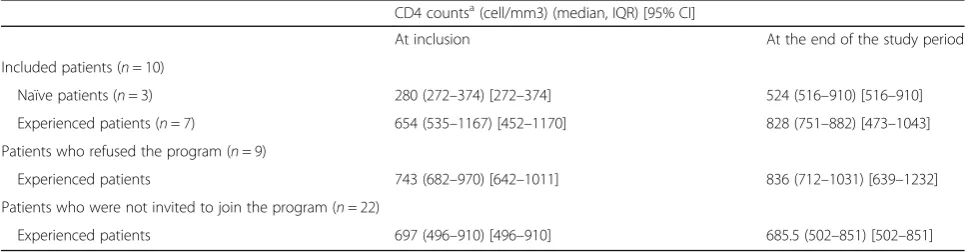
We observed that all 9 naïve HIV patients included in the program and one experienced HIV patient who was detectable at inclusion became undetectable during the follow-up. Only one blip, a temporary detectable in-crease in viremia (VL), was observed in a patient during the follow-up. Patients who refused the program were all undetectable at the moment of the proposal and stayed undetectable during the entire two-year study period. Two patients who were not invited to join the program had a blip during the study period. CD4 counts are presented in Table3.
Median adherence during the entire monitoring period was 99.5% [90–100] and was below 90% in 2 experi-enced HIV patients. Five patients had transient subopti-mal adherence (< 90%) in a total of 13 inter-visit periods. This means that pharmacists were engaged in reinfor-cing patient medication adherence in 25% (n= 13/52) of registered interviews.
Discussion Feasibility
This study showed that the physician and the nurse at the infectious disease service of the Neuchâtel hos-pital and local community pharmacists were able to implement the IMAP in their practice. The program was clearly adopted by healthcare professionals, who perceived the benefits of the program for the patient’s follow up and were motivated to implement it in their practice. The physician and the nurse were con-vinced of the positive role of the pharmacist in
im-proving medication adherence and the regular
meetings, which allowed real interprofessional collab-oration to develop and become ingrained in practice. The interviewed patients were all satisfied, which encouraged healthcare professionals to continue to deliver the program. The external support of the re-search team and of SISPha was an important factor in driving the project forward.
[image:9.595.56.539.598.724.2]Naïve HIV patients were easier to include. Experi-enced patients with psychosocial context, to whom the
Table 3Patient CD4 cells counts at inclusion and at the end of the study period
CD4 countsa(cell/mm3) (median, IQR) [95% CI]
At inclusion At the end of the study period
Included patients (n= 10)
Naïve patients (n= 3) 280 (272–374) [272–374] 524 (516–910) [516–910]
Experienced patients (n= 7) 654 (535–1167) [452–1170] 828 (751–882) [473–1043]
Patients who refused the program (n= 9)
Experienced patients 743 (682–970) [642–1011] 836 (712–1031) [639–1232]
Patients who were not invited to join the program (n= 22)
Experienced patients 697 (496–910) [496–910] 685.5 (502–851) [502–851]
program was proposed as a preventive measure, more often refused to be included. The stigmatisation existing around patients with psychosocial troubles may have hindered their inclusion. These observations brought the physician and the nurse to keep an eye on patients who refused the program and to systematically propose the program to new naïve HIV patients.
The healthcare professionals’motivation and the posi-tive perception of the program were facilitators of this project, even though the lack of motivation and physi-cian’s program perception are often described as barriers in the literature [2, 8, 11]. However, a lack of time and resources, frequently cited in the literature, were also described as barriers in this project, particularly by phar-macists [3]. The physician and the nurse cited the lack of time as a barrier but adapted their practice and in-cluded this new activity without major effort by formal-izing their actions. Before the project, the physician and the nurse were aware of the non-adherence problem and already discussed it with patients during the medical visits. Moreover, the total time needed to deliver the program is lower for them than for pharmacists, which may explain why pharmacists encountered more difficul-ties in including it in their practice. Moreover, pharma-cists faced a financial barrier as they had to develop the program without extra funding/resources. Indeed, most HIV patients only had one prescribed medicine formula-tion combining the entire tritherapy, whereas the Swiss national insurance system reimburses the pharmacist polypharmacy service if at least three medicine formula-tions are prescribed simultaneously.
To implement this program in their practice, pharma-cists had to endorse a “new position” and had to inte-grate structurally the professional team who follow the patients. Pharmacists were not comfortable including HIV patients at the pharmacy because of confidentiality issues. Indeed, pharmacists were more at ease when pa-tients were included by the physician and the nurse in a hierarchical structure as the program was then perceived by the patients as a medical prescription. Having newly joined the interprofessional team, pharmacists still doubted the credibility of their actions and the relevance of the transmitted information. These doubts resulted in irregular reporting of medication adherence to the phys-ician and nurse. Through regular meetings, the physphys-ician and the nurse took the opportunity to reinforce their ex-pectation of systematic medication adherence reports, whatever the patient adherence level (regular, stable, high vs. low, or decreasing). Consequently, pharmacists became more confident over time. These results show that the pharmacists’ nascent position in the team was strengthened by regular meetings and the active involve-ment of the physician and the nurse; both were seen as facilitators by pharmacists. These results can be
highlighted by Bandura’s theory, which provides a con-ceptual framework for self-efficacy and explaining the link between social-structural factors and organizational performance [23]. In this study, the active involvement of the physician and the nurse (social persuasion), the exchange of experience with other pharmacists (vicari-ous experience), and feedback from patients (mastery experience) improved and reinforced pharmacists’beliefs about their capacity to deliver the program over time.
Maintenance and perspectives
In this implementation, the systematization of actions and the uptake of the team were important to envision the maintenance of the program in a long-term perspec-tive. This is aligned with the literature [10, 12]. Despite the encountered barriers, healthcare professionals con-tinued to deliver the program and wanted to extend it to other pathologies. Pharmacists considered it as part of the future of their profession, but the financial barrier, which led to a lack of resources and time, may hinder the long-term development of the program and its de-velopment to a larger scale. Future strategies should be developed to maintain the program in place, includ-ing the improvement of the uptake by the team and workload organisation. The dissemination of the pro-gram and important strategies, such as organising regular meetings, were described and discussed in an-other article describing the implementation process of the project [24].
Strengths and limitations
adherence was suboptimal in 25% inter-visit interviews, giving frequent opportunities to pharmacists in the com-munity to discuss and improve medication adherence issues in collaboration with the patients on a timely basis. Patient inclusion will continue with the mainten-ance of the program, allowing us to assess its effective-ness in the future. Fifthly, regarding the selection of target patients, all naïve HIV patients were included but some complex experienced patients were more compli-cated to include. In such patients, a treatment switch or a detectable viral load could be timely facilitators to le-verage their inclusion.
Conclusion
The IMAP is a replicable model that can be adapted to other settings. This program is transposable to all chronic patients for whom medication adherence is not ritualized and/or who are going through difficult adher-ence periods. The active involvement of the physician and the nurse and the organisation of regular meetings between all stakeholders helped to drive the project for-wards and to significantly improve the interprofessional collaboration. However, the dissemination of such a pro-gram to a larger scale requires resources and external support. Finally, the monitoring of patient inclusion, the use of the electronic monitors and medication adherence reporting, and the interprofessional collaboration should be continuously assessed over time to confirm their maintenance beyond the first 2-year implementation.
Additional files
Additional file 1: Interview grids developed for focus groups with
health care professionals and individual interviews with patients. Description of data: Interview grids (translated version) used during focus groups with health care professionals and individual interviews with patients. (DOCX 44 kb)
Additional file 2: Content of organised meetings and focus groups
during the operation phase. Description of data: Description of topics covered during meetings and focus groups with health care professionals. (DOCX 20 kb)
Additional file 3: Themes inferred during the qualitative analyses and
associated sentences. Description of data: Themes defined by researchers and associated sentences classified by dimensions and measured outcomes. (DOCX 54 kb)
Additional file 4: Flow diagram of the IMAP as implemented at the
hospital and in community pharmacies. Description of data: Implemented activity at the hospital and in community pharmacies as described by each included health care professional 2 years after implementation start (1 physician, 1 nurse, 4 pharmacists) (compiled version). (DOCX 73 kb)
Abbreviations
IMAP:Interprofessional medication adherence program; PMU: [Policlinique Médicale Universitaire] = Department of ambulatory care and community medicine (Lausanne, Switzeland); VL: Viral load
Acknowledgments
We would like to thank Joanna Moullin for the fruitful discussions about this project and her guidance in the implementation sciences applied to pharmacy
services. We also would like to thank the SHCS for their contribution to this work in giving us access to their data. Finally, we would like to thank the
“Fonds Van Buuren & Fondation Jaumotte Demoulin”who gave a grant to M.
Lelubre for the end of her research and thesis.
Funding Not applicable.
Availability of data and materials
The datasets used and/or analysed during the current study are available from the corresponding author on reasonable request.
Authors’contributions
ML and MS designed the study, and collected and analyzed data. OC and MG participated in the development of the protocol and the implementation of the project in the hospital. ML drafted the manuscript and MS assisted in preparation of the manuscript. KA, CDV, and OB revised the manuscript critically and give final approval of the manuscript. All authors read and approved the final manuscript.
Ethics approval and consent to participate
The protocol study was submitted to the Ethics committee of the canton of Vaud (Switzerland) but they stated that the study was exempt from authorization. A verbal consent was asked to health care professionals for focus groups, whereas participating HIV patients were asked to sign a written consent form at the hospital for the individual interview. A separate protocol was submitted to and approved by the SHCS to collect data in the SHCS database.
Consent for publication Not applicable.
Competing interests
O. Bugnon is a member of the advisory board of SISPha. The other authors declare that they have no competing interests.
Publisher’s Note
Springer Nature remains neutral with regard to jurisdictional claims in published maps and institutional affiliations.
Author details 1
Community pharmacy, School of Pharmaceutical Sciences, University of Geneva, University of Lausanne, Geneva, Switzerland.2Community pharmacy,
Department of ambulatory care and community medicine, University of Lausanne, Lausanne, Switzerland.3Department of Pharmacotherapy and
Pharmaceutics, Faculté de Pharmacie, Université libre de Bruxelles (ULB), Brussels, Belgium.4Department of Internal Medicine and Infectious Diseases,
Pourtalès Hospital, Neuchâtel, Switzerland.
Received: 30 March 2018 Accepted: 23 October 2018
References
1. Costa FA, Scullin C, Al-Taani G, Hawwa AF, Anderson C, Bezverhni Z, et al.
Provision of pharmaceutical care by community pharmacists across Europe:
is it developing and spreading? J Eval Clin Pract. 2017;23(6):1336–47.
2. Hersberger KE, Messerli M. Development of clinical pharmacy in Switzerland:
involvement of community pharmacists in Care for Older Patients. Drugs
Aging. 2016;33:205–11.
3. Mossialos E, Courtin E, Naci H, Benrimoj S, Bouvy M, Farris K, et al. From
“retailers”to health care providers: transforming the role of community
pharmacists in chronic disease management. Health Policy. 2015;119:628–39
Available from:https://doi.org/10.1016/j.healthpol.2015.02.007.
4. Moullin JC, Sabater-Hernández D, Benrimoj SI. Qualitative study on the
implementation of professional pharmacy services in Australian community pharmacies using framework analysis. BMC Health Serv Res. 2016;16:439
Available from:http://bmchealthservres.biomedcentral.com/articles/10.1186/
s12913-016-1689-7.
5. Shoemaker SJ, Curran GM, Swan H, Teeter BS, Thomas J. Application of the
Res Soc Adm Pharm. 2017;13:905–13 Available from:https://doi.org/10. 1016/j.sapharm.2017.06.001.
6. Niquille A, Lattmann C, Bugnon O. Medication reviews led by community
pharmacists in Switzerland: A qualitative survey to evaluate barriers and
facilitators. Pharm Pract (Granada). 2010;8:35–42.
7. Kaae S, Christensen ST. Exploring long term implementation of cognitive
services in community pharmacies - a qualitative study. Pharm Pract
(Granada). 2012;10:151–8.
8. Marquis J, Schneider MP, Spencer B, Bugnon O, Du Pasquier S. Exploring the
implementation of a medication adherence programme by community
pharmacists: a qualitative study. Int J Clin Pharm. 2014;36:1014–22.
9. Feletto E, Wilson LK, Roberts AS, Benrimoj SI. Building capacity to
implement cognitive pharmaceutical services: quantifying the needs of
community pharmacies. Res Soc Adm Pharm. 2010;6:163–73 Available from:
https://doi.org/10.1016/j.sapharm.2009.08.003.
10. Roberts AS, Benrimoj SI, Chen TF, Williams KA, Aslani P. Practice change in
community pharmacy: quantification of facilitators. Ann Pharmacother.
2008;42:861–8.
11. Okonta JM, Okonta EO, Ofoegbu TC. Barriers to Implementation of
Pharmaceutical Care by Pharmacists in Nsukka and Enugu metropolis of
Enugu State. J Basic Clin Pharm. 2012;3:295–8 Available from:http://www.
pubmedcentral.nih.gov/articlerender.fcgi?artid=3979260&tool= pmcentrez&rendertype=abstract.
12. Adhien P, Van Dijk L, De Vegter M, Westein M, Nijpels G, Hugtenburg JG.
Evaluation of a pilot study to influence medication adherence of patients with diabetes mellitus type-2 by the pharmacy. Int J Clin Pharm. 2013;35:
1113–9.
13. Fraeyman J, Foulon V, Mehuys E, Boussery K, Saevels J, De Vriese C, et al.
Evaluating the implementation fidelity of new medicines service for asthma patients in community pharmacies in Belgium. Res Soc Adm Pharm. 2017;
13:98–108.
14. Garcia-Cardenas V, Benrimoj SI, Ocampo CC, Goyenechea E,
Martinez-Martinez F, Gastelurrutia MA. Evaluation of the implementation process and outcomes of a professional pharmacy service in a community pharmacy
setting. A case report. Res Soc Adm Pharm. 2017;13:614–27.
15. Lelubre M, Kamal S, Genre N, Celio J, Gorgerat S, Hugentobler Hampai D, et
al. Interdisciplinary medication adherence program: the example of a university community pharmacy in Switzerland. Biomed Res Int. 2015;2015. https://www.ncbi.nlm.nih.gov/pmc/articles/PMC4709610/.
16. Krummenacher I, Cavassini M, Bugnon O, Schneider MP. An interdisciplinary
HIV-adherence program combining motivational interviewing and
electronic antiretroviral drug monitoring. AIDS Care. 2011;23:550–61.
17. Lelubre M, Clerc O, Grosjean M, Amighi K, De Vriese C, Bugnon O.
Implementation of an interprofessional medication adherence program for HIV patients : description of the process using the framework for the
implementation of services in pharmacy. BMC Health Serv Res. 2018;18:1–8.
18. The RE-AIM [Internet]. [cited 2017 Nov 1]. Available from:http://re-aim.org/
about/
19. Curran GM, Bauer M, Mittman B, Pyne JM, Stetler C.
Effectiveness-Implementation Hybrid Design: Combining Elements of Clinical Effectiveness and Implementation Research to Enhance Public Health. Med
Care. 2012;50:217–26.
20. Swiss HIV Cohort, Schoeni-Affolter F, Ledergerber B, Rickenbach M, Rudin C,
Günthard H, et al. Cohort profile: the Swiss HIV Cohort study. Int J
Epidemiol. 2010;39:1179–89.
21. Vrijens B, De Geest S, Hughes DA, Przemyslaw K, Demonceau J, Ruppar T, et
al. A new taxonomy for describing and defining adherence to medications.
Br J Clin Pharmacol. 2012;73:691–705.
22. Bangsberg DR. Less than 95% adherence to nonnucleoside
reverse-transcriptase inhibitor therapy can Lead to viral suppression. Clin Infect Dis.
2006;43:939–41 Available from:https://academic.oup.com/cid/article-lookup/
doi/10.1086/507526.
23. Wood R, Bandura A. Social cognitive theory of organizational management.
Acad Manag Rev. 1989;14:361–84.
24. Lelubre M, Clerc O, Grosjean M, Amighi K, De Vriese C, Bugnon O, Schneider
M-P. Implementation of an interprofessional medication adherence program for HIV patients: description of the process using the framework for the implementation of services in pharmacy. BMC Health Serv Res. 2018; 18:698.
25. Motivational Interviewing Network of Trainers (MINT) [Internet]. [cited 2018