Abstract—This study aims to develop the Thinking-Based Learning (TBL) module for learning secondary school Algebra. This study uses the developmental model design and the TBL module is designed using the combination of ADDIE Model and Kemp Model. It is conducted in five phases: (1) Analysis (2) Design of TBL Module, (3) Development of TBL Module (4) Implementation, and (5) Assessment of TBL Module. The research instruments are the Content Validity Form and Module Reliability Survey. The validity of the module is validated by three experts in the field of mathematics education. Sample of the study in the evaluation phase consisted of the pre-service secondary school mathematics teachers which are selected using random sampling technique.The findings showed that the content validity and the reliability indices for the TBL module are at a satisfactory level.Significantly, the TBL module is able to provide guidance to all secondary school mathematics teachers in customary teaching practices for the inculcation of higher level thinking, thus generating knowledgeable generation and a good problem solver for the present and future challenges.
Index Terms— Thinking-based learning, ADDIE Model, Kemp Model, 21st century skills
I. INTRODUCTION
The trend of TIMSS and PISA results shows that the achievement of Malaysian students is low in mathematics, especially in answering questions requiring higher order thinking skills (HOTS) [1]. The Malaysian Education Blueprint 2013-2025 suggests a transition in mathematical education rather than emphasizing cognitive algorithmic skills to HOTS in the implementation of mathematics teaching and learning [1]. Teachers are implementers and are very important in determining the success of education aspirations in Malaysian Education Blueprint 2013-2025 [1]. Many past studies have shown that the quality of teaching has had a major impact on student participation and achievement in the classroom [2]-[10]. In fact, teachers' understanding in mathematics, curriculum and high-level thinking skills also contributes to classroom practice, professional development and student achievement [11].
HOTS among mathematics teachers in Malaysia are still very low and mathematics teaching and learning is still a procedural that emphasizes the algorithm processes [1], [12]. This is further supported by the findings of the AKEPT study which shows that 50% of the teachers are fail to deliver teaching effectively, especially to foster HOTS [1]. Some studies have also proven that the main problem faced by teachers is their inability to implement the agenda, lack of knowledge of HOTS, lack of pedagogical skills and
Revised Manuscript Received on April 12, 2019.
Nor’ainMohdTajudin, Sultan Idris Education University, Malaysia , ([email protected])
ZamzanaZamzamir,Sultan Idris Education University, Malaysia, ([email protected])
Ruslina Othman, SAM PayaJaras Sungai Buluh, Malaysia,
attitude towards teaching and learning [12]-[14], all the mathematical facts and concepts need to taught to students before they can be encouraged to think [15].In fact, until now, very few modules have been specifically documented to guide mathematics teachers on how to conduct teaching activities that can nurture high-level thinking skills [16], [17]. Hence, this research is aimed to develop a Thinking– Based Learning module (TBL) as a guide to teachers to implement appropriate activities in the classroom in order toinfusethethinking skills throughout their teaching and learning processes.
II. THINKING-BASED LEARNING
Thinking-based learning (TBL) is a method of teaching and learning where the teaching of a specific thinking skill is infused into the teaching of content or subject matter [18]. The infusion method is highly effective in not only facilitating the process of acquiring new knowledge but at the same time fostering the development or enhancement of thinking skills [19]. TBL provides step-by-step procedures or routines, and guiding rules by which a type of thinking can be carried out with a high degree of efficiency and effectiveness. Since thinking does not happen in vacuum, TBL also provides the acquisition of information on what we are thinking about, and/or where to find it. Here are four important steps to implement a TBL method: (a). Make contact with specific thinking skills in the context of everyday life. (b). Promote the use of one or more mind habits (c). Provide guidance to students in thinking efficiently by engaging content learning. (d). Encourage students to think about their thinking, then they are aware and enable them to think efficiently. Notice that besides the selected thinking skill and the content, there are two more aspects of learning that TBL explicitly develops, namely habits of mind (HOM) and meta-cognition. HOM are mental habits or disposition that enhances thinking thus making it more effective and therefore more skilful [20].
There is a key strategy in TBL that can encourage HOTS in teaching and learning and can be classified into categories that are student-centered strategies, resource-based strategies or material and task-based strategies or activities (21Mok Soon Sang, 2010). To produce a high-thinking student, Reference [22] suggested that 21st-century students need to master the skills that are also based on TBL: (a) Critical thinking and problem solving (b) Creativity and Innovation (c) Collaboration, teamwork and leadership (d) Communication skills, information, media and technologies.
A Thinking-Based Learning Module for
Enhancing 21
st
Century Skills
TBL is based on the infusion model which is more of a student-centered constructivism approach [18], [23]. This model, which is known as IERT model contains four phases namely the Introduction, Engagement, Reflection and Transfer phases. This model proposes four basic components that need to be designed in TBL where learners are able to clearly define their thinking process or aware of the thinking skills, engage in a thought-provoking process, providing an important opportunity for students to know the type of thinking involved and to relate the existing knowledge and experience with the knowledge gained from exploration.
III. OBJECTIVE AND RESEARCH QUESTION
The objective of this research is to develop a TBL Module for the Algebraic Expression topic for form one students (13- year-old students).The research questions are: (1) Does the developed TBL module for the Algebraic Expression topic have satisfactory validity?
(2) Does the developed TBL module for the Algebraic Expression topic have satisfactory reliability?
In this study, we had chosen the Algebraic Expression topic which is in the Relationship and Algebra learning area in the Curriculum and Assessment Standard Document for Malaysian Mathematics Curriculum Standards for secondary school [24]. This is based on the need analysis results which were conducted before the development of the TBL module.
IV. METHODOLOGY
A. The Design of the study
The employment of design and development research (DDR) methodology as the selected approach is justified in this study by its pragmatism in testing the theory and validating the practicality. Besides, it is described as a way to establish new procedures, techniques and tools based on specific needs analysis [25]. In this case, a new teaching module was developed.
B.The Development of the Module
This study adapted MohdAfifi’s model [26] based on the ADDIE Model [27] and Kemp, Morrison, and Ross Model[28]. There are five main phases in developing modules, namely the analysis, the design the development, the implementation, and the evaluation phases.
The analysis phase is the foundation of all phases. The following are determined before the module is developed: identifying problems, identifying the cause of the problem and determining the solution, identifying module targets, course content, assignments and teaching context. For the purpose of this analysis, a questionnaire is constructed to identify: (1) Problems, causes, and ways of solving the problem in the Relationship and Algebra learning area. (2) The suitability of the topic for teaching using the TBL module.Document analysis is also carried out on the Curriculum and Assessment Standards Document in the Relationship and Algebra learning area to determine the content and the suitability of the TBL method.
The design phase is the second phase of the TBL Module development. Reference [28] stated that the basis for the process of designing a teaching module involving four main
elements;- students, objectives, methods and assessments. Therefore, in this phase, the following elements are determined; determining learning outcomes or learning objectives, approaches, strategies, tasks, activities and appropriate teaching resources.
The next phase is to develop the TBL module. In this phase, lesson plans, course content, assignments, training and teaching aids are developed. The completed TBL module is validated by three mathematics and mathematics education experts..The next phase is the implementation and finally the assessment phase where the teaching and learning activities using the TBL module is carried out to investigate the feasibility and the reliability of the module being developed. The process involved the guidance to selected mathematics teacher on teaching and learning based on the TBL Module. Based on these two phases, the developed TBL module also confirms that it can be implemented and followed.
C. Sample of the study
There are two types of samples in this study; the sample to validate the modules and the sample to determine the reliability of the TBL module. Three mathematics education experts are selected using the purposive sampling technique. A sample of 34 randomly selected mathematics teacher trainer participated in the assessment phase.
D. Instruments
The instruments used in this study are the Content Validity Form (CVF) and the Module Reliability Survey (MRS).The CVF comprised of two sections; the face validity statement (seven items) and the content validity statement (eight items).The MRS comprised of eight statements about the ability to follow the TBL module. Both instruments allows the sample to rate items on 4-point Likert scale (1= strongly disagree, 2=disagree, 3= agree, 4= strongly agree). These instruments were validated by two mathematics education experts. The result of the pilot test revealed that the MRS has high reliability indices of 0.80. This indicated that both instruments are appropriate to be used in this study.
E. Data Analysis
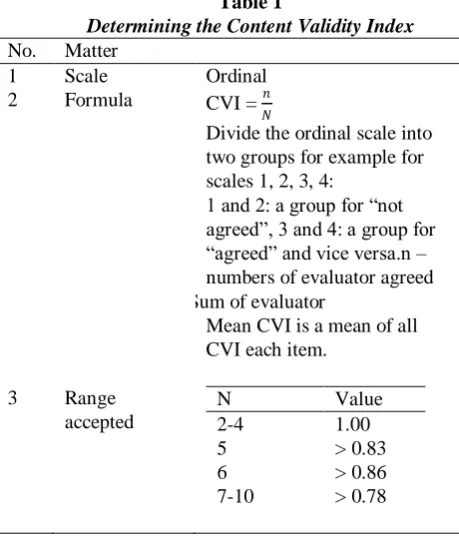
Table 1
Determining the Content Validity Index
No. Matter
1 Scale Ordinal
2 Formula CVI = 𝑛
𝑁
Divide the ordinal scale into two groups for example for scales 1, 2, 3, 4:
1 and 2: a group for “not agreed”, 3 and 4: a group for “agreed” and vice versa.n – numbers of evaluator agreed N –Sum of evaluator
Mean CVI is a mean of all CVI each item.
3 Range
accepted
N Value
2-4 1.00
5 > 0.83
6 > 0.86
7-10 > 0.78
Upon completion of validity measure, the reliability of the TBL module was established to achieve the second objective if the study. Cronbach’s Alpha coefficient is widely used to measure the reliability of Likert data that forms the psychometric instrument [30]. The value of Cronbach’s Alpha coefficient varies from 0.00 to 1.00 and the alpha value of .65 to 95 is satisfactory, showing that the module has appropriate levels of reliability.
V. RESULTS AND DISCUSSION
The results will be presented according to the research question (RQ) of the study.
RQ1: Does the developed TBL module for the Algebraic Expression topic have satisfactory validity?
[image:3.595.303.558.69.401.2]As mentioned above, the face and content validity of the TBL module are analyzed using the CVI.The CVI values for all three experts were presented in Table 2 (face validity) and Table4 (content validity).Number 1 indicated a favorable rating (experts’ rated as 3 or 4), whereas 0 means unfavorable rating (experts’ rated as 1 or 2). In addition, the experts were also requested to give comments and additional suggestion to improve the TBL module. Using the CVI method, the acceptable standard for index of average congruity recommended by [29] is 0.10 for 2 to 4 evaluators. In this case, both indices of CVI for face validity and content validity is 1.00. Therefore, the developed TBL module could be considered as having good face and content validity, indicating that the TBL module for the Algebraic Expression topic have satisfactory validity.
Table 2
CVI for Face Validity
Table 3
CVI for Content Validity
RQ2: Does the developed TBL module for the Algebraic Expression topic have satisfactory reliability?
To answer the RQ2 of the study, a survey was conducted to establish the reliability of the TBL Module [31]. The alpha Cronbach’s value will indicate the degree of consistency among the users of the module in terms how they think or feel that they can achieve the learning objectives and can follow the activities in the module. The result of the internal consistency tests for the survey was reported to be 0.83.Hence, the developed TBL module for the Algebraic Expression topic has satisfactory reliability.
The developed TBL module for Algebraic Expression topic for Form one (13 –year old) Malaysian secondary school level in this study has satisfactory validity and reliability presents the theory that skillful thinking is uniquely tied to the disciplinary content being thought about.This developed TBL module comprised of activities which is in line with thinking-basedlearningsuggested by [32] where learning requires “specific and appropriate mental procedures for the kind of thinking engaged in by the thinker” (pg. 1).
Reference [33] stated that thinking dispositions approach seems as the most suitable approach and enculturation of thinking is the most appropriate method for teaching thinking especially in elementary schools. They stressed that in infusion approach, thinking is included in the usual curriculum content; moreover, understanding and thinking about a topic can be happened
[image:3.595.301.558.74.225.2][34] asserted that infusion is a good strategy for intelligent students where they could easily identify common thinking patterns, hence could deepen their understanding. Taking long time to change the patterns is the main limitation for this approach [35]. Major changes in the existing curriculum content and teaching methods are needed to achieve the goal of permeating thinking skills in all aspects of student’s academic life. In addition, a series of uncompromising TBL professional development trainings for teachers on how to apply TBL techniques in their teaching should be conducted. Thus the developed TBL module could be further investigated in terms of its effectiveness on students’ cognitive, affective and psychomotor domains.
VI. CONCLUSION
This study has successfully developed a TBL module for Algebraic Expression topic for Form one (13 –year old) Malaysian secondary school level with a satisfactory validity and reliability indices. This study could be contributed to assertions [19], [20], [32], and [34] that to meet the challenges of the twenty-first century, current classroom pedagogy should infuse TBL. Theinstructors nowadays are not only teaching students’ critical and creative thinking but also teaching them strategically and visually how to use the forms of skillful thinking techniques in the content of learning. Hence, the developed TBL module could be able to provide guidance to all secondary school mathematics teachers in customary teaching practices because TBL highly emphasizes on the types of thinking techniques that directly lead students to obtain higher order thinking skills, thus generating knowledgeable generation and a good problem solver for the present and future challenges.
VII. ACKNOWLEDGMENT
We extend our gratitude to the Sultan Idris Education University, Malaysia for providing the funds under the University Research Grant [Code No .2018-0053-107-01] that enabled us to conduct the research. Special thanks to the mathematics teachers and students from the secondary schools in Malaysia, as well as the third year undergraduate mathematics students for their involvement in this research.
REFERENCES
1. Ministry of Education Malaysia, “Malaysian Education
Blueprint 2013-2025,” Putrajaya, Malaysia, Ministry of Education Malaysia, 2013 2009 results: Executive summary,”
2010. Available at
https://www.oecd.org/pisa/pisaproducts/46619703.pdf
2. L. Darling-Hammond, “Teacher Quality and Student
Achievement.” Education Policy Analysis., vol. 8, no 1, 2000, Available at http://epaa.asu.edu/ojs/article/view/392/515>
3. M. Barber, and M. Mourshed, “How the world's best
performing schools come out on top,” London, McKinsey and Company, 2007.
4. OECD, “PISA 2009 results: Executive summary,” 2010.
Available at www.oecd.org/pisa/pisaproducts/46619703.pdf.
5. B. Jensen, “Investing in our teachers, investing in our
economy,” Melbourne, Grattan Institute, 2010.
6. RohaniArbaa, HazriJamil and NordinAbdRazak, “Hubungan
guru-pelajardankaitannyadengankomitmenbelajarpelajar:
berkualitimenghasilkanperbezaanpembelajaranantarajantinape lajar,” JurnalPendidikan Malaysia. vol, 35, no. 2, pp. 61-69. 2010.
7. K. Elliott, “Teacher performance appraisal: More about
performance or development?,” Australian Journal of Teacher
Education, vol. 40, no. 9, 2015. Available at
http://dx.doi.org/10.14221/ajte.2015v40n9.6
8. L. Radulovic, and M. Stancic, “What is needed to develop
critical thinking in schools?”, CEPS Journal, vol. 7, no. 3, pp. 9-25, 2017.
9. M. Adnot, T. Dee, V. Katz, and J. Wycko, “Teacher turnover,
teacher quality, and student achievement in DCPS (CEPA
Working Paper No.16-03),” 2016. Available at
http://cepa.stanford.edu/wp16-03.
10. S. Ryan, “Teacher Quality and Student Achievement: A
Multilevel Analysis of Teacher Credentialization and Student Test Scores in California High Schools,” McGill Sociological Review, vol. 5, pp. 1-18, 2016.
11. S. Loucks-Horsley, P. W. Hewson, N. Love, and K. E. Stiles,
“ Designing professional development for teachers of science and mathematics, ” Thousand Oaks, CA, Corwin Press, 1998.
12. NoorizaKassim and EffandiZakaria,
“Integrasikemahiranberfikirarastinggidalampengajarandanpe mbelajaranmatematik: Analisiskeperluan guru,” Proceeding of Seminar Education Graduate Regional, Kuala Lumpur, Malaysia, 2015.
13. N. S. Rajendran, “Pengajaran&PenguasaanKemahiranBerfikir
Aras Tinggi: TeoridanAmalan,” TanjongMalim,
PenerbitUniversitiPendidikan Sultan Idris, 2017.
14. RosnaniHashim and Suhailah Hussein, “The teaching of
thinking in Malaysia (1st ed.),” Kuala Lumpur, Research Centre, International Islamic University Malaysia, 2003.
15. SukimanSaad, Noor Shah Saad, and Mohd Uzi Dollah,
“Pengajarankemahiranberfikirarastinggi: Persepsidanamalan
guru matematiksemasapengajarandanpembelajaran di
bilikdarjah.” JurnalPendidikanSains&Matematik Malaysia. vol. 2, no. 1, pp. 18-36, 2012.
16. Maria Salih, “Teachers perceptions and students’ motivation
to thinking-based learning (TBL) in a classroom context,” Journal of Research, Policy & Practice of Teachers & Teacher Education, vol. 4,no.2, pp. 5-14, 2015
17. Nor'ainMohd. Tajudin, MarzitaPuteh, and Mazlini Adnan,
“Guiding principles to foster higher order thinking skills in teaching and learning of mathematics,” International Journal of Engineering & Technology, vol. 7, no. 4.15, pp. 195-199, 2018.
18. R. J. Swartz, A. L. Costa, B. K. Beyer, and B. Kallick,
“Thinking-basedlearning promoting quality student
achievement in the 21st century,” New York, Teachers College Press, 2010.
19. M. Yusuf, “Infusing thinking-based learning in
twenty-first-century classroom: the role of training programme to enhance teachers’ skillful thinking skills,” In: Amzat I., Valdez N.
(eds), Teacher empowerment toward professional
development and practices, Springer, Singapore, 2017.
20. R. J. Swartz, and C. McGuinness, “Developing and Assessing
Thinking Skills Project Final Report Part 1,” International Baccalaureate Organisation, 2014.
21. Mok Soon Sang,
PsikologiPendidikandanPedagogiMuriddanAlamBelajar, Kuala Lumpur, Kumpulan BudimanSdn. Bhd., 2010.
22. B. Trilling, and C.Fadel, “Twenty-first century skills:
Learning for life in our times,” San Francisco, Jossey-Bass, 2009.
23. R. Swartz, and S. Parks, “Infusing the teaching of critical and
creative thinking into content instruction: A lesson design handbook for the elementary grades,” California, Critical
Thinking Press and
24. Ministry of Education,Dokumen Standard
KurikulumdanPentaksiran. RekaBentukdanTeknologiTahun
4,5dan 6, Putrajaya, Bahagian Pembangunan Kurikulum, KementerianPendidikan Malaysia, 2015.
25. R. C. Richey, and J. D. Klein, “Design and development
research: Methods, strategies and issues, Mahwah, New Jersey, Lawrence Erlbaum Associates, 2007.
26. MohdAfifiBurhanudinSetambah. Pembangunan
danpengujianpengajaranberasaskan adventure
terhadappencapaian,
pemikirankritisdankepimpinanbagitopikStatistik. Unpublished PhD thesis, UniversitiPendidikan Sultan Idris, TanjongMalim, Perak, 2017.
27. G. M. Piskurich, (2006). Rapid Instructional Design: Learning
ID Fast and Right. NJ, USA:John Wiley & Sons.
28. J. E. Kemp, G. R. Morrison, and S. M. Ross, “Designing
effective instruction,” New Jersey, Prentice-Hall Inc., 1998.
29. M. R. Lynn, M. R. (1986). “Determination and quatification
of content validity,” Nursing Research, vol. 5, pp. 382–385, 1986.
30. B. P. Subedi, “Using Likert type data in social science
research: confusion, issues and challenges,”International Journal of Contemporary Applied Sciences, vol.3, no. 2, (2016).Available at https://www.ijcas.net
31. SidekMohd Noah and Jamaludin Ahmad,”PembinaanModul:
Bagaimanamembinamodullatihandanmodulakademik,” Serdang, PenerbitUniveristi Putra Malaysa, 2005.
32. R. J. Swartz, A. Costa, B. Kallick, B.Beyer, and R. Reagan,
“Thinking-based learning: Activating students' potential,” Norwood, MA, Christopher Gordon Publishers, 2007.
33. Maryam Sedaghat andSoudehRahmani, “A review of
approaches to teaching thinking: appropriate approach for Iran education system,” Procedia - Social and Behavioral Sciences, vol. 30, pp.1037 – 1042, 2017.
34. C. McGuinness, A.Eakin, C. Curry, and N. Sheehy, “Building
thinking skills in thinking classrooms. ACTS (Activating
Children's Thinking Skills) in Northern Ireland,
2006.Available
athttp://www.ep.liu.se/ecp/021/vol1/015/ecp2107015.pdf
35. S. Zubaidah, N. M. Fuad, S. Mahanal, and E. Suarsini,“
Improving creative thinking skills of students through
differentiated science inquiry integrated with mind