
Open Access
Short Report
Determining the impact of alternative splicing events on
transcriptome dynamics
Emmanuelle Wilhelm
1, François-Xavier Pellay
2, Arndt Benecke
2and
Brendan Bell*
1Address: 1RNA Group. Département de microbiologie et d'infectiologie, Faculté de médecine et sciences de la santé, Université de Sherbrooke, 3001 12e ave Nord, Sherbrooke, Québec J1H 5N4, Canada and 2Institut des Hautes Études Scientifiques & Institut de Recherche Interdisciplinaire – CNRS USR3078 – Université Lille1; 35 route de Chartres; 91440 Bures sur Yvette, France
Email: Emmanuelle Wilhelm - [email protected]; François-Xavier Pellay - [email protected]; Arndt Benecke - [email protected]; Brendan Bell* - [email protected]
* Corresponding author
Abstract
Background: The complete sequencing of the human genome and its subsequent analysis revealed a predominant role for alternative splicing in the generation of proteome diversity. Splice switching oligonucleotides (SSOs) are a powerful and specific tool to experimentally control alternative splicing of endogenous messenger RNAs in living cells. SSOs also have therapeutic potential to treat diseases that are caused by aberrant splicing. The assignment of biological roles to alternative splicing events of currently unknown function promises to provide a largely untapped source of potential new therapeutic targets. Here we have developed a protocol that combines high sensitivity microarrays with the transfection of SSOs to monitor global changes in gene expression downstream of alternate, endogenous splice events.
Results: When applied to a well-characterized splicing event in the Bcl-x gene, the application of high sensitivity microarrays revealed a link between the induction of the Bcl-xS isoform and the repression of genes involved in protein synthesis.
Conclusion: The strategy introduced herein provides a useful approach to define the biological impact of any given alternative splicing event on global gene expression patterns. Furthermore, our data provide the first link between Bcl-xS expression and the repression of ribosomal protein gene expression.
Background
The completion of the human genome sequence [1,2] and subsequent analysis of the annotated genome [3] have revealed that the process of alternative splicing plays a key role in the generation of proteome diversity. Alternative splicing decisions control many biological processes rang-ing from sex determination in fruit flies to programmed cell death in human cells [4]. Recent estimates suggest that
at least 74% of human genes undergo alternative splicing [5]. Moreover, a rapidly growing body of evidence shows that defects in alternative splicing of mRNA are an impor-tant cause of human disease [6-8]. Strikingly, although alternative splicing is pervasive within human genes, the functions of the vast majority of alternative splicing events remain unknown [3].
Published: 24 October 2008
BMC Research Notes 2008, 1:94 doi:10.1186/1756-0500-1-94
Received: 15 May 2008 Accepted: 24 October 2008
This article is available from: http://www.biomedcentral.com/1756-0500/1/94
© 2008 Wilhelm et al; licensee BioMed Central Ltd.
Technical advances in the application of antisense RNA oligonucleotides to manipulate alternative splicing either in cultured cells for functional genomic studies, or poten-tially in patients for therapeutic purposes, are opening unprecedented avenues to characterize the function of new alternative splicing events and eventually to exploit these functions clinically. These splice switching oligonu-cleotides (SSOs) can be used to induce loss of function or, when modified to bind cellular proteins, to induce gain of function by directing splicing regulatory factors to target a given splicing event [6,8,9].
The use of genome-wide microarrays in conjunction with SSO is an underutilized but potentially powerful method to determine the functions of alternative splicing events. Here we have recorded transcriptome dynamics during SSO-mediated induction of a well-characterized Bcl-xS splice variant using high-sensitivity microarrays. The results reveal a new link between Bcl-xS expression and the repression of ribosomal protein gene expression.
Methods
Cell culture conditions, molecular biology techniques and an extensive description of SSO-coupled transcrip-tome analysis are provided [see Additional file 1].
Results
The Bcl-x gene is alternatively spliced to produce the major Bcl-xL (long) isoform with anti-apoptotic activity and a minor Bcl-xS (short) isoform that can promote
apoptosis [10]. A distal alternative 5' splice site (SS) is used to produce a short Bcl-xS isoform that possesses pro-apoptotic activity. We chose as a model system the Bcl-x gene to study downstream effects of inducing the endog-enous Bcl-xS splice variant because: 1) splice-switching oligonucleotides were first developed and tested to enforce splice site selection of the endogenous Bcl-x gene [11,12], 2) the biological consequences of inducing the pro-apoptotic Bcl-xS isoform are reasonably well-charac-terized, and 3) the Bcl-x gene is a potential target for SSO-based anti-cancer therapies. We used synthetic 2'-O -methyl-modified oligoribonucleoside phosphorothioate SSO as previously described by Kole and colleagues [12,13] to enforce splicing of Bcl-xS as schematised in Fig-ure 1.
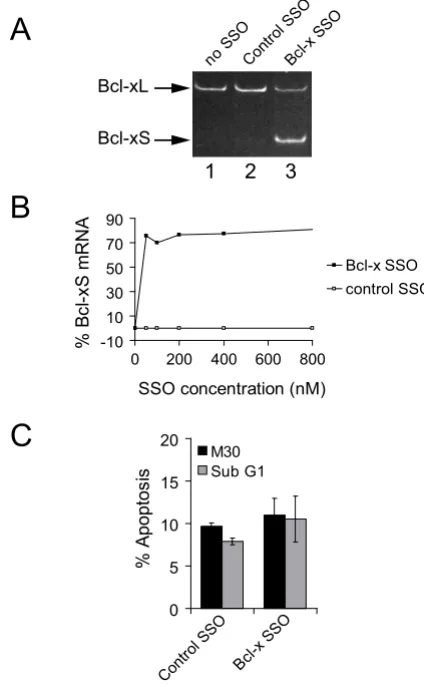
HeLa cervical carcinoma cells were transfected with an SSO that anneals to the major 5' SS of exon II of the Bcl-x gene to switch splicing to the minor 5' SS (Bcl-x SSO, Fig-ure 1). Lipofectamine was selected as the transfection rea-gent as it has previously been demonstrated to provide efficient delivery of 2'-O-methyl (2'-O-Me) phospho-rothioate oligonucleotides into the nucleus of HeLa cells [14]. The impact of transfection of Bcl-x SSO on the expression of the alternative Bcl-xS splice variant was ana-lyzed by RT-PCR with primers flanking the alternative splicing event. In untreated HeLa cells the levels of Bcl-xS mRNA were very low (Figure 2A, lane 1). Treatment of HeLa cells with a control SSO of scrambled sequence did not alter the levels of Bcl-xS mRNA (Figure 2A, lane 2),
Splice-switching oligonucleotides act on the endogenous Bcl-x gene to enforce splice site choice of the Bcl-xS
Figure 1
Splice-switching oligonucleotides act on the endogenous Bcl-x gene to enforce splice site choice of the Bcl-xS. The region of the Bcl-x pre-mRNA that includes two alternative 5' splice sites (SSs) that produce either the constitutive long (L) splice variant or the alternative short (S) splice variant is schematically depicted. Selection of an intron-proximal L 5' splice site (SS) results in production of the Bcl-xL isoform (at right) whereas the selection of the proximal S 5' SS results in the pro-duction of the Bcl-xS isoform (at left). The SSO oligonucleotide that base pair with the major L splice site forces splicing from the distal 5' SS and induces expression of the endogenous Bcl-xS isoform (at left). The Bcl-xL gene product has anti-apoptotic activity while the Bcl-xS gene product possesses pro-apoptotic activity.
II
III
II
III
mRNA
pre-mRNA
Bcl-x SSO
+
II
III
5'ss-S 5'ss-L
3'ss
indicating the absence of non-specific effects of transfec-tion of SSOs on Bcl-xS, consistent with previous reports employing an independent scrambled SSO [12] or 5 nucleotide mismatched SSO [11]. The transfection of the Bcl-x SSO caused, as previously reported, a strong shift from the predominant expression of Bcl-xL towards the expression of Bcl-xS (Figure 2A, lane 3). The levels of induction of endogenous Bcl-xS by SSO were analyzed quantitatively by transfection of increasing concentrations of the Bcl-x SSO into HeLa cells followed by analysis of the ratio of endogenous Bcl-xS/Bcl-xL+xS mRNA using Agilent LabChips. The percentage of Bcl-xS/Bcl-xL+xS in the presence of Bcl-x SSO reached 77% with treatment of cells with 200 nM SSO and higher concentrations pro-duced very little further increase in the Bcl-xS/Bcl-xL+xS ratio (Figure 2B). In contrast, no change in the Bcl-xS/Bcl-xL+xS ratio was seen with the negative control SSO of ran-dom sequence at any concentration used (Figure 2B). Based on the above results we selected treatment with 200 nM Bcl-x SSO as a robust method to enforce splice site selection of endogenous Bcl-xS for microarray studies.
Treatment of cells with Bcl-xS-inducing SSOs can either sensitize cells to apoptotic stimuli, or induce apoptosis outright depending on the cell type and the levels of expression of Bcl-x [11-13]. In order to correlate changes in gene expression induced by Bcl-xS expression with the phenotypic outcome it was important to measure the rates of apoptosis in our experimental system. To analyze the impact of shifting the expression of endogenous Bcl-x from the long to the short isoform on apoptosis, the per-centage of apoptotic cells was analyzed by flow cytometry using monoclonal antibodies that detect caspase cleaved cytokeratin-18, or by measuring Sub G1 DNA content by staining with propidium iodide. HeLa cells treated with Bcl-x SSO did not show a statistically significant increase in levels of apoptosis, in line with the previous results of Mercatante et al. in HeLa cells [13]. Therefore although Bcl-xS mRNA expression is strongly induced in HeLa cells, this change is not accompanied by cell death through apoptosis.
[image:3.612.324.536.91.434.2]To study the impact of Bcl-xS induction on gene expres-sion, we decided to record the downstream transcriptome dynamics using pan-genomic 60mer oligonucleotide microarrays and chemiluminescence detection chemistry, a combination that has previously been shown to provide increased signal dynamic range and higher sensitivity when compared to traditional microarray technologies [15,16]. The microarrays used represent 27,868 fully annotated and verified human genes. Biologic triplicate recordings for both control and Bcl-xS SSO transfected HeLa cells were acquired following total RNA purification and reverse transcriptase labeling as detailed in the meth-ods section [see Additional file 1]. After image processing,
Figure 2
Specific control of endogenous Bcl-xS splicing by modified antisense RNA oligonucleotides in living cells. (A) Antisense RNA oligonucleotide induces endog-enous Bcl-xS mRNA expression. HeLa cells were transfected with 200 nM oligonucleotide directed against the major Bcl-xL splice site (Bcl-x SSO) or a scrambled control oligonucle-otide (Control SSO). 24 hours post-transfection total RNA was isolated and subjected to RT-PCR with primers that amplify both the Bcl-xL and the alternative Bcl-xS mRNAs. (B) Concentration-dependent antisense mediated induction of Bcl-xS mRNA expression. HeLa cells were transfected with antisense RNA oligonucleotides as in A. RT-PCR was performed as in A. PCR products were separated by micro-fluidity and quantified using a 2100 Agilent bioanalyzer. The ratio of Bcl-xS mRNA over total Bcl-x mRNA is expressed on the y-axis. The values from cells treated with scrambled control SSO (open squares), or Bcl-X SSO (black squares) are shown. (C) The effect of endogenous Bcl-xS on apoptosis in HeLa cells. HeLa cells were transfected as in A. Cells were harvested 24 hours post-transfection and percentage of apoptotic cells was analyzed by flow cytometry using mono-clonal antibodies that detect caspase cleaved cytokeratin-18 (M30; black bars), or by measuring Sub G1 DNA content (grey bars). Error bars represent the standard deviation of three independent transfections.
-10 10 30 50 70 90
0 200 400 600 800 SSO concentration (nM)
% B cl -x S m RNA control SSO Bcl-x SSO Bcl-xS Bcl-xL Contr ol SSO Bcl-x SSO no SSO
1 2 3
0 5 10 15 20 Contr ol SSO % A poptos is M30 Sub G1
Bcl-x SSO
A
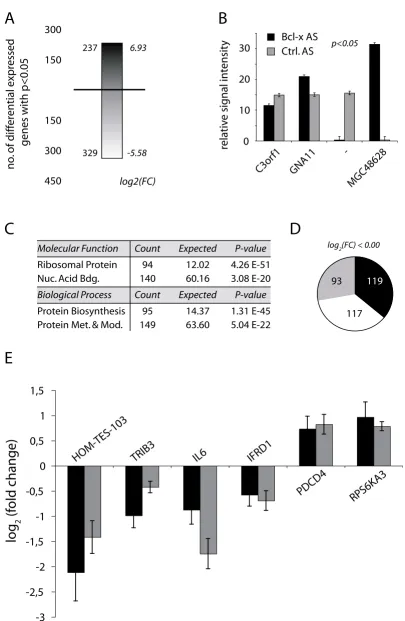
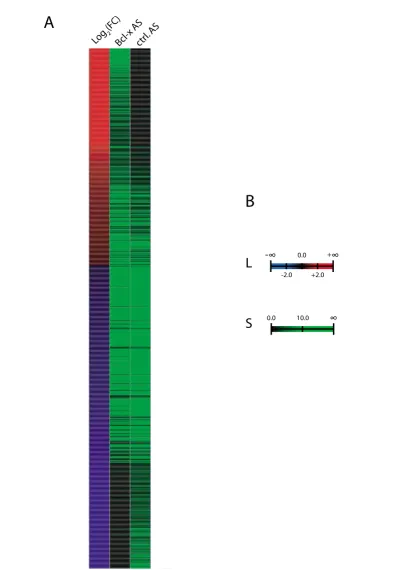
and primary data analysis, we calculated the logarithmic (base 2) fold-change for all represented genes and deter-mined their level of statistical significance according to standard methods. We found a total of 556 genes [see additional file 2] to be differentially expressed with a p-value inferior to 0.05 when comparing the transcriptome from control and Bcl-xS SSO transfected HeLa cells (Fig-ure 3A &4). Slightly more genes are repressed by Bcl-x SSO than are induced as 329 or 59% of the genes show a decrease in expression following splice-site shifting in Bcl-x. The quality of the transcriptome recordings and their analysis can be appreciated from comparing the signal intensities of the least and most induced or repressed genes (Figure 3B). In the case of the chromosome 3 open-reading frame 1 as little as a 1.2 fold-change is readily detected. We then analyzed the differentially expressed gene list for emergent properties using a meta-analysis of the available annotation information for statistically sig-nificant (p < 0.01) over-represented molecular function and biologic process ontologies. Indeed, for each cate-gory, two ontologies are highly significantly enriched (Fig-ure 3C). Note that the molecular function and biologic process ontologies are not mutually exclusive, quite to the contrary, the signals in both categories are generated by essentially the same subset of genes [see Additional files 3, 4, 5 and 6], and point towards a highly relevant enrich-ment of the protein synthesis apparatus in the Bcl-xS reg-ulated gene set. Further analysis revealed that the expression levels of the majority of genes belonging to the molecular functions singled out through the meta-analy-sis are reduced following a shift in the cellular equilibrium towards Bcl-xS (Figure 3D). For example, of 94 genes sig-nificantly regulated with the molecular function ontology being ribosomal protein genes, 93 are repressed (Figure 3C &3D). Finally, for a selected number of Bcl-xS targets we performed independent biological triplicate quantita-tive RT-PCR analysis to demonstrate reproducibility of our transcriptome measurements with an independent technology (Figure 3E). As expected, the qPCR results con-firm the microarray data for all tested genes (Figure 3E). The Pearson correlation coefficient for the correlation between the microarray data and the qPCR is 0.872, pro-viding a statistical measure that reinforces the validity of the microarray data. We therefore have demonstrated the feasibility of using high sensitivity transcriptome analysis as a tool for defining the outcome of alternative splicing events on global gene expression patterns.
Conclusion
Here we have combined splice-switching oligonucleotides (SSOs) with high-sensitivity genome-wide microarrays to reveal the impact of shifting the expression of the endog-enous Bcl-xL splice variant towards the Bcl-xS splice vari-ant. To our knowledge, only a single study attempted to address the impact of SSO on gene expression patterns
using microarrays [17]. In that study, no statistically sig-nificant impact of Bcl-xS SSO on specific cellular func-tions or pathways was uncovered. Here we demonstrate a statistically significant impact of Bcl-xS SSOs on the repression of ribosomal protein-encoding genes and genes that code for nucleic acid binding proteins. Several factors could contribute to the different outcome of our study when compared to the earlier study [17]. For exam-ple, different cell lines can give different transcriptome footprints, and we have employed HeLa whereas Mercat-ante et al. employed MCF7 and PC3 cells. Moreover the time of SSO treatment in our study was 18 hours versus 36 hours in that of Mercatante et al., a difference that could influence the number of primary versus secondary effects of the SSO. Here we have combined for the first time SSO with second-generation microarrays that possess substan-tially increased sensitivity and genome coverage and thus provide improved detection of statistically significant changes in specific gene ontologies. The capacity to detect specific cellular pathways that are impacted upon SSO represents an advance that can provide new biological insights into the function of alternative splicing events. Our study has focused on the transcriptome signature induced by Bcl-x SSO in the HeLa cell model system, how-ever the methodology we describe should also be applica-ble to any alternative splicing event in any cell line that responds efficiently to SSO transfection. Genome-wide technologies have revealed the pervasive role of alterna-tive splicing in proteome diversity, yet the functions of the vast majority of splice variants remain unknown [3]. The merging of SSO and second-generation microarray tech-nology that we present here provides a powerful and broadly applicable methodology to decipher the biologi-cal functions that are controlled by alternative splicing events.
transla-Figure 3 (see legend on next page)
A
log2(FC)
no
. of diff
er
ential expr
essed
genes with p<0.05
6.93
-5.58
329 237
300
150
150
300
450
0
10
20
30
C3or
f1
GNA11
-MGC48628
Bcl-x AS
Ctrl. AS
B
p<0.05
relativ
e signal int
ensit
y
E
C
D
Molecular Function Count P-value
Ribosomal Protein 94 4.26 E-51 Nuc. Acid Bdg. 140 3.08 E-20
Biological Process Count P-value
Protein Biosynthesis 95 1.31 E-45 Protein Met. & Mod. 149
Expected 12.02 60.16
Expected 14.37
63.60 5.04 E-22
93
117
119 log2(FC) < 0.00
IFRD1
IL6
TRIB3
HOM-TES-103
PDCD
4
RPS6K
A3
log
2
(f
old change)
-3
-2,5
-2
-1,5
-1
-0,5
0
0,5
[image:5.612.101.507.78.700.2]tional inhibition exists. Further work will be required to confirm the hypothesis of such a feedback mechanism.
In summary, we report here a protocol that enables the measurement of the impact of endogenous alternative splicing events on transcriptome dynamics. When applied to the induction of Bcl-xS mRNA by splice-switching oli-gonucleotides we demonstrate a statistically significant suppression of ribosomal protein encoding genes. The approach applied here should accelerate efforts to define the biological roles of the vast numbers of uncharacter-ized alternative splice variants within the human genome. Finally, the approach we describe can also be applied to the analysis of the mechanism of action of clinically use-ful SSOs.
Competing interests
The authors declare that they have no competing interests.
Authors' contributions
EW performed the experiments except the microarray experiments. FXP analyzed microarray data. AB designed and performed the microarray experiments and their sta-tistical analysis. BB designed the experiments and per-formed data analysis. EW, AB and BB wrote the paper. All authors read and approved the final manuscript.
Endogenous Bcl-xS expression orchestrates a cellular gene expression program linked to the protein synthesis machinery
Figure 3 (see previous page)
Transcriptome analysis
Figure 4
Transcriptome analysis. (A) A Heat-map for the Bcl-x AS versus control AS subtraction profile is shown. Note that the non-normalized signal intensities for the probes revealing statistically significant changes in gene expression (p < 0.05) are rep-resented by a black (low signal) to green (high signal) gradient. The probes are ordered in a logarithmic (base-two) fold-change descending order ("log2(FC)") which is displayed as a red (highly up-regulated) to black to blue (highly down-regulated) gradi-ent. (B) A color code legend for the data displayed in (A) is given.
B
A
Log 2 (FC)
Bcl-x ASctrl. AS
0.0 10.0 ∞
S
-∞ 0.0 +∞
-2.0 +2.0
Additional material
Acknowledgements
F.X.P. is recipient of a doctoral fellowship from the Nausicaa Combat Sa Leucémie association. A.B.'s group received funds from the European Hema-tology Association – José Carreras Foundation, and the French Ministry of Research through the "Complexité du Vivant – Action STICS-Santé" pro-gram. Work in B.B's laboratory was funded through a Discovery grant from Natural Sciences and Engineering Research Council of Canada. B.B. holds the Canada Research Chair in Genomic Regulation.
References
1. Lander ES, Linton LM, Birren B, Nusbaum C, Zody MC, Baldwin J, Devon K, Dewar K, Doyle M, FitzHugh W, et al.: Initial sequencing and analysis of the human genome. Nature 2001,
409(6822):860-921.
2. Venter JC, Adams MD, Myers EW, Li PW, Mural RJ, Sutton GG, Smith HO, Yandell M, Evans CA, Holt RA, et al.: The sequence of the human genome. Science 2001, 291(5507):1304-1351.
3. Modrek B, Lee C: A genomic view of alternative splicing. Nat Genet 2002, 30(1):13-19.
4. Black DL: Mechanisms of Alternative Pre-Messenger RNA Splicing. Annu Rev Biochem 2003.
5. Johnson JM, Castle J, Garrett-Engele P, Kan Z, Loerch PM, Armour CD, Santos R, Schadt EE, Stoughton R, Shoemaker DD: Genome-wide survey of human alternative pre-mRNA splicing with exon junction microarrays. Science 2003, 302(5653):2141-2144. 6. Garcia-Blanco MA, Baraniak AP, Lasda EL: Alternative splicing in
disease and therapy. Nat Biotechnol 2004, 22(5):535-546. 7. Lopez-Bigas N, Audit B, Ouzounis C, Parra G, Guigo R: Are splicing
mutations the most frequent cause of hereditary disease? FEBS Lett 2005, 579(9):1900-1903.
8. Wang GS, Cooper TA: Splicing in disease: disruption of the splicing code and the decoding machinery. Nat Rev Genet 2007,
8(10):749-761.
9. Kole R, Williams T, Cohen L: RNA modulation, repair and remodeling by splice switching oligonucleotides. Acta Biochim Pol 2004, 51(2):373-378.
10. Boise LH, Gonzalez-Garcia M, Postema CE, Ding L, Lindsten T, Turka LA, Mao X, Nunez G, Thompson CB: bcl-x, a bcl-2-related gene that functions as a dominant regulator of apoptotic cell death. Cell 1993, 74(4):597-608.
11. Taylor JK, Zhang QQ, Wyatt JR, Dean NM: Induction of endog-enous Bcl-xS through the control of Bcl-x pre-mRNA splic-ing by antisense oligonucleotides. Nat Biotechnol 1999,
17(11):1097-1100.
12. Mercatante DR, Bortner CD, Cidlowski JA, Kole R: Modification of alternative splicing of Bcl-x pre-mRNA in prostate and breast cancer cells. analysis of apoptosis and cell death. J Biol Chem 2001, 276(19):16411-16417.
13. Mercatante DR, Mohler JL, Kole R: Cellular response to an anti-sense-mediated shift of Bcl-x pre-mRNA splicing and antine-oplastic agents. J Biol Chem 2002, 277(51):49374-49382. 14. Sazani P, Kang SH, Maier MA, Wei C, Dillman J, Summerton J,
Mano-haran M, Kole R: Nuclear antisense effects of neutral, anionic and cationic oligonucleotide analogs. Nucleic Acids Res 2001,
29(19):3965-3974.
15. Noth S, Brysbaert G, Pellay FX, Benecke A: High-sensitivity tran-scriptome data structure and implications for analysis and biologic interpretation. Genomics Proteomics Bioinformatics 2006,
4(4):212-229.
16. Wang Y, Barbacioru C, Hyland F, Xiao W, Hunkapiller KL, Blake J, Chan F, Gonzalez C, Zhang L, Samaha RR: Large scale real-time PCR validation on gene expression measurements from two commercial long-oligonucleotide microarrays. BMC Genomics
2006, 7:59.
17. Mercatante DR, Kole R: Control of alternative splicing by anti-sense oligonucleotides as a potential chemotherapy: effects on gene expression. Biochim Biophys Acta 2002,
1587(2–3):126-132.
18. Lindenboim L, Borner C, Stein R: Bcl-x(S) can form homodimers and heterodimers and its apoptotic activity requires locali-zation of Bcl-x(S) to the mitochondria and its BH3 and loop domains. Cell Death Differ 2001, 8(9):933-942.
19. Boon-Unge K, Yu Q, Zou T, Zhou A, Govitrapong P, Zhou J: Emet-ine regulates the alternative splicing of Bcl-x through a
pro-Additional file 1
Detailed Methods. A detailed description of the methods used including cell culture conditions, molecular biology techniques and an extensive description of SSO-coupled transcriptome analysis.
Click here for file
[http://www.biomedcentral.com/content/supplementary/1756-0500-1-94-S1.doc]
Additional file 2
An ascii tab-delimited file is provided containing the listing of the probe IDs (PROBE), the log2 fold-changes (LOG_Q), the log2 fold change esti-mated variance (VAR), the P-value (P), as well as several gene identifi-ers, for the 565 selected probes from this analysis.
Click here for file
[http://www.biomedcentral.com/content/supplementary/1756-0500-1-94-S2.txt]
Additional file 3
An ascii tab-delimited file is provided containing the listing of the probe IDs (PROBE), the log2 fold-changes (LOG_Q), the log2 fold change esti-mated variance (VAR), the P-value (P), as well as several gene identifi-ers, for the subset of selected probes mapping to the Nucleic Acid Binding ontology term used for the meta-analysis.
Click here for file
[http://www.biomedcentral.com/content/supplementary/1756-0500-1-94-S3.txt]
Additional file 4
An ascii tab-delimited file is provided containing the listing of the probe IDs (PROBE), the log2 fold-changes (LOG_Q), the log2 fold change esti-mated variance (VAR), the P-value (P), as well as several gene identifi-ers, for the subset of selected probes mapping to the Protein Biosynthesis ontology term used for the meta-analysis.
Click here for file
[http://www.biomedcentral.com/content/supplementary/1756-0500-1-94-S4.txt]
Additional file 5
An ascii tab-delimited file is provided containing the listing of the probe IDs (PROBE), the log2 fold-changes (LOG_Q), the log2 fold change esti-mated variance (VAR), the P-value (P), as well as several gene identifi-ers, for the subset of selected probes mapping to the Protein Metabolism and Modification ontology term used for the meta-analysis.
Click here for file
[http://www.biomedcentral.com/content/supplementary/1756-0500-1-94-S5.txt]
Additional file 6
An ascii tab-delimited file is provided containing the listing of the probe IDs (PROBE), the log2 fold-changes (LOG_Q), the log2 fold change esti-mated variance (VAR), the P-value (P), as well as several gene identifi-ers, for the subset of selected probes mapping to the Ribosomal Protein ontology term used for the meta-analysis.
Click here for file
Publish with BioMed Central and every scientist can read your work free of charge
"BioMed Central will be the most significant development for disseminating the results of biomedical researc h in our lifetime."
Sir Paul Nurse, Cancer Research UK
Your research papers will be:
available free of charge to the entire biomedical community
peer reviewed and published immediately upon acceptance
cited in PubMed and archived on PubMed Central
yours — you keep the copyright
Submit your manuscript here:
http://www.biomedcentral.com/info/publishing_adv.asp
BioMedcentral
tein phosphatase 1-dependent mechanism. Chem Biol 2007,
![3 (2,6 Dioxopiperidin 3 yl) 3 azabicyclo[3 2 0]heptane 2,4 dione](data:image/gif;base64,R0lGODlhAQABAIAAAP///wAAACH5BAEAAAAALAAAAAABAAEAAAICRAEAOw==)