RESEARCH NOTE
Robust sampling and preservation of DNA
for microbial community profiling in field
experiments
Anneloes E. Groenenboom
1,2*, Eddy J. Smid
2and Sijmen E. Schoustra
1,3Abstract
Objective: Stabilising samples of microbial communities for DNA extraction without access to laboratory equipment can be a challenging task. In this paper we propose a method using filter paper disks for the preservation of DNA from diverse microbial communities which are found in a fermented milk product.
Results: Small adaptations to the DNA extraction method used for liquid fermented milk delivered DNA of sufficient amounts and quality to be used for later analyses, e.g. full community 16S amplicon sequencing. The microbial com-munity structure obtained via the filter paper method showed sufficient resemblance to the structure obtain via the traditional DNA extraction from the liquid milk sample. This method can therefore successfully be used to analyse diverse microbial communities from fermented milk products from remote areas.
Keywords: Filter paper disks, Field trial, Microbial community, Milk, Fermentation, DNA stabilisation
© The Author(s) 2019. This article is distributed under the terms of the Creative Commons Attribution 4.0 International License (http://creat iveco mmons .org/licen ses/by/4.0/), which permits unrestricted use, distribution, and reproduction in any medium, provided you give appropriate credit to the original author(s) and the source, provide a link to the Creative Commons license, and indicate if changes were made. The Creative Commons Public Domain Dedication waiver (http://creat iveco mmons .org/ publi cdoma in/zero/1.0/) applies to the data made available in this article, unless otherwise stated.
Introduction
Sequencing techniques are developing fast, resulting in more advanced and affordable ways to analyse DNA, such as characterising bacterial community structure using 16S amplicon sequencing. These high tech devel-opments however are of no use if DNA samples are not well preserved before reaching the laboratory. The stabi-lisation of DNA is a challenge in field experiments where researchers do not have access to a laboratory with basic equipment, like a refrigerator and a sterile work environ-ment. In some cases the DNA extraction and amplifica-tion can be performed in the field [1]. Often, biochemical solutions are being applied to stabilise the DNA [2–4]. More convenient for field trials would be the use of FTA paper [5, 6] or another solid carrier [7], as that increases the ease of storage and sending of the samples. Such low-tech methods deliver an important advantage for field researchers who want to stabilise DNA with minimal sample processing and a few materials. In this study we
explored and validated the use of simple filter paper to stabilise bacterial DNA from a fermented dairy product without prior extraction of DNA. This method is com-pared to an often used method where liquid samples are quickly cooled after sampling and transported in cold conditions [8].
In the method we studied, a small drop of a traditional fermented milk product is transferred to the filter paper and left to dry. The dried paper including the drop can be stored for a long period of time at ambient tempera-ture before the DNA extraction is performed. The sub-sequent DNA extraction method is a variation on the DNA extraction method used for liquid samples from fermented milk products. The dairy product used in this study, called Mabisi, is a traditionally fermented product found in rural areas in Zambia. As the fermentation in spontaneous, the bacterial community in the product is very diverse [9].
To study the composition of the microbial community in the fermented product, it is essential to quench micro-bial growth immediately after sampling. In a laboratory environment this would be done by cooling the sample to temperatures below 4 °C, which will slow down and stop the growth of the bacteria responsible for fermentation,
Open Access
*Correspondence: [email protected]
1 Laboratory of Genetics, Wageningen University and Research, Wageningen, The Netherlands
but will keep them viable for later analyses. The filter paper method described here will also slow down and eventually stop bacterial growth, as it fixes the bacteria and dehydrates the medium. Although the bacteria will not be viable for analyses using culturing techniques, the DNA can be isolated from the papers and used for bacterial community analyses, such as 16S amplicon sequencing.
Main text
Methods
Preparing filter paper
Discs of filter paper (qualitative 413, 75 mm, VWR Inter-national, Radnor, United States) were placed in a Petri dish. Samples of 1 mL were spotted at the centre of the filter paper. The filter papers were left to dry at uncon-trolled temperature in a hut without windows. Drying times varied between 30 min and 2 h depending on the thickness of the sample. Dried samples were stored in a Petri dish for up to 2 months before DNA extraction was performed.
Extraction of DNA
The DNA extraction method was adapted from Ercolini [10] and Schoustra [9]. To extract bacterial DNA from the milk environment, some steps are necessary to break down the casein structure. The high protein content in combination with the relatively high percentage of lipids makes the use of the other DNA methods less success-ful for milk samples. For DNA extraction from liquid samples, 1 mL of fermented milk was spun down (2 min, 12000 RPM), after which the supernatant was removed. The cells were re-suspended in a mix of 64 µL EDTA (0.5 M), 160 µL Nucleic Lysis Solution (Promega, Madi-son, United States), 5 µL RNAse (100 mg/mL), 120 µL lysozyme (10 mg/mL) and 40 µL pronase E (20 mg/mL). Samples were incubated for 60 min at 37 °C while being shaken at 350 RPM.
For the extraction of DNA from the filter paper discs, a piece, 2 by 2 cm, was cut from the middle of the filter paper with a sterile pair of scissors. This piece was posi-tioned at the bottom of a 1.5 mL Eppendorf tube with a pair of tweezers. The cells were thoroughly suspended in a mix of 132 µL 0.5 M EDTA, 320 µL Nuclei Lysis Solu-tion, 1 µL RNase, 240 µL lysozyme and 80 µL pronase E. Samples were incubated for 24 h at 37 °C and agitation of 350 RPM.
After the incubation step described above of both liq-uid samples and paper samples, a standard DNA extrac-tion protocol was used, see Addiextrac-tional file 1: Supplement A.
Bacterial community reconstruction
For validation of the method in the laboratory the DNA of the extractions was amplified in the PCR and cloned into vectors to identify the DNA fragments in a clone library (see Additional file 1: Supplement B). The DNA extracts of the field samples, containing DNA from all organisms in the community, were sent for bacterial 16S rRNA gene amplicon paired-end sequencing of the V4 hypervariable region (341F-785R) on the MiSeq Illu-mina platform by LGC genomics (Berlin, Germany). For further data processing and statistics the QIIME pipeline [11], modified from Bik et al. [12] was used (see Addi-tional file 1: Supplement C).
Results
Validation of the method in the lab
Before testing the filter paper method in the field, the DNA extraction method was tested and optimised in the laboratory. Pure Mabisi samples and ten times diluted Mabisi samples were transferred on filter paper discs. The extracted DNA from these samples was compared to the DNA extracts from a undiluted liquid Mabisi sample. The DNA concentration in the paper with the undiluted and diluted Mabisi was 172.9 ± 0.3 ng/µL and
11.8 ± 1.6 ng/µL, respectively. The amount of DNA is
comparable to the DNA obtained from the liquid sample 120.7 ± 16.5 ng/µL. Also the purity of the DNA extracts from the filter paper is comparable to that from the liq-uid DNA extracts as judged by the A260/A280 ratio (1.80 ± 0.05 and 1.83 ± 0.2, respectively).
The clone library of the DNA extracts was blasted against the NCBI database. The microbial communities of the two liquid samples and the two paper samples with diluted Mabisi contain similar species (Additional file 2: Figure S1). Variations can be found in both abundance, richness and type of species to which these reads blast. The sample size was not sufficient to make statistical inferences.
Validation of the method in the field
At the field site in Zambia eight samples of Mabisi were split in two equal parts and subsequently transferred to filter paper as well as stored at 4 °C before shipment to our laboratory in the Netherlands. There the DNA was extracted using the corresponding methods. The concentration of DNA obtained from these extrac-tions varied between 25 ng/µL and 125 ng/µL, with a higher average DNA concentration for the liquid
sam-ples (84.5 ± 25.1 ng/µL) compared to the filter paper
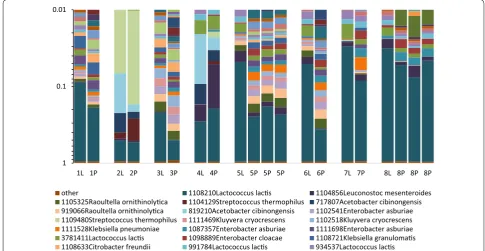
5–10 ng/µL. DNA extracts were sequenced (16S ampli-con sequencing) using MiSeq Illumina sequencing and resulting reads were analysed to construct bacterial com-munities based on operational taxonomic units (OTUs). Comparison of the bacterial communities present in the samples shows a high degree of similarity between samples processed via the filter paper discs and those obtained by direct extraction of the fermentation liquid (Fig. 1). Most communities are dominated by Lactococ-cus lactis. In some samples also a high relative abundance of other bacterial species, belonging for example to the
Acetobacter and Streptococcus genus, were found. In all cases, both collection methods (liquid and paper) show a similar microbial composition with differences in rela-tive abundance. The differences in richness and diversity
can be found in Fig. 2, where number of OTUs, Shannon
index and evenness of all samples are plotted. This anal-yses shows no difference in total amount of OTUs that returned, but shows a difference in OTU distribution. Communities obtained via the paper method showed a higher Shannon index and a higher evenness.
Discussion
The filter paper method described above can be used to determine the bacterial microbial communities in a fer-mented milk products produced in areas which have no access to basic laboratory equipment and cooling
facilities. With some minor adjustments to the DNA extraction method for fermented milk, good quality DNA could be extracted from the filter paper disks. To a large extent this extraction from filter paper showed the same microbial community structure as the DNA extracted from the liquid sample directly. Although the same num-ber of OTUs were obtained from the DNA extract the distribution was slightly different. The filter paper extrac-tion seemed to have extracted relatively less of the most
abundant OTU which represent L. lactis and relatively
more of the OTUs present in low amounts. Filter paper is known to have bias towards preservation of certain spe-cies [13–15], and more research towards this will be nec-essary to validate this bias.
To analyse all aspects of fermentation it is essential to determine the bacterial community composition dur-ing, or even before, periods of vigorous growth. With our method, in which the bacterial growth is arrested due to drying of the milk, dynamic time course samples can be stabilised and subsequently analysed at a later stage. The samples analysed here are all from fermen-tation end points. Consequently, no active growing microbial cells are expected anymore in these sam-ples due to the lack of nutrients and the low medium pH. Therefore, we can assume that at this particular stage, the bacterial community composition is already relatively stable. This makes it possible to compare
0.01
0.1
1
1L 1P 2L 2P 3L 3P 4L 4P 5L 5P 5P 5P 6L 6P 7L 7P 8L 8P 8P 8P
other 1108210Lactococcus lacs 1104856Leuconostoc mesenteroides 1105325Raoultella ornithinolyca 1104129Streptococcus thermophilus 717807Acetobacter cibinongensis 919066Raoultella ornithinolyca 819210Acetobacter cibinongensis 1102541Enterobacter asburiae 1109480Streptococcus thermophilus 1111469Kluyvera cryocrescens 1102518Kluyvera cryocrescens 1111528Klebsiella pneumoniae 1087357Enterobacter asburiae 1111698Enterobacter asburiae 3781411Lactococcus lacs 1098889Enterobacter cloacae 1108721Klebsiella granulomas 1108633Citrobacter freundii 991784Lactococcus lacs 934537Lactococcus lacs
[image:3.595.54.540.437.688.2]DNA extractions from the filter paper with extraction from the liquid sample. Still the liquid sample can-not be seen as a perfect benchmark. Where the filter paper method might overestimate bacterial diversity, the DNA extracted from liquid sample might give an underestimation of the diversity. It is however a prom-ising observation that the filter paper method was able to return low abundancy OTUs on top of identifying OTUs with high abundance. The method presented had proven its value and is sufficiently accurate for our purpose; the characterisation of the bacterial commu-nities in a traditional fermented product. Besides, this method is easier and less expensive than the commer-cially available alternatives.
This method is also used for the characterisation of the bacterial communities in cereal based fermented foods from Benin, Zambia and Tanzania (unpublished obser-vations, S. Phiri, S.E. Schoustra and A. Linnemann). Here the method also showed to be reliable and return a microbial community which is similar to a community where DNA is extracted directly from the product. The application of the presented method potentially can be extended to microbial community analysis of liquid envi-ronmental samples.
Conclusion
The discussed filter paper method for microbial com-munity preservation by DNA extraction is an interest-ing tool to use with fermented foods in the field where other tools are not successful. Besides drying carefully in a clean environment this methods does not require any high-tech or electrical machines. This makes this method very effective for the stabilisation and transport of micro-bial communities in a nutritious environment like milk.
Limitations
Resulting bacterial communities show slight variation from bacterial communities constructed using DNA extracted from a liquid sample, but this is not more than variation which can be found between multiple analyses of the same DNA extracts from filter paper disks. Unfor-tunately, there is no golden standard for DNA stabilisa-tion from fermented milk products to compare with this filter paper method. Another limitation is the risk for contamination. More developments in finding an optimal stabilising method for a longer storage time and a com-plete DNA extraction method could be done. The biggest risk arises when the papers are not dry enough. The filter paper disks do not contain any preservatives to prevent
[image:4.595.59.538.88.359.2]spoilage, so when the paper remains moist it could form a growth environment for both the organisms present in the sample as well as any contaminants. Regions with a dry climate, like the region in Zambia where the cur-rent study is performed, is ideal for this application, while more moist climates could cause difficulties in obtaining the right dryness.
Additional files
Additional file 1: Supplement A. Full DNA extraction protocol used for both filter paper and liquid samples. Supplement B. Analysis of commu-nity structure using clone libraries. Supplement C. Analysis of 16S rRNA amplicon sequencing data for bacterial community reconstruction. Additional file 2: Figure S1. Bacterial composition of liquid and paper samples all originating from the same Mabisi sample. Different colours indicate different species which could originate from different reads. Numbers 1 and 2 indicate the two technical replicates of DNA extraction.
Abbreviation
OTU: operational taxonomic unit.
Authors’ contributions
AEG, EJS and SES conceived and designed this project. AEG collected the data and performed the data analyses. AEG, EJS and SES did data interpretation and wrote the paper. All authors read and approved the final manuscript.
Author details
1 Laboratory of Genetics, Wageningen University and Research, Wageningen, The Netherlands. 2 Laboratory of Food Microbiology, Wageningen University and Research, Wageningen, The Netherlands. 3 Department of Food Science and Nutrition, School of Agricultural Sciences, University of Zambia, Lusaka, Zambia.
Acknowledgements
We would like to thank the local community in Mondake, Zambia, who pro-vided the Mabisi samples for this study. Frank Phiri and Djondoh Sikalangwe are gratefully thanked for their help during the field experiments as well as other collaborators from Heifer International Zambia. Also we thank our colleagues at the University of Zambia who helped with the preparation and lab work of this study. The help of Joost van den Heuvel in the analyses of the sequencing data is highly appreciated.
Competing interests
The authors declare that they have no competing interests.
Availability of data and materials
The data used in this manuscript will be deposited on https ://resea rchda ta.4tu.nl/home/. This depository is a collaboration between the four technical universities in the Netherlands (4TU) and it is open for public. Soon the data will be available under https ://doi.org/10.4121/uuid:5c129 650-21c9-4d0f-a0eb-7cd9f 30614 40.
Consent for publication
Not applicable.
Ethics approval and consent to participate
All research is performed with respect to international regulations and scientific ethical practices. Ethical clearance for this study was obtained from ethics committees at the University of Zambia, at the Zambian Ministry of Agriculture and Livestock and at Wageningen University.
Funding
Funding was received from NWO WOTRO Global Challenges Programme [W08.250.2013.108]. This funding body did not have a role in the design of the study and collection, analysis, and interpretation of data and in writing the manuscript.
Publisher’s Note
Springer Nature remains neutral with regard to jurisdictional claims in pub-lished maps and institutional affiliations.
Received: 30 January 2019 Accepted: 13 March 2019
References
1. Tomlinson J, Boonham N, Hughes K, Griffin R, Barker I. On-site DNA extraction and real-time PCR for detection of Phytophthora ramorum in the field. Appl Environ Microbiol. 2005;71(11):6702–10.
2. Swinfield CE, Graham EAM, Nuttall D, Maguire S, Kemp A, Rutty GN. The use of DNA stabilizing solution to enable room temperature storage and transportation of buccal and trace sample swabs. Forensic Sci Int Genet Suppl Ser. 2009;2(1):183–4.
3. Terada ASSD, Da Silva LAF, Galo R, De Azevedo A, Gerlach RF, Da Silva RHA. The use of a DNA stabilizer in human dental tissues stored under different temperature conditions and time intervals. J Appl Oral Sci. 2014;22(4):331–5.
4. Mitchell KR, Takacs-Vesbach CD. A comparison of methods for total com-munity DNA preservation and extraction from various thermal environ-ments. J Ind Microbiol Biotechnol. 2008;35(10):1139–47.
5. Fomovskaia G, Smith MA, Davis JC, Jones K. International Patent: Fta-coated media for use as a molecular diagnostic tool. 2000. p. 51. 6. Menassa N, Bosshard PPP, Kaufmann C, Grimm C, Auffarth GU, Thiel MA.
Rapid detection of fungal keratitis with DNA-stabilizing FTA filter paper. Invest Opthalmol Vis Sci. 2010;51(4):1905–10.
7. Burgoyne LA. United States Patent: Solid medium and method for DNA storage. 1996. p. 8.
8. Lore TA, Mbugua SK, Wangoh J. Enumeration and identification of microflora in suusac, a Kenyan traditional fermented camel milk product. LWT-Food Sci Technol. 2005;38(2):125–30.
9. Schoustra SE, Kasase C, Toarta C, Kassen R, Poulain AJ. Microbial commu-nity structure of three traditional zambian fermented products: Mabisi, Chibwantu and Munkoyo. PLoS ONE. 2013;8(5):e63948.
10. Ercolini D, Moschetti G, Blaiotta G, Coppola S. The potential of a polypha-sic PCR-dGGE approach in evaluating microbial diversity of natural whey cultures for water-buffalo Mozzarella cheese production: bias of culture-dependent and culture-inculture-dependent analyses. Syst Appl Microbiol. 2001;24(4):610–7.
11. Caporaso JG, Fierer N, Peña AG, Goodrich JK, Gordon JI, Huttley GA, et al. QIIME allows analysis of high-throughput community sequencing data. Nat Methods. 2010;7(5):335–6.
12. Bik HM, Maritz JM, Luong A, Shin H, Dominguez-Bello MG, Carlton JM. Microbial community patterns associated with automated teller machine keypads in New York City. mSphere. 2016;1(6):e00226-16.
13. Rajendram D, Ayenza R, Holder FM, Moran B, Long T, Shah HN. Long-term storage and safe retrieval of DNA from microorganisms for molecular analysis using FTA matrix cards. J Microbiol Methods. 2006;67(3):582–92. 14. Gray MA, Pratte ZA, Kellogg CA. Comparison of DNA preservation meth-ods for environmental bacterial community samples. FEMS Microbiol Ecol. 2013;83(2):468–77.