RESEARCH NOTE
Knowledge, attitude and preventive practice
towards tuberculosis among clients visiting
public health facilities
Ayele Semachew Kasa
1*†, Alebachew Minibel
1†and Getasew Mulat Bantie
2†Abstract
Objective: The aim of the study was to assess knowledge, attitude and preventive practice towards tuberculosis. Result: More than half of the study participants stated that bacteria are responsible agents in causing tuberculosis and as the same time 12.2% study participants thought that tuberculosis is not preventable disease. Overall, 54% of study participants had good knowledge, 68% had good attitude but only 48% had good practice in preventing tuber-culosis. Compared to many national and international studies, knowledge, attitude and preventive practice towards tuberculosis was not satisfactory. Strengthening of awareness creation and health education program towards tuber-culosis is needed.
Keywords: Tuberculosis, Knowledge, Attitude, Practice, North Mecha
© The Author(s) 2019. This article is distributed under the terms of the Creative Commons Attribution 4.0 International License (http://creat iveco mmons .org/licen ses/by/4.0/), which permits unrestricted use, distribution, and reproduction in any medium, provided you give appropriate credit to the original author(s) and the source, provide a link to the Creative Commons license, and indicate if changes were made. The Creative Commons Public Domain Dedication waiver (http://creat iveco mmons .org/ publi cdoma in/zero/1.0/) applies to the data made available in this article, unless otherwise stated.
Introduction
Globally, 9.7 million people get sick with tuberculosis (TB) and 1.7 million people die from it, each year [1]. TB continues to be a major public health problem across the world, including Ethiopia. It causes ill-health among mil-lions of people each year and ranks as the second leading cause of death from an infectious disease [2].
In 2006, 1.7 million deaths resulted from TB: the majority situated in sub-Sahara Africa [3]. Even though the incidence of TB has decreased worldwide, an esti-mated 10.4 million people developed TB in the year 2015 of which one-quarter was from Africa [4].
In every second; around the globe a person is infected with TB and every 10 s someone dies as a consequence of the disease [5].The 2018 Global TB report showed that Ethiopia is included in the 30 high TB burden countries [6] and in Ethiopia the case detection of the disease was 62 (51–74%) for all forms of TB [7, 8].
Raising communities’ awareness contributes for early diagnosis of TB which is one of the pillars of the End TB Strategy [4]. Studies documented a positive associa-tion between TB knowledge, care seeking and treatment adherence [9, 10]. To address such issues, the level of knowledge should be known to design an appropriate interventional programmes [11] in a specific regions.
The finding from various studies indicate that patient delay may be influenced by several factors, namely lack of knowledge, lack of awareness of the significance of symp-toms, negative social attitudes or combinations of these [12].
Though few studies were conducted on knowledge, atti-tude and preventive practice (KAP) towards tuberculosis in Ethiopia, no study has been done about KAP towards tuberculosis among Mecha District communities. There-fore, this study was designed to investigate KAP of Mecha District communities towards tuberculosis.
Main text
Study design
A cross-sectional descriptive study was conducted on North Mecha district residents who visited the adult out-patient departments (OPD) of public health facilities for various medical, maternity and family planning services
Open Access
*Correspondence: [email protected]; finoteayu24@gmail. com
†Ayele Semachew Kasa, Alebachew Minibel and Getasew Mulat Bantie contributed equally to this work
1 Department of Adult Health Nursing, College of Medicine & Health Sciences, Bahir Dar University, Bahir Dar, Ethiopia
from April 901 to May 30/2018. The district has 290,546 total population which is located in West Gojjam Zone which is part of Amhara Region, Ethiopia. The district is situated at 530 km North West of Addis Ababa, capital city of Ethiopia. Merawi is the administrative city of the district [13]. In this district there are a total of 10 health centers and one primary Hospital with 96% TB cure rate, 97% TB success rate, and 85% Bacillus Calmette–Guérin (BCG) vaccination coverage. The Catchment area had a total population of 14,034 in the selected health institu-tions [14].
Sample size determination and sampling procedure
Sample size was calculated using; 95% confidence inter-val (CI), 5% margin of error (d), P as 45.9% taken from a study done in Gambella Region, Ethiopia [18]. Based on the above assumptions and by adding 10% non-response rate to the initial sample size, the sample size was 420.
From the total 11 health facilities (HFs) found in North Mecha district, 4 HFs (Wotet Abay Health center, Abyot Fana Health Center, Felege Birehan Health Center and Merawi Primary Hospital) were selected using simple random sampling method. Then based on the client flow, the total sample size was proportionally allocated to each selected HFs. Finally clients visiting each of the selected health facilities in the data collection period were selected using systematic random sampling technique.
The data collection questionnaire was developed after reviewing different relevant literatures. The question-naire, first developed in English language and then trans-lated to Amharic (local language). The questionnaire had four different parts. Part-I: comprising of socio-demo-graphic questions, Part-II: comprising of twelve different knowledge assessing questions, Part-III: comprising of seven different attitude assessing questions and Part-IV: comprising of seven questions assessing the preventive practice towards TB.
Pretest was done on 5% of the total sample size at Meshenti Health Center. After the pretest, neces-sary modifications and correction took place to ensure validity. Four data collectors and one supervisor were recruited and trained for 1 day to collect and supervise the data respectively.
Data processing and analysis
Those respondents who scored greater than or equal to the mean value of knowledge questions were regarded as having good knowledge. Respondents who scored greater than or equal to the mean value of attitude assess-ing questions were regarded as havassess-ing favorable attitude. The respondents’ score greater than or equal to the mean value of preventive practice assessing questions were regarded as a participant having good practice.
The data were checked and cleaned, coded using non-overlapping numerical codes. Computer data files were thoroughly checked for errors, implausible values and inconsistencies that might be due to coding, entry, typing and other errors. Then, it was exported to SPSS version 20 for analysis. Descriptive statistics, like percentage, mean and standard deviation was used for the presenta-tion. Then the data were presented by using sentences, graphs, tables, frequencies, percentages.
Result
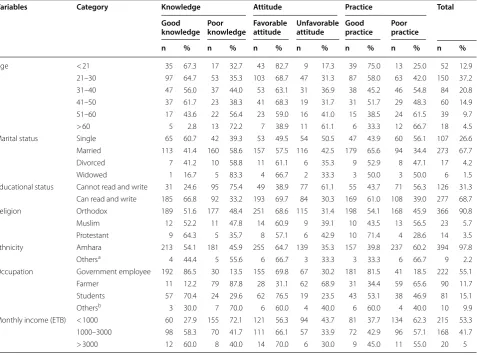
Out of the total 420 sample size, 403 individuals partic-ipated in the study making the response rate 95.9%. Of which, 53.3% respondents were females. All the respond-ents’ fall in the age range between 12 and 82 years old, with 35 years being the mean age. Majority of respond-ents were Orthodox Christian religion followers and eth-nically almost all (97.8%) were from Amhara ethnicity. The minimum monthly income of the study participants was no income to 25, 141 Ethiopian Birr (ETB) the maxi-mum monthly income and 1, 124 ETB was the average monthly income (Table 1).
From the total 403 study participants, 354 (87.8%) heard about tuberculosis. From these, majority (56.8%) of them received the information from health workers and followed by 26.8% from different Medias.
Knowledge towards TB
From those study participants who had information about TB, 74% mentioned that droplet inhalation as the main mode of transmission of the disease whereas 2% replied that heredity as the mode of transmission of the disease. Regarding sign and symptoms of TB, 39.4% men-tioned that cough for greater than or equal 2 weeks is the clinical manifestation of a client with TB. Forty-nine (12.2%) study participants thought that TB is not pre-ventable disease. More than half (56%) of the study par-ticipants stated that bacteria is the responsible agent in causing TB.
Attitude towards TB
Regarding to communities attitude towards tubercu-losis, 40.7% of study participants stated that TB is dan-gerous and serious for the community. Majority of study participants (46.2%) stated that TB is cannot transmit-ted from human to human. Almost one-fifth (19.3%) of study participants stated that discriminating TB patient is necessary.
Practice towards in the prevention of TB
participants ever screened for TB. Two-third of the study participants ever received health education about TB. From all study participants, two-third stated that they will cover their mouth during coughing if they had TB as a measure to prevent further spread of the disease (Table 2).
Overall KAP level
Two hundred eighteen (54%) of study participants had good knowledge towards TB and 193 (48%) of partici-pants had good preventive practice in preventing TB (Fig. 1).
Discussion
This study offers information on the knowledge, self-reported attitudes and practices towards TB. This
finding entails that there is a significant gaps in preven-tive practice towards TB infection control.
It is a well-known fact that knowledge can influence people’s practices regarding prevention [15]. The cur-rent study revealed that the overall knowledge about TB was 54% which was lower than a study done in Iran [16] in which 62% of participants had good knowledge about TB. Whereas the current finding was better than a study done in Thailand in which 74.2% respondents had low level of knowledge about TB [17].
[image:3.595.61.539.113.469.2]In the current study, 87.8% heard about tuberculosis which was lower from other studies conducted in dif-ferent settings. Study done in Shinile town revealed that 94.9% heard about TB [18]. Another study done in mid-dle and lower Awash valley of Afar region, Ethiopia [19] showed that, 92.8% and 95.6% of the study participants were aware of the disease, respectively. A study done in
Table 1 Summary of socio-demographic distribution and knowledge, attitude and preventive practice towards TB, Mecha District, Northwest Ethiopia, 2018
a Tigre, Agew, Oromo b Daily laborers, unemployed
Variables Category Knowledge Attitude Practice Total
Good
knowledge Poor knowledge Favorable attitude Unfavorable attitude Good practice Poor practice
n % n % n % n % n % n % n %
Age < 21 35 67.3 17 32.7 43 82.7 9 17.3 39 75.0 13 25.0 52 12.9
21–30 97 64.7 53 35.3 103 68.7 47 31.3 87 58.0 63 42.0 150 37.2
31–40 47 56.0 37 44.0 53 63.1 31 36.9 38 45.2 46 54.8 84 20.8
41–50 37 61.7 23 38.3 41 68.3 19 31.7 31 51.7 29 48.3 60 14.9
51–60 17 43.6 22 56.4 23 59.0 16 41.0 15 38.5 24 61.5 39 9.7
> 60 5 2.8 13 72.2 7 38.9 11 61.1 6 33.3 12 66.7 18 4.5
Marital status Single 65 60.7 42 39.3 53 49.5 54 50.5 47 43.9 60 56.1 107 26.6
Married 113 41.4 160 58.6 157 57.5 116 42.5 179 65.6 94 34.4 273 67.7
Divorced 7 41.2 10 58.8 11 61.1 6 35.3 9 52.9 8 47.1 17 4.2
Widowed 1 16.7 5 83.3 4 66.7 2 33.3 3 50.0 3 50.0 6 1.5
Educational status Cannot read and write 31 24.6 95 75.4 49 38.9 77 61.1 55 43.7 71 56.3 126 31.3 Can read and write 185 66.8 92 33.2 193 69.7 84 30.3 169 61.0 108 39.0 277 68.7
Religion Orthodox 189 51.6 177 48.4 251 68.6 115 31.4 198 54.1 168 45.9 366 90.8
Muslim 12 52.2 11 47.8 14 60.9 9 39.1 10 43.5 13 56.5 23 5.7
Protestant 9 64.3 5 35.7 8 57.1 6 42.9 10 71.4 4 28.6 14 3.5
Ethnicity Amhara 213 54.1 181 45.9 255 64.7 139 35.3 157 39.8 237 60.2 394 97.8
Othersa 4 44.4 5 55.6 6 66.7 3 33.3 3 33.3 6 66.7 9 2.2
Occupation Government employee 192 86.5 30 13.5 155 69.8 67 30.2 181 81.5 41 18.5 222 55.1
Farmer 11 12.2 79 87.8 28 31.1 62 68.9 31 34.4 59 65.6 90 11.7
Students 57 70.4 24 29.6 62 76.5 19 23.5 43 53.1 38 46.9 81 15.1
Othersb 3 30.0 7 70.0 6 60.0 4 40.0 6 60.0 4 40.0 10 9.9
Monthly income (ETB) < 1000 60 27.9 155 72.1 121 56.3 94 43.7 81 37.7 134 62.3 215 53.3
1000–3000 98 58.3 70 41.7 111 66.1 57 33.9 72 42.9 96 57.1 168 41.7
Libya [20], Sabah [12] and Iraq [21] also showed that 95%, 96% and 91% of the respondents heard about TB respectively. The discrepancies might be explained; study participants in the current study were from the rural communities whereas other studies were included communities from town/urban sites in which informa-tion access towards TB will be gain from health workers and Medias. But in the current study, majority of them responded the sign and symptoms of TB in a good way which was consistent with studies done in southwest Ethiopia [22], northeast Ethiopia [19], Iran [23] and Philippines [24].
The current study showed that the overall attitude towards TB was 68% which is better than a study con-ducted in Thailand [17] showed that 47.9% of study participants were categorized as they had high level of attitude.
The current finding indicated that the overall preven-tive practice towards TB was 48%. The finding was better than a study done in Iran [16] in which the overall pre-ventive practices towards TB was 42.6%. Whereas a study done in Thailand [17] showed that 55.5% of study partici-pants had high level of preventive behavior. The discrep-ancy might be due to that, those study participants from different countries may have differences in health educa-tion program design, health literacy, and access to health workers and Medias.
Regarding the screening practice for TB in the current study, 19.4% of study participants ever screened for TB which is consistent with a study conducted in Thailand [25] in which 18.6% of participants stated that they had undergone a TB screening test.
In regard to preventive measures, 66.5% of participants had practice of covering their mouth during coughing which is better than a nationwide study done in Mongo-lia [1] 42.9% of participants pointed covering their mouth and nose when coughing and sneezing. This difference might be the study done in Mongolia is a nationwide study in which more rural residents had a chance to be included and this may raise the chance of getting study participants with limited access to health information and practice.
Table 2 Communities’ practice towards for the prevention of Tuberculosis, Mecha District, Northwest Ethiopia, 2018
Variables Value n %
Does your house has window? Yes 365 90.6
No 38 9.4
Do you open your home window regularly Yes 219 60.0
No 146 40.0
Do you open car window’s during travelling Yes 118 29.3
No 285 70.7
Have you ever screened for TB? Yes 78 19.4
No 325 80.6
Have you ever got health education about TB Yes 268 66.5
No 135 33.5
If you have TB, what do you do? Consult health worker 347 86.1
Consult traditional healers 43 10.7
Kept silent 13 3.2
If you have TB, what measures would you do for the family,
com-munity Cover my mouth and nose during coughing and sneezing 268 66.5
I will cough arbitrarily 48 11.9
I do not know 87 21.6
54%
68%
48%
0% 10% 20% 30% 40% 50% 60% 70% 80%
Pe
rc
en
t
Good knowledge Good Attitude
KAP Level towards TB
Good Practice
[image:4.595.59.540.100.326.2] [image:4.595.56.291.346.510.2]Concerning the consultation practice, 86.1% of study participants in the current study stated that they would find a health worker if they got TB. This is lower than a study done in Sabah [12] in which 98% of respondents said that they would consult a doctor immediately.
Conclusion
Compared to many national and international studies, the knowledge, attitude and preventive practice towards TB was not satisfactory. The finding from this research showed that majority of participants received informa-tion about the disease but their practical knowledge, atti-tude and practice was not as such comparative with the information they received. This urges the healthcare pro-viders and other concerned bodies to design strategies to provide a better awareness creation towards the disease.
Recommendation
Based on the gaps identified, this research forwards some recommendation to the concerned body.
Mecha District Health office: to strengthen the aware-ness creation and health education program towards TB in each healthcare facilities.
Other responsible stakeholders and NGOs: to launch awareness creation session about the impact of poor TB Practice for their health and the community.
Limitations
The study was done on patients rather than community members using cross sectional study design in a single district. Study participants were not given the chance to respond for qualitative type questions so that we might not include their deep insight about their attitude and practices.
The study addresses only clients who came to health facilities.
Abbreviations
BCG: Bacillus Calmette–Guérin; DR-TB: drug resistant tuberculosis; ETB: Ethio-pian Birr; HFs: health facilities; HIV: human immune virus; KAP: knowledge, atti-tude and practice; MDR-TB: multidrug resistant tuberculosis; OPD: outpatient department; TB: tuberculosis.
Acknowledgements
We are very grateful to all study participants for their commitment in respond-ing to our questionnaires.
Authors’ contributions
ASK: conceived the proposal, participated in data collection analyzed the data and drafted the paper. AM and GMB: approved the proposal with some revisions, participated in data analysis. All authors read and approved the final manuscript.
Funding
No fund was received.
Availability of data and materials Not applicable.
Ethics approval and consent to participate
Ethical clearance was obtained from Bahir Dar University College of Medicine and Health Sciences Institutional Review Boarded. The letters was given to the North Mecha District health office Director and each Health institutions’ Head. Finally, the purpose including benefit and risk of the study was explained and the letter was shown to the study subjects. Informed written consent was obtained from the respondents. In addition study participants were assured about their right to give, interrupt or refuse to give the information and its confidentiality.
Consent to publish Not applicable.
Competing interests
The authors declare that they have no competing interests.
Author details
1 Department of Adult Health Nursing, College of Medicine & Health Sciences, Bahir Dar University, Bahir Dar, Ethiopia. 2 GAMBY Medical and Business Col-lege, Public Health Department, Bahir Dar, Ethiopia.
Received: 21 November 2018 Accepted: 3 May 2019
References
1. Davaalkham D, Naranzul D, Chimedsuren O, Batbayar O, Davaa G, Angarmurun D, Nasanjargal P, et al. Knowledge, attitudes and practices on tuberculosis among general population: the nationwide study report. Ulaanbaatar; 2012.
2. Hibstu DT, Bago BJ. Knowledge, attitude and practice of tuberculosis and its transmission among high school students in Yirgacheffe Town, Gedeo Zone, Southern Ethiopia. J Infect Dis Prev Med. 2016;4(2):4–8.
3. Haasnoot PJ, Boeting TE, Kuney MO, Van Roosmalen J. Knowledge, attitudes, and practice of tuberculosis among Maasai in Simanjiro District, Tanzania. Am Soc Trop Med Hyg Knowl. 2010;83(4):902–5.
4. World Health Organization. Global tuberculosis report. Geneva: World Health Organization; 2016.
5. Lönnroth K, Raviglione M. Global epidemiology of tuberculosis: prospects for contro. Semin Respir Crit Care Med. 2008;29:481.
6. World Health Organization. Global tuberculosis report: Neuware-Geneva, Licence: CC BY-NC-SA 3.0 IGO; 2018.
7. World Health Organization. Global tuberculosis report. Geneva: World Health Organization; 2014.
8. Federal Ministry of Health. National tuberculosis control program in Ethiopia; 2008.
9. Storla DG, Yimer S, Bjune GA. A systematic review of delay in the diagno-sis and treatment of tuberculodiagno-sis. BMC Public Health. 2008;8(1):15. 10. Cramm JM, Finkenflügel HJ, Møller V, Nieboer AP. TB treatment initiation
and adherence in a South African community influenced more by perceptions than by knowledge of tuberculosis. BMC Public Health. 2010;10(1):72.
11. Adane K, Spigt M, Johanna L, Noortje D, Abera SF, Dinant GJ. Tuberculosis knowledge, attitudes, and practices among northern Ethiopian prisoners: implications for TB control efforts. PLoS ONE. 2017;12(3):e0174692. https
://doi.org/10.1371/journ al.pone.01746 92.
12. Koay TK. Knowledge and attitudes towards tuberculosis among the people living in Kudat District, Sabah. Med J Malaysia. 2004;59(4):502–11. 13. Finance and Economic Development. North Mecha woreda finance and
economic development office report, Ethiopia; 2018.
14. North Mecha district health office. North Mecha woreda health office, report, Ethiopia, 2018; 2018.
•fast, convenient online submission
•
thorough peer review by experienced researchers in your field
• rapid publication on acceptance
• support for research data, including large and complex data types
•
gold Open Access which fosters wider collaboration and increased citations maximum visibility for your research: over 100M website views per year
•
At BMC, research is always in progress.
Learn more biomedcentral.com/submissions
Ready to submit your research? Choose BMC and benefit from: pregnancy among Yao women in rural Malawi. Trans R Soc Trop Med Hyg.
2007;101(10):980–9.
16. Amiri FB, Doosti-Irani A, Sedaghat A, Fahimfar N, Mostafavi E. Original article knowledge, attitude, and practices regarding HIV and TB among homeless people in Tehran, Iran. Int J Health Policy Manag. 2017;6(x):1–7. 17. Sreechat S. Assessment of knowledge, attitude and preventive
behavior of pulmonary tuberculosis among Myanmar refugees in Ban Mai Nai Soi temporary shelter, Mae Hong Son, Thailand. J Health Res. 2013;27(6):391–8.
18. Tolossa D, Medhin G, Legesse M. Community knowledge, attitude, and practices towards tuberculosis in Shinile town, Somali regional state, eastern Ethiopia: a cross-sectional study. BMC Public Health. 2014;14(804):1–13.
19. Legesse M, et al. Knowledge and perception of pulmonary tuberculosis in pastoral communities in the middle and lower Awash valley of Afar region, Ethiopia. BMC Public Health. 2010;10(187):1471.
20. Solliman MA, Hassali MA, Al-haddad M, Hadida MM, Saleem F, Atif M. Assessment of knowledge towards tuberculosis among general popula-tion in North East Libya. J Appl Pharm Sci. 2012;2(4):24–30.
21. Yousif TK, et al. Tuberculosis in Iraq: a post-invasion survey of knowledge, attitude and practice in the Anbar Governorate. Middle East J Fam Med. 2011;2(1):223–30.
22. Abebe G, et al. Knowledge, health seeking behaviour and perceived stigma towards tuberculosis among tuberculosis suspects in a rural com-munity in southwest Ethiopia. PLoS ONE. 2010;5(10):1371.
23. Yousif TK, Khayat MI, Salman HD. Survey of knowledge, attitude and practices: enhanced response to TB ACSM, Iraq. MEJFM. 2009;7(1):23–38. 24. Bacay-Domingo MC, Ong-Lim AL. A descriptive study of the knowledge,
attitude and practices on tuberculosis among treatment partners of pediatric patients in Tarlac city. PIDSP J. 2009;10(1):28–34.
25. Pengpid S, Peltzer K, Puckpinyo A, Tiraphat S, Viripiromgool S. Knowledge, attitudes, and practices about tuberculosis and choice of communication channels in Thailand. J Infect Dev Ctries. 2016;10(7):694–703.
Publisher’s Note