1
Achieving Quality Teaching in Developing
Countries.
Identifying factors that influence the delivery of quality
teaching in primary schools in rural Cambodia.
A research project presented in partial fulfilment of the requirements for the degree of Master of International Development.
Institute of Development Studies Massey University
Manawatu, New Zealand
2
Abstract
At a global level the Education for All focus has shifted from years of schooling to the quality of education being attained. The delivery of quality education is dependent upon quality teaching. While there is no clear definition of quality teaching there are recognised characteristics which lend themselves to quality teaching and therefore are used as proxies to identify what constitutes a quality teacher. Of importance to this study is the fact these same recognised characteristics of what constitutes quality teaching and a quality teacher are reflected in the Ministry of Education, Youth and Sport in Cambodia (MoEYS) goals and teachers in Cambodia clearly identify with these characteristics.
Drawing on a case study of Cambodia this research examines the influences that work upon a teacher to either positively influence the delivery of quality teaching or to negatively influence the same.
3 Acknowledgements
This thesis would never have been completed if it wasn’t for the patience and wisdom of Dr Rochelle Stewart-Withers. I have needed a lot of her time and attention and I am very grateful. The guidance of Dr Regina Scheyvens throughout this project and also in fielding all manner of questions is much appreciated. The whole Development Studies team at Massey University has had a role to play.
I would like to acknowledge the Ministry of Education, Youth and Sport (MoEYS) in Cambodia. This project could not have happened without the cooperation and engagement of the staff of MoEYS and, through MoEYS, the teachers and School Directors in Cambodia. Thank you.
I also wish to recognise the teams that have been a part of achieving this research. These are the Cambodian team of The Cambodia Charitable Trust being our Country Manager, Ouch Soeun, and our staff of Nget Samboeun, Im Kanovuth, Nget Srey Mom, Meas Samnang and Ouch Soeun Vibol. Without these wonderful people this research would not have been possible, let alone all the other amazing things we are achieving together in Cambodia.
4
Table of Contents
Abstract ... 2
Acknowledgements ... 3
Chapter One: Introduction ... 11
1.1 Background to this research ... 11
1.1.1 The value of education: The Right to Education for All (EFA): ... 11
1.1.2 Quantity education versus quality education ... 12
1.1.3 The challenge of achieving quality education in Cambodia ... 14
1.2 My personal interest in education in Cambodia ... 16
1.3 Research aim. ... 17
1.4 Research questions ... 17
1.5 Approach to undertaking the research. ... 17
1.6 Overview of this report. ... 18
Chapter Two: Cambodia and Formal Education ... 21
2.1 Introducing this chapter. ... 21
2.2. The Khmer Rouge’s destruction of the education system ... 21
2.3 The resumption of formal education in the wake of the Khmer Rouge ... 22
2.4 Present day education in Cambodia. ... 24
2.5 Educational reform in Cambodia. ... 25
2.6 Conclusion ... 28
Chapter Three: Literature review - Conceptualising the quality education Cambodia nexus. ... 30
3.1 Introducing this chapter ... 30
3.2 The measurement of quality education ... 31
3.3 Examining which factors have the greatest impact on quality. ... 33
3.4 The characteristics of a quality teacher ... 37
3.5 Influences on the delivery of quality teaching: Reflections on Cambodia ... 44
3.5.1 Introduction ... 44
3.5.2 Teachers feeling valued and supported ... 44
3.5.3 The impact of salary ... 47
3.5.4 The use of incentives ... 48
3.5.5 Challenges for rural schools ... 49
3.5.6 Informal fees and the teacher community relationship ... 50
3.5.7 Socio-economic status of family ... 51
5
3.5.9 Teacher training ... 53
3.5.10 Teaching resources ... 53
3.5.11 Health of the children and the teacher ... 54
3.5.12 The school environment ... 55
3.6 View of the Ministry of Education, Youth and Sport ... 55
3.7 Chapter summary ... 56
Chapter Four: Fieldwork and collecting the data. ... 57
4.1 Introducing the chapter ... 57
4.2 Ethics ... 58
4.3 Selecting the schools and the participants ... 58
4.4 Data collection methods. ... 59
4.4.1 Surveys ... 59
4.4.2 Semi structured interviews with School Directors. ... 62
4.5 Limitations to the study ... 62
4.6 Concluding points ... 63
Chapter Five: Research Findings ... 65
5.1 Introducing this chapter ... 65
5.2 Question 1: The characteristics of a quality teacher ... 65
5.3 Question 2: Positive influences on the delivery of quality teaching. ... 74
5.4 Question 3: Negative influences on the delivery of quality teaching. ... 81
5.5 Interview results ... 89
5.6 Health and nutritional status of children ... 91
5.7 Do teachers have a sense of being valued? ... 91
5.8 Chapter summary ... 92
Chapter Six: Discussion and Conclusion ... 94
6.1 Introducing this chapter ... 94
6.2 The characteristics of a quality teacher. ... 94
6.3 The factors with the greatest influence on the delivery of quality teaching. . 95
6.4 Recommendations for policy and practice ...101
6.4.1 Resourcing education ...101
6.4.2 Developing towards teachers as professionals ...101
6.4.3 Determine a measure of quality teaching and set goals ...102
6.4.4 Link health to education ...103
6.5 Recommendations for further research ...104
6
6.5.2 The differing experiences in supported and unsupported schools ....104
6.5.3 Factors which influence students’ achieving a quality education ...105
6.5.4 The different perspectives of Primary and Secondary teachers ...105
6.5.5 The relationship between positive and negative influences ...105
6.6 Closing comments ...106
References: ... 107
Appendices ... 114
MoEYS Model Exam Answers ... 114
7 List of Tables
Table Description Page
Table 1
Enrolment rates in primary schools in Cambodia 23
Table 2
Characteristics of a Quality Teacher 38
Table 3 Schools where teachers chose to participate in the survey 60
Table 4 Schools where School Directors chose to complete the survey 61
Table 5 Schools where School Directors chose to be interviewed 62
Table 6
The highest ranking characteristics of a quality teacher 68
Table 7
The lowest ranking characteristics of a quality teacher 69
Table 8 The top four ranked characteristics of a quality teacher as against
the MOEYS model answers
71
Table 9
Factors with a very strong positive influence on quality teaching 77
Table 10 The highest ranking factors with the most positive impact on the
delivery of quality teaching.
78
Table 11 The lowest ranking factors with the most positive impact on the
delivery of quality teaching.
80
Table 12 Factors with a very strong negative influence on quality teaching 84
Table 13 The highest ranking factors with the most negative influence on the
delivery of quality teaching
85
Table 14 The lowest ranking factors with the most negative influence on the
delivery of quality teaching
8 Abbreviations
CCT – The Cambodia Charitable trust (www.cctnz.org.nz) EFA – Education for All
9 List of Figures
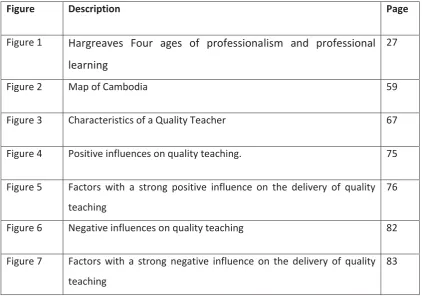
Figure Description Page
Figure 1 Hargreaves Four ages of professionalism and professional learning
27
Figure 2 Map of Cambodia 59
Figure 3 Characteristics of a Quality Teacher 67
Figure 4 Positive influences on quality teaching. 75
Figure 5 Factors with a strong positive influence on the delivery of quality
teaching
76
Figure 6 Negative influences on quality teaching 82
Figure 7 Factors with a strong negative influence on the delivery of quality
teaching
10 List of Appendices
Appendix A MoEYS Exam questions and model answers
MASSEY UNIVERSITY
MASSEY RESEARCH ONLINE http://mro.massey.ac.nz/
Massey Documents by Type Research Reports
Achieving quality teaching in developing
countries : identifying factors that influence
the delivery of quality teaching in primary
schools in rural Cambodia : a research
project presented in partial fulfilment of the
requirements for the degree of Master of
International Development, Institute of
Development Studies, Massey University,
Manawatu, New Zealand
Arnold, Denise Joy
2015http://hdl.handle.net/10179/7380