Rochester Institute of Technology
RIT Scholar Works
Theses
Thesis/Dissertation Collections
2005
Harbingers
Ilena Finocchi
Follow this and additional works at:
http://scholarworks.rit.edu/theses
This Thesis is brought to you for free and open access by the Thesis/Dissertation Collections at RIT Scholar Works. It has been accepted for inclusion
in Theses by an authorized administrator of RIT Scholar Works. For more information, please contact
Recommended Citation
Rochester Institute
ofTechnology
A
Thesis
Submitted
to
theFaculty
ofThe College
Of
Imaging
Arts
andSciences
In
Candidacy
oftheDegree
ofMaster
ofFine
Arts
Harbingers
By
Ilena Finocchi
Final Approvals:
Chief Advisor
:
Date:
Associate Advisor
:
Date:
Associate Advisor:
Date:
Chairperson:
Date:
'.!
ill" It
6-
/f
L
,
L
?'-V A-I
'7
/1k
p
C(/
'
<;
m;JAM,l
tCt?jeB5
$'-If,
/0
s:=
Richard Hirsch
Julia Galloway
Michael Rogers
j / / ?
/65-Michael Rogers
C/IC loS":
lIena Finocchi
..
I,
hereby grant perrrusslOn
to
the Wallace
Memorial
Library of RIT
to
reproduce
my thesis in whole or part. Any reproduction will
not be
for commercial use
or profit
.
"The
tragedy
in
life
is
notthat
it
ends sosoon,
but
that
we wait solong
to
begin."
Table
ofContents
I
.Thesis Proposal
1-2
II.
Background
3-7
III.
Content
8-11
III.
Historical References
12-17
IV.
Thesis
Review,
Critique
andAnalysis
18-22
V.
Conclusion
23
VI.
Work Cited
24
I.
THESIS
PROPOSAL
My
thesis
work willfocus
oncreating
ceramic sculptureusing
metaphorthat
refersto
my
childhoodself and the
difficulties
ofadulthood.Certain
aspects ofchildhood gaveme a uniqueperspective onthe
world.For
example,
I
would
play
witheveryday
objects and withoutrealizing it
transform
theminto
personalmetaphors.
This
skill camenaturally
to
me throughplay
andfantasy.
The importance
andlatitude
of creationthat camenaturally
tome as a childis
a nostalgicmemory
ofmy
current adult self.
As
anadult,
with allthe
outsideinfluences
thatcome withresponsibility
and
formal
education,
it is important
for
me tosustain a sense of childhood wonderment.For
my
thesis
I
willbe
creating my
own metaphoricallanguage
using
variousforms
whilebuilding
narrativesthroughfantasy
andplay
just
as achild would.Birds
willbe
one oftheforms
usedbecause
oftheirpersonal andhistorical
meaning.The
sculptures willincorpo
rate specific
birds,
for
example,
homing
pigeons.Homing
pigeons represent a messengerfrom
my
past.Another
exampleis
the tricycle andwheel,
whichrepresentearly
memoriesof
my
freedom.
The
use ofclay
is
the
connectionto
my
childhood and a means ofcommunicating in
aThis
will allow certain piecesto
have
anindividualized
touchwhile other pieces willhave
the
look
of repetition andlack
ofindividuality. I
willexplore multi-firingsin
oxidationwith
low
to
mediumfired
clays.These
techniques
exemplify
therealization ofmemories of
my
childhood self and allowthe
exploration ofthe
conflictbetween
pastII. BACKGROUND
I
grewup
devoid
ofthe
thought,
"I
can't."Both my
parentswere creative andwildly
inventive
people.For
example,
my
dad
wouldtake
scrapsofwire,
tubing,
andflat
metal,
then
cut,
twist,
andbend
it,
untilsuddenly it
turned
into
atoy.
My
smallfingers
rested onthe
bottom
ofthe
wireloop
that
closed andtwisted
its
way
straight up.My
otherhand
wason
the
smalltube
underneathapropeller-shapedpiece of metalthat
piercedthelong
twisted
wire."Pull up
onit,"
my
dad
saidtome.When I
pulledup
onthe
tubing
thepropeller spun around and
around,
up
thetwisted
wire and glidedinto
the
airspinning in
mid-air until
it
landed
softly
onthe
ground.It
amazed methat
my
dad
couldtake
somesimple materials and
by
combining
andaltering
them,
he
wouldtransform
theminto
something
else.It
was magical.He
did
this
notonly
on a small scale with some of ourtoys,
but
also worked onlarger
projectslike
building
ourhouse.
It
seemedmy
father
could make anything.
He easily
understoodhow
to
work withmany
different
materials.Having
afather
who couldbuild
or createjust
aboutanything
had
alasting
impression
on me.
Since I
wasmy
father's
daughter,
I
assumedI
had
the
sameability
to
create whatever
I
wanted.The
self-imposedpossibility
and potentialI
had
as achildwereboundless.
My
mom exposed meto
art and metaphorthroughearly
family
activities.When my
momwould gather
my
siblings andmyself,
sit usdown
atthe
table,
placeablank
pieceof conlead.
She
wouldstartby
drawing
abasic
shape."A
backward
letter
c,"
she would
say,
aswepicked
up
our crayons andattemptedto
draw
areversedletter.
She
would continueby
adding
more simple shapesto
her
page,
and we would mimicher
actionson our papers.When
she wasfinished
it
was acompleteddrawing
of an object or animal.I
was amazedwhen
the
drawings
werecompleted.We
allheld
themup
and while each one wasthe
samesubject,
eachdrawing
was renderedvery
differently.
Realizing
that
allthose
simple shapescould make
up
awhole,
I
began
to
seeeverything
around me as shapes.My
mom wasmy
first
artteacher.
She
didn't
realizethe
value ofthelesson
shetaught
methe
ability
to
visually
break down
an objectinto its
simplestforms.
It
was a powerfultool to
learn.
It
became
a gameto
me and withoutcomprehending
whatI
wasdoing,
I
startedtolook
atalmost
everything
this
way.Practicing
one ofthe
most essential andfundamental
ideas
ofunderstanding
form
and shape was a gameI
played on a regularbasis.
"Come,
sitin my
nest,
little
bird,"my
mother said tome as achild,
knowing
that
shewanted
to
take abreak
and restfor
abit.
The
nest she referredto
washer legs
curledup
on thecouch a position she would assume when she needed a
break
but
could stillkeep
an eye on me.
My
mother wouldlie
onher
side and curlup her
legs
sothat
her
thighs
made
up
one part ofthe
nest,
her
calves madeup
anotherpart,
andthe
couch madeup
the
back
portion ofthe
nest.I
wasthe
little
bird,
bringing
toys
and other smallobjectstoplay
with while
I
satin
thenestfor
aslong
asthe"game"
would
last.
This is
one ofmy
mostsmall
bird
withits
mouthconstantly
openfor
the
attentionofthe
motherbird.
What I
now
look back
to
in
amazementis
that
my
imaginative
childminddid
notstop
whenthe
nest game ended.
I
startedto
look
at all people asbirds
by
observing
the
character ofaperson and
matching
the
kind
ofbird
that
wouldbest
representthem.
It
didn't
stop
atbirds.
I
began
to
look
ateverything
withthe
potentialto
representsomething
else.I
wasinstinctually
defining
metaphor as:"The ordinary meaning in
the
context of useis
oddenough
to
promptusto
disregard
the question ofliteral
truth"
(Sacks,
40).
Long
before
the
mass use of video players and videomovies,
I
grewup
during
the
era ofhome
movies captured on8mm
film.
The
film had
no sound and required aprojectorto
watch a movie.
A
toy
that
fascinated
me as a child wasmy
hand-held
animated movieviewer.
This
squareplastictoy
camewith animatedfilms
on cassettesthat
you couldinsert,
put youreyeup
to the
viewer,
turnthe
hand
crank,
and thenwatch a movie.I
think
most
kids
wouldlook
through the
eyehole
andsimply
watchthe
moviethen toss
it
asideand move on
to
thenexttoy.I
liked
thistoy for
twoimportant
reasons.First,
I
watchedthe
animatedmoviesframe
by
frame
soI
could see what movementlooked like
asastopped
frame. This
changedmy way
ofthinking.Anyone
can watchsomeonein
motion.What I
began
to
question was what wasI
unableto
seebecause
ofmotion.I
questionedwhat
these
animated characterslooked like frozen
in
time
withtheirarmmid-swing,
andwondered
do both feet
everleave
theground atthe sametime.
This
waslike
looking
aton
end,
andmy interest
nevertired.
The
secondreasonI
adoredthis
toy is
thatwhenI
squeezed
my
eye againstthe
viewfinder
the
outside worlddisappeared.
I
was transportedinto
the
film.
In my
mindthere
wasnothing
better
thansitting
onmy
bed
andin
aninstant,
being
taken elsewhere.This
is something
I
thinkinspired
artdoes.
It
opensup
yourworld and
transports
you somewhereyouhave
notbeen.
When
the
film broke from
such repeated
use,
I
thought
I
had lost
my
secret world oflooking
atsomething
no onewas smart enough
to
realize.My
art work reflectsthe memories ofmy
childhood.I
am afirst
generationAmerican
onmy
father's
side.My
early
years were spentgrowing up in
a close-knitfamily,
steepedin
Italian
values.Our
home
wasfilled
withlots
ofdelicious
food,
story
telling in
Italian,
laughter,
andplenty
of music.Gatherings
aroundthedinner
tablewithmy
extendedfami
ly
included my
grandparents,
aunts and uncles.Story
telling
was animportant
way
ofsharing
during
dinner. When
I
became
enthralled withastory
I
wouldtranscendmy
surroundings.
Also
aware ofhow
the storyteller captivated everyone'sattention,
I
startedto
make
my
own stories and put on shows.Sometimes my
sisterandI
wouldperformfor
my
family
by
eithersinging
songs,
or we would cut outdrawings
and maketheminto
pup
pets.
Several
yearslater
my
dad
made a puppettheaterwhereI
couldproperly
setup
stagewith
backgrounds
and makemy
owndimensional
puppetsto
tellmy
stories moreformal
ly.
Putting
on performancesfor
whatever audienceI
couldfind
was aform
ofinstant
title,
The Black
Pearl,
wasmy
dad's favorite.
This
solo show wasimprovised
from
abasic
premise
I
had
comeup
withandmy only
audience member wasmy
dad.
The story
was acomedy,
andit
wentover so well.I
canvividly
remember myself crouchedbehind
thestage
opening
andlistening
to
my
dad
laughing
asI
performed.Not
only
did
I
captivatemy
father,
I
madehim
laugh.
It
was wonderful what asilly story
coulddo.
I
neverforgot
the
feeling
ofholding
someone'sfascination
andhaving
theability
ofchanging
theirmood.It
wasaway
to transport
someone while atthe
sametime
have
theirundivided attentionin
ordertocommunicate an
idea
orthought.
As
most childrendo,
I
had
such a sense ofawe,
but
whenmy
upbringing
was coupledwith
my
imagination,
I
wasin my
own world.I
dwelled
quitecomfortably
in
my
ownwonderland.
Making
amud pie withthick,
smooth earth nestledbetween
two
crisp
autumn
leaves
wouldoccupy
mefor hours.
When I
rodemy
tricyclearound,
I
was aflying
bird.
The
speed andthewindmusthave been
whatit
felt
like
to
be
abird
flying
andfree.
Flip
thetricycle
over,
turn thepedals with yourhands,
andthebike
became
anice
creammachine.
I
neverforgot
thatI
could go whereverI
wanted withmy imagination
and wasIII.
CONTENT
The
metaphorical contentin my
workis
presentto
makethe
work moreengaging,
comprehensible,
andto
activatethe
imagination.
My
thesis
work wascreatedto
better
understand
the
differences
ofmy
childhood selfandmy
presentadult self.The
difference
between
these two
peopleis
notjust
a separation oftime.
I
nolonger
possessthe
fearless
ness of
trying
andlearning
orthe
outlook ofunlimitedpotential thatI
did
as a child.Growing
up
andbecoming
an adult wasand stillis
a struggleto
rememberthefearless
optimist
I
once was.Capturing
momentsin
time
in
my
workis
away
ofchronologically
going
back
to
my
pasttofind
wherethat
vastgap
of changeoccurred.The
choice of particular metaphors are used
to
relateto
my
past andhelp
mebetter
understand myselfdur
ing
that time
in
hopes
ofreviving
the
essence ofthatlittle
girl.The
metaphor ofthe
bird
is
usedto
represent myself.My
mom saidI
was abird,
andI
took that
asfact.
Therefore,
I
grewup
viewing
myself as abird. I
chose whichbirds
would
best
representthe referenceto
my
pastand present self.I
selectedbirds
that
wouldvisually
contrastone anotherto
addimpact
to
thatdifference.
Beyond
visualqualities,
I
picked
the
crow andthe
homing
pigeonbecause
ofthe additionalmetaphorical referencestheircharacteristics
imply.
metaphorically
showthe
difference
between
childhood and adulthood.White
with softundertonesofmuted colors appearon
the
pigeons andspeakabout asimple,
meditativequietness.
Void
of a sterile opaquewhite,
the
surfacehas
transparency
anddepth
whilerevealing
warmth.Contrasting
blacks depict
mystery
andforeboding.
The
deep
richblacks
explorethe
idea
ofthe
unknown.The
vastgap
between
the
opposing
colorsexpresses
the
severedegree
ofimposition
and changethrough time.
The
ominousdeep
blue
that emitsfrom
thewall,
represents thedark
night sky.While
theblue
andblack
contrast
withthat
ofthe
whitebones
it
evokes asubduedwarning
when positionedbehind
the
crows.The
materials andtechniques
servethe
metaphorical content ofthework.Most
ofthe
pieces
in
the thesis
show couldbe
producedin
other mediums such as cast metal or wood.However,
the
use ofclay
givesthe
work a sense of preciousness andfragility
that
reflectstime
and nostalgia.The
surfacedraws
attention with adesire
totouch
but
thematerialimplies
that these aredelicate
objects andinvite
contemplation.The
use of moldsto createthe
work notonly
furthers
the
idea
of aloss
ofindependence,
but
the
actual process ofmold
making is
away
ofphysically capturing
a momentin
time.The
worksustains asense of
illusion
thatthese
are rarified objectsfrom
anothertime.
The
homing
pigeon was chosenfor
its
reliability
to
gofrom
onedestination
to
anotheridea
relatedwell withthe
kind
oftrust
a childmust placein
a parentnotonly
to
survive,
but
alsolearn.
The
messagesdelivered
by
the
homing
pigeons are representativeremindersof
the
important lessons
I
learned
in
childhood.The
ominousyetbeautiful
physical characteristicsof
the
crow,
in
contrastto the
pigeoninclude its
luscious black
feathers,
pointy
metallic
beak,
andsparkling
dark
eyes.Perceived
to
be
fiercely
independent
andfree,
in
folklore
the
crowis
alsoviewed ascunning
anddevious.
The
beautiful,
alluring
traits
ofthe
crow remindme ofhow
I
could not waitto grow up.Similar
to
the contradictions ofthe
crow,
whilemy
perception ofbeing
an adult was thatofmorefreedom,
I
found
theopposite
to
be
true.
When
I
wasthree
orfour
yearsold,
one ofmy
mostbeloved
possessions wasmy
tricycle.Much
in
the
sameway
that
metaphorical contradiction occursin
theuse ofthecrow,
wheels represent
freedom
andmobility
as well asthe
cycle ofeverything
having
abegin
ning
and an end.The
homing
pigeons always appear grounded with wheels.The
idea
ofthe
bird
notbeing fully
capable offlying
also givesway
to the
opportunity
for
it
to
maneuver about
in
adifferent
way.With
the scale ofthe
wheelin
closerelationship
to
thatof
the
bird,
it
appearsto
have
atoylike
quality.The
referenceto toys
occursin my
thesis
workin
hopes
to
highlight
the
lighter,
less
seriousaspect of self.
The
menacing
bodies
are changedinto
aplayfultoy
shapeand pigeons are also altered with
the
addition of wheelsto
illustrate
the
changein
perceptionwhen
transformed.
The idea
behind
the
use of a skeletalstructureimplies
that the
very
foundation
of who weare can end when we submit
to the
imposition
of adulthood confinements.Human
leg
bones
are usedto
representthe
finality
of childhood andindividuality. The
bones
areadult-sized
to
illustrate
when thisend ofindividuality
occurs.IV.
HISTORICAL
REFERENCES
The
forces
that
shape me
the
most as an artist originate
from
my
upbringing.
Historical
references
have broadened
my
foundation
and
inform
my
current work.
As
a
19-year-old
sitting
in
my
college art
history
class,
I
was exposed
to
a
painting
that
altered
my
ideas
of
how I
looked
at
form,
shape and
time.
It
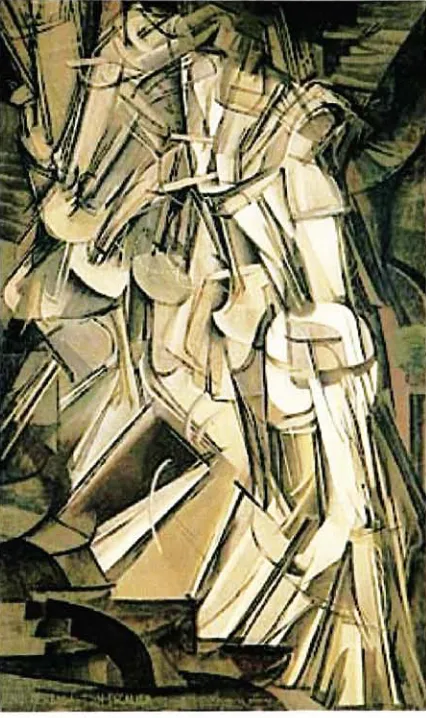
wasMarcel Duchamp's Nude
Descending
a
Staircase (No.
2). I
made
animmediate
connection
to the
work whenI
saw
his
painting.
As
a
child,
I
spent
intriguing hours,
looking
at
frozen
motion and combined
withthe
lessons
my
mom
taught
me,
visually
broke down
form into its
simplest
shape.Once
exposed
to
this
painting,
I
felt
I
had found
someone who
had
taken
my
interest
to
a
muchhigher
level.
The
painting
references
form
in
motion
through
a
sculptural
lens.
The figure is
not
just
motionlesswhile captured
in
time,
rather
Duchamp
captures
the
movement
ofthe
form
as
simple
shapes colliding
withone another
to
demonstrate
the
occu
[image:18.498.271.484.286.645.2]pied
physicalspace
ofthe
figure
descending
the
Fig. 1: Marcel
Duchamp,
Nude
Descending
aStaircase
(No. 2),
stairs.
This
impressed
uponme
the
coexistence of
1912 ^
onCaavM
form
intime.
While my
thesis
body
of workdoes
not explorethis
conceptin
physicality,
it is
the
backbone
ofthe thought
behind
my
work.My
sculpture reflectshow
my
past andpresentselfcoexist
in
the
same spacein
time.
Carrier
pigeonsare used as a metaphor ofmy
past andthe
crowis
a representationofmy
adult present.In
the
way
Duchamp's
figure
overlapsin
form,
I
wishto
create atension
in
the
spacethat
existsbetween
the two
different birds
and allowthe
viewerto
perhaps envisionthe
nextframe
of motion.I
should explainthat
my
influences
cannotbe
understoodwithoutdiscussing
the
generalities
ofthe
ideas
behind
them.This is
why
I
feel
akinship
withthe thoughts
ofFrancis
Bacon. Bacon
is
quoted assaying,
"I
have
afeeling
ofmortality
allthe
time.Because if
life
excites
you,
its
opposite,
like
ashadow,
death,
must exciteyou"
(Sylvester,
104).
Since I
was a
child,
I
have been
keenly
awarethat
my
lifetime
is
limited.
Experiencing
my
ownpain and
the
anxiety
ofillness
that
exists withinmy
family
has
putthe
perspective ofphysical
health
at an acutelevel
ofmy interest. When
I
walk somewhereI
oftentakeinto
account thatanother person
may
notbe
asfortunate
to
arrive atthe
samedestination
aseasily.
Illness
also made me realize thatlife
canbe completely
alteredin
aninstant.
Somewhere
between
childhood and adolescencemy
life
changed asquickly,
like
switching
to the
nextframe
on a roll offilm.
Three
yearsago,
I
wasfinally
preparedto take
action,
because
I
wasspending my
shortlife
notpursuing
whatI
loved.
Leaving
my
comfort zoneof a regular
job
withdecent
pay
and a self-made existenceto
pursuemy
desire
to
worksculpturally
made perfect senseto
me.My
workalwaysfringes
onthe
inescapable
fact
ofdeath.
My
thesis
workdepicts
the
endofmy
forgotten
childhood selfandthe
remindersof
my
memoriesleft behind
to
help
steermy
life back
onits
propercourse.In
interviews,
Francis Bacon's
words spoketo the
rationale ofideas
in my
ownwork.Bacon
discusses
the
use ofrealismin
his
work,
"I
believe
realismhas
to
be
reinvented.It
has
to
be
continuously
reinvented.
In
one ofhis letters
Van Gogh
speaksofthe
need tomakechanges
in
reality,
whichbecome lies
that
aretruer
thanthe
literal
truth.I
don't
seewhy
'real'doesn't
standfor
realistic.When
I say
'more
real'
I
mean morefactual"
(Sylvester,
172).
The
currentuse of realismin my
work stemsfrom
this
idea
ofmaking
the workmorefactual
ratherthan
following
the
footsteps
oftrompe
l'oeil
artists.Trompe l'oeil
capturesmoments
in
time
allowing
theviewerto
reflect onhis/her
own recollection or philosophical concerns.
I
am moreinterested
in using
realismto
question:"What
is
ourreality?"
I
found
the answersin
theartwork posedby
the
surrealistRene Magritte.
The
series ofMagritte's
work whichdeals
withthe conflict ofimages
and wordshad
aprofound affecton
my ideas
about whatit is
we arereally
seeing.In
1992,
1
waslucky
enoughto
be
in
Chicago
to
see aretrospective ofMagritte's
work attheArt Institute
ofChicago. As
I
weaved
in
and out ofthe
workit
wasMagritte's
1929
painting La Trahison Des
Images,
that
stoppedmein my
tracks.The
answerto
my
question aboutreality
wasstaring
back
atme
in
the
form
of an oil painting.
"The
simplicity
of
the
idea
that
a picture
ofa
pipe and a real pipe are not
the
same
thing
is
strengthened
by
animage
that
might
have been
taken
straight
from
a
nursery
school
primer"
(Whitfield,
67).
Magritte
challenges
the
notion
that the
viewer
is
not
observing
a physical pipe
but
a representation of an object.
Its
words,
This is
not a
Pipe,
strongly
contradict
the
main visualelement
ofthe
painted
pipe.This
conflict of
visual versusthe
written
wordenables
the
viewerto
realize
the
difference
between
the
actualobject and a
visual representationthat
canhold
new meaning.Therefore
the
reality
I
usein
my
art
is based
on
the
premise
that
what youare
looking
at
[image:21.498.229.489.65.246.2]is
not a crow
in
mid-flight,
but
rathera
representationof
something
else.Fig. 2:
Rene
Magritte,
La
Trahison
Des
Images,
1935,
Oil
onCanvas
As
in
the
workof
contemporary
ceramic
sculptor,
Adrian
Arleo,
the
expressionof
innerself
is
a mov
ing
force
in
my
own
work.Although Arleo's
sculptures
usually
include
the
human
form,
our
work shares a
similarity
of
conceptualideas.
Arleo's
workis
concernedwith"the
non-physical,
Hfr
3 Adrian
Arleo,
Plumage,
2004,
Clay
andGlaze
internal,
ephemeral,
spiritual,
emotional or
psychological
experiences"(Prange,
51).
Many
of
her figures
reflect
internal
moments and
incorporate
metaphorical
use
of
the
connection she makes with
nature.
While
my
thesis
work explores
similar
ideas,
it
contrasts
withthat
of
Arleo's
through the
loud
and outward
expressions of some of
my
pieces.
By
highlighting
the
opposites
withthe
meditative
inner
and
the
expressive outer
self,
I
active
Fig.
4:
Adrian
Arleo,
Nest
Arms,
2004,
Clay,
Glaze
andMixed Media
ly
confront
the
viewer.Arleo's
work
has
been
described
as,
"...
a certain
fearlessness in
working
so close
to
the
bone,
so close
to
self-exposure"
(Prange,
53).
It
is
that
sense of
vulnerability
and rawness
I
strive
to
explore
in
my
work.I
can
confidently
conclude
my
historical
references
by
explaining
that
I
do
not
desire
to
fit
in
a particular genre of
workbut
rather
to
pullfrom
parts
ofthe
ideologies
of
the
aforementionedartists
and
styles.It
is
painterFrida Kahlo
whose
life's
workI look
at
to
reinforcethis
Fig. 5: Frida
Kahlo,
The Two
Fridas,
1939,
Oil
onCanvas
[image:22.498.280.470.40.292.2] [image:22.498.254.465.453.666.2]decision.
Her
workspeaks with
honesty
abouta subject
she
knew
very
well,
her life.
Kahlo
struggled
withmisfortune
in
her
life,
as
many
people
do,
but it
seemed
that
her
art
work
was an
important force
that
moved
her
beyond
just
existing.
Her
art allowed
her
to
flourish
in
the
face
oflife's
obstacles."I
neverpainted
dreams,
I
painted
my
ownreality"
[image:23.498.129.388.210.557.2](Zamora,
114).
Fig. 6: Frida
Kahlo,
SelfPortrait,
1940,
Oil
onCanvas
IV
THESIS
REVIEW,
CRITIQUE AND
ANALYSIS
My
thesis
exhibition,
Harbingers,
consists of amaininstallation
piece andthree smaller
supporting
sculptures.All
the
sculpturesincorporate
birds,
particularly
homing
pigeonsandcrows.
Historically,
the
carrier pigeonhas been
usedas acommunicationtool.During
World War II
the
bird
was soinvaluable
to
foot
soldiers thatseveral pigeons receivedbadges
ofhonor,
declaring
their
value as great asthat
of ahuman.
Having
a metaphoricalrelationship
withbirds
sinceI
was achild,
it
seemedthe carrier pigeon was an excellent choiceto
representthe
messengerfrom
my
past.By
using
the
expression of closed eyes onthe
pigeons,
I
wishto
showthe
introspection
ofmy
childhood.The
crow was an obvious choicefor
the
allegoricaldepiction
ofthe
confinements of adulthood.Its
physical qualitiesand ominous
features
provided astrong
contrast withthe
characteristics ofthe
homing
pigeon.
Observing
the
common crow allowed meto
discover
something
elsein
thebird.
When I
look
at a crowI
agree withthe
sentiments ofLawrence
Kilham,
aFellow
ofthe
American
Ornithologists'Union,
"Crows
seem asthoughby
convergent evolutionto
have
something in
theirpsychescorresponding
to
something in
ourown"
(3).
The
ceramic sculptureEncircling
Youth
II,
presentsthe
viewerwithfive
ominousblack
crows
surrounding
one carrier pigeon with a message onits back. This
calm,
meditative pigeon with closed eyes seems unaffectedby
its
aggressive neighbors.The
viewercan seefrom
the
centerofthe
chest whiletwo
smaller wheels supportthe
back half
ofthe
bird.
The
moreI
worked withwheels,
the
moreI
understood
thedifferent
metaphorical meanings
behind
why I
chosethem.
The
useofthree
wheels onthis
pigeon,
the
front
wheellarger
than the two
smallerback
wheels,
is
reminiscentof atricycle.
Since
the
scale ofthewheel
is
closerto that
ofthe
bird
it
givesthe
bird
atoylike
quality.However,
sincethe
bird
is
grounded andthe
front
wheelis
depicted
as apulley,
this
expressesthe
idea
ofthebird
notbeing fully
capable offlying.
The
wheels providethe
bird
anopportunity
to
maneuver about
in
adifferent
way
whilethe
pulley
suggestsdependency
of movement.Mold-making
wasutilizedto
createthe
five
similarblack
crowssupporting
theimposition
of
uniformity
and confinement of adulthood.The black
smoke-firedbirds have
theappearance of
hard
edgesfrom
their carvedbodies,
but
the
surfaceis
soft and smooth.With
mouths and eyesopen,
they
look
onat thepigeonin
frozen
aggression.The
scratched outer edge of
the
pigeonhas
subtlehints
colorsshowing
throughatop layer
ofworn
white,
suggesting
that the
bird's
journey
has
been enduring
overtime.Although
surrounded,
the
quietness ofits
stance and meditative appearance reflect a sense ofhope
that
its
message willbe delivered.
Another
sculpture entitledChoices,
is
amirrored,
two-bodiedcarrier pigeon.This
unifiedbird
carriestwo
bundles
of rolled messages on each ofits
two
backs. Bound
withathin,
waxed
hemp
rope,
one side ofthebird
carries abundle
of white porcelainletters
andthe
otheran aged
bundle
ofblack
porcelain messages.On
thebottom
of eachsideofthe
bird's
body
are a set oftwo
wheels.Because
this
bird
is
two
headed
it is
uncertain ofits
direc
tion
aswell asthe
possibility
ofmovement.The
surfaceofthe two-headed
fowl is
differ
ent
than the
othercarrier pigeons.Deep
greens andblues
underscorethe topcoat
of wornbrown.
The
visualweightofthe
mass ofthin
rolledletters
questionswhich memoriesfrom
the
past are aburden,
andwhich are yougratefulto
carry.The
duality
of messagessuggest
that
perhaps onesetofmemories cannot existwithouttheother.Choices
explorethe
immobility
ofliving
in
the
pastrather thanthe
present.Obstacles
is
a multiple piecethat
exploresthe
perception of reality.Twenty
transfigured
crows withrounded
balls for bodies
tilt
theirdark black forms
aroundthree carrierpigeons.
The
pigeons areattached togetherwith abraided
hemp
ropein
atrain-likeconnection
moving
through
the massof assumeddoom.
Viewed
from
adistance,
multiples of
black
surrounda river of white.Twenty
crows outnumberthree
pigeonstoprovideanother visual cue oftheir
fate.
Upon
closerinspection
the crowsappear almosttoy-like
andless
threatening
to the
four-wheel
pigeons.The immediate
perception ofthe
piece
is
ofill
fated doom for
themessage-bearing
pigeons.However,
thetoy-like
crowsquestionthat
initial
reaction andillustrate
how
the
perceptionofreality
may significantly
differ
uponfurther
analysis.The
8'x
10'
wall
installation
holds
the
same name asthe title
ofthe
show.Harbingers
includes
a wave of12
black
porcelaincrowsin
gridformat,
projecting
outfrom
adeep
blue
wall.
The
crows'
bodies
are capturedin
amoment
oftime
whichhold
the
birds
mid-flight.
The
birds'out
stretched
large
black
wings,
curvedbodies,
expandedtails
and openbronze
talons
showthe
birds
in
afrozen
positionjust
before
landing.
Realistic
gesture andminute
detail
addto the
impact
ofthe
multiples.Steel
black
rods supportthe
birds
away
from
the
wall atvarying
lengths.
Anchored
to the
base
ofthe
wallis
a4'w
x8'1
x4"h
black
pedestalthat
offersa pile ofbones
and asinglestanding
crow.The
aged and pittedbones
arepiledin
hollow form
and standapproximately
2.5'in
height.
The crackling
ofthe
black
masonstainedlines
through
the solid whites ofthe
bones
supportsthe
visualizationofage.
Each
bone
joint
reveals wear or use.The
skeletalforms
suggest a visual relationship
of ageandfragility,
ratherthan
articulation ofmovement.Peering
throughthe
opening
atthe
top
ofthe
pile,
atime
worn wheelis
discovered
sitting
inside
the
bones.
Creating
this
installation increased
the
level
ofknowledge
andintensity
in my
work.Three
andfive
part molds were madefor different
sectionsofthe
body
and wings ofthecrows.
The
crowswere slip-cast withblack
porcelain andfired
to
a vitreous stateto
allowthe
raw surface ofthe
porcelainto
shine through.The bird
bodies
and wings werebisqued
separately
but final
fired
togetheronfiber
to
prevent warpage.The
rate ofloss
to
create each
flying
bird
wasapproximately
three to
one.Bronze
feet
werelost
wax cast andinserted
afterthe
firing. The
pile ofleg
bones
wereslip
castfrom four
part molds.Combustible
materials were added whenslip casting
theporcelain,
to
achieve thepittedandaged
look
ofbones.
Two
mason stains were added toincrease
thedepth
ofthe
texturebefore final
firing.
The standing
crow was createdin
a similarway
asthe
aforementionedpigeons.
A
pressmold ofthe
generalbody
form
wasused andthen
each piece washand-carvedat
the
leather hard
stageto
depict detail
andshowindividuality.
Terra
sigilatta wasapplied
for
coloring
and surface.The
crows weresmokefired
as afinal
step
to
addmore
dimension
to the
black. The
time
worn wheel waspress molded withdifferent
combustible materials
for
surfacewear andterra
sigilatta appliedbefore
firing.
The
wheelwas
bisqued
andglazedfor
its
final firing.
All
the
pieces were assembledto
createthe
installation
on site atthe
gallery.It
wasmy
fundamental
intention
for
this
installation
to
be
powerful andfrightening
but
also
beautiful.
At
the thesis
show'sopening I
wasexcitedtohear how
many
people wereusing
those
exact words todescribe
the
work.A
foreboding
blue
background
withcastshadows of
the
crows onthewallbeckons
to the
unknown aftermath.Twelve interchange
able crows created
from
molds appearin
a gridformat
to representthe
conformity
ofadulthood and
the
loss
ofidentity. The
singular crow whichstands perched atthe
edge ofthe
pile ofbones
gives adirectional
cue toinvestigate
thebones
more closely.The
skeletalpile of
human
bones
areonly
madeup
ofthe
leg
bone,
whichsymbolizes theidea behind
the
phrase"no
leg
to
standon."
The
pile also represents theaftermathofapreviousencounter withamass of crows.
Inside
the
pile,
aworn-out wheel sitsbeneath
the shadows ofthe
bones,
opento
interpretation
asto
whetherthebones
areprotecting
the
wheelor
trapping
the aged metaphorfor
my
memories.While
theimpact
ofthis
installation
belongs in
partto
its
scale andlevel
ofdetail,
its
true strengthlies
in its
content.V.
CONCLUSION
This
thesis
paper affirmsmy
decision
to
changemy
life's direction
andputmyself on apath
I
feel
more confidenttraveling.
Being
acceptedinto
graduateschoolto
study
ceramic sculpturewas
the
first
step
for
criticaldiscussion
ofmy
work.The
workI
created
for
my
thesis
exhausted allmy
resourcesto
complete.I
am gratefulto
have had
the
opportunity
to
spendtime
andfocus
on abody
of workthathas
such profoundmeaning
to
my
life.
As
anadult,
with allthe
outsideinfluences
thatcome withresponsibility
andformal
education,
it is
even moreimportant
to
meto
sustain a sense of childhood wonderment.
The
workI
createin
thefuture
willcontinueto
exploretheissues between
theconscious and
the
unconsciousis
the
limitless,
childlike state of mind whereeverything
is
possible.
Working
withclay
allows meto travelto
a place where a sense ofplay, creativity,
and
hope
are nourished.VI.
WORK
CITED
Kilham,
Lawrence.
The American Crow
andthe
Common
Raven.
Texas: Texas
A
andM
University
Press,
1989.
Prange,
Marnie. "Adrian Arleo: Nature
Studies."Ceramics Monthly.
June/July/August,
(2003):49-53.
Sacks,
Sheldon. On Metaphor. Chicago
andLondon: Chicago
Press,
1981.
Sylvester,
David. The
Brutality
ofFact: Interviews
withFrancis Bacon. Great Britain:
Oxford,
1987.
Whitfield,
Sarah. Magritte. London: South Bank
Center,
1992.
Zamora,
Martha. Frida Kahlo:
The
Brush
ofAnguish.
San Francisco:
Chronicle,
1990.
VII.
FIGURES
CITED
Arleo,
Adrian. Plumage.
2004.
"Adrian Arleo: Nature
Studies."By
Marnie Prange.
Ceramics
Monthly.
June/July/August,
(2003):49-53.
Fig.
3
and4
Duchamp,
Marcel
.Nude
Descending
aStaircase (No.
2). 1912.
Philadelphia Museum
of
Art.
<http://www.philamuseum.org/collections/modern_contemporary/1950-134-59.shtml>Fig.
1
Kahlo,
Frida.
The Two Fridas.
1939.
Frida Kahlo:
The Paintings.
By
Hayden Herrera.
Hong
Kong:
HarperCollins,
1991.
Fig.
5
and6
Magritte,
Rene. La Trahison Des
Images. 1935. Magritte.
By
Sarah
Whitfield. London:
South
Bank
Center,
1992.
Fig.
2
o o
= X
-C M=
2. Ilena
Finocchi
Harbingers 4/2005
Detail
3. Ilena Finocchi
Harbingers 4/2005
Detail
4. Ilena Finocchi
Harbingers 4/2005
Detail
6. Ilena Finocchi
Obstacles 4/2005
7. Ilena Finocchi
Obstacles
4/2005
Detail
S.
Ilena FinocchiObstacles
4/2005
Detail
9. Ilena Finocchi
Obstacles 4/2005
Detail
I 0. Ilena Finocchi
Obstacles
4/2005
Detail
I. Ilena Finocchi
Encircling
Youth II
4/2005
12.
Ilena FinocchiEncircling
Youth II
4/2005
Detail
\
j13. Ilena
Finocchi
Encircling
Youth
4/2005
Detail
14.
Ilena Finocchi
Choices
4/2005
Detail
15. Ilena Finocchi
Choices 4/2005
Detail
16. Ilena Finocchi
Choices
4/2005
(Second
View)
17. Ilena Finocchi
Carrier
ofYouth
1 2/2004
18. Ilena Finocchi
Untitled 12/2004
19. Ilena Finocchi
Nesting
Ancestry
4/2004
20. Ilena Finocchi
Fearlessness
ofYouth