COMMENTARY
Development of new malaria
diagnostics: matching performance and need
David Bell
1*, Alessandra E. Fleurent
2, Michael C. Hegg
3, John D. Boomgard
4and Caitlin C. McConnico
5Abstract
Despite advances in diagnostic technology, significant gaps remain in access to malaria diagnosis. Accurate diagnosis and misdiagnosis leads to unnecessary waste of resources, poor disease management, and contributes to a cycle of poverty in low-resourced communities. Despite much effort and investment, few new technologies have reached the field in the last 30 years aside from lateral flow assays. This suggests that much diagnostic development effort has been misdirected, and/or that there are fundamental blocks to introduction of new technologies. Malaria diagnosis is a difficult market; resources are broadly donor-dependent, health systems in endemic countries are frequently weak, and the epidemiology of malaria and priorities of malaria programmes and donors are evolving. Success in diagnostic development will require a good understanding of programme gaps, and the sustainability of markets to address them. Targeting assay development to such clearly defined market requirements will improve the outcomes of product development funding. Six market segments are identified: (1) case management in low-resourced countries, (2) parasite screening for low density infections in elimination programmes, (3) surveillance for evidence of contin-ued transmission, (4) clinical research and therapeutic efficacy monitoring, (5) cross-checking for microscopy quality control, and (6) returned traveller markets distinguished primarily by resource availability. While each of these markets is potentially compelling from a public health standpoint, size and scale are highly variable and continue to evolve. Consequently, return on investment in research and development may be limited, highlighting the need for poten-tially significant donor involvement or the introduction of novel business models to overcome prohibitive economics. Given the rather specific applications, a well-defined set of stakeholders will need to be on board for the successful introduction and scaling of any new technology to these markets.
Keywords: Malaria, Rapid diagnostic testing, Target product profiles, Malaria diagnostics market
© 2016 The Author(s). This article is distributed under the terms of the Creative Commons Attribution 4.0 International License (http://creativecommons.org/licenses/by/4.0/), which permits unrestricted use, distribution, and reproduction in any medium, provided you give appropriate credit to the original author(s) and the source, provide a link to the Creative Commons license, and indicate if changes were made. The Creative Commons Public Domain Dedication waiver (http://creativecommons.org/ publicdomain/zero/1.0/) applies to the data made available in this article, unless otherwise stated.
Background
Malaria seems ripe for the introduction of new and bet-ter diagnostic technologies. Despite being preventable, detectable and curable, it remains one of the main causes of mortality due to infectious disease. People at risk still fail to access early and accurate diagnosis, particularly in sub-Saharan Africa where the main burden of disease persists [1]. Misdiagnosis leads to unnecessary waste of resources, poor disease management, and contributes to a cycle of poverty in affected communities [2].
Despite advances in various aspects of diagnostic tech-nology development, no new diagnostics have gained wide traction or a significant commercial market since the introduction of rapid diagnostic tests (RDTs) based on lateral flow formats in the early 1990s, which now dominate the point of care testing (POCT) market [3]. In spite of deficiencies in implementation, malaria diag-nosis has improved dramatically over the last decade, albeit from a very low base, and RDT roll-out enabled the World Health Organization (WHO) recommendation in 2010 on universal parasite-based diagnosis. Reported diagnostic testing in the public sector in sub-Saharan Africa, for example, has increased from 36 % of sus-pected malaria cases tested in 2005 to 65 % tested in 2014 (after the WHO recommendations), with RDTs account-ing for 71 % of diagnostic tests [4]. However, this also
Open Access
*Correspondence: [email protected]
1 Global Good Fund/Intellectual Ventures Laboratory, 3150 139th Ave SE, Bellevue, WA 98005, USA
demonstrates that a considerable gap persists, impacting both malaria control and prospects for elimination.
Arguments for universal, parasite-based diagnosis are clear. Increasing use of lateral flow rapid diagnostic tests has provided poorly resourced, malaria endemic populations with access to diagnoses of similar accuracy to that available in hospitals in more developed health systems. This technology, when well used, is transform-ing fever management, has reformed understandtransform-ing of malaria transmission, and has made malaria elimination look achievable [5]. Good malaria diagnosis also provides countries with the information necessary to target anti-malaria resources to communities that would most ben-efit and enables donors to measure the impact of funding. There is, therefore, a clear public health case for expand-ing and improvexpand-ing malaria diagnosis, either through cur-rent or new diagnostic platforms.
To understand how to address the remaining and wide diagnostic gap, it is necessary to understand where the gap is purely technological, and where it is the result of other factors, such as health systems financing, human resources and logistics, or simple disinterest. As fund-ing for diagnostic product development is small in total [6], resources for product development must be directed to where there is real need and clear potential benefit. Research and development funding should have a good chance of achieving a useful public health outcome, and provide developers and manufacturers access to a suf-ficient market to justify their investment. This requires concentration on technologies that have characteristics that address identifiable and significant gaps, or offer significant advantages over the often low-cost, effective technologies already in use.
Priorities for malaria diagnostics have progressed sig-nificantly over recent years with renewed emphasis on tools required for malaria elimination. The transition of many countries traditionally considered to be high bur-den to a low-transmission state makes local or regional elimination potentially achievable [7]. Diagnostic requirements to address this situation have been divided elsewhere into two spheres:
• Tools to guide case management of acute fever [8, 9].
• Tools to guide and achieve elimination [8, 9].
While this dichotomy is broadly useful in guiding thinking on implementation, it encompasses a range of specific epidemiological contexts and programmatic needs and is insufficient to delineate the types of tests that are necessary to implement these quite different strategies. This paper categorizes diagnostic markets according to their role in overall malaria management, and the specific performance characteristics required to
address them. The malaria diagnostic market is broken into six distinct markets, or use-cases, to which prospec-tive technologies can be applied:
1. Case management (in low-resourced endemic coun-tries).
2. Parasite screening (for low-density infections in elim-ination programmes).
3. Population screening (surveys for evidence of contin-ued transmission).
4. Clinical research and therapeutic efficacy monitor-ing.
5. Microscopy quality control (cross-checking for light microscopy).
6. Non-endemic country (returned traveller) markets, distinguished primarily by resource availability.
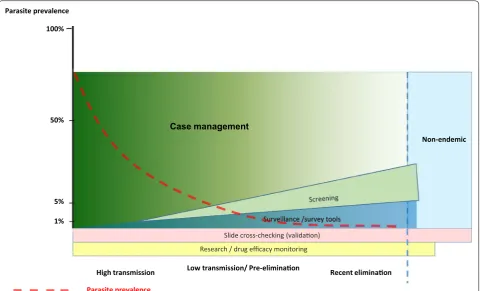
By segmenting the market into areas with clearly dif-fering requirements and resources, a framework is developed for identifying diagnostic needs based on epi-demiologic setting (Fig. 1) and minimum requirements for market entry. Such an approach could help to reduce the apparent redundancy seen in the current develop-ment of malaria diagnostics, and move the field forward more efficiently.
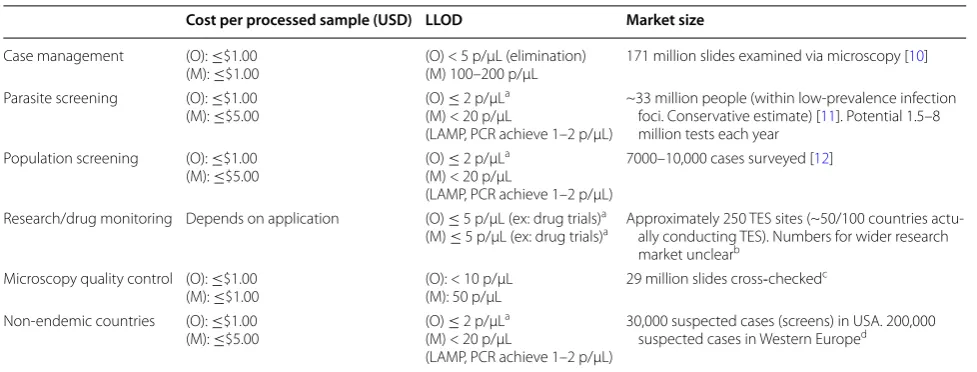
These variable requirements for malaria diagnostic tests in different market segments can be codified in target product profiles (TPPs) that specify the device require-ments necessary to perform an identified task. Some performance parameters of TPPs are essential, some are desirable, and the importance of some will vary in differ-ent settings. The principles underlying the TPPs for the six markets suggested in this discussion are addressed in the following sections and summarized in Table 1. The detailed TPPs outlined in Additional file 1: Annex S1 are intended as examples of each identified market. They are derived from the MalERA TPPs developed in 2012–2013 [8], but adapted to the market segmentation suggested here. Other TPPs are being developed elsewhere and requirements change with time in response to evolving epidemiology and programme priorities.
Detection of parasitaemia in endemic settings
Case management in low resources endemic countries
Requirements
to detect parasite densities above a threshold of 100–200 parasites/µL appears sufficient in most cases of clini-cal Plasmodium falciparum infection [13]. However, the required lower limit of detection (LLOD) may be lower for diagnosis of clinical Plasmodium vivax infection [8, 9, 14, 15]. While identifying and treating infections with parasite densities below 100 parasites/µL is clearly desirable from an elimination point of view, i.e. reducing overall transmission [16], it could be argued that distin-guishing infections likely to be responsible for symptoms from low density infections that are likely to be incidental to current illness holds some advantage in promoting the identification of other non-malarial causes of fever.
Case management diagnostic tools must provide suffi-cient immediate information to guide appropriate treat-ment. In situations where various Plasmodium species occur with different treatment requirements, tests must differentiate between species (principally P. falciparum and P. vivax). It is, however, difficult to quantify the accu-racy required in species differentiation when develop-ing TPPs. In case management, specific identification of P. vivax and Plasmodium ovale may be desirable for epi-demiological purposes, but not necessary for managing
the acute episode. In most areas of sub-Saharan Africa, mono-infections with non-P. falciparum species are rela-tively unusual and detection of P. falciparum alone can be sufficient [1], but where only non-falciparum species are endemic (e.g. areas of east Asia), it is still highly desir-able to retain capacity to detect P. falciparum as severe cases may occur in non-immune returned travellers or their secondary cases. Therefore, capacity to detect P. falciparum is essential in most cases, while discrimi-nation of other species in case management depends on species prevalence, co-infection patterns, and available resources.
Tools in current use
Endemic population case management is clearly the larg-est application of malaria diagnostic technologies, with the largest public health impact. While access to diagno-sis is still low compared to potential need, an estimated 197 million microscopy tests were performed and at least 160 million RDTs distributed to National Malaria Control Programmes in 2014 (probably a large under-estimate as manufacturers report over 300 million sales) [4]. Light microscopy and RDTs, when of good quality,
Parasite prevalence
Recent eliminaon Low transmission/ Pre-eliminaon
High transmission 100%
50%
5%
1%
Case management
Research / drug efficacy monitoring
Non-endemic
Parasite prevalence
Surveillance /survey tools
Slide cross-checking (validaon)
[image:3.595.59.542.88.379.2]are adequate to detect most cases of clinically-significant malaria [13], and can be used successfully on a broad scale [17].
In use since the 1990s, lateral flow antigen-detecting assays (known as RDTs) can provide an accurate diagno-sis for case management with a similar analytical LLOD to microscopy when in good condition and prepared and interpreted correctly, and are more amenable to remote locations and less dependent on high skill levels [18]. Currently, RDTs are available at well below US$0.50, are relatively stable in field conditions, provide some poten-tial for species differentiation, and are adaptable to a vil-lage health worker level within the health system [19, 20]. RDTs can reach an LLOD sufficient for safe case manage-ment of P. falciparum [21–27], though sensitivity may still be insufficient for non-falciparum parasites [8, 9, 14, 15]. However, RDTs are not quantitative (which is of only limited importance in case management), species differ-entiation is limited, and quality control at point of use is difficult, placing the patient at risk due to manufacturing or storage failure [28].
While most RDTs have targeted histidine-rich pro-tein-2 (HRP2) as a marker for P. falciparum infection, parasite populations have long been recognized with HRP2 gene deletions in the Amazon, undetectable by these tests [29]. Rising frequency of HRP2 gene deletions in African countries, recognized but unpublished at time of writing, raise the need for tests for non-HRP2 falcipa-rum-specific targets (e.g. lactate dehydrogenase), though
this will involve improving current technology rather than new platform introduction.
The persistence of light microscopy for malaria over a century after its introduction arises partly from its labo-ratory versatility across sample types and diseases, and from an absence of practical alternatives for applications, such as parasite quantitation and species differentiation [30]. While harder to support and less adaptable to com-munity-level use, field microscopy has similar potential in terms of cost and throughput, and is useful for disease management beyond malaria. However, its dependence on technician performance can result in poor reproduc-ibility [31–34], making the technology poorly suited to clinical decision-making in many settings where malaria is endemic. Its entrenched position, both in terms of microscopes in use and established commodity sup-ply chains, means that it is likely to remain in wide use at some levels of the health system for the foreseeable future, despite the advent and increasing use of RDTs.
In view of the various deficiencies of current tests and the persisting large unreached at-risk population, signifi-cant unaddressed diagnostic gaps do persist that retard case management in regions where most cases occur [1]. There has been a continuing technological and program-matic failure in filling this gap, and an increase in funding and interest in product development over recent years has failed to produce successful replacement technolo-gies. To be widely applicable in this market, a test will need to at least match the current performance of RDTs Table 1 Examples of minimum target product profiles and market size
All values are dependent on program capacity and epidemiological setting O optimum, M minimum
a Refer to Additional file 1: Annex S1 for exceptions and further details
b If we assume 4 sites per country, in around 50 endemic countries that actually run them. On top of that, around 50 research studies each year
c Based on unpublished estimates done by the authors using data from the World Malaria Report 2012 and 2013
d Based on unpublished estimates by the authors using data from Askling et al. [72]
Cost per processed sample (USD) LLOD Market size
Case management (O): ≤$1.00
(M): ≤$1.00 (O) < 5 p/µL (elimination)(M) 100–200 p/µL 171 million slides examined via microscopy [10] Parasite screening (O): ≤$1.00
(M): ≤$5.00 (O) ≤ 2 p/µL a (M) < 20 p/µL
(LAMP, PCR achieve 1–2 p/µL)
~33 million people (within low-prevalence infection foci. Conservative estimate) [11]. Potential 1.5–8 million tests each year
Population screening (O): ≤$1.00
(M): ≤$5.00 (O) ≤ 2 p/µL a (M) < 20 p/µL
(LAMP, PCR achieve 1–2 p/µL)
7000–10,000 cases surveyed [12]
Research/drug monitoring Depends on application (O) ≤ 5 p/µL (ex: drug trials)a
(M) ≤ 5 p/µL (ex: drug trials)a Approximately 250 TES sites (~50/100 countries actu-ally conducting TES). Numbers for wider research market unclearb
Microscopy quality control (O): ≤$1.00
(M): ≤$1.00 (O): < 10 p/µL(M): 50 p/µL 29 million slides cross‐checked c
Non-endemic countries (O): ≤$1.00
(M): ≤$5.00 (O) ≤ 2 p/µL a (M) < 20 p/µL
(LAMP, PCR achieve 1–2 p/µL)
[image:4.595.55.544.99.285.2]and good microscopy and equal them in terms of sim-plicity of use (RDTs) and cost. The failure of successful alternatives to emerge for malaria case management sug-gests that this is a technologically difficult barrier to over-come, and health system innovation may be at least as important a technology innovation to address this con-tinued need.
Parasite screening for low‑density infections in elimination programmes
Progress towards elimination has highlighted the inad-equacies of current field assays for specific applications such as screening and surveillance [35]. This is a relatively new market, and focal screen and treat (FSAT) strategies are not well established in most malaria endemic coun-tries [36]. The place of screening relative to other strat-egies also remains the subject of debate. However, there is broad consensus that low-cost, highly-sensitive and specific screening tools would benefit malaria elimina-tion in many countries currently endemic for malaria [8], whether as an adjunct to, or a driver of, elimination programmes.
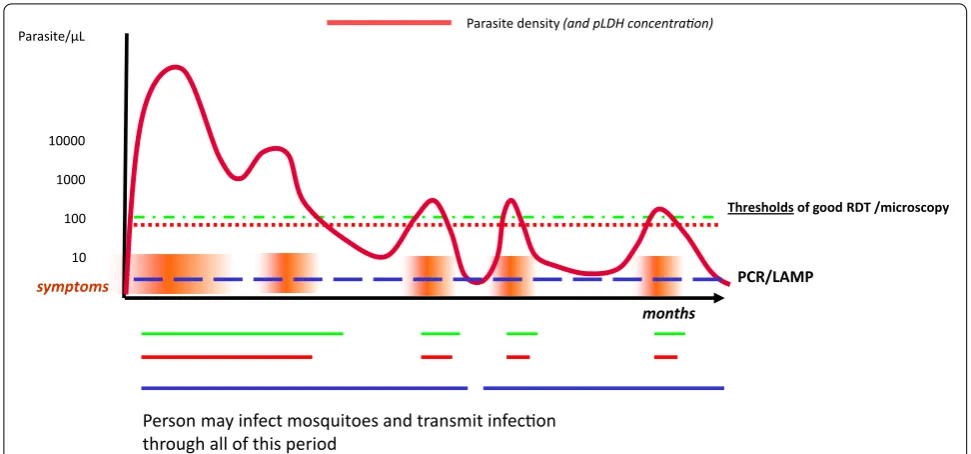
The uses of diagnostic tests in elimination strategies, including their required performance and the strategies surrounding their use, are not well defined. Individuals with little previous exposure to parasites can maintain blood stage P. falciparum infection for up to 12 months or more, and be asymptomatic much of that time [37– 43]. During the course of infection, parasite density will
frequently be below the LLOD for expert microscopy [37, 38, 40, 44–46] and may be below the LLOD of routine polymerase chain reaction (PCR) leading to reservoirs of infection that remain undetected. Peaks in parasite den-sity associated with fever could bring the patient to the attention of health services and aid diagnosis [37, 38, 47], but much of the infection course will remain hidden from routine case management diagnostic tools [16, 37, 38], leaving infectious individuals to promote transmission (Fig. 2) [48]. Light microscopy and RDTs may detect only a quarter of all cases. There is thus a need for low-cost highly sensitive field tests in low transmission settings targeting elimination [49]. Screening with these tools is, therefore, expected to be of limited use.
Leaving aside discussions on the relative impact of screening versus a combination of intensive vector man-agement, case detection and mass drug administration (MDA), there is demand for near-patient screening tests capable of identifying asymptomatic cases with low-density infections in elimination programmes (e.g. FSAT programmes) [36, 46], and in border screening to protect transmission-free areas [50]. It seems likely that a mix of FSAT and MDA strategies will be used in elimination set-tings and tailored to the requirements of local epidemiol-ogy and resources.
To be widely applicable, such screening tests will need to have LLOD sufficiently low to detect a substantial and predictable proportion of asymptomatic infections. The LLOD necessary to achieve this is unclear and probably
Thresholds of good RDT /microscopy
PCR/LAMP Parasite density (and pLDH concentraon)
months symptoms
10 10000
1000
100 Parasite/µL
Person may infect mosquitoes and transmit infecon through all of this period
[image:5.595.55.541.460.687.2]varies by epidemiological setting. A test with a LLOD of 1–2 parasites/µL can more than double detection rates compared with RDTs or microscopy [16]. As parasite density drops further, the probability of transmission from these infections will be smaller [16, 51], though this varies with time [38]. The importance of these infections to transmission also varies with the factors responsible for reducing local transmission in the first place, be they bed net use, access to case management, human behav-iour, house construction, vector habits, or environmental change. MalERA recommended an LLOD of ≤5 parasite/ µL as an optimum [8]. Detection of less than 2 parasite/ µL, similar to nested PCR, is achievable now with loop-mediated isothermal amplification (LAMP) in near-patient settings [52].
An effective screening tool in an elimination setting will need to provide a result rapid enough to enable rapid treatment of parasite positive cases. The assay will need to distinguish between species in most geographical loca-tions to provide information to guide treatment. Near-patient operability is desirable, though not essential if the screening test is used for broad population surveys to determine foci of transmission. Rapid results are of high importance to FSAT strategies to reduce both the likeli-hood that patient contact will be lost prior to treatment, and the likelihood of further onward transmission before treatment (elimination of P. vivax and P. ovale liver stage). A low false-positive rate is important, as assay results are likely to be used to determine parasite prevalence and not just guide directed treatment. As parasite preva-lence in asymptomatic populations with relatively stable low transmission will be low, high specificity is difficult to achieve. However, overtreatment in this context is not directly harmful, assuming anti-malarials with few side effects are used.
Surveillance for evidence of continued transmission
Malaria programs are required to identify areas with a high probability of ongoing transmission and areas where it is highly probable that transmission has ceased. Such evidence informs decisions on deployment of resources at the national and community levels. There is likely to be an increasing demand for surveillance, or population screening, as elimination programs progress and trans-mission becomes increasingly heterogeneous, requir-ing data to guide resource allocation and FSAT or MDA interventions and to aid confirmation of elimination. The market for population screening tools is characterized by a requirement to determine the probability of ongo-ing transmission and the lack of requirement for immedi-ate treatment (desirable, but not clinically imperative in asymptomatic cases).
Two methods may be used to establish a high probabil-ity of continuing transmission: identification of current infection in members of a population, or identification of evidence of recent infection. While detection of parasi-taemia is concrete evidence that prevalence is above zero, asymptomatic low-density parasite carriage can occur at very low prevalence in the population [40, 46]. Detec-tion requires tools with very low LLOD and sampling of a very high proportion of the population in order to detect the few current cases. Sampling for a persistent marker of recent infection reduces specificity (in terms of cur-rent infection) but samples a wider temporal window and so should provide greater sensitivity with a lower sample size. The immediate candidate biomarkers are host anti-bodies specific to the malaria parasite [53–56]. Ideally, such antibodies would have relatively short half-lives, and so indicate infections within a defined time period. Screening based on longer-lasting antibody responses must be restricted to children of an age group consist-ent with the timeframe to be sampled [53, 57], and such groups may have atypical exposure, complicating inter-pretation of results.
Serological assays for population screening will need to be sufficiently low cost to enable a statistically significant population size to be sampled. Savings in better target-ing of anti-malarial resources could justify the cost. It is likely that such a test would be coupled with follow-up by intensive case management interventions, MDA or FSAT, with targeting guided by the population screening results. This market is currently poorly served by exist-ing technologies, and population screenexist-ing is rarely per-formed outside of pilot and research studies. The market is, therefore, unpredictable but could evolve if suitable assays were available.
Clinical research and therapeutic efficacy monitoring
but of significant public health importance if the develop-ment of drug resistance is to be monitored routinely by national malaria programmes, and drug policy is to be sufficiently responsive to early changes in patterns of effi-cacy. More broadly, standardization of tests used in clini-cal research would improve the comparability of malaria trials across space and time—currently poor due to lack of adherence to common standards [59].
Cross‑checking for microscopy quality control
Case management diagnosis in endemic settings con-tinues to rely extensively upon light microscopy, with reported microscopy use increasing to 197 million microscopic examinations in 2013 [1]. To be reliable, light microscopy requires high levels of quality assur-ance, including slide cross-checking (validation) to moni-tor microscopist performance post hoc. Cross-checking is frequently poorly performed or absent due to limita-tions of technician skill, training, and time to perform the validation [60]. A potential market exists for an auto-mated cross-checking platform that could process large numbers of Romanowski-stained light microscopy slides (Giemsa, Field’s or JSB Stain) at a central location and provide results that are highly consistent and of similar LLOD to expert microscopy. If such a device was suf-ficiently portable and cheap, it might replace manual malaria microscopy and change the use-case to include case management, but would still require some form of on-going validation.
An assay to validate microscopy technician perfor-mance must be capable of quantitation and species dif-ferentiation, and operate on slides that have been read previously and are not in current practice routinely cslipped. While the TPP of such an assay may over-lap with that for case management or other tools, the requirement to be near point-of-care is removed. Auto-mated slide feed would have clear advantages.
As with the market for a quantitative test for drug monitoring, the market size for such a test is limited, but the absence of a tool that fits the requirement of the mar-ket is a significant current impediment to ensuring the quality of malaria microscopy [60, 61]. The WHO recom-mends a minimum sample size for cross-checking of 10 randomly selected slides per month for a clinical labora-tory; five slides reported as low density, and five reported as negative [30]. This could presumably be increased if an automated validation system were available. Should a digital automated slide reader of sufficient quality be developed, it will still be dependent on systems being in place for feedback, supervision and retraining. Estimat-ing the true market for such a system is therefore some-what difficult, and will depend also on the persistence of microscopy as a major platform for malaria diagnosis.
Non‑endemic country markets distinguished primarily by resource availability
The diagnostic market in non-endemic settings is essen-tially case management for febrile returned travelers. It is highly diverse and generally better-resourced than other market segments considered. Testing is likely to be two-tiered: there is a requirement for rapid testing at point of care to guide immediate management, and for tests that provide high sensitivity at low parasite densities, on the basis that patients are non-immune and may pre-sent clinically early in an infection course. Such require-ments may be addressed initially by a rapid near-patient test, with confirmation by a test with high sensitivity (e.g. PCR), or by a highly sensitive near-patient test, such as LAMP [62], as resource constraints are less of an issue. The use of highly sensitive tests may also be driven by other imperatives such as litigation and public expec-tations, and by lack of confidence in point of care tests performed by technicians with very limited malaria expe-rience. Malaria infections in developed countries are also generally more closely monitored, with more emphasis on parasite quantitation [63, 64].
A special case exists where screening of immigrant populations or other travelers is desired to avoid re-introduction and resumption of transmission [50, 65]. This requires parasite screening tools as described ear-lier, with a high probability of detecting very low parasite density (asymptomatic) infections, returning results in a sufficiently timely manner to enable identification and treatment of positive cases and to minimize the prob-ability of onward transmission while awaiting results. A further area of need includes screening tools for donated blood–blood bank screening is a complex area with requirements varying with endemicity, travel history, and availability of alternative sources, and is not addressed further here.
Estimating market size
quality more centrally [31–34]. Some programmes may operate in areas where populations are clustered around well-serviced nodes, while in others malaria may be con-fined to remote areas and predominantly mobile popula-tions [67].
Performance, cost, and ease-of-use requirements exist that determine the usefulness of a given diagnostic tech-nology. Examples of benchmarks set by current prod-ucts that determine market entry criteria can be seen in case management, screening and non-endemic markets. These are addressed in turn below. A paucity of accu-rate data and dependence of future markets on changes in strategy development and donor funding renders the size of malaria diagnostics markets difficult to estimate and predict. For example, at what level does a population very close to malaria elimination, in which malaria case management no longer a priority, cease to be a market for case-management diagnostics? And when will elimi-nation screening be introduced at scale, if at all?
Case management
The annual diagnostic need in case management of acute fever in populations at risk of malaria could be several times higher than the market suggested based on the 319 million RDTs sold by manufacturers and 197 million microscopic examinations performed [1]. The market is restricted by availability of financial resources, trained staff, and competing public health priorities; it will there-fore vary with the costs of the assays used. However, access is still inadequate across many endemic countries, illustrating the room for growth in this market. Further, the definition of ‘suspected malaria’ is obviously fluid: as example, a few hundred million people in China are at theoretical risk of malaria but the level of suspicion there, and consequently the likelihood of testing, differs in com-parison to a high-transmission country.
High prevalence countries commonly have nearly the entirety of their populations living in at-risk areas. These countries also tend to be characterized by relatively resource-poor health systems and often have limited data available on diagnostic practice, or on quality assur-ance programs for these tests. Microscopy and RDT use is mixed: Burkina Faso, for example, used 0.57 million microscopy slides and 4.02 million RDTs in 2011 [10]. Many febrile patients did not receive a diagnosis [68], indicating that the total size of the potential market is well above the current level of use. The mix of private and public sector diagnosis also varies, with private sector market data even harder to obtain. Private sector health access varies greatly between countries, but likely con-tributes little to overall diagnostic numbers, due to a low use of malaria diagnostics in this sector [69].
Medium-prevalence countries (as defined by WHO) occur predominantly in South and Southeast Asia, and are the regions most affected by malaria after Africa with 29 million reported cases in the 2011–2012 season [70]. The majority of these populations live in low transmis-sion areas, while a small proportion live in high trans-mission areas. Overall, 2.1 billion people in South and Southeast Asia live in areas at theoretical risk of malaria infection, approximately 62 % of the region’s total popu-lation. Microscopy is most often used in these regions. India, with its high at-risk population, dominates glob-ally in number of microscopy slides examined each year; over 120 million in 2013 [1]. However, with only 2 % of these being parasite-positive, the market is fragile, and a decision to restrict testing or transition to RDTs as the primary diagnostic could remove much of the global microscopy market. Continuation at current scale in the face of such low slide positive rates must be uncertain, although increased emphasis on elimination may serve to increase market size. Microscopy rates are relevant for introduction of technologies aimed at improving micros-copy quality assurance, based on an assumption that microscopy persists for reasons not served by RDTs, such as parasite quantitation.
Non-endemic country markets are essentially based on case-management needs of travelers (and to some extent screening for blood donation). Again, reliable data is not readily available. While malaria positive rates may be collated, data on tests performed are less accessible. As an example, we can consider the case management mar-ket in the United Kingdom (UK) and Western Europe. Between 1987 and 2006, 39,300 cases of malaria were reported to the UK’s Malaria Reference Laboratory [71]. With some extrapolation, a general idea of market size can be gained. Data on actual cases suggests about 10,000 cases of malaria each year in all of Western Europe, with about 70 % of these concentrated in the UK, France, Ger-many and Italy [72]. Assuming the positivity rate of 5 % is broadly accurate, it can be assumed that approximately 200,000 tests are performed. Much will depend on the pool from which immigrants arise and the areas to which nationals travel. While overall numbers appear small, the value of the market in monetary terms is more signifi-cant, as far greater resources are available for individual health care.
Market for parasite screening tests
in the Philippines in 2011 [75] but prevalence in febrile cases still reaches 49 % in some areas against a back-ground national rate of 4 %. A mix of diagnostic and screening practices is therefore likely to be required, including measures to prevent or reduce reintroduction from transmission to non-transmission areas, and high surveillance levels in areas where relatively little trans-mission persists. However, the market size for each of these applications is dependent on the priorities of the national programme, local priorities, and funding sup-port (e.g. elimination in low-transmission areas versus reducing mortality and morbidity in high-burden areas), and so will remain unpredictable.
The WHO lists 20 countries as being in the pre-elimi-nation and elimipre-elimi-nation phases, and nine preventing rein-troduction of malaria [4]. Despite these achievements, 3.3 billion people were at risk of contracting malaria and developing disease in 2014, with 1.2 billion being consid-ered high-risk [1]. Targeted screening for asymptomatic infections is likely to have a potential role in accelerating elimination and reducing the probability of reintroduc-tion and resurgent transmission in these populareintroduc-tions. As FSAT strategies and screening of immigrant populations remain limited by a lack of appropriate tools, and policies on wide-scale interventions (e.g. MDA) versus focused activity are still debated, these estimates of market size need to be treated with caution. Much will depend on priorities of large funding bodies, the availability of appropriate technologies, and the outcomes of future studies on impact of screening for low-density infections on interruption of transmission.
Finally, a small but more predictable screening mar-ket exists in countries conducting malaria indicator surveys (MIS) or similar surveys of large populations, where highly sensitive tests may be required to determine realistic prevalence in areas where low-parasite density infections are common. Typical MIS surveys sample about 7000–10,000 cases (e.g. Zambia) [12], but occur at irregular intervals.
Lastly, non-endemic country markets are typically characterized by much higher available resources, and an immunologically-naive population. Screening is still commonly based on microscopy, either initially or as a backup to RDTs [63, 64]. Total cases tested are very low for population size, with approximately 38,000 cases tested out of a population of 317 million in the UK will be spread across a wide range of health care access points (figure derived from positivity rates in the UK, based on unpublished analysis conducted by the authors in malaria diagnostics market analysis and report). Therefore, while resources are relatively high, the investment required per case diagnosed will be very high if a diagnostic platform
is to be readily available across primary care settings, so fixed and variable costs are still relevant to market acceptability.
Conclusion
Diagnostic markets can thus be categorized accord-ing to their role in overall malaria management, and the specific performance characteristics required to address them. Such market segmentation is necessary to under-stand whether a new technology is likely to be useful in malaria diagnosis, and if so, what market size might be expected. This paper suggests six distinct markets, to which diagnostic platforms can be applied. These vary in how adequately they are served by current technologies. While each of these markets is potentially compelling from a public health standpoint, size and scale are highly variable and continue to evolve. Consequently, returns on investment in research and development are unpre-dictable, highlighting the need for potentially significant donor involvement or the introduction of novel business models to overcome prohibitive economics. These invest-ments need to be targeted to areas with real technology gaps, and where sufficient interest exists to sustain manu-facture and justify the targeting of relatively scanty devel-opment funding.
Furthermore, given the rather specific applications, a well-defined set of stakeholders will need to be on board for the successful introduction and scaling of any new technology to these markets. Though the potential impact is quite significant, potential innovators in this space need to be aware of these challenges, and thor-oughly understand the implications of the associated target product profiles before proceeding. Limited fund-ing for research and development needs to be directed to technologies that are likely to address real areas of tech-nological need (distinguishing from unrelated program-matic need). Assessing these gaps requires a realistic view of the effectiveness and shortfalls of existing technolo-gies, rather than reiteration of the burden of malaria and fever cases. Current technologies are often very effective, the gaps can lie elsewhere.
Abbreviations
FSAT: focal screen and treat; LAMP: loop-mediated isothermal amplification; LLOD: lower limit of detection; MDA: Mass Drug Administration; MIS: malaria indicator surveys; PCR: polymerase chain reaction; POCT: point of care testing; RDT: routine diagnostics tests; TPP: target product profiles; WHO: World Health Organization.
Additional file
Authors’ contributions
DB guided review concept and contributed to writing of manuscript. AF and DB conducted preliminary research and MH, JB, and CM conducted background research and co-wrote final manuscript. All authors contributed significantly to the content and provided approval of the final manuscript. All authors read and approved the final manuscirpt.
Author details
1 Global Good Fund/Intellectual Ventures Laboratory, 3150 139th Ave SE, Belle-vue, WA 98005, USA. 2 Concept Foundation, Geneva, Switzerland. 3 iSense, LLC, Cambridge, MA, USA. 4 Independent Consultant, Seattle, USA. 5 International Training and Education Center for Health (I-TECH), Gaborone, Botswana.
Acknowledgements
The authors gratefully acknowledge Bill and Melinda Gates for their sponsor-ship through the Intellectual Ventures Global Good Fund.
Competing interests
DB and CM receive salary or consulting fees from an organization (Global Good Fund) engaged in development of diagnostic tests, including tests intended for malaria.
Availability of data and materials
Data sharing not applicable to this article as no datasets were generated or analysed during the current study.
Funding
An original report by DB and AF on which this document is based was pro-vided by Global Good Fund to the Foundation for Innovative New Diagnostics.
Received: 6 July 2016 Accepted: 28 July 2016
References
1. WHO. World malaria report 2014. Geneva: World Health Organization; 2014. http://www.who.int/entity/malaria/publications/world_malaria_ report_2014/wmr-2014-no-profiles.pdf?ua=1. Accessed 2016. 2. Amexo M, Tolhurst R, Barnish G, Bates I. Malaria misdiagnosis: effects on
the poor and vulnerable. Lancet. 2004;364:1896.
3. StJohn A, Price CP. Existing and emerging technologies for point-of-care testing. Clin Biochem Rev. 2014;35:155–67.
4. WHO. World malaria report 2015. Geneva: World Health Organization; 2015. http://apps.who.int/iris/bitstr
eam/10665/200018/1/9789241565158_eng.pdf. Accessed 2016. 5. Thiam S, Thior M, Faye B, Ndiop M, Diouf ML, Diouf MB, et al. Major
reduction in anti-malarial drug consumption in Senegal after nation-wide introduction of malaria rapid diagnostic tests. PLoS ONE. 2011;6:e18419. 6. PATH. Staying the course? Malaria research and development in a time of
economic uncertainty. PATH; 2011. http://www.malariavaccine.org/files/ RD-report-June2011.pdf.
7. Roll back malaria partnership. eliminating malaria: learning from the past, looking forward. Roll Back Malaria Partnership; 2011. Report No.: 9:
http://www.archiverbm.rollbackmalaria.org/ProgressImpactSeries/docs/ report9-en.pdf. Accessed 2016.
8. malERA Consultative Group on Diagnoses and Diagnostics. A research agenda for malaria eradication: diagnoses and diagnostics. PLoS Med. 2011;8:e1000396.
9. Elahi R, Mohon A, Khan W, Haque R, Alam M. Performance of a HRP-2/ pLDH based rapid diagnostic test at the Bangladesh–India–Myanmar border areas for diagnosis of clinical malaria. Malar J. 2013;12:378. 10. WHO. World malaria report 2012. Geneva: World Health
Organization; 2012. http://www.who.int/iris/bitstr
eam/10665/78945/1/9789241564533_eng.pdf. Accessed May 2016. 11. World Health Organization. World malaria report 2011. Geneva: World
Health Organization; 2011. http://www.who.int/malaria/world_malaria_ report_2011/WMR2011_noprofiles_lowres.pdf?ua=1. Accessed 2016.
12. Zambia Ministry of Health (MOH). Zambia National Malaria Indicator Survey 2010. Lusaka: Zambia Ministry of Health; 2010. http://www.nmcc. org.zm/files/FullReportZambiaMIS2010_001.pdf.
13. WHO. Parasitological confirmation of malaria diagnosis: report of a WHO technical consultation, Geneva, 6–8 October 2009. Geneva: World Health Organization; 2010. p. 67. http://www.whqlibdoc.who.int/publica-tions/2010/9789241599412_eng.pdf. Accessed 2016.
14. Singh N, Bharti P, Singh M, Mishra S, Shukla M, Sharma R, et al. Compara-tive evaluation of bivalent malaria rapid diagnostic tests versus traditional methods in field with special reference to heat stability testing in central India. PLoS ONE. 2013;8:e58080.
15. Jang J, Cho C, Han E, An SS, Lim C. pLDH level of clinically isolated Plas-modium vivax and detection limit of pLDH based malaria rapid diagnostic test. Malar J. 2013;12:181.
16. Okell LC, Ghani AC, Lyons E, Drakeley CJ. Submicroscopic infection in Plasmodium falciparum-endemic populations: a systematic review and meta-analysis. J Infect Dis. 2009;200:1509.
17. Yukich JO, Bennett A, Albertini A, Incardona S, Moonga H, Chisha Z, et al. Reductions in artemisinin-based combination therapy consumption after the nationwide scale up of routine malaria rapid diagnostic testing in Zambia. Am J Trop Med Hyg. 2012;87:437–46.
18. Abba K, Deeks JJ, Olliaro P, Naing CM, Jackson SM, Takwoingi Y, et al. Rapid diagnostic tests for diagnosing uncomplicated P. falciparum malaria in endemic countries. Cochrane Database Syst. Rev. 2011;CD008122 19. Counihan H, Harvey SA, Sekeseke-Chinyama M, Hamainza B, Banda R,
Malambo T, et al. Community health workers use malaria rapid diagnostic tests (RDTs) safely and accurately: results of a longitudinal study in Zam-bia. Am J Trop Med Hyg. 2012;87:57–63.
20. WHO-FIND-CDC-TDR. Malaria rapid diagnostic test performance: results of WHO product testing of malaria RDTs: round 4 (2012). Geneva: World Health Organization; 2012. http://www.who.int/iris/ bitstream/10665/77748/1/9789241504720_eng.pdf. Accessed May 2016.
21. WHO-FIND-CDC-HTD. Methods manual for product testing of malaria rapid diagnostic tests (Version 5). Geneva: World Health Organization; 2013. http://www.wpro.who.int/malaria/NR/rdonlyres/D4FA2361-9894- 4ABE-9639-7D4CF798836B/0/METHODSMANUALMalRDTPT_FINAL_Ver-sion5.pdf. Accessed 2016.
22. Yeboah-Antwi K, Pilingana P, Macleod WB, Semrau K, Siazeele K, Kalesha P, et al. Community case management of fever due to malaria and pneu-monia in children under five in Zambia: a cluster randomized controlled trial. PLoS Med. 2010;7:e1000340.
23. Faucher J-F, Makoutode P, Abiou G, Beheton T, Houze P, Ouendo E, et al. Can treatment of malaria be restricted to parasitologically confirmed malaria? A school-based study in Benin in children with and without fever. Malar J. 2010;9:104.
24. Senn N, Rarau P, Manong D, Salib M, Siba P, Robinson LJ, et al. Rapid diagnostic test-based management of malaria: an effectiveness study in Papua New Guinean infants with Plasmodium falciparum and Plasmo-dium vivax malaria. Clin Infect Dis. 2012;54:644–51.
25. Mtove G, Hendriksen I, Amos B, Mrema H, Mandia V, Manjurano A, et al. Treatment guided by rapid diagnostic tests for malaria in Tanzanian children: safety and alternative bacterial diagnoses. Malar J. 2011;10:290. 26. D’Acremont V, Malila A, Swai N, Tillya R, KahamaMaro J, Lengeler C, et al. Withholding antimalarials in febrile children who have a negative result for a rapid diagnostic test. Clin Infect Dis. 2010;51:506–11.
27. Ansah EK, Narh-Bana S, Epokor M, Akanpigbiam S, Quartey AA, Gyapong J, et al. Rapid testing for malaria in settings where microscopy is available and peripheral clinics where only presumptive treatment is available: a randomised controlled trial in Ghana. BMJ. 2010;340:c930.
28. Bell B, Wongsrichanalai C, Barnwell JW. Ensuring quality and access for malaria diagnosis: how can it be achieved? Nat Rev Microbiol. 2006;4:682. 29. Gamboa D, Ho M-F, Bendezu J, Torres K, Chiodini PL, Barnwell JW, et al. A
large proportion of P. falciparum isolates in the Amazon region of Peru lack pfhrp2 and pfhrp3: implications for malaria rapid diagnostic tests. PLoS ONE. 2010;5:e8091.
31. O’Meara WP, Mckenzie FE, Magill AJ, Forney JR, Permpanich B, Lucas C, et al. Sources of variability in determining malaria parasite density by microscopy. Am J Trop Med Hyg. 2005;73:593–8.
32. Kahama-Maro J, D’Acremont V, Mtasiwa D, Genton B, Lengeler C. Low quality of routine microscopy for malaria at different levels of the health system in Dar es Salaam. Malar J. 2011;10:332.
33. Harchut K, Standley C, Dobson A, Klaassen B, Rambaud-Althaus C, Althaus F, et al. Over-diagnosis of malaria by microscopy in the Kilombero Valley, Southern Tanzania: an evaluation of the utility and cost-effectiveness of rapid diagnostic tests. Malar J. 2013;12:159.
34. Ngasala B, Mubi M, Warsame M, Petzold MG, Massele AY, Gustafsson LL, et al. Impact of training in clinical and microscopy diagnosis of childhood malaria on antimalarial drug prescription and health outcome at primary health care level in Tanzania: a randomized controlled trial. Malar J. 2008;7:199.
35. McMorrow ML, Aidoo M, Kachur SP. Malaria rapid diagnostic tests in elimination settings—can they find the last parasite? Clin Microbiol Infect. 2011;17:1624–31.
36. Hoyer S, Nguon S, Kim S, Habib N, Khim N, Sum S, et al. Focused screen-ing and treatment (FSAT): a PCR-based strategy to detect malaria parasite carriers and contain drug resistant P. falciparum, Pailin, Cambodia. PLoS ONE. 2012;7:e45797.
37. Collins WE, Jeffery GM. A retrospective examination of sporozoite- and trophozoite-induced infections with Plasmodium falciparum: develop-ment of parasitologic and clinical immunity during primary infection. Am J Trop Med Hyg. 1999;61:4–19.
38. Collins WE, Jeffery GM. A retrospective examination of mosquito infection on humans infected with Plasmodium falciparum. Am J Trop Med Hyg. 2003;68:366–71.
39. Collins WE, Jeffery GM, Roberts JM. A retrospective examination of ane-mia during infection of humans with Plasmodium vivax. Am J Trop Med Hyg. 2003;68:410–2.
40. Roper C, Elhassan IM, Hviid L, Giha H, Richardson W, Babiker H, et al. Detection of very low level Plasmodium falciparum infections using the nested polymerase chain reaction and a reassessment of the epidemiol-ogy of unstable malaria in Sudan. Am J Trop Med Hyg. 1996;54:325–31. 41. Toma H, Kobayashi J, Vannachone B, Arakawa T, Sato Y, Nambanya S, et al.
A field study on malaria prevalence in southeastern Laos by polymerase chain reaction assay. Am J Trop Med Hyg. 2001;64:257–61.
42. Alves FP, Durlacher RR, Menezes MJ, Krieger H, Silva LHP, Camargo EP. High prevalence of asymptomatic Plasmodium vivax and Plasmodium falciparum infections in native Amazonian populations. Am J Trop Med Hyg. 2002;66:641–8.
43. Zakeri S, Najafabadi S, Zare A, Djadid N. Detection of malaria parasites by nested PCR in south-eastern Iran: evidence of highly mixed infections in Chahbahar District. Malar J. 2002;1:2.
44. Manjurano A, Okell L, Lukindo T, Reyburn H, Olomi R, Roper C, et al. Asso-ciation of sub-microscopic malaria parasite carriage with transmission intensity in north–eastern Tanzania. Malar J. 2011;10:370.
45. Bell DR, Wilson DW, Martin LB. False-positive results of a Plasmodium falciparum histidine-rich protein 2-detecting malaria rapid diagnostic test due to high sensitivity in a community with fluctuating low parasite density. Am J Trop Med Hyg. 2005;73:199–203.
46. Steenkeste N, Incardona S, Chy S, Duval L, Ekala M-T, Lim P, et al. Towards high-throughput molecular detection of Plasmodium: new approaches and molecular markers. Malar J. 2009;8:86.
47. Bell D, Go R, Miguel C, Walker J, Cacal L, Saul A. Diagnosis of malaria in a remote area of the Philippines: comparison of techniques and their acceptance by health workers and the community. Bull World Health Organ. 2001;79:933–41.
48. Okell LC, Bousema T, Griffin JT, Ouédraogo AL, Ghani AC, Drakeley CJ. Factors determining the occurrence of submicroscopic malaria infections and their relevance for control. Nat Commun. 2012;3:1237.
49. Imwong M, Nguyen TN, Tripura R, Peto TJ, Lee SJ, Lwin KM, et al. The epidemiology of subclinical malaria infections in South-East Asia: findings from cross-sectional surveys in Thailand-Myanmar border areas, Cambo-dia, and Vietnam. Malar J. 2015;14:381.
50. Tatarsky A, Aboobakar S, Cohen JM, Gopee N, Bheecarry A, Moonasar D, et al. Preventing the reintroduction of malaria in Mauritius: a program-matic and financial assessment. PLoS ONE. 2011;6:e23832.
51. Collins WE, Jeffery GM, Roberts JM. A retrospective examination of the effect of fever and microgametocyte count on mosquito infec-tion on humans infected with Plasmodium vivax. Am J Trop Med Hyg. 2004;70:638–41.
52. Hopkins H, Asiimwe C, Bell D. Access to antimalarial therapy: accurate diagnosis is essential to achieving long term goals. BMJ. 2009;339:324. 53. Bretscher M, Supargiyono S, Wijayanti M, Nugraheni D, Widyastuti A, Lobo
N, et al. Measurement of Plasmodium falciparum transmission intensity using serological cohort data from Indonesian school children. Malar J. 2013;12:21.
54. Drakeley CJ, Corran PH, Coleman PG, Tongren JE, Mcdonald SLR, Carneiro I, et al. Estimating medium- and long-term trends in malaria transmission by using serological markers of malaria exposure. Proc Natl Acad Sci USA. 2005;102:5108–13.
55. Bejon P, Turner L, Lavstsen T, Cham G, Olotu A, Drakeley CJ, et al. Sero-logical evidence of discrete spatial clusters of Plasmodium falciparum parasites. PLoS ONE. 2011;6:e21711.
56. Bousema T, Youssef RM, Cook J, Cox J, Alegana VA, Amran J, et al. Sero-logic markers for detecting malaria in areas of low endemicity, Somalia, 2008. Emerg Infect Dis. 2010;16:392–9.
57. Stewart L, Gosling R, Griffin J, Gesase S, Campo J, Hashim R, et al. Rapid assessment of malaria transmission using age-specific sero-conversion rates. PLoS ONE. 2009;4:e6083.
58. WHO. Methods for surveillance of antimalarial drug efficacy. Geneva: World Health Organization; 2009. http://www.whqlibdoc.who.int/publi-cations/2009/9789241597531_eng.pdf?ua=1. Accessed 2016.
59. WHO. Microscopy for the detection, identification and quantification of malaria parasites on stained thick and thin blood films in research settings—proce-dure. Geneva: World Health Organization; 2015. http://www.wwarn.org/sites/ default/files/attachments/procedures/microscopy_eng.pdf. Accessed 2016 60. Ashraf S, Kao A, Hugo C, Christophel EM, Fatunmbi B, Luchavez J, et al. Developing standards for malaria microscopy: external competency assessment for malaria microscopists in the Asia–Pacific. Malar J. 2012;11:352.
61. Khan MA, Walley JD, Munir MA, Khan MA, Khokar NG, Tahir Z, et al. District level external quality assurance (EQA) of malaria microscopy in Pakistan: pilot implementation and feasibility. Malar J. 2011;10:45.
62. Polley SD, González IJ, Mohamed D, Daly R, Bowers K, Watson J, et al. Clinical evaluation of a loop-mediated amplification kit for diagnosis of imported malaria. J Infect Dis. 2013;208:637–44.
63. Lalloo DG, Shingadia D, Pasvol G, Chiodini PL, Whitty CJ, Beeching NJ, et al. UK malaria treatment guidelines. J Infect. 2007;54:111–21. 64. CDC. Treatment of malaria (guidelines for Clinicians). 2013. http://www.
cdc.gov/malaria/resources/pdf/clinicalguidance.pdf. Accessed 2014. 65. Sultan DM, Khalil MM, Abdouh AS, Doleh WF, Al Muthanna AAM.
Imported malaria in United Arab Emirates: evaluation of a new DNA extraction technique using nested PCR. Korean J Parasitol. 2009;47:227–33.
66. Nateghpour M, Edrissian G, Raeisi A, Motevalli-Haghi A, Farivar L, Mohseni G, et al. The role of malaria microscopy training and refresher training courses in malaria control program in Iran during 2001–2011. Iran J Parasitol. 2012;7:104–9.
67. Delacollette C, D’Souza C, Christophel E, Thimasarn K, Abdur R, Bell D, et al. Malaria trends and challenges in the Greater Mekong Subregion. Southeast Asian J Trop Med Public Health. 2009;40:674–91.
68. WHO. World malaria report 2013. Geneva: World Health Organization; 2013. http://www.who.int/entity/malaria/publications/world_malaria_ report_2013/wmr2013_no_profiles.pdf?ua=1.
69. Albertini A, Djalle D, Faye B, Gamboa D, Luchavez J, Mationg ML, et al. Preliminary enquiry into the availability, price and quality of malaria rapid diagnostic tests in the private health sector of six malaria-endemic countries. Trop Med Int Health. 2012;17:147–52.
70. Roll Back Malaria Partnership. Defeating malaria in Asia, the Pacific, Ameri-cas, Middle East, and Europe; 2012. http://www.archiverbm.rollbackma-laria.org/ProgressImpactSeries/docs/report12.pdf.
71. Smith AD, Bradley DJ, Smith V, Blaze M, Behrens RH, Chiodini PL, et al. Imported malaria and high risk groups: observational study using UK surveillance data 1987–2006. BMJ. 2008;337:a120.
• We accept pre-submission inquiries
• Our selector tool helps you to find the most relevant journal
• We provide round the clock customer support
• Convenient online submission
• Thorough peer review
• Inclusion in PubMed and all major indexing services
• Maximum visibility for your research
Submit your manuscript at www.biomedcentral.com/submit
Submit your next manuscript to BioMed Central
and we will help you at every step:
73. Simon C, Moakofhi K, Mosweunyane T, Jibril H, Nkomo B, Motlaleng M, et al. Malaria control in Botswana, 2008-2012: the path towards elimina-tion. Malar J. 2013;12:458.
74. Kobayashi T, Chishimba S, Shields T, Hamapumbu H, Mharakurwa S, Thuma PE, et al. Temporal and spatial patterns of serologic responses to
Plasmodium falciparum antigens in a region of declining malaria trans-mission in southern Zambia. Malar J. 2012;11:438.