Rochester Institute of Technology
RIT Scholar Works
Theses
Thesis/Dissertation Collections
11-1-1995
Perpetual cycles
Lauren MacBlane
Follow this and additional works at:
http://scholarworks.rit.edu/theses
This Thesis is brought to you for free and open access by the Thesis/Dissertation Collections at RIT Scholar Works. It has been accepted for inclusion
in Theses by an authorized administrator of RIT Scholar Works. For more information, please contact
Recommended Citation
ROCHESTER
INSTITUTE
OF
TECHNOLOGY
A
Thesis Submitted
to the
Faculty
ofThe
College
ofImaging
Arts
andSciences
In
Candidacy
for
the
Degree
ofMASTER
OF FINE ARTS
PERPETUAL
CYCLES
BY
Lauren Elizabeth
MacBlane
Approvals
Adviser:
Date:
Associate Adviser:
Date:
Associate Adviser:
Date:
Department Chairperson:
Date:
Mark Stanitz
//-/1"-fs-Len Urso
d-/~-'?S
-Steve L ar
/
I, Lauren Elizabeth MacBlane, hereby grant permission to the Wallace Memorial
Library of RIT to reproduce my thesis in whole or in part. Any reproduction will
not be for commercial use or profit.
TABLE
OF CONTENTS
INTRODUCTION
1
STATEMENT
OF INTENT
3
BACKGROUND
5
BUILDING BLOCKS
7
SINGULAR
ASSIMLATION
10
ENLIGHTENMENT
14
CONCLUSION
16
FINAL
REFLECTION
17
BIBLIOGRAPHY
28
LIST OF ILLUSTRATIONS
Figure
Page
I.
Building
Blocks
I
18
II.
Building
Blocks
II
19
IH.
Building
Blocks
IE
20
IV.
Singular Assimilation
I
21
V
.Singular
Assimilation II
22
VI.
Singular
Assimilation II
23
VII.
Singular Assimilation IH
24
VIII.
Enlightenment
I
25
IX.
Enlightenment
II
26
X.
Enlightenment
III
27
Life is
nothing
if
nottransition.
The
demise
and re-creation ofthe
self and allthe
emotionsthat
go withit
form
a wheelthat
will spinthrough
allthe
days
of yourlife.
Remember
that
what you see atany
given momentis
notthe
sumtotal
of yourexistence,
but merely
atiny
piece ofthe
whole.INTRODUCTION
I
have
alwaysbeen
apprehensive aboutgetting
old.I
feared
the
speed withwhich
the
years pass andfelt
time
would run outbefore
I
truly
understoodthe
rapture of life.1
I
alsotended to
focus
onthe
physicaldeterioration
of ourbodies
as we age.Engaging
in
conversations aboutthe
pastdid
notinvoke
spiritedfeelings
in
me,
but instead
only
reminded methat
I
amgetting
older.Furthermore,
the
ubiquitous youthfulness
in
media andfashion
combined withstereotyping
the
elderly
asburdens
only
enhancedmy
fear
ofthe
inevitable
aging
process.I
could not appreciatethe
idea
that
we experience"advantages
andprivileges"2
with age
because
my
fears
paralyzedmy ability
to
understandthe
elusive concept.I
wantedto
changethese
fears into
anunderstanding
and appreciation ofthe
aging
process.I
wantedto
understand what we gain as we age andhow
we gainit.
Gail
Sheehy,
in
her book
New Passages
believes
that
webecome
''better,
stronger,
deeper,
wiser,
funnier, freer,
sexier and more attentiveto
living
the
privileged moments"3as we get older.
This
made senseto
mebecause
it
is
only
with agethat
we achievethis
superlative state ofbeing.
We
could notpossibly
possessthese
traits
withoutthe
knowledge
and experience we gain asthe
years pass.However,
I
neededto
engagein
a personal and activeinvestigation
before
better understanding
these
'gifts'and wanted
to
usemy
thesis
asthe
force behind
this
personaljourney.
I
plannedto
viewlife
in
alinear
mannerthat
progressesthrough the
stages oflife
including
childhood,
adulthood and old age.I
would usejewelry
asmy
vehicle of1
Joseph
Campbell
frequently
wrote abouttherapture ofbeing
alive.He
exploredancientmythology
as away
tounderstandand explaintoothers thejoysoflife. His
writings ontheart ofliving
played apivotalrolein
my
thesis journey.Joseph Campbell, Joseph Campbell
andthePower
ofMyth (New
York,
Journal
Graphics
Inc, 1988),
17.2
Gifts
ofAge
portrayedthirty-twowomenoverseventy
yearsin
agewhoselives
wereenrichedwith age.
The book
wasinspirational in
my
desire
tolook
closely
ataging
asaprocess of non-physicalbeauty.
Charlotte Painter, Gifts
ofAge,
with photographsby
Pamela
Valois (San Francisco:
Chronicle
Books, 1985),
viii.3
expression as
I
investigated
the
progression ofthese
stages.I
washoping
that
my
questions wouldbe
answered andmy fears
woulddissipate
asI
explored,
in-depth,
the
stages oflife.
Unfortunately,
whileconceiving
andfabricating
my
first
series of pieces ~the
birth
and youth stages oflife
I
realizedthat
identifying
andrepresenting
the
stagesof
life
would not changemy
perspective on aging.Instead,
I
focused
even more onthe
physical changesthat
occur asthe
body
ages andthe
fact
that there
is
an endto
life's
progression.Furthermore,
there
was nomystery
to
what appearedto
be
the
obvious stages of
life
we areborn,
we arechildren,
we areyoung
adultsthen
olderSTATEMENT
OF
INTENT
With
the
recognitionthat
my
originalthesis
premise would not providethe
avenue
for
my
enlightenment, I
began
exploring
the
moreinvisible,
spiritualnature of our existence.
Our
spiritual selfis
essentially everything
we can notphysically
see orknow
about who we are andis
found
deep
in
the
center of ourhearts.
Looking
for,
finding
andnourishing
this
center makes us unique andvaluable.
It
soonbecame
apparentto
methat
by
allowing
ourselvesto
understandand nurture our
inner,
spiritualside,
we could recognizethe
gifts of age asdefined
by
Ms. Sheehy.
Although
shedefines
these
gifts as specific adjectivesdescribing
whowe
are,
I
sawthem
moregenerally
as anability
to
continually
grow and mature aswe age.
Charlotte
Painter
refersto this
growth andmaturity
when she summarizesthe
attitude ofher
female
subjectstowards
aging
anddeath in her introduction
to
the
Gifts
ofAge.
She
statesthat the
women see. . .
living
[as]
part of a cyclic process anddeath
[is]
a part ofthat
cycle oflife.
There
[as]
afeeling
of a spiraltoward
knowledge
and ofwholeness,
completion,
the
way
a circleis
complete.4These
women seeaging
as an accumulation ofknowledge,
culminating
in
death.
Death
is
merely
the
end ofthe
questfor
knowledge,
signifying
they
have
completed
the task
ofliving.
Knowing
andunderstanding
our spiritual selves requires usto
look
below
our surface and reflect on our essence.
This
act ofintrospection
can meandifferent
things to
different
people andthe
possibilities arelimited only
by
imagination
~ onemight
meditate,
listen
to music,
read abook,
learn
to sing,
help
less
fortunate
people,
or walkin
the
woods.If
we allowit
~and we will need
to
ourintrospection
willultimately
lead
to
our owntransformation
as wereact,
change4
and evolve with our new
discoveries.
It is
the
changes we allowin
ourselvesthat
bring
usthe
gifts of growth and maturity.The
process ofintrospection
andtransformation
is
a cycle whichcontinually
repeats
itself
as welive
ourlives. This
transcends the
linear
phases ofmy
earlierexplorations and
focuses
on adeeper,
morefascinating
level
of our existence.My
thesis
evolvedinto
an exploration ofthe
idea
that
aging
is
about acyclical,
life-long
process of self examination and
transformation
resulting
in
ourreceiving
the
giftsBACKGROUND
We
embark on along
and neverending
journey
ofselfdiscovery
as welearn
about ourselves and change with newdiscoveries.
We
begin
this
journey
atbirth
with a vagueblueprint
whichis
amap
ofthe
path ofdevelopment
we willfollow.
This
blueprint
is
shaped,
in
our earlieryears,
by
parents,
family,
teachers
and other role models.
From
these
people welearn,
among
otheractions,
how
to
respond
to
different situations,
how
to
interact
withothers,
andhow
to
expressourselves.
At
somepoint,
webecome less influenced
by
our role models andbegin
a more
individual
journey
of selfdiscovery.
From
here,
wehave
the
responsibility
of
continuing
on ourjourney
to
examine andtransform
our earlier establishedblueprint.
This
responsibility
is
notsomething
consciously
addedto
a 'todo'
list
but
is incorporated
into
oureveryday
lives.
More
importantly,
the
map
wefollow
is
found
in
ourheart,
not plantedin
ourheads
by
someone else.I
usethe
wordscontinual,
life-long
and perpetualbecause
ourjourney
ofdiscovery
endsonly
whenthe
journey
oflife
ends.We
do
notstop
growing
andmaturing.
We
do
not make adecision
asto
who wethink
we are without everrevisiting
that
choice.Instead,
welive
a perpetual cycle ofreadjusting,
breaking-down
andrebuilding
ourselves.We
needto
keep
moving
on ourjourney
as weenter
into
andleave
each stage oflife
to
receivethe
gifts age will give us.While
exploring
the
idea
that
growth andmaturity accompany
aging,
I
sawthat
individual
empowermentis
necessary
to
enable examination andtransformation
ofthe
self.An
empoweredindividual
is
a secure anddisciplined
individual
and usesthat
security
asthe
catalystfor
self-examination.Furthermore,
he
takes
advantage ofhis
ability
to
make choices and choosesto
embrace changeinstead
ofavoiding
it.
An
empoweredindividual
is
not afraid ofintrospection,
what
he may
ormay
notfind
orthe
painhe
may
experienceduring
his journey.
He
knows,
asBenjamin Franklin
said,
"those
things that
hurt,
Based
onthe
premisethat the
neverending
cycle of selfexamination andtransformation
createsincreasing
growth andmaturity, I
proceeded withconceiving
and
creating
the
body
ofmy
thesis.
However,
I
had
to
addressthe
issue
ofthe
already
completeBuilding
Blocks
(Fig,
I, II, III),
my first
series of pieces aboutbirth
and youth.
The series,
viewed asoriginally
intended,
representedthe
earliest stagesof
life but did
not adddimension
to
my
premise.However,
viewing
these
samepieces as
descriptions
ofthe
nature of our earliest yearsthe
potential with whichwe are
born,
our earliest vulnerabilities andthe
creativity
and explorationdone
soexquisitely
in
our youththey
are ableto
provideinsights into
ourlife-long
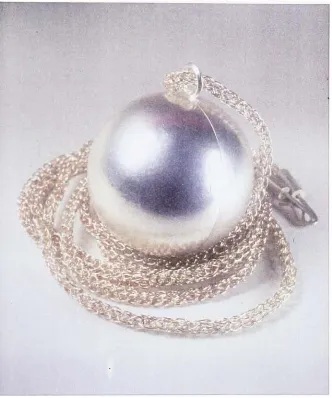
BUILDING BLOCKS
Building
Blocks
I
(Fig.
I)
referredoriginally
to the
first
breaths
of a newborn.The
sphere symbolizedthe
beginning
oflife's
journey
just
asthe
rising
sun marks anew
day.
The
container wouldhold
the
endless potential of newlife
and wasto
be
worn at
the
level
of a mother'swomb,
reminding
us where webegin.
The
surfacemarkings
left from
the
fabrication
ofthe
sphere representedthe
process ofbirth
andthe
vision of a newborninfant.
The inside
surface ofthe
spherical container wasimprinted
with atextured
hammer
to
symbolize our earliestblueprint.
Viewing
the
sphere as notonly
the
beginning
of ourjourney,
but
asthe
beginning
ofany
journey
wetake
withinourselves, there
arestriking
similarities.We
will crossinto
uncharted areas as we explore and examine who we arejust
as anewborn
does
withits first breath
outsidethe
womb.The
possibilities ofdiscovery
are endless
if
wekeep
an open mind andignore
our preconceived notions oflife.
just
as a newbornbegins life
withonly
an elementalblueprint,
devoid
ofany firm
instructions.
Building
Blocks
II
(Fig.
II)
originally
referredto the
vulnerable andfragile
stateof a
young
child.A
primitive cradleinfluenced
the
form
ofthe
brooch
worn closeto
the
breast
ofthe wearer,
mimicking
the
way
a motherholds
and protects a child.The
elementsforming
the
'cradle' were connecteddelicately
yethaphazardly,
conveying
the
fragile
yet oftenconfusing
nature of our youth.Fragile
because
achild
is
totally
dependent
onhis
parentsfor
allhis
needs;
confusing
because
a childis
bombarded
with so much newinformation
(we
experience our greatest growththrough
learning
before
agethree5)
yetis
easily
influenced
by
all ofit.
At
the
beginning
ofany
potential transformation ofourselves,
we arevulnerable
to
what wemay
discover.
We
fear
the
confusing
andpotentially
painfulAndre
Atkins,
"Choosing
Child
Care,"outcome of a
journey
because
wemay
ormay
notlike
what wefind.
We
may
desire
a sense of protection
like
our parents providedto
us as children.We
may
notbe
sure
down
which road ourjourney
ofdiscovery
willtake
us.These
arefeelings
aschildren we
take
for
grantedbut
as adults wefind difficult
to
accept.However,
weshould accept
the
feelings
as natural and not allowthem to
interfere
with ourjourney.
Building
Blocks
HI
(Fig.
Ill)
wasoriginally
about allthose
greatthings
wedid
aschildren and
the
attitudesthat
precededthose
actions.Children
playfully
andcreatively
approachlife
asthey
begin
to
figure
out whothey
are.They
try
ondifferent hats
andclothes,
pretendto
be
grownups andplay
avariety
of pretendgames
in
an effortto
discover
themselves.
Children
step
outsidethe
boundaries
ofbehavior
with noinhibitions because
they
do
not yetknow
there
areboundaries.
Teenagers
rebel againstthe
boundaries
they
arebeginning
to
recognizebut
notready
to
accept.The
body
mobile was astep
outsidethe
parameters oftypical
jewelry.
The
piece was created
to
resemblebuilding
blocks
whichhave
endless potential usesin
the
eyes of a child.The
blocks
are notsimply
blocks
ofwood,
they
may
alsobe
battleships for
a game ofwar orteacups
for
an afternoontea.
Joseph
Campbell
describes
the
wonders of childhood whenhe
writes:"As
children,
weknew
whento
be
still andwatchful,
so asto
bring
just
the
right people and creaturetowards
us.It
was
easy,
andthe
magic waseverywhere."6
This
'young' attitudeis,
unfortunately,
something
that
many
of usleave
behind
with our childhood.We
lose
our youthful approachto
life
as ourteachers,
parents and other role models
bombard
us withwhatis
right andwrong,
thereby
creating
parameters of acceptability.We
loose
our youthfulability
to
create withoutinhibition,
pretend,
play
and experiment as society's systemis imposed
on us.We
operate under
increasingly
more constraints as we age andbecome
more aware ofthe
pressuresto
live
within certain parameters and rules ofthe
community.As
wetravel
on ourjourney
ofself-discovery,
we needto
returnto the
simplemagic of our
childhood,
leaving
behind
what we can ofthe
baggage
accumulatedover
the
years.We
may
then take the
necessary
risksto
instigate
changejust like
achild
fearlessly
ski'sdown
a slope or climbs atree.
We
may
be
morewilling
to
try
on
different
or unusual 'hats'looking
for
an answerto
our questions about who weare.
We
may
be
morelikely
to
seethe
building
blocks
asthe tools
wemay
use onour
journey;
tools that
cantake
any
form,
limited only
by
ourimagination.
We
may
have fun
andplay
to
alleviatethe
stresses we experience withincreased
responsibilities.
Adult
fun
may
be
cycling
orstamp collecting
instead
ofBarbies,
GI
Joes,
orNintendo but
play
willhelp
open our eyesto the
possibilitiesin
ourlives,
unmuddled with
the
stresses of ourday.
Our
childhood spiritwillbe
shapedby
the
maturity
we gain as we age.However,
we canlearn
valuablelessons
by
retaining
our youthful attitude or
returning
to
some of ouryoung
ways.Not
only
does
the
Building
Block
series provide a youthfulframework for
ourjourney
of selfdiscovery,
the
seriesinspired
meto
carry
ayoung
spirit with me asI
traveled
onmy
personalthesis
journey.
I
left
the
security
ofthe
known
andinstead
made
up
my
own rules ofthe
game.I
did
notlet
my
established parameters of whatconstitutes wearable
body
adornmenthinder
the
creation ofmy
thesis.
If
a piece wasnot
inherently
wearable,
comfortable andcomplimentary
to the
body
my
ownstrict parameters
I
madeit
anyway.The important
thing
wasto
let
the
concepts ofmy
thesis
guidethe
creation ofthe
pieces.While
working,
I
also reminded myselfof
the
way
time
passedin
my
childhood-an
hour
seemedlike
aday,
aday
seemedlike
a week and summer seemedlike
alifetime.
This
allowed meto
playfully
andcreatively
wanderthrough
my
explorations.I
walkeddown
pathsI
may
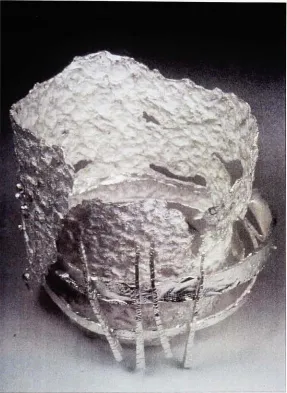
have
SINGULAR
ASSIMILATION
The
nexttwo
series ofmy thesis,
Singular
Assimilation
andEnlightenment,
are a result of
my
effortsto
better
understandthe
gifts we receive as we engageourselves
in
a perpetual cycle ofintrospection
andtransformation.
More
specifically, I
exploredhow
the
needto
know
ourinner-self
though
introspection
conflicts with
the
realities of ourday-to-day
existence,
requiring
usto
find
anacceptable
balance between
them.
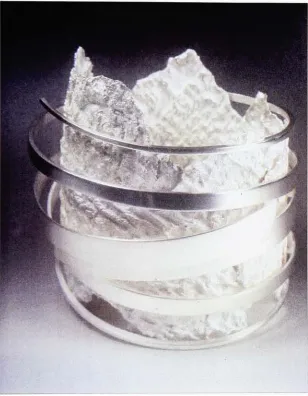
The
Singular
Assimilation
series of arm cuffs(Fig.
IV, V, VI, VII),
explorehow
we achievethis
within our community.Our
community
is
the
world around us andincludes
ourfamily
andfriends,
our peers atwork,
andthe
peopleliving
in
ourtown
or city.Our
daily
life includes
responsibilities within our
community
such asjob,
family,
mortgage payments orrent,
grocery
bills
andthe
like.
Essentially,
this
is
the
'real
world.'Oftentimes,
these
responsibilities preclude us
from
attending
to
ourinner
needs.However,
ourspiritual self can not afford
to
be forgotten
orignored.
As
Joseph
Campbell believes:
"We're
so engagedin
doing
things
to
achieve purposes of outer valuethat
weforget
that the
inner
value, the
rapturethat
is
associated withbeing
alive,
is
whatit's
allabout."7
If
weignore
this
side ofourselves, the
outer valuethat
we spent so muchtime
achieving
willbe
rendered meaningless and unfulfilling.Conversely,
if
wehave
given ourinner-self
enoughattention,
it
can act as our guideto
find
contentment
in
ourdaily
responsibilities.Both
aspects of our personaldevelopment
are vitalto
our continuedability
to
grow and mature as we age.Throughout
ourexistence,
wehave formed
communitiesin
orderto
ensuresurvival of
the individual.
Communities
fulfill
ourbasic
needs ofcompanionship,
food,
procreation, religion,
and other necessities.Communities
also assistin
balancing
the
fortunate
withthe
less
fortunate
asthe
strong
take
care ofthe
weak.Campbell,
6.Unfortunately,
ourcommunity
is
also adouble
edged swordin
that
it
fulfills
ourbasic human
needsbut
atthe
sametime
imposes
its
values onthe
individual.
This
puts us
in
the
situation of'can't live
withit
and can'tlive
without it.'Fortunately,
we
have
the
capability
ofchoosing
how
to
incorporate
the
community's systeminto
our
lives
withoutbecoming
its
slave.For example,
most of ushave
to
workto
make money.
We
can chooseto
workin
ajob
requiring
long
hours for
alot
ofmoney,
evenit
wedo
notenjoy
our work.We
may
do
this
because
society
tells
usthat
money
equals success.Or
we can chooseto
pursue a careerfor less
money
but
one
that
providesdaily
joy
and allows usto
be
successful within ourselves.Our
task
is
to
find
away
to
live
on our ownterms
whileremaining
acontributing
member ofour community.
This
balancing
act requires constant attention as we proceed onthe
journey
oflife.
Satisfaction
in
ourrelationship
withthe
community
requires usto
changeand evolve as our
community
does
the
same.Our
world changesin
a multitude ofways,
including
populationincreases,
newjobs
createdby
new orexpanding
businesses,
jobs
lost
as companies close theirdoors
or reducetheir workforce,
rising
levels
ofcrime,
andcontinually evolving
social values.These
transformations
force
usto
choose a newcareer,
increase
our needfor
personal safe-guards orrethink our values.
Not
only
does
ourchanging
community
affectus,
but
wemay
need
to
instigate
changein
ourselves regardless ofthe
state ofthe
community.We
can either choose
to
face
the
challenges of change or chooseto
avoidthem.
However,
asM.
Scott
Peck,
in
his book
The Road Less Traveled, states,
"It is
through
the
pain ofconfronting
andresolving
problemsthat
welearn."8
Our
personalgrowth and
maturity
depends
on ourdecision
to
face
the
challenges.We
have
to
evaluate
how
these
challenges affectus, then adjust,
fine-tune
and/ortransform
ourselves
to
maintain ourrelationship
with and establishmentin
the
community.This
constant evaluation engages usin
the
perpetual cycle ofintrospection,
transformation,
growth and maturity.M.
Scott
Peck,
The
Road Less Traveled (New York: Simon
andSchuster,1978),
16.The
three
cuffsin
the
Singular
Assimilation
seriesvisually
explore ourefforts
to
balance
ourinner
needs withthe
systemsimposed
on usby
outsideforces.
This is
accomplishedin
the
interaction
between
the
linear
elements andthe
walls ofthe
cuff.The
walls arethe
systems otherstry
to
impose
on us andthe
linear
elements represent
the
way
wetake
an active rolein
finding harmony
withinourselves
despite
these
systems.Viewed
together,
the
overallimpact
ofthe
cuffsis
one of
swirling
activity.The
linear
elements aresearching,
circling
inside
andoutside
the
walls ofthe
cuff whilethe
walls remainstrong
and stable.The
circularnature of
the cuffs,
both
in
the
form
ofthe
walls andthe
swirling
elements,
reference
the
perpetual nature ofthe
balancing
act we perform as ourcommunity
and
its
systemscontinually
evolve.Viewed
separately,
each cuff represents an element ofthis
endlessbalancing
act.
The
first
cuff,
Singular
Assimilation I (Fig.
IV),
exploresthe
power webelieve
in
when
making decisions
about ourselvesin
relationto the
worldin
which welive.
We
canbe
anything
anddo
anything
andthere
are no rulesto
follow.
We
do
notsee
the
system of obstacles placedin
our pathby
the
community
or ourselves.The
linear
elementsstrongly
surroundthe
walls ofthe
cuffin
a show of powerbecause
we
rightfully
think
we can accomplishanything
and approachliving
withthat
very
attitude.
We
do
not seethe
difficulties
in
finding
ajob,
sending
our childrento
school,
orpaying
the
rent.We
do
not seethe
prescriptionssociety
has
writtenfor
us.
We
do
notbelieve
in
the
fixed
roles anddefined
terms
ofthe
community.We
know
to
follow,
notthe
path ofothers,
but
our own unique pathfound
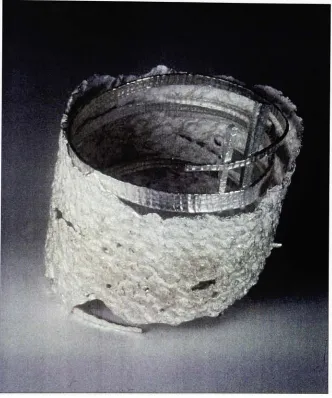
within.Singular
Assimilation U
(Fig.
V),
the
second cuffin
the
series,
represents ourawareness of
the
constraining
system our world attemptsto
impose
on us.As
wetry
to
find happiness
in
ourdaily
life,
weeventually
runinto
the
obstacles ofthis
system and
have
to
decide
how
to
embracethem
withoutbecoming
"part
ofthe
machinery."9
Joseph Campbell
refersto this
conflict whenhe
writes"It is
very
difficult
to
find
in
the
outside worldsomething
that
matches whatthe
systeminside
David
Denby,
"A Foreign
Affair,"New York,
February
6, 1995,
59.you
is
yearning
for."10There is
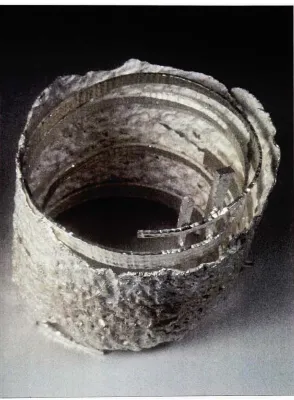
astruggling interaction
between
the
walls andinterior
elements ofthe
cuff.The
walls ofthe
cuffs seeminsurmountable
solid,
strong
andunforgiving
-as
they
surroundthe
linear
elements which swirlinside,
trying
to
getfree (Fig.
VI).
This interaction
conveysthe
darkness
we must experiencebefore
wefind
ahome
in
our community.The
last
cuff,
Singular
Assimilation
HI
(Fig.
VII),
representsthe
light
webegin
to
see as wefind
ourbalance. The
linear
elementspeacefully
coexist within and aroundthe
walls as we realize our power of choice overthe
system andfigure
outhow
to
acceptit.
We
seehow
to
embracethe
necessary
rules anddiscard
the
restto
avoid
becoming
aworking
part ofthe
machinery.We listen
to
ourselves andlearn
to
balance
ourinner
voice withthe
systems anddemands
ofthe
real world.10
Osbon,
63.ENLIGHTENMENT
Unlike
our outer-self whichhas
the to
deal
withthe
imposed
system ofthe
community,
ourinner-self
knows only
our ownbounds.
Singular
Assimilation
explored
the
balancing
act wehave
to
perform with our outer-self on one end andour
inner-self
onthe
other.Both
sides needto
be
on-stagefor
ourlife's
performance.
However,
"the
privilege of alifetime is
being
who youare."11
The
series of
books
entitledEnlightenment (Fig.
Vm, IX,
X)
explores our effortsto
find
privilege
in
knowing
andbeing
who we are.The
book
was chosen as an metaphorfor
this
inward
journey
because reading
abook is
apersonal,
intimate
experience.Reading
allowsfor
private observation andcontemplation
through
a personaldialogue
withthe
subject matterjust
asdiscovering
ourspirituality
is,
in
essence,
a personaldialogue
with ourselves.Furthermore,
abook
containsinformation
and/
orhas
astory
to tell
just
as ourinner-selves have
muchto tell
us.We
simply
have
to
readthe
book
to
accessthe
information.
The
progression ofthe three
books
in
the
series exploresthe
nature of ourpersonal
dialogue
with ourselves as we searchfor
anunderstanding
of who we are.The
first
book,
Enlightenment I
(fig.
VHI)
is
just
opening,
referring
to the
beginning
of
this
inward
journey.
Our curiosity is
piquedby
what mightbe discovered
aboutour
inner-self just
as we are excited and curious with anticipation aboutthe
contentsof a new
book.
The
piecehas
almost nodetail because
very little has been
discovered
in
the
early
stages of ourjourney.
The lack
ofdetail in Enlightenment I
further
emphasizesthe
mystery
of ourjourney
-there
is
obviously
something
onthe
book's
pagesbut
the
markings are not clear.There is
also a'bookmark'
ready
to
11
Ibid,
back
cover.mark an
intriguing
pagerequiring
closerreading,
when a rest orthe
beginning
of anew
transformation
is
needed.The
secondbook,
Enlightenment
II
(Fig.
IX),
is
wide openfor reading
andconveys
the
carefulinvestigation
we undertake on ourjourney.
Specifically,
the
book
is
full
oflayers,
andboth
obvious and subtle patterns andtextures.
These
details
areintriguing
because
they
arevague,
varied and abstract.The intrigue
compels
the
viewerto
examine moreclosely
the
potential contained withinthe
piece.
The
book is
asking
to
be
explored andthen
understoodjust
as our spiritualself needs
to
be
continually
examined, understood, transformed
andthen
reexamined.
We look for
clarity,
revelation andunderstanding
of ourselvesjust
aswe
look
for
these things
when we read abook.
The
third
book,
Enlightenment III
(Fig.
X),
appears old andworn,
representing
the
many
'readings' of ourselves we undertakethroughout
ourlives.
We
re-readour
inner
book
many
times just
as we might read abeloved book
over and over.Elena
Mary
Siff,
an artist who creates artbooks,
conveysthis
whenspeaking
ofher
own work:
"it's better
to
read onebook
onehundred
times
than
onehundred books
one
time."12
Reading
areally
goodbook
onceis
not enoughto
uncover allits
potential;
we needto
readit
again and againto
uncoverfurther
subtleties ofthe
story.
Likewise,
eachtime
we read and re-readthe
chapters of ourinner
book,
wegain a greater
understanding
of who weare,
thereby
enhancing
our continuedpersonal growth and maturity.
That
is,
eachreading fuels
the
wheelsspinning
onour
journey
of selfdiscovery.
12
[Judith
T-Tnffhprg]
CrossCurrents: Bookworks From theEripeofthePacific
(Pasadena,
CA:
Umbrella
Associates, 1991),
45.CONCLUSION
The
last book in
the
Enlightenment
series(Fig.
X)
is
torn,
wrinkled anddiscolored,
indicating
the
passage oftime.
The
passage oftime,
however,
has
neither
taken
away
the
beauty
ofthe
book
northe
knowledge
contained within.Just
as
the
passage oftime
brought
a newkind
ofbeauty
to
andunderstanding
ofthe
book,
it
is
only
withthe
passage oftime that
we cantruly
understand ourselves andachieve
the
wholeness oflife described
by
Charlotte Painter.
Wholeness
is
the
culmination of our growth and maturity.
In
orderto
receivethese gifts,
wehave
to
let
the
hands
ofthe
clock continueto tick.
We have
to
age.Halting
the
clock ofaging
wouldsurely stop
our physicaldecline but
we would notbe
ableto
understandthe
world around us or ourselves withthe
continually
increasing
level
ofknowledge
andmaturity
we gain as we age.FINAL
REFELCTION
Although
I
would stilllove
to
stop
the
clock ofaging,
or atleast
slowit
down,
I
now can atleast
deal
withmy
inability
to
do
so.However,
I
will continuelife
following
my
unique path asI
attendto
my
inner
and outer existence.Most
importantly,
I
willkeep
the
wheel ofdiscovery
turning
in
perpetual motion.FigL
Ppndant.BuildingBlod<sLsilver,2"x2,'x36"
[image:24.554.116.448.172.570.2]>
u.
bJ)
n
5-1
PQ
bb
FigUI BridyMoHle.BuildingBlocks HL
silver, woodstainless steel22"
x
12"
x
28'
Fig
IV.
ArmCuff
.SingularAssimilation
L
silver,35"x3"
[image:27.554.126.434.185.581.2]FigV.
Arm Oiff.Srngiilar
Assimilation
IL
silver.35"x3" [image:28.554.113.445.180.578.2]Fig
VI Arm
HiffSingularAssimilation
H
silver,3.5"x3" [image:29.554.134.428.178.578.2]FigVE Arm Cuff. Singular Assimilation
HL
silver,35"x3"
in. in
x
in
en8
5
6)
I
p..
>
bb
X
en
U
8
>
&
>
fin
Fig
X
Pendant,
EnlightenmentllL
copper, silver,
7"x4"
[image:33.554.114.446.129.636.2]BIBLIOGRAPHY
Atkins,
Andre.
"Choosing
Child
Care."Better Homes
andGardens.
September
1995,
62.
Campbell,
Joseph. Joseph
Campbell
andThe Power
ofMyth.
New York:
Journal
Graphics
Inc.,
1988.
Denby,
David.
"A Foreign
Affair."New York.
6
February
1995,
59.
Ferguson,
Gary,
andKathleen Wall.
Lights
ofPassage.
San Fransisco:
HarperCollins,
1994.
[Hoffberg,
Judith].
Cross
Currents:
Bookworks from
the
Edge
ofthe
Pacific.
Pasadena,
CA:
Umbrella
Associates,
1991.
Osbon,
Diane,
ed.A Joseph Campbell Companion.
New York:
HarperCollins,
1991.
Painter,
Charlotte.
Gifts
ofAge.
San Francisco: Chronicle
Books,
1985.
Peck,
M. Scott. The Road
Less Traveled.
New York:
Simon
andSchuster,
1978.
Sheehy,
Gail. New Passages.
New York:
Random
House,
1995.