R E S E A R C H
Open Access
Modelling the impact of insecticide-based
control interventions on the evolution of
insecticide resistance and disease
transmission
Susana Barbosa
1,2, Katherine Kay
1,3, Nakul Chitnis
4,5and Ian M. Hastings
1*Abstract
Background:Current strategies to control mosquito-transmitted infections use insecticides targeted at various stages of the mosquito life-cycle. Control is increasingly compromised by the evolution of insecticide resistance but there is little quantitative understanding of its impact on control effectiveness. We developed a computational approach that incorporates the stage-structured mosquito life-cycle and allows tracking of insecticide resistant genotypes. This approach makes it possible to simultaneously investigate: (i) the population dynamics of mosquitoes throughout their whole life-cycle; (ii) the impact of common vector control interventions on disease transmission; (iii) how these interventions drive the spread of insecticide resistance; and (iv) the impact of resistance once it has arisen and, in particular, whether it is sufficient for malaria transmission to resume. The model consists of a system of difference equations that tracks the immature (eggs, larvae and pupae) and adult stages, for males and females separately, and incorporates density-dependent regulation of mosquito larvae in breeding sites.
Results:We determined a threshold level of mosquitoes below which transmission of malaria is interrupted. It is
based on a classic Ross-Macdonald derivation of the malaria basic reproductive number (R0) and may be used to
assess the effectiveness of different control strategies in terms of whether they are likely to interrupt disease transmission. We simulated different scenarios of insecticide deployment by changing key parameters in the model to explore the comparative impact of insecticide treated nets, indoor residual spraying and larvicides.
Conclusions:Our simulated results suggest that relatively low degrees of resistance (in terms of reduced mortality following insecticide contact) can induce failure of interventions, and the rate of spread of resistance is faster when insecticides target the larval stages. The optimal disease control strategy depends on vector species demography and local environmental conditions but, in our illustrative parametrisation, targeting larval stages achieved the greatest reduction of the adult population, followed by targeting of non-host-seeking females, as provided by indoor residual spraying. Our approach is designed to be flexible and easily generalizable to many scenarios using different calibrations and to diseases other than malaria.
Keywords:Insecticide, Resistance, Modelling, Malaria, Epidemiology, Mosquito
* Correspondence:[email protected]
1Parasitology Group, Liverpool School of Tropical Medicine, L3 5QA,
Liverpool, UK
Full list of author information is available at the end of the article
Background
Approximately 17% of human infectious diseases are transmitted by vectors such as mosquitoes, ticks and fleas [1, 2] and many are controlled by public health interventions using insecticides to target the vector. Malaria is the most serious example of a vector-borne infection and caused an estimated 212 million clinical cases and 429,000 deaths in 2016 [3]. Deploying insecti-cides against Anopheline mosquitoes, primarily in the form of insecticide-treated nets (ITNs) and indoor re-sidual spraying (IRS), has been highly successful (see for example [4–7]) and are credited with contributing 68% and 13%, respectively, to recent dramatic reductions in falciparum malaria in Africa [7]. These successes come at a cost: large amounts of insecticides have to be deployed, and it is estimated that more than 50% of the population in sub-Saharan Africa was protected by at least one vector control intervention in 2015 [8]. A near-inevitable consequence has been the emergence and spread of insecticide resistance (IR) in mosquito vector species [9]. Almost two thirds of countries with ongoing malaria transmission now report resist-ance to one or more classes of insecticide [10–12] and this is widely recognised as a major threat to the sustainable impact of malaria control programmes (reviewed in [9]). Similar patterns of insecticide resist-ance are noted in other mosquito populations under public health control, notably the Aedes mosquitoes that transmit dengue.
The threat posed by insecticide resistance in mosquito populations has stimulated a series of theoretical papers to investigate the processes. They have been of two main forms. The first relates to evolutionary genetic and/or mathematical models exploring resistance management strategies designed to minimise selection for resistance (e.g. [13–20]). These models simply regarded insecticide resistance as something to be avoided and sought ways to understand, avoid or slow its evolution; this meant they usually had to ignore the most important operational factor of IR, i.e. its quantitative impact on undermining insecticide-based control of human disease transmission. A second suite of models does investigate the impact of insecticide resistance on mosquito population demography and hence on disease transmission (e.g. [19, 21, 22]). These could assess the impact of IR on control (using a ‘with’ vs
‘without’ comparison) but neglected the dynamics by which IR evolved and spread, and how it might be potentially delayed. The purpose of this paper is to close this methodological disconnect between the two approaches and demonstrate how they can be com-bined to simultaneously quantify the likely impact of insecticide deployment and resistance on malaria transmission potential.
We developed a demographic/genetic model for mosquito population dynamics that tracks overlapping generations and runs in discrete time steps of one day. It focuses on malaria transmission by its key vectors,
Anopheles, although it can easily be modified to accom-modate the bionomics of other species. The model incorporates the stage-structured mosquito life-cycle, i.e. eggs, larvae, pupae and adults. Modelling the adult stage allows mortality rates to differ between sexes (males do not blood-feed) and between the feeding and digesting/ oviposition stages of the adult female. Density-dependent competition, and hence population regulation, is assumed to occur at the larval stage such that the emergence rate of new mosquitoes includes the non-linear impact of in-secticides on reducing the population size. We integrated insecticide resistance into the model and allowed differen-tial survival of mosquitoes depending on their genotypes (SS, SR and RR where S is the sensitive allele and R is the resistant), sex and the stage of the life-cycle (egg, larvae, pupae, adults). We then show how to interrogate this demography to calculate the R0of the mosquito popula-tion; if vector R0is less than 1 then the mosquito popula-tion will go extinct and disease transmission will cease. If extinction does occur we can then predict whether the presence (or importation) of resistance will be sufficient to re-establish the vector population, i.e. whether its R0 in the presence of resistance is greater than 1. We then used a Ross-Macdonald model to investigate situations where vector R0> 1 to predict whether malaria transmission will continue despite control interventions reducing adult female population size and longevity and/or whether transmission will re-emerge once resistance is present in vector populations. The model is, therefore, designed to
simultaneously answer a series of questions that arise naturally from control programmes:
What impact do insecticides have on the mosquito
population: will it be driven to extinction and, if not, how will insecticide deployment affect mosquito numbers and adult female longevity?
What impact will these changes in mosquito
demography have on disease transmission: assuming the mosquito populations are not eliminated, will there still be ongoing transmission?
How will different patterns of insecticide deployment select for resistance?
How will the spread of insecticide resistance affect mosquito populations and compromise attempts to reduce disease transmission?
Methods
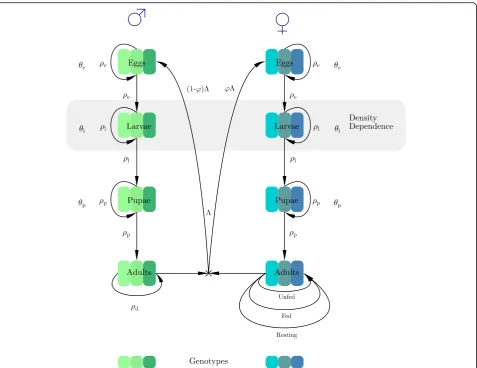
The anopheline mosquitoes that transmit malaria undergo complete metamorphosis through four distinct life-cycle stages: egg, larva, pupa and adult. Adult females feed on a vertebrate host and lay eggs in water bodies. Eggs hatch, within one or two days to a week or more, into larvae that breathe air through tubes, eating floating organic matter. Larvae moult four times until they became pupae. Pupae live near the surface of the water and do not eat, breathing through siphons on their back, and after a few days emerge as adults. The adult lives for a few days to several weeks [23]. The juvenile stages are similar in males and females, but the adult stage differs significantly in their behaviours as only females seek and feed on vertebrate hosts. A more detailed de-scription of the life-cycle from a modelling perspective can be found in [24]. Note that because males do not bite and transmit infections they can be ignored in models that deal solely with transmission (e.g. [24,25]) but they must be included here because they contribute half the genes to the next generation and their behaviour means adult males often inhabit a largely insecticide-free“refugia”with corresponding low selection for resistance [19]. Figure1 outlines the model structure designed to reflect this life-cycle, and its parameterisation. It was constructed as a discrete-time, stage-structured model using a system of difference equations. The inclusion of the stage-structure allows realistic modelling of the life-cycle and selection of resistance at appropriate points within that life-cycle. Population regulation was assumed to occur through lar-val competition. The model was implemented in R [26] and used discrete time steps of one day to capture the cir-cadian nature of mosquito behaviour.
We assumed resistance is encoded at a single gene with two alleles encoding resistance and sensitivity. We simul-taneously ran this model in parallel for the three geno-types i.e. SS, SR and RR.This allows the genotypes to have different patterns of mortality depending on their level of insecticide resistance. Note that larval competition directly occurs between all three genotypes and that adults mate (at random) between the three genotypes. We assumed that males can mate multiple times but female mosquitoes mate once, immediately after emergence from pupae, and carry the sperm for the rest of their lives. We explicitly tracked the genotype of the sperm each female carries.
A demographic/genetic model of mosquitoes under insecticide control
We use two superscripts in the notations: the first to denote gender (ffor females andmfor males) and the sec-ond to denote the mosquito genotypej, wherejis one of SS, RS, or RR. We append a third superscript,k, to adult female mosquitoes, wherekis one of SS, SR or RR and de-notes the genotype of the male mosquito that she mated
with. We describe the model parameters, and their specific values, for the life-cycle in Table1.
Tracking the mosquito juvenile population
Development through the juvenile life-cycle is tracked using the indexito represent days since the egg was laid (i= 1 denotes a newly laid egg):θeis the duration of the egg stage, θl is the duration of the larval stage and θp is the duration of the pupal stage (all measured in days). The total duration of the juvenile stages is therefore ζ where ζ=θe+θl+θp and we denote the female juvenile mosquito population of genotypejat timetasxfj(t) where xfjiðtÞfor 1≤i≤θedenotes the number of female egg
stages, of genotypej, of agei, at timet,
xfjiðtÞfor (θe+ 1)≤i≤(θe+θl) denotes the number of female larval stages of genotypej, of agei, at timet,
xfjiðtÞfor (θe+θl+ 1)≤i≤ζdenotes the number of female pupal stages of genotypej, of agei, at timet.
The male juvenile population is described in an analogous manner with a superscript m instead of f. Note that the symbol x−−i ðtÞ denotes the number of juveniles at stage “i” at the end of day “t”. The equations in this section therefore all function in the same way. They calculate the number of mosquitoes coming into stage “i” at the start of the current day [i.e. from the previous day and stage, x−−i−1ðt−1Þ], allowing for factors such as density dependence and mating, and then multiplying this number by the sur-vival probability of that stage to obtain the number surviving at the end of that day, i.e. x−−i ðtÞ.
We describe the dynamics of the juvenile male and female mosquito populations of genotypejin Eqs.1to8. After each iteration, mosquitoes are moved forward in chronological time (tot + 1) and in developmental time (toi+ 1).
The juvenile female mosquito population of genotypej
at timet,xfj(t) was tracked by first determining the num-ber of newly laid female eggs i.e. the first day of the egg stage,i= 1:
x1fjð Þ ¼t Λjðt−1Þφρfje ð1Þ
whereΛj(t−1) is the total number of eggs of genotypej
laid at timet –1 (see later discussion of Eqs.15to 17) and φ is the proportion of female eggs (always set to 0.5 here).
The developing eggs after the first day were tracked using:
xfjið Þ ¼t xfji−1ðt−1Þρfjefor 2≤i≤θe ð2Þ
The larval stages were tracked as:
xfjið Þ ¼t x fj i−1ðt−1Þ
1
1þcfji
L tð−1Þ Z 2
6 4
3 7 5ρfj
lforðθeþ1Þ≤i≤ðθeþθlÞ
ð3Þ
where larval stages persist for θl days and progress is dependent on the daily larval survival probability ρl. In this model, density-dependent population regulation (DDPR) occurs in the larval stages of both sexes and is represented by the factor encoded in square brackets.
This factor is described in more detail below in Eqs. 9 and10.
The pupal stages were tracked as:
xfjið Þ ¼t xfji−1ðt−1Þρpfjforðθeþθlþ1Þ≤i≤ζ ð4Þ
The juvenile male mosquito population of genotype j
at timet,xmj(t) was similarly defined for number of male eggs, developing eggs, larval stages and pupal stages as
xmj1 ð Þ ¼t Λjðt−1Þð1−φÞρmje ð5Þ
xmji ð Þ ¼t xmji−1ðt−1Þρmje for 2≤i≤θe ð6Þ
[image:4.595.61.539.86.454.2]xmji ð Þ ¼t x mj i−1ðt−1Þ
1
1þcmji
L tð−1Þ Z 2
6 4
3 7 5ρmj
l forðθeþ1Þ≤i≤ðθeþθlÞ
ð7Þ
xmji ð Þ ¼t xmji−1ðt−1Þρpmjforðθeþθlþ1Þ≤i≤ζ ð8Þ
Implementing density-dependent population regulation (DDPR)
The DDPR was incorporated into the larval populations in Eqs. 3 and 7 using the Leslie Gower population growth model, analogous to Beverton-Holt (B-H), which is a classic discrete time population growth model whose continuous-time equivalent is logistic growth towards a carrying capacity [27]. The B-H equation is:
xtþ1¼xtR0 1
1þxt Z
2 6 4
3 7
5 ð9Þ
wherextis the number of individuals at generationt, R0 is the per capita growth rate per generation and Z is a number that determines the carrying capacity of the population, K, as K= (R0−1)Z. We extend the B-H
model in Eqs. 3and 7with a change in scale from indi-vidual animals (Zin Eq.9) to amount of larval resources to account for competition between different genotypes (in this manuscript). The DDPR described within square brackets in Eqs. 3 and 7 is analogous to that in Eq. 9 with this change of scale. The total amount of larval resources is user-defined as a constant Z in arbitrary, undefined units, which sets the carrying capacity of the population.L(t) is the current amount of larval resources being consumed at time t (see below) hence the ratio
L(t)/Zin Eqs.3and7plays exactly the same role asx(t)/
Zin Eq.9; it is simply that Eq.7defines the approach to carrying capacity in units of resources while Eq. 9 defines it in units of population. The only remaining difference between Eqs. 7 and 9 is the extra term c in Eq. 7 that describes relative competitive ability of the genotypes, age and sex of the larvae. The competitive
[image:5.595.56.544.98.368.2]ability of larvae, cfji and cmji , may differ depending on their genotype (for example, resistant forms may pay a fitness penalty for carrying the resistance mutation) and the resource consumption (denoted ωfj and ωmj, see below) of each genotype may vary (for example, resistant forms may be larger and consume more resources). Similarly, older larvae are likely to consume more food Table 1Parameters used in the mosquito demographic simulations
Symbol Meaning Default value (range)
θe Duration of the egg stage (days) 2
ρfj
e(ρmje Þ Proportion of female (male) eggs of genotypejthat survive one day 0.72 (0–1)
θl Duration of the larval stage (days) 10
ρfj l (ρ
mj
l ) Density-independent proportion of female (male) larvae of genotypejthat survive one day 0.94 (0–1)
Z Total larval resources availability (arbitrary units) 0.25 × 10⁸(1 × 10⁶–0.33 × 10¹¹)
cfji (cmji ) Effect of larval competition on female (male) larvae of genotypejin stagei 0.67 (0–1)
ωfj i (ω
mj
i ) Relative resource consumption of female (male) larvae of genotypejin stagei 0.67 (0–1)
θp Duration of the pupal stage (days) 3
ρfj
pðρmjp Þ Proportion of female (male) pupae of genotypejthat survive one day 0.55 (0–1)
τ Duration of the resting period of the gonotrophic cycle of a female adult mosquito (days) 3 Hj Proportion of adult females of genotypejthat find a host and successfully feed while seeking per day 0.67 (0–1)
ρfj
s Proportion of adult females of genotypejthat survive while host-seeking per day 0.71 (0–1)
ρfj
n Proportion of adult females of genotypejthat survive while resting per day 0.96 (0–1)
ρmj
d Proportion of male adults of genotypejthat survive one day 0.5 (0–1)
βj
Number of eggs laid per oviposit by female mosquitoes of genotypej 100
σk
Mating viability of a male of genotypek. 0 <σk≤1 1.0
φ Proportion of eggs that are female 0.5
and may be more resilient to competition. The total lar-val consumption of resources by male and female larvae of all genotypes is obtained simply by summing over the sexes, genotypes, and stages, i.e.
L tð Þ ¼Xj∈fSS;RS;RRg
Xθ
eþθl
i¼θeþ1ω
fj ix
fj ið Þ þt ω
mj i x
mj i ð ÞÞt
ð10Þ
where ωi is the relative resource consumption of the larval sex/genotype, the latter being indicated by its superscript, j, of age i. Isolating the DDPR as a distinct factor in Eqs. 3 and 7 means it is simple to substitute other forms of DDPR if required (e.g. [24, 25]) or other functions such as the Ricker function [28].
Tracking the mosquito adult population
The adult male population of genotypejat timet,ymj(t) is:
ymjð Þ ¼t ymjðt−1Þ þxmjζ ðt−1Þ
h i
ρmj
d ð11Þ
which is the number of male adults that survived from the previous day (ymj(t−1)) augmented by male adults that emerged from pupae ðxmjζ ðt−1ÞÞ, scaled by the probability that they survive the day (ρmjd ).
Females mate once when they emerge and store the sperm to fertilise all their future egg production while males may mate multiple times (see for example [29]). Female anophelines need to blood-feed to produce eggs, so their behaviour differs significantly from those of males (who do not blood-feed). Fertilised females initiate their gonotrophic cycle that consists of 3 phases: (i) foraging for a host and blood-feeding; (ii) resting to allow digestion of the blood and egg maturation; and (iii) searching for a suitable oviposition site and ovipos-ition (Fig. 1). This gonotrophic cycle is repeated throughout the female’s remaining lifespan.
The female adult population timet+ 1 is described in Eqs. 12 to 14. Recall that adult female mosquitoes re-quire a third superscript k(wherek is one of SS, SR or RR) to denote the genotype of the male mosquito she mated with (which will be the paternal genotype for her subsequent egg production).
The number of host-seeking unfed females in the current gonotrophic cycle is:
yfjk1ð Þ ¼ ½t xfjζðt−1Þ σ
k ymkðt−1Þ þxmk
ζ ðt−1Þ
ρmk d
P
hεfSS;RS;RRgσH ymkðt−1Þ þxmkζ ðt−1Þ
ρmk d
þ yfjk1ðt−1Þ1−Hj þ yτfjkðt−1Þρfis
ð12Þ
where the first term describes the number of newly emerged female adults f, of genotype j ðxfjζðt−1ÞÞ, that
will mate with a male of genotype k i:e:ðymkðt−1Þ þxmk
ζ
ðt−1ÞÞρmk
d , which has a mating viability σ k
(this term is normalised by dividing by the total adult male population weighted by their mating viability). The second term, yfjk1 ðt−1Þð1−HjÞ, refers to other female mosquitoes still in the host-seeking state that were unfed adults the previous day and unsuccessful in finding a host on the previous day (H is the probabil-ity of successfully finding a host and feeding). The third term, yfjkτ ðt−1Þ represents females that success-fully laid eggs, completing their gonotrophic cycle, and are now seeking a host in their new gonotrophic cycle. These terms are then scaled by the probability that they survive this day of host-seeking, i.e.pfj
s: The number of female mosquitoes entering the second adult phase of the gonotrophic cycle (resting and fed the previous day) corresponds to individuals in y1 that survived and successfully fed (a proportion Hj) and is described as:
y2fjkð Þ ¼t yfjk1 ðt−1ÞHjpfjn ð13Þ
The number of females in the remaining days of this
“resting”phase of digestion of the blood and egg matur-ation, was found using:
yfjki ð Þ ¼t yfjki−1ðt−1Þρfjnfor 3≤i≤τ ð14Þ
if the duration of the resting stage is sufficiently long i.e. (τ≥3).
We assume, for simplicity, that the probability rested females successfully survive while finding an oviposition site and mating (the third phase of the female gono-trophic cycle) is the same as their daily probability of survival while resting, i.e.ρj
n. This factor enters the equa-tions describing egg laying, i.e. Eqs.15to17below.
Tracking the spread of resistance
The number of homozygous susceptible eggs laid at timetis
ΛSSð Þ ¼t βSSρSS
n yfSSSSτ ð Þ þt
1 2y
fSSRS
τ ð Þt
þβRSρRS n
1 2y
fRSSS
τ ð Þ þt
1 4y
fRSRS
τ ð Þt
ð15Þ
The number of heterozygous eggs laid at timetis
∧RSð Þ ¼t βSSρSS n
1 2y
fSSRS
τ ð Þ þt yfSSRRτ ð Þt
þβRSρRS n
1 2y
fRSSS
τ ð Þ þt 12yfRSRSτ ð Þ þt 12yfRSRRτ ð Þt
þβRRρRR
n yfRRSSτ ð Þ þt 1 2y
fRRRS
τ ð Þt
ð16Þ
The number of homozygous resistant eggs laid at time
tis
ΛRRð Þ ¼t βRSρRS n
1 4y
fRSRS
τ ð Þ þt 12yfRSRRτ ð Þt
þβRRρRR n
1 2y
fRRRS
τ ð Þ þt yfRRRRτ ð Þt
ð17Þ
The ρ parameters in these equations represent the additional mortality associated with searching for oviposition sites; for simplicity, these were assumed to be equal to that of non-host-seeking.
Immigration, emigration and mutation are absent but it would be straightforward to include these effects by al-tering genotype frequencies at the egg stage (mutations) or by altering the number and/or genotypes of adult stages to represent immigration/emigration.
Estimating population basic reproductive rate (R0) for
mosquitoes
A natural question considered by control programmes is whether an intervention will eliminate the local mosquito population. It is possible to run the model described above to find if a population is viable, i.e. start the demographic simulation from extremely low mosquito numbers and find if they increase over the longer term and a stable age distribution has been reached. This is computationally expensive, especially if large-scale sensitivity analyses are being run, so an
algebraic expression for R0 is desirable. The R0 for female mosquitoes, ignoring differences in genotypes, is
R0¼ φβρ
θe e ρ
θl l ρ
θp p ρsHρτn−1 1−ρsð1−HÞ−ρsHρτ−1
n
ð18Þ
This equation can be derived in two ways (using an
“intuitive” approach and a rigorous mathematical approach); both yield the same result and are described in Additional files 1 and 2, respectively. Obviously if R0 < 1, the mosquitoes are locally extinct and no dis-ease transmission will occur, i.e. the intervention has succeeded.
Estimating population basic reproductive rate (R0) for
malaria and human malaria prevalence
Assuming a viable mosquito population remains despite the intervention (i.e. R0 > 1 for mosquitoes, see above), the next step is to predict whether this mosquito popula-tion is able to transmit malaria. The basic reproductive rate of malaria,R0m, using the approach attributed to Ross and Macdonald (R-M) [31] is as follows (although we note there are several variations of this basic equation [32]):
R0m ¼ ma2b
1b2
gr ρi¼
M N∙
a2b 1b2
gr ρi ð19Þ
where:
m=M/Nis the number of female mosquitoes per human host whereNis the size of the human population andMis the size of the female adult mosquito population (i.e.Af(t) in our models, see later description of Eq.23);
ais the rate of biting on humans by a single mosquito (number of bites per unit time);
b1is the probability of infection transmission from infectious mosquitoes to susceptible humans;
b2is the probability of infection transmission from infectious humans to susceptible mosquitoes
ris the per capita rate of recovery for humans (so 1/ris the average duration of infection in the human host);
gis the per capita constant mortality rate for female mosquitoes (so 1/gis the average life time of a
mosquito). This is usually obtained as−ln(p) wherepis the daily survival rate (Box 2 of [32]);
The R-M approach does not differentiate between females in different stages of their gonotrophic cycle whereas our approach explicitly defines different death rates according to the behaviour of the female of any given day (i.e. actively host-seeking or resting). We now illustrate how the R-M approach may be used with differential female survivorship in different states. We will assume, for convenience, locally intense transmis-sion of malaria by An. gambiae, a vector that feeds almost exclusively on humans and bites approximately every 4 days (see Additional file3). Assuming the female always completes her cycle in these 4 days and then pro-ceeds to the next cycle, the approximate adult female daily survival probability is the geometric mean of daily survival rates during the cycle, so that the daily mortality rate is:
g¼− ln
ffiffiffiffiffiffiffiffiffiffiffiffiffiffiffiffiffi
ρj s ρnj
3 4
r
" #
¼− ln ρsj ρnj 3
h i
=4 ð20Þ
The duration of the extrinsic incubation period depends on temperature but assuming ideal conditions, we will let it be ~10 days; we also assume that the adult always finds a human on the day she starts host-seeking. The mosquitoes will have fed at the start of the extrinsic incubation period so the extrinsic incubation period will consist of 3 days resting, another day host-seeking, 3 days resting, another day feeding and 3 days resting until she is ready to feed again and transmit the infection, i.e. 9 days resting and 2-host-seeking so we can estimate the probability of surviving the extrinsic incubation period as:
ρi¼ ρ
j n
9
ρj s 2
ð21Þ
These calculations were, as mentioned above, based on ideal situations for mosquitoes [i.e. they always find hosts (soH= 1), extrinsic incubation only lasts 10 days, and so on]. Mosquitoes can be age-dated by parity in the field so we can revise Eq. 21 to obtain the prob-ability a mosquito survives 3 or more feeding/parity cycles, each cycle of 3 days resting and one feeding, as (0.963 × 0.71)3 = 0.25. This is rather high but not unrealistic. Gilles & Wiles [33] found 20% and 23% of
An. gambiae and An. funestus, respectively, were
“3-parous and older” in Muheza, Tanzania; these data came from 1965 when there was much less insecticide be-ing deployed in public health. Background mortality rates will be higher in contemporary settings with widespread insecticide deployment although incorporating this background exposure greatly complicates extraction of basal mortality rates (see [34] for a recent example). More
realistic calculations may be used to incorporate‘ non-per-fect’conditions in the mosquito populations, for example wide scale ITN coverage may mean mosquitoes take two or even three days of host-searching to obtain a blood meal. Equations20and21can be updated to reflect these new combinations of days spent searching and resting. In reality, a range of different combinations will occur in the mosquito population and the solutions to the equations will be a type of weighted mean across the combinations [35]. We omitted these complications in the interests of simplicity, because the calculations only serve as illustra-tive target reductions for interventions (see later) and to avoid duplication of previous work [35].
This approach does enable us to obtain the parameters required to calculate, M’, the target number of adult mosquitoes that results inR0m < 1 and hence elimination of malaria as
M0<N rg a2b
1b2ρi
ð22Þ
These equations do not distinguish between the genotypes with differing levels of insecticide resistance (which results in the different genotypes having different survival probabilities). It is straightforward to incorp-orate resistant genotypes by regarding them as equivalent to different “species”; since malaria is often spread by more than one vector species, methods for calculating R0 in the presence of several species is well worked out [36, 37].
The value of R0m allows the equilibrium preva-lence, P^ of malaria in humans to be calculated algebraically. Anderson & May [31], for example, calculated it as ^P¼ ðR0−1Þ=ðR0þab2=gÞ. The problem
with R-M applied to malaria is that it does not allow for super-infection or for acquired immunity so preva-lences obtained algebraically should be interpreted with caution. An alternative, and probably more robust approach, is to obtain R0m as described above and then obtain malaria prevalence using their empir-ical relationships estimated from field surveys; for example, using figure 2 of [38] to convert R0 to ento-mological inoculation rate (EIR) and then figure 1 of [39] to convert EIR to prevalence.
Simulating mosquito populations
frequency changes, allowing better estimation of selec-tion coefficients; these coefficients are key summary measures in population genetic theory allowing results to be generalised. For example, section coefficients determine the rate of geographical migration of resistance, and the chance of resistance alleles first emerging in the populations (e.g. [40]). The genotypes were introduced in Hardy-Weinberg equilibrium, i.e. 25, 50 and 25% of the SS, SR and RR genotypes, respectively. We calibrate the models for an area of high malaria transmission and use a value of 110 for mosquito density (i.e. number of adult female mos-quitoes per human host; m in the Ross-Macdonald model) as justified in Additional file 3.
A useful starting point for identifying high-impact interventions is to use the calculations developed above to identify those parameters, such as larval sur-vival probability, in which small changes may have a disproportionately large impact on adult female popu-lation size. This enables us to identify key parameters which are prime candidates to be targeted by insecti-cides. The demographic/genetic model described above was run to equilibrium adult population size using 3000 randomly generated combinations of parameter values drawn from the parameter space described in Table 1 with no genetic differences in resistance levels. The output allowed us to perform a sensitivity analysis of the influence of the parameters on female population size. The total number of adult females at time t, Af(t) is the sum of the number of mosquitoes in each day of the feeding cycle as described by Eqs. 12 to 14, i.e.
Afð Þ ¼t Xτ
i¼1
X
j∈fSS;SR;RRg X
k∈fSS;SR;RRg
yfjki ð Þt ð23Þ
Mann-Witney and t-tests were used to compare the mean parameter values that generated a viable malaria population with those that lead to extinction. Partial rank correlation coefficients (PRCC) were then calcu-lated as a sensitivity analysis of the model using only the simulations that generated viable populations. The PRCC were only calculated between parameters expected to be affected by vector control measures (i.e.
ρe, ρl, ρp, ρs, ρn, c, ω, Z, ρd and H, assuming no differ-ences between males or females in parameter values in the non-adult stages); the magnitude of the absolute PRCC values can be used to rank the relative importance of the 10 input parameters.
The impact of insecticide deployment and threat posed by resistance
Our main goal with the development of this model was to address operational issues of insecticide deployment and how it both drives, and is compromised by,
resistance. We focus on exploring the generic issues concerning the application of insecticides rather than attempting to parameterise a particular setting because there are limited data on many of the key parameters, particularly for differential survival of the different sensi-tive/resistant genotypes. The combination of default pa-rameters given in Table1resulted in a viable population in the absence of insecticide deployment; we then inves-tigated the likely impact of insecticide deployment (and resistance) by changing the values of parameters that are likely to be affected by the intervention. In particular, we ran simulations that mimic larvicides, ITNs and IRS and their impact on the mosquito population.
The total adult female mosquito population at equi-librium (Eq. 23) for the default parameters in Table 1 is Af = 135,878. The equivalent number of humans for this default setting was then obtained as N = 1235 using the value of m = 110 (Additional file3). It is now possible to use this value ofNtogether with the numbers of adult female mosquitoes when under control measures to obtain M′ using Eq.22and hence to predict whether disease transmission is possible.
We then investigated how the emergence and spread of resistance would impact insecticide-based interven-tions and, in particular, whether the spread of resistance would allow mosquito populations to recover to the ex-tent that malaria transmission would restart, i.e.R0m> 1. We present the worst-case scenarios in terms of spread of resistance, because we assume resistance to be com-pletely dominant, i.e. we assume the survival probabil-ities of the heterozygote and homozygote resistant genotypes to be equal.
DDPR; their deaths lessen competition at this stage and help reduce the impact of female larval mortality on the eventual adult population size.
Single-insecticide interventions
We initially simulate the dynamics of the mosquito population under reduced survival imposed by the use of insecticides that target single stages of the life-history and without the emergence of resistance. We use the de-fault values given on Table 1as the baseline values that lead to a viable population. We assume that ITNs act by decreasing the survival probability of female adults while host-seeking,ρs; IRS reduces female adult survival while resting,ρn; larvicides reduce the survival probabilities of larvae, ρl; and a pupacide that kills only pupae, ρp (we are unaware of any agents that do this but include this hypothetical example for methodological completeness). Henceforth we will be using the intervention name and the parameter that we assume it affects interchangeably.
We reduced each survival probability by 10, 30, 40 and 80% of the original value to explore the impact of differ-ent degrees of intervdiffer-ention effectiveness. We tracked the number of adult female mosquitoes post-intervention and the intervention was considered to be successful if the number of females was reduced below a threshold value obtained using Eq. 22, below which malaria trans-mission would be theoretically interrupted.
Combined-insecticide interventions
Interventions often use combinations of insecticides that target two or more stages of the mosquito life-history. The impact of these interventions was investigated, as for single interventions, by reducing the survival probabilities of the affected life-stages by 10%, 30%, 40% and 80% of the original value and tracking the number of adult female mosquitoes. We investigated three specific interventions as listed below. They are designed to illustrate our approach rather than to simulate specific, well-calibrated examples (see later discussion around calibration). The interventions are as follows:
ITNs and IRS: these interventions reduce the survival probabilities of host-seeking adult females (ITN:ρs) and resting females (IRS:ρn).
Larviciding and IRS: larviciding (for example with temephos) is assumed to affect both larvae and pupae (ρlandρp) while IRS, as above, reduces the survival of non-host-seeking adult females (ρn)
Larviciding and ITNs: as above, larviciding is assumed to reduceρlandρpwhile ITN reduces the survival of host-seeking adult females,ρs.
The combination of interventions was considered successful if the number of females was reduced below
the critical threshold value below which malaria trans-mission is theoretically interrupted.
Results
We ran the model using 3000 randomly generated com-binations of parameters from the distributions described in Table1which resulted in viable mosquito populations at equilibrium in 103 (3.4%) of these runs. Statistical analysis (two-tailed t-tests and Mann-Witney U-tests) on the parameters used in the sensitivity analysis (Table 1) showed that the following parameters were highly significantly (P< 0.0001 in both tests after correcting for multiple testing using the BH method) higher in simula-tions that resulted in viable populasimula-tions compared to those that went extinct: the daily survival probabilities of the immature stages (i.e. eggs, larvae and pupae), of fe-males seeking a host, and of fefe-males resting (ρe,ρl,ρp,ρs,ρn respectively). In contrast, parameters describing the ef-fect of larval competition (c), relative resource consump-tion (ω), resource availability (Z), the daily probability that a female successfully finds a host and feeds (H), and the proportion of male mosquitoes (ρd) were not statis-tically different (P > 0.05). Among the non-significant parameters, the first three are associated with the larval competition that is absent when populations are at very low densities and are therefore expected to have no effect on determining whether a population is viable or not (although they will, of course affect the equilibrium size of viable populations). The fourth factor, H, is non-significant, presumably because a female that fails to find a host one day can survive and successfully feed the next. Finally, ρd is daily adult male survivorship which again is not expected to affect whether a popula-tion is viable because we assume females always find a male and that males can mate multiple times.
survival are non-significant. The only difference is in factors associated with resource availability (ω, Z and c) which affect final population size but, for reasons described above, have no impact on whether or not a population is viable.
The impact of insecticide deployment prior to the emergence of resistance
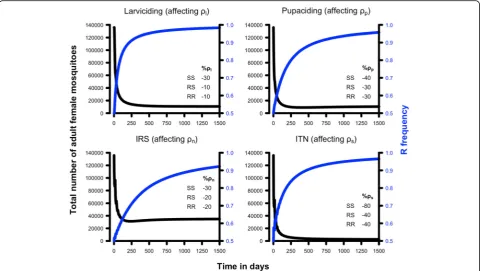
An equilibrium adult female population size (Af(t)) of 135,878 was reached using the default parameterization given in Table1; the ability of the controlled population to transmit disease can be investigated using a Ross-Macdonald model calibrated as described in Table 2. This equilibrium population size of adult females served as the baseline adult female population size in the absence of intervention in all simulations/scenarios (i.e. Figs. 3, 4, 5 and 6).
We investigated the likely impact of single-insecticide interventions by assuming insecticide deployment decreases survival probabilities in various parts of the mosquitoes’ lifestyle by 10, 30, 40 or 80% (Table 3).
[image:11.595.59.540.88.264.2]Whether these impacts are sufficient to interrupt malaria transmission can be investigated using Eq. 22 with the calibration developed above (as summarised in Tables1 and 2) to identify the threshold density of mosquitoes below which malaria transmission cannot be sustained. The equilibrium number of females present after the intervention are given in Table 3. A 30% reduction of the larval daily survival (0.94 to 0.66) resulted in extinc-tion of the mosquito populaextinc-tion, and hence interrupextinc-tion of malaria transmission. The pupae survival probabil-ity, ρp, would have to be lowered by 40% (0.55 to 0.33) to drive the population to extinction. Note that we mod-elled pupae independently from larvae, because pupae do not feed and therefore are believed not to incur density-dependence regulation, but in practice both stages share the same physical space and interventions such as larviciding may affect both stages. This scenario of decreasing survival of only the pupal stage is, there-fore, very unlikely to be used in the field. However, it serves to show that theoretically we would have to reduce pupae daily survival more than larval survival to Fig. 2Partial rank correlation coefficients (PRCC) between equilibrium adult female population size and selected model parameters. The parameters symbols in the y-axes are defined in Table1and the horizontal error bars delimit the 95% confidence intervals. In order of importance:ωis resource consumption of larvae,ρlis larval survival (per day),Zis total larval resources,cis the impact of larval competition,ρpis pupal survival (per day),ρnis adult female survival (per day) when resting,ρsis adult female survival (per day) when host-seeking,ρeis egg survival (per day),His the proportion of adult females that successfully find a host (per day), andρdis adult male survival (per day)
Table 2Parameters used in the Ross-Macdonald transmission calculations
Symbol Meaning Default value
m Mosquito density, i.e. number of adult female mosquitoes per human host 110
a Mosquito biting rate on humans 0.25
b1 Probability a bite from an infectious mosquito transmits malaria to susceptible humans 0.5
b2 Probability a susceptible mosquito acquires a malaria infection when biting an infectious human 0.15
r Rate at which humans recover from a malaria infection 0.01
[image:11.595.55.540.631.715.2]achieve the same level of reduction in the adult female population, the underlying reason being that the pupal stage is shorter so daily survival must be much lower to achieve comparable overall killing to the longer larval stage. Targeting adult females only in the non-feeding, resting stage, ρn, requires a more modest decrease of 30% (0.96 to 0.67) to generate near-extinction of the mosquito population with consequent cessation of mal-aria transmission. ITNs target adult females seeking a host for a blood meal and is one of the most widespread malaria interventions; our results suggest it would be necessary to decrease survival during the seeking stage, ρs, by around 40% (0.96 to 0.58) to eliminate the mosquito population.
Figure3illustrates the dynamics of these interventions summarised in Table 3, taking the pre-intervention population of 135,878 as its starting point. The bottom panel of Fig. 3shows the impact of reducing adult male survival. As expected, it is not possible to decrease the female adult population by targeting the male population alone because our model assumes males can mate mul-tiple times and so changes in male number caused by re-duced ρd have no impact on the size of the next generation unless they are so large as to eliminate all
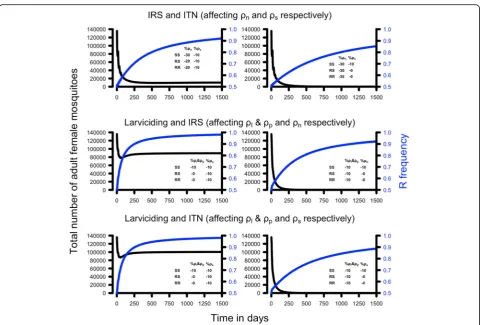
males. We use a similar approach to investigate the im-pact of combined-insecticide interventions by assuming the insecticides reduced life-cycle survivals by 10 or 30%. The results are summarised in Table 4. The hypo-thetical example of combining IRS and ITNs is sufficient to drive the mosquito population to extinction or to a very small size that is well below the threshold for inter-ruption of malaria transmission assuming a decrease in survival of 10% in the non-host-seeking females (ρn= 0.87) and 30% in the host-seeking females (ρs= 0.5), or
vice versa (Table 4). Combining larviciding with either IRS or ITN suggests that small reductions (10%) in both parameters are sufficient to render the mosquito popula-tion inviable and to interrupt malaria transmission (Table 4).
[image:12.595.59.536.88.382.2]slower. Importantly, the final equilibrium population size will not be affected by how rapidly the intervention is deployed and the proportionate reduction in population size can be obtained from Table 3 noting that the original population size was 135,878 (so, for example, Table3shows that if larviciding decreases larval survival by 10%, this will reduce the population size to 10,711 which is a 92% reduction in population size).
The impact of resistance on insecticide-based interventions The simulations shown in Figs. 3 and 4assumed only a single genotype was present, i.e. the homozygous sensi-tive, SS, genotype. We introduced resistance SR and RR genotypes and re-ran these simulations to illustrate the potential impact of resistance on insecticide-based control programmes. The resistant allele, R, was
[image:13.595.62.538.85.456.2]adult females) then impose interventions that have il-lustrative, differential effects on the sensitive and resistant genotypes (as defined in the panels of Figs.5and6).
Examples of hypothetical single-insecticide interven-tions are shown in Fig.5. In all cases, resistance spread rapidly during the intervention. However, the magnitude of the resistance phenotype was insufficient to prevent the mosquito population from rapid, large and sustained reductions post-intervention. Despite this apparent success, Table 5 suggests this “crashed” population was sufficiently large that malaria transmission would be maintained. The adult population sizes in the absence of resistance (i.e. if only SS genotypes were present) would be zero in each example (second column of Table5, but the presence of resistance may allow a viable mosquito population to be maintained once resistance has been fixed (fourth column of Table5) that is sufficiently large so that malaria transmission is possible.
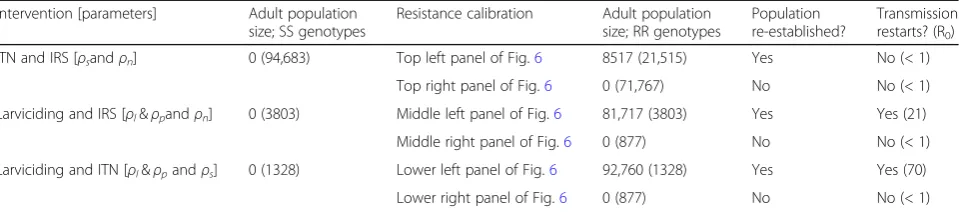
The analogous example of combined-insecticide inter-ventions in the presence of resistance is shown in Fig.6 and summarised in Table 6. The same basic dynamics occurred as for single-insecticide interventions, i.e. a rapid increase in resistance and an immediate fall in the
adult female population. The impact of the latter was more heterogeneous. All interventions would have reduced mosquito populations to negligible sizes and blocked transmission (column 2 of Table 6). However, the spread of resistance allowed mosquito population sizes to recover sufficiently that disease transmission would re-start in 2 of the 6 scenarios (columns 4 to 6 of Table6).
Discussion
[image:14.595.58.539.88.359.2]standard demographic model and added three novel fac-tors: the ability to track insecticide resistance spread within the mosquito demography, derived an equation for R0of mosquitoes that predicts whether interventions will drive local mosquitoes populations to extinction, and fi-nally used the parameters of insect demography to derive
a Ross-Macdonald equation for R0for malaria that indi-cates whether it is likely that the reduction in mosquito numbers and/or their longevity is sufficient to interrupt malaria transmission. In summary, we have described a transparent methodology that allows researchers to inves-tigate specific scenarios, while being sufficiently flexible Fig. 6The potential impact of insecticide resistance on combined-insecticide control interventions. The legend in each panel shows the
[image:15.595.58.541.84.409.2]percentage of decreased survival imposed by the intervention on each parameter for each of the three genotypes. The blue line shows the resistant allele frequency over time and the black line shows the total number of female adult mosquitoes. As in Fig.5, the magnitude of the resistance phenotype was not sufficient to prevent a population crash although the smaller, resistant, populations may be sufficiently large to allow malaria transmission (see Table6and main text for details). Resistance was assumed to be dominant, interventions started with a resistance allele frequency of 50% and the three genotypes in Hardy-Weinberg equilibrium.Abbreviations: IRS, indoor residual spraying; ITN, insecticide-treated net; SS, the homozygous sensitive genotype; SR, the heterozygous sensitive/resistant genotype; RR, the homozygous resistant genotype
Table 3The impact of insecticide-based interventions that target one stage of the life-cycle Reduction in
parameter value
Intervention [parameter affected]
Larviciding [ρl] Pupacide [ρp] IRS [ρn] ITN [ρs]
-10% 10,711 (877) 84,873 (877) 81,717 (3803) 92,760 (1328)
-30% 0 (877) 5483 (877) 0 (71,767) 28,909 (3163)
-40% 0 (877) 0 (877) 0 (373,954) 2502 (5113)
-80% 0 (877) 0 (877) 0 (~1010) 0 (97,845)
The table gives the equilibrium adult female population sizes achieved after the interventions plotted on Fig.3. The associated critical values of the adult female population size below which malaria transmission will cease, is given in parenthesis (M’, obtained from Eq.22); note that the parametersρlandρpdo not affect
adult mosquito mortality so the target population size is unaffected by their value). Note that male adult survivalρdhas no impact on female population size so is
[image:15.595.57.540.616.698.2]that the genetic component can also be used to investigate other systems such as sex-linked resistance and genetic control mechanisms [18].
We developed a basal model as proof-of principle which is sufficiently flexible to allow alternative control strategies to be incorporated and evaluated. One such example is the proposal to target male mating swarms to reduce mosquito population size [43]. We assumed above that males could effectively inseminate an infinite number of females, hence, the number of males made no difference to the population size (and hence male survival was immaterial; lower panel of Fig. 3). This is a simplifying assumption, often made in ecology/demog-raphy, that recognises that female number is the usual determinant of population size. We could relax this assumption. For example, if males are believed to be unable to inseminate more than ten females per night, we could restrict the number of mated females per night to less than ten times the adult male population size. Similarly, for species where mating occurs in a male swarm (such asAn. gambiae) if a male population size is reduced to the extent that females find it difficult to locate a swarm then the female mating probability can be reduced. We ignored these potential complications in this manuscript to focus on the basic genetics and demography but note that they can be included in mod-elling directed at more specific intervention scenarios.
[image:16.595.56.539.101.172.2]Similarly, we assume a single genetic locus encodes re-sistance but the methodology could be extended, albeit with a substantial increase in complexity, to include two genetic loci which would allow users to investigate the impact of joint-insecticide strategies such as the use of mixtures (e.g. [18, 20, 44]). This assumption that one gene encodes resistance to an insecticide has been commonly made throughout the literature (e.g. [45–49] and subsequent work). The results presented herein are also valid if resistance is coded by polygenes (i.e. resist-ance level is modulated by a large number of genes, each with a very small effect). For example, Tables 5 and 6 and Figs. 5 and 6 show the impact of a reduction in mortality on mosquito population size and disease transmission caused by IR. The genetic basis of the degree of IR is immaterial for this impact, e.g. a re-duction in larval mortality by 10% has the same im-pact irrespective of whether its genetic basis is a single gene or many genes. The dynamics of spread will be very different between single- and poly-genetic resistance [50] but the impact of resistance on control can be investigated in the same way. A final, strategic application is to simulate interventions, quantify how rapidly resistance spreads, and use these dynamics to extract the selective advantage of resistance which is a key input parameter for calibrating genetic models of IR evolution.
Table 4The impact of insecticide-based interventions that target two stages of the life-cycle Reductions in
parameter values
Intervention [parameters affected]
IRS and ITN [ρnandρs] Larviciding and IRS [ρl,ρp andρn] Larviciding and ITN [ρl,ρpandρs]
-10% and -10% 50,432 (5329) 0 (3803) 0 (1328)
-30% and -10% 0 (94,683) 0 (3803) 0 (1328)
-10% and -30% 0 (11,307) 0 (71,767) 0 (3163)
The table gives the equilibrium adult female population sizes achieved after the interventions plotted on Fig.4with, in parenthesis, the critical value of adult female population size below which malaria transmission will cease
Table 5The impact of resistance on control interventions that target a single stage of the life-cycle. This is quantified by adult mosquito population size
Intervention [parameter] Adult population size; SS genotypes
Resistance calibration Adult population size; RR genotypes
Population re-established?
Transmission restarts? (R0)
Larviciding [ρl] 0 (877) Top left panel of Fig.5 10,711 (877) Yes Yes (12)
Pupacide [ρp] 0 (877) Top right panel of Fig.5 5483 (877) Yes Yes (6.3)
IRS [ρn] 0 (71,767) Lower left panel of Fig.5 29,636 (15,946) Yes Yes (1.8)
ITN [ρs] 0 (97,845) Lower right panel of Fig.5 2502 (5113) Yes No (< 1)
The column“Adult population size; SS genotypes”shows the equilibrium female mosquito population sizes post-intervention assuming no resistance is present (i.e. only SS genotypes) and, in brackets, the critical adult female population size required to block malaria transmission using the Ross-Macdonald approach (i.e. M’, obtained from Eq.22); all these interventions eradicated the local mosquito population and hence stopped malaria transmission. The column“Adult population size; RR genotypes”gives the equivalent values of population size and M’but assuming only RR genotypes are present. The parameterisations are as shown in the panel captions of Fig.5; for example, the first row of this Table is equivalent to the top left panel of Fig.5, i.e. the values are calibrated by assuming that the insecticide intervention reduces larval survivalρlof the SS genotype by 30% while the RR and RS genotypes are less affected by insecticide and their
[image:16.595.55.540.569.647.2]Operationally, ITNs and IRS may have two additional effects not captured in our model: repelling and possibly diverting mosquitoes to alternative hosts due to insecti-cide irritation (e.g. [19]) and/or the physical barrier of the net, and lengthening the duration of the gonotrophic cycle leading to a reduced oviposition rate [24]. The methodology can also incorporate behavioural changes that may evolve in response to insecticide resistance [51–54], for example, a reduced tendency to rest indoors after feeding, which will lower mortality rates during the female gonadotrophic cycle. These factors can be brought into insecticide resistance modelling but we have ignored these possible effects for simplicity; in particular, a formal sensitivity analysis (discussed later) would reveal the extent to which behavioural changes may affect the evolution of resistance and its impact on disease transmission.
The Ross-Macdonald (R-M) approach is the easiest algebraic method of predicting whether disease trans-mission will cease (see [32] for an extensive review of R-M). It is also flexible: for example, we assume a female always finds a mate on the first day of emergence, and that the adult female feeding cycle is as quantified as in Eq.21, but heterogeneity in such factors can be regarded as occurring in different mosquito‘species’and the over-all R0 calculated from the relative frequencies of these different ‘species’. The two main criticisms of R-M, that it does not allow super-infection or acquired human im-munity, do not apply in our usage because cessation of malaria transmission at R0< 1 implies no infections and hence no super-infection, and no acquired immunity. The drawback of R-M is that it generates a simple yes/ no prediction of whether the mosquito population has the capacity to sustain malaria transmission, but it is not a robust method to quantitatively predict the intensity of malaria transmission nor its epidemiological impact; the latter depends on factors such as malaria super-infection in humans, levels of human acquired immunity, malaria importation rates and so on [32]. The methodology developed here is focused on mosquito demography and, if malaria transmission is identified as being viable, then these details of mosquito demography need to be passed
to more sophisticated, individual-based simulations models of malaria transmission that do incorporate the human elements of malaria epidemiology (e.g. [55, 56]) to simulate the impact on human populations.
[image:17.595.59.539.99.205.2]The results of the interventions targeting single stages of the mosquitoes’ life-cycle (using the PRCC values in Fig.2 and examples in Fig.3) indicate that the most ef-fective method of controlling the mosquito population, all other factors being equal, would be to target the lar-val and the adult resting stages. These results reflect the belief that larval survival has a great impact on the adult population density although, as pointed out by White et al. [24], it does not kill adult mosquitoes that are poten-tially infectious so may have a smaller impact on disease transmission (i.e. female adult death rate is not affected). Alternatively, it may be better to target the host-seeking female mosquitoes to reduce disease transmission; this may make little difference to overall mosquito popula-tion size but their reduced longevity makes a substantial difference to malaria transmission. The strategy with the most impact will also depend on individual species dem-ography and local environmental conditions. In our par-ameterisation, larvae were a good intervention target because they spend ten days in this stage so mortality at this stage operates over ten days. Conversely, we assume a ten day extrinsic incubation period (EIP) so mortality in resting females operates over nine days (Eq.21). How-ever, if temperature falls such that the EIP increases to 20 days then female mortality while resting will operate over 18 days and this stage may become a far more ef-fective point of control. In reality “all other factors” are not equal as there are operational and financial differ-ences associated with each strategy. An obvious example from laviciding is how to identify a substantial propor-tion of the breeding sites (e.g. [57]) because these de-pend on local mosquito ecology that may vary widely even within a species. Despite this requirement to iden-tify breeding sites, larviding is likely to become increas-ing important as the most plausible insecticide-based method of targeting the outdoor-biting mosquito spe-cies responsible for “residual” malaria transmission once the primary indoor resting/biting species have Table 6The impact of resistance on control interventions that target two or more stages of the life-cycle
Intervention [parameters] Adult population
size; SS genotypes
Resistance calibration Adult population size; RR genotypes
Population re-established?
Transmission restarts? (R0)
ITN and IRS [ρsandρn] 0 (94,683) Top left panel of Fig.6 8517 (21,515) Yes No (< 1)
Top right panel of Fig.6 0 (71,767) No No (< 1)
Larviciding and IRS [ρl&ρpandρn] 0 (3803) Middle left panel of Fig.6 81,717 (3803) Yes Yes (21)
Middle right panel of Fig.6 0 (877) No No (< 1)
Larviciding and ITN [ρl&ρpandρs] 0 (1328) Lower left panel of Fig.6 92,760 (1328) Yes Yes (70)
Lower right panel of Fig.6 0 (877) No No (< 1)
been controlled. Our methodology is therefore cap-able of providing insight into how control may be optimised by balancing operational difficulty against likely impact; for example, contrasting a low impact, operationally simple and hence widespread interven-tion, against an operationally complex, more focussed approach with high local impact on mosquito popula-tions. We emphasise that this manuscript primarily describes methodological advances, tying together the separate strands of insecticide deployment, insect demography and bionomics, the evolution of resist-ance and the impact of resistresist-ance on disease trans-mission. The conclusions described above, for example the high impact of larviciding, are correct for the specific instances we investigated but could not yet be used as a basis for general policy recom-mendations. Such recommendations would need to be based on a far more detailed sensitivity analysis than the rather arbitrary one used here (Additional file 3). Full exploration of plausible parameter space may well conclude that no one strategy is universally su-perior, but that the optimal strategy depends on local conditions (as occurred, for example, in our recent work on whether insecticides should be deployed se-quentially or in mixtures [18]).
There is increasing emphasis on the need for rational, co-ordinated efforts to control disease vectors, and inte-grated vector management (IVM) schemes are now an integral part of WHO policy [58]. Achieving the goals of programmes such as Roll Back Malaria may require an integrated approach combining disease treatment and interventions against both adult and larval stages of the vector [25]. IVM strategies often deploy combinations of interventions targeting two or more stages of the life-cycle. Combinations are intuitively likely to be more effective than interventions targeting a single stage. In reality, there are a number of important confounding factors that can affect the effectiveness of combined in-secticide interventions. A comprehensive review of these factors can be found in [59] but they include, for example, (i) whether the insecticides act independently or may interfere or synergise with each other, (ii) whether the durations of insecticide persistence are matched or whether one decays more rapidly leaving the other to act alone for extended periods, and (iii) the behaviour of the vector, such as the extent to which it is anthropophilic and/or endophilic. As a real example, data from the Solomon Islands [60] suggested that house spraying (with DDT) was more effective than ITNs but that the amount of the insecticide required would be re-duced if ITNs were also used. However, the same study was not able to associate reduction in malaria cases with larviciding (with temephos) in combination with other interventions. In particular, the use of IRS and ITNs in
combination is thought to increase the probability of a mosquito meeting an insecticide, and help to reach and maintain high coverage levels that are often difficult to attain with single deployment strategies [61, 62]. Simi-larly, the addition of larviciding to ITN deployment has been shown to be highly beneficial [63] as has larval source management, although this depends on the ability to identify a large proportion of breeding sites [64]. The problem is that the more effective an interven-tion, the greater the selection for resistance; trading short-term benefits in reducing disease transmission, against longer-term impacts of driving IR means that both processes should ideally be combined in the same model as was done here.
Resistance is a constant threat to interventions and our results suggest that when deploying a single inter-vention, even a small increase in survival due to insecti-cide resistance may be sufficient to restore a mosquito population to sustainable levels (Tables5and6). The re-sults presented above suggest that, in terms of reducing adult female population size, the use of larviciding seems an effective option either alone or in combination, although unlike ITN and IRS, it will not reduce the longevity of adult females. Importantly, it is likely that resistance will spread faster if insecticides target the larval stages rather than the adult stages. This occurs for two reasons. First, because insecticides have a bigger impact on larval survival: their effects are com-pounded over the ten days of larval life, so selection for resistance may be higher. Secondly, because larvi-ciding applies selection pressure on both sexes; in contrast, adulticides used in IRS or ITNs differentially target females, leaving the exophilic males as a sort of unexposed refugia shielded from selection pres-sures [19, 65].
model, obtaining preliminary, illustrative results, and anticipate that its main use will be in future sensitiv-ity analyses. These analyses recognise that accurate calibration is often impossible and instead explore a single, plausible parameter space (e.g. [18]); the key operational issue then is to identify what interven-tions are best (however ‘best’ is defined, e.g. cost, simplicity, short- or long-term impact on transmis-sion) and whether the ‘best’ policy depends on local vector bionomics and patterns of transmission. Our results are, therefore, preliminary and serve the pur-pose of demonstrating the potential of our computa-tional approach. If one policy always performs better irrespective of underlying parameters, then it is a ro-bust conclusion to use that policy. If some policies work better in certain situations and worse in others, then analysis of the models can show under which conditions (i.e. parameter combinations) each policy works best (most obviously using classification trees, e.g. [67]) and hence identify policies appropriate to local conditions. The illustrative analyses we per-formed explored the comparative impact of ITNs, IRS and larvicides, and quantified the benefits that can be achieved by combining these interventions.
Conclusions
We develop and describe a stand-alone model that sim-ultaneously incorporates mosquito demography and the genetics of resistance, to simulate the impact on disease transmission and the extent to which this impact is threatened by the spread of resistance. Future develop-ment would be to link the model to one of health economics to investigate the cost-effectiveness of each intervention and the extent to which short-term gains in control might be offset by longer-term losses due to resistance. There is currently intense interest in modelling malaria to underpin elimination efforts [66], and models such as the one developed here link-ing demography and the genetics of resistance have a key role to play in designing sustainable control and elimination strategies.
Additional files
Additional file 1:A mathematically-rigorous derivation of R0for anophelene mosquitoes. (PDF 141 kb)
Additional file 2:An equivalent, intuitive, derivation of R0for anophelene mosquitoes. (DOCX 18 kb)
Additional file 3:Notes on model calibration. (DOCX 21 kb)
Abbreviations
DDPR:Density-dependent population regulation; EIP: Extrinsic incubation period; IR: Insecticide resistance; IRS: Indoor residual spraying; ITN: Insecticide-treated net; IVM: Integrated vector management; R0: Basic reproductive
number; RR: The homozygous resistant genotype; SR: The heterozygous sensitive/resistant genotype; SS: The homozygous sensitive genotype
Acknowledgements
We thank Dr Andy South and two anonymous reviewers for many helpful comments on the manuscript.
Funding
This study was funded by the Fundação para a Ciência e Tecnologia, Portugal and Siemens Portugal; the Bill and Melinda Gates Foundation; the Wellcome Trust Institutional Strategic Strengthening Fund; and the Innovative Vector Control Consortium. NC was partly supported by the project,“Increased susceptibility toPlasmodium falciparumof insecticide resistantAnophelesin West Africa”which is a partnership of Swiss TPH with West African institutions funded by the Swiss Network for International Studies.
Availability of data and materials
Not applicable. The article describes entirely theoretical research and calibration data were extracted from published, publicly-available literature.
Authors’contributions
SB, NC and IH developed the algebra which was later verified by KK. SB wrote the R scripts and produced the figures. All authors contributed to the writing and revising of the manuscript. All authors read and approved the final manuscript.
Ethics approval and consent to participate Not applicable.
Consent for publication Not applicable.
Competing interests
The authors declare that they have no competing interests.
Publisher’s Note
Springer Nature remains neutral with regard to jurisdictional claims in published maps and institutional affiliations.
Author details
1Parasitology Group, Liverpool School of Tropical Medicine, L3 5QA,
Liverpool, UK.2Present address: Université Côte d’Azur, Centre National de la
Recherche Scientifique, Institut de Pharmacologie Moléculaire et Cellulaire, Valbonne, France.3Present address: Department of Pharmaceutical Sciences,
State University of New York at Buffalo, Buffalo, New York 14214, USA.
4Department of Epidemiology and Public Health, Swiss Tropical and Public
Health Institute, Socinstrasse 57, 4002 Basel, Switzerland.5University of Basel, Petersplatz 1, 4003 Basel, Switzerland.
Received: 23 March 2018 Accepted: 18 July 2018
References
1. Camejo A. Control issues. Trends Parasitol. 2016;32:169–71.
2. World Health Organization. A global brief on vector-borne diseases. Geneva: World Health Organization; 2014.
3. World Health Organization. World Malaria Report 2017. Geneva: World Health Organization; 2017.
4. Eisele TP, Larsen D, Steketee RW. Protective efficacy of interventions for preventing malaria mortality in children inPlasmodium falciparumendemic areas. Int J Epidemiol. 2010;39(Suppl. 1):i88–i101.
5. Christian L. Insecticide-treated bed nets and curtains for preventing malaria. Cochrane Database Syst Rev. 2004;2:CD000363.
6. Pluess B, Tanser FC, Lengeler C, Sharp BL. Indoor residual spraying for preventing malaria. Cochrane Database Syst Rev. 2010;4:CD006657. 7. Bhatt S, Weiss DJ, Cameron E, Bisanzio D, Mappin B, Dalrymple U, et al. The
effect of malaria control onPlasmodium falciparumin Africa between 2000 and 2015. Nature. 2015;526:207–11.